
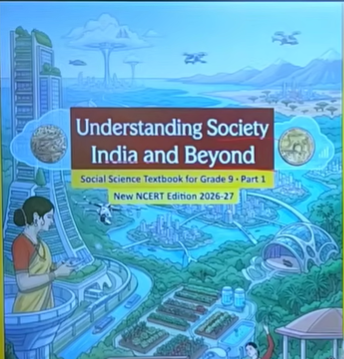
Revolutionizing Learning: The New NCERT Social Science Curriculum (2026-27)
The academic year 2026-27 marks a significant shift in Indian education with the introduction of the New NCERT Social Science books. Moving away from rote memorization, this latest syllabus focuses on multidisciplinary learning, Indian Knowledge Systems (IKS), and real-world financial literacy.
Whether you are exploring the “Story of the Earth” or diving into “Elections and Democracy,” these textbooks are designed to make you a global citizen with deep Indian roots. This guide provides the most accurate NCERT Solutions for Class 9 Social Science, ensuring you stay ahead in your CBSE board preparation.
Part 1: Foundations of Our Society (Understanding society India & Beyond)
Module 1: Understanding Social Science
This introductory chapter bridges the gap between history, geography, and economics. It explains why we study society and how India has historically viewed the world as one family (Vasudhaiva Kutumbakam).
Module 2: Shaping of the Earth’s Surface
Discover the restless nature of our planet. This chapter explains the Theory of Plate Tectonics—the giant puzzle pieces of the Earth’s crust that create mountains and trigger earthquakes. You will learn about the agents of gradation like rivers and glaciers that act as nature’s sculptors.
Module 3: Atmosphere and Climate
Why does it rain in July? Why is the Arctic melting? From the composition of the air we breathe to the complex patterns of the Indian Monsoon, this chapter covers it all. It also tackles the urgent issue of Carbon Footprints and climate change.
Module 4: Early Humans and Beginning of Civilisation
Travel 2 million years back in time. From the first stone tools to the sophisticated urban planning of the Harappan Civilization, this module tells the story of human resilience and the birth of farming.
Module 5: State and Society (upto 1000 CE)
Explore the Vedic age, the rise of great Indian empires, and the ancient trade routes that made India the “Golden Bird.” It highlights India’s rich educational heritage and the ancient universities that attracted scholars from across the globe.
Module 6: Democracy
Democracy is not just a form of government; it is a way of life. This chapter traces the roots of democracy in India (from ancient Ganas and Sanghas) to the modern challenges we face today.
Module 7: Elections
How does a vote become a government? Understand the role of the Election Commission of India, the process of delimitation, and why every single vote matters in a vibrant party system.
Module 8: Building Blocks in Economics
Economics is the study of choices. Learn about Scarcity, Opportunity Cost, and the difference between Market and Mixed economic systems. This chapter simplifies the “What, How, and for Whom” of production.
Module 9: The Price Puzzle: What Drives the Market
Ever wondered why prices go up? Dive into the Laws of Demand and Supply. This module explains market failures and how “Price Ceilings” work in the real world to protect consumers.
Part 2: Oceans, Resilience, and Innovation
Module 10: Oceans and Life
The ocean is the lifeblood of Earth. Learn about ocean relief, the rhythmic waves and tides, and the vital marine resources that support millions of livelihoods.
Module 11: Life on Earth
A deep dive into Biosphere Reserves and Biomes. This chapter focuses on conservation efforts and how forest dwellers have protected our wildlife for centuries.
Module 12: Resistance and Resilience (1000 CE–1700 CE)
A story of bravery. This module covers the resistance against foreign invasions, the spiritual revolution of the Bhakti Tradition, and the magnificent architecture of Indian forts.
Module 13: India and the World-I
India was never isolated. Discover the ancient trade links with Rome, Greece, and China, and how Indian Mathematics and Medicine influenced the world long before the modern era.
Module 14: From Ideas to Startups
For the first time, NCERT introduces Entrepreneurship. Learn about the startup ecosystem, the “Make in India” initiative, and the steps to turn a creative idea into a successful business plan.
Module 15: Smart Ways to Manage Your Finances
The most practical chapter yet. Master the art of Budgeting, understand how Inflation eats your savings, and learn the difference between simple and compound interest. It’s your first step toward financial independence.
❓ Frequently Asked Questions (FAQs)
Q1: Is the Class 9 Social Science syllabus changed for 2026-27?
Yes, the syllabus has been updated to align with the National Curriculum Framework (NCF). It now includes new modules on Financial Literacy, Entrepreneurship, and Indian Knowledge Systems.
Q2: Are these NCERT Solutions based on the new “Part 1 and Part 2” books?
Absolutely. These solutions cover all chapters from both the Part 1 and Part 2 textbooks released by NCERT for the current academic session.
Q3: How do the new Economics chapters differ from the old ones?
The new syllabus shifts focus from just poverty and food security to Market Dynamics, Startups, and Personal Finance, making it much more relevant for today’s students.
Q4: Where can I find the PDF for the New NCERT Social Science book?
You can download the official PDFs from the NCERT website or access our chapter-wise summaries here for a storytelling-based learning experience.
Q5: Will the board exams be based on this new syllabus?
Yes, all CBSE and state board exams for Class 9 and eventually Class 10 will strictly follow this updated curriculum starting from the 2026-27 session.