
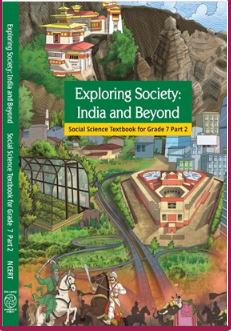
NCERT Solutions by EduGrown: Comprehensive Guide to Class 7 Social Science (Exploring Society: India and Beyond – Part II)
Welcome to EduGrown, your dedicated partner for the latest NCERT curriculum. This guide covers the second part of the Class 7 Social Science series: Exploring Society: India and Beyond-II.
In this volume, the latest syllabus takes students deeper into the socio-economic evolution of India, its political structures, and its place in the global neighborhood. Our solutions are designed to build critical thinking and help students connect historical developments with the modern world.
Theme-wise Breakdown: The Exploring Society-II Curriculum
Theme A: India and the World: Land and the People
Exploring how we utilize our land and relate to our neighbors.
- Chapter 1: The Story of Indian Farming – A look at the evolution of agriculture, from traditional methods to modern scientific farming.
- Chapter 2: India and Her Neighbours – Understanding India’s diplomatic, cultural, and geographical ties with surrounding nations.
Theme B: Tapestry of the Past
Tracking the rise and fall of medieval powers.
- Chapter 3: Empires and Kingdoms: 6th to 10th Centuries – Studying the regional powers and administrative systems of early medieval India.
- Chapter 4: Turning Tides: 11th and 12th Centuries – An analysis of the changing political landscape and the arrival of new influences in the subcontinent.
Theme C: Our Cultural Heritage and Knowledge Traditions
- Chapter 5: India, a Home to Many – Celebrating India’s melting pot of cultures, languages, and religions that have coexisted for centuries.
Theme D: Governance and Democracy
Understanding the machinery of the modern state.
- Chapter 6: The State, the Government, and You – A breakdown of how state governments function, the role of the Governor and Chief Minister, and how citizens interact with the system.
Theme E: Economic Life Around Us
The pillars of a developing economy.
- Chapter 7: Infrastructure: Engine of India’s Development – The role of transport, communication, and energy in building a nation.
- Chapter 8: Banks and the Magic of Finance – How the banking system works, the importance of savings, and an introduction to modern digital finance.[Image showing a simple flow of money in a banking system]
Frequently Asked Questions (FAQs) – Latest Syllabus
1. How does Part II differ from Part I of ‘Exploring Society’?
While Part I focused on the foundations of geography and early history, Part II moves toward practical applications—such as how farming (Economics) works, how the State Government (Civics) operates, and how India interacts with its neighbors (International Relations).
2. Why is ‘Indian Farming’ taught as a ‘Story’ in Chapter 1?
The latest syllabus uses a narrative approach to show that farming isn’t just a business but a cultural evolution. EduGrown solutions help students understand the transition from the Green Revolution to sustainable organic farming.
3. What is the focus of the ‘Governance’ section in Chapter 6?
This chapter focuses specifically on the State Government. It clarifies the difference between the Central and State levels of power, explaining how laws are made in the Legislative Assembly (Vidhan Sabha).
4. Is ‘Banks and the Magic of Finance’ (Chapter 8) difficult for Class 7?
Not at all. The book introduces finance through simple concepts like “Why do we need banks?” and “What is interest?”. EduGrown provides simplified charts to explain how money circulates in the economy.
5. How should students prepare for the ‘Empires and Kingdoms’ section?
Focus on the Administrative reforms and Architecture of the time. The current pattern values understanding how these kings managed their subjects more than just memorizing dates of battles.
For thematic mind maps, digitized historical timelines, and practice assessments for the latest Class 7 Social Science Part-II, stay tuned to EduGrown!