- Home
- CBSE
- ICSE
- NCERT
- Text Book Solutions
- Our Products
- More

Angles are useful in many situations in day-to-day life.
In this chapter, you will learn about adjacent and vertically opposite angles.
Adjacent angle: Two angles are said to be adjacent angles if,
Vertically opposite angles:
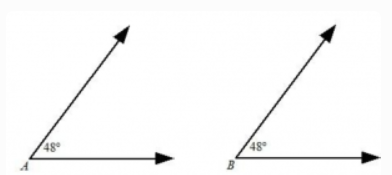
Congruent angles: Angles having the same angular measurement value are said to be congruent angles.
The word complementary takes its origin from the Latin completum which means “completed” since
the right angle is believed to be a complete angle. The word supplement comes from Latin supplere, which means to “supply” what is needed.
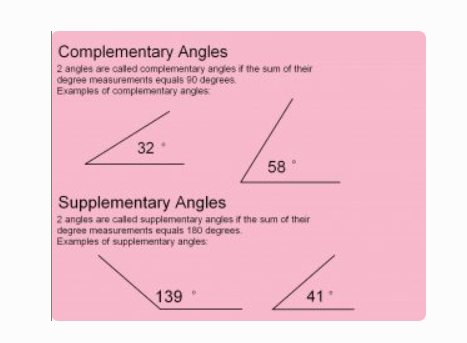
The two angles which add up to 90 degrees is said to be complementing each other. Similarly, two angles which add up to 180 degrees are said to be supplementary angles.
Complementary angle: When the sum of the measures of two angles is 90°, such angles are called complementary angles and each angle is called a complement of the other.
Supplementary angles: When the sum of the measures of two angles is 180°, such angles are called supplementary angles and each of them is called a supplement of the other.
When two straight lines meet at a point an angle is formed. Angles can be seen every day. When you are sitting in a room, you can see an angle at the meeting point of two walls. When you open a book holding it straight, the two pages are open at a certain angle.
The applications of angles are plenty. They are essential in architecture, to make furniture, clocks and so on.

In this chapter, you will learn about angles.
Angle: Two different rays starting from the same fixed point forms an angle. Symbol ∠ is used to represent an angle.
The measure of the Angle: The amount of turning which one arm must be turned about the vertex to bring it to the position of the other arm is called the measure of an angle.
Interior of the Angle: It is the region that lies within the angle.
Exterior of the Angle: It is the region that lies outside the angle.
The unit of measurement of angles is degrees. ° is used to represent degrees.
A protractor is a semi-circular plastic marked in degrees from 0 to 180° on its semi-circular part is used to measure angles.
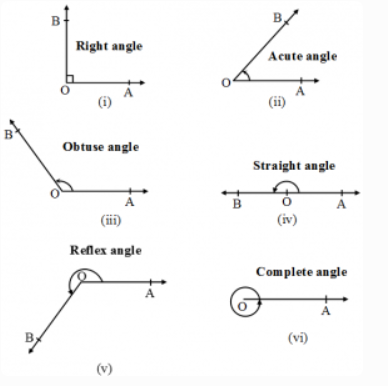
Sum of angles around a point is always 360°