Exercises
Page No: 253
1. Define growth, differentiation, development, dedifferentiation, redifferentiation, determinate growth, meristem and growth rate.
Answer
• Growth is an irreversible permanent increase in size of an organ or its parts or even of an individual cell.
• Differentiation is the process in which the cells derived from root apical and shoot-apical meristems and cambium differentiate and mature to perform specific functions.
• Development is a term that includes all changes that an organism goes through during its life cycle from germination of the seed to senescence.
• Dedifferentiation is the process in which permanent plant cells regain the power to divide under certain conditions.
• Redifferentiation is the process in which de-differentiated cells become mature again and lose their capacity to divide.
• Determinate growth is the type of growth in which growth stops after a certain phase.
• Meristem are the specialised regions in the plants where active cell divisions take place.
• The increased growth per unit time is termed as growth rate.
2. Why is not any one parameter good enough to demonstrate growth throughout the life of a flowering plant?
Answer
Growth, at a cellular level, is principally a consequence of increase in the amount of protoplasm. Measuring the growth of protoplasm involves many parameters such as the weight of the fresh tissue sample, the weight of the dry tissue sample, the differences in length, area, volume, and cell number measured during the growth period. Hence, there cannot be one parameter good enough to demonstrate growth throughout the life of a flowering plant.
3. Describe briefly:(a) Arithmetic growth(b) Geometric growth(c) Sigmoid growth curve(d) Absolute and relative growth rates
Answer
(a) In arithmetic growth, following mitotic cell division, only one daughter cell continues to divide while the other differentiates and matures. The elongation of roots at a constant rate is an example of arithmetic growth. On plotting length of the organ against time, a linear curve is obtained. Mathematically, it is expressed as:
Lt = L0 + rt
Here, Lt is length at time ‘t’, L0 is length at time 0 and r is the rate per unit time.
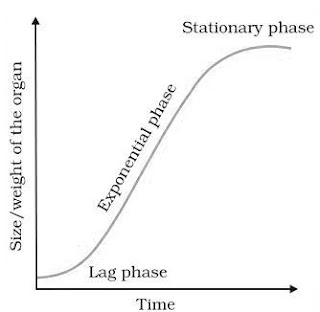
(b) In most systems, the initial growth is slow and called lag phase, and it increases rapidly thereafter at an exponential rate and called log or exponential phase. Here, both the progeny cells following mitotic cell division retain the ability to divide and continue to do so. However, with limited nutrient supply, the growth slows down leading to a stationary phase. The graph of the geometric growth gives a sigmoid curve.
(c) A sigmoid curve is a characteristic of living organism growing in a natural environment. This curve is divided into three phases – lag phase, log phase or exponential phase of rapid growth, and stationary phase.
Exponential growth can be expressed as:
W1= W0ert
W1 = final size (weight, height, number etc.)
W0 = initial size at the beginning of the period
r = growth rate
t = time of growth
e = base of natural logarithms
(d) The measurement and the comparison of total growth per unit time is called the absolute growth rate.
The growth of the given system per unit time expressed on a common basis, e.g., per unit initial parameter is called the relative growth rate.
4. List five main groups of natural plant growth regulators. Write a note on discovery, physiological functions and agricultural/horticultural applications of any one of them.
Answer
The five main groups of natural plant growth regulators are:
(i) Auxins
(ii) Gibberellic acid
(iii) Cytokinins
(iv) Ethylene
(v) Abscisic acid
A note on discovery, physiological functions and agricultural/horticultural applications of Auxins are: