- Home
- CBSE
- ICSE
- NCERT
- Text Book Solutions
- Our Products
- More

Q.1What are the two major sources of human capital in a country?
ANSWER:Two main sources of human capital are investment in education and health.
Q.2 What are the indicators of educational achievement in a country?
ANSWER: Educational attainment is measured by primary education, youth literacy and adult literacy.
Q.3 Why do we observe regional differences in educational attainment in India?
ANSWER: Regional differences in educational attainment in India is due to :
Q.4 Bring out the differences between human capital and human development.
ANSWER: Difference between Human Capital and Human Development
Human Capital
1. Human capital considers education and health as a means to increase labour productivity.
2. Human capital is a narrow concept which treats human beings as a means to achieve an end which is higher productivity, failing which the investment is not considered to be productive.
Human Development
1. Human development is based on the idea that education and health are integral to human well-being since only when people have the ability to read and apply their knowledge to derive maximum benefit they will be able to lead a long and healthy life.
2. Human development is a broader concept which considers human beings as ends in themselves. Human welfare can be achieved through investments in education and health. It considers welfare — a right of every individual irrespective of their contribution to labour productivity. Every individual has right to be literate and lead a healthy life.
Q.5 How is human development a broader term as compared to human capital?
ANSWER:
Q.6 What factors contribute to human capital formation?
ANSWER: .Sources of Human Capital Formation :
Q.7 Mention two government organisations each that regulate the health and education sectors.
ANSWER: n India, the ministries of education at the Centre and State level, departments of education and
various organisations such as National Council of Educational Research and Training (NCERT),
University Grants Commission (UGC) and All India Council of Technical Education (AICTE) regulate the education sector. Similarly, the ministries of health at the Union and State level, departments of health and various organisations like Indian Council for Medical Research (ICMR) regulate the health sector.
Q.8 Education is considered an important input for the development of a nation. How?
or
Examine the role of education in the economic development of a nation.
ANSWER: Expenditure on education is an important source of capital formation. Education is an important source of human capital formation, because:
Q.9 Discuss the following’as a sources of human capital formation
(a) Health infrastructure
(b) Expenditure on migration.
ANSWER:
Q.10 Establish the need for acquiring information relating to health and education expenditure for the effective utilisation of human resources.
ANSWER: People need to have information on the cost and benefit of investment in health and education. When people know the benefits of their investment in these two areas, they make more expenditure. The result is more human capital formation.
Q.11 How does investment in human capital contribute to growth?
ANSWER: Role of Human Capital Formation in Economic Growth:
Q.12 ‘There is a downward trend in inequality world-wide with a rise in the average education levels.Comment.
ANSWER: This is true, because education makes everyone equal and they earn similar salaries. It reduces inequalities of income world wide.
Q.13 Explain how investment in education stimulates economic growth. (or)
Explain the role of education in the development of a country.
ANSWER: Education is an important source of human capital formation. Investment in education stimulates economic development in the following ways:
Q.14 Bring out the need forjm-the-j ob-training for a person.
ANSWER: Technical training adds to the capacity of the people to produce more. Firms given on-the-job- training to enhance the productive skills of the workers so as to enable them to absorb new technologies and modem ideas. It can be given in two forms:
Q.15 Trace the relationship between human capital and economic growth.
ANSWER: Human capital formation raises the process of economic growth and economic growth raises the process of human capital formation. There is a cause and effect relationship between human capital and economic growth. It is shown in the figure.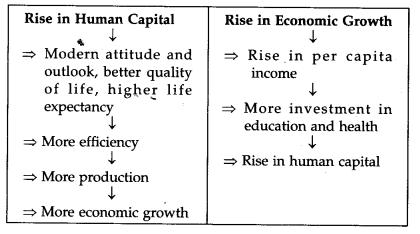
Q.16 Discuss the need for promoting women’s education in India.
ANSWER: Women Education Council has been set up to provide technical education to the women. It has
set up many women polytechnics. It is essential to promote women’s education in India to:
Q.17 Argue in favour of the need for different forms of government intervention in education and health sectors.
ANSWER: Government intervention in education and health sectors is necessary because of the following reasons:
Q.18 What are the main problems of human capital formation in India?
ANSWER: Main problems of human capital formation in India are:
Q.19 In your view, is it essential for the government to regulate the fee structure in education and health care institutions? If so, why?
ANSWER: Yes, government intervention is necessary in regulating the fee structure in education and health care institutions: