- Home
- CBSE
- ICSE
- NCERT
- Text Book Solutions
- Our Products
- More

MCQs
Question 1.
Large stepped-wells were called
(a) ponds
(b) superstructures
(c) quiblas
(d) baolis
Answer: (d) baolis
Question 2.
The baolis were constructed
(a) to provide a place for bathing for royals
(b) to fulfil the water demand
(c) for rainwater harvesting
(d) for entertainment of royals
Answer: (c) for rainwater harvesting
Question 3.
The surface of the Qutb Minar is
(a) triangular
(b) rectangular
(c) circular
(d) curved and angular
Answer: (d) curved and angular
Question 4.
uperstructure was the term given to
(a) the large mansions
(b) the part of the building above the ground floor
(c) large stepped wells
(d) an ornamented hall
Answer: (b) the part of the building above the ground floor
Question 5.
What is Shikhara?
(a) The main shrine of the temple
(b) An ornamented hall of the temple
(c) The topmost pointed portion of a temple
(d) None of the above
Answer: (c) The topmost pointed portion of a temple
Question 6.
The Dhangadeva was the king of
(a) Pandayan dynasty
(b) Rajput dynasty
(c) Khalji dynasty
(d) Chandela dynasty
Answer: (d) Chandela dynasty
Question 7.
The temples and mosques were beautifully constructed because
(a) they were the place of worship
(b) they meant to demonstrate power and wealth
(c) they meant to demonstrate devotion of kings
(d) all of the above
Answer: (d) all of the above
Question 8.
Which Pandayan king invaded Sri Lanka?
(a) King Sena – I
(b) Shrimara Shrivallabha
(c) King Rajendra
(d) None of these
Answer: (b) Shrimara Shrivallabha
Question 9.
Diwan-i Khas or Diwan-i am courts were also described as
(a) chihil Sutun
(b) qibia
(c) chahar bagh
(d) pishtaq
Answer: (a) chihil Sutun
Question 10.
The “river-front garden” was the another name of
(a) baoli
(b) chahar bagh
(c) reservoir
(d) hauz
Answer: (b) chahar bagh
Question 11.
Akbar’s capital was at
(a) Delhi
(b) Red Fort
(c) Siri Fort
(d) Agra
Answer: (d) Agra
Question 12.
Fatehpur Sikri’s architecture was influenced by the styles of which region?
(a) Bengal
(b) Gujarat
(c) Vijaynagara
(d) Bijapur
Answer: (b) Gujarat
Match the contents of Column A with that of Column B:
| Column A | Column B |
| 1. Agra fort | (a) Forty pillared hall |
| 2. Chilhil Sutun | (b) Iltutmish |
| 3. Jami Masjid | (c) Shah Jahan |
| 4. Hauz-i-Sultani | (d) Buddhist monk |
| 5. Dhammakitti | (e) Eight Paradises |
| 6. Hasht Bihisht | (f) Akbar |
Answer:
| Column A | Column B |
| 1. Agra fort | (f) Akbar |
| 2. Chilhil Sutun | (a) Forty pillared hall |
| 3. Jami Masjid | (c) Shah Jahan |
| 4. Hauz-i-Sultani | (b) Iltutmish |
| 5. Dhammakitti | (d) Buddhist monk |
| 6. Hasht Bihisht | (e) Eight Paradises |
Fill in the blanks with appropriate words:
1. The ……….. temple at Thanjavur had tallest Shikhara.
Answer: Rajarajeshvara
2. …………. did not claim to be the incarnation of God.
Answer: Muslim Sultans
3. King Sena I of Sri Lanka was defeated by ………….. ruler Shrimara.
Answer: Pandyan
4. Idea of construction of ………… was described by Babur in his autobiography.
Answer: Chahar bagh
5. The Pietra Dura work on the emperor’s throne depicts the Greek God …………. playing the flute.
Answer: Orpheus
6. Shah Jahan constructed a new city called ………… in Delhi.
Answer: Shahjahanabad
Question 1.
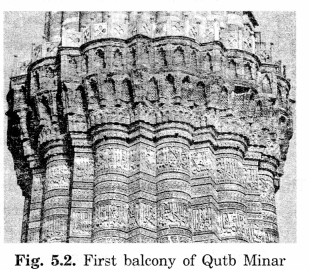
Study the figure given below and give your observations.
Answer:
Question 2
What two types of structures were built by the kings and their officers between 8th and 18th century?
Ans
Two kinds/types of structures.
Question 3.
Who got different type of structures build?
Answer:
Kings built different structures for the use and comfort of their subjects. This got them praise. Merchants got temples, mosques and well constructed.
Only domestic structures like havelis, large mansions have survived from the 18th century.
Question 4.
Who constructed Agra Fort? How many labourers were used to construct it?
Answer:
Akbar constructed Agra Fort. It required
Engineering Skills And Construction
Question 1.
Give an account of new technological developments used during 7th to 13th centimes.
Answer:
Question 2.
How were the roofs constructed in earlier times?
Answer:
Roofs were constructed by placing wooden beams or a stone slab across four walls. This task was becoming difficult if the size of structure was elaborate.
Question 3.
What is superstructure? What does it need?
Answer:
Superstructure is a part of building above the ground floor.
It needs sophisticated skills.
Question 4.
Which two technological and stylistic developments took place from the 12th century?
Answer:
From the 12th century two artistic developments took place.
Temple construction in the Early Eleventh Century
Question 1.
Name three ruling dynasties of Southern India and mention names of temples constructed by them.
Answer:
The three ruling dynasties of Southern India and names of the famous temples constructed by them are given below: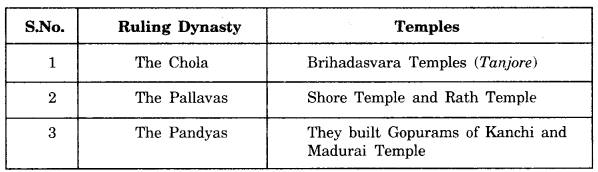
Question 2.
Give an account of temple construction in the early eleventh century.
Answer:
Temple Construction in the Early Eleventh Century
Mahadeva Temple:
Rajarajeshvara Temple:
Building Temples, Mosques and Tanks
Question 1.
Why were temples and mosques beautifully constructed?
Ans.
Temples and mosques were beautifully constructed because of the following reasons:
Question 2.
Which temple was constructed by Rajarajadeva?
Answer:
The temples communicated the importance of a king in following manner.
Question 3.
What did the royal temples signify?
Answer:
The largest temples were constructed by the kings. In the temple made by Rajarajadeva worship of one god Rajarajeshvaram honoured another-Rajarajadeva.
The other lesser deities were the gods and goddesses of the allies and subordinate of the ruler. The temples were the miniature model of the world ruled by the king and his allies. As they worshipped the deities together in the temple, it seemed as if just rule of the gods is brought on earth.
Question 4.
Give an account of the Sultans as the shadows of God.
Ans.
Question 5.
What did the rulers do to get the praise and respect of the people?
Answer:
To get the praise and respect of his people and the moral right to rule, the kings:
Why were Temples Destroyed?
Question 1.
Why were the temples destructed by the invaders?
Answer:
An incomplete list included.
Question 2.
What did Sultan Mahmud of Ghazni do with Temples?
Answer:
Gardens, Tombs and Forts
Question 1.
Give an account of gardens during Mughal rule.
Answer:
Question 2.
Akbar’s reign saw several architectural innovations. Comment.
Answer:
There were several important architectural innovations during Akbar’s reign. . – Akbar’s architects turned to the tombs of his Central Asian ancestor, Timur.
Question 3.
Describe how forts were constructed during Shah Jahan’s reign.
Answer:
During Shah Jahan’s reign different elements of Mughal architecture were fused together:
Question 4.
How was the connection between royal justice and the imperial court was emphasised by architecture?
Answer:
The king as the representative of God on earth was suggested by Shah Jahan’s audience halls with throne on pedestal and referred as ‘qibla’. These audience halls communicated that king’s justice would treat all as equal creating a world where all live in harmony.
Question 5.
What were the other developments in architecture during Shah Jahan’s reign?
Answer:
Shah Jahan’s capital was Agra. There the nobles constructed their houses on the bank of Yamuna. These were set in middle of formal gardens in style of Chahar Bagh format or the ‘river front gardens’. In river front garden style the houses were at the edge, close to the river.
The Taj Mahal was constructed on a terrace by the edge of the river with garden at its south. This was done to control the access of the nobles to the river.
New city of Shahjahanabad in Delhi the palace commanded the river front. Only special nobles like eldest son Dara Shukoh had the access to the river. All other nobles had to construct their homes in the’ city away from the river.
Question 6.
Define the term Pietra Dura.
Answer:
Coloured hard stones placed in depressions carved into marble or sandstone structures. This style of decoration is called Pietra Dura.
Region and Empire
Question 1.
Give an account of the regional influence on art.
Answer:
Regions and Art:
With increase in construction activity between the eighth and eighteenth centuries there was a considerable sharing of ideas across regions.
The traditions of one region were adopted by another.
Mughal rulers were particularly skilled in adapting regional architectural styles in the construction of their own buildings.