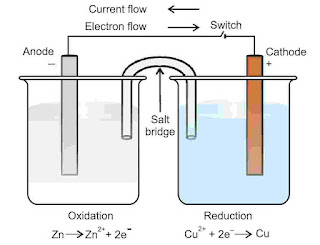
Chapter 6- Hydrocarbons | class 11th | revision notes chemistry

Hydrocarbons Class 11 Notes Chemistry

Introduction

The term ‘hydrocarbon’ is self-explanatory meaning compounds of carbon and hydrogen only. Hydrocarbons hold economic potential in our daily life. Natural gas and petroleum are chief sources of aliphatic hydrocarbons at the present time, and coal is one of the major sources of aromatic hydrocarbons. Petroleum is a dark, viscous mixture of many organic compounds, most of them being hydrocarbons, mainly alkanes, cycloalkanes and aromatic hydrocarbons.

Classification

As we are quite aware that there are different types of hydrocarbons. Depending upon the types of carbon-carbon bonds present, they can be classified into three main categories –

  1. saturated hydrocarbons
  2. unsaturated hydrocarbons and
  3. aromatic hydrocarbons.

Saturated hydrocarbons contain carbon-carbon and carbon-hydrogen single bonds. If different carbon atoms are joined together to form open chain of carbon atoms with single bonds, they are termed as alkanes. On the other hand, if carbon atoms form a closed chain or ring, they are termed as cycloalkanesUnsaturated hydrocarbons contain carbon-carbon multiple bonds – double bonds, triple bonds or both. Aromatic hydrocarbons are a special type of cyclic compounds.

Alkanes

These are the saturated chains of hydrocarbons containing carbon-carbon single bonds. Methane (CH4), is the first member of this family containing single carbon atom. Since it is found in coal mines and marshy areas, is also known as ‘marsh gas’. These hydrocarbons exhibited low reactivity or no reactivity under normal conditions with acids, bases and other reagents, they were earlier known as paraffins. The general formula for alkane is CnH2n + 2, where n stands for number of hydrogen atoms in the molecule.

Structure of Methane

(A). Nomenclature

For nomenclature of alkanes in IUPAC system, the longest chain of carbon atoms containing the single bond is selected. Numbering of the chain is done from the one end so that maximum carbon will be included in chain. The suffix ‘ane’ is used for alkanes. The first member of the alkane series is CH4 known as methylene (common name) or methene (IUPAC name). IUPAC names of a few members of alkenes are given below :

S.No.StructureIUPAC Name
1.CH4Methane
2.C2H6Ethane
3.C3H8Propane
4.C4H10Butane
5.C5H12Pentane
6.C6H14Hexane
7.C7H16Heptane
8.C8H18Octane
9.C9H20Nonane
10.C10H22Decane

(B). Preparation of Alkanes

Though petroleum and natural gas are the main sources of alkanes, it can be prepared by several other methods as well.

1. From unsaturated hydrocarbons

The addition of dihydrogen to unsaturated hydrocarbons like alkenes and alkynes in the presence of a suitable catalyst under a given set of conditions produces saturated hydrocarbons or alkanes. This process of addition of dihydrogen is known as hydrogenation process.

CH2=CH2 + H2 ⟶ CH3-CH3

CH☰CH + 2H2 ⟶ CH3-CH3

2. From alkyl halides

(a) Reduction: Alkyl halides undergo reduction with zinc and dilute hydrochloric acid to give alkanes. In general the reaction can be represented as

CH3-Cl ⟶ CH4

(b) Wurtz reaction: Alkyl halides on treatment with sodium metal in dry ether give higher alkanes. This reaction is known as Wurtz reaction.

CH3Br + 2Na + BrCH3 ⟶ CH3-CH3 + 2NaBr

3. From carboxylic acids

(a) By decarboxylation of carboxylic acids: Sodium salts of carboxylic acids on heating with soda lime give alkanes containing one carbon atom less than the carboxylic acid. A molecule of carbon dioxide is eliminated which dissolves in NaOH to form sodium carbonate.

CH3COONa + NaOH ⟶ CH4 + Na2CO3

(b) Kolbe’s electrolytic method: An aqueous solution of sodium or potassium salt of a carboxylic acid on electrolysis gives alkane containing even number of carbon atoms at anode.

CH3COONa + 2H2O ⟶ CH3-CH3 + 2CO2 + H2 + NaOH

(C). Properties of Alkanes

I. Physical Properties

(i) State: Due to the weak van der Waals forces, the first four members C1 to C4 i.e., methane, ethane, propane and butane are gases. From C5 to C17 are liquids and those containing 18 carbon atoms or more are solids at 298 K. They all are colourless and odourless.

(ii) Solubility: Alkanes are generally insoluble in water or in polar solvents but they are soluble in non-polar solvents like, ether, benzene, carbontetrachloride etc. The solubility of alkanes follow the property “Like Dissolves like”.

(iii) Boiling point: The boiling points of straight chain alkanes increase regularly with the increase of number of carbon atoms. This is due to the fact that the intermolecular van der Waals forces increase with increase in the molecular size or the surface area of the molecule.

II. Chemical Properties

Generally alkanes show inertness or low reactivity towards acids, bases, oxidizing and reducing agents at ordinary conditions because of their non-polar nature and absence of π bond. The C–C and C–H bonds are strong sigma bonds which do not break under ordinary conditions but they undergo certain reactions under given suitable conditions.

(1) Halogenation reaction: When hydrogen atom of an alkane is replaced by a halogen, it is known as halogenation reaction. Halogenation takes place either at high temperature (300–500°C) or in the presence of diffused sunlight or ultraviolet light.

CH4 + Cl2 ⟶ CH3Cl + HCl

(2) Combustion: Alkanes on heating in presence of air gets completely oxidized to carbon dioxide and water. It burns with a non-luminous flame. The combustion of alkanes is an exothermic process i.e., it produces a large amount of heat.

CH4 + 2O2 ⟶ CO2 + 2H2O

(3) Controlled oxidation: When methane and dioxygen compressed at 100 atm are passed through heated copper tube at 523 K yield methanol.

2CH4 + O2 ⟶ 2CH3OH

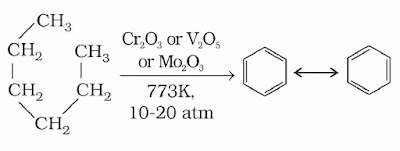
(4) Aromatization: The conversion of aliphatic compounds into aromatic compounds is known as aromatisation. n-Alkanes having six or more carbon atoms on heating to 773 K at 10–20 atmospheric pressure in the presence of oxides of vanadium, molybdenum or chromium supported over alumina get dehydrogenated and cyclised to benzene and its homologues. This reaction is also known as reforming.
Hydrocarbons Class 11 Notes

(5) Reaction with steam: Methane reacts with steam at 1273 K in the presence of nickel catalyst to form carbon monoxide and dihydrogen. This method is used for industrial preparation of dihydrogen gas.

CH4 + H2O ⟶ CO + 3H2

Alkenes

Alkenes are unsaturated hydrocarbons containing at least one carbon-carbon double bond with general formula CnH2n. Alkenes are also known as olefins (oil forming) since the first member, ethylene or ethene (C2H4) was found to form an oily liquid on reaction with chlorine.

(A). Nomenclature

For nomenclature of alkenes in IUPAC system, the longest chain of carbon atoms containing the double bond is selected. Numbering of the chain is done from the end which is nearer to the double bond. The suffix ‘ene’ replaces ‘ane’ of alkanes. The first member of the alkene series is C2H4 known as ethylene (common name) or ethene (IUPAC name). IUPAC names of a few members of alkenes are given below :

S.No.StructureIUPAC Name
1.C2H4Ethene
2.C3H6Propene
3.C4H8Butene
4.C5H10Pentene
5.C6H12Hexene
6.C7H14Heptene
7.C8H16Octene
8.C9H18Nonene
9.C10H20Dekene

(B). Preparation

1. From alkynes: Alkynes undergo partial reduction with calculated amount of dihydrogen producing alkenes.

CH☰CH + H2 ⟶ CH2=CH2

2. From alkyl halides: Alkyl halides (R–X) on heating with alcoholic potash eliminates one molecule of halogen acid to form alkenes. This reaction is known as dehydrohalogenation i.e., removal of halogen acid.

CH3CH2Cl ⟶ CH2=CH2 + HCl

3. From alcohols by acidic dehydration: Alcohols on heating with concentrated sulphuric acid form alkenes with the elimination of one water molecule since a water molecule is eliminated from the alcohol molecule in the presence of an acid, this reaction is known as acidic dehydration of alcohols.

CH3CH2OH ⟶ CH2=CH2 + H2O

(C). Properties of Alkenes

I. Physical properties

  1. The first three members of alkenes are gases, the next fourteen are liquids and the higher ones are solids.
  2. Ethene is a colourless gas with a faint sweet smell. All other alkenes are colourless and odourless, insoluble in water but fairly soluble in non-polar solvents like benzene, petroleum ether.
  3. They show a regular increase in boiling point with increase in size i.e., every —CH2 group added increase the boiling point by 20–30 K.

II. Chemical properties

1. Addition of dihydrogen: Alkenes adds one mole of dihydrogen gas in presence of catalysts such as Ni at 200–250°C, or finely divided Pt or Pd at room temperature to give an alkane.

CH2=CH2 + H-H ⟶ CH3-CH3

2. Addition of halogens: Halogens like bromine or chlorine add up to alkene to form vicinal dihalides in presence of CCl4 as solvent. The order of reactivity of halogens is F > Cl > Br > I.

CH2=CH2 + Br-Br ⟶ Br-CH2-CH2-Br

3. Addition of hydrogen halides: Hydrogen halides (HCl, HBr, HI) add upto alkenes to form alkyl halides. The order of reactivity of hydrogen halides is HI > HBr > HCl. Like addition of halogens to alkenes, addition of hydrogen halides is an example of electrophilic addition reaction.

CH2=CH2 + H-Br ⟶ CH3-CH2-Br

Markovnikov rule: According to the rule, the negative part of the addendum (adding molecule) adds to that carbon atom of the unsymmetrical alkene which is maximum substituted or which possesses lesser number of hydrogen atoms.

CH3CH=CH2 + HBr ⟶ CH3-CH(Br)-CH3

Anti Markovnikov addition or Peroxide effect or Kharash effect: In the presence of peroxide, addition of HBr to unsymmetrical alkenes like propene takes place contrary to the Markovnikov rule. This happens only with HBr but not with HCl or HI. This reaction is known as peroxide or Kharash effect or addition reaction anti to Markovnikov rule.

CH3CH=CH2 + HBr ⟶ CH3-CH2-CH2-Br

4. Polymerisation: Polymerisation is the process where monomers combines together to form polymers. The large molecules thus obtained are called polymers. Other alkenes also undergo polymerisation.

n(CH2=CH2) ⟶ (-CH2-CH2-)n

Alkynes

Like alkenes, alkynes are also unsaturated hydrocarbons with general formula CnH2n – 2. They contain at least one triple bond between two carbon atoms. These have four H-atoms less compared to alkanes. The first stable member of alkyne series is ethyne commonly known as acetylenes.

(A). Nomenclature

In common system, alkynes are named as derivatives of acetylene. In IUPAC system, they are named as derivatives of the corresponding alkanes replacing ‘ane’ by the suffix ‘yne’. The position of the triple bond is indicated by the first triply bonded carbon. Common and IUPAC names of a few members of alkyne series are given in the table below :

S.No.StructureIUPAC Name
1.C2H2Ethyne
2.C3H4Propyne
3.C4H6Butyne
4.C5H8Pentyne
5.C6H10Hexyne

(B). Preparation

1. From calcium carbide: On industrial scale, ethyne is prepared by reacting calcium carbide with water. Calcium carbide is prepared by heating quick lime with coke. Quick lime can be obtained by heating limestone as shown in the following reactions :

CaCO3 ⟶ CaO + CO2

CaO + 3C ⟶ CaC2 + CO

CaC2 + 2H2O ⟶ Ca(OH)2 + C2H2

2. From vicinal dihalides: Vicinal dihalides on treatment with alcoholic potassium hydroxide undergo dehydrohalogenation. One molecule of hydrogen halide is eliminated to form alkenyl halide which on treatment with sodamide gives alkyne.

CH2(Br)-CH2(Br) + KOH ⟶ CH2=CH2 ⟶ CH☰CH

(A). Properties of Alkynes

I. Physical properties

  1. The first three members (acetylene, propyne and butynes) are gases, the next eight are liquids and higher ones are solids.
  2. All alkynes are colourless. All alkynes except ethyne which have an offensive characteristic odour, are odourless.
  3. Alkynes are weakly polar in nature and nearly insoluble in water. They are quite soluble in organic solvents like ethers, carbon tetrachloride and benzene.
  4. Their melting point, boiling point and density increase with increase in molar mass.

II. Chemical properties

(i) Addition of dihydrogen: Alkynes contain a triple bond, so they add up, two molecules of dihydrogen.

CH☰CH + H2 ⟶ CH2=CH2 ⟶ CH3-CH3

(ii) Addition of halogens: Alkynes contain a triple bond, so they add up, two molecules of halogen.

CH☰CH + Cl2 ⟶ CH(Cl)=CH(Cl) ⟶ CH(Cl)2-CH(Cl)2

(iii) Addition of hydrogen halides: Two molecules of hydrogen halides (HCl, HBr, HI) add to alkynes to form gemdihalides (in which two halogens are attached to the same carbon atom).

CH☰CH + HCl ⟶ CH2=CH(Cl)

(iv) Addition of water: Like alkanes and alkenes, alkynes are also immiscible and do not react with water. However, one molecule of water adds to alkynes on warming with mercuric sulphate and dilute sulphuric acid at 333 K to form carbonyl compounds.

CH☰CH + H2O ⟶ CH3-CHO

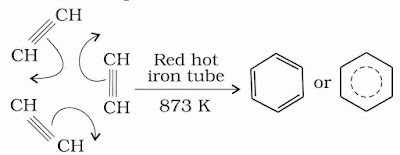
(v) Polymerisation: Ethyne on passing through red hot iron tube at 873 K undergoes cyclic polymerization. Three molecules polymerise to form benzene, which is the starting molecule for the preparation of derivatives of benzene, dyes, drugs and large number of organic compounds.
Hydrocarbons Class 11 Notes

(vi) Oxidation:

2C2H2 + 5O2 ⟶ 4CO2 + 2H2O

Aromatic Hydrocarbon

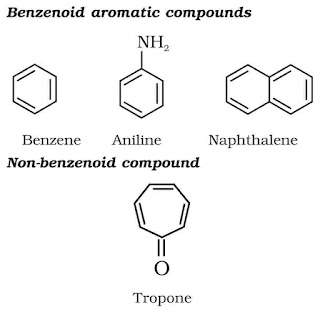
Aromatic hydrocarbons are also known as ‘arenes’. Since most of them possess pleasant odour (Greek; aroma meaning pleasant smelling), the class of compounds are known as ‘aromatic compounds’. Most of the compounds are found to have benzene ring. Benzene ring is highly unsaturated and in a majority of reactions of aromatic compounds, the unsaturation of benzene ring is retained. Aromatic compounds containing benzene ring are known as benzenoids and those, not containing a benzene ring are known as non-benzenoids.

Nomenclature

Since all the six hydrogen atoms in benzene are equivalent; so it forms one and only one type of monosubstituted product. When two hydrogen atoms in benzene are replaced by two similar or different monovalent atoms or groups, three different position isomers are possible which differ in the position of substituents. So we can say that disubstituted products of benzene show position isomerism. The three isomers obtained are 1, 2 or 1, 6 which is known as the ortho (o-), the 1, 3 or 1, 5 as meta (m-) and 1, 4 as para (p-) disubstitued compounds.

Hydrocarbons Class 11 Notes

(B). Structure

The molecular formula of benzene, C6H6, indicates a high degree of unsaturation. All the six carbon and six hydrogen atoms of benzene are identical. On the basis of this observation August Kekule in 1865 proposed the following structure for benzene having cyclic arrangement of six carbon atoms:

Hydrocarbons Class 11 Notes

(C). Resonance

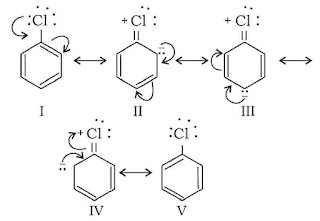
Even though the double bonds keep on changing their positions. The structures produced is such that the position of nucleus remains the same in each of the structure. The structural formula of such a compound is somewhat intermediate (hybrid) between the various propose formulae. This state is known as Resonance.
Hydrocarbons Class 11 Notes

(D). Preparation of Benzene

(i) Cyclic polymerisation of ethyne: Ethyne on passing through red hot iron tube at 873 K undergoes cyclic polymerization.

Hydrocarbons Class 11 Notes

(ii) Decarboxylation of aromatic acids: Sodium salt of benzoic acid i.e., sodium benzoate on heating with sodalime gives benzene.

Hydrocarbons Class 11 Notes

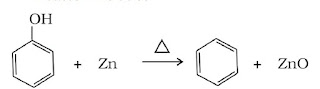
(iii) Reduction of phenol: Phenol is reduced to benzene by passing its vapour over heated zinc dust.
Hydrocarbons Class 11 Notes

(E). Properties of Benzene

I. Physical Properties

  1. Aromatic hydrocarbons are non-polar molecules and are usually colourless liquids or solids with a characteristic aroma.
  2. The napthalene balls used in toilets and for preservation of clothes because of unique smell of the compound.
  3. Aromatic compounds are insoluble in water but soluble in organic solvents such as alcohol and ether.
  4. They burn with sooty flame.

II. Chemical Properties

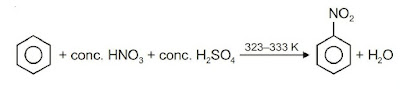
(i) Nitration: A nitro group is introduced into the benzene ring when benzene is heated with a mixture of concentrated nitric acid and concentrated sulphuric acid.
Hydrocarbons Class 11 Notes

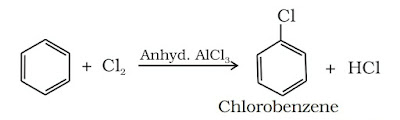
(ii) Halogenation: Arenes undergo halogenation when it is treated with halogens in presence of Lewis catalyst such as anhy. FeCl3, FeBr3 or AlCl3 to yield haloarenes.
Hydrocarbons Class 11 Notes

(iii) Sulphonation: The replacement of a hydrogen atom by a sulphonic acid group in a ring is called sulphonation. It is carried out by heating benzene with fuming sulphuric acid or oleum (conc. H2SO4 + SO3).

Hydrocarbons Class 11 Notes

(iv) Friedel-Crafts alkylation reaction: When benzene is treated with an alkyl halide in the presence of anhydrous aluminium chloride, alkylbenzene is formed.

Hydrocarbons Class 11 Notes

Activating Groups: Electron donating groups (EDG, +M, +I, +H. C. effect) in the benzene ring will more stabilize the σ-complex (Arenium ion complex) with respect to that of benzene and hence they are known as activator.

Deactivating Groups: Electron drawing groups (–M, –I effects) will destabilize σ-complex as compared to that of benzene. Therefore substituted benzenes where substituents are electron withdrawing decreases reactivity towards SE reactions.

Read More

Chapter 5- Organic Chemistry : Some Basic Principles and Techniques | class 11th | revision notes chemistry

Organic Chemistry Some Basic Principles and Techniques Class 11 Notes Chemistry

Structural Representations of Organic Compounds

(i). Structural Formulas

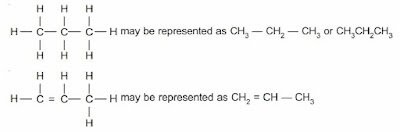
The lewis structures can be simplified by representing the two electron covalent bonds by a dash (–). In this representation, a single bond is represented by a single dash (–), a double bond by a double dash (=) and a triple bond by a triple dash (≡). The lone pair on an atom may or may not be shown. This representation is called structural formula.

Organic Chemistry Some Basic Principles and Techniques Class 11 Notes

(ii). Condensed Formulas

In this formula, the arrangement of atoms are shown but the bonds between may be omitted and the number of identical groups attached to an atom are indicated by a subscript.

Organic Chemistry Some Basic Principles and Techniques Class 11 Notes

(iii). Bond Line Formulas

In this representation, the carbon and hydrogen atoms are not shown and the lines between carbon-carbon bonds are shown in a zig-zag manner.

Organic Chemistry Some Basic Principles and Techniques Class 11 Notes

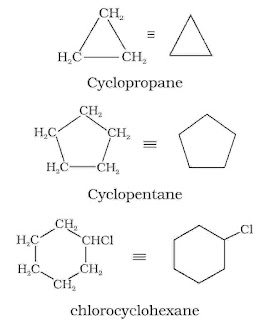
In cyclic compounds, the bond-line formulas may be given as follows :

Organic Chemistry Some Basic Principles and Techniques Class 11 Notes

Three-dimensional representation of organic molecules

The three-dimensional (3-D) structure of organic molecules can be represented on paper by using certain conventions. In these formulae, the thick solid (or heavy) line or the solid wedge indicates a bond lying above the plane of the paper and projecting towards the observer while a dashed wedge is used to represent a bond lying below the plane of the paper and projecting away from the observer.

Organic Chemistry Some Basic Principles and Techniques Class 11 Notes

Classification of Organic Compounds

On the basis of their structures, organic compounds are broadly classified as follows :

Organic Chemistry Some Basic Principles and Techniques Class 11 Notes

Open Chain Compounds

These compounds contain open chains of carbon atoms in their molecules. The carbon chains may be either straight chains or branched chains. They are also called aliphatic compounds.

Closed Chain or Ring Compounds

These compounds contain chains or rings of atoms in their molecules.

Alicyclic Compounds : These compounds contain a ring of three or more carbon atoms in them. They resemble aliphatic compounds in many of their properties.

Organic Chemistry Some Basic Principles and Techniques Class 11 Notes

Aromatic Compounds : These have a cyclic system containing at last one benzene ring. The parent member of the family is called benzene. Benzene has a homocyclic hexagonal ring of six carbon atoms with three double bonds in the alternate positions.

Organic Chemistry Some Basic Principles and Techniques Class 11 Notes

Heterocyclic Compounds : In these compounds, the ring contains one or more atoms of either nitrogen, oxygen or sulphur in addition to carbon atoms. The atom other than carbon (such as N, O, S) present in the ring is called hetero atoms.

Organic Chemistry Some Basic Principles and Techniques Class 11 Notes

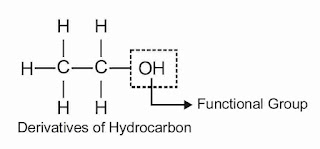
Functional Groups : An atom or group of atoms which largely determines the properties of the organic compounds particularly the chemical properties.

Organic Chemistry Some Basic Principles and Techniques Class 11 Notes

Homologous Series : Homologous series may be defined as “a series of similarly constituted compounds in which the members possess the same functional group and have similar chemical characteristics”. The two consecutive members differ in their molecular formula by –CH2– group.

1. CH3OH – Methyl alcohol
2. C2H5OH – Ethyl alcohol
3. C3H7OH – Propyl alcohol
4. C4H9OH – Butyl alcohol)
5. C5H11OH – Pentyl alcohol
6. C6H13OH – Hexyl alcohol

Nomenclature of Organic Compounds

The term ‘nomenclature’ means the system of naming of organic compounds. There are two systems of nomenclature:

(i) Trivial or Common System

In this nomenclature, the names of organic compounds were assigned based on their source of origin or certain properties. For instance, citric acid got its name from the source (citrus fruits) from which it was first isolated. Formic acid was named so as it was first obtained from red ant. In Latin, ant word is formica.

(ii) IUPAC System of Nomenclature

A systematic method of naming has been developed and is known as the IUPAC (International Union of Pure and Applied Chemistry) system of nomenclature. In this systematic nomenclature, the names are correlated with the structure such that the reader or listener can deduce the structure from the name.

A. Nomenclature of Alkanes

(i). Straight Chain Hydrocarbons: The names of straight chain hydrocarbons consist of word root and primary suffix. The primary suffix for alkanes is ‘ane’.

Organic Chemistry Some Basic Principles and Techniques Class 11 Notes

The IUPAC names of some unbranched saturated hydrocarbons (Carbon-Carbon single bond) are given below.

Organic Chemistry Some Basic Principles and Techniques Class 11 Notes

(ii) Branched Chain Hydrocarbons: In branched chain hydrocarbons, small side chains of carbon atoms are attached to the main carbon parent chain. These side chains are called as alkyl groups and are prefixed t the name of parent alkane. Alkyl groups are derived from alkane by removal of one hydrogen atom so have general formula CnH2n+1 and represented by –R. An alkyl group is named by replacing ‘ane’ of the alkane to ‘yl’.

Organic Chemistry Some Basic Principles and Techniques Class 11 Notes

B. Branched Chain Hydrocarbons:

By following certain rules the branched chain hydrocarbons can be named without any difficulty:

(i) Longest Chain Rule: The initial step of nomenclature is to identify the longest carbon chain which is then called as parent chain.

(ii) Lowest Number Rule: The numbering of the parent chain is done in such a way that the substituents attached to the parent chain should get the lowest possible position.

Organic Chemistry Some Basic Principles and Techniques Class 11 Notes

(iii) Alphabetical Order of the Side Chain: The names of the alkyl group are prefixed before the nam of the parent chain. The position of the alkyl group is indicated by carefully numbering the parent chain Moreover care is taken to name of the substituents in the alphabetical order when different alkyl group are present as substituents.

Organic Chemistry Some Basic Principles and Techniques Class 11 Notes

(iv) In the IUPAC name of an organic compound, the numbers are separated by comma from each other, das or hyphen (-) is put between a number and a letter and the successive words are merged into one word If the branched hydrocarbon contains more than one alkyl groups, then their names are not repeated, instead the number of the same alkyl substituents is written by prefix di for two, tri for three, tetra fo four, penta for five, hexa for six etc.

Organic Chemistry Some Basic Principles and Techniques Class 11 Notes

(v) When the organic compound has more than one alkyl group, then their names are written in the alphabetical order but the prefixed di, tri etc. are not considered for alphabetical order. Thus the correc name of the following compound is 3-ethyl-4, 4-dimethylheptane.

(vi) Numbering of Different Alkyl Groups at Equivalent Positions: When the two different alkyl groups are present at the equivalent positions, then the numbering of the parent chain is done in such a wa so as to assign the lower number of the alkyl group which comes first in the alphabetical order.

Organic Chemistry Some Basic Principles and Techniques Class 11 Notes

(vii) Cyclic Compounds: For naming cyclic hydrocarbons ‘cyclo’ prefix is used before the name of parent chain and the remaining rules are same as explained earlier.

Organic Chemistry Some Basic Principles and Techniques Class 11 Notes

Nomenclature of Unsaturated Hydrocarbons

(i) Select the longest possible carbon chain having maximum number of unsaturated carbon atoms or maximum number of double or triple bonds, even if the prior rules are violated.

Organic Chemistry Some Basic Principles and Techniques Class 11 Notes

(ii) Hydrocarbon containing both C=C and C☰C: When hydrocarbon contains one double bond and one triple bond they are called alkenynes (not alkynenes). The parent chain is numbered in such a way that multiple bond (double or triple) is assigned the lowest possible number. When these bonds are located at equivalent positions, the double bond is given priority over the triple bond.

Organic Chemistry Some Basic Principles and Techniques Class 11 Notes

Nomenclature of Organic Compounds having functional group

Functional Group: Functional group may be defined as an atom or a group of atoms bonded together in a unique manner present in a molecule which largely determines its chemical properties.

The presence of a functional group is indicated by either adding their suffixes or prefixes. The prefixes and suffixes of same functional groups are given in the following table.

Organic Chemistry Some Basic Principles and Techniques Class 11 Notes

The organic compounds with same functional group show similar chemical properties. For example, alcohols like CH3OH, CH3CH2OH,(CH3)2CHOH, etc, all produce hydrogen when treated with sodium metal.

  1. Identify functional groups.
  2. Decide the principal functional group according to its position in priority list. The principal functional group is identified by suffix and the other functional group by prefixes.
  3. Select the longest chain containing the functional groups including C=C or C☰C bond or both as the main chain and name the hydrocarbon on the basis of number of carbons in the main chain.
  4. Derive from the hydrocarbon name the parent name of the compound for the principal functional group.
  5. Assign number of carbon atoms in the main chain so that the principal functional group is given the lowest possible number.
  6. Put the positional number for the functional group, if necessary in the parent name at suitable place.
  7. Complete the name of the compound by placing substituents just before the parent name.

Nomenclature of Substituted Benzene Compounds

(1) For naming the substituted benzene compounds, the prefix used for the substituent is prefixed to the word ‘benzene’ simply.

Organic Chemistry Some Basic Principles and Techniques Class 11 Notes

(2) Many substituted benzene compounds are universally known by their common names.

Organic Chemistry Some Basic Principles and Techniques Class 11 Notes

Isomerism

Such organic compounds which have the same molecular formula but differ from each other in their properties are called as isomers and the phenomenon is called as isomerism. It is of two types:

Organic Chemistry Some Basic Principles and Techniques Class 11 Notes
  1. Structural isomerism
  2. Stereoisomerism

1. Structural Isomerism: Compounds having the same molecular formula but different structure are called structural isomers and the phenomenon is called structural isomerism. It is also known as constitutional isomerism. It is of the following types:

(i) Chain Isomerism: The compounds having same molecular formula but different chain of carbon atom. For example: Butane and 2-methyl propane are chain isomers.

Organic Chemistry Some Basic Principles and Techniques Class 11 Notes

(ii) Position Isomerism: Compounds having the same molecular formula but different in position substituents, C = C, C ≡ C or functional group are called position isomers.

Organic Chemistry Some Basic Principles and Techniques Class 11 Notes

(iii) Functional Isomerism: The compounds having same molecular formula but different functional groups in the molecule are called functional isomers.

Organic Chemistry Some Basic Principles and Techniques Class 11 Notes

(iv) Metamerism: The compounds having same molecular formula but different alkyl group on either side of the functional group, are called metamers.

Organic Chemistry Some Basic Principles and Techniques Class 11 Notes

(v) Tautomerism: When two or more constitutionally distinct compounds are in dynamic equilibrium because of the shift of an atom (generally proton) from one place to another place in a molecule. The phenomenon is called Tautomerism and various constitutional isomers are known as tautomers.

Organic Chemistry Some Basic Principles and Techniques Class 11 Notes

2. Stereoisomerism: Isomers which have the same structural formula but have different relative arrangement of atoms or groups in space are called stereoisomers and the phenomenon is called stereoisomerism. It has three types:

  1. Geometrical Isomerism
  2. Conformational Isomerism
  3. Optical Isomerism

(i) Geometrical Isomerism: When two compounds differ in spatial arrangement of groups because of restricted rotation, these compounds are known as geometrical isomers.

Organic Chemistry Some Basic Principles and Techniques Class 11 Notes

Fundamental Concepts in Organic Reaction Mechanism

A. Fission of a Covalent Bond

Organic reactions usually involve making and breaking of covalent bonds. The fission of bonds can take place in two ways:

(i) Heterolytic Fission: When a covalent bond between two atoms A & B breaks in such a way that both the electrons of the covalent bond are taken away by one of the bonded atoms, the mode of bond cleavage is called heterolytic fission. Heterolytic fission is usually indicated by a curved arrow (↷) which denotes a two-electron displacement.

(ii) Homolytic Fission: If a covalent bond breaks in such a way that each atom takes away one electron of the shared pair, it is called homolytic or symmetrical fission. Homolytic fission is usually indicated by a fish arrow (↶↷) which denotes a one-electron displacement.

B. Attacking Reagents

(i) Electrophiles: A reagent that takes away an electron pair is called electrophile. There are positively charged or neutral species which are deficient of electrons and can accept a pair of electrons. They are also called electron-loving (philic) or electron-seeking species (E). Ex- H+, H3O+, Cl+, CH3+, NO2+, AlCl3, BF3 etc.

(ii) Nucleophiles: A reagent that brings an electron pair is called nucleophile. These reagent contain an atom having unshared or lone pair of electrons. A nucleophile is electron-rich and seeks electron-deficient sites i.e., nucleus-loving or nucleus-seeking (Nu). According to lewis concept of acids and basis, nucleophiles behave as lewis bases. Ex- X OH, CN, RCOO, NH3, H2O etc.

Electron Displacements in Covalent Bonds

(a) Inductive Effect (I-effect): This is a permanent effect which arises whenever an electron-withdrawing group is attached to the end of a carbon chain. To understand this, let us consider a chain of carbon atoms having Cl atom at one end.

C4-C3-C2-C1-Cl

Hence, Cl-atom is more electronegative than C so, the σ-electrons of the C—Cl -bond are attracted by or displaced towards the more electronegative atom. As a result, the atom Cl acquires a small negative charge (δ) and C1 acquires a small positive charge (δ+) as shown below.

C4-C3-C2-C1δ+-Clδ-

(i) –I effect: If the substitutent attached to the end of the carbon chain is electron-withdrawing, the effect is called –I effect.

(ii) + I effect: If the substituent attached to the end of the carbon chain is electron-donating, the effect is called +I effect.

Applications

  1. Acidic and Basic strength of various organic acids and bases can be explained through this effect.
  2. Stability of carbocations and carbanions.
  3. Reactivity of alkyl halides.
  4. Diplole moment, bp, mp etc.

(b) Electromeric Effect (E-effect): It is temporary effect which operates in the organic compounds having multiple bonds i.e., double or triple bonds under the influence of an outside attacking species. As a result, one pi electron pair of the multiple bond gets completely transferred to one of the bonded atoms which is usually more electronegative.

The electromeric effect is shown by a curved arrow (↷) representing the electron transfer originating from the centre of the multiple bond and pointing towards one of the atoms which is more electronegative.

Organic Chemistry Some Basic Principles and Techniques Class 11 Notes

(i) +E effect: If the pi-electron pair of the multiple bond is transferred to the atom to which the attacking reagent gets attached, then the effect is called +E effect.

Organic Chemistry Some Basic Principles and Techniques Class 11 Notes

(ii) –E effect: In this case the pi-electron pair of the multiple bond is transferred away from the atom which gets linked to the attacking reagent, the effect is known as –E effect.

Organic Chemistry Some Basic Principles and Techniques Class 11 Notes

(c) Resonance or Mesomeric Effect (R-effect): The phenomenon of exhibiting more than one possible structure is called as resonance. The resonance can be explained clearly on the basis of structure of benzene. The benzene can be represented by following two canonical form.

Organic Chemistry Some Basic Principles and Techniques Class 11 Notes

(i) + R effect: If a conjugated system has an electron-donating group is said to have + R or + M effect. Such as –OH, –OR, –SH, –NH2, –NHR, –X (halogen) etc.

(ii) –R or –M Effect: If a conjugated system has an electron-withdrawing group is said to have – R or – M effect. Such as –CHO, –COOH, –COOR, –CN, –NO2, >C=O etc.

Aromaticity

Huckel’s Rule of Aromaticity

Huckel’s rule is valid for compounds containing atleast:

  1. One planar ring (i.e., monocyclic)
  2. Conjugated (complete continuous conjugation) (c) Planarity
  3. (4n+2)π electrons where n is either zero or positive integer.
Organic Chemistry Some Basic Principles and Techniques Class 11 Notes

Hypercojugation

When an alkyl group is attached to an unsaturated system such as double bond or a benzene ring. The order of inductive effect is actually reversed. This effect is called hyperconjugation effect or Baker-Nathan effect.

Reaction Intermediates

The species produced during cleavage of bonds are called reaction intermediates, these are generally short-lived and highly reactive and hence cannot be isolated. The typical intermediates are:

(i) Carbocations: A carbocation may be defined as “A group of atoms with a positively charged carbon atom having six electrons in the valence shell after sharing”.

(ii) Carbanions: It may be defined as “chemical species bearing a negative charge on carbon and possessing eight electrons in its valence shell are called carbanions”.

(iii) Free Radicals: It may be defined as “an atom or group of atoms with an odd or unpaired electron.”

Types of Reactions

There are basically four types of reaction:

  1. Addition reaction
  2. Elimination reaction
  3. Substitution reaction
  4. Rearrangement

(i) Addition Reaction: In which a group adds to the system, unsaturated organic compounds comes under this category e.g.

CH2 = CH2 + H2 → CH3—CH3

(ii) Elimination Reaction: The reactions in which two atoms or groups of the molecule are removed are called elimination reactions.

CH3—CH2Br → CH2 = CH2 + HBr

(iii) Substitution Reaction: When a group is removed and another group takes its place. These can also be called displacement reactions. The displacement of the halide group by an OH group to form alcohol.

CH3Cl + KOH → CH3OH + KCl

(iv) Rearrangement: When the molecule rearranges itself by shifting its own part to some other site within the molecule. This is done to attain higher stability if it can be achieved. The various isomerization reactions come under this category.

CH3—CH2—CH2+ → CH3—CH+—CH3

Methods of Purification of Organic Compounds

The organic compounds whether isolated from a natural source or prepared in the laboratory are mostly impure. These are generally contaminated with some other substances. A number of methods are available for the purification. The choice of a particular technique or method depends upon the nature of the compound whether solid or liquid and also upon the nature of the impurities associated with it. The common techniques used for purification are as follows:

  1. Sublimation
  2. Crystallisation
  3. Distillation 
  4. Differential extraction
  5. Chromatography

(i) Sublimation: Certain organic solids on heating directly change from solid to vapour state without passing through a liquid state. Such substances are called sublimable. This process is called sublimation. The vapours on cooling change back to the solid form. The sublimation process is used for the separation of sublimable volatile compounds such as camphor, naphthalene, anthracene, benzoic acid etc.

Solid ⇌ Vapour

(ii) Crystallisation: This is the most common method for purifying organic solids. This method is based on the differences in the solubility of the organic compound and its impurities in a suitable solvent.

(iii) Distillation: “Distillation is the process of converting a liquid into vapours upon heating and then cooling the vapours back to the liquid state”. The process of simple distillation is used to purify those organic liquids which are quite stable at their boiling points and the impurities present are non-volatile. Liquids such as benzene, toluene, ethanol, acetone, chloroform, carbon tetrachloride can be purified by simple distillation.

Organic Chemistry Some Basic Principles and Techniques Class 11 Notes

(iv) Differential Extraction: This technique is normally used to separate certain organic solids dissolved in water by shaking with a suitable organic solvent. The process called extraction is done in a separating funnel. The organic solvent selected should be such that (a) The given solid must be more soluble in the organic solvent than in water. (b) Water and organic solvent should not be miscible with each other.

Organic Chemistry Some Basic Principles and Techniques Class 11 Notes

(v) Chromatography: Chromatography is a modern and sensitive techniques used for rapid and efficient separation or analysis of components of a mixture and purification of the compounds. “The technique of separating the components of a mixture in which separation is achieved by the differential movement of individual components through a stationary phase under the influence of a mobile phase”.

Organic Chemistry Some Basic Principles and Techniques Class 11 Notes

Qualitative Analysis of Organic Compounds

In the study of any organic compound, it is an important step to know the elements present in it. In addition to carbon and hydrogen, organic compounds contain some other elements, e.g., nitrogen, sulphur, halogens, etc. These are detected as follows:

(a) Detection of Carbon and Hydrogen: Carbon and hydrogen are detected by heating the compound with copper (II) oxide. Carbon present in the compound is oxidised to carbon dioxide and hydrogen to water vapours.

C + 2CuO ⟶ 2Cu + CO2

(b) Test for Nitrogen: About 2 ml of sodium extract is taken in a test tube and made alkaline by adding NaOH solution. To this reaction mixture is added freshly prepared FeSO4 solution and boiled for 3–4 minutes. The formation of Prussian blue colour or precipitate shows the presence of nitrogen.

Na + C + N ⟶ NaCN

(c) Test for Sulphur: If organic compound contains both nitrogen and sulphur, sodium thiocyanate is formed.

Na + C + N + S ⟶ NaSCN

(d) Test for Halogens: A portion of the sodium extract is Boiled with 2–3 ml concentrated HNO3 followed by cooling and addition of AgNO3 solution when a pale yellow precipitate partially soluble in ammonia solution indicates the presence of bromine.

NaBr + AgNO3 ⟶ AgBr + NaNO3

Read More

Chapter 4- The p-Block Elements | class 11th | revision notes chemistry

The p-Block Elements Class 11 Notes Chemistry

Introduction

The elements in which last electron enters into p-subshell are called as p-block elements. The number of p-orbitals is three and, therefore, the maximum number of electrons that can be accommodated in a set of p-orbitals is six, hence p-block contains six groups.

Boron Family

Group III A contains six elements : boron, aluminium, gallium, indium, thallium and ununtrium. The penultimate shell (next to the outermost) conains 1s2 in boron, 2s2 2p6 (8 electrons) in aluminium and (n–1)s2(n–1)p6(n–1)d10 (18 electrons) in other elements.

Boron is a non-metal and always form covalent bonds. Boron family is known as most heterogeneous family as there is no regular trend in all properties, as it comes after d-block, lanthanoid contraction, poor shielding of d-orbital, they have large deviation in properties.

I. Physical Properties

The atomic radius, ionic radius and density increases when one moves from top to bottom in a group in periodic table. While melting point decreases from B to Ga and then increases from (Ga to In). Ionisation energy decreases from B to Al, but shows a reverse trend in going from Al to Ga.

II. Chemical Properties

1. Reaction with air: Impure boron in air forms oxide while pure boron is less reactive.

4B + 3O2 ⟶ 2B2O3

2. Reaction with water: Boron is not affected by water or steam under ordinary conditions. However, Aluminium reacts with cold water if oxide layer is not present on its surface.

4Tl + 2H2O + O2 ⟶ 4TlOH

3. Reaction with acids: Boron is not affected by non-oxidising acids like HCl and dilute H2SO4 while other elements dissolve and liberate H2 gas.

2Al + 6HCl ⟶ 2AlCl3 + 3H2

4. Reaction with alkalies: Boron, Aluminium, Gallium react with alkali solutions whereas Indium and Thallium are not affected by alkalies.

2B + 6NaOH ⟶ 2Na2BO3 + 3H2

Anomalous Properties of Boron

Boron, the first member of group 13 elements, shows anomalous behaviour and differ from rest of the members of its family. The main reason for this difference are :

  • exceptionally small atomic and ionic size.
  • high ionization enthalpy.
  • absence of d orbital in its valence shell.
  • It has higher melting and boiling point than those of the other members of its group.

Compounds of Boron

[A]. Borax/Sodium Tetraborate (Na2B4O7·10H2O)

It is the most important compound of boron. It is a white crystalline solid. Borax dissolves in water to give an alkaline solution.

I. Preparation

From Boric acid: Boric acid is neutralised with sodium carbonate and the resulting solution is cooled to get crystals of borax.

H3BO3 + Na2CO3 ⟶ Na2B4O7 + H2O + CO2

II. Properties

(i) It gets hydrolysed with water to form an alkaline solution

Na2B4O7 + 7H2O ⟶ 2NaOH + H3BO3

(ii) Borax bead test: On heating borax first swells up due to elimination of water molecules. On further heating it melts to a liquid which then solidifies to a transparent glassy mass.

Na2B4O7.10H2O ⟶ Na2B4O7 + 10H2O

Na2B4O7 ⟶ 2NaBO2 + B2O3

(iii) It is a useful primary standard for titration against acids.

Na2[B4O5(OH)4]·8H2O + 2HCl ⟶ 2NaCl + 4 H3BO3 + 5H2O

[B]. Diborane : B2H6

The simplest boron hydride known, is diborane. It is prepared by treating boron trifluoride with LiAlH4 in diethyl ether.

I. Preparation

3LiAlH4 + 4BCl3 ⟶ 3LiCl + 3AlCl3 + B2H6

II. Properties

(i) Stable at low temperature only, colourless and highly toxic.

(ii) B2H6 + 6H2O ⟶ 2H3BO3 + 6H2

(iii) B2H6 + 6Cl2 ⟶ 2BCl3 + 6HCl

(iv) B3H6 + 2Me3N ⟶ 2[Me3N.BH3]

Uses of Boron and Aluminium and Their Compounds

Boron Compounds

Boron is a hard solid having high melting point low density and very low electrical conductivity. Some important boron compounds are :

(a) Boron fibers: It is mixed with plastic to form a material which is lighter than aluminium but tougher and stiffer than steel hence it is used in body armour, missiles and aircrafts.

(b) Boron-10 (10B) isotope: Boron carbide rods or boron steel are used to control nuclear reactions as neutron absorbers.

5B10 + 0n1 ⟶ 5B11

(c) Borax: It is used in manufacture of enamels and glazes for pottery and tiles. It is also used in making optical glasses and also borosilicate glasses which is very resistant to heat and shock. It is used as an antispectic.

(d) Boric acid: It is used in glass industry, in food industry as preservative. It is also used as an antiseptic and eye wash under the name ‘boric lotion’. It is also used in manufacture of enamels and glazes for pottery.

(e) Boron carbide: Hardest boron compound.

I. Aluminium Compounds

Aluminium and its alloy are used in packing industry, utensil industry, aeroplane and transportation industry etc.

1. Alumina (Al2O3)

(a) Used in chromatography.

(b) Used in making bauxite bricks which are used for lining furnaces.

2. Aluminium chloride (AlCl3): Used in manufacture of dyes, drugs and perfumes and also in manufacture of gasoline. It is also used as catalyst in Friedel Craft reaction.

3. Potash Alum. [K2SO4⋅Al2(SO4)3⋅24 H2O]: Used in purification of water, leather tanning, as antiseptic and as a mordant.

Group 14 Elements : The Carbon Family

Group IV A contains six elements : carbon, silicon, germanium, tin, lead and ununquadium. The penultimate shell (prior to outermost) contains 1s2 -grouping in carbon, 2s22p6 (8 electrons) in silicon and (n–1)s2(n–1)p6(n–1)d10 (18 electrons) in other elements. This shows why carbon differs from silicon in some respects and these two differ from rest of the members of this group. General electronic configuration is ns2np2.

[A]. Atomic and Physical Properties

The important properties of carbon family are discussed below:

(1) Atomic Radii: The atomic radii of group 14 elements are less than the corresponding elements of group 13. However, the atomic radii increases down the family.

(2) Ionisation Energies: The higher ionisation energies than group 13 are due to the higher nuclear charge and smaller size of atoms of group 14 elements. While moving down the group, the ionisation energies decreases till Sn.

C > Si > Ge > Sn < Pb

(3) Oxidation state and valency: The elements of group 14 show tetravalency by sharing four of its valence electrons. Therefore, they have oxidation state of +4. In addition, Ge, Sn and Pb also show +2 oxidation state.

(4) Catenation: Catenation is ability of like atoms to link with one another through covalent bonds. Tendency decreases from C to Pb. It is due to the decreasing M-M single bond energy. Thus, the tendency for catenation decreases as:

C > Si > Ge > Sn > Pb

(5) Allotropy: All the elements of the carbon family with the exception of lead exhibit allotropy. Carbon exists as two important allotropic forms diamond and graphite.

[B]. Chemical Properties

1. Reactivity towards air: All members of this group form monoxide of the general formula MO such as CO, SiO, SnO and PbO. All members of this group form dioxides of molecular formula MO2 such as CO2, SiO2, GeO2, SnO2 and PbO2.

2. Reactivity towards water: In this family three members i.e., carbon, silicon and germanium are affected by water while lead is not affected by water due to formation of protective oxide film but tin decomposes with steam into tin dioxide and hydrogen gas.

3. Reactivity towards halogen: These elements form two types of hallides – MX2 and MX4. Most of the MX4 are covalent. SnF4 and PbF4 are ionic in nature.

Anomalous Behaviour of Carbon

Carbon shows anomalous behaviour due to its smaller size, higher electronegativity, higher ionization enthalpy and unavailability of d orbitals. Carbon atom forms double or triple bonds involving pπ-pπ bonding. Carbon has also the property to form closed chain compounds with O, S and N atoms as well as forming pπ-pπ multiple bonds with other elements particularly N, S and O. When we move down the group size increases and electronegativity decreases hence catenation tendency decreases. Order is

C >> Si > Ge ≈ S

Allotropes of Carbon

Carbon shows allotropism due to catenation and pπ-pπ bond formation. Carbon exists in two allotropic forms – crystalline and amorphous. The crystalline forms are diamond and graphite while the amorphous forms are coal, charcoal and lamp-black. The third form is fullerenes discovered by Kroto, Smalley and Curl.

Note: Tin has maximum number of allotropes.

Diamond

In diamond each carbon is joined to other four carbon tetrahedrally and carbon-carbon bond length is 1.54Å and bond angle is 109º28′ having sp3 hybridisation on each carbon. All four electrons in carbon are involved in bonding hence, it is bad conductor of electricity. Diamond is an excellent thermal conductor.

Diamond

It is hardest natural substance known. It is transparent and has a specific gravity 3.52 and its refractive index is high (2.45). Difficult to break due to extented covalent bonding. Diamond is used for making cutters. Blades of diamond are used in eye surgery and as an abrasive for sharpening hard tools. Impure diamonds (black) are used in knives for cutting glass.

Graphite

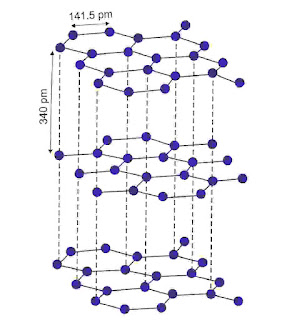
Each carbon is sp2 hybridised. It has layered structure. These layers are attracted by van der Waals force. Each carbon has one free electron in p-orbital, so it is a good conductor of electricity. All electrons get delocalized in one layer and form π-bond. Electron jumps from one orbital to another hence it is a good conductor of heat and electricity. In graphite carbon-carbon bond length is 141.5 pm and distance between adjacent graphite layer is 340 pm.

Graphite

Graphite is used as a lubricant at high temperature. Oil gets burn or denatured at high temperature but graphite does not get denatured even at high temperature so, preferred over oil and grease.

Fullerene

It was made as a result of action of a laser beam or strong heating of a sample of graphite in presence of inert atmosphere. The sooty material mainly contains C60 with C70 (small amount). Most common fullerene is C60 called Buckminsterfullerene which has football-like structure. It contains 20 six-membered ring and 12 five-membered ring. It is used to make ball bearings.

Fullerene

Coal

It is the crude form of carbon. It has been formed in nature as a result of slow decomposition of vegetable matter under the influence of heat, pessure and limited supply of air. The successive stages of transformation are : peat, lignite, bituminous, steam coal and anthracite. Bituminous is hard stone, burns with smoky flame. The superior quality is anthracite which burns with non-smoky flame.

Uses of carbon

  • Graphite: In making lead pencils, electrodes of electric furnances, as a moderator in nuclear reactor, as a lubricant in machinery.
  • Charcol: In removing offensive odour from air, in removing fused oil from crude spirit, in decolourising sugar syrup, in gas masks etc.
  • Carbon black: For making printing inks, black paints, Indian inks, boot polishes and ribbons of typewriters.
  • Coal: For the manufacture of coal gas, coal tar, coke and synthetic petrol.

Compounds of Carbon

(1) Carbon Monoxide (CO)

Preparation: Carbon monoxide is majorly prepared by

2C + O2 ⟶ 2CO

Properties:

  • (i) Burns with blue flame2CO + O2 ⟶ 2CO2 
  • (ii) CO + Cl2 ⟶ COCl2 (Phosgene)
  • (iii) CO + 2H2 ⟶ CH3OH
  • (iv) Many of the transition metals form metal carbonylsNi + 4CO ⟶ Ni(CO)4

(2) Carbon Dioxide (CO2)

Preparation: Carbon dioxide is mostly prepared by decomposition of carbonates and bicarbonates

  • (i) CaCO3 + 2HCl ⟶ CaCl2 + H2O + CO2 
  • (ii) CaCO3 ⟶ CaO + CO2

Properties: Carbon dioxide is an acidic, colourless gas. The important properties are:

  • (i) Zn + CO2 ⟶ ZnO + CO
  • (ii) 2Mg + CO2 ⟶ 2MgO + C
  • (iii) 2NaOH + CO2 ⟶ Na2CO3 + H2O
  • (iv) Na2CO3 + H2O + CO2 ⟶ 2NaHCO3
Read More

Chapter 3- The s-Block Elements | class 11th | revision notes chemistry

The s-Block Elements Class 11 Notes Chemistry

The s-Block Elements

The s-block elements of the Periodic Table are those in which the last electron enters the outermost s-orbital. As the s-orbital can accommodate only two electrons, two groups (1 & 2) belong to the s-block of the Periodic Table.

Group-1 of periodic table contains : Lithium (Li), Sodium (Na), Potassium (K), Rubidium (Rb), Caesium (Cs) and Francium (Fr). Together these elements are called alkali metals because they form hydroxides on reaction with water, which are strongly alkaline in nature.

The group-2 includes Beryllium (Be), Magnesium (Mg), Calcium (Ca), Strontium (Sr), Barium (Ba) and Radium (Ra). Except Beryllium, rest of the elements of group-2 are called the alkaline earth metals. These are called so because their oxides and hydroxides are alkaline in nature and these metal oxides are found in the earth crust.

Group-1 Elements : Alkali Metals

1. Electronic Configuration

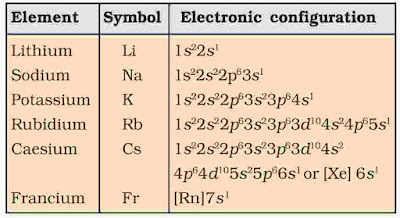
Electronic Configuration of elements of group-1 is ns1, where n represents the valence shell. The alkali metals have one valence electron, outside the noble gas core.

The s-Block Elements

2. Atomic and ionic radii

The atoms of alkali metals have the largest size in their respective periods. The atomic radius increases on moving down the group because on moving down the group there is a progressive addition of new energy shells.

3. Ionization enthalpy

The ionization enthalpies of the alkali metals are generally low and decrease down the group from Li to Cs. This is because on moving down the group is due to increase in size of the atoms of alkali metals and increase in the magnitude of screening effect.

4. Hydration enthalpy

The alkali metal ions are extensively hydrated in aqueous solutions. The hydration enthalpies of alkali metal ions decrease with increase in ionic size Li+ > Na+ > K+ > Rb+ > Cs+.

5. Physical properties

  1. Alkali metals are silvery white in colour and are generally soft and light metals.
  2. The densities of alkali metals are low and increase down the group.Alkali metals have low melting and boiling point.
  3. When alkali are heated metals they impart characteristic colours to the flame.
  4. When the excited electron comes back to the ground state, there is emission of radiation in the visible region.

6. Chemical Properties

The alkali metals are highly reactive elements. The cause for their high chemical reactivity is

  • (i) Low value of first ionisation enthalpy
  • (ii) Large size
  • (iii) low heat of atomisation.

(i). Reaction with Air: Alkali metals burn very fast in oxygen and form different kind of oxides like monoxides, peroxides and superoxides. In all the compounds formed by alkali metals with oxygen, their oxidation state is +1.

4Li + O2 ⟶ 2Li2O (Oxide)

Na + O2 ⟶ Na2O2 (Peroxide)

M + O2 ⟶ MO2 (Superoxide)

(ii). Reaction with Water: The alkali metals on reaction with water form their respective hydroxide and dihydrogen.

2M + 2H2O ⟶ 2M+ + 2OH + H2

(M = an alkali metal)

(iii). Reaction with Dihydrogen: Alkali metal react with dry di-hydrogen at about 673 K (lithium at 1073 K) to form crystalline hydrides which are ionic in nature and have high melting points.

2M + H2 ⟶ 2M+H

(iv). Reaction with Halogens: The alkali metals react vigorously with halogens and form halides which are ionic in nature, M+X. But the halides of lithium are a bit covalent in nature.

(v). Reaction with Mercury: The alkali metals have strong tendency to get oxidised, that is why they act as strong reducing agents, among these lithium is the strongest and sodium is the least powerful reducing agent.

(vi). Reducing Nature: Alkali metals combine with mercury to form amalgams. The reaction is highly exothermic in nature.

Na + Hg ⟶ Na[Hg]

(vii). Solutions in liquid Ammonia: All alkali metals dissolve in liquid ammonia and give deep blue colour solution which are conducting in nature. These solutions contain ammoniated cations and ammoniated electrons as shown below:

M + (x + y)NH3 ⟶ [M(NH3)x]+ + [e(NH3)y]

Uses of Alkali Metals

  1. Lithium is used as a metal in a number of alloys. Its alloys with aluminium to make aircraft parts.
  2. Lithium hydroxides is used in the ventilation systems of space crafts and submarines to absorb carbondioxide.
  3. Lithium aluminium hydride (LiAlH4) is a powerful reducing agent which is commonly used in organic synthesis.
  4. Liquid sodium or its alloys with potassium is used as a coolant in nuclear reactors.
  5. Sodium-lead alloy is used for the preparation of tetraethyl lead, Pb(C2H5)4, which is used as an antiknocking agent in petrol.
  6. Sodium is used in the production of sodium vapour lamps.
  7. Potassium chloride is used as fertilizer.
  8. Potassium hydroxide is used in the manufacture of soft soaps and also as absorbent of carbon dioxide.
  9. Potassium ions play a vital role in biological systems.
  10. Caesium is used in photoelectric cells.

Anomalous Properties of Lithium

Lithium shows properties which are very different from the other members of its group. This is due to the

  1. exceptionally small size of its atom and ion.
  2. greater polarizing power of lithium ion.
  3. as compared to other alkali metals, lithium is harder and its melting point and boiling point are higher.
  4. among all the alkali metals lithium is least reactive but the strongest reducing agent.

Some important Compounds of Sodium

Sodium is highly reactive and always found in combined state. The isotope of sodium (Na) is used in detection of leukemia. The compound of sodium are given below:

1. Sodium Oxide (Na2O)

Preparation:

2NaNO2 + 6Na ⟶ 4Na2O + N2

Properties:

  1. Sodium oxide is a colourless ionic solid.
  2. Aqueous solution of sodium oxide is strongly basic.
  3. Sodium oxide on reaction with liquid ammonia forms sodamide.
  4. At low temperature, when sodium peroxide is reacted with water or acids, H2O2 is formed.

2. Sodium Peroxide (Na2O2)

Preparation:

Sodium when heated in excess of air or when heated in excess of pure oxygen gives sodium peroxide.

2Na + O2 ⟶ Na2O2

Properties:

  1. Sodium peroxide is a pale yellow diamagnetic compound.
  2. Sodium peroxide is a powerful oxidising agent.
  3. Sodium peroxide combines with CO and CO2 to give carbonate.
  4. At low temperature, when sodium peroxide is reacted with water or acids, H2O2 is formed.

Na2O2 + 2H2O ⟶ 2NaOH + H2O2

3. Sodium Hydroxide (Caustic Soda) (NaOH)

Preparation:

When sodium carbonate is treated with calcium hydroxide it give calcium carbonate along with sodium hydroxide. Also known as lime caustic soda process. It is a reversible reaction.

Na2CO3 + Ca(OH)2 ⟶ 2NaOH + CaCO3

Properties

  1. Sodium hydroxide is a white crystalline deliquescent solid.
  2. Sodium hydroxide is corrosive in nature.
  3. Sodium hydroxide is highly soluble in water.
  4. Sodium hydroxide reacts with acid forming corresponding salts.

NaOH + HCl ⟶ NaCl + H2O

Uses: It is used in

the manufacture of soap, paper, artificial silk and a number of chemicals,

  1. in petroleum refining,
  2. in the purification of bauxite,
  3. in the textile industries for mercerising cotton fabrics,
  4. for the preparation of pure fats and oils, and
  5. as a laboratory reagent.

4. Sodium Carbonate (Na2CO3)

Preparation:

NH3 + H2O + CO2 ⟶ NH4HCO3

NaCl + NH4HCO3 ⟶ NaHCO3 + NH4Cl

2NaHCO3 ⟶ Na2CO3 + H2O + CO2

Properties:

  1. Sodium carbonate is a white crystalline solid.
  2. Na2CO3.10H2O is known as washing soda.
  3. Sodium carbonate reacts with acids to give carbon dioxide.

Uses:

  1. It is used in water softening, laundering and cleaning.
  2. It is used in the manufacture of glass, soap, borax and caustic soda.
  3. It is used in paper, paints and textile industries.
  4. It is an important laboratory reagent both in qualitative and quantitative analysis.

Na2CO3 + HCl ⟶ NaCl + H2O + CO2

Properties:

On heating sodium bicarbonate loses CO2 and H2O forming Na2CO3.

2NaHCO3 ⟶ Na2CO3 + H2O + CO2

6. Sodium Chloride (NaCl)

Manufacture of sodium chloride is done from sea water. Sea water is allowed to dry up under summer heat in small tanks and solid crust so formed is collected.

Properties:

  1. Sodium chloride is a white crystalline solid.
  2. It is slightly hygroscopic.
  3. It is soluble in water and insoluble in alcohol.

Uses:

  1. It is used as a common salt or table salt for domestic purpose.
  2. It is used for the preparation of Na2O2, NaOH and Na2CO3.

5. Sodium Bicarbonate (Baking Soda) (NaHCO3)

Preparation:

When NaOH is treated with CO2 in presence of H2O it gives sodium bicarbonate.

NaOH + CO2 + H2O ⟶ NaHCO3

Properties:

On heating sodium bicarbonate loses CO2 and H2O forming Na2CO3.

2NaHCO3 ⟶ Na2CO3 + H2O + CO2

Group-2 Elements : Alkaline Earth Metals

The elements of group-2 are Beryllium (Be), Magnesium (Mg), Calcium (Ca), Strontium (Sr), Barium (Ba) and Radium (Ra). Except for Be, rest are known as alkaline earth metals, because they were alkaline in nature and existed in the earth.

1. Electronic Configuration

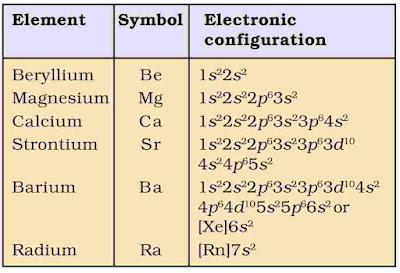
The alkaline earth metals have 2 electrons in the s-orbital of the valence shell. Their general electroni configuration [Noble gas]ns2

Electronic Configuration

2. Atomic and Ionic Radii

The atomic radii as well as ionic radii of the members of the family are smaller than the corresponding members of alkali metals. Within the group, the atomic and ionic radii increase with increase in atomic number.

3. Ionization Enthalpies

The alkaline earth metals owing to their large size of atoms have fairly low values of ionization enthalpies. Within the group, the ionization enthalpy decreases as the atomic number increases.

4. Hydration Enthalpies

The hydration enthalpies of alkaline earth metal ions are larger than those of alkali metal ions. Therefore, compounds of alkaline earth metals are more extensively hydrated, for example, magnesium chloride and calcium chloride exist. the hydration enthalpies of alkaline earth metal ions decrease with increase in ionic size down the group. Be2+ > Mg2+ > Ca2+ > Sr2+ > Ba2+

5. Physical Properties

The alkaline earth metals are silvery white, lustrous and relatively soft but harder than the alkali metals.The melting and boiling points of these metals are higher than the corresponding alkali metals.The electropositive character increases down the group from Be to Ba.Calcium, strontium and barium impart characteristic brick red, crimson and apple green colours respectively to the flame.Th alkaline earth metals just like those of alkali metals have high electrical and thermal conductivities.

6. Chemical Properties

As compared to alkali metals, alkaline earth metals are less reactive due to their relatively higher ionization enthalpies. The reactivity of alkaline earth metals increases on going down the group.

(i). Reaction with water: Ca Sr, and Ba have reduction potentials similar to those of corresponding group Ist metals and are quite high in the electrochemical series. They react with cold water readily, liberating hydrogen forming metal hydroxides.

Ca + 2H2O ⟶ Ca(OH)2 + H2

(ii). Reaction with Air: Except Be these metals are easily tarnished in air as a layer of oxide is formed on their surface. Ba in powdered form bursts into flame on exposure to air.

(iii). Reaction with hydrogen: The elements Mg, Ca, Sr and Ba all react with hydrogen to form hydrides MH2.

(iv). Reaction with oxygen: Except Ba and Ra the elements when burnt in oxygen form oxides of the type MO.

(v). Reaction with halogens: When heated with halogens the alkaline earth metals directly combine with them and form the halides of the type MX2.

Ca + Cl2 ⟶ CaCl2

(vi). Reaction with acids: The alkaline earth metals readily react with acids liberating dihydrogen.

M + 2HCl ⟶ MCl2 + H2

Uses of alkaline earth metals

  1. Beryllium is used in the manufacture of alloys. Cooper-Beryllium alloys are used in the making of high strength springs.
  2. Metallic beryllium is used for making windows of X-rays tubes.
  3. Magnesium, being a light metal, forms many light alloys with aluminum, zinc, manganese and tin.
  4. Magnesium is used in flash powders and bulbs, incendiary bombs and signals.
  5. Magnesium-aluminium alloys are used in aircraft construction.
  6. Magnesium is used as sacrificial anode for the prevention of corrosion of iron.
  7. A suspension of magnesium hydroxide in water (called milk of magnesia) is used as an ant-acid to control excess acidity in stomach.
  8. Magnesium carbonate is an ingredient of tooth-paste.
  9. Calcium is used in the extraction of metals from oxides which are difficult to reduce with carbon.
  10. Calcium and barium metals are used to remove air from vacuum tubes, due to their tendency to react with oxygen and nitrogen at high temperature.
  11. Radium salts are used for radio therapy of cancer.

Anomalous Behaviour of Beryllium

Beryllium shows different behaviour from the rest members of its group and shows diagonal relationship to aluminium due to reasons discussed below.

  1. Beryllium has exceptionally small atomic and ionic sizes and therefore does not compare well with other members of the group, because of high ionisation enthalpy and small size it forms compounds which are largely covalent and get easily hydrolysed.
  2. Beryllium does not exhibit coordination number more than four as in its valence shell, there are only four orbitals. The remaining members of the group can have a coordination number of six by making use of d-orbitals.
  3. The oxides and hydroxide of beryllium unlike the hydroxide of other elements in the group, are amphoteric in nature.

Compounds of Calcium

1. Calcium Oxide (CaO)

Preparation:

Calcium carbonate when decomposed at 800°C gives calcium oxide.

CaCO3 ⟶ CaO + CO2

Properties:

  1. Calcium oxide is also known as ‘Quick lime’ or ‘Burnt lime’, is white amorphous substance.
  2. When water is added to lime a hissing sound is produced along with clouds of steam. The lime forms slaked lime [Ca(OH)2].
  3. Calcium oxide reacts with moist chlorine to form bleaching powder. CaO + Cl2 ⟶ CaOCl2 
  4. Calcium oxide on reaction with moist HCl gas forms CaCl2.CaO + 2HCl ⟶ CaCl2 + H2O

2. Calcium Carbonate (CaCO3)

Preparation:

Carbon dioxide when passed through lime water gives calcium carbonate.

Ca(OH)2 + CO2 ⟶ CaCO3 + H2O

Properties:

  1. Calcium carbonate is a white powder insoluble in water.
  2. Calcium carbonate dissolves in water in presence of CO2 due to formation of calcium bicarbonate.

CaCO3 + H2O + CO2 ⟶ Ca(HCO3)2

3. Calcium Chloride (CaCl2)

Preparation:

Calcium oxide, calcium hydroxide or calcium carbonate when treated with HCl gives calcium chloride.

CaO + 2HCl ⟶ CaCl2 + H2O

Properties:

  1. Calcium chloride is a colourless deliquescent crystalline substance which is soluble in water as well as in alcohol.
  2. Crystals of calcium chloride when strongly heated gives off water of crystalisation.

4. Calcium sulphate (Plaster of Paris)

Preparation:

When Gypsum is heated at about 120° – 130°C, Plaster of Paris is formed.

2CaSO4 + 4H2O ⟶ (CaSO4)2H2O + 3H2O

Properties:

  1. It is a white crystalline solid. It is sparingly soluble in water.
  2. It becomes anhydrous at about 200°C. Anhydrous form is known as dead burnt plaster.

5. Calcium hydroxide Ca(OH)2

Preparation:

CaO + H2O ⟶ Ca(OH)2

Properties:

1. It gives CaCO3 and Ca(HCO3)2 with CO2

Ca(OH)2 + CO2 ⟶ CaCO3 + H2O

2. On prolong treatment with CO2 milkiness disappears due to formation of Ca(HCO3)2

CaCO3 + H2O + CO2 ⟶ Ca(HCO3)2

Summary

  1. s-block elements : The elements in which last electron enters into s-orbital are called s-block elements.
  2. Alkali metals : The elements of group 1 whose hydroxide are strong alkali.
  3. Alkaline earth metal : The elements of group 2, and their oxides and hydroxides are alkaline in nature and their oxides are found in the Earth’s crust.
  4. Diagonal relationship : The resemblance in properties of elements of second period with elements of third period present diagonally on the right hand side.
  5. Monovalent sodium and potassium ions and divalent magnesium and calcium ions are found in large proportions in biological fluids. These ions perform important biological functions such as maintenance of ion balance and nerve impulse conduction.
Read More

Chapter 2- Hydrogen | class 11th | revision notes chemistry

Hydrogen Class 11 Notes Chemistry

Introduction

In this chapter we will study the preparation, properties of dihydrogen and of some important compounds formed by hydrogen like H2O and H2O2.

Hydrogen is the first element of the periodic table. The atomic structure of hydrogen is the most simplest one with only one proton and one electron. Hydrogen occurs in its atomic form only at very high temperatures. Water is one of the most important compounds formed by hydrogen. Even its name hydrogen was given by Lavoisier because of its ability to form water as in Greek, hydro means water and gene means forming.

Position of Hydrogen in the Periodic Table

Hydrogen is the first element in the periodic table. The electronic configuration of hydrogen is 1s1, yet its position in the periodic table is not certain and unsatisfactory. Hydrogen exhibits properties similar to both alkali metals (Group 1) and halogens (Group 17).

Resemblance with Alkali Metals

  1. Like alkali metals, hydrogen has only one electron in its outer shell.
  2. Alkali metals have a strong tendency to lose one electron from their outermost shell. Similarly, hydrogen also loses electron to form H+ ion.
  3. Alkali metals form stable oxides, halides and sulphides. Similarly, hydrogen also forms stable oxide (H2O), halides (HF) and sulphide (H2S).

Resemblance with Halogens

  1. Halogens have a tendency to gain one electron. Similarly, hydrogen (1s1) gains one electron to form H ion.
  2. Hydrogen molecule is diatomic (H2) and so are the molecules of halogens (say F2).
  3. Hydrogen forms hydrides with carbon (e.g., CH4), just like halogens form halides with carbon (CCl4).

Isotopes of Hydrogen

Isotopes are the different forms of the same element having same atomic number but different mass numbers. There are three isotopes of hydrogen namely protiumdeuterium and tritium.

1. Protium or ordinary hydrogen (1H1): It has one proton and no neutron in the nucleus and one electron revolves around the nucleus.

2. Deuterium (1H2 or D): It is also known as heavy hydrogen. It has one proton and one neutron in the nucleus around which one electron revolves.

3. Tritium (1H3 or T): This isotope of hydrogen is radioactive and emits low energy β particles having half life period of 12.33 years. It has one proton and two neutrons in the nucleus. The concentration of tritium is very low.

Dihydrogen

Occurrence

Dihydrogen is the most abundant element in the universe. It constitutes about 70% of the total mass of the universe. But its abundance in earth’s atmosphere is very less. It is just 0.15% by mass in the earth’s atmosphere. In free state hydrogen is present in volcanic gases and in the combined form it constitutes 15.4% of the earth’s crust and the oceans. However, it is also present in the plant and animal tissues, carbohydrates, proteins etc. Even hydrogen is present in mineral resources like coal and petroleum.

Hydrogen is the principal element in the solar atmosphere. It is present in the outer atmosphere of Sun and other stars of the universe like Jupiter and Saturn.

Preparation of Dihydrogen

1. Laboratory Preparation of Dihydrogen

(i) In laboratory dihydrogen is prepared by the reaction of granulated zinc with dilute hydrochloric acid or dilute sulphuric acid.

Zn + 2H+(dil) ⟶ Zn2+ + H2

(ii) Zinc reacts with aqueous alkali to give dihydrogen

Zn + 2NaOH ⟶ Na2ZnO + H2

2. Commercial Production of Dihydrogen

(i). By the electrolysis of water : Electrolysis of acidified water using platinum electrodes is used for the bulk preparation of hydrogen.

2H2O ⟶ 2H2 + O2

(ii). By the action of steam on coke : Dihydrogen is prepared by passing steam over coke or hydrocarbons at high temperature (1270 K) in the presence of Nickel catalyst.

C + H2O ⟶ CO + H2

The mixture of CO(g) and H2(g) is called water gas. It is also known as synthesis gas or simply ‘syn gas’ because it is used in the synthesis of methanol and many other hydrocarbons.

Properties of Dihydrogen

(i). Physical Properties

  • Dihydrogen is a colourless, odourless, tasteless, combustible gas.
  • It is lighter than air.
  • It is insoluble in water.

(ii). Chemical Properties

Reaction with halogens: It reacts with halogens, X2 to give hydrogen halides, HX,

H2 + X2 ⟶ 2HX (X F,Cl, Br,I)

Reaction with dioxygen: It reacts with dioxygen to form water. The reaction is highly exothermic.

2H2 + O2 ⟶ 2H2O

Reaction with dinitrogen: With dinitrogen it forms ammonia.

3H2 + N2 ⟶ NH3

Reactions with metals: Dihydrogen reacts with metals to yield hydrides at high temperature.

H2 + 2M(g) ⟶ 2MH(s)

where M is an alkali metal.

Hydrogenation of vegetable oils: Edible oils (unsaturated) like cotton seed oil, groundnut oil are converted into solid fat (saturated) also called vegetable ghee by passing hydrogen through it in the presence of Ni at 473 K.

Vegetable oil + H2 ⟶ Fat

Uses of Dihydrogen

1. Synthesis of ammonia: Dihydrogen is used in Haber’s process in the synthesis of ammonia.

2. Hydrogenation of oils: Dihydrogen is added to oils like soyabean oil, cotton seed oil for manufacturing vanaspati fat.

3. Manufacture of methyl alcohol: Water gas enriched with hydrogen gas in the presence of cobalt catalyst gives methanol.

4. Manufacture of hydrogen chloride: It is used in the manufacturing of hydrogen chloride which is a very important chemical.

5. Manufacture of metal hydrides: It is used in the manufacture of many metal hydrides.

6. Metallurgical processes: Since, dihydrogen is used to reduce heavy metal oxides to metals, as it is a reducing agent. Therefore, it finds its use in metallurgical processes.

7. Rocket fuel: It is used as a rocket fuel for space research in the form of liquid hydrogen and liquid oxygen.

8. Fuel Cells: Dihydrogen is used in fuel cells for the generation of electrical energy.

9. It is used in the atomic hydrogen torch and oxyhydrogen torches for cutting and welding purposes.

Hydrides

Hydrogen combines with a large number of other elements including metals and non-metals, except noble gases to form binary compounds called hydrides. If ‘E’ is the symbol of the element then hydrides are represented as EHx(e.g., BeH2)

Based on their physical and chemical properties, the hydrides have been classified into three main categories:

  • Ionic or saline or salt like hydrides
  • Covalent or molecular hydrides
  • Metallic or non-stoichiometric hydrides

Ionic or Saline Hydrides

The ionic hydrides are stoichiometric which are formed when hydrogen combines with elements of s-block elements except Be. Ionic hydrides are formed by transfer of electrons from metals to hydrogen atoms and contain hydrogen as H ion e.g., sodium hydride (Na+H)

Covalent or Molecular Hydrides

Covalent or molecular hydrides are the compounds of hydrogen with p-block elements. The most common hydrides are CH4, H2O, NH3 etc. Covalent hydrides are volatile compounds.

Metallic or Non-Stoichiometric Hydrides

The elements of group 3, 4, 5 (d-block) and f-block elements form metallic hydrides. In group 6, only chromium forms hydride (CrH). Metals of group 7, 8, 9 do not form hydrides. These hydrides are known as metallic hydrides because they conduct electricity.

Water

Water is one of the most readily available chemical. Water is an oxide of hydrogen. It is an important component of all living organisms. Water constitutes about 65% of human body and 95% of plants. It is therefore essential for life. The ability of water to dissolve so many other substances makes it a compound of great importance. Almost three-fourth of the earth’s surface is covered with water.

Physical Properties of Water

  1. Pure water is colourless, odourless and tasteless.
  2. Water is present in the liquid state at room temperature.
  3. Water boils at 100°C and changes into the gaseous state whereas it freezes at 0°C to form ice.
  4. Water molecules undergo extensive hydrogen bonding.
  5. It is an excellent solvent for many thing like alcohols and carbohydrates dissolve in water.

Structure of Water

Structure of Water

Structure of Ice

Structure of Water

Chemical Properties

1. Amphoteric nature: Water can act both as an acid as well as a base and is thus said to be an amphoteric substance.

Water as base: Water acts as a base towards acids stronger than it as shown below,

H2O + HCl ⟶ H3O+ + Cl

Water as an acid: Water acts as an acid towards bases stronger than it

H2O + NH3 ⟶ OH + NH4+

2. Redox reactions involving water: Water can act both as oxidising as well as reducing agent.

Oxidising agent: Water acts as an oxidising agent when it gets reduced.

2H2O + 2Na ⟶ 2NaOH + H2

Reducing agent: Water acts as a reducing agent when it gets oxidised.

2H2O + 2F2 ⟶ 4H+ + 4F + O2

3. Hydrolysis reaction: Water is an excellent solvent due to its high dielectric constant (78.39). In addition, water can easily hydrolyse many ionic and covalent compounds.

(i) Water hydrolyses oxides and halides of non-metals forming their respective acids

P4O10 + 6H2O ⟶ 4H3PO4

4. Hydrates Formation: From aqueous solutions many salts can be crystallised as hydrated salts. Hydrates are of three types:

(i) Coordinated water

For example: [Ni(H2O)6]2+ (NO3)2 and [Fe(H2O)6]Cl3

(ii) Interstitial water

For example: BaCl2.2H2O

(iii) Hydrogen bonded water

For example: [Cu(H2O)4]2+ SO42- H20 in CuS04.5H2O

Hard and Soft Water

Hard water is the one which does not produce lather with soap easily due to the presence of calcium and magnesium salts in the form of their bicarbonates, chlorides and sulphates. For example, sea water etc.

Soft water is the one which is free from the soluble salts of calcium and magnesium. It gives lather with soap easily. For example, distilled water, rain water etc.

Types of Hardness

1. Temporary hardness: It is due to the presence of bicarbonates of calcium and magnesium. Temporary hardness is called so because it can be easily removed by boiling.

2. Permanent hardness: This type of hardness is due to the presence of chlorides and sulphates of calcium and magnesium dissolved in water. As this type of hardness cannot be removed by simple boiling, therefore it is known as permanent hardness.

Softening of Water

The process of removal of hardness from water is called softening of water.

(i) Removal of temporary hardness: Temporary hardness can be removed by the following methods:

(a) Boiling: The temporary hardness of water can easily be removed by boiling the water in large boilers. During boiling the soluble Mg(HCO3)2 is converted into Mg(OH)2 instead of MgCO3 because Mg(OH)2 is precipitated easily, whereas Ca(HCO3)2 is changed to insoluble CaCO3 and gets precipitated. These precipitates can be removed by filtration process. So, the filtrate obtained will be soft water.

Mg(HCO3)2 ⟶ Mg(OH)2 + 2CO2

Ca(HCO3)2 ⟶ Ca(OH)2 + H2O + 2CO2

(b) Clark’s method: In this process the calculated amount of lime is added to hard water containing bicarbonates of calcium and magnesium. It precipitates out calcium carbonate and magnesium hydroxide which are then filtered to obtain soft water.

Ca(HCO3)2 + Ca(OH)2 ⟶ 2CaCO3↓ + 2H2O

Mg(HCO3)2 + 2Ca(OH)2 ⟶ 2CaCO3↓ + Mg(OH)2↓ + 2H2O

(ii) Permanent hardness: Permanent hardness of water is due to the presence of chlorides and sulphates of calcium and magnesium. It cannot be removed by simple boiling. So, the following methods are employed for removing permanent hardness:

(a) Treatment with washing soda: When calculated amount of Na2CO3 (washing soda) is added to hard water containing soluble sulphates and chlorides of calcium and magnesium, then these soluble salts get converted into insoluble carbonates which get precipitated.

CaCl2 + Na2CO3 ⟶ 3CaCO3↓ + 2NaCl

MgSO4 + Na2CO3 ⟶ 3MgCO3↓ + Na2SO4

(b) Ion-exchange method: This process employs the use of zeolite or permutit which is hydrated sodium aluminium silicate (NaAlSiO4), therefore, it is also known as zeolite/permutit process. For the sake of simplicity sodium aluminium silicate is written as NaZ. When zeolite is added to hard water, the cations present in hard water are exchanged for sodium ions.

2NaZ(s) + M2+(aq) ⟶ MZ2(s) + 2Na+(aq) (M = Mg, Ca)

Hydrogen Peroxide

Hydrogen peroxide was discovered by a French chemist J. L. Thenard. It is an important chemical used in pollution control treatment of domestic and industrial effluents.

Preparation

By the action of sulphuric acid on hydrated barium peroxide

BaO.8H2O + H2SO4 ⟶ BaSO4 + H2O2 + H2O

Physical Properties

  1. Pure hydrogen peroxide is a syrupy liquid. It is colourless but gives a bluish tinge in thick layers.
  2. It is soluble in water, alcohol and ether in all proportions.
  3. It is more viscous than water. This is due to the fact that molecules of H2O2 are more associated through H-bonding.

Structure

Structure of H2O2

Chemical Properties

(a) Oxidising property: Hydrogen peroxide acts as an oxidising agent both in acidic as well as in alkaline medium.

H2O2 + 2H+ + 2e ⟶ 2H2O

(b) Reducing Property: In presence of strong oxidising agents, hydrogen peroxide behaves as a reducing agent in both the medium.

H2O2 + O3 ⟶ H2O + 2O2

(c) Decomposition: H2O2 is an unstable liquid

2H2O2 ⟶ 2H2O + O2

Uses

  1. In daily life it is used as a material to bleach delicate materials like hair, cotton, wool, silk etc.
  2. It is used as a mild disinfectant. It is also a valuable antiseptic which is sold under the name of perhydrol.
  3. In the manufacture of sodium perborate, sodium percarbonate. These are used in high quality detergents.
  4. In the synthesis of hydroquinone, tartaric acid and certain food products and pharmaceuticals (cephalosporin) etc.
  5. It is used in industries as a bleaching agent for paper pulp, leather, oils, fats and textiles etc.

Heavy Water (D2O)

Heavy water is chemically deuterium oxide (D2O). It was discovered by Urey in 1932.

Preparation

It is prepared by the exhaustive electrolysis of water. When prolonged electrolysis of water is done, then H2 is liberated much faster than D2 and the remaining water becomes enriched in heavy water.

H2O + D2 ⟶ D2O + H2

Uses

  1. Heavy water is used as a moderator in nuclear reactors.
  2. It is used as a tracer compound, in studying the reaction mechanisms.
  3. It is used as a starting material for the preparation of a number of deuterium compounds.
Read More

Chapter 1- Redox Reactions | class 11th | revision notes chemistry

Redox Reactions Class 11 Notes Chemistry

Introduction

Redox reaction is related to gain or loss of electrons. Reaction in which oxidation and reduction takes place simultaneously is called redox reaction. This chapter deals with problems based on redox reactions, oxidation number and balancing of redox reactions by ion, electron method and oxidation number method.

Oxidation Reactions

Oxidation is defined as the addition of oxygen/electronegative element to a substance or rememoval of hydrogen/ electropositive element from a susbtance.

2Mg(s) + O2(g) ⟶ 2MgO(s)

Mg(s) + Cl2(g) ⟶ MgCl2(s)

Reduction Reactions

Reduction is defined as the memoval of oxygen/electronegative element from a substance or addition of hydrogen or electropositive element to a substance.

2FeCl3(aq) + H2(g) ⟶ 2FeCl2(aq) + 2HCl(aq)

2HgO(s) ⟶ 2Hg(l) + O2(g)

Redox Reactions

Reaction in which oxidation and reduction takes place simultaneously is called redox reaction. Oxidation and reduction are complementary to each other, one cannot take place alone. So both oxidation and reduction will occur simultaneously. It is obvious that if a substance takes electrons there must be another substance to give up these electrons.

2FeCl3 + SnCl2 ⟶ 2Fecl2 + SnCl4

Oxidation Number or Oxidation State

Oxidation number for an element is the arbitrary charge present on one atom when all other atoms bonded to it are removed. For example, if we consider a molecule of HCl, the Cl atom is more electronegative than H-atom, therefore, the bonded electrons will go with more electronegative chlorine atom resulting in formation of H+ and Cl ions. So oxidation number of H and Cl in HCl are +1 and –1 respectively.

The following points are important to determine the oxidation number of an element.

  1. The oxidation number of an atom in pure elemental form is considered to be zero. e.g., H2, O2, Na, Mg
  2. Oxidation number of any element in simple monoatomic ion will be equal to the charge on that ion, for example, oxidation number of Na in Na+ is +1.
  3. Oxidation number of fluorine in its compound with other elements is always –1.
  4. Oxidation number of oxygen is generally –2 but in case of peroxide (H2O2) oxygen has oxidation number –1. In a compound OF2 the oxidation number of oxygen is +2.
  5. The oxidation number of alkali metals (Na, K) and alkaline earth metals (Ca, Mg) are +1 and +2 respectively.
  6. The oxidation number of halogens is generally –1 when they are bonded to less electronegative elements.
  7. Oxidation number of hydrogen is generally +1 in most of its compounds but in case of metal hydride (NaH, CaH2) the oxidation number is hydrogen is –1.
  8. The algebraic sum of the oxidation numbers of all the atoms in a neutral compound is zero. In an ion, the algebraic sum of oxidation number is equal to the charge on that ion.

Oxidising and Reducing Agent

A substance which undergoes oxidation acts as a reducing agent while a substance which undergoes reduction acts as an oxidising agent. For example, we take a redox reaction,

Zn + Cu2+ ⟶ Zn2+ + Cu

In this reaction, Zn is oxidised to Zn2+ so Zn is reducing agent and Cu2+ is reduced to Cu so Cu2+ is an oxidising agent.

Types of Redox Reactions

1. Combination reactions

A combination reaction is a reaction in which two or more substances combine to form a single new substance. Combination reactions can also be called synthesis reactions. The general form of a combination reaction is:

A + B ⟶ AB

Na(s) + Cl2(g) ⟶ 2NaCl(s)

2. Decomposition reactions

A decomposition reaction is a reaction in which a compound breaks down into two or more simpler substances. The general form of a decomposition reaction is:

AB ⟶ A + B

2HgO(s) ⟶ 2Hg(l) + O2(g)

3. Displacement reactions

Displacement reaction is a chemical reaction in which a more reactive element displaces a less reactive element from its compound.

CuSO4(aq) + Zn(s) ⟶ ZnSO4(aq) + Cu

4. Disproportionation reactions

The reactions in which a single reactant is oxidized and reduced is known as Disproportionation reactions. The disproportionation reaction is given below

2H2O2 ⟶ 2H2O + O2

Balancing of Redox Reactions

(a) Oxidation Number Method

In this method number of electrons lost in oxidation must be equal to number of electrons gained in reduction. Following rules are followed for balancing of reactions:

  1. Write the skeletal equation of all the reactants and products of the reaction.
  2. Indicate the oxidation number of each element and identify the elements undergoing change in oxidation number.
  3. Equalize the increase or decrease in oxidation number by multiplying both reactants and products undergoing change in oxidation number by a suitable integer.
  4. Balance all atoms other than H and O, then balance O atom by adding water molecules to the side short of O-atoms.
  5. In case of ionic reactions(a) For acidic medium : First balance O atoms by adding H2O molecules to the side deficient in O atoms and then balance H-atoms by adding H+ ions to the side deficient in H atoms.(b) For basic medium : First balance O atoms by adding H2O molecules to whatever side deficient in O atoms. The H atoms are then balanced by adding H2O molecules equal in number to the deficiency of H atoms and an equal number of OH– ions are added to the opposite side of the equations.
Redox Reactions Class 11 Notes

(b) Ion-Electron Method

  1. Write the skeleton equation and indicate the oxidation number of all the elements which appear in the skeletal equation above their respective symbols.
  2. Find out the species which are oxidised and which are reduced.
  3. Split the skeleton equation into two half reactions, i.e., oxidation half reaction and reduction half reaction.
  4. Balance the two half reaction equations separately by the rules described below(i) In each half reaction, 1st balance the atoms of the elements which have undergone a change in oxidation number.(ii) Add electrons to whatever side is necessary to make up the difference in oxidation number in each half reaction.(iii) Balance oxygen atoms by adding required number of H2O molecules to the side deficient in O atoms.(iv) In the acidic medium, H atoms are balanced by adding H+ ions to the side deficient in H-atoms. However, in the basic medium, H atoms are balanced by adding H2O molecules equal in number to the deficiency of H atoms and an equal number OH ions are included in the opposite side of the equation.
  5. The two half reactions are then multiplied by suitable integers so that the total number of electrons gained in one half of the reaction is equal to the number of electrons lost in the other half reaction. The two half reactions are then added up.
  6. To verify whether the equation thus obtained is balanced or not, the total charge on either side of the equation must be equal.

Galvanic Cell and Electrode Potential

A galvanic cell or voltaic cell is simple electrochemical cell in which a redox reaction is used to convert chemical energy into electrical energy. It means electricity can be generated with the help of redox reaction in which oxidation and reduction takes place in two separate compartments. Each compartment consists of a metallic conductor and dipped in suitable electrolytic solution of same metal. Metallic rod acts as electrode.

The compartment having electrode dipped in solution of electrolyte is known as half cell and a half cell has a redox couple. A redox couple means a solution having reduced and oxidised form of a substance together, taking part in oxidation or reduction half reaction. It is depicted as M+n / M i.e., oxidised form / reduced form. To prepare a galvanic cell two half cells are externally connected through a conducting wire and internally through salt bridge.

Redox Reactions Class 11 Notes

Anodic oxidation : Zn2 ⟶ Zn+2(aq) + 2e(s)

Cathodic reduction : Cu+2(aq) + 2e ⟶ Cu(s)

Net reaction : Zn(s) + Cu+2(aq) ⟶ Zn+2(aq) + Cu(s)

This cell can be briefly presented in one line, known as cell notation i.e.,

Zn | Zn+2 || Cu+2 | Cu

Read More

 Chapter 7- Equilibrium | class 11th | revision notes chemistry

Class 11 Chemistry Revision Notes for Equilibrium of Chapter 7


equilibrium-cbse-notes-for-class-11-chemistry-10
equilibrium-cbse-notes-for-class-11-chemistry-12
equilibrium-cbse-notes-for-class-11-chemistry-19
equilibrium-cbse-notes-for-class-11-chemistry-20

• Chemical Equilibrium
In a chemical reaction chemical equilibrium is defined as the state at which there is no further change in concentration of reactants and products.
For example,
equilibrium-cbse-notes-for-class-11-chemistry-1
At equilibrium the rate of forward reaction is equal to the rate of backward reaction. Equilibrium mixture: The mixture of reactants and products in the equilibrium state is called an equilibrium mixtures.
Based on the extent to which the reactions proceed to reach the state of equilibrium, these may be classified in three groups:
(i) The reactions which proceed almost to completion and the concentrations of the reactants left are negligible.
(ii) The reactions in which most of the reactants remains unchanged, i.e. only small amounts of products are formed.
(iii) The reactions in which the concentrations of both the reactants and products are comparable when the system is in equilibrium.
• Equilibrium in Physical Processes
(i) Solid-Liquid Equilibrium: The equilibrium is represented as
equilibrium-cbse-notes-for-class-11-chemistry-2
Rate of melting of ice = Rate of freezing of water.
The system here is in dynamic equilibriums and following can be inferred.
(a) Both the opposing processes occur simultaneously
(b) Both the processes occur at the same rate so that the amount of ice and water – remains constant.
(ii) Liquid-Vapour Equilibrium
The equilibrium can be represented as
equilibrium-cbse-notes-for-class-11-chemistry-3
Rate of evaporation = Rate of condensation
When there is an equilibrium between liquid and vapours, it is called liquid-vapour equilibrium.
(iii) Solid-Vapour Equilibrium
This type of equilibrium is attained where solids sublime to vapour phase. For example, when solid iodine is placed in a closed vessel, violet vapours start appearing in the vessel whose intensity increases with time and ultimately, it becomes constant.
equilibrium-cbse-notes-for-class-11-chemistry-4
• Equilibrium involving Dissolution of Solid in Liquid
Solution: When a limited amount of salt or sugar or any solute dissolves in a given amount of water solution is formed.
At a given temperature state is reached when no more solute can be dissolved then the solution is called saturated solution.
The equilibrium between a solid and its solution is indicated by the saturated solution and may be represented as
equilibrium-cbse-notes-for-class-11-chemistry-5
Here dissolution and precipitation takes place with the same speed.
On adding a small amount of radioactive sugar to the saturated solution it will be found that the sugar present in the solution as well as in the solid state is radioactive.
• Equilibrium between a Gas and its Solution in Liquid
This type of equilibrium can be seen by the following example:
Let us consider a sealed soda water bottle in which C02 gas is dissolved under high pressure. A state of equilibrium is attained between CO2 present in the solution and vapours of the gas.
equilibrium-cbse-notes-for-class-11-chemistry-6
Henry’s law: The solubility of a gas in a liquid at a certain temperature is governed by Henry’s law. It states that the mass of a gas that dissolves in a given mass of a solvent at any temperature is proportional to the pressure of the gas above the surface of the solvent.
equilibrium-cbse-notes-for-class-11-chemistry-7
• Characteristics of Equilibria Involving Physical Processes
(i) The equilibrium can be attained only in closed systems at a given temperature.
(ii) At the equilibrium the measurable properties of the system remain constant.
(iii) The equilibrium is dynamic since both the forward and backward processes occur at same rate.
(iv) At equilibrium, the concentrations of substances become constant at constant temperature.
(v) The value of equilibrium constant represents the extent to which the process proceeds before equilibrium is achieved.
• Equilibrium in Chemical Processes
Like equilibria in physical systems it can also be achieved in chemical process involving reversible chemical reactions carried in closed container.
equilibrium-cbse-notes-for-class-11-chemistry-8
The dynamic nature of chemical equilibrium can be demonstrated in the synthesis of ammonia by Haber’s process. Haber started his experiment with the known amounts of N2 and H2 at high temperature and pressure. At regular intervals of time he determined the amount of ammonia present. He also found out concentration of unreacted N2 and H2.
After a certain time he found that the composition of mixture remains the same even though some of the reactants are still present. This constancy indicates the attainment of equilibrium. In general, for a reversible reaction the chemical equilibria can be shown by
equilibrium-cbse-notes-for-class-11-chemistry-9
After a certain time the two reactions occur at the same rate and the system reaches a state of equilibrium. This can be shown by the given figure.

• Equilibrium in Homogeneous System
When in a system involving reversible reaction, reactants and products are in the same phase, then the system is called as homogeneous system.
For Example,
equilibrium-cbse-notes-for-class-11-chemistry-11
After some time it can be observed that an equilibrium is formed. The equilibrium can be seen by constancy in the colour of the reaction mixture.

• Law of Chemical Equilibrium
At a constant temperature, the rate of a chemical reaction is directly proportional to the product of the molar concentrations of the reactants each raised to a power equal to the corresponding stoichiometric coefficients as represented by the balanced chemical equation. Let us consider the reaction,
equilibrium-cbse-notes-for-class-11-chemistry-13
• Relationship between Equilibrium constant K, reaction Quotient Q and Gibbs energy G.
A mathematical expression of thermodynamic view of equilibrium can be described by tine equation.
equilibrium-cbse-notes-for-class-11-chemistry-14
equilibrium-cbse-notes-for-class-11-chemistry-15
• Factors Affecting Equilibria
Le Chatelier’s principle: If a system under equilibrium is subjected to a change in temperature, pressure or concentration, then the equilibrium shifts in such a manner as to reduce or to counteract the effect of change.
Effect of Change of Concentration: When the concentration of any of the reactants or products in a reaction at equilibrium is changed, the composition of the equilibrium changes so as to minimise the effect.
Effect of Pressure Change
If the number of moles of gaseous reactants and products are equal, there is no effect of pressure.
When the total number of moles of gaseous reactants and total number of moles of gaseous products are different.
On increasing pressure, total number of moles per unit volume increases, thus the equilibrium will shift in direction in which number of moles per unit volume will be less.
If the total number of moles of products are more than the total number of moles of reactants, low pressure will favour forward reaction.
If total number of moles of reactants are more than total number of moles of products, high pressure is favourable to forward reaction.
Effect of Inert Gas Addition
If the volume is kept constant there is no effect on equilibrium after the addition of an inert gas.
Reason: This is because the addition of an inert gas at constant volume does not change the partial pressure or the molar concentration.
The reaction quotient changes only if the added gas is involved in the reaction.
Effect of Temperature Change
When the temperature of the system is changed (increased or decreased), the equilibrium shifts in opposite direction in order to neutralize the effect of change. In exothermic reaction low temperature favours forward reaction e.g.,
equilibrium-cbse-notes-for-class-11-chemistry-16
but practically very low temperature slows down the reaction and thus a catalyst is used. In case of endothermic reaction, the increase in temperature will shift the equilibrium in the direction of the endothermic reaction.
Effect of a Catalyst
Catalyst has no effect on the equilibrium composition of a reaction mixture.
Reason: Since catalyst increases the speed of both the forward and backward reactions to the same extent in a reversible reaction.
• Ionic Equilibrium in Solution
Electrolytes: Substances which conduct electricity in their aqueous solution.
Strong Electrolytes: Those electrolytes which on dissolution in water are ionized almost completely are called strong electrolytes.
Weak electrolyte: Those electrolytes which on dissolution in water partially dissociated are called weak electrolyte.
Ionic Equilibrium: The equilibrium formed between ions and unionised substance is called ionic equilibrium, e.g.,
equilibrium-cbse-notes-for-class-11-chemistry-17
Acids: Acids are the substances which turn blue litmus paper to red and liberate dihydrogen on reacting with some metals.
Bases: Bases are the substances which turn red litmus paper blue. It is bitter in taste. Common Example: NaOH, Na2C03.
• Arrhenius Concept of Acids and Bases
Acids: According to Arrhenius theory, acids are substances that dissociates in water to give hydrogen ions H+(aq).
Bases: Bases are substances that produce OH(aq) after dissociation in water.
equilibrium-cbse-notes-for-class-11-chemistry-18
• Limitations of the Arrhenius Concept
(i) According to the Arrhenius concept, an acid gives H+ ions in water but the H+ ions does not exist independently because of its very small size (~H-18 m radius) and intense electric field.
(ii) It does not account for the basicity of substances like, ammonia which does not possess a hydroxyl group.
• The Bronsted-Lowry Acids and Bases
According to Bronsted-Lowry, an acid is a substance which is capable of donating a hydrogen ion H+ and bases are substances capable of accepting a hydrogen ion H+.
In other words, acids are proton donors and bases are proton acceptors. This can be explained by the following example.

• Acid and Base as Conjugate Pairs
The acid-base pair that differs only by one proton is called a conjugate acid-base pair.
Let us consider the example of ionization of HCl in water.

Here water acts as a base because it accepts the proton.
CL is a conjugate base of HCl and HCl is the conjugate acid of base CL. Similarly, H20 is conjugate base of an acid H30+ and H30+ is a conjugate acid of base H2O.
• Lewis Acids and Bases
According to Lewis, acid is a substance which accepts electron pair and base is a substance with donates an electron pair.
Electron deficient species like AlCl3, BH3, H+ etc. can act as Lewis acids while species like H20, NH3 etc. can donate a pair of electrons, can act as Lewis bases.
• Ionization of Acids and Bases
Strength of acid or base is determined with the help of extent of ionization in aqueous solution.
pH Scale: Hydrogen-ion concentration are measured as the number of gram ions of hydrogen ions present per litre of solution. Since these concentrations are usually small, the concentration is generally expressed as the pH of the solution. pH being the logarithm of the reciprocal of the hydrogen ion concentration.
equilibrium-cbse-notes-for-class-11-chemistry-21
• Di and Polybasic Acids
Acids which contain more than one ionizable proton per molecule are called Dibasic acids or polybasic acids or polyprotic acids.
Common examples are oxalic acid, sulphuric acid, phosphoric acid etc.
equilibrium-cbse-notes-for-class-11-chemistry-22
equilibrium-cbse-notes-for-class-11-chemistry-23
Factors Affecting Acid Strength
When the strength of H-A bond decreases
equilibrium-cbse-notes-for-class-11-chemistry-24
The energy required to break the bond decreases, H-A becomes a stronger acid.
As the size of A increases down the group, H-A bond strength decreases and so the acid strength increases.
In a period, as the electronegativity of A increases, the strength of the acid increases.
equilibrium-cbse-notes-for-class-11-chemistry-25
• Common Ion Effect
If in a aqueous solution of a weak electrolyte, a strong electrolyte is added having an ion common with the weak electrolyte, then the dissociation of the weak electrolyte is decreased or suppressed. The effect by which the dissociation of weak electrolyte is suppresed is known as common ion effect.
equilibrium-cbse-notes-for-class-11-chemistry-26
• Hydrolysis of Salts and the pH of their Solutions
equilibrium-cbse-notes-for-class-11-chemistry-27
equilibrium-cbse-notes-for-class-11-chemistry-28
• Solubility Products
It is applicable to sparingly soluble salt. There is equilibrium between ions and unionised solid substance.
equilibrium-cbse-notes-for-class-11-chemistry-29
• Equilibrium: It can be established for both physical and chemical processes. At the state of equilibrium rate of forward and backward reactions are equal.
• Equilibrium constant: Kc is expressed as the concentration of products divided by reactants each term raised to the stoichiometric coefficients. For reactions,
equilibrium-cbse-notes-for-class-11-chemistry-30
• Le Chatelier’s principle: It states that the change in any factor such as temperature, pressure, concentration etc., will cause the equilibrium to shift in such a direction so as to reduce the effect of the change.
• Electrolytes: Substances that conduct electricity in aqueous solutions are called electrolytes.
• Arrhenius Concept: According to Arrhenius, acids give hydrogeneous while bases produce hydroxyl ions in their aqueous solution.
• Bronsted-Lowry concept: Bronsted-Lowry defined acid as proton donor and a base as a proton acceptor.
• Conjugate base and Conjugate acid: When a Bronsted-Lowry acid reacts with a base it produces its conjugate base and conjugate acid.
• Conjugate pair of acid and base: Conjugate pair of acid and base differs only by one proton.
• Lewis acids: Define acid as an electron pair acceptor and a base as an electron pair donor.
• pH Scale: Hydronium ion concentration in molarity is more conveniently expressed on a logarithmic scale known as the pH scale. The pH of pure water is 7.
• Buffer solution: It is the solution whose pH does not change by addition of small amount of strong acid or base.
For example: CH3COOH + CH3COONa.
• Solubility product (Ksp): For a sparingly soluble salt, it is defined as the product of molar concentration of the ions raised to the power equal to the number of times each ion occurs in the equation for solubilities.

Read More

Chapter 6- Thermodynamics | class 11th | revision notes chemistry

Class 11 Chemistry Revision Notes for Thermodynamics of Chapter 6


thermodynamics-cbse-notes-for-class-11-chemistry-1
thermodynamics-cbse-notes-for-class-11-chemistry-2
thermodynamics-cbse-notes-for-class-11-chemistry-8

• Important Terms and Definitions
System: Refers to the portion of universe which is under observation.
Surroundings: Everything else in the universe except system is called surroundings. The Universe = The System + The Surroundings.

Open System: In a system, when there is exchange of energy and matter taking place with
the surroundings, then it is called an open system.
For Example: Presence of reactants in an open beaker is an example of an open system. Closed System: A system is said to be a closed system when there is no exchange of matter ‘ but exchange of energy is possible.
For example: The presence of reactants in a closed vessel made of conducting material.
Isolated System: In a system, when no exchange of energy or matter takes place with the surroundings, is called isolated system.
For example: The presence of reactants in a thermoflask, or substance in an insulated closed vessel is an example of isolated system.

Homogeneous System: A system is said to be homogeneous when all the constituents present is in the same phase and is uniform throughout the system.
For example: A- mixture of two miscible liquids.
Heterogeneous system: A mixture is said to be heterogeneous when it consists of two or more phases and the composition is not uniform.
For example: A mixture of insoluble solid in water. ’
The state of the system: The state of a thermodynamic system means its macroscopic or bulk properties which can be described by state variables:
Pressure (P), volume (V), temperature (T) and amount (n) etc.
They are also known as state functions.
Isothermal process: When the operation is carried out at constant temperature, the process is said to be isothermal. For isothermal process, dT = 0 Where dT is the change in temperature.
Adiabatic process: It is a process in which no transfer of heat between system and surroundings, takes place.
Isobaric process: When the process is carried out at constant pressure, it is said to be isobaric. i.e. dP = 0
Isochoric process: A process when carried out at constant volume, it is known as isochoric in nature.
Cyclic process: If a system undergoes a series of changes and finally returns to its initial state, it is said to be cyclic process.
Reversible Process: When in a process, a change is brought in such a way that the process could, at any moment, be reversed by an infinitesimal change. The change r is called reversible.
• Internal Energy
It is the sum of all the forms of energies that a system can possess.
In thermodynamics, it is denoted by AM which may change, when
— Heat passes into or out of the system
— Work is done on or by the system
— Matter enters or leaves the system.
Change in Internal Energy by Doing Work
Let us bring the change in the internal energy by doing work.
Let the initial state of the system is state A and Temp. TA Internal energy = uA
On doing’some mechanical work the new state is called state B and the temp. TB. It is found to be
TB > TA
uB is the internal energy after change.
∴ Δu = uB – uA
Change in Internal Energy by Transfer of Heat
Internal energy of a system can be changed by the transfer of heat from the surroundings to the system without doing work.
Δu = q
Where q is the heat absorbed by the system. It can be measured in terms of temperature difference.
q is +ve when heat is transferred from the surroundings to the system. q is -ve when heat is transferred from system to surroundings.
When change of state is done both by doing work and transfer of heat.
Δu = q + w
First law of thermodynamics (Law of Conservation of Energy). It states that, energy can neither be created nor be destroyed. The energy of an isolated system is constant.
Δu = q + w.
• Work (Pressure-volume Work)
Let us consider a cylinder which contains one mole of an ideal gas in which a frictionless piston is fitted.
thermodynamics-cbse-notes-for-class-11-chemistry-3
thermodynamics-cbse-notes-for-class-11-chemistry-4
• Work Done in Isothermal and Reversible Expansion of Ideal Gas
thermodynamics-cbse-notes-for-class-11-chemistry-5
• Isothermal and Free Expansion of an Ideal Gas
For isothermal expansion of an ideal gas into vacuum W = 0
thermodynamics-cbse-notes-for-class-11-chemistry-6
• Enthalpy (H)
It is defined as total heat content of the system. It is equal to the sum of internal energy and pressure-volume work.
Mathematically, H = U + PV
Change in enthalpy: Change in enthalpy is the heat absorbed or evolved by the system at constant pressure.
ΔH = qp
For exothermic reaction (System loses energy to Surroundings),
ΔH and qp both are -Ve.
For endothermic reaction (System absorbs energy from the Surroundings).
ΔH and qp both are +Ve.
Relation between ΔH and Δu.
thermodynamics-cbse-notes-for-class-11-chemistry-7
• Extensive property
An extensive property is a property whose value depends on the quantity or size of matter present in the system.
For example: Mass, volume, enthalpy etc. are known as extensive property.
• Intensive property
Intensive properties do not depend upon the size of the matter or quantity of the matter present in the system.
For example: temperature, density, pressure etc. are called intensive properties.
• Heat capacity
The increase in temperature is proportional to the heat transferred.
q = coeff. x ΔT
q = CΔT
Where, coefficient C is called the heat capacity.
C is directly proportional to the amount of substance.
Cm = C/n
It is the heat capacity for 1 mole of the substance.
• Molar heat capacity
It is defined as the quantity of heat required to raise the temperature of a substance by 1° (kelvin or Celsius).
• Specific Heat Capacity
It is defined as the heat required to raise the temperature of one unit mass of a substance by 1° (kelvin or Celsius).
q = C x m x ΔT
where m = mass of the substance
ΔT = rise in temperature.
• Relation Between Cp and Cv for an Ideal Gas
At constant volume heat capacity = Cv
At constant pressure heat capacity = Cp
At constant volume qv= CvΔT = ΔU
At constant pressure qp = Cp ΔT = ΔH
For one mole of an ideal gas
ΔH = ΔU + Δ (PV) = ΔU + Δ (RT)
ΔH = ΔU + RΔT
On substituting the values of ΔH and Δu, the equation is modified as
Cp ΔT = CvΔT + RΔT
or Cp-Cv = R
• Measurement of ΔU and ΔH—Calorimetry
Determination of ΔU: ΔU is measured in a special type of calorimeter, called bomb calorimeter.

Working with calorimeter. The calorimeter consists of a strong vessel called (bomb) which can withstand very high pressure. It is surrounded by a water bath to ensure that no heat is lost to the surroundings.
Procedure: A known mass of the combustible substance is burnt in the pressure of pure dioxygen in the steel bomb. Heat evolved during the reaction is transferred to the water and its temperature is monitored.
thermodynamics-cbse-notes-for-class-11-chemistry-9
• Enthalpy Changes During Phase Transformation
Enthalpy of fusion: Enthalpy of fusion is the heat energy or change in enthalpy when one mole of a solid at its melting point is converted into liquid state.
thermodynamics-cbse-notes-for-class-11-chemistry-10
Enthalpy of vaporisation: It is defined as the heat energy or change in enthalpy when one mole of a liquid at its boiling point changes to gaseous state.
thermodynamics-cbse-notes-for-class-11-chemistry-11
Enthalpy of Sublimation: Enthalpy of sublimation is defined as the change in heat energy or change in enthalpy when one mole of solid directly changes into gaseous state at a temperature below its melting point.
thermodynamics-cbse-notes-for-class-11-chemistry-12
• Standard Enthalpy of Formation
Enthalpy of formation is defined as the change in enthalpy in the formation of 1 mole of a substance from its constituting elements under standard conditions of temperature at 298K and 1 atm pressure.
thermodynamics-cbse-notes-for-class-11-chemistry-13
Enthalpy of Combustion: It is defined as the heat energy or change in enthalpy that accompanies the combustion of 1 mole of a substance in excess of air or oxygen.
thermodynamics-cbse-notes-for-class-11-chemistry-14
• Thermochemical Equation
A balanced chemical equation together with the value of ΔrH and the physical state of reactants and products is known as thermochemical equation.
thermodynamics-cbse-notes-for-class-11-chemistry-15
Conventions regarding thermochemical equations
1. The coefficients in a balanced thermochemical equation refer to the number of moles of reactants and products involved in the reaction.
thermodynamics-cbse-notes-for-class-11-chemistry-16
• Hess’s Law of Constant Heat Summation
The total amount of heat evolved or absorbed in a reaction is same whether the reaction takes place in one step or in number of steps.
thermodynamics-cbse-notes-for-class-11-chemistry-17
thermodynamics-cbse-notes-for-class-11-chemistry-18
• Born-Haber Cycle
It is not possible to determine the Lattice enthalpy of ionic compound by direct experiment. Thus, it can be calculated by following steps. The diagrams which show these steps is known as Born-Haber Cycle.
thermodynamics-cbse-notes-for-class-11-chemistry-19
• Spontaneity
Spontaneous Process: A process which can take place by itself or has a tendency to take place is called spontaneous process.
Spontaneous process need not be instantaneous. Its actual speed can vary from very slow to quite fast.
A few examples of spontaneous process are:
(i) Common salt dissolves in water of its own.
(ii) Carbon monoxide is oxidised to carbon dioxide of its own.
• Entropy (S)
The entropy is a measure of degree of randomness or disorder of a system. Entropy of a substance is minimum in solid state while it is maximum in gaseous state.
The change in entropy in a spontaneous process is expressed as ΔS
thermodynamics-cbse-notes-for-class-11-chemistry-20
• Gibbs Energy and Spontaneity
A new thermodynamic function, the Gibbs energy or Gibbs function G, can be defined as G = H-TS
ΔG = ΔH – TΔS
Gibbs energy change = enthalpy change – temperature x entropy change ΔG gives a criteria for spontaneity at constant pressure and temperature, (i) If ΔG is negative (< 0) the process is spontaneous.
(ii) If ΔG is positive (> 0) the process is non-spontaneous.
• Free Energy Change in Reversible Reaction
thermodynamics-cbse-notes-for-class-11-chemistry-21
thermodynamics-cbse-notes-for-class-11-chemistry-22
thermodynamics-cbse-notes-for-class-11-chemistry-23

Read More

Chapter 5- States of Matter | class 11th | revision notes chemistry

Class 11 Chemistry Revision Notes for States of Matter of Chapter 5


states-of-matter-cbse-notes-for-class-11-chemistry-1
states-of-matter-cbse-notes-for-class-11-chemistry-2
states-of-matter-cbse-notes-for-class-11-chemistry-11
states-of-matter-cbse-notes-for-class-11-chemistry-15
states-of-matter-cbse-notes-for-class-11-chemistry-16
states-of-matter-cbse-notes-for-class-11-chemistry-17

 Intermolecular Forces
Intermolecular forces are the forces of attraction and repulsion between interacting particles
have permanent dipole moments. This interaction is stronger than the London forces but is weaker than ion-ion interaction because only partial charges are involved.
The attractive forces decrease with the increase of distance between dipoles. The interaction energy is proportional to 1/r6 where r is the distance between polar molecules.
Ion-Dipole Interaction: This is the force of attraction which exists between the ions (cations or anions) and polar molecules. The ion is attracted towards the oppositely charged end of dipolar molecules.
The strength of attraction depends upon the charge and size of the ion and the dipole moment and the size of the polar molecule.
For example: Solubility of common salt (NaCl) in water.
• Ion-induced Dipolar Interactions
In this type of interaction permanent dipole of the polar molecule induces dipole on the electrically neutral molecule by deforming its electronic cloud. Interaction energy is proportional to 1/r6 where r is the distance between two molecules.

• London Forces or Dispersion Forces
As we know that in non-polar molecules, there is no dipole moment because their electronic . charge cloud is symmetrically distributed. But, it is believed that at any instant of time, the electron cloud of the molecule may be distorted so that an instantaneous dipole or momentary dipole is produced in which one part of the molecule is slightly more negative than the other part. This momentary dipole induces dipoles in the neighbouring molecules. Thus, the force of attraction exists between them and are exactly same as between permanent dipoles. This force of attraction is known as London forces or Dispersion forces. These forces are always attractive and the interaction energy is inversely proportional to the sixth power of the
distance between two interacting particles, (i.e. 1/r6 where r is the distance between two particles).
This can be shown by fig. given below.

Hydrogen bonding: When hydrogen atom is attached to highly electronegative element by covalent bond, electrons are shifted towards the more electronegative atom. Thus a partial positive charge develops on the hydrogen atom. Now, the positively charged hydrogen atom of one molecule may attract the negatively charged atom of some other molecule and the two molecules can be linked together through a weak force of attraction.
states-of-matter-cbse-notes-for-class-11-chemistry-3
Thermal Energy: The energy arising due to molecular motion of the body is known as thermal energy. Since motion of the molecules is directly related to kinetic energy and kinetic energy is directly proportional to the temperature.
• The Gaseous State
Physical Properties of Gaseous State
(i) ases have no definite volume and they do not have specific shape,
(ii) Gases mix evenly and completely in all proportions without any mechanical aid.
(iii) Their density is much lower than solids and liquids. :
(iv) They are highly compressible and exert pressure equally in all directions.
• Boyle’s Law (Pressure-Volume Relationship)
At constant temperature, the volume of a given mass of gas is inversely proportional to its pressure.
states-of-matter-cbse-notes-for-class-11-chemistry-4
Charles’ law: At constant pressure, the volume of a given mass of a gas is directly proportional to its absolute temperature.
states-of-matter-cbse-notes-for-class-11-chemistry-5
• Gay Lussac’s Law (Pressure-Temperature Relationship)
At constant volume, pressure of a given mass of a gas is directly proportional to the temperature.
states-of-matter-cbse-notes-for-class-11-chemistry-6
states-of-matter-cbse-notes-for-class-11-chemistry-7
• Avogadro Law (Volume-Amount Relationship)
Avogadro’s law states that equal volumes of all gases under the same conditions of temperature and pressure contain equal number of molecules.
V α n
Where n is the number of moles of the gas.
Avogadro constant: The number of molecules in one mole of a gas
= 6.022 x 10²³
Ideal Gas: A gas that follows Boyle’s law, Charles’ law and Avogadro law strictly, is called an ideal gas.
Real gases follow these laws only under certain specific conditions. When forces of interaction are practically negligible.
• Ideal Gas Equation
This is the combined gas equation of three laws and is known as ideal gas equation.
states-of-matter-cbse-notes-for-class-11-chemistry-8
states-of-matter-cbse-notes-for-class-11-chemistry-9
• Dalton’s Law of Partial Pressure
When two or more non-reactive gases are enclosed in a vessel, the total pressure exerted by the gaseous mixture is equal to the sum of the partial pressure of individual gases.
Let P1 ,P2, and P3 be the pressure of three non reactive gases A, B, and C. When enclosed separately in the same volume and under same condition.
PTotal = P1+ P2 + P3
Where, PTotal = P is the total pressure exerted by the mixture of gases.
• Aqueous Tension
Pressure of non reacting gases are generally collected over water and therefore are moist. Pressure of dry gas can be calculated by substracting vapour pressure of water from total pressure of moist gas.
P2Dry gas = PTotal – Aqueous Tension
• Partial Pressure in terms of Mole Fraction
Let at the temperature T, three gases enclosed in the volume V, exert partial pressure P1 , Pand Prespectively, then
states-of-matter-cbse-notes-for-class-11-chemistry-10
• Kinetic Molecular Theory of Gases
(i) Gases consist of large number of very small identical particles (atoms or molecules),
(ii) Actual volume occupied by the gas molecule is negligible in comparison to empty space between them.
(iii) Gases can occupy all the space available to them. This means they do not have any force of attraction between their particles.
(iv) Particles of a gas are always in constant random motion.
(v) When the particles of a gas are in random motion, pressure is exerted by the gas due to collision of the particles with the walls of the container.
(vi) Collision of the gas molecules are perfectly elastic. This means there is no loss of energy after collision. There may be only exchange of energy between colliding molecules.
(vii) At a particular temperature distribution of speed between gaseous particles remains constant.
(viii) Average kinetic energy of the gaseous molecule is directly proportional to the absolute temperature.
• Deviation From Ideal Gas Behaviour
Real Gas: A gas which does not follow ideal gas behaviour under all conditions of temperature and pressure, is called real gas.
Deviation with respect to pressure can be studied by plotting pressure Vs volume curve at a given temperature. (Boyle’s law)

Compressibility factor (Z): Deviation from ideal behaviour can be measured in terms of compressibility factor, Z.
states-of-matter-cbse-notes-for-class-11-chemistry-12

• van der Waals Equation
states-of-matter-cbse-notes-for-class-11-chemistry-14
Where V is a constant for molecular attraction while ‘V is a constant for molecular volume.
(a) There is no force of attraction between the molecules of a gas.
(b) Volume occupied by the gas molecule is negligible in comparison to the total volume of the gas.
Above two assumptions of the kinetic theory of gas was found to be wrong at very high pressure and low temperature.
• Liquifaction of Gases
Liquifaction of gases can be achieved either by lowering the temperature or increasing the pressure of the gas simultaneously.
Thomas Andrews plotted isotherms of C02 at various temperatures shown in figure.

Critical Temperature (Tc): It is defined as that temperature above which a gas cannot be liquified however high pressure may be applied on the gas.
Tc = 8a/27bR
(Where a and b are van der Waals constants)
Critical Pressure (Pc): It is the pressure required to Liquify the gas at the critical temperature.
Pc = a/27b2
The volume occupied by one mole of the gas at the critical temperature and the critical pressure is called the critical volume (Vc).
For Example. For C02 to Liquify.
Tc = 30.98°C
Pc = 73,9 atm.
Vc = 95-6 cm3/mole
All the three are collectively called critical constants.
• Liquid State
Characteristics of Liquid State
(i) In liquid, intermolecular forces are strong in comparison to gas.
(ii) They have definite volume but irregular shapes or we can say that they can take the shape of the container.
(iii) Molecules of liquids are held together by attractive intermolecular forces.
Vapour Pressure: The pressure exerted by the vapour of a liquid, at a particular temperature in a state of dynamic equilibrium, is called the vapour pressure of that liquid at that temperature.
Vapour Pressure depends upon two factors:
(i) Nature of Liquid (ii) Temperature

• Surface Tension
It is defined as the force acting per unit length perpendicular to the line drawn on the surface of liquid.
S.I. unit of Surface Tension = Nm-1
Surface Tension decreases with increase in temperature, because force acting per unit length decreases due to increase in kinetic energy of molecules.
• Viscosity
It is defined as the internal resistance to flow possessed by a liquid.
The liquids which flow slowly have very high internal resistance, which is due to strong intermolecular forces and hence are said to be more viscous.

When liquid flows, the layer immediately below it tries to retard its flow while the one above tries to accelerate.
Thus, force is required to maintain the flow of layers.
states-of-matter-cbse-notes-for-class-11-chemistry-18
Effect of Temp, on Viscosity: Viscosity of liquids decreases as the temperature rises because at high temperature, molecules have high kinetic energy and can overcome the intermolecular forces to slip past one another.
• Boyle’s Law: It states that, under isothermal conditions pressure of a given mass of a gas is inversely proportional to its volume.
states-of-matter-cbse-notes-for-class-11-chemistry-19
states-of-matter-cbse-notes-for-class-11-chemistry-20

Read More

Chapter 4- Chemical Bonding and Molecular Structure | class 11th | revision notes chemistry

Class 11 Chemistry Revision Notes for Chemical Bonding and Molecular Structure of Chapter 4


• Chemical Bond
The force that holds different atoms in a molecule is called chemical bond.
• Octet Rule
Atoms of different elements take part in chemical combination in order to complete their octet or to attain the noble gas configuration.
• Valence Electrons
It is the outermost shell electron which takes part in chemical combination.
• Facts Stated by Kossel in Relation to Chemical Bonding
— In the periodic table, the highly electronegative halogens and the highly electro-positive alkali metals are separated by noble gases.
— Formation of an anion and cation by the halogens and alkali metals are formed by gain of electron and loss of electron respectively.
— Both the negative and positive ions acquire the noble gas configuration.
— The negative and positive ions are stabilized by electrostatic attraction Example,
chemical-bonding-and-molecular-structure-cbse-notes-for-class-11-chemistry-1
• Modes of Chemical Combination
— By the transfer of electrons: The chemical bond which formed by the complete transfer of one or more electrons from one atom to another is termed as electrovalent bond or ionic bond.
— By sharing of electrons: The bond which is formed by the equal sharing of electrons between one or two atoms is called covalent bond. In these bonds electrons are contributed by both.
— Co-ordinate bond: When the electrons are contributed by one atom and shared by both, the bond is formed and it is known as dative bond or co-ordinate bond.
• Ionic or Electrovalent Bond
Ionic or Electrovalent bond is formed by the complete transfer of electrons from one atom to another. Generally, it is formed between metals and non-metals. We can say that it is the electrostatic force of attraction which holds the oppositely charged ions together.
The compounds which is formed by ionic or electrovalent bond is known as electrovalent compounds. For Example, ,
(i) NaCl is an electrovalent compound. Formation of NaCl is given below:
chemical-bonding-and-molecular-structure-cbse-notes-for-class-11-chemistry-2
Na+ ion has the configuration of Ne while Cl ion represents the configuration of Ar.
(ii) Formation of magnesium oxide from magnesium and oxygen.
chemical-bonding-and-molecular-structure-cbse-notes-for-class-11-chemistry-3
Electrovalency: Electrovalency is the number of electrons lost or gained during the formation of an ionic bond or electrovalent bond.
• Factors Affecting the Formation of Ionic Bond
(i) Ionization enthalpy: As we know that ionization enthalpy of any element is the amount of energy required to remove an electron from outermost shell of an isolated gaseous atom to convert it into cation.
Hence, lesser the ionization enthalpy, easier will be the formation of a cation and have greater chance to form an ionic bond. Due to this reason alkali metals have more tendency to form an ionic bond.
For example, in formation of Na+ ion I.E = 496 kJ/mole
While in case of magnesium, it is 743 kJ/mole. That’s why the formation of positive ion for sodium is easier than that of magnesium.
Therefore, we can conclude that lower the ionization enthalpy, greater the chances of ionic bond formation.
(ii) Electron gain enthalpy (Electron affinities): It is defined as the energy released when an isolated gaseous atom takes up an electron to form anion. Greater the negative electron gain enthalpy, easier will be the formation of anion. Consequently, the probability of formation of ionic bond increases.
For example. Halogens possess high electron affinity. So, the formation of anion is very common in halogens.
chemical-bonding-and-molecular-structure-cbse-notes-for-class-11-chemistry-4
(iii) Lattice energy or enthalpy: It is defined as the amount of energy required to separate 1 mole of ionic compound into separate oppositely charged ions.
Lattice energy of an ionic compound depends upon following factors:
(i) Size of the ions: Smaller the size, greater will be the lattice energy.
(ii) Charge on the ions: Greater the magnitude of charge, greater the interionic attraction and hence higher the lattice energy.
• General Characteristics of ionic Compounds
(i) Physical’State: They generally exist as crystalline solids, known as crystal lattice. Ionic compounds do not exist as single molecules like other gaseous molecules e.g., H, N, 0, Cletc.
(ii) Melting and boiling points: Since ionic compounds contain high interionic force between them, they generally have high melting and boiling points.
(iii) Solubility: They are soluble in polar solvents such as water but do not dissolve in organic solvents like benzene, CCl4etc.
(iv) Electrical conductivity: In solid state they are poor conductors of electricity but in molten state or when dissolved in water, they conduct electricity.
(v) Ionic reactions: Ionic compounds produce ions in the solution which gives very fast reaction with oppositely charged ions.
For example,
chemical-bonding-and-molecular-structure-cbse-notes-for-class-11-chemistry-5
• Covalent Bond—Lewis-Langmuir Concept
When the bond is formed between two or more atoms by mutual contribution and sharing of electrons, it is known as covalent bond.
If the combining atoms are same the covalent molecule is known as homoatomic. If they are different, they are known as heteroatomic molecule.
For Example,
chemical-bonding-and-molecular-structure-cbse-notes-for-class-11-chemistry-6
chemical-bonding-and-molecular-structure-cbse-notes-for-class-11-chemistry-7
• Lewis Representation of Simple Molecules (the Lewis Structures)
The Lewis dot Structure can be written through the following steps:
(i) Calculate the total number of valence electrons of the combining atoms.
(ii) Each anion means addition of one electron and each cation means removal of one electron. This gives the total number of electrons to be distributed.
(iii) By knowing the chemical symbols of the combining atoms.
(iv) After placing shared pairs of electrons for single bond, the remaining electrons may account for either multiple bonds or as lone pairs. It is to be noted that octet of each atom should be completed.
chemical-bonding-and-molecular-structure-cbse-notes-for-class-11-chemistry-8
chemical-bonding-and-molecular-structure-cbse-notes-for-class-11-chemistry-9
• Formal Charge
In polyatomic ions, the net charge is the charge on the ion as a whole and not by particular atom. However, charges can be assigned to individual atoms or ions. These are called formal charges.
It can be expressed as
chemical-bonding-and-molecular-structure-cbse-notes-for-class-11-chemistry-10
chemical-bonding-and-molecular-structure-cbse-notes-for-class-11-chemistry-11
• Limitations of the Octet Rule
(i) The incomplete octet of the central atoms: In some covalent compounds central atom has less than eight electrons, i.e., it has an incomplete octet. For example,

Li, Be and B have 1, 2, and 3 valence electrons only.
(ii) Odd-electron molecules: There are certain molecules which have odd number of electrons the octet rule is not applied for all the atoms.

(iii) The expanded Octet: In many compounds there are more than eight valence electrons around the central atom. It is termed as expanded octet. For Example,

• Other Drawbacks of Octet Theory
(i) Some noble gases, also combine with oxygen and fluorine to form a number of compounds like XeF, XeOFetc.
(ii) This theory does not account for the shape of the molecule.
(iii) It does not give any idea about the energy of The molecule and relative stability.
• Bond Length
It is defined as the equilibrium distance between the centres of the nuclei of the two bonded atoms. It is expressed in terms of A. Experimentally, it can be defined by X-ray diffraction or electron diffraction method.

• Bond Angle
It is defined as -the angle between the lines representing the orbitals containing the bonding – electrons.
It helps us in determining the shape. It can be expressed in degree. Bond angle can be experimentally determined by spectroscopic methods.
• Bond Enthalpy
It is defined as the amount of energy required to break one mole of bonds of a particular type to separate them into gaseous atoms.
Bond Enthalpy is also known as bond dissociation enthalpy or simple bond enthalpy. Unit of bond enthalpy = kJ mol-1
Greater the bond enthalpy, stronger is the bond. For e.g., the H—H bond enthalpy in hydrogen is 435.8 kJ mol-1.
The magnitude of bond enthalpy is also related to bond multiplicity. Greater the bond multiplicity, more will be the bond enthalpy. For e.g., bond enthalpy of C —C bond is 347 kJ mol-1 while that of C = C bond is 610 kJ mol-1.
In polyatomic molecules, the term mean or average bond enthalpy is used.
chemical-bonding-and-molecular-structure-cbse-notes-for-class-11-chemistry-16
• Bond Order
According to Lewis, in a covalent bond, the bond order is given by the number of bonds between two atoms in a molecule. For example,
Bond order of H2 (H —H) =1
Bond order of 02 (O = O) =2
Bond order of N2 (N = N) =3
Isoelectronic molecules and ions have identical bond orders. For example, F2 and O22- have bond order = 1. N2, CO and NO+ have bond order = 3. With the increase in bond order, bond enthalpy increases and bond length decreases. For example,
chemical-bonding-and-molecular-structure-cbse-notes-for-class-11-chemistry-17
• Resonance Structures
There are many molecules whose behaviour cannot be explained by a single-Lew is structure, Tor example, Lewis structure of Ozone represented as follows:
chemical-bonding-and-molecular-structure-cbse-notes-for-class-11-chemistry-18
Thus, according to the concept of resonance, whenever a single Lewis structure cannot explain all the properties of the molecule, the molecule is then supposed to have many structures with similar energy. Positions of nuclei, bonding and nonbonding pairs of electrons are taken as the canonical structure of the hybrid which describes the molecule accurately. For 03, the two structures shown above are canonical structures and the III structure represents the structure of 03 more accurately. This is also called resonance hybrid.
Some resonating structures of some more molecules and ions are shown as follows:
chemical-bonding-and-molecular-structure-cbse-notes-for-class-11-chemistry-19
• Polarity of Bonds
Polar and Non-Polar Covalent bonds
Non-Polar Covalent bonds: When the atoms joined by covalent bond are the same like; H2, 02, Cl2, the shared pair of electrons is equally attracted by two atoms and thus the shared electron pair is equidistant to both of them.
Alternatively, we can say that it lies exactly in the centre of the bonding atoms. As a result, no poles are developed and the bond is called as non-polar covalent bond. The corresponding molecules are known as non-polar molecules.
For Example,

Polar bond: When covalent bonds formed between different atoms of different electronegativity, shared electron pair between two atoms gets displaced towards highly electronegative atoms.
For Example, in HCl molecule, since electronegativity of chlorine is high as compared to hydrogen thus, electron pair is displaced more towards chlorine atom, thus chlorine will acquire a partial negative charge (δ) and hydrogen atom have a partial positive charge (δ+) with the magnitude of charge same as on chlorination. Such covalent bond is called polar covalent bond.
chemical-bonding-and-molecular-structure-cbse-notes-for-class-11-chemistry-21
• Dipole Moment
Due to polarity, polar molecules are also known as dipole molecules and they possess dipole moment. Dipole moment is defined as the product of magnitude of the positive or negative charge and the distance between the charges.
chemical-bonding-and-molecular-structure-cbse-notes-for-class-11-chemistry-22
• Applications of Dipole Moment
(i) For determining the polarity of the molecules.
(ii) In finding the shapes of the molecules.
For example, the molecules with zero dipole moment will be linear or symmetrical. Those molecules which have unsymmetrical shapes will be either bent or angular.
(e.g., NH3with μ = 1.47 D).
(iii) In calculating the percentage ionic character of polar bonds.
• The Valence Shell Electron Pair Repulsion (VSEPR) Theory
Sidgwick and Powell in 1940, proposed a simple theory based on repulsive character of electron pairs in the valence shell of the atoms. It was further developed by Nyholm and Gillespie (1957).
Main Postulates are the following:
(i) The exact shape of molecule depends upon the number of electron pairs (bonded or non bonded) around the central atoms.
(ii) The electron pairs have a tendency to repel each other since they exist around the central atom and the electron clouds are negatively charged.
(iii) Electron pairs try to take such position which can minimize the rupulsion between them.
(iv) The valence shell is taken as a sphere with the electron pairs placed at maximum distance.
(v) A multiple bond is treated as if it is a single electron pair and the electron pairs which constitute the bond as single pairs.
• Valence Bond Theory
Valence bond theory was introduced by Heitler and London (1927) and developed by Pauling and others. It is based on the concept of atomic orbitals and the electronic configuration of the atoms.
Let us consider the formation of hydrogen molecule based on valence-bond theory.
Let two hydrogen atoms A and B having their nuclei N and N and electrons present in them are eA and e.
As these two atoms come closer new attractive and repulsive forces begin to operate.
(i) The nucleus of one atom is attracted towards its own electron and the electron of the other and vice versa.
(ii) Repulsive forces arise between the electrons of two atoms and nuclei of two atoms. Attractive forces tend to bring the two atoms closer whereas repulsive forces tend to push them apart.
• Orbital Overlap Concept
According to orbital overlap concept, covalent bond formed between atoms results in the overlap of orbitals belonging to the atoms having opposite spins of electrons. Formation of hydrogen molecule as a result of overlap of the two atomic orbitals of hydrogen atoms is shown in the figures that follows:

Stability of a Molecular orbital depends upon the extent of the overlap of the atomic orbitals.
• Types of Orbital Overlap
Depending upon the type of overlapping, the covalent bonds are of two types, known as sigma (σ ) and pi (π) bonds.
(i) Sigma (σ bond): Sigma bond is formed by the end to end (head-on) overlap of bonding orbitals along the internuclear axis.
The axial overlap involving these orbitals is of three types:
• s-s overlapping: In this case, there is overlap of two half-filled s-orbitals along the internuclear axis as shown below:

• s-p overlapping: This type of overlapping occurs between half-filled s-orbitals of one atom and half filled p-orbitals of another atoms.

• p-p overlapping: This type of overlapping takes place between half filled p-orbitals of the two approaching atoms.

(ii) pi (π bond): π bond is formed by the atomic orbitals when they overlap in such a way that their axes remain parallel to each other and perpendicular to the internuclear axis.The orbital formed is due to lateral overlapping or side wise overlapping.

• Strength of Sigma and pf Bonds
Sigma bond (σ bond) is formed by the axial overlapping of the atomic orbitals while the π-bond is formed by side wise overlapping. Since axial overlapping is greater as compared to side wise. Thus, the sigma bond is said to be stronger bond in comparison to a π-bond.
Distinction between sigma and n bonds
chemical-bonding-and-molecular-structure-cbse-notes-for-class-11-chemistry-28
• Hybridisation
Hybridisation is the process of intermixing of the orbitals of slightly different energies so as to redistribute their energies resulting in the formation of new set of orbitals of equivalent energies and shape.
Salient Features of Hybridisation:
(i) Orbitals with almost equal energy take part in the hybridisation.
(ii) Number of hybrid orbitals produced is equal to the number of atomic orbitals mixed,
(iii) Geometry of a covalent molecule can be indicated by the type of hybridisation.
(iv) The hybrid orbitals are more effective in forming stable bonds than the pure atomic orbitals.
Conditions necessary for hybridisation:
(i) Orbitals of valence shell take part in the hybridisation.
(ii) Orbitals involved in hybridisation should have almost equal energy.
(iii) Promotion of electron is not necessary condition prior to hybridisation.
(iv) In some cases filled orbitals of valence shell also take part in hybridisation.
Types of Hybridisation:
(i) sp hybridisation: When one s and one p-orbital hybridise to form two equivalent orbitals, the orbital is known as sp hybrid orbital, and the type of hybridisation is called sp hybridisation.
Each of the hybrid orbitals formed has 50% s-characer and 50%, p-character. This type of hybridisation is also known as diagonal hybridisation.
chemical-bonding-and-molecular-structure-cbse-notes-for-class-11-chemistry-29

(ii) sp2 hybridisation: In this type, one s and two p-orbitals hybridise to form three equivalent sp2 hybridised orbitals.
All the three hybrid orbitals remain in the same plane making an angle of 120°. Example. A few compounds in which sp2 hybridisation takes place are BF3, BH3, BCl3 carbon compounds containing double bond etc.

(iii) sp3 hybridisation: In this type, one s and three p-orbitals in the valence shell of an atom get hybridised to form four equivalent hybrid orbitals. There is 25% s-character and 75% p-character in each sp3 hybrid orbital. The four sp3 orbitals are directed towards four corners of the tetrahedron.

The angle between sp3 hybrid orbitals is 109.5°.
A compound in which sp3 hybridisation occurs is, (CH4). The structures of NH2 and H20 molecules can also be explained with the help of sp3 hybridisation.
• Formation of Molecular Orbitals: Linear Combination of Atomic Orbitals (LCAO)
The formation of molecular orbitals can be explained by the linear combination of atomic orbitals. Combination takes place either by addition or by subtraction of wave function as shown below.
chemical-bonding-and-molecular-structure-cbse-notes-for-class-11-chemistry-33
chemical-bonding-and-molecular-structure-cbse-notes-for-class-11-chemistry-34
chemical-bonding-and-molecular-structure-cbse-notes-for-class-11-chemistry-35
The molecular orbital formed by addition of atomic orbitals is called bonding molecular orbital while molecular orbital formed by subtraction of atomic orbitals is called antibonding molecular orbital.
Conditions for the combination of atomic orbitals:
(1) The combining atomic orbitals must have almost equal energy.
(2) The combining atomic orbitals must have same symmetry about the molecular axis.
(3) The combining atomic orbitals must overlap to the maximum extent.
• Types of Molecular Orbitals
Sigma (σ) Molecular Orbitals: They are symmetrical around the bond-axis.
pi (π) Molecular Orbitals: They are not symmetrical, because of the presence of positive lobes above and negative lobes below the molecular plane.
• Electronic configuration and Molecular Behaviour
The distribution of electrons among various molecular orbitals is called electronic configuration of the molecule.
• Stability of Molecules
chemical-bonding-and-molecular-structure-cbse-notes-for-class-11-chemistry-36
• Bond Order
Bond order is defined as half of the difference between the number of electrons present in bonding and antibonding molecular orbitals.
Bond order (B.O.) = 1/2 [Nb-Na]
The bond order may be a whole number, a fraction or even zero.
It may also be positive or negative.
Nature of the bond: Integral bond order value for single double and triple bond will be 1, 2 and 3 respectively.
Bond-Length: Bond order is inversely proportional to bond-length. Thus, greater the bond order, smaller will be the bond-length.
Magnetic Nature: If all the molecular orbitals have paired electrons, the substance is diamagnetic. If one or more molecular orbitals have unpaired electrons, it is paramagnetic e.g., 02 molecule.
• Bonding in Some Homonuclear (Diatomic) Molecules
(1) Hydrogen molecule (H2): It is formed by the combination of two hydrogen atoms. Each hydrogen atom has one electron in Is orbital, so, the electronic configuration of hydrogen molecule is
chemical-bonding-and-molecular-structure-cbse-notes-for-class-11-chemistry-37
This indicates that two hydrogen atoms are bonded by a single covalent bond. Bond dissociation energy of hydrogen has been found = 438 kJ/mole. Bond-Length = 74 pm
No unpaired electron is present therefore,, it is diamagnetic.
(2) Helium molecule (He2): Each helium atom contains 2 electrons, thus in He2 molecule there would be 4 electrons.
The electrons will be accommodated in σ1s and σ*1s molecular orbitals:
chemical-bonding-and-molecular-structure-cbse-notes-for-class-11-chemistry-38
chemical-bonding-and-molecular-structure-cbse-notes-for-class-11-chemistry-43
chemical-bonding-and-molecular-structure-cbse-notes-for-class-11-chemistry-40
• Hydrogen Bonding
When highly electronegative elements like nitrogen, oxygen, flourine are attached to hydrogen to form covalent bond, the electrons of the covalent bond are shifted towards the more electronegative atom. Thus, partial positive charge develops on hydrogen atom which forms a bond with the other electronegative atom. This bond is known as hydrogen bond and it is weaker than the covalent bond. For example, in HF molecule, hydrogen bond exists between hydrogen atom of one molecule and fluorine atom of another molecule.
It can be depicted as
chemical-bonding-and-molecular-structure-cbse-notes-for-class-11-chemistry-41
• Types of H-Bonds
(i) Intermolecular hydrogen bond (ii) Intramolecular hydrogen bond.
(i) Intermolecular hydrogen bond: It is formed between two different molecules of the same or different compounds. For Example, in HF molecules, water molecules etc.
(ii) Intramolecular hydrogen bond: In this type, hydrogen atom is in between the two highly electronegative F, N, O atoms present within the same molecule. For example, in o-nitrophenol, the hydrogen is in between the two oxygen atoms.
chemical-bonding-and-molecular-structure-cbse-notes-for-class-11-chemistry-42

Read More