Ch 2 Acids, Bases and Salts Class 10 Important Questions | NCERT Science Chapter-2

Ch 2 Acids, Bases and Salts Class 10 Important Questions

The start of class 10 marks the beginning of the foundation for class 11 and class 12. It is very important study the basics in order to understand each and every chapter properly. In this page, we have provided all the important question for cbse class 9 that could be asked in the examination. Students also need to study the ncert solutions for class 10 in order to gain more knowledge and understanding the lessons. Questions and Answers are way to learn the new things in a proper way. NCERT textbooks downloads for class 9 in pdf are also available for the students if they need more help. By downloading these books, they can study from it. Our experts also prepared revision notes for class 9 so that students should see the details of each and every chapters. Class 9 important questions are the best to revise all the chapters in the best way.

Short Answer Questions-I (SAQs-I): 2 Marks
Q1. Classify the following into acidic oxides anc basic oxides : Na2O, SO2, MgO, CO2

AnswerAcidic oxides — SO2, CO2Basic oxides — Na2O, MgO2


Q2. What is the change in pH values of milk when it changes into curd? Explain. 

Answer

pH decrease by the presence of lactic acid in curd because acids generally have a low pH value. Hence, pH will decrease when milk changes into curd. 


Q3.What is cause of decay of tooth? What is the pH of mouth required.

Answer

The enamel of our tooth started getting damaged when pH of tooth is less than 5.5. Tooth decay starts when the pH of the mouth is lower than 5.5 . Bacteria present in the mouth produce acids by degradation of sugar and food particles remaining in the mouth after eating.  Toothpaste is basic in nature is used to neutralize the acid.


Q4. A white powder is added while baking breads and cakes to make them soft and fluffy. What is the name of the powder? What are the main ingredients in it? What are the functions of each ingredient? AnswerBaking powder.Baking soda and an edible acid like tartaric acid. Baking soda (NaHCO3) is used to release CO2 gas when heated. Tartaric acid is used to avoid the bitter taste by reacting with the Na2CO3 formed.


Short Answer Questions-II (SAQs-II): 3 Marks

Q1. (a) What is the action of litmus on: (i) dry ammonia gas(ii) solution of ammonia gas in water (b) State the observations you would make on adding sodium hydroxide to aqueous solution of (i) ferrous sulphate(ii) aluminium chloride. Give balanced chemical equations.

Answer(a)

(i) No change in colour (ii) Red litmus turns blue 

(b)

(i) 2NaOH(aq) + FeSO4(aq) → Fe(OH)2(s) + Na2SO4(aq) Sodium hydroxide + Ferrous sulphate → Ferrous hydroxide + Sodium Sulphate 

(ii) 3NaOH(aq) + AlCl3(aq) → Al(OH)3(s) + NaCl(aq)Sodium hydroxide + Aluminium chloride → Aluminium hydroxide + Sodium chloride 

Q2. Name the three products of ‘chlor-alkali process. Write one commercially or industrially important material each that can be prepared from each of these products.

 AnswerThe three products are: Sodium hydroxide (NaOH), Chlorine (Cl2) and Hydrogen (H2).NaOH: used in making soaps and detergents and also in paper making or artificial fibres.Cl2: PVC, pesticides, CFCs.H2: fuels, margarine, NH3 for fertilizers. 


Q3. Draw a neat and labelled diagram to show the following activity: Action of dilute sulphuric acid on zinc granules(i) Name the gas evolved. (ii) How will you test for the gas. 
Answer

(i) The gas evolved is hydrogen. (ii) Zn(s) + H2SO4(aq) → ZnSO4(aq) + H2(g) Test for H2 gas: The presence of H2 gas can be tested by passing the gas through soap solution and then bringing a burning splinter near the soap bubbles filled with the gas. If the gas burns with a pop sound, it is hydrogen. 


Long Answer Questions (LAQs): 5 Marks


1. (i) Explain why is hydrochloric acid a strong acid and acetic acid, a weak acid. How can it be verified? (ii) Explain why aqueous solution of an acid conducts electricity. (iii) You have four solutions A, B, C and D. The pH of solution A is 6, B is 9, C is 12 and D is 7.(a) Identify the most acidic and most basic solutions.(b) Arrange the above four solutions in the increasing order of H+ ion concentration. (c) State the change in colour of pH paper on dipping in solution C and D. 
Answer
(i) HCI will give rise to more H+ ions and CH3COOH produces less H+ ions on dissociation. The colour of pH paper depends on the concentration of H+ ion. Colour becomes red for high H+ concentration.(ii) Aqueous solution of acids have H+ which carry electric current through the solution.(iii) (a) Most acidic: A and Most basic: C(b) C, B, D, A/C < B < D < A(c) In C: blue, In D: green


2. Give suitable reasons for the following statements: (i) Rain water conducts electricity but distilled water does not.(ii) We feel burning sensation in the stomach when we over eat.(iii) A tarnished copper vessel regains its shine when rubbed with lemon.(iv) The crystals of washing soda change to white powder on exposure to air. (v) An aqueous solution of sodium chloride is neutral but an aqueous solution of sodium carbonate is basic. 
Answer
(i) Distilled water is a pure form of water, is neither acidic nor basic in nature. So distilled water does not dissociate into ions, since, conduction of electricity requires free ions so, distilled water does not conduct electricity. While rain water being an impure form of water, contains many ionic species. These ions are responsible for electrical conductivity of rain water.(ii) Because when we over eat too much HCI is produced in our stomach which causes burning sensation.(iii) Copper vessels tarnish is due to the formation of basic copper carbonate [Cu2(OH)2CO3] which gets neutralized when rubbed with lemon and the copper vessel regains its shine.(iv) Washing soda (sodium carbonate decahydrate), Na2CO3.10H2O when exposed to air, it loses 10 molecules of water and changes to white powder.(v) Sodium chloride is a salt of strong acid HCI and strong base NaOH, so it is neutral. Sodium carbonate is a salt of weak acid H2CO3 and strong base NaOH, so it is basic. NaCI + H2O → NaOH + HCI Na2CO3 + H2O → NaOH + H2CO3

Important Links

NCERT Quick Revision Notes- Ch 2 Acids, Bases and Salts

NCERT Solution- Ch 2 Acids, Bases and Salts 

Important MCQs- Ch 2 Acids, Bases and Salts

For Free, Video Lectures Click here

Read More

Ch 1 Chemical Reactions and Equations Class 10 Important Questions | NCERT Science Chapter-1

Ch 1 Chemical Reactions and Equations Class 10 Important Questions

The start of class 10 marks the beginning of the foundation for class 11 and class 12. It is very important study the basics in order to understand each and every chapter properly. In this page, we have provided all the important question for cbse class 9 that could be asked in the examination. Students also need to study the ncert solutions for class 10 in order to gain more knowledge and understanding the lessons. Questions and Answers are way to learn the new things in a proper way. NCERT textbooks downloads for class 9 in pdf are also available for the students if they need more help. By downloading these books, they can study from it. Our experts also prepared revision notes for class 9 so that students should see the details of each and every chapters. Class 9 important questions are the best to revise all the chapters in the best way.

Short Answer Questions-I (SAQs-I): 2 Marks


Q1. Why does the colour of copper sulphate solution change when an iron nail is dipped in it? Write chemical equation for the reaction involved. 
Answer

Iron is more reactive than copper so it displaces copper from copper sulphate solution and forms iron sulphate, hence the colour of solution changes.Equation: Fe + CuSO4 (aq) → FeSO4 (aq) + CuO 


Q2. State reason for the following: (i) Potato chips manufactures fill the packet of chips with nitrogen gas. (ii) Iron articles are shining when new, but get coated with a reddish brown powder, when left for some time. 
Answer

(i) Potato chips manufactures fill the packet of chips with nitrogen gas to prevent rancidity.(ii) Rusting and corrosion. 


Q3. A student prepares aqueous solutions of the following salts: Copper sulphate : ferrous sulphate, Sodium sulphate, barium chloride. Write the colour of each solution thus formed. 
Answer

Copper sulphate — Green Ferrous sulphate — Pale green Sodium sulphate — Milky white Barium chloride — White 


Q4. Barium chloride reacts with aluminium sulphate to give, aluminium chloride and barium sulphate.(i) State the two types in which the above reaction can be classified. (ii) Translate the above statement into a chemical equation. 
Answer

(i) Double displacement reaction and Precipitation reaction. (ii) 3BaCl2 + Al2(SO4)3 → 2AlCl3 + 3BaSO4(↓)


Short Answer Questions-II (SAQs-II): 3 Marks

Q1. Write one equation each for decomposition reactions where energy is supplied in the form of heat, light and electricity.
Answer

(i) Decomposition by heat of lead nitrate.

(ii) Decomposition by light of Silver Chloride

(iii) Decomposition by electricity of Water

Q2. State the kind of chemical reactions in the following examples in terms of loss and gain of energy:
(i) Digestion of food in stomach 
(ii) Combustion of coal in air 
(iii) Heating of limestone.
Answer

Digestion of food in StomachC6H12O6 + 6O2 → 6CO2 + 6H2O + EnergyEnergy is released in the process. It is exothermic reaction.Combustion of CoalCoal is Carbon. It is a combustion reaction.C+O2→CO2Energy is released in the process hence it is known as exothermic reaction.Heating of Limestone. Limestone is calcium carbonate. Ca2CO3

Energy is absorbed in the process. So, the reaction is endothermic reaction.


Q3. A solution of a substance ‘X’ is used for testing carbon dioxide. Write the equation of the reaction of X with carbon dioxide. (b) How is X obtained? Write chemical equation.
Answer
(a) Substance X is lime water which is aqueous solution of Calcium Hydroxide. Ca(OH)2 (aq)+CO2 (g)→CaCO3 (s)+H2O(l)When limewater reacts with Carbon di oxide, it turns milky, that is Calcium Hydroxide.
(b) Calcium oxide reacts vigorously with water to produced slaked time (calcium hydroxide) releasing a large amount of heat.

Q4. Write the steps for balancing the chemical equation for the formation of ammonia by the combination of nitrogen and hydrogen.
Answer
First, we write the skeletal chemical equation for the process.N2+H2→NH3Examine the number of atoms of different elements present in the unbalanced equation.In the above reaction both the sides Nitrogen and Oxygen both are unbalanced.To balance hydrogen, H2 is multiplied by 3 LHS. It makes 6H-atoms on the left hand side. Now, to balance hydrogen, in RHS, 2 is multiplied to NH3. Nitrogen is balanced automatically. N2 (g)+3H2 (g)→2NH3 (g)


Long Answer Questions (LAQs): 5 Marks


Q1. (a) Explain the term “rancidity.” Name the type of chemical reaction responsible for causing rancidity and define it. (b) Write three methods for preventing rancidity of food.
Answer
We have seen food getting contaminated and having an unpleasant smell if it is left open in summer.  In a hot weather, Oil present in food get oxidized and become Rancid. Such food is not recommended for consumption. The food is getting oxidized so the reaction is oxidation reaction.Methods for preventing food from getting oxidized are:-(a) Food is kept in cool place like refrigerator.(b) Packaging should be air tight(c) Antioxidants should be added to food.


Q2. (a) List any three observations that determine that a chemical reaction has taken place. Also list three informations that cannot be obtained about a chemical reaction, merely by its chemical equation.(b) Balance the following chemical equations.(i) Fe + H2O → Fe3O4 + H2(ii) CO2 + H2O → C6H12O6+O2
Answer
The three observations are(i) Change of color(ii) Change of temperature(iii) Evolution of Gas The three informations are Atmospheric conditions(i) Catalyst involved(ii) Physical states of reactants and productsBalancing Equations(i)  3Fe+4H2O→Fe3O4+4H2(ii)  6CO2+6H2O→C6H12O6+6O2

Important Links

NCERT Quick Revision Notes- Ch 1 Chemical Reactions and Equations 

NCERT Solution- Ch 1 Chemical Reactions and Equations 

Important MCQs- Ch 1 Chemical Reactions and Equations 

For Free, Video Lectures Click here

Read More

Probability Class 10 Important Questions | NCERT Maths Chapter-15

Probability Class 10 Important Questions

The start of class 10 marks the beginning of the foundation for class 11 and class 12. It is very important study the basics in order to understand each and every chapter properly. In this page, we have provided all the important question for cbse class 9 that could be asked in the examination. Students also need to study the ncert solutions for class 10 in order to gain more knowledge and understanding the lessons. Questions and Answers are way to learn the new things in a proper way. NCERT textbooks downloads for class 9 in pdf are also available for the students if they need more help. By downloading these books, they can study from it. Our experts also prepared revision notes for class 9 so that students should see the details of each and every chapters. Class 9 important questions are the best to revise all the chapters in the best way.

Question 4.
In a single throw of a pair of different dice, what is the probability of getting

  1. a prime number on each dice?
  2. a total of 9 or 11?

Solution:
Total possible cases when two dice are thrown together = 6 x 6 = 36
Favourable cases when both numbers are prime are (2, 2), (2, 3), (2, 5), (3, 2), (3, 3),(3, 5), (5, 2), (5, 3), (5,5), i.e. 9 outcomes
Probability Class 10 Maths CBSE Important Questions With Solutions 4
(ii) Favourable cases when sum of numbers are 9 or 11 are (3, 6), (4, 5), (5, 4), (5, 6),(6, 3), (6,5), i.e. 6 outcomes
Probability Class 10 Maths CBSE Important Questions With Solutions 5

Question 5.
Two different dice are thrown together. Find the probability of:

  1. getting a number greater than 3 on each die.
  2. getting a total of 6 or 7 of the numbers on two dice

Solution:

  1. When two dice are thrown together total possible outcomes = 6 X 6 = 36
    Favourable outcomes when both dice have number more than 3 are (4, 4), (4, 5),(4, 6), (5, 4), (5, 5), (5, 6), (6,4), (6,5), (6, 6), i.e. 9 outcomes.
    Probability Class 10 Maths CBSE Important Questions With Solutions 6
    =9/36=1/4
  2. Favourable outcomes when sum of the numbers appearing on the dice is 6 or 7 are, i.e. (1,5), (1, 6), (2,4), (2,5), (3,3), (3,4), (4, 2), (4, 3), (5,1), (5,2), (6,1), outcomes.
    P(a total of 6 or 7) =11/36

Question 6.
A box consists of 100 shirts of which 88 are good, 8 have minor defects and 4 have major defects. Ramesh, a shopkeeper will buy only those shirts which are good but ‘Kewal’ another shopkeeper will not buy shirts with major defects. A shirt is taken out of the box at random. What is the probability that

  1. Ramesh will buy the selected shirt?
  2. ‘Kewal’ will buy the selected shirt?

Solution:

  1. When one shirt is taken out, then number of total possible outcomes = 100
    Ramesh will purchase when shirt is good,
    Favourable outcomes = number of good shirts = 88
    Probability Class 10 Maths CBSE Important Questions With Solutions 7
  2. Kewal will buy shirt if a shirt is not having major defect.
    Number of favourable outcomes = Number of shirts without major defect = 96
    P(Kewal buys a shirt) =96/100=24/25

Question 7.
Three different coins are tossed together. Find the probability of getting

  1. exactly two heads
  2. at least two heads
  3. at least two tails.

Solution:
Possible outcomes when three coins are tossed HHH, HHT, HTT, TTT, THH, TTH, HTH, THT

  1. Number of exactly two heads are HHT, HTH and THH.
    P(exactly two heads) = 3/8
  2. In case of at least two heads, outcomes are HHT, HTH, THH and HHH.
    P(at least two heads) = 4/8=1/2
  3. In case of at least two tails, outcomes are TTH, THT, HTT and TTT.
    P(at least two tails) = 4/8=1/2

Question 8.
From a pack of 52 playing cards, Jacks, Queens and Kings of red colour are removed. From the remaining, a card is drawn at random. Find the probability that drawn card is:

  1. a black king.
  2. a card of red colour.
  3. a card of black colour.

Solution:
Removed red colour cards = 3×2 = 6
Remaining cards = 52 – 6 = 46

  1. Number of black kings = 2
    P(a black king) = 2/46=1/23
  2. Number of red colour cards = 26
    Remaining red colour cards = 26 – 6 = 20
    P(a card of red colour) = 20/46=10/23
  3. Number of black cards = 26
    P(a black colour card) =26/46=13/23

Question 9.
There are 100 cards in a bag on which numbers from 1 to 100 are written. A card is taken out from the bag at random. Find the probability that the number on the selected card:

  1. is divisible by 9 and is a perfect square.
  2. is a prime number greater than 80.

Solution:
Total possible cases = 100

  1. Favourable cases when number is a perfect square and is divisible by 9 are 9, 36 and 81.
    So, number of favourable cases = 3
    Probability Class 10 Maths CBSE Important Questions With Solutions 8
  2. Favourable cases the prime numbers greater than 80 are 83, 89 and 97
    So, number of favourable cases = 3
    Probability Class 10 Maths CBSE Important Questions With Solutions 9

Question 10.
A game consist of tossing a one-rupee coin 3 times and nothing the outcome each time. Ramesh will win the game if all the show the tosses same result, (i.e. either all three heads or all three tails) and loses the game otherwise. Find the probability that Ramesh will lose the game.
Solution:
When three coins are tossed together, then total outcomes are HHH, HHT, HTT, TTT, TTH, THH, HTH, THT Total possible cases = 8
Favourable cases to win the game are HHH or TTT, i.e. two cases.
Probability Class 10 Maths CBSE Important Questions With Solutions 10
Required probability = P(Ramesh will loose the game) = 1 -1/4=3/4

Long Answer Type Questions [4 Marks]

Question 11.
A game of chance consists of spinning an arrow on a circular board, divided into 8 equal parts, which comes to rest pointing at one of the numbers 1,2,3,…, 8 which are equally likely outcomes. What is the probability that the arrow will point at

  1. an odd number
  2. a number greater than 3
  3. a number less than 9.
    Probability Class 10 Maths CBSE Important Questions With Solutions 11

Solution:

  1. Total possible outcomes when the arrow points at one of the numbers are 8.
    Favourable outcomes when the required number is odd are 1, 3, 5, 7, i.e. 4 outcomes.
    Probability Class 10 Maths CBSE Important Questions With Solutions 12
  2. Favourable outcomes when the required number is more than 3 are 4,5,6,7, 8, i.e. 5 outcomes.
    Probability Class 10 Maths CBSE Important Questions With Solutions 13
  3. Favourable outcomes when the required number is less than 9 are 1,2,3,4,5,6,7,8 i.e 8 outcomes
    Probability Class 10 Maths CBSE Important Questions With Solutions 14

Question 12.
A number JC is selected at random from the numbers 1,2,3 and 4. Another number y is selected at random from the numbers 1, 4, 9 and 16. Find the probability that product of JC and y is less than 16.
Solution:
x can be any one of 1, 2, 3 or 4 andy can be any one of 1, 4, 9 or 16.
Total number of cases of xy = 16
Number of cases when product is less than 16 are 1 x 1,1 x 4,1 x 9, 2 x 1, 2 x 4, 3 x 1, 3 x 4,4 x 1, i.e. 8 cases.
Probability Class 10 Maths CBSE Important Questions With Solutions 15

Question 13.
A number x is selected at random from the numbers 1,4,9,16 and another numbery is selected at random from the numbers 1, 2, 3, 4. Find the probability that the value of xy is more than 16
Solution:
x can be 1, 4, 9 or 16 andy can be 1, 2,3 or 4.
Total number of cases of Ay are 16.
Number of cases when Ay is more than 16 are (9 x 2), (9 x 3), (9 x 4), (16 x 2), (16 x 3), (16 x 4), i.e. 6 cases.
6 3
P(value of xy more than 16) =6/16=3/8

Question 14.
In figure is shown a disc on which a player spins an arrow twice. The fraction a/b is formed, where ‘a’ is the number of sector on which arrow stops on the first and b is the numberof the sector in which the arrow stops on second spin. On each spin, each sector has equal chance of selection by the arrow. Find the probability that the a/b> 1.
Probability Class 10 Maths CBSE Important Questions With Solutions 16
Solution:
For a/b > 1, when a = 1, b can not take any value
a = 2, b can take 1 value
a = 3, b can take 2 value, i.e. 1 and 2
a = 4, b can take 3 value, i.e. 1, 2, 3
a = 5, b can take 4 value, i.e. 1, 2, 3,4
a = 6, b can take 5 value, i.e. 1,2,3,4,5
Total possible outcomes = 6 x 6 = 36
Favourable outcomes = 1 + 2 + 3 + 4 + 5 = 15
Probability Class 10 Maths CBSE Important Questions With Solutions 17

Important Links

NCERT Quick Revision Notes- Probability

NCERT Solution- Probability

Important MCQs- Probability

For Free, Video Lectures Click here

Read More

Statistics Class 10 Important Questions | NCERT Maths Chapter-14

Surface Areas and Volumes Class 10 Important Questions

The start of class 10 marks the beginning of the foundation for class 11 and class 12. It is very important study the basics in order to understand each and every chapter properly. In this page, we have provided all the important question for cbse class 9 that could be asked in the examination. Students also need to study the ncert solutions for class 10 in order to gain more knowledge and understanding the lessons. Questions and Answers are way to learn the new things in a proper way. NCERT textbooks downloads for class 9 in pdf are also available for the students if they need more help. By downloading these books, they can study from it. Our experts also prepared revision notes for class 9 so that students should see the details of each and every chapters. Class 9 important questions are the best to revise all the chapters in the best way.

Question 3.
Statistics Class 10 Maths CBSE Important Questions With Solutions 2
Solution:
Statistics Class 10 Maths CBSE Important Questions With Solutions 3

Question 4.
Statistics Class 10 Maths CBSE Important Questions With Solutions 4
Solution:
Statistics Class 10 Maths CBSE Important Questions With Solutions 5

Short Answer Type Questions II [3 Marks]

Question 5.
The following data gives the information on the observed life times (in hours) of 150 electrical components
Statistics Class 10 Maths CBSE Important Questions With Solutions 6
Solution:
Statistics Class 10 Maths CBSE Important Questions With Solutions 7

Question 6.
The average score of boys in the examination of a school is 71 and that of the the girls is 73. The average score of the school in the examination is 71.8. Find the ratio of the number of boys to the number of girls who appeared in the examination.
Solution:
Let number of boys in the school be x
Average score of boys = 71
Total score of boys in the examination of the school = 71xx = 71x
Let number of girls in the school be y
Average score of girls = 73
Total score of girls in the examination of the school = 73 x y = 73y
Now,
average score of the school in examination = 71.8
Statistics Class 10 Maths CBSE Important Questions With Solutions 8

Question 7.
Statistics Class 10 Maths CBSE Important Questions With Solutions 9
Statistics Class 10 Maths CBSE Important Questions With Solutions 10
Solution:
Statistics Class 10 Maths CBSE Important Questions With Solutions 11
Statistics Class 10 Maths CBSE Important Questions With Solutions 12

Long Answer Type Questions [4 Marks]

Question 8.
Statistics Class 10 Maths CBSE Important Questions With Solutions 13
Solution:
Statistics Class 10 Maths CBSE Important Questions With Solutions 14
Statistics Class 10 Maths CBSE Important Questions With Solutions 15
Statistics Class 10 Maths CBSE Important Questions With Solutions 16
Statistics Class 10 Maths CBSE Important Questions With Solutions 17

Question 9.
Statistics Class 10 Maths CBSE Important Questions With Solutions 18
Solution:
Statistics Class 10 Maths CBSE Important Questions With Solutions 19

Question 10.
Statistics Class 10 Maths CBSE Important Questions With Solutions 20
Solution:
Statistics Class 10 Maths CBSE Important Questions With Solutions 21

Important Links

NCERT Quick Revision Notes- Statistics

NCERT Solution- Statistics

Important MCQs- Statistics

For Free, Video Lectures Click here

Read More

Surface Areas and Volumes Class 10 Important Questions | NCERT Maths Chapter-13

Surface Areas and Volumes Class 10 Important Questions

The start of class 10 marks the beginning of the foundation for class 11 and class 12. It is very important study the basics in order to understand each and every chapter properly. In this page, we have provided all the important question for cbse class 9 that could be asked in the examination. Students also need to study the ncert solutions for class 10 in order to gain more knowledge and understanding the lessons. Questions and Answers are way to learn the new things in a proper way. NCERT textbooks downloads for class 9 in pdf are also available for the students if they need more help. By downloading these books, they can study from it. Our experts also prepared revision notes for class 9 so that students should see the details of each and every chapters. Class 9 important questions are the best to revise all the chapters in the best way.

Question 1.
In Figure, a decorative block, made up of two solids a cube and a hemisphere. The base of the block is a cube of side 6 cm and the hemisphere fixed on the top has a diameter of 3.5 cm. Find the total surface area of the block.(use π=22/7)
Surface Areas and Volumes Class 10 Maths CBSE Important Questions With Solutions 1
Solution:
Side of the cube = 6 cm
Surface Areas and Volumes Class 10 Maths CBSE Important Questions With Solutions 2

Question 2.
A well of diameter 4 m is dug 21 m deep. The earth taken out of it has been spread evenly all around it in the shape of a circular ring of width 3 m to form an embankment. Find the height of the embankment
Solution:
Surface Areas and Volumes Class 10 Maths CBSE Important Questions With Solutions 3
Surface Areas and Volumes Class 10 Maths CBSE Important Questions With Solutions 4

Question 3.
The sum of the radius of base and height of a solid right circular cylinder is 37 cm. If the total surface area of the solid cylinder is 1628 sq. cm, find the volume of the cylinder, (use π=22/7)
Solution:
Surface Areas and Volumes Class 10 Maths CBSE Important Questions With Solutions 5

Question 4.
A right circular cone of radius 3 cm, has a curved surface area of 47.1 cm2. Find the volume of the cone, (use π = 3.14)
Solution:
Surface Areas and Volumes Class 10 Maths CBSE Important Questions With Solutions 6

Question 5.
A toy is in the form of a cone of base radius 3.5 cm mounted on a hemisphere of base diameter 7 cm. If the total height of the toy is 15.5 cm, find the total surface area of the toy(use π =22/7)
Solution:
Surface Areas and Volumes Class 10 Maths CBSE Important Questions With Solutions 7

Question 6.
In figure, a tent is in the shape of a cylinder surmounted by a conical top of same diameter. If the height and diameter of cylindrical part are 2.1 m and 3 m respectively and the slant height of conical part is 2.8 m, find the cost of canvas needed to make the tent if the canvas is available at therate of rupees 500/sq. metre. (use π=22/7)
Surface Areas and Volumes Class 10 Maths CBSE Important Questions With Solutions 8
Solution:
Surface Areas and Volumes Class 10 Maths CBSE Important Questions With Solutions 9

Question 7.
A conical vessel, with base radius 5 cm and height 24 cm, is full of water. This water is emptied into a cylindrical vessel of base radius 10 cm. Find the height to which the water will rise in the cylindrical vessel
Solution:
Surface Areas and Volumes Class 10 Maths CBSE Important Questions With Solutions 10
Surface Areas and Volumes Class 10 Maths CBSE Important Questions With Solutions 11

Question 8.
A sphere of diameter 12 cm, is dropped in a right circular cylindrical vessel, partly filled with water. If the sphere is completely submerged in water, the water level in the cylindrical vessel rises by 3×5/9 cm. Find the diameter of the cylindrical vessel
Solution:
Surface Areas and Volumes Class 10 Maths CBSE Important Questions With Solutions 12

Question 9.
A hemispherical tank, of diameter 3 m, is full of water. It is being emptied by a pipe 3×4/7 litre per second. How much time will it take to make the tank half empty?
Solution:
Surface Areas and Volumes Class 10 Maths CBSE Important Questions With Solutions 13
Surface Areas and Volumes Class 10 Maths CBSE Important Questions With Solutions 14

Question 10.
A cylindrical tub, whose diameter is 12 cm and height 15 cm is full of ice-cream. The whole ice-cream is to be divided into 10 children in equal ice-cream cones, with conical base surmounted by hemispherical top. If the height of conical portion is twice the diameter of base, find the diameter of conical part of ice-cream cone.
Solution:
Surface Areas and Volumes Class 10 Maths CBSE Important Questions With Solutions 15
Question 11.
A metal container, open from the top, is in the shape of a frustum of a cone of height 21 cm with radii of its lower and upper circular ends are as 8 cm and 20 cm respectively. Find the cost of milk which can completely fill the container at of rupees 35/litre
Solution:
Surface Areas and Volumes Class 10 Maths CBSE Important Questions With Solutions 16
=1/3 x 22/7 x 21[400+64+160]=22 x 624/1000 liters[1 cm³=1/1000 l]
cost of 1l milk=35rupees
cost of milk in container=35  22 x 624/1000=480.48 rupees

Long Answer Type Questions [4 Marks]

Question 12.
A bucket open at the top is in the form of a frustum of a cone with a capacity of 12308.8 cm³. The radii of the top and bottom circular ends are 20 cm and 12 cm respectively. Find the height of the bucket and the area of metal sheet used in making the bucket, (use π=3.14)
Solution:
Let R, r and V be the upper radius, lower radius and volume of the frustum respectively then
R = 20 cm, r = 12 cm and V = 12508.8 cm³
Surface Areas and Volumes Class 10 Maths CBSE Important Questions With Solutions 17
12308.8 = 1/3x 3.14 [400 + 144 +240]h
h=12308.8 x 3/3.14 x 784 h=15 cm
Now, l (slant height) =√(20-12)²+15²=√64+225=√289=17 cm²
Total area of the metal sheet=curved surface area of the cone+area of the base=  π(R+r)l+πr²
=π(20+12)x 17+π x 12 x 12
=π x 32 x 17 +144π =688π
=688 x 3.14 =2160.32 cm²

Question 13.
The perimeter of a right triangle is 60 cm. Its hypotenuse is 25 cm. Find the area of the triangle
Solution:
Surface Areas and Volumes Class 10 Maths CBSE Important Questions With Solutions 18

Question 14.
Due to heavy floods in a state, thousands were rendered homeless. 50 schools collectively offered to the state government to provide place and the canvas for 1500 tents to be fixed by the government and decided to share the whole expenditure equally. The lower part of each tent is cylindrical of base radius 2.8 m and height 3.5m, with conical upper part of same base radius but of height 2.1 m. If the canvas used to make the tents costs ? 120 per sq.m, find the amount shared by each school to set up the tents.What value is genetated by above problem?
Solution:
Surface Areas and Volumes Class 10 Maths CBSE Important Questions With Solutions 19

Question 15.
In figure, shown a right circular cone of height 30 cm. A small cone is cut off from the top by a plane parallel to the base. If the volume of the small cone is 1/27 of the volume of given cone, find at what height above the base is the section made.
Surface Areas and Volumes Class 10 Maths CBSE Important Questions With Solutions 20
Solution:
Surface Areas and Volumes Class 10 Maths CBSE Important Questions With Solutions 21
Surface Areas and Volumes Class 10 Maths CBSE Important Questions With Solutions 22
Surface Areas and Volumes Class 10 Maths CBSE Important Questions With Solutions 23

Important Links

NCERT Quick Revision Notes- Surface Areas and Volumes

NCERT Solution- Surface Areas and Volumes

Important MCQs- Surface Areas and Volumes

For Free, Video Lectures Click here

Read More

Areas Related to Circles Class 10 Important Questions | NCERT Maths Chapter-12

Areas Related to Circles Class 10 Important Questions

The start of class 10 marks the beginning of the foundation for class 11 and class 12. It is very important study the basics in order to understand each and every chapter properly. In this page, we have provided all the important question for cbse class 9 that could be asked in the examination. Students also need to study the ncert solutions for class 10 in order to gain more knowledge and understanding the lessons. Questions and Answers are way to learn the new things in a proper way. NCERT textbooks downloads for class 9 in pdf are also available for the students if they need more help. By downloading these books, they can study from it. Our experts also prepared revision notes for class 9 so that students should see the details of each and every chapters. Class 9 important questions are the best to revise all the chapters in the best way.

Question 1.
In figure, ABCD is a square of side 14 cm. Semi-circles are drawn with each side of square as diameter. Find the area of the shaded region.
Areas Related to Circles Class 10 Maths CBSE Important Questions With Solutions 1
Solution:
Area of the square ABCD = 14 x 14 = 196 cm²
Area of semicircle AOB=1/2 x πr²
=1/2×22/7x7x7
Similarly, area of semicircle DOC = 77 cm²
Hence, the area of shaded region (Part W and Part Y) = Area of square -Area of two semicircles AOB and COD
= 196 – 154 = 42 cm²
Therefore, area of four shaded parts (i.e. X, Y, W, Z) = (2 x 42) cm² = 84 cm²

Question 2.
In figure, are shown two arcs PAQ and PBQ. Arc PAQ is a part of circle with centre O and radius OP while arc PBQ is a semicircle drawn on PQ as diameter with centre M. If OP = PQ = 10 cm, show that area of shaded region is
25(√3- π /6)cm²
Areas Related to Circles Class 10 Maths CBSE Important Questions With Solutions 2
Solution:
OP = OQ = 10 cm
PQ = 10 cm
So, ΔOPQ is an equilateral triangle
∠POQ = 60°
Area of segment PAQM = Area of sector OPAQ – Area of ΔOPQ
=60/360 x π x 10 x 10-√3/4 x 10 x 10
=(100π/6-100√3/4)cm²
Area of semicircle =1/2 x π x 5 x 5 = 25/2π cm²
Area of the shaded region =25/2π-(100π/6-100√3/4)=25π/2-50π/3+25√3
=75π-100π/6+25√3=25√3-25π/6
=25(√3-π/6)cm²

Question 3.
In figure, O is the centre of a circle such that diameter AB = 13 cm and AC = 12 cm. BC is joined. Find the area of the shaded region.
Areas Related to Circles Class 10 Maths CBSE Important Questions With Solutions 3
Solution:
Here, BC² = AB²-AC²
= 169-144 = 25 BC = 5
Area of shaded region = Area of semicircle – Area of right triangle ABC
=1/2 x πr²-1/2AC x BC
=1/2 x 3.14(13/2)²-1/2 x 12 x 5
=66.33 – 30 = 36.33 cm²

Question 4.
In figure, find the area of the shaded region, enclosed between two concentric circles of radii 7 cm and 14 cm where∠AOC = 40°.
Areas Related to Circles Class 10 Maths CBSE Important Questions With Solutions 4
Solution:
Area of shaded region=360°-θ/360° x π(R²-r²)
=320°/360° x π[(14)²-(7)²]
=8/9 x 22/7(196-49)=8/9 x 22/7 x 147
=1232/3=410.67 cm²

Question 5.
Find the area of shaded region in figure, where a circle of radius 6 cm has been drawn with vertex O of an equilateral triangle OAB of side 12 cm
Areas Related to Circles Class 10 Maths CBSE Important Questions With Solutions 5
Solution:
Area of  ΔOAB=√3/4(side)²=√3/4 x (12)²
=36√3=36 x 1.73
=62.28 cm²
area of circle with center O =πr²=3.14 x (6)²
=3.14 x 36 =113.04 cm²
area of sector(OLQP)=πr² x θ/360°=3.14 x 6² x 60°/360°
=3.14 x 36 x 1/6 =18.84 cm²
area of shaded region=area of ΔOAB+area of circle-2 area of sector OLQP
=(62.28+113.04-2 x 18.84)cm²
=137.64cm²

Question 6.
In figure, is a chord AB of a circle, with centre O and radius 10 cm, that subtends a right angle at the centre of the circle. Find the area of the minor segment AQBP. Hence, find the area of major segment ALBQA
Areas Related to Circles Class 10 Maths CBSE Important Questions With Solutions 6
Solution:
Area of minor segment APBQ=θ/360° x πr²-r²sin45°cos45°
=3.14 x 100/4-100 x 1/√2 x 1/√2
=(78.5-50)cm²=28.5 cm²
Area of major segment ALBQA =πr²-area of minor segment
=3.14 x (10)²-28.5
=(314-28.5)cm²=285.5 cm²

Long Answer Type Questions [4 Marks]

Question 7.
An elastic belt is placed around the rim of a pulley of radius 5 cm. From one point C on the belt, the elastic belt is pulled directly away from the centre O of the pulley until it is at P, 10 cm from the point O. Find the length of the belt that is still in contact with the pulley.Also find the shaded area, (use π = 3.14 and √3 = 1.73)
Areas Related to Circles Class 10 Maths CBSE Important Questions With Solutions 7
Solution:
Areas Related to Circles Class 10 Maths CBSE Important Questions With Solutions 8
Areas Related to Circles Class 10 Maths CBSE Important Questions With Solutions 9
Areas Related to Circles Class 10 Maths CBSE Important Questions With Solutions 10

Question 8.
In figure, is shown a sector OAP of a circle with centre O, containing Z0. AB is perpendicular to the radius OA and meets OP produced at B. Prove that the perimeter of shaded region is r[tanθ+secθ+πθ/180-1]
Areas Related to Circles Class 10 Maths CBSE Important Questions With Solutions 11
Solution:
Areas Related to Circles Class 10 Maths CBSE Important Questions With Solutions 12
Areas Related to Circles Class 10 Maths CBSE Important Questions With Solutions 13

Question 9.
Find the area of the shaded region in figure, where APD, AQB, BRC and CSD are semi-circles of diameter
14 cm, 3.5 cm, 7 cm and 3.5 cm respectively
Areas Related to Circles Class 10 Maths CBSE Important Questions With Solutions 14
Solution:
Area of shaded region
= Area of semicircle APD + Area of semicircle BRC – 2 x Area of semicircle AQB
Areas Related to Circles Class 10 Maths CBSE Important Questions With Solutions 15
Areas Related to Circles Class 10 Maths CBSE Important Questions With Solutions 16

2015

Short Answer Type Questions II [3 Marks

Question 10.
In figure, APB and AQO are semicircle, and AO = OB. If the perimeter of the figure is 40 cm, find the area of the shaded region.
Areas Related to Circles Class 10 Maths CBSE Important Questions With Solutions 126
Solution:
Let r be the radius of the semicircle APB, i.e. OB = OA = r, then r/2 is the radius of the semicircle AQO.
Areas Related to Circles Class 10 Maths CBSE Important Questions With Solutions 18

Question 11.
In figure, find the area of the shaded region
Areas Related to Circles Class 10 Maths CBSE Important Questions With Solutions 19
Solution:
Areas Related to Circles Class 10 Maths CBSE Important Questions With Solutions 20

Question 12.
Find the area of the minor segment of a circle of radius 14 cm, when its central angle is 60°. Also find the area of the corresponding major segment
Solution:
Areas Related to Circles Class 10 Maths CBSE Important Questions With Solutions 21

Question 13.
All the vertices of a rhombus lie on a circle.Find the area of rhombus,if the area of circle is 1256 cm²
Solution:
Areas Related to Circles Class 10 Maths CBSE Important Questions With Solutions 22

Question 14.
The long and short hand of a clock are 6cm and 4 cm long respectively,Find the sum of the distance travelled by their tips in 24hrs.
Solution:
Areas Related to Circles Class 10 Maths CBSE Important Questions With Solutions 23

Question 15.
Areas Related to Circles Class 10 Maths CBSE Important Questions With Solutions 24

Areas Related to Circles Class 10 Maths CBSE Important Questions With Solutions 25
Solution:

Areas Related to Circles Class 10 Maths CBSE Important Questions With Solutions 26

Important Links

NCERT Quick Revision Notes- Areas Related to Circles

NCERT Solution- Areas Related to Circles

Important MCQs- Areas Related to Circles

For Free, Video Lectures Click here

Read More

Constructions Class 10 Important Questions | NCERT Maths Chapter-11

Constructions Class 10 Important Questions

The start of class 10 marks the beginning of the foundation for class 11 and class 12. It is very important study the basics in order to understand each and every chapter properly. In this page, we have provided all the important question for cbse class 9 that could be asked in the examination. Students also need to study the ncert solutions for class 10 in order to gain more knowledge and understanding the lessons. Questions and Answers are way to learn the new things in a proper way. NCERT textbooks downloads for class 9 in pdf are also available for the students if they need more help. By downloading these books, they can study from it. Our experts also prepared revision notes for class 9 so that students should see the details of each and every chapters. Class 9 important questions are the best to revise all the chapters in the best way.

Question 1.
Draw two concentric circles of radii 3 cm and 5 cm. Construct a tangent to smaller circle from a point on the larger circle. Also measure its length
Solution:
Constructions Class 10 Maths CBSE Important Questions With Solutions 1
Now after measuring, PA and PB comes out to be 4 cm.
Steps of construction of tangents:

  1. Take point O. Draw 2 concentric circles of radii 3 cm and 5 cm respectively.
  2. Locate point P on the circumference of larger circle.
  3. Join OP and bisect it. Let M be mid-point of OP.
  4. Taking M as centre and MP as radius, draw an arc intersecting smaller circle at A and B.
  5. Join PA and PB. Thus, PA, PB are required tangents

Question 2.
Construct a triangle ABC in which BC = 6 cm, AB = 5 cm and∠ABC = 60°. Then construct another triangle whose sides are 3/4 times the corresponding sides of ΔABC.
Solution:

Constructions Class 10 Maths CBSE Important Questions With Solutions 2
Steps of construction:

  1. Draw ΔABC with side BC = 6 cm, AB = 5 cm, ∠ABC = 60°.
  2. Draw ray BX making an acute angle with BC on opposite side of vertex A.
  3. Locate 4 points P1 P2, P3, P4 on line segment BY.
  4. Join P4C and draw a line through P3, parallel to P4C intersecting BC at C’.
  5. Draw a line through C’ parallel to AC intersecting AB at A’. ΔA’BC’ is the required triangle

Question 3.
Draw a triangle ABC with BC = 7 cm, ∠B = 45° and ∠A = 105°. Then construct a triangle whose sides are 4/5 times the corresponding sides of ΔABC.
Solution:

Constructions Class 10 Maths CBSE Important Questions With Solutions 3
Given, ∠B = 45°,∠A = 105°
Sum of all interior angles in Δ = 180°
∠A +∠B + ∠C = 180°
∠C = 30°
Steps of construction:

  1. Draw ΔABC with side BC = 7 cm,∠B = 45°, ∠C = 30°.
  2. Draw a ray BX making an acute angle with BC on opposite side of vertex A.
  3. Locate 5 points P1, P2, P3, P4, P5 on BZ.
  4. Join P5C. Draw line through P4 parallel to P5C intersecting BC at C’.
  5. Through C’, draw line parallel to AC intersecting AB at A’. ΔA’BC’ is the required triangle

Question 4.
Draw a circle of radius 4 cm. Draw two tangents to the circle inclined at an angle of 60° to each other
Solution:
Constructions Class 10 Maths CBSE Important Questions With Solutions 4
Steps of construction:
1. Draw a circle of radius 4 cm with centre O.
2. Take point A on circle. Join OA.
3- Draw line AP perpendicular to radius OA.
4. Draw ∠AOB = 120° at O.
5. Join A and B at P, to get 2 tangents. Here ∠APB = 60°.

Question 5.
Draw an isosceles ΔABC in which BC = 5.5 cm and altitude AL = 3 cm. Then construct another triangle whose sides are  3/4 of the corresponding sides of ΔABC
Solution:
Constructions Class 10 Maths CBSE Important Questions With Solutions 5
Steps of construction:

  1. Draw BC = 5.5 cm.
  2. Construct AP the perpendicular bisector of BC meeting BC at L.
  3. Along LP cut off LA = 3 cm.
  4. Join BA and CA. Then ΔABC so obtained is the required ΔABC.
  5. Draw an acute angle CBY and cut 4 equal lengths as BA1 = A1A2 = A2A3 = A3A4 and join CA4.
  6. Now draw a line through A3 parallel to CA4 intersecting BC at C’.
  7. Draw a line through C’ and parallel to AC intersecting AB at A’. BA’C’ is the required triangle.

Question 6.
Draw a triangle with sides 5 cm, 6 cm and 7 cm. Then draw another triangle whose 4/5 sides are y of the corresponding sides of first triangle
Solution:
Constructions Class 10 Maths CBSE Important Questions With Solutions 6

  1. Draw a line segment AB of length 7 cm.
    Then using A as centre and distance 5 cm draw an arc C.
    Also draw an arc using B as centre and with distance 6 cm, which intersect earlier drawn arc at C. Join AC and BC.
  2. Draw an acute angle BAZ and cut AZ as AA1 = A1A2 = A2A3 = A3A4 = A4A5 and join BA5.
  3. Through A4 draw a line parallel BA5 intersecting AB at B’.
  4. Through B’ draw a line parallel to BC intersecting AC at C’. AAB’C’ is the required triangle.

Question 7.
Draw a ΔABC in which AB = 4 cm, BC = 5 cm and AC = 6 cm. Then construct another triangle whose sides are 3/5 of the corresponding sides of ΔABC
Solution:
Constructions Class 10 Maths CBSE Important Questions With Solutions 7
Steps of construction:

  1. Draw a line segment AC = 6 cm.
  2. Draw an arc with A as centre and radius equal to 5 cm.
  3. Draw an arc with C as centre and radius equal to 4 cm intersecting the previous drawn arc at B.
  4. Join AB and CB, then ΔABC is required triangle.
  5. Below AC make an acute angle CAX.
  6. Along AX mark of 5 points A1, A2, A3, A4, A5 such that AA1= A1A2 = A2A3= A3A4 = A4A5.
  7. Join A5C.
  8. From A3 draw A3D | | A3C meeting AC at D.
  9. From D, draw ED | | BC meeting AB at E. Then we have ΔEDA which is the required triangle.

Question 8.
Draw a triangle with sides 4 cm, 5 cm and 6 cm. Then construct another triangle whose sides are 2/5 of the corresponding sides of given (first) triangle
Solution:
Constructions Class 10 Maths CBSE Important Questions With Solutions 8
Steps of construction:

  1. Draw a line segment BC = 6 cm.
  2. Draw an arc with B as centre and radius equal to 5 cm.
  3. Draw an arc with C as centre and radius equal to 4 cm intersecting the previous one at A.
  4. Join AB and AC, then ΔABC is the required triangle.
  5. Below BC, make an acute angle CBX.
  6. Along BX, mark off 5 points B1, B2, B3, B4, B5 such that BB1 = B1B2 = B2B3 = B3B4 = B4B5.
  7. Join B5C.
  8. From B2, draw B2D ¦ ¦B5C, meeting BC at D.
  9. From D, draw ED ¦ ¦ AC, meeting BA at E. Then we have ΔEDB which is the required triangle.

Question 9.
Draw a right triangle in which the sides (other than hypotenuse) are of lengths 8 cm and 6 cm. Then construct another triangle whose sides are 3/4 times the sides of first triangle
Solution:
Constructions Class 10 Maths CBSE Important Questions With Solutions 9
Steps of construction:

  1. Draw line BC = 8 cm then at B draw a line making angle of 90°.
  2. Cut a length of 6 cm and name it A. Join AC. ΔABC is the right triangle.
  3. Below BC make an acute angle ∠CBX.
  4. Along BX mark off 4 points B1, B2, B3, B4 such that BB1=B1B2 = B2B3 = B3B4.
  5. Join B4C.
  6. From B3 draw B3D ¦ ¦ B4C meeting BC at D.
  7. From D draw ED 11 AC meeting BA at E. Now we have ΔEBD which is the required triangle whose sides are 3/4 of the corresponding sides of ΔABC

2015

Long Answer Type Questions [4 Marks]

Question 10.
Construct a triangle ABC with BC = 7 cm, ∠B = 60° and AB = 6 cm. Construct another triangle whose sides are 3/4 times the corresponding sides of ΔABC
Solution:
Constructions Class 10 Maths CBSE Important Questions With Solutions 10
Steps of construction:

  1. Draw a line segment BC = 7 cm.
  2. Draw ∠B = 60° at point B. Thus∠XBC = 60°
  3. Take an arc of 6 cm, with B as centre mark an arc on BX to get point A.
  4. Join AC.
  5. ΔABC is constructed triangle.
  6. Draw an acute angle CBY below BC.
  7. Take points P1, P2, P3, P4, at BY such that BP1 = P1P2=P2P3=P3P4
  8. Join P4C with line.
  9. Draw a line parallel to P4C through the point P3 which intersects BC at C’.
  10. Join P3C’ with line
  11. Draw a line parallel to AC through the point C’ which intersects AB at point A’. ΔA’BC’ is the required triangle whose sides are 3/4 times the corresponding sides of ΔABC.

Question 11.
Construct an isosceles triangle whose base is 6 cm and altitude 4 cm. Then construct another triangle whose sides are 3/4 times the corresponding sides of the isosceles triangle.
Solution:
Constructions Class 10 Maths CBSE Important Questions With Solutions 11
Steps of construction:

  1. Draw a line segment BC = 6 cm.
  2. Draw perpendicular bisector of BC which intersects BC at point D.
  3. Take an arc of 4 cm, with D as centre mark on arc ⊥ bisector as point A.
  4. Join AB and AC. ΔABC is constructed isosceles Δ.
  5. Draw an acute angle CBY below BC.
  6. Take points P1,P2,P3, P4 at BY such that BP1 = P1P2 = P2P3=P3P4
  7. Join P4C with dotted line.
  8. Draw a line parallel to P4C through the point P3 which intersects BC at C’.
  9. Join P3C’ with dotted line.
  10. Draw a line parallel to AC through the point C’ which intersects AB at A’.
    ΔABC is the required triangle whose sides are 3/4 times the corresponding sides of ΔABC.

Question 12.
Draw a line segment AB of length 7 cm. Taking A as centre, draw a circle of radius 3 cm and taking B as centre, draw another circle of radius 2 cm. Construct tangents to each circle from the centre of the other circle
Solution:
Constructions Class 10 Maths CBSE Important Questions With Solutions 12
Required tangents are

  1. BP and BQ
  2. AR and AS.
    Steps of construction:
  • Draw AB = 7 cm. Taking A and B as centres, draw two circles of 3 cm and 2 cm radius.
  • Bisect line AB. Let mid-point of AB be C.
  • Taking C as centre, draw circle of AC radius which will intersect circles at P, Q, R, S. Join BP, BQ, AR, AS

Question 13.
Construct a ΔABC in which AB = 6 cm, ∠A = 30° and ∠B = 60°. Construct another ΔAB’C’ similar to ΔABC with base AB’ = 8 cm
Solution:
Constructions Class 10 Maths CBSE Important Questions With Solutions 13
Steps of construction:

  1. Draw AB = 6 cm and make an angle of 60° at point B and 30° at point A.
  2. Make any acute angle BAX at point A.
  3. Cut four arcs A1,A2, A3, A4 on line AX such that AA1=A1A2=A2A3=A3A4
  4. Join B to A3.
  5. Draw line from A4 parallel to A3B cutting AB extended to B’.
  6. Draw line from B’ | | BC cuts AC at C’.

Question 14.
Construct a right triangle ABC with AB = 6 cm, BC = 8 cm and ∠B = 90°. Draw BD, the perpendicular from B on AC. Draw the circle through B, C and D and construct the tangents from A to this circle
Solution:
Constructions Class 10 Maths CBSE Important Questions With Solutions 14
Thus, AP and AB are the required tangents
Steps of construction:

  1. Draw BC = 8 cm, ∠B = 90°.
  2. Take an arc of 6 cm, with B as centre, mark an arc on point A. Join AB.
  3. Draw BD ⊥ AC. Bisect line BC at E as mid-point of BC.
  4. Taking E as centre and EC as its radius, draw circle which will intersect AC at D. Join BD.
  5. Mark point P on circle. Join A to P.

Question 15.
Construct a triangle ABC in which AB = 5 cm, BC = 6 cm and ∠ABC = 60°. Now construct another triangle whose sides are 5/7  times the corresponding sides of ΔABC.
Solution:
Constructions Class 10 Maths CBSE Important Questions With Solutions 15pt>
Steps of construction:

  1. Draw BC = 6 cm.
  2. Take any radius (less than half of BC) and centre B, draw an arc intersecting BC at P. With same radius and centre P, draw another arc intersecting previous arc at Q.
  3. Join BQ, extend it to D.
  4. Take radius = 5 cm and centre B, we draw arc intersecting BD at A. Join AC, get ΔABC.
  5. Draw line BX, as ∠CBX is any acute angle. Draw 7 equal radius arcs on line BX intersecting at B1, B2, B3, B4, B5, B6, B7 as BB1=B1B2=B2B3=B3B4=B4B5=B5B6=B6B7
  6. Join B7 to C. Draw line from B5 as parallel to B7C intersecting BC at C’.
  7. Draw line from C’as parallel to AC intersecting AB at A’.

Question 16.
Draw a circle of radius 3 cm. From a point P, 7 cm away from its centre draw two tangents to the circle. Measure the length of each tangent.
Solution:
Constructions Class 10 Maths CBSE Important Questions With Solutions 16
We know, radius perpendicular to tangent with OA = 3 cm, OP = 7 cm
In right ΔOAP, (OP)² = (OA)² + (PA)²
PB = PA = 2√10 cm
Steps of construction:

  1. Take point O as centre, draw circle of radius 3 cm. Locate point P, 7 cm away from its centre O. Join OP.
  2. Bisect OP. Let Q be mid-point of PO.
  3. Taking Q as centre and QO as radius, draw a circle.
  4. Let this circle intersect previous circle at A and B.
  5. Join AP, BP which are required tangents.
    .’. AP = 6.3 cm (approx.)

Question 17.
To a circle of radius 4 cm, draw two tangents which are inclined to each other at an angle of 60°.
Solution:
Refer to Ans 4.

Question 18.
Draw a circle of radius 3.5 cm. Draw two tangents to the circle which are perpendicular to each other
Solution:
Constructions Class 10 Maths CBSE Important Questions With Solutions 17
Steps of construction:

  1. Draw a circle of radius 3.5 cm with centre O.
  2. Take point A on circle. Join OA.
  3. Draw perpendicular to OA at A.
  4. Draw radius OB, making an angle of 90° with OA.
  5. Draw perpendicular to OB at point B. Let these perpendiculars intersect at C.
    Hence, CA and CB are required tangents inclined at angle of 90°.

Important Links

NCERT Quick Revision Notes- Constructions

NCERT Solution- Constructions

Important MCQs- Constructions

For Free, Video Lectures Click here

Read More

Circles Class 10 Important Questions | NCERT Maths Chapter-10

Circles Class 10 Important Questions

The start of class 10 marks the beginning of the foundation for class 11 and class 12. It is very important study the basics in order to understand each and every chapter properly. In this page, we have provided all the important question for cbse class 9 that could be asked in the examination. Students also need to study the ncert solutions for class 10 in order to gain more knowledge and understanding the lessons. Questions and Answers are way to learn the new things in a proper way. NCERT textbooks downloads for class 9 in pdf are also available for the students if they need more help. By downloading these books, they can study from it. Our experts also prepared revision notes for class 9 so that students should see the details of each and every chapters. Class 9 important questions are the best to revise all the chapters in the best way.

Question 4.
In given figure, a circle is inscribed in a ΔABC, such that it touches the sides AB, BC and CA at points D, E and F respectively. If the lengths of sides AB, BC and CA are 12 cm, 8 cm and 10 cm respectively, find the lengths of AD, BE and CF
Circles Class 10 Maths CBSE Important Questions With Solutions 6
Solution:
Circles Class 10 Maths CBSE Important Questions With Solutions 7

Question 5.
If given figure, AP and BP are tangents to a circle with centre O, such that AP = 5 cm and ∠APB = 60°. Find the length of chord AB.
Circles Class 10 Maths CBSE Important Questions With Solutions 8
Solution:
Circles Class 10 Maths CBSE Important Questions With Solutions 9

Question 6.
In figure, a quadrilateral ABCD is drawn to circumscribe a circle, with centre O, in such a way that the sides AB, BC, CD and DA touch the circle at the points P, Q, R and S respectively. Prove that AB + CD = BC + DA.
Circles Class 10 Maths CBSE Important Questions With Solutions 10
Solution:
Circles Class 10 Maths CBSE Important Questions With Solutions 11

Question 7.
In given figure, from an external point P, two tangents PT and PS are drawn to a circle with centre O and radius r.If PO = 2r, show that ∠OTS =∠OST = 30°.
Circles Class 10 Maths CBSE Important Questions With Solutions 12
Solution:
Circles Class 10 Maths CBSE Important Questions With Solutions 13

Question 8.
In given figure, from a point P, two tangents PT and PS are drawn to a circle with centre O such that ∠SPT = 120°, Prove that OP = 2PS
Circles Class 10 Maths CBSE Important Questions With Solutions 14
Solution:
Circles Class 10 Maths CBSE Important Questions With Solutions 15

Question 9.
In given figure, there are two concentric circles of radii 6 cm and 4 cm with centre O. If AP is a tangent to the larger circle and BP to the smaller circle and length of AP is 8cm, find the length of BP
Circles Class 10 Maths CBSE Important Questions With Solutions 16
Solution:
Circles Class 10 Maths CBSE Important Questions With Solutions 17

Long Answer Type Questions [4 Marks]

Question 10.
Prove that the lengths of tangents drawn from an external point to a circle are equal
Solution:
Circles Class 10 Maths CBSE Important Questions With Solutions 18
Circles Class 10 Maths CBSE Important Questions With Solutions 19

Question 11.
Circles Class 10 Maths CBSE Important Questions With Solutions 20
Circles Class 10 Maths CBSE Important Questions With Solutions 21
Solution:
Circles Class 10 Maths CBSE Important Questions With Solutions 22

Question 12.
Prove that the tangent at any point of a circle is perpendicular to the radius through the point of contact
Solution:
Circles Class 10 Maths CBSE Important Questions With Solutions 23

Question 13.
In given figure, two equal circles, with centres O and O’, touch each other at X. OO’ produced meets the circle with centre O’ at A. AC is tangent to the circle with centre O, at the point C. O’D is perpendicular to AC. Find the value of DO’/CO.
Circles Class 10 Maths CBSE Important Questions With Solutions 24
Solution:
Circles Class 10 Maths CBSE Important Questions With Solutions 25

Question 14.
In given figure, AB is a chord of a circle, with centre O, such that AB = 16 cm and radius of circle is 10 cm. Tangents at A and B intersect each other at P. Find the length of PA
Circles Class 10 Maths CBSE Important Questions With Solutions 26
Solution:
Circles Class 10 Maths CBSE Important Questions With Solutions 27

Question 18.
In figure, AB is the diameter of a circle with centre O and AT is a tangent. If ∠AOQ = 58°, find ∠ATQ
Circles Class 10 Maths CBSE Important Questions With Solutions 32
Solution:
Circles Class 10 Maths CBSE Important Questions With Solutions 33

Question 19.
From a point T outside a circle of centre O, tangents TP and TQ are drawn to the circle. Prove that OT is the right bisector of the line segment PQ.
Solution:
Circles Class 10 Maths CBSE Important Questions With Solutions 34
Circles Class 10 Maths CBSE Important Questions With Solutions 35

Question 20.
In figure, two tangents RQ and RP are drawn from an external point R to the circle with centre O. If ∠PRQ = 120°, then prove that OR = PR + RQ.
Circles Class 10 Maths CBSE Important Questions With Solutions 36
Solution:
Circles Class 10 Maths CBSE Important Questions With Solutions 37

Question 21.
In figure, a triangle ABC is drawn to circumscribe a circle of radius 3 cm, such that the segments BD and DC are respectively of lengths 6 cm and 9 cm. If the area of ΔABC is 54 cm², then find the lengths of sides AB and AC
Circles Class 10 Maths CBSE Important Questions With Solutions 38
Solution:
Circles Class 10 Maths CBSE Important Questions With Solutions 39

Question 22.
In figure, O is the centre of a circle. PT and PQ are tangents to the circle from an external point P. If ∠TPQ = 70°, find ∠TRQ
Circles Class 10 Maths CBSE Important Questions With Solutions 40
Solution:
Circles Class 10 Maths CBSE Important Questions With Solutions 41

Question 23.
In figure, PQ is a chord of length 8 cm of a circle of radius 5 cm. The tangents at P and Q intersect at a point T. Find the lengths of TP and TQ
Circles Class 10 Maths CBSE Important Questions With Solutions 42
Solution:
Circles Class 10 Maths CBSE Important Questions With Solutions 43

Long Answer Type Questions [4 Marks]

Question 24.
In figure, tangents PQ and PR are drawn from an external point P to a circle with centre O, such that ∠RPQ = 30°. A chord RS is drawn parallel to the tangent PQ. Find ∠RQS
Circles Class 10 Maths CBSE Important Questions With Solutions 44
Solution:
Circles Class 10 Maths CBSE Important Questions With Solutions 45
Circles Class 10 Maths CBSE Important Questions With Solutions 46

Question 25.
Prove that the tangent at any point of a circle is perpendicular to the radius throug the point of contact
Solution:
Refer to Ans. 12

Question 26.
Prove that the lengths of the tangents drawn from an external point to a circle are equal
Solution:
Refer to Ans. 10.

Question 27.
Prove that the tangent drawn at the mid-point of an arc of a circle is parallel to the chord joining the end points of the arc.
Solution:
Circles Class 10 Maths CBSE Important Questions With Solutions 47
Circles Class 10 Maths CBSE Important Questions With Solutions 48

Question 28.
In figure, O is the centre of the circle and TP is the tangent to the circle from an external point T. If ∠PBT = 30°, prove that BA: AT = 2:1
Circles Class 10 Maths CBSE Important Questions With Solutions 49
Solution:
Circles Class 10 Maths CBSE Important Questions With Solutions 50

Important Links

NCERT Quick Revision Notes- Circles

NCERT Solution- Circles

Important MCQs- Circles

For Free, Video Lectures Click here

Read More

Some Applications of Trigonometry Class 10 Important Questions | NCERT Maths Chapter-9

Some Applications of Trigonometry Class 10 Important Questions

The start of class 10 marks the beginning of the foundation for class 11 and class 12. It is very important study the basics in order to understand each and every chapter properly. In this page, we have provided all the important question for cbse class 9 that could be asked in the examination. Students also need to study the ncert solutions for class 10 in order to gain more knowledge and understanding the lessons. Questions and Answers are way to learn the new things in a proper way. NCERT textbooks downloads for class 9 in pdf are also available for the students if they need more help. By downloading these books, they can study from it. Our experts also prepared revision notes for class 9 so that students should see the details of each and every chapters. Class 9 important questions are the best to revise all the chapters in the best way.

Short Answer Type Questions II [3 Marks]

Question 4.
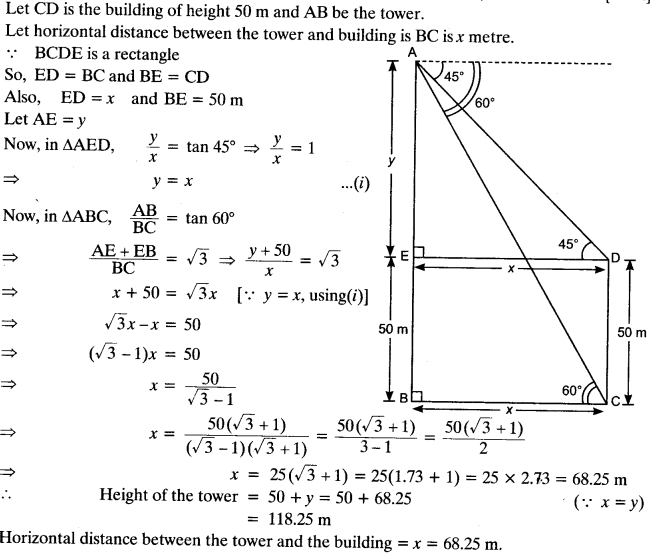
The angles of depression of the top and bottom of a 50 m high building from the top of a tower are 45° and 60° respectively. Find the height of the tower and the horizontal distance between the tower and the building,
Solution:
Some Applications of Trigonometry Class 10 Maths CBSE Important Questions With Solutions 5

Question 5.
A man standing on the deck of a ship, which is 10 m above water level, observes the angle of elevation of the top of a hill as 60° and the angle of depression of the base of hill as 30°. Find the distance of the hill from the ship and the height of the hill.
Solution:
Some Applications of Trigonometry Class 10 Maths CBSE Important Questions With Solutions 6

Question 6.
Two men on either side of a 75 m high building and in line with base of building observe the angles of elevation of the top of the building as 30° and 60°. Find the distance between the two men
Solution:
Some Applications of Trigonometry Class 10 Maths CBSE Important Questions With Solutions 7

Question 7.
A 7 m long flagstaff is fixed on the top of a tower standing on the horizontal plane. From a point on the ground, the angles of elevation of the top and bottom of the flagstaff are 60° and 45° respectively. Find the height of the tower correct to one place of decimal
Some Applications of Trigonometry Class 10 Maths CBSE Important Questions With Solutions 8
Solution:
Some Applications of Trigonometry Class 10 Maths CBSE Important Questions With Solutions 9

Question 8.
An aeroplane, when flying at a height of 4000 m  from the ground passes vertically above another aeroplane at an instant when the angles of elevation of the two planes from the same point on the ground are 60° and 45° respectively. Find the vertical distance between the aeroplanes at that instant
Solution:
Some Applications of Trigonometry Class 10 Maths CBSE Important Questions With Solutions 10

Long Answer Type Questions [4 Marks]

Question 9.
A bird is sitting on the top of a 80 m high tree. From a point on the ground, the angle of elevation of the bird is 45°. The bird flies away horizontally in such a way that it remained at a constant height from the ground. After 2 seconds, the angle of elevation of the bird from the same point is 30°. Find the speed of flying of the bird.
Solution:
Some Applications of Trigonometry Class 10 Maths CBSE Important Questions With Solutions 11
Some Applications of Trigonometry Class 10 Maths CBSE Important Questions With Solutions 12

Question 10.
The angles of elevation of the top of a tower from two points at a distance of 4 m and 9 m from the base of the tower and in the same straight line with it are 60° and 30° respectively. Find the height of the tower.
Solution:
Some Applications of Trigonometry Class 10 Maths CBSE Important Questions With Solutions 13

Question 11.
The angle of elevation of the top Q of a vertical tower PQ from a point X on the ground is 60°. From a point Y, 40 m vertically above X, the angle of elevation of the top Q of tower is 45°. Find the height of the tower PQ and the distance PX.
Solution:
Some Applications of Trigonometry Class 10 Maths CBSE Important Questions With Solutions 14
Some Applications of Trigonometry Class 10 Maths CBSE Important Questions With Solutions 15

Question 12.
As observed from the top of a light house, 100 m high above sea level, the angles of depression of a ship, sailing directly towards it, changes from 30° to 60°. Find the distance travelled by the ship during the period of observation.
Solution:
Some Applications of Trigonometry Class 10 Maths CBSE Important Questions With Solutions 16

Question 13.
From a point on the ground, the angle of elevation of the top of a tower is observed to be 60°. From a point 40 m vertically above the first point of observation, the angle of elevation of the top of the tower is 30°. Find the height of the tower and its horizontal distance from the point of observation.
Solution:
Some Applications of Trigonometry Class 10 Maths CBSE Important Questions With Solutions 17
Some Applications of Trigonometry Class 10 Maths CBSE Important Questions With Solutions 18

Question 14.
Some Applications of Trigonometry Class 10 Maths CBSE Important Questions With Solutions 19
Solution:
Some Applications of Trigonometry Class 10 Maths CBSE Important Questions With Solutions 20

Important Links

NCERT Quick Revision Notes- Some Applications of Trigonometry

NCERT Solution- Some Applications of Trigonometry

Important MCQs- Some Applications of Trigonometry

For Free, Video Lectures Click here

Read More

Introduction to Trigonometry Class 10 Important Questions | NCERT Maths Chapter-8

Introduction to Trigonometry Class 10 Important Questions

The start of class 10 marks the beginning of the foundation for class 11 and class 12. It is very important study the basics in order to understand each and every chapter properly. In this page, we have provided all the important question for cbse class 9 that could be asked in the examination. Students also need to study the ncert solutions for class 10 in order to gain more knowledge and understanding the lessons. Questions and Answers are way to learn the new things in a proper way. NCERT textbooks downloads for class 9 in pdf are also available for the students if they need more help. By downloading these books, they can study from it. Our experts also prepared revision notes for class 9 so that students should see the details of each and every chapters. Class 9 important questions are the best to revise all the chapters in the best way.

Question 1.
Given tan A = 5/12 , find the other trigonometric ratios of the angle A.
Solution:
Introduction to Trigonometry Class 10 Maths CBSE Important Questions With Solutions 5

Question 2.
Prove that 1/sec A – tan A-1/cosA=1/ cos A -1/sec A + tan A
Solution:
Introduction to Trigonometry Class 10 Maths CBSE Important Questions With Solutions 6

Question 3.
If sin θ = 12/13, 0° < θ < 90°, find the value of: sin² θ- cos² θ /2 sin θ. cos θ  x 1/tan² θ
Solution:
Introduction to Trigonometry Class 10 Maths CBSE Important Questions With Solutions 7

Long Answer Type Questions [4 Marks]

Question 4.
If sin (A + B) = 1 and tan (A – B) = 1/√3, find the value of:

  1. tan A + cot B
  2. sec A – cosec B

Solution:
Introduction to Trigonometry Class 10 Maths CBSE Important Questions With Solutions 8

Question 9.
If sec A = x + 1/4x, prove that sec A + tan A = 2x or 1/2x
Solution:
Introduction to Trigonometry Class 10 Maths CBSE Important Questions With Solutions 9

Question 10.
Introduction to Trigonometry Class 10 Maths CBSE Important Questions With Solutions 10
Solution:
Introduction to Trigonometry Class 10 Maths CBSE Important Questions With Solutions 11

Question 11.
Introduction to Trigonometry Class 10 Maths CBSE Important Questions With Solutions 12
Solution:
Introduction to Trigonometry Class 10 Maths CBSE Important Questions With Solutions 13

Question 12.
If sec θ – tan θ = x, show that: sec θ=1/2(x+1/x) and tan θ=1/2(1/x-x)
Solution:
Introduction to Trigonometry Class 10 Maths CBSE Important Questions With Solutions 14

Important Links

NCERT Quick Revision Notes- Coordinate Geometry

NCERT Solution- Coordinate Geometry

Important MCQs- Coordinate Geometry

For Free, Video Lectures Click here

Read More