Chapter 6- Thermodynamics | class 11th | revision notes chemistry

Class 11 Chemistry Revision Notes for Thermodynamics of Chapter 6


thermodynamics-cbse-notes-for-class-11-chemistry-1
thermodynamics-cbse-notes-for-class-11-chemistry-2
thermodynamics-cbse-notes-for-class-11-chemistry-8

• Important Terms and Definitions
System: Refers to the portion of universe which is under observation.
Surroundings: Everything else in the universe except system is called surroundings. The Universe = The System + The Surroundings.

Open System: In a system, when there is exchange of energy and matter taking place with
the surroundings, then it is called an open system.
For Example: Presence of reactants in an open beaker is an example of an open system. Closed System: A system is said to be a closed system when there is no exchange of matter ‘ but exchange of energy is possible.
For example: The presence of reactants in a closed vessel made of conducting material.
Isolated System: In a system, when no exchange of energy or matter takes place with the surroundings, is called isolated system.
For example: The presence of reactants in a thermoflask, or substance in an insulated closed vessel is an example of isolated system.

Homogeneous System: A system is said to be homogeneous when all the constituents present is in the same phase and is uniform throughout the system.
For example: A- mixture of two miscible liquids.
Heterogeneous system: A mixture is said to be heterogeneous when it consists of two or more phases and the composition is not uniform.
For example: A mixture of insoluble solid in water. ’
The state of the system: The state of a thermodynamic system means its macroscopic or bulk properties which can be described by state variables:
Pressure (P), volume (V), temperature (T) and amount (n) etc.
They are also known as state functions.
Isothermal process: When the operation is carried out at constant temperature, the process is said to be isothermal. For isothermal process, dT = 0 Where dT is the change in temperature.
Adiabatic process: It is a process in which no transfer of heat between system and surroundings, takes place.
Isobaric process: When the process is carried out at constant pressure, it is said to be isobaric. i.e. dP = 0
Isochoric process: A process when carried out at constant volume, it is known as isochoric in nature.
Cyclic process: If a system undergoes a series of changes and finally returns to its initial state, it is said to be cyclic process.
Reversible Process: When in a process, a change is brought in such a way that the process could, at any moment, be reversed by an infinitesimal change. The change r is called reversible.
• Internal Energy
It is the sum of all the forms of energies that a system can possess.
In thermodynamics, it is denoted by AM which may change, when
— Heat passes into or out of the system
— Work is done on or by the system
— Matter enters or leaves the system.
Change in Internal Energy by Doing Work
Let us bring the change in the internal energy by doing work.
Let the initial state of the system is state A and Temp. TA Internal energy = uA
On doing’some mechanical work the new state is called state B and the temp. TB. It is found to be
TB > TA
uB is the internal energy after change.
∴ Δu = uB – uA
Change in Internal Energy by Transfer of Heat
Internal energy of a system can be changed by the transfer of heat from the surroundings to the system without doing work.
Δu = q
Where q is the heat absorbed by the system. It can be measured in terms of temperature difference.
q is +ve when heat is transferred from the surroundings to the system. q is -ve when heat is transferred from system to surroundings.
When change of state is done both by doing work and transfer of heat.
Δu = q + w
First law of thermodynamics (Law of Conservation of Energy). It states that, energy can neither be created nor be destroyed. The energy of an isolated system is constant.
Δu = q + w.
• Work (Pressure-volume Work)
Let us consider a cylinder which contains one mole of an ideal gas in which a frictionless piston is fitted.
thermodynamics-cbse-notes-for-class-11-chemistry-3
thermodynamics-cbse-notes-for-class-11-chemistry-4
• Work Done in Isothermal and Reversible Expansion of Ideal Gas
thermodynamics-cbse-notes-for-class-11-chemistry-5
• Isothermal and Free Expansion of an Ideal Gas
For isothermal expansion of an ideal gas into vacuum W = 0
thermodynamics-cbse-notes-for-class-11-chemistry-6
• Enthalpy (H)
It is defined as total heat content of the system. It is equal to the sum of internal energy and pressure-volume work.
Mathematically, H = U + PV
Change in enthalpy: Change in enthalpy is the heat absorbed or evolved by the system at constant pressure.
ΔH = qp
For exothermic reaction (System loses energy to Surroundings),
ΔH and qp both are -Ve.
For endothermic reaction (System absorbs energy from the Surroundings).
ΔH and qp both are +Ve.
Relation between ΔH and Δu.
thermodynamics-cbse-notes-for-class-11-chemistry-7
• Extensive property
An extensive property is a property whose value depends on the quantity or size of matter present in the system.
For example: Mass, volume, enthalpy etc. are known as extensive property.
• Intensive property
Intensive properties do not depend upon the size of the matter or quantity of the matter present in the system.
For example: temperature, density, pressure etc. are called intensive properties.
• Heat capacity
The increase in temperature is proportional to the heat transferred.
q = coeff. x ΔT
q = CΔT
Where, coefficient C is called the heat capacity.
C is directly proportional to the amount of substance.
Cm = C/n
It is the heat capacity for 1 mole of the substance.
• Molar heat capacity
It is defined as the quantity of heat required to raise the temperature of a substance by 1° (kelvin or Celsius).
• Specific Heat Capacity
It is defined as the heat required to raise the temperature of one unit mass of a substance by 1° (kelvin or Celsius).
q = C x m x ΔT
where m = mass of the substance
ΔT = rise in temperature.
• Relation Between Cp and Cv for an Ideal Gas
At constant volume heat capacity = Cv
At constant pressure heat capacity = Cp
At constant volume qv= CvΔT = ΔU
At constant pressure qp = Cp ΔT = ΔH
For one mole of an ideal gas
ΔH = ΔU + Δ (PV) = ΔU + Δ (RT)
ΔH = ΔU + RΔT
On substituting the values of ΔH and Δu, the equation is modified as
Cp ΔT = CvΔT + RΔT
or Cp-Cv = R
• Measurement of ΔU and ΔH—Calorimetry
Determination of ΔU: ΔU is measured in a special type of calorimeter, called bomb calorimeter.

Working with calorimeter. The calorimeter consists of a strong vessel called (bomb) which can withstand very high pressure. It is surrounded by a water bath to ensure that no heat is lost to the surroundings.
Procedure: A known mass of the combustible substance is burnt in the pressure of pure dioxygen in the steel bomb. Heat evolved during the reaction is transferred to the water and its temperature is monitored.
thermodynamics-cbse-notes-for-class-11-chemistry-9
• Enthalpy Changes During Phase Transformation
Enthalpy of fusion: Enthalpy of fusion is the heat energy or change in enthalpy when one mole of a solid at its melting point is converted into liquid state.
thermodynamics-cbse-notes-for-class-11-chemistry-10
Enthalpy of vaporisation: It is defined as the heat energy or change in enthalpy when one mole of a liquid at its boiling point changes to gaseous state.
thermodynamics-cbse-notes-for-class-11-chemistry-11
Enthalpy of Sublimation: Enthalpy of sublimation is defined as the change in heat energy or change in enthalpy when one mole of solid directly changes into gaseous state at a temperature below its melting point.
thermodynamics-cbse-notes-for-class-11-chemistry-12
• Standard Enthalpy of Formation
Enthalpy of formation is defined as the change in enthalpy in the formation of 1 mole of a substance from its constituting elements under standard conditions of temperature at 298K and 1 atm pressure.
thermodynamics-cbse-notes-for-class-11-chemistry-13
Enthalpy of Combustion: It is defined as the heat energy or change in enthalpy that accompanies the combustion of 1 mole of a substance in excess of air or oxygen.
thermodynamics-cbse-notes-for-class-11-chemistry-14
• Thermochemical Equation
A balanced chemical equation together with the value of ΔrH and the physical state of reactants and products is known as thermochemical equation.
thermodynamics-cbse-notes-for-class-11-chemistry-15
Conventions regarding thermochemical equations
1. The coefficients in a balanced thermochemical equation refer to the number of moles of reactants and products involved in the reaction.
thermodynamics-cbse-notes-for-class-11-chemistry-16
• Hess’s Law of Constant Heat Summation
The total amount of heat evolved or absorbed in a reaction is same whether the reaction takes place in one step or in number of steps.
thermodynamics-cbse-notes-for-class-11-chemistry-17
thermodynamics-cbse-notes-for-class-11-chemistry-18
• Born-Haber Cycle
It is not possible to determine the Lattice enthalpy of ionic compound by direct experiment. Thus, it can be calculated by following steps. The diagrams which show these steps is known as Born-Haber Cycle.
thermodynamics-cbse-notes-for-class-11-chemistry-19
• Spontaneity
Spontaneous Process: A process which can take place by itself or has a tendency to take place is called spontaneous process.
Spontaneous process need not be instantaneous. Its actual speed can vary from very slow to quite fast.
A few examples of spontaneous process are:
(i) Common salt dissolves in water of its own.
(ii) Carbon monoxide is oxidised to carbon dioxide of its own.
• Entropy (S)
The entropy is a measure of degree of randomness or disorder of a system. Entropy of a substance is minimum in solid state while it is maximum in gaseous state.
The change in entropy in a spontaneous process is expressed as ΔS
thermodynamics-cbse-notes-for-class-11-chemistry-20
• Gibbs Energy and Spontaneity
A new thermodynamic function, the Gibbs energy or Gibbs function G, can be defined as G = H-TS
ΔG = ΔH – TΔS
Gibbs energy change = enthalpy change – temperature x entropy change ΔG gives a criteria for spontaneity at constant pressure and temperature, (i) If ΔG is negative (< 0) the process is spontaneous.
(ii) If ΔG is positive (> 0) the process is non-spontaneous.
• Free Energy Change in Reversible Reaction
thermodynamics-cbse-notes-for-class-11-chemistry-21
thermodynamics-cbse-notes-for-class-11-chemistry-22
thermodynamics-cbse-notes-for-class-11-chemistry-23

Read More

Chapter 5- States of Matter | class 11th | revision notes chemistry

Class 11 Chemistry Revision Notes for States of Matter of Chapter 5


states-of-matter-cbse-notes-for-class-11-chemistry-1
states-of-matter-cbse-notes-for-class-11-chemistry-2
states-of-matter-cbse-notes-for-class-11-chemistry-11
states-of-matter-cbse-notes-for-class-11-chemistry-15
states-of-matter-cbse-notes-for-class-11-chemistry-16
states-of-matter-cbse-notes-for-class-11-chemistry-17

 Intermolecular Forces
Intermolecular forces are the forces of attraction and repulsion between interacting particles
have permanent dipole moments. This interaction is stronger than the London forces but is weaker than ion-ion interaction because only partial charges are involved.
The attractive forces decrease with the increase of distance between dipoles. The interaction energy is proportional to 1/r6 where r is the distance between polar molecules.
Ion-Dipole Interaction: This is the force of attraction which exists between the ions (cations or anions) and polar molecules. The ion is attracted towards the oppositely charged end of dipolar molecules.
The strength of attraction depends upon the charge and size of the ion and the dipole moment and the size of the polar molecule.
For example: Solubility of common salt (NaCl) in water.
• Ion-induced Dipolar Interactions
In this type of interaction permanent dipole of the polar molecule induces dipole on the electrically neutral molecule by deforming its electronic cloud. Interaction energy is proportional to 1/r6 where r is the distance between two molecules.

• London Forces or Dispersion Forces
As we know that in non-polar molecules, there is no dipole moment because their electronic . charge cloud is symmetrically distributed. But, it is believed that at any instant of time, the electron cloud of the molecule may be distorted so that an instantaneous dipole or momentary dipole is produced in which one part of the molecule is slightly more negative than the other part. This momentary dipole induces dipoles in the neighbouring molecules. Thus, the force of attraction exists between them and are exactly same as between permanent dipoles. This force of attraction is known as London forces or Dispersion forces. These forces are always attractive and the interaction energy is inversely proportional to the sixth power of the
distance between two interacting particles, (i.e. 1/r6 where r is the distance between two particles).
This can be shown by fig. given below.

Hydrogen bonding: When hydrogen atom is attached to highly electronegative element by covalent bond, electrons are shifted towards the more electronegative atom. Thus a partial positive charge develops on the hydrogen atom. Now, the positively charged hydrogen atom of one molecule may attract the negatively charged atom of some other molecule and the two molecules can be linked together through a weak force of attraction.
states-of-matter-cbse-notes-for-class-11-chemistry-3
Thermal Energy: The energy arising due to molecular motion of the body is known as thermal energy. Since motion of the molecules is directly related to kinetic energy and kinetic energy is directly proportional to the temperature.
• The Gaseous State
Physical Properties of Gaseous State
(i) ases have no definite volume and they do not have specific shape,
(ii) Gases mix evenly and completely in all proportions without any mechanical aid.
(iii) Their density is much lower than solids and liquids. :
(iv) They are highly compressible and exert pressure equally in all directions.
• Boyle’s Law (Pressure-Volume Relationship)
At constant temperature, the volume of a given mass of gas is inversely proportional to its pressure.
states-of-matter-cbse-notes-for-class-11-chemistry-4
Charles’ law: At constant pressure, the volume of a given mass of a gas is directly proportional to its absolute temperature.
states-of-matter-cbse-notes-for-class-11-chemistry-5
• Gay Lussac’s Law (Pressure-Temperature Relationship)
At constant volume, pressure of a given mass of a gas is directly proportional to the temperature.
states-of-matter-cbse-notes-for-class-11-chemistry-6
states-of-matter-cbse-notes-for-class-11-chemistry-7
• Avogadro Law (Volume-Amount Relationship)
Avogadro’s law states that equal volumes of all gases under the same conditions of temperature and pressure contain equal number of molecules.
V α n
Where n is the number of moles of the gas.
Avogadro constant: The number of molecules in one mole of a gas
= 6.022 x 10²³
Ideal Gas: A gas that follows Boyle’s law, Charles’ law and Avogadro law strictly, is called an ideal gas.
Real gases follow these laws only under certain specific conditions. When forces of interaction are practically negligible.
• Ideal Gas Equation
This is the combined gas equation of three laws and is known as ideal gas equation.
states-of-matter-cbse-notes-for-class-11-chemistry-8
states-of-matter-cbse-notes-for-class-11-chemistry-9
• Dalton’s Law of Partial Pressure
When two or more non-reactive gases are enclosed in a vessel, the total pressure exerted by the gaseous mixture is equal to the sum of the partial pressure of individual gases.
Let P1 ,P2, and P3 be the pressure of three non reactive gases A, B, and C. When enclosed separately in the same volume and under same condition.
PTotal = P1+ P2 + P3
Where, PTotal = P is the total pressure exerted by the mixture of gases.
• Aqueous Tension
Pressure of non reacting gases are generally collected over water and therefore are moist. Pressure of dry gas can be calculated by substracting vapour pressure of water from total pressure of moist gas.
P2Dry gas = PTotal – Aqueous Tension
• Partial Pressure in terms of Mole Fraction
Let at the temperature T, three gases enclosed in the volume V, exert partial pressure P1 , Pand Prespectively, then
states-of-matter-cbse-notes-for-class-11-chemistry-10
• Kinetic Molecular Theory of Gases
(i) Gases consist of large number of very small identical particles (atoms or molecules),
(ii) Actual volume occupied by the gas molecule is negligible in comparison to empty space between them.
(iii) Gases can occupy all the space available to them. This means they do not have any force of attraction between their particles.
(iv) Particles of a gas are always in constant random motion.
(v) When the particles of a gas are in random motion, pressure is exerted by the gas due to collision of the particles with the walls of the container.
(vi) Collision of the gas molecules are perfectly elastic. This means there is no loss of energy after collision. There may be only exchange of energy between colliding molecules.
(vii) At a particular temperature distribution of speed between gaseous particles remains constant.
(viii) Average kinetic energy of the gaseous molecule is directly proportional to the absolute temperature.
• Deviation From Ideal Gas Behaviour
Real Gas: A gas which does not follow ideal gas behaviour under all conditions of temperature and pressure, is called real gas.
Deviation with respect to pressure can be studied by plotting pressure Vs volume curve at a given temperature. (Boyle’s law)

Compressibility factor (Z): Deviation from ideal behaviour can be measured in terms of compressibility factor, Z.
states-of-matter-cbse-notes-for-class-11-chemistry-12

• van der Waals Equation
states-of-matter-cbse-notes-for-class-11-chemistry-14
Where V is a constant for molecular attraction while ‘V is a constant for molecular volume.
(a) There is no force of attraction between the molecules of a gas.
(b) Volume occupied by the gas molecule is negligible in comparison to the total volume of the gas.
Above two assumptions of the kinetic theory of gas was found to be wrong at very high pressure and low temperature.
• Liquifaction of Gases
Liquifaction of gases can be achieved either by lowering the temperature or increasing the pressure of the gas simultaneously.
Thomas Andrews plotted isotherms of C02 at various temperatures shown in figure.

Critical Temperature (Tc): It is defined as that temperature above which a gas cannot be liquified however high pressure may be applied on the gas.
Tc = 8a/27bR
(Where a and b are van der Waals constants)
Critical Pressure (Pc): It is the pressure required to Liquify the gas at the critical temperature.
Pc = a/27b2
The volume occupied by one mole of the gas at the critical temperature and the critical pressure is called the critical volume (Vc).
For Example. For C02 to Liquify.
Tc = 30.98°C
Pc = 73,9 atm.
Vc = 95-6 cm3/mole
All the three are collectively called critical constants.
• Liquid State
Characteristics of Liquid State
(i) In liquid, intermolecular forces are strong in comparison to gas.
(ii) They have definite volume but irregular shapes or we can say that they can take the shape of the container.
(iii) Molecules of liquids are held together by attractive intermolecular forces.
Vapour Pressure: The pressure exerted by the vapour of a liquid, at a particular temperature in a state of dynamic equilibrium, is called the vapour pressure of that liquid at that temperature.
Vapour Pressure depends upon two factors:
(i) Nature of Liquid (ii) Temperature

• Surface Tension
It is defined as the force acting per unit length perpendicular to the line drawn on the surface of liquid.
S.I. unit of Surface Tension = Nm-1
Surface Tension decreases with increase in temperature, because force acting per unit length decreases due to increase in kinetic energy of molecules.
• Viscosity
It is defined as the internal resistance to flow possessed by a liquid.
The liquids which flow slowly have very high internal resistance, which is due to strong intermolecular forces and hence are said to be more viscous.

When liquid flows, the layer immediately below it tries to retard its flow while the one above tries to accelerate.
Thus, force is required to maintain the flow of layers.
states-of-matter-cbse-notes-for-class-11-chemistry-18
Effect of Temp, on Viscosity: Viscosity of liquids decreases as the temperature rises because at high temperature, molecules have high kinetic energy and can overcome the intermolecular forces to slip past one another.
• Boyle’s Law: It states that, under isothermal conditions pressure of a given mass of a gas is inversely proportional to its volume.
states-of-matter-cbse-notes-for-class-11-chemistry-19
states-of-matter-cbse-notes-for-class-11-chemistry-20

Read More

Chapter 4- Chemical Bonding and Molecular Structure | class 11th | revision notes chemistry

Class 11 Chemistry Revision Notes for Chemical Bonding and Molecular Structure of Chapter 4


• Chemical Bond
The force that holds different atoms in a molecule is called chemical bond.
• Octet Rule
Atoms of different elements take part in chemical combination in order to complete their octet or to attain the noble gas configuration.
• Valence Electrons
It is the outermost shell electron which takes part in chemical combination.
• Facts Stated by Kossel in Relation to Chemical Bonding
— In the periodic table, the highly electronegative halogens and the highly electro-positive alkali metals are separated by noble gases.
— Formation of an anion and cation by the halogens and alkali metals are formed by gain of electron and loss of electron respectively.
— Both the negative and positive ions acquire the noble gas configuration.
— The negative and positive ions are stabilized by electrostatic attraction Example,
chemical-bonding-and-molecular-structure-cbse-notes-for-class-11-chemistry-1
• Modes of Chemical Combination
— By the transfer of electrons: The chemical bond which formed by the complete transfer of one or more electrons from one atom to another is termed as electrovalent bond or ionic bond.
— By sharing of electrons: The bond which is formed by the equal sharing of electrons between one or two atoms is called covalent bond. In these bonds electrons are contributed by both.
— Co-ordinate bond: When the electrons are contributed by one atom and shared by both, the bond is formed and it is known as dative bond or co-ordinate bond.
• Ionic or Electrovalent Bond
Ionic or Electrovalent bond is formed by the complete transfer of electrons from one atom to another. Generally, it is formed between metals and non-metals. We can say that it is the electrostatic force of attraction which holds the oppositely charged ions together.
The compounds which is formed by ionic or electrovalent bond is known as electrovalent compounds. For Example, ,
(i) NaCl is an electrovalent compound. Formation of NaCl is given below:
chemical-bonding-and-molecular-structure-cbse-notes-for-class-11-chemistry-2
Na+ ion has the configuration of Ne while Cl ion represents the configuration of Ar.
(ii) Formation of magnesium oxide from magnesium and oxygen.
chemical-bonding-and-molecular-structure-cbse-notes-for-class-11-chemistry-3
Electrovalency: Electrovalency is the number of electrons lost or gained during the formation of an ionic bond or electrovalent bond.
• Factors Affecting the Formation of Ionic Bond
(i) Ionization enthalpy: As we know that ionization enthalpy of any element is the amount of energy required to remove an electron from outermost shell of an isolated gaseous atom to convert it into cation.
Hence, lesser the ionization enthalpy, easier will be the formation of a cation and have greater chance to form an ionic bond. Due to this reason alkali metals have more tendency to form an ionic bond.
For example, in formation of Na+ ion I.E = 496 kJ/mole
While in case of magnesium, it is 743 kJ/mole. That’s why the formation of positive ion for sodium is easier than that of magnesium.
Therefore, we can conclude that lower the ionization enthalpy, greater the chances of ionic bond formation.
(ii) Electron gain enthalpy (Electron affinities): It is defined as the energy released when an isolated gaseous atom takes up an electron to form anion. Greater the negative electron gain enthalpy, easier will be the formation of anion. Consequently, the probability of formation of ionic bond increases.
For example. Halogens possess high electron affinity. So, the formation of anion is very common in halogens.
chemical-bonding-and-molecular-structure-cbse-notes-for-class-11-chemistry-4
(iii) Lattice energy or enthalpy: It is defined as the amount of energy required to separate 1 mole of ionic compound into separate oppositely charged ions.
Lattice energy of an ionic compound depends upon following factors:
(i) Size of the ions: Smaller the size, greater will be the lattice energy.
(ii) Charge on the ions: Greater the magnitude of charge, greater the interionic attraction and hence higher the lattice energy.
• General Characteristics of ionic Compounds
(i) Physical’State: They generally exist as crystalline solids, known as crystal lattice. Ionic compounds do not exist as single molecules like other gaseous molecules e.g., H, N, 0, Cletc.
(ii) Melting and boiling points: Since ionic compounds contain high interionic force between them, they generally have high melting and boiling points.
(iii) Solubility: They are soluble in polar solvents such as water but do not dissolve in organic solvents like benzene, CCl4etc.
(iv) Electrical conductivity: In solid state they are poor conductors of electricity but in molten state or when dissolved in water, they conduct electricity.
(v) Ionic reactions: Ionic compounds produce ions in the solution which gives very fast reaction with oppositely charged ions.
For example,
chemical-bonding-and-molecular-structure-cbse-notes-for-class-11-chemistry-5
• Covalent Bond—Lewis-Langmuir Concept
When the bond is formed between two or more atoms by mutual contribution and sharing of electrons, it is known as covalent bond.
If the combining atoms are same the covalent molecule is known as homoatomic. If they are different, they are known as heteroatomic molecule.
For Example,
chemical-bonding-and-molecular-structure-cbse-notes-for-class-11-chemistry-6
chemical-bonding-and-molecular-structure-cbse-notes-for-class-11-chemistry-7
• Lewis Representation of Simple Molecules (the Lewis Structures)
The Lewis dot Structure can be written through the following steps:
(i) Calculate the total number of valence electrons of the combining atoms.
(ii) Each anion means addition of one electron and each cation means removal of one electron. This gives the total number of electrons to be distributed.
(iii) By knowing the chemical symbols of the combining atoms.
(iv) After placing shared pairs of electrons for single bond, the remaining electrons may account for either multiple bonds or as lone pairs. It is to be noted that octet of each atom should be completed.
chemical-bonding-and-molecular-structure-cbse-notes-for-class-11-chemistry-8
chemical-bonding-and-molecular-structure-cbse-notes-for-class-11-chemistry-9
• Formal Charge
In polyatomic ions, the net charge is the charge on the ion as a whole and not by particular atom. However, charges can be assigned to individual atoms or ions. These are called formal charges.
It can be expressed as
chemical-bonding-and-molecular-structure-cbse-notes-for-class-11-chemistry-10
chemical-bonding-and-molecular-structure-cbse-notes-for-class-11-chemistry-11
• Limitations of the Octet Rule
(i) The incomplete octet of the central atoms: In some covalent compounds central atom has less than eight electrons, i.e., it has an incomplete octet. For example,

Li, Be and B have 1, 2, and 3 valence electrons only.
(ii) Odd-electron molecules: There are certain molecules which have odd number of electrons the octet rule is not applied for all the atoms.

(iii) The expanded Octet: In many compounds there are more than eight valence electrons around the central atom. It is termed as expanded octet. For Example,

• Other Drawbacks of Octet Theory
(i) Some noble gases, also combine with oxygen and fluorine to form a number of compounds like XeF, XeOFetc.
(ii) This theory does not account for the shape of the molecule.
(iii) It does not give any idea about the energy of The molecule and relative stability.
• Bond Length
It is defined as the equilibrium distance between the centres of the nuclei of the two bonded atoms. It is expressed in terms of A. Experimentally, it can be defined by X-ray diffraction or electron diffraction method.

• Bond Angle
It is defined as -the angle between the lines representing the orbitals containing the bonding – electrons.
It helps us in determining the shape. It can be expressed in degree. Bond angle can be experimentally determined by spectroscopic methods.
• Bond Enthalpy
It is defined as the amount of energy required to break one mole of bonds of a particular type to separate them into gaseous atoms.
Bond Enthalpy is also known as bond dissociation enthalpy or simple bond enthalpy. Unit of bond enthalpy = kJ mol-1
Greater the bond enthalpy, stronger is the bond. For e.g., the H—H bond enthalpy in hydrogen is 435.8 kJ mol-1.
The magnitude of bond enthalpy is also related to bond multiplicity. Greater the bond multiplicity, more will be the bond enthalpy. For e.g., bond enthalpy of C —C bond is 347 kJ mol-1 while that of C = C bond is 610 kJ mol-1.
In polyatomic molecules, the term mean or average bond enthalpy is used.
chemical-bonding-and-molecular-structure-cbse-notes-for-class-11-chemistry-16
• Bond Order
According to Lewis, in a covalent bond, the bond order is given by the number of bonds between two atoms in a molecule. For example,
Bond order of H2 (H —H) =1
Bond order of 02 (O = O) =2
Bond order of N2 (N = N) =3
Isoelectronic molecules and ions have identical bond orders. For example, F2 and O22- have bond order = 1. N2, CO and NO+ have bond order = 3. With the increase in bond order, bond enthalpy increases and bond length decreases. For example,
chemical-bonding-and-molecular-structure-cbse-notes-for-class-11-chemistry-17
• Resonance Structures
There are many molecules whose behaviour cannot be explained by a single-Lew is structure, Tor example, Lewis structure of Ozone represented as follows:
chemical-bonding-and-molecular-structure-cbse-notes-for-class-11-chemistry-18
Thus, according to the concept of resonance, whenever a single Lewis structure cannot explain all the properties of the molecule, the molecule is then supposed to have many structures with similar energy. Positions of nuclei, bonding and nonbonding pairs of electrons are taken as the canonical structure of the hybrid which describes the molecule accurately. For 03, the two structures shown above are canonical structures and the III structure represents the structure of 03 more accurately. This is also called resonance hybrid.
Some resonating structures of some more molecules and ions are shown as follows:
chemical-bonding-and-molecular-structure-cbse-notes-for-class-11-chemistry-19
• Polarity of Bonds
Polar and Non-Polar Covalent bonds
Non-Polar Covalent bonds: When the atoms joined by covalent bond are the same like; H2, 02, Cl2, the shared pair of electrons is equally attracted by two atoms and thus the shared electron pair is equidistant to both of them.
Alternatively, we can say that it lies exactly in the centre of the bonding atoms. As a result, no poles are developed and the bond is called as non-polar covalent bond. The corresponding molecules are known as non-polar molecules.
For Example,

Polar bond: When covalent bonds formed between different atoms of different electronegativity, shared electron pair between two atoms gets displaced towards highly electronegative atoms.
For Example, in HCl molecule, since electronegativity of chlorine is high as compared to hydrogen thus, electron pair is displaced more towards chlorine atom, thus chlorine will acquire a partial negative charge (δ) and hydrogen atom have a partial positive charge (δ+) with the magnitude of charge same as on chlorination. Such covalent bond is called polar covalent bond.
chemical-bonding-and-molecular-structure-cbse-notes-for-class-11-chemistry-21
• Dipole Moment
Due to polarity, polar molecules are also known as dipole molecules and they possess dipole moment. Dipole moment is defined as the product of magnitude of the positive or negative charge and the distance between the charges.
chemical-bonding-and-molecular-structure-cbse-notes-for-class-11-chemistry-22
• Applications of Dipole Moment
(i) For determining the polarity of the molecules.
(ii) In finding the shapes of the molecules.
For example, the molecules with zero dipole moment will be linear or symmetrical. Those molecules which have unsymmetrical shapes will be either bent or angular.
(e.g., NH3with μ = 1.47 D).
(iii) In calculating the percentage ionic character of polar bonds.
• The Valence Shell Electron Pair Repulsion (VSEPR) Theory
Sidgwick and Powell in 1940, proposed a simple theory based on repulsive character of electron pairs in the valence shell of the atoms. It was further developed by Nyholm and Gillespie (1957).
Main Postulates are the following:
(i) The exact shape of molecule depends upon the number of electron pairs (bonded or non bonded) around the central atoms.
(ii) The electron pairs have a tendency to repel each other since they exist around the central atom and the electron clouds are negatively charged.
(iii) Electron pairs try to take such position which can minimize the rupulsion between them.
(iv) The valence shell is taken as a sphere with the electron pairs placed at maximum distance.
(v) A multiple bond is treated as if it is a single electron pair and the electron pairs which constitute the bond as single pairs.
• Valence Bond Theory
Valence bond theory was introduced by Heitler and London (1927) and developed by Pauling and others. It is based on the concept of atomic orbitals and the electronic configuration of the atoms.
Let us consider the formation of hydrogen molecule based on valence-bond theory.
Let two hydrogen atoms A and B having their nuclei N and N and electrons present in them are eA and e.
As these two atoms come closer new attractive and repulsive forces begin to operate.
(i) The nucleus of one atom is attracted towards its own electron and the electron of the other and vice versa.
(ii) Repulsive forces arise between the electrons of two atoms and nuclei of two atoms. Attractive forces tend to bring the two atoms closer whereas repulsive forces tend to push them apart.
• Orbital Overlap Concept
According to orbital overlap concept, covalent bond formed between atoms results in the overlap of orbitals belonging to the atoms having opposite spins of electrons. Formation of hydrogen molecule as a result of overlap of the two atomic orbitals of hydrogen atoms is shown in the figures that follows:

Stability of a Molecular orbital depends upon the extent of the overlap of the atomic orbitals.
• Types of Orbital Overlap
Depending upon the type of overlapping, the covalent bonds are of two types, known as sigma (σ ) and pi (π) bonds.
(i) Sigma (σ bond): Sigma bond is formed by the end to end (head-on) overlap of bonding orbitals along the internuclear axis.
The axial overlap involving these orbitals is of three types:
• s-s overlapping: In this case, there is overlap of two half-filled s-orbitals along the internuclear axis as shown below:

• s-p overlapping: This type of overlapping occurs between half-filled s-orbitals of one atom and half filled p-orbitals of another atoms.

• p-p overlapping: This type of overlapping takes place between half filled p-orbitals of the two approaching atoms.

(ii) pi (π bond): π bond is formed by the atomic orbitals when they overlap in such a way that their axes remain parallel to each other and perpendicular to the internuclear axis.The orbital formed is due to lateral overlapping or side wise overlapping.

• Strength of Sigma and pf Bonds
Sigma bond (σ bond) is formed by the axial overlapping of the atomic orbitals while the π-bond is formed by side wise overlapping. Since axial overlapping is greater as compared to side wise. Thus, the sigma bond is said to be stronger bond in comparison to a π-bond.
Distinction between sigma and n bonds
chemical-bonding-and-molecular-structure-cbse-notes-for-class-11-chemistry-28
• Hybridisation
Hybridisation is the process of intermixing of the orbitals of slightly different energies so as to redistribute their energies resulting in the formation of new set of orbitals of equivalent energies and shape.
Salient Features of Hybridisation:
(i) Orbitals with almost equal energy take part in the hybridisation.
(ii) Number of hybrid orbitals produced is equal to the number of atomic orbitals mixed,
(iii) Geometry of a covalent molecule can be indicated by the type of hybridisation.
(iv) The hybrid orbitals are more effective in forming stable bonds than the pure atomic orbitals.
Conditions necessary for hybridisation:
(i) Orbitals of valence shell take part in the hybridisation.
(ii) Orbitals involved in hybridisation should have almost equal energy.
(iii) Promotion of electron is not necessary condition prior to hybridisation.
(iv) In some cases filled orbitals of valence shell also take part in hybridisation.
Types of Hybridisation:
(i) sp hybridisation: When one s and one p-orbital hybridise to form two equivalent orbitals, the orbital is known as sp hybrid orbital, and the type of hybridisation is called sp hybridisation.
Each of the hybrid orbitals formed has 50% s-characer and 50%, p-character. This type of hybridisation is also known as diagonal hybridisation.
chemical-bonding-and-molecular-structure-cbse-notes-for-class-11-chemistry-29

(ii) sp2 hybridisation: In this type, one s and two p-orbitals hybridise to form three equivalent sp2 hybridised orbitals.
All the three hybrid orbitals remain in the same plane making an angle of 120°. Example. A few compounds in which sp2 hybridisation takes place are BF3, BH3, BCl3 carbon compounds containing double bond etc.

(iii) sp3 hybridisation: In this type, one s and three p-orbitals in the valence shell of an atom get hybridised to form four equivalent hybrid orbitals. There is 25% s-character and 75% p-character in each sp3 hybrid orbital. The four sp3 orbitals are directed towards four corners of the tetrahedron.

The angle between sp3 hybrid orbitals is 109.5°.
A compound in which sp3 hybridisation occurs is, (CH4). The structures of NH2 and H20 molecules can also be explained with the help of sp3 hybridisation.
• Formation of Molecular Orbitals: Linear Combination of Atomic Orbitals (LCAO)
The formation of molecular orbitals can be explained by the linear combination of atomic orbitals. Combination takes place either by addition or by subtraction of wave function as shown below.
chemical-bonding-and-molecular-structure-cbse-notes-for-class-11-chemistry-33
chemical-bonding-and-molecular-structure-cbse-notes-for-class-11-chemistry-34
chemical-bonding-and-molecular-structure-cbse-notes-for-class-11-chemistry-35
The molecular orbital formed by addition of atomic orbitals is called bonding molecular orbital while molecular orbital formed by subtraction of atomic orbitals is called antibonding molecular orbital.
Conditions for the combination of atomic orbitals:
(1) The combining atomic orbitals must have almost equal energy.
(2) The combining atomic orbitals must have same symmetry about the molecular axis.
(3) The combining atomic orbitals must overlap to the maximum extent.
• Types of Molecular Orbitals
Sigma (σ) Molecular Orbitals: They are symmetrical around the bond-axis.
pi (π) Molecular Orbitals: They are not symmetrical, because of the presence of positive lobes above and negative lobes below the molecular plane.
• Electronic configuration and Molecular Behaviour
The distribution of electrons among various molecular orbitals is called electronic configuration of the molecule.
• Stability of Molecules
chemical-bonding-and-molecular-structure-cbse-notes-for-class-11-chemistry-36
• Bond Order
Bond order is defined as half of the difference between the number of electrons present in bonding and antibonding molecular orbitals.
Bond order (B.O.) = 1/2 [Nb-Na]
The bond order may be a whole number, a fraction or even zero.
It may also be positive or negative.
Nature of the bond: Integral bond order value for single double and triple bond will be 1, 2 and 3 respectively.
Bond-Length: Bond order is inversely proportional to bond-length. Thus, greater the bond order, smaller will be the bond-length.
Magnetic Nature: If all the molecular orbitals have paired electrons, the substance is diamagnetic. If one or more molecular orbitals have unpaired electrons, it is paramagnetic e.g., 02 molecule.
• Bonding in Some Homonuclear (Diatomic) Molecules
(1) Hydrogen molecule (H2): It is formed by the combination of two hydrogen atoms. Each hydrogen atom has one electron in Is orbital, so, the electronic configuration of hydrogen molecule is
chemical-bonding-and-molecular-structure-cbse-notes-for-class-11-chemistry-37
This indicates that two hydrogen atoms are bonded by a single covalent bond. Bond dissociation energy of hydrogen has been found = 438 kJ/mole. Bond-Length = 74 pm
No unpaired electron is present therefore,, it is diamagnetic.
(2) Helium molecule (He2): Each helium atom contains 2 electrons, thus in He2 molecule there would be 4 electrons.
The electrons will be accommodated in σ1s and σ*1s molecular orbitals:
chemical-bonding-and-molecular-structure-cbse-notes-for-class-11-chemistry-38
chemical-bonding-and-molecular-structure-cbse-notes-for-class-11-chemistry-43
chemical-bonding-and-molecular-structure-cbse-notes-for-class-11-chemistry-40
• Hydrogen Bonding
When highly electronegative elements like nitrogen, oxygen, flourine are attached to hydrogen to form covalent bond, the electrons of the covalent bond are shifted towards the more electronegative atom. Thus, partial positive charge develops on hydrogen atom which forms a bond with the other electronegative atom. This bond is known as hydrogen bond and it is weaker than the covalent bond. For example, in HF molecule, hydrogen bond exists between hydrogen atom of one molecule and fluorine atom of another molecule.
It can be depicted as
chemical-bonding-and-molecular-structure-cbse-notes-for-class-11-chemistry-41
• Types of H-Bonds
(i) Intermolecular hydrogen bond (ii) Intramolecular hydrogen bond.
(i) Intermolecular hydrogen bond: It is formed between two different molecules of the same or different compounds. For Example, in HF molecules, water molecules etc.
(ii) Intramolecular hydrogen bond: In this type, hydrogen atom is in between the two highly electronegative F, N, O atoms present within the same molecule. For example, in o-nitrophenol, the hydrogen is in between the two oxygen atoms.
chemical-bonding-and-molecular-structure-cbse-notes-for-class-11-chemistry-42

Read More

Chapter 3- Classification of Elements and Periodicity in Properties 

Introduction

Why Do We Need Classification?

Elements are the basic units of all types of matter. At present, 118 elements are known. With such a large number of elements, it is very difficult to study individually the chemistry of all these elements and their number of compounds. So to make the study of chemistry simpler, scientists searched for a systematic way to organise their knowledge by classifying the elements. Main aim behind this classification was to keep the elements of same properties together, so that by studying one element out of that group, we can have general idea about the properties of all the elements in that group.

Periodic Table

Periodic table may be defined as the tabular arrangement of elements in such a way that the elements having same properties are kept together.

Dobereiner’s Triads Law

1st attempt towards the classification of elements was made by Johann W. Dobereiner in 1817. He arranged elements in the groups of three and in such a way that the atomic weight of middle element was equal or nearly equal to the average of atomic weights of other two elements.

Classification of Elements and Periodicity in Properties Class 11 Notes

Drawback : Only limited triads were arranged in this pattern.

Newland’s Law of Octaves

In 1865, John Newland observed that in a series of elements arranged in the increasing order of atomic weights, 1st and 8th elements have same properties. Now, a days, 1st and 9th elements have same properties in that series because noble gases were discovered late.

Classification of Elements and Periodicity in Properties Class 11 Notes

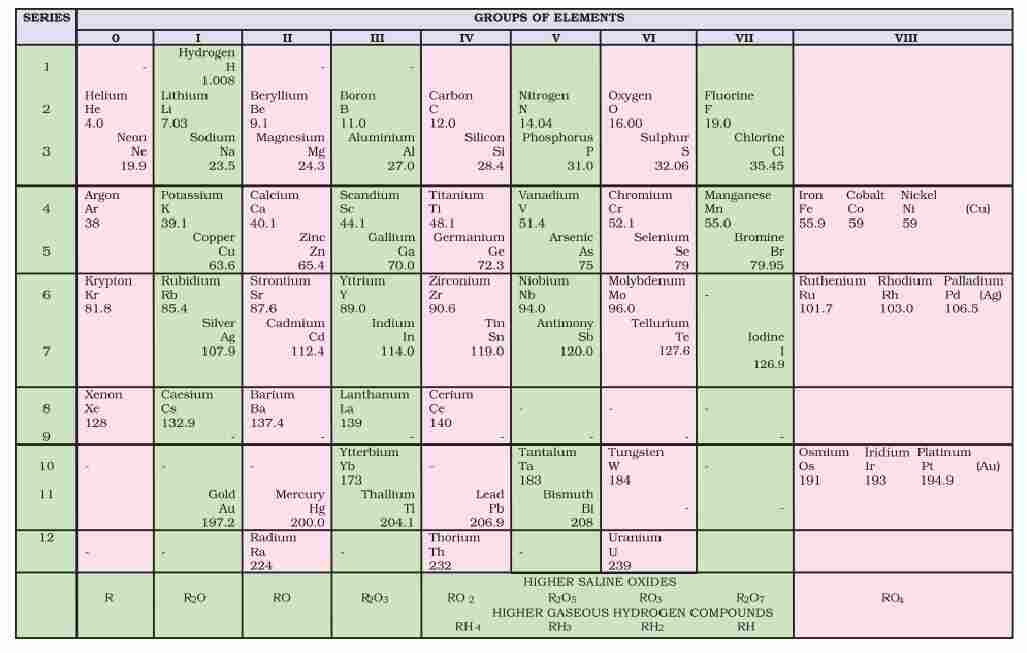
Mendeleev’s Periodic Table

“The physical and chemical properties of elements are a periodic function of atomic weights”.

Mendeleev arranged elements in horizontal rows and vertical columns of a table in order of their increasing atomic weights in such a way that the elements with similar properties occupied the same vertical column or group. Vertical Colums are called groups which are numbered I to VIII group, each group is further subdivided into sub groups A and B. Horizontal rows are called periods.

Classification of Elements and Periodicity in Properties Class 11 Notes

Defects in Mendeleev’s Table

(i) Position of hydrogen : Position of hydrogen was not justified.

(ii) Position of isotope : Isotopes should be placed separately according to periodic law. But actually one place was given to all isotopes of an element.

(iii) Cause of periodicity : Mendeleev could not explain why elements exhibit a periodicity in their properties when arranged in the order of increasing atomic weight.

(iv) Anomalous pairs of elements : Some anomalous pairs were present in table. As Tellurium (128 u) comes in VI group before Iodine (127 u).

Moseley’s Modern Periodic Table

“The physical and chemical properties are the periodic function of their atomic numbers”.

The long form of periodic table, also called Modem Periodic Table, is based on Modern periodic law. In this table, the elements have been arranged in order of increasing atomic numbers.

A modern version, the so-called “long form” of the Periodic Table of the elements, is the most convenient and widely used. The horizontal rows are called periods and the vertical columns, groups. Elements having similar outer electronic configurations in their atoms are arranged in vertical columns, referred to as groups or families. According to the recommendation of International Union of Pure and Applied Chemistry (IUPAC), the groups are numbered from 1 to 18 replacing the older notation of groups IA … VIIA, VIII, IB … VIIB and 0.

There are altogether seven periods. The period number corresponds to the highest principal quantum number (n) of the elements in the period. The first period contains 2 elements. The subsequent periods consists of 8, 8, 18, 18 and 32 elements, respectively. The seventh period is incomplete and like the sixth period would have a theoretical maximum of 32 elements. In this form of the Periodic Table, 14 elements of both sixth and seventh periods (lanthanoids and actinoids, respectively) are placed in separate panels at the bottom.

Classification of Elements and Periodicity in Properties Class 11 Notes

IUPAC Nomenclature of Elements

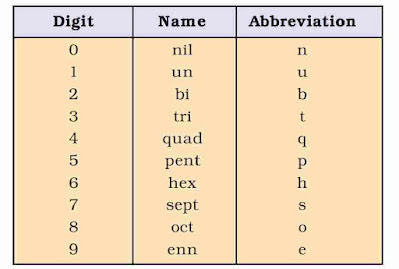
The IUPAC names are derived by using roots for three digit atomic number of the elements.

Classification of Elements and Periodicity in Properties Class 11 Notes

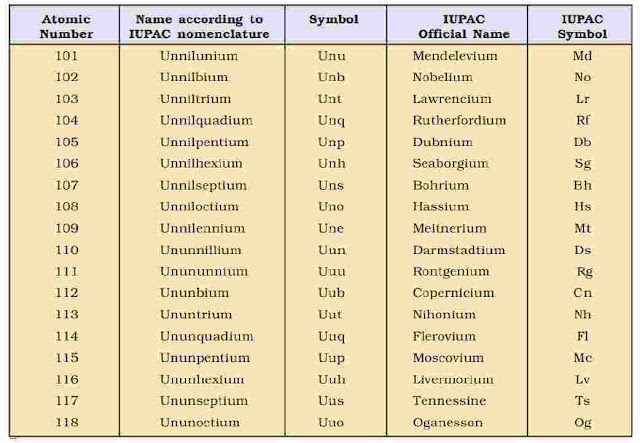
A systematic nomenclature be derived directly from the atomic number of the element using the numerical roots for 0 and numbers 1-9. The roots are put together in order of digits which make up the atomic number and “ium” is added at the end. The IUPAC names for elements with Z above 100 are shown below :

Classification of Elements and Periodicity in Properties Class 11 Notes

Division of Elements into Blocks

s-block

The elements of Group 1 (alkali metals) and Group 2 (alkaline earth metals) which have ns1 and ns2 outermost electronic configuration belong to the s-Block Elements.

Characteristics of s-Block elements

  1. Except Be and Mg, all impart characteristic colour to the flame.
  2. These have low ionisation energy.
  3. These are highly reactive.
  4. These are the highly electropositive elements.
  5. All the elements are soft metals.
  6. They have low melting and boiling points.

p-block

The p-Block Elements comprise those belonging to Group 13 to 18 and these together with the s-Block Elements are called the Representative Elements or Main Group Elements. The outermost electronic configuration varies from ns2np1 to ns2np6 in each period.

Characteristics of p-Block elements

  1. The compounds of p-block elements are generally covalent although their ionic character increases down the group.
  2. From left to right 13 to 18, reducing character decreases.
  3. The p-block elements generally show more than one oxidation state.
  4. The reactivity of elements in a group generally decreases downwards.
  5. At the end of each period is a noble gas element with a closed valence shell ns2 np6 configuration.

d-block

These are the elements of Group 3 to 12 in the centre of the Periodic Table. These are characterised by the filling of inner d orbitals by electrons and are therefore referred to as d-Block Elements. These elements have the general outer electronic configuration (n-1)d1-10ns0-2.

Characteristics of d-Block elements

  1. They are all metals with high melting and boiling points.
  2. The compounds of the elements are generally paramagnetic in nature.
  3. They mostly form coloured ions, exhibit variable valence (oxidation states).
  4. They are of tenly used as catalysts.
  5. These elements have high melting point.

f-block

The two rows of elements at the bottom of the Periodic Table, called the Lanthanoids, Ce(Z = 58) – Lu(Z = 71) and Actinoids, Th(Z=90) – Lr (Z=103) are characterised by the outer electronic configuration (n-2)f1-14(n-1)d0–1ns2. The last electron added to each element is filled in f-orbital. These two series of elements are hence called the Inner-Transition Elements (f-Block Elements).

Characteristics of f-Block elements

  1. All actinoids are radioactive. Elements after uranium are known as transuranium element.
  2. They form coloured compounds.
  3. These two series of elements are called Inner Transition Elements (f-Block Elements).
  4. They are all metals. Within each series, the properties of the elements are quite similar.
  5. They generally have high melting and boiling points.

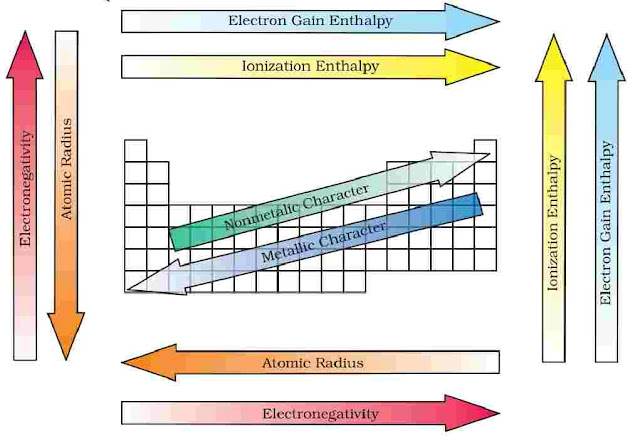
Periodic Properties

The properties which generally have a regular trend along a group or period are called periodic properties. These are as given below :

  1. Atomic size
  2. Ionisation energy
  3. Electron gain enthalpy
  4. Electronegativity

(i) Atomic Size

Atomic Radius is the distance from the centre of the nucleus to the outermost shell containing electron.

Ionic Radius

The ionic radii can be estimated by measuring the distances between cations and anions in ionic crystals. In general, the ionic radii of elements exhibit the same trend as the atomic radii.

Cation: The removal of an electron from an atom results in the formation of a cation. The radius of cation is always smaller than that of the atom.

Anion: Gain of an electron leads to an anion. The radius of the anion is always larger than that ‘ of the atom.

(ii) Ionisation energy

It is the amount of energy required to remove the outer most electron from an isolated atom in its gaseous state. It is the measured in the unit of kJ/mole. It is denoted by (∆iH).

M(g) – e ⟶ M+(g)

(iii) Electron gain enthalpy

It is the enthalpy change when an electron is added to the gaseous neutral atom. Electron gain enthalpy provides a measure of the ease with which an atom adds an electron to form anion. It is the measured in the unit of kJ/mole. It is denoted by (∆egH).

X(g) + e ⟶ X(g)

(iv) Electronegativity

Electronegativity is a measure of the tendency of an element to attract bonded electron pair towards itself in a covalently bonded molecule.

  1. Metallic character: It decreases across a period, maximum on the extreme left (alkali metals).
  2. Non-metallic character: It increases along a period, from left to right.
  3. Atomic Size: It decreases across a period.
  4. Ionisation energy: It increases along a period.
  5. Electron gain enthalpy: It increases along a period.
  6. Electronegativity: It increases along a period.
  7. Basic nature of oxides: It decreases from left to right in a period.
  8. Acidic nature of oxides: It increases from left to right in a period.

Variation in Chemical Properties along a a Group

  1. Metallic character: Generally increases because increase in atomic size and hence decrease in the ionizatiorn energy of the elements in a group from top to bottom.
  2. Non-metallic character: It generally decreases down a group. As electronegativity of elements decreases from top to bottom in a group.
  3. Atomic Size: It increases along a group.
  4. Ionisation energy: It decreases across a period.
  5. Electron gain enthalpy: It decreases across a period.
  6. Electronegativity: It decreases across a period.
  7. Basic nature of oxides: Since metallic character or electropositivity of elements increases in going from top to bottom in a group basic nature of oxidise naturally increases.
  8. Acidic character of oxides: It generally decreases as non-metallic character of elements decreases in going from top to bottom in a group.
  9. Reactivity of metals: It generally increases down a group. Since tendency to lose electron increases.
Classification of Elements and Periodicity in Properties Class 11 Notes

Read More

Chapter 2- Structure of Atom | class 11th | revision notes chemistry 


Class 11 Chemistry Revision Notes for Structure of Atom of Chapter 2


• Discovery of Electron—Discharge Tube Experiment
In 1879, William Crooks studied the conduction of electricity through gases at low pressure. He performed the experiment in a discharge tube which is a cylindrical hard glass tube about 60 cm in length. It is sealed at both the ends and fitted with two metal electrodes as shown in Fig. 2.1.
structure-of-the-atom-cbse-notes-for-class-11-chemistry-1
The electrical discharge through the gases could be observed only at very low pressures and at very high voltages.
The pressure of different gases could be adjusted by evacuation. When sufficiently high voltage is applied across the electrodes, current starts flowing through a stream of particles moving in the tube from the negative electrode (cathode) to the positive electrode (anode). These were called cathode rays or cathode ray particles.
• Properties of Cathode Rays
(i) Cathode rays travel in straight line.
(ii) Cathode rays start from cathode and move towards the anode.
(iii) These rays themselves are not visible but their behaviour can be observed with the help of certain kind of materials (fluorescent or phosphorescent) which glow when hit by them.
(iv) Cathode rays consist of negatively charged particles. When electric field is applied on the cathode rays with the help of a pair of metal plates, these are found to be deflected towards the positive plate indicating the presence of negative charge.
(v) The characteristics of cathode rays do not depend upon the material of electrodes and the nature of gas present in the cathode ray’tube.
• Determination of Charge/Mass (elm) Ratio for Electrons
J. J. Thomson for the first time experimentally determined charge/mass ratio called elm ratio for the electrons. For this, he subjected the beam of electrons released in the discharge tube as cathode rays to influence the electric and magnetic fields. These were acting perpendicular to one another as well as to the path followed by electrons.
According to Thomson, the amount of deviation of the particles from their path in presence of electrical and magnetic field depends upon following factors:
(i) Greater the magnitude of the charge on the particle, greater is the interaction with the electric or magnetic field and thus greater is the deflection.
(ii) The mass of the particle — lighter the particle, greater the deflection.
(iii) The deflection of electrons from their original path increases with the increase in the voltage across the electrodes or strength of the magnetic field.
By carrying out accurate measurements on the amount of deflections observed by the electrons on the electric field strength or magnetic field strength, Thomson was able to determine the value of
e/me = 1.758820 x 10¹¹ C kg-1 where me = Mass of the electron in kg
e = magnitude of charge on the electron in coulomb (C).
• Charge on the Electron
R.A. Millikan devised a method known as oil drop experiment to determine the charge on the electrons.
structure-of-the-atom-cbse-notes-for-class-11-chemistry-2
• Discovery of Proton—Anode Rays
In 1886, Goldstein modified the discharge tube by using a perforated cathode. On reducing the pressure, he observed a new type of luminous rays passing through the holes or perforations of the cathode and moving in a direction opposite to the cathode rays. These rays were named as positive rays or anode rays or as canal rays. Anode rays are not emitted from the anode but from a space between anode and cathode.
• Properties of Anode Rays
(i) The value of positive charge (e) on the particles constituting anode rays depends upon the nature of the gas in the discharge tube.
(ii) The charge to mass ratio of the particles is found to depend on the gas from which these originate.
(iii) Some of the positively charged particles carry a multiple of the fundamental unit of electrical charge.
(iv) The behaviour of these particles in the magnetic or electric field is opposite to that observed for electron or cathode rays.
• Proton
The smallest and lightest positive ion was obtained from hydrogen and was called proton. Mass of proton = 1.676 x 10⁻²⁷ kg
Charge on a proton = (+) 1.602 x 10⁻¹⁹ C
• Neutron
It is a neutral particle. It was discovered by Chadwick (1932).
By the bombardment of thin sheets of beryllium with fast moving a-particles he observed • that highly penetrating rays consist of neutral particles which were named neutrons.
• Thomson Model of Atom
structure-of-the-atom-cbse-notes-for-class-11-chemistry-3
(i) J. J. Thomson proposed that an atom may be regarded as a sphere of approximate radius 1CT8 cm carrying positive charge due to protons and in which negatively charged electrons are embedded.
(ii) In this model, the atom is visualized as a pudding or cake of positive charge with electrons embedded into it.
(iii) The mass of atom is considered to be evenly spread over the atom according to this model.
Drawback of Thomson Model of Atom
This model was able to explain the overall neutrality of the atom, it could not satisfactorily, explain the results of scattering experiments carried out by Rutherford in 1911.
• Rutherford’s a-particle Scattering Experiment
Rutherford in 1911, performed some scattering experiments in which he bombarded thin foils of metals like gold, silver, platinum or copper with a beam of fast moving a-particles. The thin gold foil had a circular fluorescent zinc sulphide screen around it. Whenever a-particles struck the screen, a tiny flash of light was produced at that point.
From these experiments, he made the following observations:
structure-of-the-atom-cbse-notes-for-class-11-chemistry-4
(i) Most of the a-particles passed through the foil without undergoing any deflection,
(ii) A few a-particles underwent deflection through small angles.
(iii) Very few mere deflected back i.e., through an angle of nearly 180°.
From these observations, Rutherford drew the following conclusions:
(i) Since most of the a-particles passed through the foil without undergoing any deflection, there must be sufficient empty space within the atom.
(ii) A small fraction of a-particles was deflected by small angles. The positive charge has to be concentrated in a very small volume that repelled and deflected a few positively charged a-particles. This very small portion of the atom was called nucleus.
(iii) The volume of nucleus is very small as compared to total volume of atom.
• Rutherford’s Nuclear Model of an Atom
(i) The positive charge and most of the mass of the atom was densely concentrated in an extremely small region. This very small portion of the atom was called nucleus by Rutherford.
(ii) The nucleus is surrounded by electrons that move around the nucleus with a very high speed in circular paths called orbits.
(iii) Electrons and nucleus are held together by electrostatic forces of attraction.
• Atomic Number
The number of protons present in the nucleus is equal to the atomic number (z). For example, the number of protons in the hydrogen nucleus is 1, in sodium atom it is 11, therefore, their atomic numbers are 1 and 11. In order to keep the electrical neutrality, the number of electrons in an atom is equal to the number of protons (atomic number, z). For example, number of electrons in hydrogen atom and sodium atom are 1 and 11 respectively.
Atomic Number (z) = Number of protons in the nucleus of an atom.
= Number of electrons in a neutral atom.
• Mass Number
Number of protons and neutrons present in the nucleus are collectively known as nucleons. The total number of nucleons is termed as mass number (A) of the atom.
Mass Number (A) = Number of protons (p) + Number of neutrons (n).
• Isotopes
Atoms with identical atomic number but different atomic mass number are known as Isotopes.
Isotopes of Hydrogen:
structure-of-the-atom-cbse-notes-for-class-11-chemistry-5
These three isotopes are shown in the figure below:
structure-of-the-atom-cbse-notes-for-class-11-chemistry-6
structure-of-the-atom-cbse-notes-for-class-11-chemistry-7
Characteristics of Isotopes
(i) Since the isotopes of an element have the same atomic number, but different mass number, the nuclei of isotopes contain the same number of protons, but different number of neutrons.
(ii) Since, the isotopes differ in their atomic masses, all the properties of the isotopes depending upon the mass are different.
(iii) Since, the chemical properties are mainly determined by the number of protons in the nucleus, and the number of electrons in the atom, the different isotopes of an element exhibit similar chemical properties. For example, all the isotopes of carbon on burning give carbon dioxide.
• Isobars
structure-of-the-atom-cbse-notes-for-class-11-chemistry-8
• Drawbacks of Rutherford Model
(i) When a body is moving in an orbit, it achieves acceleration. Thus, an electron moving around nucleus in an orbit is under acceleration.
According to Maxwell’s electromagnetic theory, charged particles when accelerated must emit electromagnetic radiations. Therefore, an electron in an orbit will emit radiations, the energy carried by radiation comes from electronic motion. Its path will become closer to nucleus and ultimately should spiral into nucleus within . 10-8 s. But actually this does not happen.
Thus, Rutherford’s model cannot explain the stability of atom if the motion of electrons is described on the basis of classical mechanics and electromagnetic theory.
(ii) Rutherford’s model does not give any idea about distribution of electrons around the nucleus and about their energies.
• Developments Leading to the Bohr’s Model of Atom
Two developments played a major role in the formulation of Bohr’s model of atom. These were:
(i) Dual character of the electromagnetic radiation which means that radiations possess both wave like and particle like properties.
(ii) Experimental results regarding atomic spectra which can be explained only by assuming quantized electronic energy levels in atoms.
• Nature of Electromagnetic Radiation (Electromagnetic Wave Theory)
This theory was put forward by James Clark Maxwell in 1864. The main points of this theory are as follows:
(i) The energy is emitted from any source (like the heated rod or the filament of a bulb through which electric current is passed) continuously in the form of radiations and is called the radiant energy.
(ii) The radiations consist of electric and magnetic fields oscillating perpendicular to each other and both perpendicular to the direction of propagation of the radiation.
(iii) The radiations possess wave character and travel with the velocity of light 3 x 10⁸ m/sec.
(iv) These waves do not require any material medium for propagation. For example, rays from the sun reach us through space which is a non-material medium.
• Characteristics of a Wave
Wavelength: It is defined as the distance between any two consecutive crests or troughs. It is represented by X and its S.I. unit is metre.
structure-of-the-atom-cbse-notes-for-class-11-chemistry-9
Frequency: Frequency of a wave is defined as the number of waves passing through a point in one second. It is represented by v (nu) and is expressed in Hertz (Hz).
1 Hz = 1 cycle/sec.
Velocity: Velocity of a wave is defined as the linear distance travelled by the wave in one second.
It is represented by c and is expressed in cm/sec or m/sec.
Amplitude: Amplitude of a wave is the height of the crest or the depth of the through. It is represented by V and is expressed in the units of length.
Wave Number: It is defined as the number of waves present in 1 metre length. Evidently it will be equal to the reciprocal of the wavelength. It is represented by bar v (read as nu bar).
structure-of-the-atom-cbse-notes-for-class-11-chemistry-10
Electromagnetic Spectrum: When electromagnetic radiations are arranged in order of their increasing wavelengths or decreasing frequencies, the complete spectrum obtained is called electromagnetic spectrum.
structure-of-the-atom-cbse-notes-for-class-11-chemistry-11
• Limitations of Electromagnetic Wave Theory
Electromagnetic wave theory was successful in explaining properties of light such as interference, diffraction etc; but it could not explain the following:
(i) The phenomenon of black body radiation.
(ii) The photoelectric effect.
(iii) The variation of heat capacity of solids as a function of temperature.
(iv) The line spectra of atoms with reference to hydrogen.
• Black Body Radiation
The ideal body, which emits and absorbs all frequencies is called a black body and the radiation emitted by such a body is called black body radiation. The. exact frequency distribution of the emitted radiation from a black body depends only on its temperature.
structure-of-the-atom-cbse-notes-for-class-11-chemistry-12
At a given temperature, intensity of radiation emitted increases with decrease of wavelength, reaches a maximum value at a given wavelength and then starts decreasing with further decrease of wavelength as shown in Fig 2.6.
• Planck’s Quantum Theory
To explain the phenomenon of ‘Black body radiation’ and photoelectric effect, Max Planck in 1900, put forward a theory known as Planck’s Quantum Theory.
This theory was further extended by Einstein in 1905. The main points of this theory was as follows: ,
(i) The radiant energy emitted or absorbed in the form of small packets of energy. Each such packets of energy is called a quantum.
(ii) The energy of each quantum is directly proportional to the frequency of the radiation
structure-of-the-atom-cbse-notes-for-class-11-chemistry-13
where h is a proportionality constant, called Planck’s constant. Its value is equal to 6.626 x 10⁻³⁴ Jsec.
• Photoelectric Effect
Hertz, in 1887, discovered that when a beam of light of certain frequency strikes the surface of some metals, electrons are emitted or ejected from the metal surface. The phenomenon is called photoelectric effect.
structure-of-the-atom-cbse-notes-for-class-11-chemistry-14
Observations in Photoelectric Effect
(i) Only photons of light of certain minimum frequency called threshold frequency (v0) can cause the photoelectric effect. The value of v0 is different for different metals.
(ii) The kinetic energy of the electrons which are emitted is directly proportional to the frequency of the striking photons and is quite independent of their intensity.
(iii) The number of electrons that are ejected per second from the metal surface depends upon the intensity of the striking photons or radiations and not upon their frequency.
Explanation of Photoelectric Effect
Einstein in (1905) was able to give an explanation of the different points of the photoelectric effect using Planck’s quantum theory as under:
(i) Photoelectrons are ejected only when the incident light has a certain minimum frequency (threshold frequency v0)
(ii) If the frequency of the incident light (v) is more than the threshold frequency (v0), the excess energy (hv – hv0) is imparted to the electron as kinetic energy.
K.E. of the ejected electron
structure-of-the-atom-cbse-notes-for-class-11-chemistry--15
energy of the emitted electron.
(iii) On increasing the intensity of light, more electrons are ejected but the energies of the electrons are not altered.
• Dual Behaviour of Electromagnetic Radiation
From the study of behaviour of light, scientists came to the conclusion that light and other electromagnetic radiations have dual nature. These are wave nature as well as particle nature. Whenever radiation interacts with matter, it displays particle like properties in contrast to the wavelike properties (interference and diffraction) which it exhibits when it propagates. Some microscopic particles, like electrons, also exhibit this wave-particle duality.
• Spectrum
When a ray of white light is passed through a prism the wave with shorter wavelength bends more than the one with a longer wavelength. Since ordinary white light consists of waves with all the wavelengths in the visible range, array of white light is spread out into a series of coloured bands called spectrum. The light of red colour which has longest wavelength is deviated the least while the violet light, which has shortest wavelength is deviated the most.
Continuous Spectrum
When a ray of white light is analysed by passing through a prism it is observed that it splits up into seven different wide bands of colours from violet to red (like rainbow). These colours are so continuous that each of them merges into the next. Hence, the spectrum is called continuous spectrum.
Emission Spectra
Emission Spectra is noticed when the radiations emitted from a source are passed through a prism and then received on the photographic plate. Radiations can be emitted in a number of ways such as:
(i) from sun or glowing electric bulb.
(ii) by passing electric discharge through a gas at low pressure.
(iii) by heating a substance to high temperature.
Line Spectra
When the vapours of some volatile substance are allowed to fall on the flame of a Bunsen burner and then analysed with the help of a spectroscope. Some specific coloured lines appear on the photographic plate which are different for different substances. For example, sodium or its salts emit yellow light while potassium or its salts give out violet light.
Absorption Spectra
When white light is passed through the vapours of a substance and the transmitted light is then allowed to strike a prism, dark lines appear in the otherwise continuous spectrum. The dark lines indicate that the radiations corresponding to them were absorbed by the substance from the white light. This spectrum is called absorption spectrum.
Dark lines appear exactly at the same positions where the lines in the emission spectra appear.
• Line Spectrum of Hydrogen
When electric discharge is passed through hydrogen gas enclosed in discharge tube under low pressure and the emitted light is analysed by a spectroscope, the spectrum consists of a large number of lines which are grouped into different series. The complete spectrum is known as hydrogen spectrum.
On the basis of experimental observations, Johannes Rydberg noted that all series of lines in the hydrogen spectrum could be described by the following expression:
structure-of-the-atom-cbse-notes-for-class-11-chemistry-16
Rydberg in 1890, and has given a simple theoretical equation for the calculation of wavelengths and wave numbers of the spectral lines in different series of hydrogen spectrum. The equation is known as Rydberg formula (or equation).
structure-of-the-atom-cbse-notes-for-class-11-chemistry-17
This relation is valid for hydrogen atom only. For other species,
structure-of-the-atom-cbse-notes-for-class-11-chemistry-18
where Z is the atomic number of the species.
Here RH = constant, called Rydberg constant for hydrogen and n1 , n2 are integers (n2 > n1)
For any particular series, the value of n1 is constant while that of n2 changes. For example,
For Lyman series, n1= 1, n2= 2, 3, 4, 5………..
For Balmer series, n1 = 2, n2 = 3, 4, 5, 6………..
For Paschen series, n1= 3, n2 = 4, 5, 6, 7………..
For Brackett series,n1 = 4, n2 = 5, 6, 7, 8………..
For Pjund series, n1 =5, n2 = 6, 7, 8, 9………..
Thus, by substituting the values of n1 and n2 in the above equation, wavelengths and wave number of different spectral lines can be calculated. When n1 = 2, the expression given above is called Balmer’s formula.
• Bohr’s Model of Atom
Niels Bohr in 1913, proposed a new model of atom on the basis of Planck’s Quantum Theory. The main points of this model are as follows:
(i) In an atom, the electrons revolve around the nucleus in certain definite circular paths called orbits.
(ii) Each orbit is associated with definite energy and therefore these are known as energy
levels or energy shells. These are numbered as 1, 2, 3, 4……….. or K, L, M, N………..
(iii) Only those energy orbits are permitted for the electron in which angular momentum of the electron is a whole number multiple of h/2π
Angular momentum of electron (mvr) = nh/2π (n = 1, 2, 3, 4 etc).
m = mass of the electron.
v = tangential velocity of the revolving electron.
r = radius of the orbit.
h = Planck’s constant.
n is an integer.
(iv) As long as electron is present in a particular orbit, it neither absorbs nor loses energy and its energy, therefore, remains constant.
(v) When energy is supplied to an electron, it absorbs energy only in fixed amounts as quanta and jumps to higher energy state away from the nucleus known as excited state. The excited state is unstable, the electron may jump back to the lower energy state and in doing so, it emits the same amount of energy. (∆E = E2 – E1).
• Achievements of Bohr’s Theory
1. Bohr’s theory has explained the stability of an atom.
2. Bohr’s theory has helped in calculating the energy of electron in hydrogen atom and one electron species. The mathematical expression for the energy in the nth orbit is,
structure-of-the-atom-cbse-notes-for-class-11-chemistry-19
structure-of-the-atom-cbse-notes-for-class-11-chemistry-20
3. Bohr’s theory has explained the atomic spectrum of hydrogen atom.
• Limitations of Bohr’s Model
(i) The theory could not explain the atomic spectra of the atoms containing more than one electron or multielectron atoms.
(ii) Bohr7s theory failed to explain the fine structure of the spectral lines.
(iii) Bohr’s theory could not offer any satisfactory explanation of Zeeman effect and Stark effect.
(iv) Bohr’s theory failed to explain the ability of atoms to form molecule formed by chemical bonds.
(v) It was not in accordance with the Heisenberg’s uncertainty principle.
• Dual Behaviour of Matter (de Broglie Equation)
de Broglie in 1924, proposed that matter, like radiation, should also exhibit dual behaviour i.e., both particle like and wave like properties. This means that like photons, electrons also have momentum as well as wavelength.
From this analogy, de Broglie gave the following relation between wavelength (λ) and momentum (p) of a material particle.
structure-of-the-atom-cbse-notes-for-class-11-chemistry-21
• Heisenberg’s Uncertainty Principle
It states that, “It is impossible to determine simultaneously, the exact position and exact momentum (or velocity) of an electron”.
structure-of-the-atom-cbse-notes-for-class-11-chemistry-22
• Significance of Uncertainty Principle
(i) It rules out existence of definite paths or trajectories of electrons and other similar particles.
(ii) The effect of Heisenberg’s uncertainty principle is significant only for microscopic objects and is negligible for macroscopic objects.
• Reasons for the Failure of Bohr Model
(i) The wave character of the electron is not considered in Bohr Model.
(ii) According to Bohr Model an orbit is a clearly defined path and this path can completely be defined only if both the position and the velocity of the electron are known exactly at the same time. This is not possible according to the Heisenberg’s uncertainty principle.
• Quantum Mechanical Model of Atom
Quantum mechanics: Quantum mechanics is a theoretical science that deals with the study of the motions of the microscopic objects that have both observable wave like and particle like properties.
Important Features of Quantum Mechanical Model of Atom
(i) The energy of electrons in atom is quantized i.e., can only have certain values.
(ii) The existence of quantized electronic energy level is a direct result of the wave like properties of electrons.
(iii) Both the exact position and exact velocity of an electron in an atom cannot be determined simultaneously.
(iv) An atomic orbital has wave function φ. There are many orbitals in an atom. Electron occupy an atomic orbital which has definite energy. An orbital cannot have more than two electrons. The orbitals are filled in increasing order of energy. All the information about the electron in an atom is stored in orbital wave function φ.
(v) The probability of finding electron at a point within an atom is proportional to square of orbital wave function i.e., |φ2|at that point. It is known as probability density and is always positive.
From the value of φ2 at different points within atom, it is possible to predict the region around the nucleus where electron most probably will be found.
• Quantum Numbers
Atomic orbitals can be specified by giving their corresponding energies and angular momentums which are quantized (i.e., they have specific values). The quantized values can be expressed in terms of quantum number. These are used to get complete information about electron i.e., its location, energy, spin etc.
Principal Quantum Number (n)
It is the most important quantum number since it tells the principal energy level or shell to which the electron belongs. It is denoted by the letter V and can have any integral value except zero, i.e., n = 1, 2, 3, 4……….. etc.
The various principal energy shells are also designated by the letters, K, L, M, N, O, P ….. etc. Starting from the nucleus.
The principal quantum number gives us the following information:
(i) It gives the average distance of the electron from the nucleus.
(ii) It completely determines the energy of the electron in hydrogen atom and hydrogen like particles.
(iii) The maximum number of electrons present in any principal shell is given by 2n2 where n is the number of the principal shell.
Azimuthal or Subsidiary or Orbital Angular Quantum Number (l)
It is found that the spectra of the elements contain not only the main lines but there are many fine lines also present. This number helps to explain the fine lines of the spectrum.
The azimuthal quantum number gives the following information:
(i) The number of subshells present in the main shell.
(ii) The angular momentum of the electron present in any subshell.
(in) The relative energies of various subshells.
(iv) The shapes of the various subshells present within the same principal shell.
This quantum number is denoted by the letter T. For a given value of n, it can have any value ranging from 0 to n – 1. For example,
For the 1st shell (k), n = 1, l can have only one value i.e., l = 0 For n = 2, the possible value of l can be 0 and 1.
Subshells corresponding to different values of l are represented by the following symbols:
value of l 0 1 2 3 4 5 ……………..
Notation for subshell s p d f g h ………………..
Magnetic Orbital Quantum Number (m or m1)
The magnetic orbital quantum number determines the number of preferred orientations of the electrons present in a subshell. Since each orientation corresponds to an orbital, therefore, the magnetic orbital quantum number determines the number of orbitals present in any subshell.
The magnetic quantum number is denoted by letter m or ml and for a given value of l, it can have all the values ranging from – l to + l including zero.
Thus, for energy value of l, m has 2l + 1 values.
For example,
For l = 0 (s-subshell), ml can have only one value i.e., m1 = 0.
This means that s-subshell has only one orientation in space. In other words, s-subshell has only one orbital called s-orbital.
Spin Quantum Number (S or ms)
This quantum number helps to explain the magnetic properties of the substances. A spinning electron behaves like a micromagnet with a definite magnetic moment. If an orbital contains two electrons, the two magnetic moments oppose and cancel each other.
• Shapes of s-orbitals
s-orbital is present in the s-subshell. For this subshell, l = 0 and ml = 0. Thus, s-orbital with only one orientation has a spherical shape with uniform electron density along all the three axes.
The probability of Is electron is found to be maximum near the nucleus and decreases with the increase in the distance from the nucleus. In 2s electron, the probability is also maximum near the nucleus and decreases to zero probability. The spherical empty shell for 2s electron is called nodal surface or simply node.
structure-of-the-atom-cbse-notes-for-class-11-chemistry-23
• Shapes of p-orbitals
p-orbitals are present in the p-subshell for which l = 1 and m1 can have three possible orientations – 1, 0, + 1.
Thus, there are three orbitals in the p-subshell which are designated as px, py and pz orbitals depending upon the axis along which they are directed. The general shape of a p-orbital is dumb-bell consisting of two portions known as lobes. Moreover, there is a plane passing through the nucleus along which finding of the electron density is almost nil. This is known as nodal plane as shown in the fig.
structure-of-the-atom-cbse-notes-for-class-11-chemistry-24
From the dumb-bell pictures, it is quite obvious that unlike s-orbital, a p-orbital is directional in nature and hence it influences the shapes of the molecules in the formation of which it participates.
• Shapes of d-orbitals
d-orbitals are present in d-subshell for which l = 2 and m[ = -2, -1, 0, +1 and +2. This means that there are five orientations leading to five different orbitals.
structure-of-the-atom-cbse-notes-for-class-11-chemistry-25
• Aufbau Principle
The principle states: In the ground state of the atoms, the orbitals are filled in order of their increasing energies.
In other words, electrons first occupy the lowest energy orbital available to them and enter into higher energy orbitals only after the lower energy orbitals are filled.
The order in which the energies of the orbitals increase and hence the order in which the orbitals are filled is as follows:
Is, 2s, 2p, 3s, 3p, 4s, 3d, 4p, 5s, id, 5p, 6s, if, 3d, 6p, 7s, 5f 6d, 7p
The order may be remembered by using the method given in fig. 2.11.
structure-of-the-atom-cbse-notes-for-class-11-chemistry-26
• Pauli Exclusion Principle
According to this principle, no two electrons in an atom can have the same set of four quantum numbers.
Pauli exclusion principle can also be stated as: Only two electrons may exist in the same orbital and these electrons must have opposite spins.
• Hund’s Rule of Maximum Multiplicity
It states that: pairing of electrons in the orbitals belonging to the same subshell (p, d or f) does not take place until each orbital belonging to that subshell has got one electron each i.e., it is singly occupied.
• Electronic Configuration of Atoms
The distribution of electrons into orbitals of an atom is called its electronic configuration. The electronic configuration of different atoms can be represented in two ways.
For example:
structure-of-the-atom-cbse-notes-for-class-11-chemistry-27
• Causes of Stability of Completely Filled and Half Filled Subshells
The completely filled and half filled subshells are stable due to the following reasons:
structure-of-the-atom-cbse-notes-for-class-11-chemistry-28
1. Symmetrical distribution of electrons: The completely filled or half filled subshells have symmetrical distribution of electrons in them and are therefore more stable.
2. The stabilizing effect arises whenever two or more electrons with same spin are present in the degenrate orbitals of a subshell. These electrons tend to exchange their positions
and the energy released due to their exchange is called exchange energy. The number of exchanges that can takes place is maximum when the subshell is either half filled or completely filled.
-As a result the exchange energy is maximum and so is the stability.
structure-of-the-atom-cbse-notes-for-class-11-chemistry-29
structure-of-the-atom-cbse-notes-for-class-11-chemistry-30

Read More

Chapter 1- Some Basic Concepts of Chemistry | class 11th | revision notes chemistry 

Class 11 Chemistry Revision Notes for Some Basic Concepts of Chemistry of Chapter 1


• Importance of Chemistry
Chemistry has a direct impact on our life and has wide range of applications in different fields. These are given below:
(A) In Agriculture and Food:
(i) It has provided chemical fertilizers such as urea, calcium phosphate, sodium nitrate, ammonium phosphate etc.
(ii) It has helped to protect the crops from insects and harmful bacteria, by the use ‘ of certain effective insecticides, fungicides and pesticides.
(iii) The use of preservatives has helped to preserve food products like jam, butter, squashes etc. for longer periods.
(B) In Health and Sanitation:
(i) It has provided mankind with a large number of life-saving drugs. Today, dysentery and pneumonia are curable due to discovery of sulpha drugs and penicillin life-saving drugs. Cisplatin and taxol have been found to be very effective for cancer therapy and AZT (Azidothymidine) is used for AIDS victims.
(ii) Disinfectants such as phenol are used to kill the micro-organisms present in drains, toilet, floors etc.
(iii) A low concentration of chlorine i.e., 0.2 to 0.4 parts per million (ppm) is used ’ for sterilization of water to make it fit for drinking purposes.
(C) Saving the Environment:
The rapid industrialisation all over the world has resulted in lot of pollution.
Poisonous gases and chemicals are being constantly released in the atmosphere. They are polluting environment at an alarming rate. Scientists are working day and night to develop substitutes which may cause lower pollution. For example, CNG (Compressed Natural Gas), a substitute of petrol, is very effective in checking pollution caused by automobiles.
(D) Application in Industry:
Chemistry has played an important role in developing many industrially ^ manufactured fertilizers, alkalis, acids, salts, dyes, polymers, drugs, soaps,
detergents, metal alloys and other inorganic and organic chemicals including new materials contribute in a big way to the national economy.
• Matter
Anything which has mass and occupies space is called matter.
For example, book, pencil, water, air are composed of matter as we know that they have
mass and they occupy space.
• Classification of Matter
There are two ways of classifying the matter:
(A) Physical classification
(B) Chemical classification
(A) Physical Classification:
Matter can exist in three physical states:
1. Solids 2. Liquids 3. Gases
1. Solids: The particles are held very close to each other in an orderly fashion and there is not much freedom of movement.
Characteristics of solids: Solids have definite volume and definite shape.
2. Liquids: In liquids, the particles are close to each other but can move around. Characteristics of liquids: Liquids have definite volume but not definite shape.
3. Gases: In gases, the particles are far apart as compared to those present in solid or liquid states. Their movement is easy and fast.
Characteristics of Gases: Gases have neither definite volume nor definite shape. They completely occupy the container in which they are placed.
(B) Chemical Classification:
Based upon the composition, matter can be divided into two main types:
1. Pure Substances 2. Mixtures.
1. Pure substances: A pure substance may be defined as a single substance (or matter) which cannot be separated by simple physical methods.
Pure substances can be further classified as (i) Elements (ii) Compounds
(i) Elements: An element consists of only one type of particles. These particles may be atoms or molecules.
For example, sodium, copper, silver, hydrogen, oxygen etc. are some examples of elements. They all contain atoms of one type. However, atoms of different elements are different in nature. Some elements such as sodium . or copper contain single atoms held together as their constituent particles whereas in some others two or more atoms combine to give molecules of the element. Thus, hydrogen, nitrogen and oxygen gases consist of molecules in which two atoms combine to give the respective molecules of the element.
(ii) Compounds: It may be defined as a pure substance containing two or more elements combined together in a fixed proportion by weight and can be decomposed into these elements by suitable chemical methods. Moreover, the properties of a compound are altogether different from the constituting elements.
The compounds have been classified into two types. These are:
(i) Inorganic Compounds: These are compounds which are obtained from non-living sources such as rocks and minerals. A few
examples are: Common salt, marble, gypsum, washing soda etc.
(ii) Organic Compounds are the compounds which are present in plants and animals. All the organic compounds have been found to contain carbon as their essential constituent. For example, carbohydrates, proteins, oils, fats etc.
2. Mixtures: The combination of two or more elements or compounds which are not chemically combined together and may also be present in any proportion, is called mixture. A few examples of mixtures are: milk, sea water, petrol, lime water, paint glass, cement, wood etc.
Types of mixtures: Mixtures are of two types:
(i) Homogeneous mixtures: A mixture is said to be homogeneous if it has a uniform composition throughout and there are no visible boundaries of separation between the constituents.
For example: A mixture of sugar solution in water has the same sugar water composition throughout and all portions have the same sweetness.
(ii) Heterogeneous mixtures: A mixture is said to be heterogeneous if it does not have uniform composition throughout and has visible boundaries of separation between the various constituents. The different constituents of a heterogeneous mixture can be seen even with naked eye.
For example: When iron filings and sulphur powder are mixed together, the mixture formed is heterogeneous. It has greyish-yellow appearance and the two constituents, iron and sulphur, can be easily identified with naked eye.
• Differences between Compounds and Mixtures
Compounds
1. In a compound, two or more elements are combined chemically.
2. In a compound, the elements are present in the fixed ratio by mass. This ratio cannot change.
3. CompoUnds are always homogeneous i.e., they havethe same composition throughout.
4 In a compound, constituents cannot be separated by physical methods
5. In a compound, the constituents lose their identities i.e., i compound does not show the characteristics of the constituting elements.
Mixtures
1. In a mixture, or more elements or compounds are simply mixed and not combined chemically.
2. In a mixture the constituents are not present in fixed ratio. It can vary
3. Mixtures may be either homogeneous or heterogeneous in nature.
4. Constituents of mixtures can be separated by physical methods.
5, In a mixture, the constituents do not lose their identities i.e., a mixture shows the characteristics of all the constituents .
We have discussed the physical and chemical classification of matter. A flow sheet representation of the same is given below.
some-basic-concepts-of-chemistry-cbse-notes-for-class-11-chemistry-1
• Properties of Matter and Their Measurements
Physical Properties: Those properties which can be measured or observed without changing the identity or the composition of the substance.
Some examples of physical properties are colour, odour, melting point, boiling point etc. Chemical Properties: It requires a chemical change to occur. The examples of chemical properties are characteristic reactions of different substances. These include acidity, basicity, combustibility etc.
• Units of Measurement
Fundamental Units: The quantities mass, length and time are called fundamental quantities and their units are known as fundamental units.
There are seven basic units of measurement for the quantities: length, mass, time, temperature, amount of substance, electric current and luminous intensity.
Si-System: This system of measurement is the most common system employed throughout the world.
It has given units of all the seven basic quantities listed above.
some-basic-concepts-of-chemistry-cbse-notes-for-class-11-chemistry-2
• Definitions of Basic SI Units
1. Metre: It is the length of the path travelled by light in vacuum during a time interval of 1/299792458 of a second.
2. Kilogram: It is the unit of mass. It is equal to the mass of the international prototype
of the kilogram. ,
3. Second: It is the duration of 9192631, 770 periods of radiation which correspond to the transition between the two hyper fine levels of the ground state of caesium- 133 atom.
4. Kelvin: It is the unit of thermodynamic temperature and is equal to 1/273.16 of the thermodynamic temperature of the triple point of water.
5. Ampere: The ampere is that constant current which if maintained in two straight parallel conductors of infinite length, of negligible circular cross section and placed, 1 metre apart in vacuum, would produce between these conductors a force equal to 2 x 10⁻⁷ N per metre of length.
6. Candela: It may be defined as the luminous intensity in a given direction, from a source which emits monochromatic radiation of frequency 540 x 1012 Hz and that has a radiant intensity in that direction of 1/ 683 watt per steradian.
7. Mole: It is the amount of substance which contains as many elementary entities as there are atoms in 0.012 kilogram of carbon -12. Its symbol is ‘mol’.
• Mass and Weight
Mass: Mass of a substance is the amount of matter present in it.
The mass of a substance is constant.
The mass of a substance can be determined accurately in the laboratory by using an analytical
balance. SI unit of mass is kilogram.
some-basic-concepts-of-chemistry-cbse-notes-for-class-11-chemistry-3
Weight: It is the force exerted by gravity on an object. Weight of substance may vary from one place to another due to change in gravity.
Volume: Volume means the space occupied by matter. It has the units of (length)3. In SI units, volume is expressed in metre3 (m3). However, a popular unit of measuring volume, particularly in liquids is litre (L) but it is not in SI units or an S.I. unit.
Mathematically,
1L = 1000 mL = 1000 cm3 = 1dm3.
Volume of liquids can be measured by different devices like burette, pipette, cylinder, measuring flask etc. All of them have been calibrated.
some-basic-concepts-of-chemistry-cbse-notes-for-class-11-chemistry-4
Temperature: There are three scales in which temperature can be measured. These are known as Celsius scale (°C), Fahrenheit scale (°F) and Kelvin scale (K).
some-basic-concepts-of-chemistry-cbse-notes-for-class-11-chemistry-5
-> Thermometres with Celsius scale are calibrated from 0°C to 100°C.
-> Thermometres with Fahrenheit scale are calibrated from 32°F to 212°F.
-> Kelvin’scale of temperature is S.I. scale and is very common these days.Temperature on this scale is shown by the sign K.
The temperature on two scales are related to each other by the relationship
some-basic-concepts-of-chemistry-cbse-notes-for-class-11-chemistry-6
Density: Density of a substance is its amount of mass per unit volume. So, SI unit of density can be obtained as follows:
some-basic-concepts-of-chemistry-cbse-notes-for-class-11-chemistry-7
This unit is quite large and a chemist often expresses density in g cm3 where mass is expressed in gram and volume is expressed in cm3.
• Uncertainty in Measurements
All scientific measurements involve certain degree of error or uncertainty. The errors which arise depend upon two factors.
(i) Skill and accuracy of the worker (ii) Limitations of measuring instruments.
• Scientific Notation
It is an exponential notation in which any number can be represented in the form N x 10n where n is an exponent having positive or negative values and N can vary between 1 to 10. Thus, 232.508 can be written as 2.32508 x 10² in scientific notation.
Now let us see how calculations are carried out with numbers expressed in scientific notation.
(i) Calculation involving multiplication and division
some-basic-concepts-of-chemistry-cbse-notes-for-class-11-chemistry-8
(ii) Calculation involving addition and subtraction: For these two operations, the first numbers are written in such a way that they have the same exponent. After that, the coefficients are added or subtracted as the case may be. For example,
some-basic-concepts-of-chemistry-cbse-notes-for-class-11-chemistry-9
• Significant Figures
Significant figures are meaningful digits which are known with certainty. There are certain rules for determining the number of significant figures. These are stated below:
1. All non-zero digits are significant. For example, in 285 cm, there are three significant figures and in 0.25 mL, there are two significant figures.
2. Zeros preceding to first non-zero digit are not significant. Such zeros indicates the position of decimal point.
For example, 0.03 has one significant figure and 0.0052 has two significant figures.
3. Zeros between two non-zero digits are significant. Thus, 2.005 has four significant figures.
4. Zeros at the end or right of a number are significant provided they are on the right side of the decimal point. For example, 0.200 g has three significant figures.
5. Counting numbers of objects. For example, 2 balls or 20 eggs have infinite significant figures as these are exact numbers and can be represented by writing infinite number of zeros after placing a decimal.
i.e., 2 = 2.000000
or 20 = 20.000000
• Addition and Subtraction of Significant Figures
In addition or subtraction of the numbers having different precisions, the final result should be reported to the same number of decimal places as in the term having the least number of decimal places.
For example, let us carry out the addition of three numbers 3.52, 2.3 and 6.24, having different precisions or different number of decimal places.

The final result has two decimal places but the answer has to be reported only up to one decimal place, i.e., the answer would be 12.0.
Subtraction of numbers can be done in the same way as the addition.

The final result has four decimal places. But it has to be reported only up to two decimal places, i.e., the answer would be 11.36.
• Multiplication and Division of Significant Figures
In the multiplication or division, the final result should be reported upto the same number of significant figures as present in the least precise number.
Multiplication of Numbers: 2.2120 x 0.011 = 0.024332
According to the rule the final result = 0.024
Division of Numbers: 4.2211÷3.76 = 1.12263
The correct answer = 1.12
• Dimensional Analysis
Often while calculating, there is a need to convert units from one system to other. The method used to accomplish this is called factor label method or unit factor method or dimensional analysis.
• Laws of Chemical Combinations
The combination of elements to form compounds is governed by the following five basic laws.
(i) Law of Conservation of Mass
(ii) Law of Definite Proportions
(iii) Law of Multiple Proportions
(iv) Law of Gaseous Volume (Gay Lussac’s Law)
(v) Avogadro’s Law
(i) Law of Conservation of Mass
The law was established by a French chemist, A. Lavoisier. The law states:
In all physical and chemical changes, the total mass of the reactants is equal to that of the products.
In other words, matter can neither be created nor destroyed.
The following experiments illustrate the truth of this law.
(a) When matter undergoes a physical change.
some-basic-concepts-of-chemistry-cbse-notes-for-class-11-chemistry-12
It is found that there is no change in weight though a physical change has taken place.
(b) When matter undergoes a chemical change.
For example, decomposition of mercuric oxide.
some-basic-concepts-of-chemistry-cbse-notes-for-class-11-chemistry-13
During the above decomposition reaction, matter is neither gained nor lost.
(ii) Law of Definite Proportions
According to this law:
A pure chemical compound always consists of the same elements combined together in a fixed proportion by weight.
For example, Carbon dioxide may be formed in a number of ways i.e.,
some-basic-concepts-of-chemistry-cbse-notes-for-class-11-chemistry-14
(iii) Law of Multiple Proportions
If two elements combine to form two or more compounds, the weight of one of the elements which combines with a fixed weight of the other in these compounds, bears simple whole number ratio by weight.
For example,
some-basic-concepts-of-chemistry-cbse-notes-for-class-11-chemistry-15
(iv) Gay Lussac’s Law of Gaseous Volumes
The law states that, under similar conditions of temperature and pressure, whenever gases combine, they do so in volumes which bear simple whole number ratio with each other and also with the gaseous products. The law may be illustrated by the following examples.
(a) Combination between hydrogen and chlorine:
some-basic-concepts-of-chemistry-cbse-notes-for-class-11-chemistry-16
(b) Combination between nitrogen and hydrogen: The two gases lead to the formation of ammonia gas under suitable conditions. The chemical equation is
some-basic-concepts-of-chemistry-cbse-notes-for-class-11-chemistry-17
(v) Avogadro’s Law: Avogadro proposed that, equal volumes of gases at the same temperature and pressure should contain equal number of molecules.
For example,
If we consider the reaction of hydrogen and oxygen to produce water, we see that two volumes of hydrogen combine with one volume of oxygen to give two volumes of water without leaving any unreacted oxygen.
some-basic-concepts-of-chemistry-cbse-notes-for-class-11-chemistry-18
• Dalton’s Atomic Theory
In 1808, Dalton published ‘A New System of Chemical Philosophy’ in which he proposed the following:
1. Matter consists of indivisible atoms.
2. All the atoms of a given element have identical properties including identical mass. Atoms of different elements differ in mass.
3. Compounds are formed when atoms of different elements combine in a fixed ratio.
4. Chemical reactions involve reorganisation of atoms. These are neither created nor destroyed in a chemical reaction.
• Atomic Mass
The atomic mass of an element is the number of times an atom of that element is heavier than an atom of carbon taken as 12. It may be noted that the atomic masses as obtained above are the relative atomic masses and not the actual masses of the atoms.
One atomic mass unit (amu) is equal to l/12th of the mass of an atom of carbon-12 isotope. It is also known as unified mass.
Average Atomic Mass
Most of the elements exist as isotopes which are different atoms of the same element with different mass numbers and the same atomic number. Therefore, the atomic mass of an element must be its average atomic mass and it may be defined as the average relative mass of an atom of an element as compared to the mass of carbon atoms (C-12) taken as 12w.
Molecular Mass
Molecular mass is the sum of atomic masses of the elements present in a molecule. It is obtained by multiplying the atomic mass of each element by number of its atoms and adding them together.
For example,
Molecular mass of methane (CH4)
= 12.011 u + 4 (1.008 u)
= 16.043 u
Formula Mass
Ionic compounds such as NaCl, KNO3, Na2C03 etc. do not consist of molecules i.e., single entities but exist “as ions closely packed together in a three dimensional space as shown in -Fig. 1.5.

In such cases, the formula is used to calculate the formula mass instead of molecular mass. Thus, formula mass of NaCl = Atomic mass of sodium + atomic mass of chlorine
= 23.0 u + 35.5 u = 58.5 u.
• Mole Concept
It is found that one gram atom of any element contains the same number of atoms and one gram molecule of any substance contains the same number of molecules. This number has been experimentally determined and found to be equal to 6.022137 x 10²³ The value is generally called Avogadro’s number or Avogadro’s constant.
It is usually represented by NA:
Avogadro’s Number, NA = 6.022 × 10²³
• Percentage Composition
One can check the purity of a given sample by analysing this data. Let us understand by taking the example of water (H20). Since water contains hydrogen and oxygen, the percentage composition of both these elements can be calculated as follows:
some-basic-concepts-of-chemistry-cbse-notes-for-class-11-chemistry-20
• Empirical Formula
The formula of the compound which gives the simplest whole number ratio of the atoms of yarious elements present in one molecule of the compound.
For example, the formula of hydrogen peroxide is H202. In order to express its empirical formula, we have to take out a common factor 2. The simplest whole number ratio of the atoms is 1:1 and the empirical formula is HO. Similarly, the formula of glucose is C6H1206. In order to get the simplest whole number of the atoms,
Common factor = 6
The ratio is = 1 : 2 : 1 The empirical formula of glucose = CH20
• Molecular Formula
The formula of a compound which gives the actual ratio of the atoms of various elements present in one molecule of the compound.
For example, molecular formula of hydrogen peroxide = H202and Glucose = C6H1206
Molecular formula = n x Empirical formula
Where n is the common factor and also called multiplying factor. The value of n may be 1, 2, 3, 4, 5, 6 etc.
In case n is 1, Molecular formula of a compound = Empirical formula of the compound.
• Stoichiometry and Stoichiometric Calculations
The word ‘stoichiometry’ is derived from two Greek words—Stoicheion (meaning element) and metron (meaning measure). Stoichiometry, thus deals with the calculation of masses (sometimes volume also) of the reactants and the products involved in a chemical reaction. Let us consider the combustion of methane. A balanced equation for this reaction is as given below:
some-basic-concepts-of-chemistry-cbse-notes-for-class-11-chemistry-21
Limiting Reactant/Reagent
Sometimes, in alchemical equation, the reactants present are not the amount as required according to the balanced equation. The amount of products formed then depends upon the reactant which has reacted completely. This reactant which reacts completely in the reaction is called the limiting reactant or limiting reagent. The reactant which is not consumed completely in the reaction is called excess reactant.
Reactions in Solutions
When the reactions are carried out in solutions, the amount of substance present in its given volume can be expressed in any of the following ways:
1. Mass percent or weight percent (w/w%)
2. Mole fraction
3. Molarity
4. Molality
1. Mass percent: It is obtained by using the following relation:
some-basic-concepts-of-chemistry-cbse-notes-for-class-11-chemistry-22
2. Mole fraction: It is the ratio of number of moles of a particular component to the total number of moles of the solution. For a solution containing n2 moles of the solute dissolved in n1 moles of the solvent,
some-basic-concepts-of-chemistry-cbse-notes-for-class-11-chemistry-23
3. Molarity: It is defined as the number of moles of solute in 1 litre of the solution.
some-basic-concepts-of-chemistry-cbse-notes-for-class-11-chemistry-24
4. Molality: It is defined as the number of moles of solute present in 1 kg of solvent. It is denoted by m.
some-basic-concepts-of-chemistry-cbse-notes-for-class-11-chemistry-25
• All substances contain matter which can exist in three states — solid, liquid or gas.
• Matter can also be classified into elements, compounds and mixtures.
• Element: An element contains particles of only one type which may be atoms or molecules.
• Compounds are formed when atoms of two or more elements combine in a fixed ratio to each other.
• Mixtures: Many of the substances present around us are mixtures.
• Scientific notation: The measurement of quantities in chemistry are spread over a wide rhnge of 10-31to 1023. Hence, a convenient system of expressing the number in scientific notation is used.
• Scientific figures: The uncertainty is taken care of by specifying the number of significant figures in which the observations are reported.
• Dimensional analysis: It helps to express the measured quantities in different systems of units.
• Laws of Chemical Combinations are:
(i) Law of Conservation of Mass
(ii) Law of Definite Proportions
(iii) Law of Multiple Proportions
(iv) Gay Lussac’s Law of Gaseous Volumes
(v) Avogadro’s Law.
• Atomic mass: The atomic mass of an element is expressed relative to 12C isotope of carbon which has an exact value of 12u.
• Average atomic mass: Obtained by taking into account the natural aboundance of different isotopes of that element.
• Molecular mass: The molecular mass of a molecule is obtained by taking sum of atomic masses of different atoms present in a molecule.
• Avogadro number: The number of atoms, molecules or any other particles present in a given system are expressed in terms of Avogadro constant.
= 6.022 x 10²³
• Balanced chemical equation: A balanced equation has the same number of atoms of each element on both sides of the equation.
• Stoichiometry: The quantitative study of the reactants required or the products formed is called stoichiometry. Using stoichiometric calculations, the amounts of one or more reactants required to produce a particular amount of product can be determined and vice-versa.

Read More

Chapter 15- Waves | CLASS 11TH | REVISION NOTES PHYSICS

Waves Notes Class 11 Physics

Class XI: Physics

Waves

Key Learning:

1. Waves carry energy from one place to another.

2. The amplitude is the magnitude of the maximum displacement of the elements from their equilibrium positions as the wave passes through them.

3. The wavelength λ of a wave is the distance between repetitions of the shape of the wave. In a stationary wave, it is twice the distance between two consecutive nodes or anti nodes.

4. The period T of oscillation of a wave is the time any string element takes to move through one full oscillation.

5. A mechanical wave travels in some material called the medium. Mechanical waves are governed by Newton’s Laws.

6. The speed of the wave depends on the type of wave and the properties of the medium.

7. The product of wavelength and frequency equals the wave speed.

9. In transverse waves the particles of the medium oscillate perpendicular to the direction of wave propagation.

10. In longitudinal waves the particles of the medium oscillate along the direction of wave propagation.

11. Progressive wave is a wave that moves from one point of medium to another.

12. The speed of a transverse wave on a stretched string is set by the properties of the string. The speed on a string with tension T and linear mass density μ is v=√T/μ

13. Sound waves are longitudinal mechanical waves that can travel through solids, liquids, or gases. The speed v of sound wave in a fluid having bulk modulus B and density ρ is  v=√B/ρ

The speed of longitudinal waves in a metallic bar of Young’s modulus Y and density ρ isY  v=√ Y/ρ

For gases, since B =g P , the speed of sound is v=√gP/ρ

12. When two or more waves traverse the same medium, the displacement of any element of the medium is the algebraic sum of the displacements due to each wave. This is known as the principle of superposition of waves

13. Two sinusoidal waves on the same string exhibit interference, adding or canceling according to the principle of superposition.

14. A traveling wave, at a rigid boundary or a closed end, is reflected with a phase reversal but the reflection at an open boundary takes place without any phase change.

For an incident wave
yi (x, t) = a sin (kx – ωt )
The reflected wave at a rigid boundary is
yr (x, t) = – a sin (kx + ωt )
For reflection at an open boundary
yr (x,t ) = a sin (kx + ωt)

15. The interference of two identical waves moving in opposite directions produces standing waves. For a string with fixed ends, the standing wave is given by
y (x, t) = [2a sin kx ] cos ωt

16. Standing waves are characterized by fixed locations of zero displacement called nodes and fixed locations of maximum displacements called antinodes. The separation between two
consecutive nodes or antinodes is λ/2.

17. A stretched string of length L fixed at both the ends vibrates with frequencies given by
ν = 1/2 V/2L , 1,2,3…..

The set of frequencies given by the above relation are called the normal modes of oscillation of the system. The oscillation mode with lowest frequency is called the fundamental mode or the first harmonic. The second harmonic is the oscillation mode with n = 2 and so on.

16. A string of length L fixed at both ends or an air column closed at one end and open at the other end, vibrates with frequencies called its normal modes. Each of these frequencies is a resonant frequency of the system.

17. Beats arise when two waves having slightly different frequencies, ν1 and ν2 and comparable amplitudes, are superposed. The beat frequency, νbeat = ν1 ~ ν2

18. The Doppler’s effect is a change in the observed frequency of a wave when the source and the observer move relative to the medium.
5. The velocity of sound changes with change in pressure, provided temperature remains constant.

16. The plus/minus sign is decided by loading/filling any of the prongs of either tuning fork.

17. on loading a fork, its frequency decrease and on filling its frequency increases.

Read More

Chapter 14- Oscillations | CLASS 11TH | REVISION NOTES PHYSICS

Oscillations And Waves Class 11 Physics Revision Notes

Class 11 Physics students should refer to the following concepts and notes for Oscillations And Waves in standard 11. These exam notes for Grade 11 Physics will be very useful for upcoming class tests and examinations and help you to score good marks

Oscillations And Waves Notes Class 11 Physics

Oscillations and Waves

•Periodic Motion: A motion which repeats itself over and over again after a regular interval of time.

 Oscillatory Motion: A motion in which a body moves back and forth repeatedly about a fixed point.

 Periodic function: A function that repeats its value at regular intervals of its argument is called periodic function. The following sine and cosine functions are periodic with period T.

f(t) =[ sin 2π /T]   and      g(t) = [cos  2π /T]

These are called Harmonic Functions.

Note :- All Harmonic functions are periodic but all periodic functions are not harmonic.

One of the simplest periodic functions is given by

f(t) = A cos ωt       [ω = 2π/T]

If the argument of this function ωt is increased by an integral multiple of 2π radians, the value of the function remains the same. The function f(t) is then periodic and its period, T is given by

T = 2π /ω

Thus the function f(t) is periodic with period T

f(t) = f(t +T)

Linear combination of sine and cosine functions

f(t) = A sin ωt + B cos ωt

A periodic function with same period T is given as

A = D cos ø and B = D sin ø

f(t) = D sin (ωt + ø)

D = √ A2 + B2 and ø = tan-1 x /α

• Simple Harmonic Motion (SHM): A particle is said to execute SHM if it moves to and fro about a mean position under the action of a restoring force which is directly proportional to its displacement from mean position and is always directed towards mean position. Restoring Force Displacement

α x

F= -kx

Where ‘k’ is force constant.

• Amplitude: Maximum displacement of oscillating particle from its mean position.

xMax = + A

•Time Period: Time taken to complete one oscillation.

 Frequency: 1 /r . Unit of frequency is Hertz (Hz).

1 Hz = 1 S-1

  Angular Frequency:

= 2π /T = 2πν

S.I unit ω = rad S-1

 Phase:

1. The Phase of Vibrating particle at any instant gives the state of the particle as regards its position and the direction of motion at that instant.

It is denoted by ø.

2. Initial phase or epoch: The phase of particle corresponding to time t = 0.

It is denoted by ø.

 Displacement in SHM :

  X=A cos( ωt+ ø0)

Where,X= Displacement,

A = Amplitude

ωt = Angular Frequency

ø0 = Initial Phase.

Read More

Chapter 13- Kinetic Theory | class 11th | revision notes physics | Handwritten Notes

Chapter 13 Kinetic Theory Of Gases Hand written Notes Class 11 Physics

Chapter 13 Kinetic Theory Of Gases Notes Class 11 Physics

Kinetic Theory of Matter:-

(a) Solids:- It is the type of matter which has got fixed shape and volume. The force of attraction between any two molecules of a solid is very large.

(b) Liquids:- It is the type of matter which has got fixed volume but no fixed shape. Force of attraction between any two molecules is not that large as in case od solids.

(c) Gases:- It is the type of matter does not have any fixed shape or any fixed volume.Random Motion of Gas Molecule

  • Ideal Gas:- A ideal gas is one which has a zero size of molecule and zero force of interaction between its molecules.
  • Ideal Gas Equation:- A relation between the pressure, volume and temperature of an ideal gas is called ideal gas equation.

PV/T = Constant  or PV = nRT

Here, n is the number of moles and R is the universal gas constant.

Gas Constant:-

(a) Universal gas constant (R):-

R= P0 V0/T0

=8.311 J mol-1K-1

(b) Specific gas constant (r):- 

PV= (R/MT = rT,              

Here,  r = R/M

  • Real Gas:-The gases which show deviation from the ideal gas behavior are called real gas.
  • Vander wall’s equation of state for a real gas:-

[P+(na/V)2?][V-nb] = nRT

Here n is the number of moles of gas.

Avogadro’s number (N):- Avogadro’s number (N), is the number of carbon atoms contained in 12 gram of carbon-12.

N = 6.023×10²³

(a) To calculate the mass of an atom/molecule:-

Mass of one atom = atomic weight (in gram)/N

Mass of one molecule = molecular weight (in gram)/N

(b) To calculate the number of atoms/molecules in a certain amount of substance:-

Number of atoms in m gram = (N/atomic weight)×m

Number of molecules in m gram = (N/molecular weight)×m

(c) Size of an atom:-

Volume of the atom, V = (4/3)πr3

Mass of the atom, m = A/N

Here, A is the atomic weight and N is the Avogadro’s number.

Radius, r =[3A/4π]1/3\

Here ρ is the density.

Gas laws:-

Graph Between Pressure and Volume for Boyle's Law(a) Boyle’s law:- It states that the volume of a given amount of gas varies inversely as its pressure, provided its temperature is kept constant.

PV = Constant

(b) Charlers law or Gey Lussac’s law:- It states that volume of a given mass of a gas varies directly as its absolute temperature, provided its pressure is kept constant.

Graph Between Volume and Temperature for Charles LawV/TConstant

V–V0/V0t = 1/273 = γp

Here γp (=1/273) is called volume coefficient of gas at constant pressure.

Volume coefficient of a gas, at constant pressure, is defined as the change in volume per unit volume per degree centigrade rise of temperature.

(c) Gay Lussac’s law of pressure:- It states that pressure of a given mass of a gas varies directly as its absolute temperature provided the volume of the gas is kept constant.

P/T = P0/T0 or P – P0/P0t = 1/273 = γp

Here γp (=1/273) is called pressure coefficient of the gas at constant volume.

Pressure coefficient of a gas, at constant volume, is defined as the change in pressure per unit pressure per degree centigrade rise of temperature.

(d) Dalton’s law of partial pressures:-

Partial pressure of a gas or of saturated vapors is the pressure which it would exert if contained alone in the entire confined given space.

P= p1+p2+p3+……..

nRT/V = p1+p2+p3+……..

(e) Grahm’s law of diffusion:- Grahm’s law of diffusion states that  the rate of diffusion of gases varies inversely as the square root of the density of gases.

R∝1/√ρ    or R1/R2 =√ρ2/ ρ1

So, a lighter gas gets diffused quickly.

(f) Avogadro’s law:- It states that under similar conditions of pressure and temperature, equal volume of all gases contain equal number of molecules.

For m gram of gas, PV/T = nR = (m/MR

  • Pressure of a gas (P):- P = 1/3 (M/V) C2 = 1/3 (ρ) C2
  • Root mean square (r.m.s) velocity of the gas:- Root mean square velocity of a gas is the square root of the mean of the squares of the velocities of individual molecules.

C= √[c12+ c22+ c32+…..+ cn2]/n = √3P/ ρ

  • Pressure in terms of kinetic energy per unit volume:- The pressure of a gas is equal to two-third of kinetic energy per unit volume of the gas.

P= 2/3 E

  • Kinetic interpretation of temperature:- Root mean square velocity of the molecules of a gas is proportional to the square root of its absolute temperature.

C= √3RT/M

Root mean square velocity of the molecules of a gas is proportional to the square root of its absolute temperature.

At, T=0, C=0

Thus, absolute zero is the temperature at which all molecular motion ceases.

  • Kinetic energy per mole of gas:-

K.E. per gram mol of gas = ½ MC2 = 3/2 RT

  • Kinetic energy per gram of gas:-

½ C2 = 3/2 rt

Here, ½ C2 = kinetic energy per gram of the gas and r = gas constant for one gram of gas.

  • Kinetic energy per molecule of the gas:-

Kinetic energy per molecule = ½ mC2 = 3/2 kT

Here, k (Boltzmann constant) = R/N

Thus, K.E per molecule is independent of the mass of molecule. It only depends upon the absolute temperature of the gas.

  • Regnault’s law:- P∝T
  • Graham’s law of diffusion:-

R1/R2 = C1/C2 = √ρ2/ ρ1

Distribution of molecular speeds:-

(a) Number of molecules of gas possessing velocities between v and v+dv :-

(b) Number of molecules of gas possessing energy between u and u+dv:-

(c) Number of molecules of gas possessing momentum between p and p+dp :-

(d) Most probable speed:- It is the speed, possessed by the maximum number of molecules of a gas contained in an enclosure.

Vm= √[2kT/m]

(e) Average speed (Vav):- Average speed of the molecules of a gas is the arithmetic mean so the speeds of all the molecules.

Vav= √[8kT/πm]

(f) Root mean square speed (Vrms):- It is the square root of the mean of the squares of the individual speeds of the molecules of a gas.

Vrms = √[3kT/m]

  • Vrms > Vav > Vm
  • Degree of Freedom (n):- Degree of freedom, of a mechanical system, is defined as the number of possible independent ways, in which the position and configuration of the system may change.

In general, if N is the number of particles, not connected to each other, the degrees of freedom n of such a system will be,

n = 3N

If K is the number of constraints (restrictions), degree of freedom n of the system will be,

n = 3N –K

Degree of freedom of a gas molecule:-

(a) Mono-atomic gas:- Degree of freedom of monoatomic molecule, n = 3

(b) Di-atomic gas:-

At very low temperature (0-250 K):- Degree of freedom, n = 3

At medium temperature (250 K – 750 K):- Degree of freedom, n = 5 (Translational = 3, Rotational = 2)

At high temperature (Beyond 750 K):- Degree of freedom, n = 6 (Translational = 3, Rotational = 2, Vibratory =1), For calculation purposes, n = 7

  • Law of equipartition of energy:- In any dynamical system, in thermal equilibrium, the total energy is divided equally among all the degrees of freedom and energy per molecule per degree of freedom is ½ kT.

E = ½ kT

  • Mean Energy:- K.E of one mole of gas is known as mean energy or internal energy of the gas and is denoted by U.

U = n/2 RT

Here n is the degree of freedom of the gas.

(a) Mono-atomic gas(= 3):- U = 3/2 RT

(b) Diatomic gas:-

At low temperature (n=3):- U = 3/2 RT

At medium temperature (n=5):- U = 5/2 RT

At high temperature (n=7):- U = 7/2 RT

Relation between ratio of specific heat capacities (γ) and degree of freedom (n):-

γ = Cp/Cv = [1+(2/n)]

(a) For mono-atomic gas (n=3):- γ = [1+(2/n)] = 1+(2/3) = 5/3=1.67

(b) For diatomic gas (at medium temperatures (n=5)):- γ = [1+(2/5)] = 1+(2/5) = 7/5=1.4

(c) For diatomic gas (at high temperatures (n=7)):- γ = [1+(2/7)] = 9/7 = 1.29

Read More

Chapter 12- Thermodynamics | class 11th | revision notes physics | Hand written notes Physics

Link-1 Chapter 12 Thermodynamics Class 11 Hand written notes Physics

Link-2 Chapter 12 Thermodynamics Class 11 Hand written notes Physics

Thermodynamics Class 11 notes Physics Chapter 12

Introduction

The foundation of thermodynamics is the conservation of energy and the fact that heat flows spontaneously from hot to cold body and not the other way around. The study of heat and its transformation to mechanical energy is called thermodynamics. It comes from a Greek word meaning “Movement of Heat”.

In this chapter, we shall study the laws of thermodynamics, various process, basic theory of heat enginesrefrigerators and Carnot engine.

Thermal Equilibrium

When the temperature of the mixture becomes almost stable with the surrounding there is no further exchange of energy. This state in thermodynamics is called thermal equilibrium. So we may say in thermal equilibrium, the temperatures of the two systems are equal.

Zeroth Law of Thermodynamics

Zeroth law of thermodynamics states that “If two systems are in thermal equilibrium with a third system separately are in thermal equilibrium with each other.” Physical quantity whose value is equal for two systems in thermal equilibrium is called temperature (T).

Thermodynamics Class 11 Physics Notes

Heat and Internal Energy

(i). Heat

Heat is that form of energy which gets transferred between a system and its surrounding because of temperature difference between them. Heat flows from the body at a higher temperature to the body at lower temperature. The flow stops when the temperature equalises. i.e., the two bodies are then in thermal equilibrium.

(ii). Internal Energy

It is sum of the kinetic energies and potential energies of all the constituent molecules of the system. It is denoted by ‘U’. U depends only on the state of the system. It is a state variable which is independent of the path taken to arrive at that state.

Work Done by a Gas

A container of cross sectional area A is fitted with a movable piston. Let the pressure of gas is P. Due to force applied by gas on piston, piston is displaced by Δx

Work done by gas,

W=F.△rW=F.△r

W=F△xcos0W=F△xcos0

W=F△xW=F△x

W=PA△xW=PA△x

W=P△VW=P△V

First Law of Thermodynamics

The first law of thermodynamics is a particular form of the general law of conservation of energy. Suppose the amount of heat Q is supplied to a system. It is normally spent in two ways.

  1. Partially, it is spent in increasing internal energy of system.
  2. The remaining part of it is spent in expanding the body against the external pressure, i.e. in doing external work W.

If ΔU the change in internal energy “since energy can neither be created nor destroyed but only convert from one form to another“, we have then

Q = ΔU + W…………(1)

If dQ, dU and dW are infinitesimal changes in heat, internal energy and work respectively, then equation (1) becomes

dQ = dU + dW

This equation represents the differential form of first law of thermodynamics.

Limitations of First Law of Thermodynamics

The first law of thermodynamics plays an important role in thermodynamics as it can be applied to know how much work will be obtained by transferring a certain amount of heat energy in a given thermodynamic process. However, first law of thermodynamics suffers from the following limitations :

  • First law of thermodynamics does not indicate the direction of heat transfer.
  • First law of thermodynamics does not tell anything about the conditions under which heat can be transformed into work.
  • The first law does not indicate as to why the whole of the heat energy cannot be continuously converted into mechanical work.

Specific Heat Capacity

Specific heat capacity of a substance is defined as the heat required to raise the temperature of unit mass through 1°C (or 1 K).

Heat capacity of a substance is given by

S=△Q△TS=△Q△T

If we divide S by mass of the substance m in kg, we get

C=Sm=1m△Q△TC=Sm=1m△Q△T

here s is known as the specific heat capacity of the substance. It depends on the nature of the substance and its temperature. The unit of s is J kg–1 K–1.

The specific heat at constant volume Cv

It is defined as the amount of heat required to raise the temperature of a 1 mole of a gas through 1°C when its volume is kept constant. It is denoted by (Cv) and given by

CV=(△Q△T)VCV=(△Q△T)V

The specific heat at constant pressure Cp

It is defined as the amount of heat required to raise the temperature of 1 mole of the gas through 1°C when its pressure is kept constant. It is denoted by (Cp) and given by

CP=(△Q△T)PCP=(△Q△T)P

Derivation of Mayer’s Formula

From 1st law,

ΔQ = ΔU + ΔW = ΔU + PΔV

At constant volume ΔV = 0 so ΔQ = ΔU

Cv=(ΔQΔT)v=(ΔUΔT)vCv=(ΔQΔT)v=(ΔUΔT)v

Cv=ΔUΔTCv=ΔUΔT

On the other hand, at constant pressure,

ΔQ = ΔU + PΔV

Cp=(ΔQΔT)p=(ΔUΔT)p+P(ΔVΔT)pCp=(ΔQΔT)p=(ΔUΔT)p+P(ΔVΔT)p

Now, for a mole of an ideal gas

PV = RT

ΔVΔT=RPΔVΔT=RP

Cp=(ΔUΔT)p+P×RPCp=(ΔUΔT)p+P×RP

Cp=Cv+RCp=Cv+R

Cp−Cv=RCp-Cv=R

This formula is known as Mayer’s Formula. All the three quantities (Cp), (Cv) and R in this equation should be expressed in the same units either in joule/mole°C or in cal/mole°C.

Thermodynamic state variables and equation of state

The parameters or variables which describe equilibrium states of the system are called state variables.

(i). Intensive Variable

These are the variables which are independent of the size. e.g., pressure, density and temperature.

(ii). Extensive Variable

These are the variables which depend on the size of the system. e.g., volume, mass, internal energy.

(iii). Equation of State

The relation between the state variables is called the equation of state.

Thermodynamic processes

Any change in the thermodynamic coordinates of a system is called a process. The following are familiar processes in the thermodynamics.

(i). Isothermal Process

When a thermodynamic system undergoes a process under the condition that its temperature remains constant, then the process is said to be isothermal process. The essential condition for an isothermal process is that the system must be contained in a perfectly conducting chamber.

For isothermal process,

ΔU = 0

from the first lawof thermodynamics,

ΔU = Q-W

0 = Q-W

Q = W

Hence, for an ideal gas all heat is converted into work in isothermal process.

(ii). Adiabatic Process

When a thermodynamic system undergoes a process under the condition that no heat comes into or goes out of the system, then the process is said to be adiabatic process. Such a process can occur when a system is perfectly insulated from the surroundings.

For adiabatic process,

Q = 0

from the first lawof thermodynamics,

ΔU = Q-W

ΔU = 0-W

ΔU = -W

(iii). Isobaric Process

If the working substance is taken in expanding chamber in which the pressure is kept constant, the process is called isobaric process. In this process the gas either expands or shrinks to maintain a constant pressure and hence a net amount of work is done by the system or on the system.

(iv). Isochoric Process

If a substance undergoes a process in which the volume remains unchanged, the process is called an isochoric process. The increase of pressure and temperature produced by the heat supplied to a working substance contained in a non-expanding chamber is an example of isochoric process.

For isochoric process,

ΔV = 0,     W = PΔV,       W = 0

from the first law of thermodynamics,

ΔU = Q-W

ΔU = Q-0

ΔU = Q

(v). Quasi Static Process

quasi-static process is defined as the process in which the deviation from thermodynamics equilibrium is infinitesimal and all the states through which the system passes during quasi-static process may be treated as aquarium states. Thus it may be defined as a succession of equilibrium states.

Heat engines

Any “cyclic” device by which heat is converted into mechanical work is called a heat engine. For a heat engine there are three essential requirements :

  • Source:- A hot body, at a fixed high temperature T1 from which the heat can be drawn heat, is called source or hot reservoir.
  • Sink:- A cold body at a fixed lower temperature T2 to which any amount of heat can be rejected, is called sink or cold reservoir.
  • Working Substance:- The material, which on being supplied with heat, performs mechanical work is called the working substance.
Heat Engine

In a heat engine, the working substance takes in heat from the source, converts a part of it into external work, gives out the rest to the sink and returns to its initial state. This series of operations constitute a cycle. The work can be continuously obtained by performing the same cycle over and over again.

Suppose the working substance takes in an amount of heat Q1 from the source, and gives out an amount Q2 to the sink. Let W be the amount of work obtained. The net amount of heat absorbed by the substance is Q1 – Q2, which has been actually converted into work. Applying the  of thermodynamics to one complete cycle. We get

Q1 – Q2 = W

Thermal Efficiency

The thermal efficiency (e) of an engine is defined as the ratio of the work obtained to the heat taken in from the source, that is,

e=WQ1=Q1−Q2Q1e=WQ1=Q1-Q2Q1

e=1−Q2Q1e=1-Q2Q1

This equation indicates that the efficiency of the heat engine will be unity (efficiency 100%) when Q2 = 0. This is, however, not possible in practice, This means that the engine cannot convert all the heat taken in from the source into work.

Refrigerators and heat pumps

(i). Reversible Process

reversible process is one which can be retraced in opposite order by slightly changing the external conditions. The working substance in the reverse process passes through all the stages as in the direct process in such a way that all changes occurring in the direct process are exactly repeated in the opposite order and inverse sense and no changes are left in any of the bodies participating in the process or in the surroundings.

For reversible process,

ΔU = 0

from the first law of thermodynamics,

ΔU = Q-W

0 = Q-W

Q = W

(ii). Irreversible Process

Those process which can not be retraced in the opposite order by reversing the controlling factors are known as irreversible processes.

Second law of thermodynamics

This has two statements. First is Kelvin-Planck statement which is based upon the performance of heat engine and second is Clausius statement which is based upon the performance of refrigerator.

Kelvin-Planck statement

This may be stated as, “It is impossible to construct a device which operating in a cycle, has a sole effect of extracting heat from a reservoir at performing an equivalent amount of work“. Thus, a single reservoir at a single temperature can not continuously transfer heat into work.

Clausius statement

This may be stated as, “It is impossible for a self-acting machines working in a cycle process, unaided by any external agency to transfer heat from a body at a lower temperature to a body at a higher temperature.” In other words it may be stated as “Heat cannot flow itself from a colder to a hotter body”.

Reversible and Irreversible Processes

Reversible Process: A thermodynamic process is said to be reversible if the process can be turned back such that both the system and the surroundings return to their original states, with no other change anywhere else in the universe. Ex- extension of springs, slow adiabatic compression or expansion of gases.

Irreversible Process: An irreversible process can be defined as a process in which the system and the surroundings do not return to their original condition once the process is initiated. Ex- Relative motion with friction, Heat transfer.

Carnot Engine

reversible heat engine operating between two temperatures is called a Carnot engine and the sequences of steps constituting one cycle is called the Carnot cycle.

Carnot Theorem

Carnot gave the most important results which are:

  • No engine can have efficiency more than that of the Carnot engine.
  • The efficiency of the Carnot engine is independent of the nature of the working substance.
Read More