Chapter 1- The Living World | class 11th | revision notes biology

The Living World Class 11 Notes Biology Chapter 1

1. Living World: Characteristics

Non-living things like mountains, boulders, sand dunes also grow in size, but just by accumulating the material on their external surface. Thus, growth in living things is internal, while in non-living things, it is external. It is to be noted that a dead organism do not grow.

2. Reproduction
Reproduction, a characteristic of living organisms is the process of producing offsprings, possessing features similar to those of parents. In multicellular organisms, the mode of reproduction is generally sexual. Living organisms also reproduce by asexual means.
Some examples are given below
(i) Fungi spread and multiply fast by producing millions of asexual spores. Some fungi, the filamentous algae and the protonema of mosses multiply by fragmentation.
(ii) In yeast and Hydra, budding occurs to produce new organisms. While, in Planaria (flatworm),
regeneration of fragmented body parts occur. These parts inturn grow as a new organism.
(iii) Unicellular organisms like bacteria, algae and Amoeba reproduce by increasing the number of cells, i.e., through cell division (growth is synonymous with reproduction).
Some organisms like mules, sterile worker bees, infertile human couples, etc., do not reproduce. Hence, reproduction also cannot be an all-inclusive defining characteristic of living organisms.

living-world-cbse-notes-class-11-biology-2

3. Metabolism
Metabolism is an another characteristic and defining feature of all living things. The sum total of anabolic or constructive reactions (anabolism) and catabolic or destructive reactions (catabolism) continuously occurring inside the body is called metabolism.
Metabolism —> Anabolism + Catabolism Metabolism occurs in all unicellular and multi cellular organisms. Its two stages include, i.e., anabolism, the process of building up or synthesis of complex substances from simpler ones, e.g., Photo synthesis and catabolism, the process of breakdown of complex substances into simpler substances, e.g., Respiration, releasing waste outside.
Metabolic reactions can also be demonstrated outside the body in cell free systems, which are neither living nor non-living. Thus, these reactions in vitro are surely living reactions not living things. Hence, metabolism can be considered as a defining feature of all living organisms without exception.
The important differences between anabolism and catabolism are

Viruses are considered as non-living because they don’t need energy for their activities, i.e., metabolic activities are altogether absent in them.

4. Cellular Organisation
The cells are the building blocks of all living things whether plants, animals or humans. The unicellular organisms are made of a single cell, while multi cellular organisms are formed by millions of cells. The cells contain protoplasm (living matter) and cell organelles (inside the cells) which perform several activities at the cellular level and result into various life processes.

5. Consciousness
All living organisms have excellent ability to sense their environment. They respond to various physical, chemical and biological stimuli.
The various external factors to which living organisms respond are light, water, temperature, pollutants, other organisms, etc. Light duration or photo period affects many seasonal breeders, plants as well as animals. All living things respond to chemicals, entering their * bodies.
Humans are superior to all living things as they have an additional ability of self-consciousness. Therefore, consciousness can also said to be a defining property of living organisms.
However, in human beings, it is more difficult to define living state, e.g., Patients lying in coma supported by machines that replace heart and lungs, are brain-dead with no self-consciousness.

6. Body Organisation
The body of living organisms is organised, i.e., several component and sub-components cooperate with each other for the functioning of whole body.

Physical and Biological Hierarchies
There is a physical (non-living) hierarchy and biological hierarchy in the organisation of living body. In physical hierarchy, various non-living components aggregate to form compounds, which finally enter the living world in the form of cells. These cells organise to form tissues, that form organs and several organs combustive to form organ-systems. Finally, many organ systems organise and form a living organism.

The properties of tissues are not present in the constituent cells but arise as a result of interactions among the constituent cells. For example, bone is a hard tissue, which provides framework to the body. But, the cells present inside it do not have this property. This phenomenon of interactions between various components of the body results in the hierarchy of organisation.

The various life processes are the result of this interaction and coordination. The complexity in organisation enable living organisms as to be self-replicating, evolving, self-regulating and responding to external stimuli. All living organisms along with their ancestors and descendants are linked to one another by sharing of common genetic material in the form of DNA in varying degrees. This DNA is responsible for the expression of specific traits in organisms. Thus, Biology is the story of life on earth. It is the story of evolution of living organisms on the earth.

Some Other Characteristics of Living Organisms
We have discussed some important and defining characteristics of living things. However, organisms . also have many other features that differentiate them from non-living things, such as, shape & size, life cycle, movement, self-regulation, variations, adaptations, healing & repair, excretion and death.

2. Living World : Diversity and Taxonomy

The earth hosts an immense variety of living organisms. According to a survey, the number of species that are known and described are between 1.7-1.8 million.
This number refers to the biodiversity on the earth. The term Biodiversity or Biological diversity means the number and types of organisms present on the earth, forms of life in the living world. The living world includes all the living organisms, such as microorganisms, plants, animals and humans.
Biodiversity is not limited to the existing life forms. If we explore new areas and even old ones, new organisms are continuously being added. This huge available variety cannot be studied and identified without having a proper system of classification and nomenclature.

Systematics
The word ‘Systematics’ is derived from the Latin word Systema, which means systematic arrangement of organisms. Linnaeus used Systema Naturae as the title of his book. He. coined the term Systematics in 1751.
Systematics is the branch of science that deals with unique properties of species and groups to recognise, describe, name and arrange the diverse organisms according to an organised plan.
In 1961, Simpson, defined systematics as the study of diversity of organisms and all their comparative and evolutionary relationships based on comparative’ anatomy, physiology, biochemistry and ecology. The word ‘Systematics’ and ‘Taxonomy’ are often used interchangeably by the biologists. Systematics includes the following:

Identification
It aims at finding the correct name and appropriate position of an organism. The morphological and anatomical characters are examined for proper identification.

Classification
It is almost impossible to study all the living organisms. So, it is necessary to devise some means to make this possible. This can be done by classifying the organisms.
Thus, classification is the process by which organisms are grouped into categories based on some easily observable characters.
Biological classification is the scientific arrangement of organisms in a hierarchy of groups and sub-groups on the basis of similarities and differences in their traits.

Advantages of Classification
(a) It helps to identify an organism easily.
(b) New organisms easily get correct place in their respective groups.
(c) It makes study of fossils easy.
(d) It also helps in building evolutionary pathways.
(e) It becomes easy to know the features of whole group by studying one or two organisms of the group.
Thus, based on these characteristics, all living organisms are classified into different taxa.

Nomenclature

living-world-cbse-notes-class-11-biology-4

Nomenclature is the system of naming living organism in a way that a particular organism is known by the same name all over the world.
i. Common Names
The common names or vernacular names are the local names given to an organism in a specific language in a particular region. There are different names of a same organism in different regions even with in a country.

Advantages of Common Names
(a) Common names are easy to pronounce and are short, e.g., Cat or billi.
(b) People are familiar to these names since childhood.
(c) They are based on some features of organisms, e.g., Cowa (crow—Caawn-Caawn sound).

Dis-Advantages of Common Names
(a) All the organisms cannot be named by this method as there are organism of different sizes and shapes.
e.g., Microbes.
(b) An organism may have several names in a given language, e.g., 8 Hindi names of prickly poppy and water lily has 15 English names.
(c) A common names may have different meanings in different countries, e.g., Maize, means wheat and other grains in USA and it is called corn in common wealth countries.
(d) Common names may have little relevance, e.g., Lady’s finger (okra), widows tears (Tradescantia-Rhoeo), etc.
(e) Common names may be incorrect, e.g., Jelly fish (a coelenterate), silverfish (an arthropod), starfish (an echinoderm) are not real fishes.
(f) These names are not useful for scientific studies.

ii. Scientific Names
A scientific name is given by biologists. These names represent a particular organism in every part of the world. The system of providing scientific names is called binomial nomenclature.
The scientific names must be
(a) acceptable in every part of the world.
(b) assigned on agreed principles and criteria.
(c) different for each species and not used for other organisms earlier.

Binomial Nomenclature
Binomial nomenclature was developed by Carolus Linnaeus in 1751 (Philosphica Botanica). All scientific names for animals under binomial nomenclature were given by Linnaeus in the tenth edition of his book Systerna Naturae (1758). Linnaeus named plants according to binomial nomenclature in his book Species Plantarum (1753). Binomial nomenclature is the system of providing distinct and appropriate names to organisms, each consisting of two words, first generic name {i.e., name of genus) and second specific epithet (i.e., name of species).
For example, Scientific name of mango is written as Mangifera indica. In this name, Mangifera represents the genus and indica is a particular species or specific epithet.

Rules of Binomial Nomenclature
Rules of binomial nomenclature were initially framed by Linnaeus in his books, Species Plantarum and Systema Naturae.

The rules were revised again by the following nomenclature codes
(i) International Code for Botanical Nomenclature (ICBN).
(ii) International Code of Zoological Nomenclature (ICZN).
(iii) International Code of Bacteriological Nomenclature (ICBN).
(iv) International Code of Viral Nomenclature (ICVN).
(v) International Code of Nomenclature for Cultivated Plants (ICNCP).

The rules framed by Linnaeus and by these codes are as follows
(i) The names are generally in Latin and written in italics. They are Latinised or derived from Latin irrespective of their origin.
(ii) The first word in a biological name represent the genus while, the second component denotes the specific epithet.
(iii) Both the words in a biological name, when handwritten are separately underlined or printed in italics to indicate their Latin origin.
(iv) The first word denoting the genus starts with capital letter while, the specific epithet starts with a small letter, e.g., Mangifera indica.
(v) Generic and common names may be same, e.g., Gorilla gorilla.
(vi) No names are recognised prior to those used by Linnaeus in 1753 for plants in Species Plantarum and in 1758 for animals in the 10th edition of Systema Naturae.
(vii) The name of categories higher than the rank of genus are not printed in italics. Bold letters can, however be used.
(viii) When a species is transferred or revised, the name of the original worker is retained but in parenthesis, e.g., Syzygium cumini (L) Skeels.

Advantages of Binomial Nomenclature
(i) Binomial names are universally acceptable and recognised.
(ii) They remain same in all languages.
(iii) The names are small and comprehensive.
(iv) There is a mechanism to provide a scientific name to every newly discovered organism.
(v) The names indicate relationship of a species with other species present in the same genus.
(vi) A new organism can be easily provided with a new scientific name.

Taxonomy

It is the science of identification, classification and nomenclature. Based on their special / characteristics, all living organisms can be classified into different taxa. This process of classification is called taxonomy. Carolus Linnaeus is known as father of taxonomy.
The basis of modern taxonomy studies are external and internal structure (comparative morphology), along with the structure of cells (cytology), development process (embryology) and ecological information of organisms (ecology). It provide information according to similarities, dissimilarities and evolutionary relationships of various organisms.

The basic processes for taxonomic studies are
(i) Organisms are described on the basis of morphology and other characteristics.
(ii) The description of characteristics helps in the placement of the organism in various taxa.
(iii) A new taxon can be framed if the organism is different from the existing taxa.
(iv) The correct naming of an organism can be done after placing it in various taxon. A new organism can be given a new name after following the standardized rules.

Classical Taxonomy (Old Taxonomy)
The concept of classical or old taxonomy exists since, the time of Aristotle and Theophrastus and continued up to Linnaeus. It states that 4 .
(i) Species is the basic unit of taxonomy, that can be described on the basis of one or few preserved specimens.
(ii) Species are fixed and do not change with time.
(iii) A species is delimited based on morphological features.
(iv) Organisms are classified on the basis of some limited features such as root modification, leaf venation, floral structures, number of cotyledons in case of plants.
Due to the limited number of groups, many organisms could not be classified correctly. This finally led to artificial system of classification.

living-world-cbse-notes-class-11-biology-7

Modern Taxonomy (New Taxonomy)
The concept of modern taxonomy was given by Julian Huxley (1940). It uses evidences from all the areas of biology like morphology, anatomy, biochemistry, cell biology, physiology, genetics, evolution, etc.
The modem taxonomy is based on the following features
(i) The studies are done on a huge number of organisms based on all the variations.
(ii) Study is also focused on sub-species, varieties, races and populations.
(iii) Species are not isolated. They are related by common descent and vary from them due to accumulation of variations.
(iv) Species is considered as dynamic and ever-changing entity.
(v) Biological delimitation includes various branches of systematics, e.g., Cytotaxonomy, experimental taxonomy, numerical taxonomy, chemotaxonomy, etc. This led to the development of phylogenetic system or cladistics of classification.
Taxonomic Categories
Classification is not a single step process. It involves hierarchy of steps in which each step represents a rank or category. Since, the category is a part of overall taxonomic arrangement, it is called the taxonomic category and all categories together constitute the taxonomic hierarchy.

Taxon
Each category, referred to as a unit of classification, in fact, represents a rank and is commonly termed as taxon (Pi. taxa). The term Taxon was first introduced by ICBN during 1956.
According to Mayr (1964) taxon is a group of any rank that is sufficiently distinct to be worthy of being assigned a definite category. In simple words, taxon refers to a group of similar, genetically related individuals having certain characters distinct from those of other groups.
A taxon that includes a common ancestral species and all the species descended from it is called a clade or a monophyletic taxon.

Taxonomic Hierarchy

The taxonomic hierarchy is the system of arranging taxonomic categories in a descending order. It was first introduced by Linnaeus (1751) and hence, it is also known as Linnaen hierarchy.
Groups represent category and category further denotes rank. Each rank or taxon represents a unit of classification.
These taxonomic groups/categories are distinct biological entities and not merely morphological aggregates.

Obligate/Common Categories
The taxonomic categories, which are always used in hierarchical classification of organisms are called obligate or common categories.
They are seven in number. In descending order, these are kingdom, phylum or division, class, order, family, genus and species.
All the members of taxonomic categories possess some similar characters, which are different from those of others. The maximum similarity occurs in species, which is also the lowest category in the hierarchy of categories. Similarity of characters decreases with the rise in hierarchy.

i. Species
Taxonomic studies consider a group of individual organisms with fundamental similarities as a species (John Ray).

Species is considered as the lowest or basic taxonomic category, which consists of one or more individuals of a populations that resemble one another more closely than individuals of other species. The members of species interbreed freely and are reproductively isolated from others. For example, Mangifera indica (mango), Solarium tuberosum (potato) and Panthera leo (lion).

All the three names indica, tuberosum and leo represent the specific epithets while, the first words Mangifera, Solanum and Panthera are genera and represents another higher level of taxon or category.
Each genus may have one or more than one specific epithets representing different organisms, but having morphological similarities. For example, Panthera has another specific epithet called tigris and Solanum includes species like nigrum and melongena.

ii. Genus
Genus (John Ray) comprises a group of related species, which has more characters common in comparison to species of other genera. In other words, genera are aggregates of closely related species.

iii. Family
Family (John Ray) is a group of related genera with less number of similarities as compared to genus and species. All the genera of a family have some common or correlated features. They are separable from genera of a related family by important differences in both vegetative and reproductive features.
A plant family ends in a suffix -aeae and sub-family -oideae. While, an animal family has a suffix -idae and sub-family -inae.

living-world-cbse-notes-class-11-biology-10

iv. Order
An order (Linnaeus) is a group of one or more related families that possess some similar correlated characters, which are lesser in number as compared to a family or genera.
Plants and Animal Orders with their Respective Families
Order Animals and Families
Carnivora Canidae (dog, wolf and fox), Felidae (cat, leopard, tiger and lion), Ursidae (bear) and Hyaenidae (hyaena)
Polemoniales Solanaceae (potato and tomato), Convolvucaceae (sweet potato and morning glory), Polemoniaceae (herbs, shrubs and small trees) and Hydrophyllaceae (water leaf).
Primates Lemuridae (lemurs), Cebidae (new world monkeys), Pongidae (apes) and Hominidae (humans).

v. Class
Class (Linnaeus) is a major category, which includes related orders. For example, order-Primata comprises monkey, gorilla & gibbon and is placed in class—Mammalia along with order—Carnivora that includes animals like tiger, cat and dog.
Class-Mammalia has other orders also.

vi. Phylum or Division
Phylum or Division (Cuvier, Eichler) is a taxonomic category higher than class and lower” in rank to kingdom. The term Phylum is used for animals, while division is commonly employed for plants.
It consists of more than one class having some similar corelated characters.
For example, Phylum— Chordata of animals contain following classes, e.g., Pisces, amphibians, reptiles, aves and mammals.

vii. Kingdom
It is known to be the highest category in taxonomy. This includes all the organisms, which share a set of distinguished characters. For example, all the animals belonging to various phyla are assigned the highest category called kingdom.
For example, Animalia in the classification system of animals. Similarly, all the plants are kept in kingdom—Plantae.
RH Whittaker. (1969) assigned five kingdom classification of organisms.
These are Monera, Protista, Fungi, Plantae and Animalia.

Intermediate Categories
The taxonomic categories from species to kingdom are broad categories or obligate categories. However, taxonomists have also developed sub-categories in this hierarchy to facilitate more sound and scientific placement of various taxa. These sub-categories are sub-species (or varieties), sub-genera, sub-families, sub-orders, sub-classes and sub-phyla.
These sub-categories are referred to as intermediate categories.

Taxonomical Aids

Taxonomical aids are techniques and procedures to store information as well as specimens or identification and classification of organisms.

The taxonomic studies of various plants, animals and other organisms are useful in areas like agriculture, forestry, industry and knowing our bioresources. All these studies need correct identification and classification of organisms. Identification of organisms requires intensive laboratory and field studies. The collection of actual specimens of plants and animal species, knowing their habitats and other traits are essential and are the prime source of taxonomic studies. All this information is used in classification of an organism and is also stored along with the specimens. Sometimes, specimens are also preserved for future studies.
Some of the taxonomical aids developed by Biologists include Herbarium, Botanical gardens, Museum, Zoological parks, Key, etc.

1. Herbarium
Herbarium (Pi. Herbaria) is a store house of collected plant specimens that are dried, pressed and preserved on sheets. These sheets are arranged further according to a universally accepted system of classification. The institutes and universities maintain their own herbarium by collecting specimens from local and far away places.


Uses of Herbaria
The uses of herbaria are listed below
(a) These are used for identification of plants.
(b) Compilation of floras, monographs and manuals are mainly based on the specimens in herbaria.
(c) Herbaria are useful in locating wild varieties and relatives of economically important plants.
(d) They help in knowing the morphological variations found in species.
(e) Herbaria are useful for research in plant taxonomy, morphology, ecological distribution, etc.

living-world-cbse-notes-class-11-biology-15

2. Botanical Gardens
Botanical gardens are specialised gardens that have collections of living plants for reference. These gardens generally have facilities like library, laboratory, herbarium and museum. The botanical gardens are maintained by government, semi-government and other private organisations. Botanists and gardeners look after plants in botanical gardens.

Role of Botanical Gardens
A botanical garden has following important roles
(a) Botanical gardens have aesthetic appeal and provide recreation facility to people.
(b) A wide variety of plant species grow there, so they provide ready material for research.
(c) These gardens also play an important role in conservation of endangered plant species and genetic diversity.
(d) There are more than 500 botanical gardens all over the world. These provide free exchange of seeds.
(e) These improve the environment, provide greenery, help in creating pollution free environment and some serves as habitat for animals.
Knowledge Plus
Indian Botanical Garden-Largest Botanical Garden of Asia.
First Botanical Garden-Pisa Botanical Garden, Italy established by Luca Glini (1490-1556).

3. Museums
Museum is a place for collections of preserved plants and animal specimens for study and reference. The universities and educational institutes maintain their own museums in their botany and zoology departments. Plants, which cannot be kept in herbaria are preserved in museums.

living-world-cbse-notes-class-11-biology-16

For example, algae, fungi, mosses, ferns, fruits, etc. Specimens are preserves in containers or jars in preservative solutions. Plant and animal specimens may also be preserved as dry specimens. Insects are preserved in insect boxes after collecting killing and pinning. While, the larger animals are stuffed and preserved in skeletal forms.

4. Zoological Parks
Zoological parks or zoo are the places where wild animals are kept in protected environments under human care and which enable us to learn about their food habits and behaviour. Zoological parks provide natural habitat to the animals.
In India there are about 200 zoological parks. These zoos are managed by the Central Zoo Authority of India. The World Zoo Conservation Strategy (WZCS) refer to all these zoological institutions as zoos.
Role of Zoological Parks
(a) The zoological parks increase understanding of wildlife.
(b) These are the centres for recreation and education.
(c) Zoos are the centres for conservation of threatened and rare animal species.
(d) These provide sites for ex situ breeding of endangered animals. conservation through captive breeding of endangered animals.

5. Key
Key is also a taxonomical aid used for identification of plants and animals based on the similarities and dissimilarities.
It helps in the identification of plants and animals by selecting and eliminating the characters according to their presence or absence in the organism under study.
The keys generally use two contrasting characters called couplet. This results in acceptance of one present in organism and rejection of the other. Each statement in the key is called a lead.
These taxonomic keys are of two types

Indented Key
The indented key or yolked key provides a sequence of choices between two or more characteristics. By careful selection of characters at each sub-division, the exact name of the organism can be arrived at.

Bracketed Key
The bracketed key also uses contrasting characters like the indented key. But in, these characters are not separated by intervening sub-dividing characters. Each character in this case is given a number in brackets.

Other Means of Recording Descriptions
Apart from the all mentioned means of keeping records of description. Some other means are also present.

These are of following types
Flora
Floras are the important resource that provide information on the taxonomy, nomenclature and descriptive data for the taxa covered.
The floras also include information on the biology, distribution and habitat preferences of the taxa, as well as illustrations, identification keys and other notes. These provide index to the plant species found in a particular area.

Manuals and Catalogues
These are other means of recording descriptions. They also help in correct identification. Manuals are useful in providing information for identification of names of species found in an area.

Monograph
A monograph is a comprehensive treatment of a taxon in biological taxonomic studies. These contain information on any one taxon. Monographs revise all known species within a group, add any newly discovered species, collect and organise available information on the ecological associations, geographic distributions and morphological variations within the group.
The first ever monograph of a plant taxon was given in Robert Morison (1672) Plantarum Umbelliferarum Distributio Nova.
Read More

Chapter 7- Environmental Chemistry | class 11th | revision notes chemistry

Environmental Chemistry Class 11 Notes Chemistry

Introduction

Interrelation of biological, social, economical, physical and chemical studies with our surrounding is called environmental studies. Environmental pollution is the greatest health hazard all over the world. Environmental chemistry deals with the study of the origin, transport reactions, effects and fates of chemical species in the environment.

An undesirable change in physical, chemical or biological characteristics of air, water and land that is harmful to human life and other living organisms, living conditions, cultural assets, industrial progress and harms our resources is called pollution.

Environmental Pollution

Undesirable changes that have harmful effects on plants, animals and human beings in our surrounding is called environmental pollution.

Pollutant

The substance which causes pollution and is harmful for environment is called pollutant. Pollutants are of two types :

(i). Biodegradable

Those substances which are degraded rapidly by natural process or artificial methods are called biodegradable pollutantsEx- discarded vegetables.

(ii). Non-biodegradable

Those substances which degrade at very slow rate or does not degrade by natural biological process, for example, DDT, arsenic salts of heavy metals, radioactive materials and plastics are non-biodegradable pollutants.

Atmospheric Pollution

Lowest layer of atmosphere is troposphere which have dust, water vapour and clouds, it contains dust, water vapour and clouds while stratosphere contains ozone. Atmospheric pollution includes both troposphere and stratosphere pollution.

(i). Tropospheric Pollution

Tropospheric pollution occurs due to the presence of undesirable solid or gaseous particles in the air.

Gaseous air pollutants

(a) Oxides of Sulphur: Oxides of sulphur are produced when sulphur containing fossil fuel is burnt. The most common species, sulphur dioxide, is a gas that is poisonous to both animals and plants. It has been reported that even a low concentration of sulphur dioxide causes respiratory diseases e.g., asthma, bronchitis, emphysema in human beings. Sulphur dioxide causes irritation to the eyes, resulting in tears and redness.

2SO2 + O2 ⟶ 2SO3

(b) Oxides of Nitrogen : Mainly produced by combustion of fossil fuels at high temperature in automobile engines mainly NO and NO2.

These produce reddish brown haze or brown air NO2 is more dangerous than NO. These oxides can cause pulmonary oedema, dilation of arteries, eye irritation, heart problems, injury to liver and kidneys and also causes acid rains.

N2 + O2 ⟶ 2NO

2NO + O2 ⟶ 2NO2

(c) Hydrocarbons : Produced naturally (e.g., marsh gas) as well as due to incomplete combustion. These are carcinogenic and causes irritation of mucous membrane, eyes. They causes ageing, breakdown of tissues, shedding of flower, leaves and twigs in plants.

(d) Carbon monoxide : It is colourless, odourless gas. It is produced by incomplete combustion of fuels, naturally it is produced by oceans or by decaying of organic matter by bacteria. It is poisonous because it combines with haemoglobin to form 300 more times stable carboxyhaemoglobin which reduces oxygen-carrying capacity of blood and results into giddiness, headache, decreased vision, cardiovascular malfunction and asphyxia. Cigarette smoke also contains a lot of CO which induces premature birth deformed babies and spontaneous abortions in pregnant women.

(e) Carbon dioxide : It is produced naturally by volcanic eruptions, respiration. It is also produced by burning of fossil fuels. Increased level of CO2 is controlled by green plants during photosynthesis. It is a greenhouse gas and responsible for global warming. It causes headache nausea and asphyxiation.

Greenhouse Effect

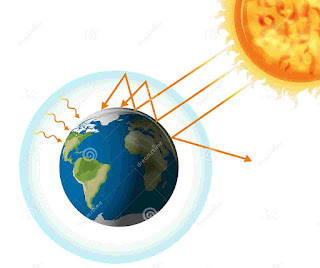
This effect was discovered by Fourier and the term was coined by Arrhenius. 75% of solar radiation is absorbed by earth surface and remaining is reflected back. Some of which is absorbed by greenhouse gases such as carbon dioxide, methane, ozone, chlorofluorocarbon compounds (CFCs) and water vapour in the atmosphere which increases temperature of atmosphere is called greenhouse effect.

Environmental Chemistry Class 11 Notes

Acid Rain

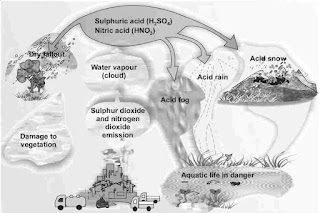
When the pH value of the rain water drops below 5.6, it is known as acid rain. Acid rain is a byproduct of a variety of human activities that emit the oxides of sulphur and nitrogen in the atmosphere.

Environmental Chemistry Class 11 Notes

2SO2(g) + O2(g) + 2H2O(l) ⟶ 2H2SO4(aq)

(ii). Stratospheric Pollution

Ozone Hole

Depletion in the concentration of ozone over a restricted area as over Antarctica is called ozone hole. Stratospheric clouds are formed over Antarctica.

Molecular oxygen splits into free oxygen atoms by UV radiations which combine with molecular oxygen to form ozone.

O2(g) ⟶ [O](g) + [O](g)

[O](g) + O2(g) ⟶ O3(g)

As ozone is thermodynamically unstable hence, there exists dynamic equilibrium between its decomposition and formation. Ultraviolet radiations dissociate chlorofluorocarbon to give chlorine-free radical, which combines with ozone to form chlorine monoxide radical which combines with free oxygen to form more chlorine-free radicals.

CF2Cl2 ⟶ [C]F2Cl + [Cl]

[Cl] + O3 ⟶ Cl[O] + O2

2Cl[O] + O3 ⟶ 2[Cl] + 2O2

Effects of Depletion of The Ozone Layer

Bad ozone is formed in troposphere that harms plants and animals while good ozone is formed in stratosphere which acts as shield. UV rays can enter in earth’s atmosphere.

  • It is harmful as can cause skin cancer.
  • It increases transpiration hence decreases soil moisture.
  • It damages paints and fibres, causing them to fade faster.

Water Pollution

Any unwanted change which detiorate quality of water and make it unfit for drinking is called water pollution. Pollution of water originates from human activities.

Causes of Water Pollution

  1. Organic matter such as leaves, grass, trash etc. as well as excessive phytoplankton growth in water causes water pollution as this matter is decomposed through microbial activity is known as putrescibility which requires oxygen. Degree of impurity of water due to organic matter is measured in terms of Biochemical Oxygen Demand (BOD).
  2. Pathogens : Disease-causing agents are called pathogens e.g., viruses, bacteria, protozoa, helminthes, algae etc. Human excreta contains E.coli and Streptococcus faecalis bacteria which cause gastrointestinal diseases.
  3. Chemical pollutants : These are of two types, inorganic and organic.Inorganic pollutants constitute acids, salts, heavy metals such as Cd, Hg, Ni etc. Heavy metals can damage central nervous system, liver and kidneys.Organic pollutants constitute, pesticides, petroleum pollutants, PCBs, detergents, fertilizers etc. PCBs (Polychlorinated Biphenyls) are carcinogenic and phosphatic fertilizers increase algae growth. Acidic water is harmful for aquatic life as well as for drinking.

Soil Pollution

It is unfavourable alteration of soil by addition or removal of substances and factors which decrease soil productivity, quality of plants and ground water is called soil pollution. Mainly caused by chemicals added into soil as pesticides, herbicides and fertilizers for better productivity.

Causes of Soil Pollution

  1. Pesticides : These are actually synthetic toxic chemicals with ecological repercussions. These are used in killing pathogens, pests and in inhibiting unwanted growth in agriculture, horticulture, forestry and water.
  2. Fertilizers : Excessive use of fertilizers decreases natural microflora hence detiorate soil. Therefore, now a days organic farming is encouraged which involves organic pesticides, biofertilizers and disease resistant varieties.
  3. Industrial wastes : These are both solid and liquid and are dumped over the soil. These contain toxic chemicals like mercury, copper, zinc, lead, cadmium, cyanides, acid, alkalies etc

Strategies to Control Environmental Pollution

Two sources of environment pollutant are household waste and industrial waste. Following method can be used to control them.

  1. Recycling : Waste are recycled into manufacturing of new material. For example, scrap iron, broken glass, clothes can be made from recycled plastic waste and soon becomes available in market. We can also recover energy from burning combustible waste.
  2. Digestion : Waste material can be degraded by anaerobic micro-organisms in absence of air. It can be used to produce electricity. First biodegradable and non-biodegradable waste are separated then biodegradable wastes are mixed with water and cultured by bacterial species which produce methane.
  3. Dumping : Sewage sludge acts as fertilizer because it contains nitrogen and phosphorus hence, it is dumped in land areas which increases soil fertility.

Green Chemistry

Green chemistry is a way of thinking and is about utilizing the existing knowledge and principles of chemistry and other sciences to reduce the adverse impact on environment. Utilization of existing knowledge base for reducing the chemical hazards along with the development activities are the foundation of green chemistry.

Read More

Chapter 6- Hydrocarbons | class 11th | revision notes chemistry

Hydrocarbons Class 11 Notes Chemistry

Introduction

The term ‘hydrocarbon’ is self-explanatory meaning compounds of carbon and hydrogen only. Hydrocarbons hold economic potential in our daily life. Natural gas and petroleum are chief sources of aliphatic hydrocarbons at the present time, and coal is one of the major sources of aromatic hydrocarbons. Petroleum is a dark, viscous mixture of many organic compounds, most of them being hydrocarbons, mainly alkanes, cycloalkanes and aromatic hydrocarbons.

Classification

As we are quite aware that there are different types of hydrocarbons. Depending upon the types of carbon-carbon bonds present, they can be classified into three main categories –

  1. saturated hydrocarbons
  2. unsaturated hydrocarbons and
  3. aromatic hydrocarbons.

Saturated hydrocarbons contain carbon-carbon and carbon-hydrogen single bonds. If different carbon atoms are joined together to form open chain of carbon atoms with single bonds, they are termed as alkanes. On the other hand, if carbon atoms form a closed chain or ring, they are termed as cycloalkanesUnsaturated hydrocarbons contain carbon-carbon multiple bonds – double bonds, triple bonds or both. Aromatic hydrocarbons are a special type of cyclic compounds.

Alkanes

These are the saturated chains of hydrocarbons containing carbon-carbon single bonds. Methane (CH4), is the first member of this family containing single carbon atom. Since it is found in coal mines and marshy areas, is also known as ‘marsh gas’. These hydrocarbons exhibited low reactivity or no reactivity under normal conditions with acids, bases and other reagents, they were earlier known as paraffins. The general formula for alkane is CnH2n + 2, where n stands for number of hydrogen atoms in the molecule.

Structure of Methane

(A). Nomenclature

For nomenclature of alkanes in IUPAC system, the longest chain of carbon atoms containing the single bond is selected. Numbering of the chain is done from the one end so that maximum carbon will be included in chain. The suffix ‘ane’ is used for alkanes. The first member of the alkane series is CH4 known as methylene (common name) or methene (IUPAC name). IUPAC names of a few members of alkenes are given below :

S.No.StructureIUPAC Name
1.CH4Methane
2.C2H6Ethane
3.C3H8Propane
4.C4H10Butane
5.C5H12Pentane
6.C6H14Hexane
7.C7H16Heptane
8.C8H18Octane
9.C9H20Nonane
10.C10H22Decane

(B). Preparation of Alkanes

Though petroleum and natural gas are the main sources of alkanes, it can be prepared by several other methods as well.

1. From unsaturated hydrocarbons

The addition of dihydrogen to unsaturated hydrocarbons like alkenes and alkynes in the presence of a suitable catalyst under a given set of conditions produces saturated hydrocarbons or alkanes. This process of addition of dihydrogen is known as hydrogenation process.

CH2=CH2 + H2 ⟶ CH3-CH3

CH☰CH + 2H2 ⟶ CH3-CH3

2. From alkyl halides

(a) Reduction: Alkyl halides undergo reduction with zinc and dilute hydrochloric acid to give alkanes. In general the reaction can be represented as

CH3-Cl ⟶ CH4

(b) Wurtz reaction: Alkyl halides on treatment with sodium metal in dry ether give higher alkanes. This reaction is known as Wurtz reaction.

CH3Br + 2Na + BrCH3 ⟶ CH3-CH3 + 2NaBr

3. From carboxylic acids

(a) By decarboxylation of carboxylic acids: Sodium salts of carboxylic acids on heating with soda lime give alkanes containing one carbon atom less than the carboxylic acid. A molecule of carbon dioxide is eliminated which dissolves in NaOH to form sodium carbonate.

CH3COONa + NaOH ⟶ CH4 + Na2CO3

(b) Kolbe’s electrolytic method: An aqueous solution of sodium or potassium salt of a carboxylic acid on electrolysis gives alkane containing even number of carbon atoms at anode.

CH3COONa + 2H2O ⟶ CH3-CH3 + 2CO2 + H2 + NaOH

(C). Properties of Alkanes

I. Physical Properties

(i) State: Due to the weak van der Waals forces, the first four members C1 to C4 i.e., methane, ethane, propane and butane are gases. From C5 to C17 are liquids and those containing 18 carbon atoms or more are solids at 298 K. They all are colourless and odourless.

(ii) Solubility: Alkanes are generally insoluble in water or in polar solvents but they are soluble in non-polar solvents like, ether, benzene, carbontetrachloride etc. The solubility of alkanes follow the property “Like Dissolves like”.

(iii) Boiling point: The boiling points of straight chain alkanes increase regularly with the increase of number of carbon atoms. This is due to the fact that the intermolecular van der Waals forces increase with increase in the molecular size or the surface area of the molecule.

II. Chemical Properties

Generally alkanes show inertness or low reactivity towards acids, bases, oxidizing and reducing agents at ordinary conditions because of their non-polar nature and absence of π bond. The C–C and C–H bonds are strong sigma bonds which do not break under ordinary conditions but they undergo certain reactions under given suitable conditions.

(1) Halogenation reaction: When hydrogen atom of an alkane is replaced by a halogen, it is known as halogenation reaction. Halogenation takes place either at high temperature (300–500°C) or in the presence of diffused sunlight or ultraviolet light.

CH4 + Cl2 ⟶ CH3Cl + HCl

(2) Combustion: Alkanes on heating in presence of air gets completely oxidized to carbon dioxide and water. It burns with a non-luminous flame. The combustion of alkanes is an exothermic process i.e., it produces a large amount of heat.

CH4 + 2O2 ⟶ CO2 + 2H2O

(3) Controlled oxidation: When methane and dioxygen compressed at 100 atm are passed through heated copper tube at 523 K yield methanol.

2CH4 + O2 ⟶ 2CH3OH

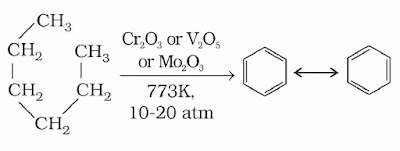
(4) Aromatization: The conversion of aliphatic compounds into aromatic compounds is known as aromatisation. n-Alkanes having six or more carbon atoms on heating to 773 K at 10–20 atmospheric pressure in the presence of oxides of vanadium, molybdenum or chromium supported over alumina get dehydrogenated and cyclised to benzene and its homologues. This reaction is also known as reforming.

Hydrocarbons Class 11 Notes

(5) Reaction with steam: Methane reacts with steam at 1273 K in the presence of nickel catalyst to form carbon monoxide and dihydrogen. This method is used for industrial preparation of dihydrogen gas.

CH4 + H2O ⟶ CO + 3H2

Alkenes

Alkenes are unsaturated hydrocarbons containing at least one carbon-carbon double bond with general formula CnH2n. Alkenes are also known as olefins (oil forming) since the first member, ethylene or ethene (C2H4) was found to form an oily liquid on reaction with chlorine.

(A). Nomenclature

For nomenclature of alkenes in IUPAC system, the longest chain of carbon atoms containing the double bond is selected. Numbering of the chain is done from the end which is nearer to the double bond. The suffix ‘ene’ replaces ‘ane’ of alkanes. The first member of the alkene series is C2H4 known as ethylene (common name) or ethene (IUPAC name). IUPAC names of a few members of alkenes are given below :

S.No.StructureIUPAC Name
1.C2H4Ethene
2.C3H6Propene
3.C4H8Butene
4.C5H10Pentene
5.C6H12Hexene
6.C7H14Heptene
7.C8H16Octene
8.C9H18Nonene
9.C10H20Dekene

(B). Preparation

1. From alkynes: Alkynes undergo partial reduction with calculated amount of dihydrogen producing alkenes.

CH☰CH + H2 ⟶ CH2=CH2

2. From alkyl halides: Alkyl halides (R–X) on heating with alcoholic potash eliminates one molecule of halogen acid to form alkenes. This reaction is known as dehydrohalogenation i.e., removal of halogen acid.

CH3CH2Cl ⟶ CH2=CH2 + HCl

3. From alcohols by acidic dehydration: Alcohols on heating with concentrated sulphuric acid form alkenes with the elimination of one water molecule since a water molecule is eliminated from the alcohol molecule in the presence of an acid, this reaction is known as acidic dehydration of alcohols.

CH3CH2OH ⟶ CH2=CH2 + H2O

(C). Properties of Alkenes

I. Physical properties

  1. The first three members of alkenes are gases, the next fourteen are liquids and the higher ones are solids.
  2. Ethene is a colourless gas with a faint sweet smell. All other alkenes are colourless and odourless, insoluble in water but fairly soluble in non-polar solvents like benzene, petroleum ether.
  3. They show a regular increase in boiling point with increase in size i.e., every —CH2 group added increase the boiling point by 20–30 K.

II. Chemical properties

1. Addition of dihydrogen: Alkenes adds one mole of dihydrogen gas in presence of catalysts such as Ni at 200–250°C, or finely divided Pt or Pd at room temperature to give an alkane.

CH2=CH2 + H-H ⟶ CH3-CH3

2. Addition of halogens: Halogens like bromine or chlorine add up to alkene to form vicinal dihalides in presence of CCl4 as solvent. The order of reactivity of halogens is F > Cl > Br > I.

CH2=CH2 + Br-Br ⟶ Br-CH2-CH2-Br

3. Addition of hydrogen halides: Hydrogen halides (HCl, HBr, HI) add upto alkenes to form alkyl halides. The order of reactivity of hydrogen halides is HI > HBr > HCl. Like addition of halogens to alkenes, addition of hydrogen halides is an example of electrophilic addition reaction.

CH2=CH2 + H-Br ⟶ CH3-CH2-Br

Markovnikov rule: According to the rule, the negative part of the addendum (adding molecule) adds to that carbon atom of the unsymmetrical alkene which is maximum substituted or which possesses lesser number of hydrogen atoms.

CH3CH=CH2 + HBr ⟶ CH3-CH(Br)-CH3

Anti Markovnikov addition or Peroxide effect or Kharash effect: In the presence of peroxide, addition of HBr to unsymmetrical alkenes like propene takes place contrary to the Markovnikov rule. This happens only with HBr but not with HCl or HI. This reaction is known as peroxide or Kharash effect or addition reaction anti to Markovnikov rule.

CH3CH=CH2 + HBr ⟶ CH3-CH2-CH2-Br

4. Polymerisation: Polymerisation is the process where monomers combines together to form polymers. The large molecules thus obtained are called polymers. Other alkenes also undergo polymerisation.

n(CH2=CH2) ⟶ (-CH2-CH2-)n

Alkynes

Like alkenes, alkynes are also unsaturated hydrocarbons with general formula CnH2n – 2. They contain at least one triple bond between two carbon atoms. These have four H-atoms less compared to alkanes. The first stable member of alkyne series is ethyne commonly known as acetylenes.

(A). Nomenclature

In common system, alkynes are named as derivatives of acetylene. In IUPAC system, they are named as derivatives of the corresponding alkanes replacing ‘ane’ by the suffix ‘yne’. The position of the triple bond is indicated by the first triply bonded carbon. Common and IUPAC names of a few members of alkyne series are given in the table below :

S.No.StructureIUPAC Name
1.C2H2Ethyne
2.C3H4Propyne
3.C4H6Butyne
4.C5H8Pentyne
5.C6H10Hexyne

(B). Preparation

1. From calcium carbide: On industrial scale, ethyne is prepared by reacting calcium carbide with water. Calcium carbide is prepared by heating quick lime with coke. Quick lime can be obtained by heating limestone as shown in the following reactions :

CaCO3 ⟶ CaO + CO2

CaO + 3C ⟶ CaC2 + CO

CaC2 + 2H2O ⟶ Ca(OH)2 + C2H2

2. From vicinal dihalides: Vicinal dihalides on treatment with alcoholic potassium hydroxide undergo dehydrohalogenation. One molecule of hydrogen halide is eliminated to form alkenyl halide which on treatment with sodamide gives alkyne.

CH2(Br)-CH2(Br) + KOH ⟶ CH2=CH2 ⟶ CH☰CH

(A). Properties of Alkynes

I. Physical properties

  1. The first three members (acetylene, propyne and butynes) are gases, the next eight are liquids and higher ones are solids.
  2. All alkynes are colourless. All alkynes except ethyne which have an offensive characteristic odour, are odourless.
  3. Alkynes are weakly polar in nature and nearly insoluble in water. They are quite soluble in organic solvents like ethers, carbon tetrachloride and benzene.
  4. Their melting point, boiling point and density increase with increase in molar mass.

II. Chemical properties

(i) Addition of dihydrogen: Alkynes contain a triple bond, so they add up, two molecules of dihydrogen.

CH☰CH + H2 ⟶ CH2=CH2 ⟶ CH3-CH3

(ii) Addition of halogens: Alkynes contain a triple bond, so they add up, two molecules of halogen.

CH☰CH + Cl2 ⟶ CH(Cl)=CH(Cl) ⟶ CH(Cl)2-CH(Cl)2

(iii) Addition of hydrogen halides: Two molecules of hydrogen halides (HCl, HBr, HI) add to alkynes to form gemdihalides (in which two halogens are attached to the same carbon atom).

CH☰CH + HCl ⟶ CH2=CH(Cl)

(iv) Addition of water: Like alkanes and alkenes, alkynes are also immiscible and do not react with water. However, one molecule of water adds to alkynes on warming with mercuric sulphate and dilute sulphuric acid at 333 K to form carbonyl compounds.

CH☰CH + H2O ⟶ CH3-CHO

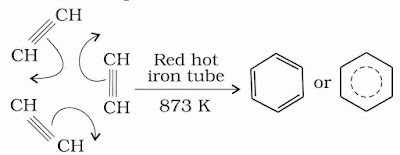
(v) Polymerisation: Ethyne on passing through red hot iron tube at 873 K undergoes cyclic polymerization. Three molecules polymerise to form benzene, which is the starting molecule for the preparation of derivatives of benzene, dyes, drugs and large number of organic compounds.

Hydrocarbons Class 11 Notes

(vi) Oxidation:

2C2H2 + 5O2 ⟶ 4CO2 + 2H2O

Aromatic Hydrocarbon

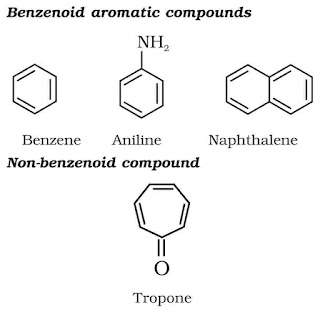
Aromatic hydrocarbons are also known as ‘arenes’. Since most of them possess pleasant odour (Greek; aroma meaning pleasant smelling), the class of compounds are known as ‘aromatic compounds’. Most of the compounds are found to have benzene ring. Benzene ring is highly unsaturated and in a majority of reactions of aromatic compounds, the unsaturation of benzene ring is retained. Aromatic compounds containing benzene ring are known as benzenoids and those, not containing a benzene ring are known as non-benzenoids.

Nomenclature

Since all the six hydrogen atoms in benzene are equivalent; so it forms one and only one type of monosubstituted product. When two hydrogen atoms in benzene are replaced by two similar or different monovalent atoms or groups, three different position isomers are possible which differ in the position of substituents. So we can say that disubstituted products of benzene show position isomerism. The three isomers obtained are 1, 2 or 1, 6 which is known as the ortho (o-), the 1, 3 or 1, 5 as meta (m-) and 1, 4 as para (p-) disubstitued compounds.

Hydrocarbons Class 11 Notes

(B). Structure

The molecular formula of benzene, C6H6, indicates a high degree of unsaturation. All the six carbon and six hydrogen atoms of benzene are identical. On the basis of this observation August Kekule in 1865 proposed the following structure for benzene having cyclic arrangement of six carbon atoms:

Hydrocarbons Class 11 Notes

(C). Resonance

Even though the double bonds keep on changing their positions. The structures produced is such that the position of nucleus remains the same in each of the structure. The structural formula of such a compound is somewhat intermediate (hybrid) between the various propose formulae. This state is known as Resonance.

Hydrocarbons Class 11 Notes

(D). Preparation of Benzene

(i) Cyclic polymerisation of ethyne: Ethyne on passing through red hot iron tube at 873 K undergoes cyclic polymerization.

Hydrocarbons Class 11 Notes

(ii) Decarboxylation of aromatic acids: Sodium salt of benzoic acid i.e., sodium benzoate on heating with sodalime gives benzene.

Hydrocarbons Class 11 Notes

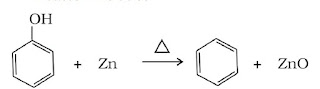
(iii) Reduction of phenol: Phenol is reduced to benzene by passing its vapour over heated zinc dust.

Hydrocarbons Class 11 Notes

(E). Properties of Benzene

I. Physical Properties

  1. Aromatic hydrocarbons are non-polar molecules and are usually colourless liquids or solids with a characteristic aroma.
  2. The napthalene balls used in toilets and for preservation of clothes because of unique smell of the compound.
  3. Aromatic compounds are insoluble in water but soluble in organic solvents such as alcohol and ether.
  4. They burn with sooty flame.

II. Chemical Properties

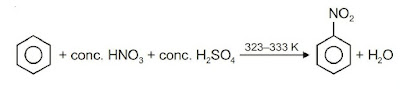
(i) Nitration: A nitro group is introduced into the benzene ring when benzene is heated with a mixture of concentrated nitric acid and concentrated sulphuric acid.

Hydrocarbons Class 11 Notes

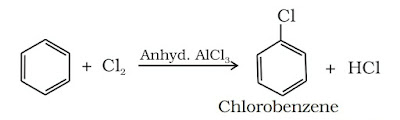
(ii) Halogenation: Arenes undergo halogenation when it is treated with halogens in presence of Lewis catalyst such as anhy. FeCl3, FeBr3 or AlCl3 to yield haloarenes.

Hydrocarbons Class 11 Notes

(iii) Sulphonation: The replacement of a hydrogen atom by a sulphonic acid group in a ring is called sulphonation. It is carried out by heating benzene with fuming sulphuric acid or oleum (conc. H2SO4 + SO3).

Hydrocarbons Class 11 Notes

(iv) Friedel-Crafts alkylation reaction: When benzene is treated with an alkyl halide in the presence of anhydrous aluminium chloride, alkylbenzene is formed.

Hydrocarbons Class 11 Notes

Activating Groups: Electron donating groups (EDG, +M, +I, +H. C. effect) in the benzene ring will more stabilize the σ-complex (Arenium ion complex) with respect to that of benzene and hence they are known as activator.

Deactivating Groups: Electron drawing groups (–M, –I effects) will destabilize σ-complex as compared to that of benzene. Therefore substituted benzenes where substituents are electron withdrawing decreases reactivity towards SE reactions.

Read More

Chapter 5- Organic Chemistry : Some Basic Principles and Techniques | class 11th | revision notes chemistry

Organic Chemistry Some Basic Principles and Techniques Class 11 Notes Chemistry

Structural Representations of Organic Compounds

(i). Structural Formulas

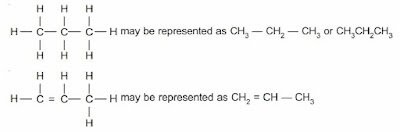
The lewis structures can be simplified by representing the two electron covalent bonds by a dash (–). In this representation, a single bond is represented by a single dash (–), a double bond by a double dash (=) and a triple bond by a triple dash (≡). The lone pair on an atom may or may not be shown. This representation is called structural formula.

Organic Chemistry Some Basic Principles and Techniques Class 11 Notes

(ii). Condensed Formulas

In this formula, the arrangement of atoms are shown but the bonds between may be omitted and the number of identical groups attached to an atom are indicated by a subscript.

Organic Chemistry Some Basic Principles and Techniques Class 11 Notes

(iii). Bond Line Formulas

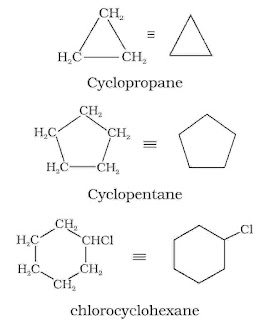
In this representation, the carbon and hydrogen atoms are not shown and the lines between carbon-carbon bonds are shown in a zig-zag manner.

Organic Chemistry Some Basic Principles and Techniques Class 11 Notes

In cyclic compounds, the bond-line formulas may be given as follows :

Organic Chemistry Some Basic Principles and Techniques Class 11 Notes

Three-dimensional representation of organic molecules

The three-dimensional (3-D) structure of organic molecules can be represented on paper by using certain conventions. In these formulae, the thick solid (or heavy) line or the solid wedge indicates a bond lying above the plane of the paper and projecting towards the observer while a dashed wedge is used to represent a bond lying below the plane of the paper and projecting away from the observer.

Organic Chemistry Some Basic Principles and Techniques Class 11 Notes

Classification of Organic Compounds

On the basis of their structures, organic compounds are broadly classified as follows :

Organic Chemistry Some Basic Principles and Techniques Class 11 Notes

Open Chain Compounds

These compounds contain open chains of carbon atoms in their molecules. The carbon chains may be either straight chains or branched chains. They are also called aliphatic compounds.

Closed Chain or Ring Compounds

These compounds contain chains or rings of atoms in their molecules.

Alicyclic Compounds : These compounds contain a ring of three or more carbon atoms in them. They resemble aliphatic compounds in many of their properties.

Organic Chemistry Some Basic Principles and Techniques Class 11 Notes

Aromatic Compounds : These have a cyclic system containing at last one benzene ring. The parent member of the family is called benzene. Benzene has a homocyclic hexagonal ring of six carbon atoms with three double bonds in the alternate positions.

Organic Chemistry Some Basic Principles and Techniques Class 11 Notes

Heterocyclic Compounds : In these compounds, the ring contains one or more atoms of either nitrogen, oxygen or sulphur in addition to carbon atoms. The atom other than carbon (such as N, O, S) present in the ring is called hetero atoms.

Organic Chemistry Some Basic Principles and Techniques Class 11 Notes

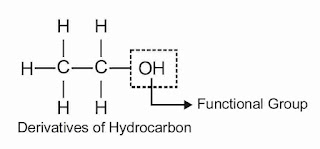
Functional Groups : An atom or group of atoms which largely determines the properties of the organic compounds particularly the chemical properties.

Organic Chemistry Some Basic Principles and Techniques Class 11 Notes

Homologous Series : Homologous series may be defined as “a series of similarly constituted compounds in which the members possess the same functional group and have similar chemical characteristics”. The two consecutive members differ in their molecular formula by –CH2– group.

1. CH3OH – Methyl alcohol
2. C2H5OH – Ethyl alcohol
3. C3H7OH – Propyl alcohol
4. C4H9OH – Butyl alcohol)
5. C5H11OH – Pentyl alcohol
6. C6H13OH – Hexyl alcohol

Nomenclature of Organic Compounds

The term ‘nomenclature’ means the system of naming of organic compounds. There are two systems of nomenclature:

(i) Trivial or Common System

In this nomenclature, the names of organic compounds were assigned based on their source of origin or certain properties. For instance, citric acid got its name from the source (citrus fruits) from which it was first isolated. Formic acid was named so as it was first obtained from red ant. In Latin, ant word is formica.

(ii) IUPAC System of Nomenclature

A systematic method of naming has been developed and is known as the IUPAC (International Union of Pure and Applied Chemistry) system of nomenclature. In this systematic nomenclature, the names are correlated with the structure such that the reader or listener can deduce the structure from the name.

A. Nomenclature of Alkanes

(i). Straight Chain Hydrocarbons: The names of straight chain hydrocarbons consist of word root and primary suffix. The primary suffix for alkanes is ‘ane’.

Organic Chemistry Some Basic Principles and Techniques Class 11 Notes

The IUPAC names of some unbranched saturated hydrocarbons (Carbon-Carbon single bond) are given below.

Organic Chemistry Some Basic Principles and Techniques Class 11 Notes

(ii) Branched Chain Hydrocarbons: In branched chain hydrocarbons, small side chains of carbon atoms are attached to the main carbon parent chain. These side chains are called as alkyl groups and are prefixed t the name of parent alkane. Alkyl groups are derived from alkane by removal of one hydrogen atom so have general formula CnH2n+1 and represented by –R. An alkyl group is named by replacing ‘ane’ of the alkane to ‘yl’.

Organic Chemistry Some Basic Principles and Techniques Class 11 Notes

B. Branched Chain Hydrocarbons:

By following certain rules the branched chain hydrocarbons can be named without any difficulty:

(i) Longest Chain Rule: The initial step of nomenclature is to identify the longest carbon chain which is then called as parent chain.

(ii) Lowest Number Rule: The numbering of the parent chain is done in such a way that the substituents attached to the parent chain should get the lowest possible position.

Organic Chemistry Some Basic Principles and Techniques Class 11 Notes

(iii) Alphabetical Order of the Side Chain: The names of the alkyl group are prefixed before the nam of the parent chain. The position of the alkyl group is indicated by carefully numbering the parent chain Moreover care is taken to name of the substituents in the alphabetical order when different alkyl group are present as substituents.

Organic Chemistry Some Basic Principles and Techniques Class 11 Notes

(iv) In the IUPAC name of an organic compound, the numbers are separated by comma from each other, das or hyphen (-) is put between a number and a letter and the successive words are merged into one word If the branched hydrocarbon contains more than one alkyl groups, then their names are not repeated, instead the number of the same alkyl substituents is written by prefix di for two, tri for three, tetra fo four, penta for five, hexa for six etc.

Organic Chemistry Some Basic Principles and Techniques Class 11 Notes

(v) When the organic compound has more than one alkyl group, then their names are written in the alphabetical order but the prefixed di, tri etc. are not considered for alphabetical order. Thus the correc name of the following compound is 3-ethyl-4, 4-dimethylheptane.

(vi) Numbering of Different Alkyl Groups at Equivalent Positions: When the two different alkyl groups are present at the equivalent positions, then the numbering of the parent chain is done in such a wa so as to assign the lower number of the alkyl group which comes first in the alphabetical order.

Organic Chemistry Some Basic Principles and Techniques Class 11 Notes

(vii) Cyclic Compounds: For naming cyclic hydrocarbons ‘cyclo’ prefix is used before the name of parent chain and the remaining rules are same as explained earlier.

Organic Chemistry Some Basic Principles and Techniques Class 11 Notes

Nomenclature of Unsaturated Hydrocarbons

(i) Select the longest possible carbon chain having maximum number of unsaturated carbon atoms or maximum number of double or triple bonds, even if the prior rules are violated.

Organic Chemistry Some Basic Principles and Techniques Class 11 Notes

(ii) Hydrocarbon containing both C=C and C☰C: When hydrocarbon contains one double bond and one triple bond they are called alkenynes (not alkynenes). The parent chain is numbered in such a way that multiple bond (double or triple) is assigned the lowest possible number. When these bonds are located at equivalent positions, the double bond is given priority over the triple bond.

Organic Chemistry Some Basic Principles and Techniques Class 11 Notes

Nomenclature of Organic Compounds having functional group

Functional Group: Functional group may be defined as an atom or a group of atoms bonded together in a unique manner present in a molecule which largely determines its chemical properties.

The presence of a functional group is indicated by either adding their suffixes or prefixes. The prefixes and suffixes of same functional groups are given in the following table.

Organic Chemistry Some Basic Principles and Techniques Class 11 Notes

The organic compounds with same functional group show similar chemical properties. For example, alcohols like CH3OH, CH3CH2OH,(CH3)2CHOH, etc, all produce hydrogen when treated with sodium metal.

  1. Identify functional groups.
  2. Decide the principal functional group according to its position in priority list. The principal functional group is identified by suffix and the other functional group by prefixes.
  3. Select the longest chain containing the functional groups including C=C or C☰C bond or both as the main chain and name the hydrocarbon on the basis of number of carbons in the main chain.
  4. Derive from the hydrocarbon name the parent name of the compound for the principal functional group.
  5. Assign number of carbon atoms in the main chain so that the principal functional group is given the lowest possible number.
  6. Put the positional number for the functional group, if necessary in the parent name at suitable place.
  7. Complete the name of the compound by placing substituents just before the parent name.

Nomenclature of Substituted Benzene Compounds

(1) For naming the substituted benzene compounds, the prefix used for the substituent is prefixed to the word ‘benzene’ simply.

Organic Chemistry Some Basic Principles and Techniques Class 11 Notes

(2) Many substituted benzene compounds are universally known by their common names.

Organic Chemistry Some Basic Principles and Techniques Class 11 Notes

Isomerism

Such organic compounds which have the same molecular formula but differ from each other in their properties are called as isomers and the phenomenon is called as isomerism. It is of two types:

Organic Chemistry Some Basic Principles and Techniques Class 11 Notes
  1. Structural isomerism
  2. Stereoisomerism

1. Structural Isomerism: Compounds having the same molecular formula but different structure are called structural isomers and the phenomenon is called structural isomerism. It is also known as constitutional isomerism. It is of the following types:

(i) Chain Isomerism: The compounds having same molecular formula but different chain of carbon atom. For example: Butane and 2-methyl propane are chain isomers.

Organic Chemistry Some Basic Principles and Techniques Class 11 Notes

(ii) Position Isomerism: Compounds having the same molecular formula but different in position substituents, C = C, C ≡ C or functional group are called position isomers.

Organic Chemistry Some Basic Principles and Techniques Class 11 Notes

(iii) Functional Isomerism: The compounds having same molecular formula but different functional groups in the molecule are called functional isomers.

Organic Chemistry Some Basic Principles and Techniques Class 11 Notes

(iv) Metamerism: The compounds having same molecular formula but different alkyl group on either side of the functional group, are called metamers.

Organic Chemistry Some Basic Principles and Techniques Class 11 Notes

(v) Tautomerism: When two or more constitutionally distinct compounds are in dynamic equilibrium because of the shift of an atom (generally proton) from one place to another place in a molecule. The phenomenon is called Tautomerism and various constitutional isomers are known as tautomers.

Organic Chemistry Some Basic Principles and Techniques Class 11 Notes

2. Stereoisomerism: Isomers which have the same structural formula but have different relative arrangement of atoms or groups in space are called stereoisomers and the phenomenon is called stereoisomerism. It has three types:

  1. Geometrical Isomerism
  2. Conformational Isomerism
  3. Optical Isomerism

(i) Geometrical Isomerism: When two compounds differ in spatial arrangement of groups because of restricted rotation, these compounds are known as geometrical isomers.

Organic Chemistry Some Basic Principles and Techniques Class 11 Notes

Fundamental Concepts in Organic Reaction Mechanism

A. Fission of a Covalent Bond

Organic reactions usually involve making and breaking of covalent bonds. The fission of bonds can take place in two ways:

(i) Heterolytic Fission: When a covalent bond between two atoms A & B breaks in such a way that both the electrons of the covalent bond are taken away by one of the bonded atoms, the mode of bond cleavage is called heterolytic fission. Heterolytic fission is usually indicated by a curved arrow (↷) which denotes a two-electron displacement.

(ii) Homolytic Fission: If a covalent bond breaks in such a way that each atom takes away one electron of the shared pair, it is called homolytic or symmetrical fission. Homolytic fission is usually indicated by a fish arrow (↶↷) which denotes a one-electron displacement.

B. Attacking Reagents

(i) Electrophiles: A reagent that takes away an electron pair is called electrophile. There are positively charged or neutral species which are deficient of electrons and can accept a pair of electrons. They are also called electron-loving (philic) or electron-seeking species (E). Ex- H+, H3O+, Cl+, CH3+, NO2+, AlCl3, BF3 etc.

(ii) Nucleophiles: A reagent that brings an electron pair is called nucleophile. These reagent contain an atom having unshared or lone pair of electrons. A nucleophile is electron-rich and seeks electron-deficient sites i.e., nucleus-loving or nucleus-seeking (Nu). According to lewis concept of acids and basis, nucleophiles behave as lewis bases. Ex- X OH, CN, RCOO, NH3, H2O etc.

Electron Displacements in Covalent Bonds

(a) Inductive Effect (I-effect): This is a permanent effect which arises whenever an electron-withdrawing group is attached to the end of a carbon chain. To understand this, let us consider a chain of carbon atoms having Cl atom at one end.

C4-C3-C2-C1-Cl

Hence, Cl-atom is more electronegative than C so, the σ-electrons of the C—Cl -bond are attracted by or displaced towards the more electronegative atom. As a result, the atom Cl acquires a small negative charge (δ) and C1 acquires a small positive charge (δ+) as shown below.

C4-C3-C2-C1δ+-Clδ-

(i) –I effect: If the substitutent attached to the end of the carbon chain is electron-withdrawing, the effect is called –I effect.

(ii) + I effect: If the substituent attached to the end of the carbon chain is electron-donating, the effect is called +I effect.

Applications

  1. Acidic and Basic strength of various organic acids and bases can be explained through this effect.
  2. Stability of carbocations and carbanions.
  3. Reactivity of alkyl halides.
  4. Diplole moment, bp, mp etc.

(b) Electromeric Effect (E-effect): It is temporary effect which operates in the organic compounds having multiple bonds i.e., double or triple bonds under the influence of an outside attacking species. As a result, one pi electron pair of the multiple bond gets completely transferred to one of the bonded atoms which is usually more electronegative.

The electromeric effect is shown by a curved arrow (↷) representing the electron transfer originating from the centre of the multiple bond and pointing towards one of the atoms which is more electronegative.

Organic Chemistry Some Basic Principles and Techniques Class 11 Notes

(i) +E effect: If the pi-electron pair of the multiple bond is transferred to the atom to which the attacking reagent gets attached, then the effect is called +E effect.

Organic Chemistry Some Basic Principles and Techniques Class 11 Notes

(ii) –E effect: In this case the pi-electron pair of the multiple bond is transferred away from the atom which gets linked to the attacking reagent, the effect is known as –E effect.

Organic Chemistry Some Basic Principles and Techniques Class 11 Notes

(c) Resonance or Mesomeric Effect (R-effect): The phenomenon of exhibiting more than one possible structure is called as resonance. The resonance can be explained clearly on the basis of structure of benzene. The benzene can be represented by following two canonical form.

Organic Chemistry Some Basic Principles and Techniques Class 11 Notes

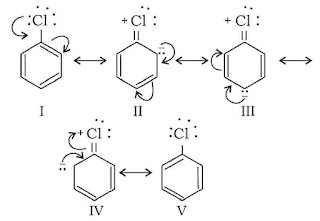
(i) + R effect: If a conjugated system has an electron-donating group is said to have + R or + M effect. Such as –OH, –OR, –SH, –NH2, –NHR, –X (halogen) etc.

(ii) –R or –M Effect: If a conjugated system has an electron-withdrawing group is said to have – R or – M effect. Such as –CHO, –COOH, –COOR, –CN, –NO2, >C=O etc.

Aromaticity

Huckel’s Rule of Aromaticity

Huckel’s rule is valid for compounds containing atleast:

  1. One planar ring (i.e., monocyclic)
  2. Conjugated (complete continuous conjugation) (c) Planarity
  3. (4n+2)π electrons where n is either zero or positive integer.
Organic Chemistry Some Basic Principles and Techniques Class 11 Notes

Hypercojugation

When an alkyl group is attached to an unsaturated system such as double bond or a benzene ring. The order of inductive effect is actually reversed. This effect is called hyperconjugation effect or Baker-Nathan effect.

Reaction Intermediates

The species produced during cleavage of bonds are called reaction intermediates, these are generally short-lived and highly reactive and hence cannot be isolated. The typical intermediates are:

(i) Carbocations: A carbocation may be defined as “A group of atoms with a positively charged carbon atom having six electrons in the valence shell after sharing”.

(ii) Carbanions: It may be defined as “chemical species bearing a negative charge on carbon and possessing eight electrons in its valence shell are called carbanions”.

(iii) Free Radicals: It may be defined as “an atom or group of atoms with an odd or unpaired electron.”

Types of Reactions

There are basically four types of reaction:

  1. Addition reaction
  2. Elimination reaction
  3. Substitution reaction
  4. Rearrangement

(i) Addition Reaction: In which a group adds to the system, unsaturated organic compounds comes under this category e.g.

CH2 = CH2 + H2 → CH3—CH3

(ii) Elimination Reaction: The reactions in which two atoms or groups of the molecule are removed are called elimination reactions.

CH3—CH2Br → CH2 = CH2 + HBr

(iii) Substitution Reaction: When a group is removed and another group takes its place. These can also be called displacement reactions. The displacement of the halide group by an OH group to form alcohol.

CH3Cl + KOH → CH3OH + KCl

(iv) Rearrangement: When the molecule rearranges itself by shifting its own part to some other site within the molecule. This is done to attain higher stability if it can be achieved. The various isomerization reactions come under this category.

CH3—CH2—CH2+ → CH3—CH+—CH3

Methods of Purification of Organic Compounds

The organic compounds whether isolated from a natural source or prepared in the laboratory are mostly impure. These are generally contaminated with some other substances. A number of methods are available for the purification. The choice of a particular technique or method depends upon the nature of the compound whether solid or liquid and also upon the nature of the impurities associated with it. The common techniques used for purification are as follows:

  1. Sublimation
  2. Crystallisation
  3. Distillation 
  4. Differential extraction
  5. Chromatography

(i) Sublimation: Certain organic solids on heating directly change from solid to vapour state without passing through a liquid state. Such substances are called sublimable. This process is called sublimation. The vapours on cooling change back to the solid form. The sublimation process is used for the separation of sublimable volatile compounds such as camphor, naphthalene, anthracene, benzoic acid etc.

Solid ⇌ Vapour

(ii) Crystallisation: This is the most common method for purifying organic solids. This method is based on the differences in the solubility of the organic compound and its impurities in a suitable solvent.

(iii) Distillation: “Distillation is the process of converting a liquid into vapours upon heating and then cooling the vapours back to the liquid state”. The process of simple distillation is used to purify those organic liquids which are quite stable at their boiling points and the impurities present are non-volatile. Liquids such as benzene, toluene, ethanol, acetone, chloroform, carbon tetrachloride can be purified by simple distillation.

Organic Chemistry Some Basic Principles and Techniques Class 11 Notes

(iv) Differential Extraction: This technique is normally used to separate certain organic solids dissolved in water by shaking with a suitable organic solvent. The process called extraction is done in a separating funnel. The organic solvent selected should be such that (a) The given solid must be more soluble in the organic solvent than in water. (b) Water and organic solvent should not be miscible with each other.

Organic Chemistry Some Basic Principles and Techniques Class 11 Notes

(v) Chromatography: Chromatography is a modern and sensitive techniques used for rapid and efficient separation or analysis of components of a mixture and purification of the compounds. “The technique of separating the components of a mixture in which separation is achieved by the differential movement of individual components through a stationary phase under the influence of a mobile phase”.

Organic Chemistry Some Basic Principles and Techniques Class 11 Notes

Qualitative Analysis of Organic Compounds

In the study of any organic compound, it is an important step to know the elements present in it. In addition to carbon and hydrogen, organic compounds contain some other elements, e.g., nitrogen, sulphur, halogens, etc. These are detected as follows:

(a) Detection of Carbon and Hydrogen: Carbon and hydrogen are detected by heating the compound with copper (II) oxide. Carbon present in the compound is oxidised to carbon dioxide and hydrogen to water vapours.

C + 2CuO ⟶ 2Cu + CO2

(b) Test for Nitrogen: About 2 ml of sodium extract is taken in a test tube and made alkaline by adding NaOH solution. To this reaction mixture is added freshly prepared FeSO4 solution and boiled for 3–4 minutes. The formation of Prussian blue colour or precipitate shows the presence of nitrogen.

Na + C + N ⟶ NaCN

(c) Test for Sulphur: If organic compound contains both nitrogen and sulphur, sodium thiocyanate is formed.

Na + C + N + S ⟶ NaSCN

(d) Test for Halogens: A portion of the sodium extract is Boiled with 2–3 ml concentrated HNO3 followed by cooling and addition of AgNO3 solution when a pale yellow precipitate partially soluble in ammonia solution indicates the presence of bromine.

NaBr + AgNO3 ⟶ AgBr + NaNO3

Read More

Chapter 4- The p-Block Elements | class 11th | revision notes chemistry

The p-Block Elements Class 11 Notes Chemistry

Introduction

The elements in which last electron enters into p-subshell are called as p-block elements. The number of p-orbitals is three and, therefore, the maximum number of electrons that can be accommodated in a set of p-orbitals is six, hence p-block contains six groups.

Boron Family

Group III A contains six elements : boron, aluminium, gallium, indium, thallium and ununtrium. The penultimate shell (next to the outermost) conains 1s2 in boron, 2s2 2p6 (8 electrons) in aluminium and (n–1)s2(n–1)p6(n–1)d10 (18 electrons) in other elements.

Boron is a non-metal and always form covalent bonds. Boron family is known as most heterogeneous family as there is no regular trend in all properties, as it comes after d-block, lanthanoid contraction, poor shielding of d-orbital, they have large deviation in properties.

I. Physical Properties

The atomic radius, ionic radius and density increases when one moves from top to bottom in a group in periodic table. While melting point decreases from B to Ga and then increases from (Ga to In). Ionisation energy decreases from B to Al, but shows a reverse trend in going from Al to Ga.

II. Chemical Properties

1. Reaction with air: Impure boron in air forms oxide while pure boron is less reactive.

4B + 3O2 ⟶ 2B2O3

2. Reaction with water: Boron is not affected by water or steam under ordinary conditions. However, Aluminium reacts with cold water if oxide layer is not present on its surface.

4Tl + 2H2O + O2 ⟶ 4TlOH

3. Reaction with acids: Boron is not affected by non-oxidising acids like HCl and dilute H2SO4 while other elements dissolve and liberate H2 gas.

2Al + 6HCl ⟶ 2AlCl3 + 3H2

4. Reaction with alkalies: Boron, Aluminium, Gallium react with alkali solutions whereas Indium and Thallium are not affected by alkalies.

2B + 6NaOH ⟶ 2Na2BO3 + 3H2

Anomalous Properties of Boron

Boron, the first member of group 13 elements, shows anomalous behaviour and differ from rest of the members of its family. The main reason for this difference are :

  • exceptionally small atomic and ionic size.
  • high ionization enthalpy.
  • absence of d orbital in its valence shell.
  • It has higher melting and boiling point than those of the other members of its group.

Compounds of Boron

[A]. Borax/Sodium Tetraborate (Na2B4O7·10H2O)

It is the most important compound of boron. It is a white crystalline solid. Borax dissolves in water to give an alkaline solution.

I. Preparation

From Boric acid: Boric acid is neutralised with sodium carbonate and the resulting solution is cooled to get crystals of borax.

H3BO3 + Na2CO3 ⟶ Na2B4O7 + H2O + CO2

II. Properties

(i) It gets hydrolysed with water to form an alkaline solution

Na2B4O7 + 7H2O ⟶ 2NaOH + H3BO3

(ii) Borax bead test: On heating borax first swells up due to elimination of water molecules. On further heating it melts to a liquid which then solidifies to a transparent glassy mass.

Na2B4O7.10H2O ⟶ Na2B4O7 + 10H2O

Na2B4O7 ⟶ 2NaBO2 + B2O3

(iii) It is a useful primary standard for titration against acids.

Na2[B4O5(OH)4]·8H2O + 2HCl ⟶ 2NaCl + 4 H3BO3 + 5H2O

[B]. Diborane : B2H6

The simplest boron hydride known, is diborane. It is prepared by treating boron trifluoride with LiAlH4 in diethyl ether.

I. Preparation

3LiAlH4 + 4BCl3 ⟶ 3LiCl + 3AlCl3 + B2H6

II. Properties

(i) Stable at low temperature only, colourless and highly toxic.

(ii) B2H6 + 6H2O ⟶ 2H3BO3 + 6H2

(iii) B2H6 + 6Cl2 ⟶ 2BCl3 + 6HCl

(iv) B3H6 + 2Me3N ⟶ 2[Me3N.BH3]

Uses of Boron and Aluminium and Their Compounds

Boron Compounds

Boron is a hard solid having high melting point low density and very low electrical conductivity. Some important boron compounds are :

(a) Boron fibers: It is mixed with plastic to form a material which is lighter than aluminium but tougher and stiffer than steel hence it is used in body armour, missiles and aircrafts.

(b) Boron-10 (10B) isotope: Boron carbide rods or boron steel are used to control nuclear reactions as neutron absorbers.

5B10 + 0n1 ⟶ 5B11

(c) Borax: It is used in manufacture of enamels and glazes for pottery and tiles. It is also used in making optical glasses and also borosilicate glasses which is very resistant to heat and shock. It is used as an antispectic.

(d) Boric acid: It is used in glass industry, in food industry as preservative. It is also used as an antiseptic and eye wash under the name ‘boric lotion’. It is also used in manufacture of enamels and glazes for pottery.

(e) Boron carbide: Hardest boron compound.

I. Aluminium Compounds

Aluminium and its alloy are used in packing industry, utensil industry, aeroplane and transportation industry etc.

1. Alumina (Al2O3)

(a) Used in chromatography.

(b) Used in making bauxite bricks which are used for lining furnaces.

2. Aluminium chloride (AlCl3): Used in manufacture of dyes, drugs and perfumes and also in manufacture of gasoline. It is also used as catalyst in Friedel Craft reaction.

3. Potash Alum. [K2SO4⋅Al2(SO4)3⋅24 H2O]: Used in purification of water, leather tanning, as antiseptic and as a mordant.

Group 14 Elements : The Carbon Family

Group IV A contains six elements : carbon, silicon, germanium, tin, lead and ununquadium. The penultimate shell (prior to outermost) contains 1s2 -grouping in carbon, 2s22p6 (8 electrons) in silicon and (n–1)s2(n–1)p6(n–1)d10 (18 electrons) in other elements. This shows why carbon differs from silicon in some respects and these two differ from rest of the members of this group. General electronic configuration is ns2np2.

[A]. Atomic and Physical Properties

The important properties of carbon family are discussed below:

(1) Atomic Radii: The atomic radii of group 14 elements are less than the corresponding elements of group 13. However, the atomic radii increases down the family.

(2) Ionisation Energies: The higher ionisation energies than group 13 are due to the higher nuclear charge and smaller size of atoms of group 14 elements. While moving down the group, the ionisation energies decreases till Sn.

C > Si > Ge > Sn < Pb

(3) Oxidation state and valency: The elements of group 14 show tetravalency by sharing four of its valence electrons. Therefore, they have oxidation state of +4. In addition, Ge, Sn and Pb also show +2 oxidation state.

(4) Catenation: Catenation is ability of like atoms to link with one another through covalent bonds. Tendency decreases from C to Pb. It is due to the decreasing M-M single bond energy. Thus, the tendency for catenation decreases as:

C > Si > Ge > Sn > Pb

(5) Allotropy: All the elements of the carbon family with the exception of lead exhibit allotropy. Carbon exists as two important allotropic forms diamond and graphite.

[B]. Chemical Properties

1. Reactivity towards air: All members of this group form monoxide of the general formula MO such as CO, SiO, SnO and PbO. All members of this group form dioxides of molecular formula MO2 such as CO2, SiO2, GeO2, SnO2 and PbO2.

2. Reactivity towards water: In this family three members i.e., carbon, silicon and germanium are affected by water while lead is not affected by water due to formation of protective oxide film but tin decomposes with steam into tin dioxide and hydrogen gas.

3. Reactivity towards halogen: These elements form two types of hallides – MX2 and MX4. Most of the MX4 are covalent. SnF4 and PbF4 are ionic in nature.

Anomalous Behaviour of Carbon

Carbon shows anomalous behaviour due to its smaller size, higher electronegativity, higher ionization enthalpy and unavailability of d orbitals. Carbon atom forms double or triple bonds involving pπ-pπ bonding. Carbon has also the property to form closed chain compounds with O, S and N atoms as well as forming pπ-pπ multiple bonds with other elements particularly N, S and O. When we move down the group size increases and electronegativity decreases hence catenation tendency decreases. Order is

C >> Si > Ge ≈ S

Allotropes of Carbon

Carbon shows allotropism due to catenation and pπ-pπ bond formation. Carbon exists in two allotropic forms – crystalline and amorphous. The crystalline forms are diamond and graphite while the amorphous forms are coal, charcoal and lamp-black. The third form is fullerenes discovered by Kroto, Smalley and Curl.

Note: Tin has maximum number of allotropes.

Diamond

In diamond each carbon is joined to other four carbon tetrahedrally and carbon-carbon bond length is 1.54Å and bond angle is 109º28′ having sp3 hybridisation on each carbon. All four electrons in carbon are involved in bonding hence, it is bad conductor of electricity. Diamond is an excellent thermal conductor.

Diamond

It is hardest natural substance known. It is transparent and has a specific gravity 3.52 and its refractive index is high (2.45). Difficult to break due to extented covalent bonding. Diamond is used for making cutters. Blades of diamond are used in eye surgery and as an abrasive for sharpening hard tools. Impure diamonds (black) are used in knives for cutting glass.

Graphite

Each carbon is sp2 hybridised. It has layered structure. These layers are attracted by van der Waals force. Each carbon has one free electron in p-orbital, so it is a good conductor of electricity. All electrons get delocalized in one layer and form π-bond. Electron jumps from one orbital to another hence it is a good conductor of heat and electricity. In graphite carbon-carbon bond length is 141.5 pm and distance between adjacent graphite layer is 340 pm.

Graphite

Graphite is used as a lubricant at high temperature. Oil gets burn or denatured at high temperature but graphite does not get denatured even at high temperature so, preferred over oil and grease.

Fullerene

It was made as a result of action of a laser beam or strong heating of a sample of graphite in presence of inert atmosphere. The sooty material mainly contains C60 with C70 (small amount). Most common fullerene is C60 called Buckminsterfullerene which has football-like structure. It contains 20 six-membered ring and 12 five-membered ring. It is used to make ball bearings.

Fullerene

Coal

It is the crude form of carbon. It has been formed in nature as a result of slow decomposition of vegetable matter under the influence of heat, pessure and limited supply of air. The successive stages of transformation are : peat, lignite, bituminous, steam coal and anthracite. Bituminous is hard stone, burns with smoky flame. The superior quality is anthracite which burns with non-smoky flame.

Uses of carbon

  • Graphite: In making lead pencils, electrodes of electric furnances, as a moderator in nuclear reactor, as a lubricant in machinery.
  • Charcol: In removing offensive odour from air, in removing fused oil from crude spirit, in decolourising sugar syrup, in gas masks etc.
  • Carbon black: For making printing inks, black paints, Indian inks, boot polishes and ribbons of typewriters.
  • Coal: For the manufacture of coal gas, coal tar, coke and synthetic petrol.

Compounds of Carbon

(1) Carbon Monoxide (CO)

Preparation: Carbon monoxide is majorly prepared by

2C + O2 ⟶ 2CO

Properties:

  • (i) Burns with blue flame2CO + O2 ⟶ 2CO2 
  • (ii) CO + Cl2 ⟶ COCl2 (Phosgene)
  • (iii) CO + 2H2 ⟶ CH3OH
  • (iv) Many of the transition metals form metal carbonylsNi + 4CO ⟶ Ni(CO)4

(2) Carbon Dioxide (CO2)

Preparation: Carbon dioxide is mostly prepared by decomposition of carbonates and bicarbonates

  • (i) CaCO3 + 2HCl ⟶ CaCl2 + H2O + CO2 
  • (ii) CaCO3 ⟶ CaO + CO2

Properties: Carbon dioxide is an acidic, colourless gas. The important properties are:

  • (i) Zn + CO2 ⟶ ZnO + CO
  • (ii) 2Mg + CO2 ⟶ 2MgO + C
  • (iii) 2NaOH + CO2 ⟶ Na2CO3 + H2O
  • (iv) Na2CO3 + H2O + CO2 ⟶ 2NaHCO3
Read More

Chapter 3- The s-Block Elements | class 11th | revision notes chemistry

The s-Block Elements Class 11 Notes Chemistry

The s-Block Elements

The s-block elements of the Periodic Table are those in which the last electron enters the outermost s-orbital. As the s-orbital can accommodate only two electrons, two groups (1 & 2) belong to the s-block of the Periodic Table.

Group-1 of periodic table contains : Lithium (Li), Sodium (Na), Potassium (K), Rubidium (Rb), Caesium (Cs) and Francium (Fr). Together these elements are called alkali metals because they form hydroxides on reaction with water, which are strongly alkaline in nature.

The group-2 includes Beryllium (Be), Magnesium (Mg), Calcium (Ca), Strontium (Sr), Barium (Ba) and Radium (Ra). Except Beryllium, rest of the elements of group-2 are called the alkaline earth metals. These are called so because their oxides and hydroxides are alkaline in nature and these metal oxides are found in the earth crust.

Group-1 Elements : Alkali Metals

1. Electronic Configuration

Electronic Configuration of elements of group-1 is ns1, where n represents the valence shell. The alkali metals have one valence electron, outside the noble gas core.

The s-Block Elements

2. Atomic and ionic radii

The atoms of alkali metals have the largest size in their respective periods. The atomic radius increases on moving down the group because on moving down the group there is a progressive addition of new energy shells.

3. Ionization enthalpy

The ionization enthalpies of the alkali metals are generally low and decrease down the group from Li to Cs. This is because on moving down the group is due to increase in size of the atoms of alkali metals and increase in the magnitude of screening effect.

4. Hydration enthalpy

The alkali metal ions are extensively hydrated in aqueous solutions. The hydration enthalpies of alkali metal ions decrease with increase in ionic size Li+ > Na+ > K+ > Rb+ > Cs+.

5. Physical properties

  1. Alkali metals are silvery white in colour and are generally soft and light metals.
  2. The densities of alkali metals are low and increase down the group.Alkali metals have low melting and boiling point.
  3. When alkali are heated metals they impart characteristic colours to the flame.
  4. When the excited electron comes back to the ground state, there is emission of radiation in the visible region.

6. Chemical Properties

The alkali metals are highly reactive elements. The cause for their high chemical reactivity is

  • (i) Low value of first ionisation enthalpy
  • (ii) Large size
  • (iii) low heat of atomisation.

(i). Reaction with Air: Alkali metals burn very fast in oxygen and form different kind of oxides like monoxides, peroxides and superoxides. In all the compounds formed by alkali metals with oxygen, their oxidation state is +1.

4Li + O2 ⟶ 2Li2O (Oxide)

Na + O2 ⟶ Na2O2 (Peroxide)

M + O2 ⟶ MO2 (Superoxide)

(ii). Reaction with Water: The alkali metals on reaction with water form their respective hydroxide and dihydrogen.

2M + 2H2O ⟶ 2M+ + 2OH + H2

(M = an alkali metal)

(iii). Reaction with Dihydrogen: Alkali metal react with dry di-hydrogen at about 673 K (lithium at 1073 K) to form crystalline hydrides which are ionic in nature and have high melting points.

2M + H2 ⟶ 2M+H

(iv). Reaction with Halogens: The alkali metals react vigorously with halogens and form halides which are ionic in nature, M+X. But the halides of lithium are a bit covalent in nature.

(v). Reaction with Mercury: The alkali metals have strong tendency to get oxidised, that is why they act as strong reducing agents, among these lithium is the strongest and sodium is the least powerful reducing agent.

(vi). Reducing Nature: Alkali metals combine with mercury to form amalgams. The reaction is highly exothermic in nature.

Na + Hg ⟶ Na[Hg]

(vii). Solutions in liquid Ammonia: All alkali metals dissolve in liquid ammonia and give deep blue colour solution which are conducting in nature. These solutions contain ammoniated cations and ammoniated electrons as shown below:

M + (x + y)NH3 ⟶ [M(NH3)x]+ + [e(NH3)y]

Uses of Alkali Metals

  1. Lithium is used as a metal in a number of alloys. Its alloys with aluminium to make aircraft parts.
  2. Lithium hydroxides is used in the ventilation systems of space crafts and submarines to absorb carbondioxide.
  3. Lithium aluminium hydride (LiAlH4) is a powerful reducing agent which is commonly used in organic synthesis.
  4. Liquid sodium or its alloys with potassium is used as a coolant in nuclear reactors.
  5. Sodium-lead alloy is used for the preparation of tetraethyl lead, Pb(C2H5)4, which is used as an antiknocking agent in petrol.
  6. Sodium is used in the production of sodium vapour lamps.
  7. Potassium chloride is used as fertilizer.
  8. Potassium hydroxide is used in the manufacture of soft soaps and also as absorbent of carbon dioxide.
  9. Potassium ions play a vital role in biological systems.
  10. Caesium is used in photoelectric cells.

Anomalous Properties of Lithium

Lithium shows properties which are very different from the other members of its group. This is due to the

  1. exceptionally small size of its atom and ion.
  2. greater polarizing power of lithium ion.
  3. as compared to other alkali metals, lithium is harder and its melting point and boiling point are higher.
  4. among all the alkali metals lithium is least reactive but the strongest reducing agent.

Some important Compounds of Sodium

Sodium is highly reactive and always found in combined state. The isotope of sodium (Na) is used in detection of leukemia. The compound of sodium are given below:

1. Sodium Oxide (Na2O)

Preparation:

2NaNO2 + 6Na ⟶ 4Na2O + N2

Properties:

  1. Sodium oxide is a colourless ionic solid.
  2. Aqueous solution of sodium oxide is strongly basic.
  3. Sodium oxide on reaction with liquid ammonia forms sodamide.
  4. At low temperature, when sodium peroxide is reacted with water or acids, H2O2 is formed.

2. Sodium Peroxide (Na2O2)

Preparation:

Sodium when heated in excess of air or when heated in excess of pure oxygen gives sodium peroxide.

2Na + O2 ⟶ Na2O2

Properties:

  1. Sodium peroxide is a pale yellow diamagnetic compound.
  2. Sodium peroxide is a powerful oxidising agent.
  3. Sodium peroxide combines with CO and CO2 to give carbonate.
  4. At low temperature, when sodium peroxide is reacted with water or acids, H2O2 is formed.

Na2O2 + 2H2O ⟶ 2NaOH + H2O2

3. Sodium Hydroxide (Caustic Soda) (NaOH)

Preparation:

When sodium carbonate is treated with calcium hydroxide it give calcium carbonate along with sodium hydroxide. Also known as lime caustic soda process. It is a reversible reaction.

Na2CO3 + Ca(OH)2 ⟶ 2NaOH + CaCO3

Properties

  1. Sodium hydroxide is a white crystalline deliquescent solid.
  2. Sodium hydroxide is corrosive in nature.
  3. Sodium hydroxide is highly soluble in water.
  4. Sodium hydroxide reacts with acid forming corresponding salts.

NaOH + HCl ⟶ NaCl + H2O

Uses: It is used in

the manufacture of soap, paper, artificial silk and a number of chemicals,

  1. in petroleum refining,
  2. in the purification of bauxite,
  3. in the textile industries for mercerising cotton fabrics,
  4. for the preparation of pure fats and oils, and
  5. as a laboratory reagent.

4. Sodium Carbonate (Na2CO3)

Preparation:

NH3 + H2O + CO2 ⟶ NH4HCO3

NaCl + NH4HCO3 ⟶ NaHCO3 + NH4Cl

2NaHCO3 ⟶ Na2CO3 + H2O + CO2

Properties:

  1. Sodium carbonate is a white crystalline solid.
  2. Na2CO3.10H2O is known as washing soda.
  3. Sodium carbonate reacts with acids to give carbon dioxide.

Uses:

  1. It is used in water softening, laundering and cleaning.
  2. It is used in the manufacture of glass, soap, borax and caustic soda.
  3. It is used in paper, paints and textile industries.
  4. It is an important laboratory reagent both in qualitative and quantitative analysis.

Na2CO3 + HCl ⟶ NaCl + H2O + CO2

Properties:

On heating sodium bicarbonate loses CO2 and H2O forming Na2CO3.

2NaHCO3 ⟶ Na2CO3 + H2O + CO2

6. Sodium Chloride (NaCl)

Manufacture of sodium chloride is done from sea water. Sea water is allowed to dry up under summer heat in small tanks and solid crust so formed is collected.

Properties:

  1. Sodium chloride is a white crystalline solid.
  2. It is slightly hygroscopic.
  3. It is soluble in water and insoluble in alcohol.

Uses:

  1. It is used as a common salt or table salt for domestic purpose.
  2. It is used for the preparation of Na2O2, NaOH and Na2CO3.

5. Sodium Bicarbonate (Baking Soda) (NaHCO3)

Preparation:

When NaOH is treated with CO2 in presence of H2O it gives sodium bicarbonate.

NaOH + CO2 + H2O ⟶ NaHCO3

Properties:

On heating sodium bicarbonate loses CO2 and H2O forming Na2CO3.

2NaHCO3 ⟶ Na2CO3 + H2O + CO2

Group-2 Elements : Alkaline Earth Metals

The elements of group-2 are Beryllium (Be), Magnesium (Mg), Calcium (Ca), Strontium (Sr), Barium (Ba) and Radium (Ra). Except for Be, rest are known as alkaline earth metals, because they were alkaline in nature and existed in the earth.

1. Electronic Configuration

The alkaline earth metals have 2 electrons in the s-orbital of the valence shell. Their general electroni configuration [Noble gas]ns2

Electronic Configuration

2. Atomic and Ionic Radii

The atomic radii as well as ionic radii of the members of the family are smaller than the corresponding members of alkali metals. Within the group, the atomic and ionic radii increase with increase in atomic number.

3. Ionization Enthalpies

The alkaline earth metals owing to their large size of atoms have fairly low values of ionization enthalpies. Within the group, the ionization enthalpy decreases as the atomic number increases.

4. Hydration Enthalpies

The hydration enthalpies of alkaline earth metal ions are larger than those of alkali metal ions. Therefore, compounds of alkaline earth metals are more extensively hydrated, for example, magnesium chloride and calcium chloride exist. the hydration enthalpies of alkaline earth metal ions decrease with increase in ionic size down the group. Be2+ > Mg2+ > Ca2+ > Sr2+ > Ba2+

5. Physical Properties

The alkaline earth metals are silvery white, lustrous and relatively soft but harder than the alkali metals.The melting and boiling points of these metals are higher than the corresponding alkali metals.The electropositive character increases down the group from Be to Ba.Calcium, strontium and barium impart characteristic brick red, crimson and apple green colours respectively to the flame.Th alkaline earth metals just like those of alkali metals have high electrical and thermal conductivities.

6. Chemical Properties

As compared to alkali metals, alkaline earth metals are less reactive due to their relatively higher ionization enthalpies. The reactivity of alkaline earth metals increases on going down the group.

(i). Reaction with water: Ca Sr, and Ba have reduction potentials similar to those of corresponding group Ist metals and are quite high in the electrochemical series. They react with cold water readily, liberating hydrogen forming metal hydroxides.

Ca + 2H2O ⟶ Ca(OH)2 + H2

(ii). Reaction with Air: Except Be these metals are easily tarnished in air as a layer of oxide is formed on their surface. Ba in powdered form bursts into flame on exposure to air.

(iii). Reaction with hydrogen: The elements Mg, Ca, Sr and Ba all react with hydrogen to form hydrides MH2.

(iv). Reaction with oxygen: Except Ba and Ra the elements when burnt in oxygen form oxides of the type MO.

(v). Reaction with halogens: When heated with halogens the alkaline earth metals directly combine with them and form the halides of the type MX2.

Ca + Cl2 ⟶ CaCl2

(vi). Reaction with acids: The alkaline earth metals readily react with acids liberating dihydrogen.

M + 2HCl ⟶ MCl2 + H2

Uses of alkaline earth metals

  1. Beryllium is used in the manufacture of alloys. Cooper-Beryllium alloys are used in the making of high strength springs.
  2. Metallic beryllium is used for making windows of X-rays tubes.
  3. Magnesium, being a light metal, forms many light alloys with aluminum, zinc, manganese and tin.
  4. Magnesium is used in flash powders and bulbs, incendiary bombs and signals.
  5. Magnesium-aluminium alloys are used in aircraft construction.
  6. Magnesium is used as sacrificial anode for the prevention of corrosion of iron.
  7. A suspension of magnesium hydroxide in water (called milk of magnesia) is used as an ant-acid to control excess acidity in stomach.
  8. Magnesium carbonate is an ingredient of tooth-paste.
  9. Calcium is used in the extraction of metals from oxides which are difficult to reduce with carbon.
  10. Calcium and barium metals are used to remove air from vacuum tubes, due to their tendency to react with oxygen and nitrogen at high temperature.
  11. Radium salts are used for radio therapy of cancer.

Anomalous Behaviour of Beryllium

Beryllium shows different behaviour from the rest members of its group and shows diagonal relationship to aluminium due to reasons discussed below.

  1. Beryllium has exceptionally small atomic and ionic sizes and therefore does not compare well with other members of the group, because of high ionisation enthalpy and small size it forms compounds which are largely covalent and get easily hydrolysed.
  2. Beryllium does not exhibit coordination number more than four as in its valence shell, there are only four orbitals. The remaining members of the group can have a coordination number of six by making use of d-orbitals.
  3. The oxides and hydroxide of beryllium unlike the hydroxide of other elements in the group, are amphoteric in nature.

Compounds of Calcium

1. Calcium Oxide (CaO)

Preparation:

Calcium carbonate when decomposed at 800°C gives calcium oxide.

CaCO3 ⟶ CaO + CO2

Properties:

  1. Calcium oxide is also known as ‘Quick lime’ or ‘Burnt lime’, is white amorphous substance.
  2. When water is added to lime a hissing sound is produced along with clouds of steam. The lime forms slaked lime [Ca(OH)2].
  3. Calcium oxide reacts with moist chlorine to form bleaching powder. CaO + Cl2 ⟶ CaOCl2 
  4. Calcium oxide on reaction with moist HCl gas forms CaCl2.CaO + 2HCl ⟶ CaCl2 + H2O

2. Calcium Carbonate (CaCO3)

Preparation:

Carbon dioxide when passed through lime water gives calcium carbonate.

Ca(OH)2 + CO2 ⟶ CaCO3 + H2O

Properties:

  1. Calcium carbonate is a white powder insoluble in water.
  2. Calcium carbonate dissolves in water in presence of CO2 due to formation of calcium bicarbonate.

CaCO3 + H2O + CO2 ⟶ Ca(HCO3)2

3. Calcium Chloride (CaCl2)

Preparation:

Calcium oxide, calcium hydroxide or calcium carbonate when treated with HCl gives calcium chloride.

CaO + 2HCl ⟶ CaCl2 + H2O

Properties:

  1. Calcium chloride is a colourless deliquescent crystalline substance which is soluble in water as well as in alcohol.
  2. Crystals of calcium chloride when strongly heated gives off water of crystalisation.

4. Calcium sulphate (Plaster of Paris)

Preparation:

When Gypsum is heated at about 120° – 130°C, Plaster of Paris is formed.

2CaSO4 + 4H2O ⟶ (CaSO4)2H2O + 3H2O

Properties:

  1. It is a white crystalline solid. It is sparingly soluble in water.
  2. It becomes anhydrous at about 200°C. Anhydrous form is known as dead burnt plaster.

5. Calcium hydroxide Ca(OH)2

Preparation:

CaO + H2O ⟶ Ca(OH)2

Properties:

1. It gives CaCO3 and Ca(HCO3)2 with CO2

Ca(OH)2 + CO2 ⟶ CaCO3 + H2O

2. On prolong treatment with CO2 milkiness disappears due to formation of Ca(HCO3)2

CaCO3 + H2O + CO2 ⟶ Ca(HCO3)2

Summary

  1. s-block elements : The elements in which last electron enters into s-orbital are called s-block elements.
  2. Alkali metals : The elements of group 1 whose hydroxide are strong alkali.
  3. Alkaline earth metal : The elements of group 2, and their oxides and hydroxides are alkaline in nature and their oxides are found in the Earth’s crust.
  4. Diagonal relationship : The resemblance in properties of elements of second period with elements of third period present diagonally on the right hand side.
  5. Monovalent sodium and potassium ions and divalent magnesium and calcium ions are found in large proportions in biological fluids. These ions perform important biological functions such as maintenance of ion balance and nerve impulse conduction.
Read More

Chapter 2- Hydrogen | class 11th | revision notes chemistry

Hydrogen Class 11 Notes Chemistry

Introduction

In this chapter we will study the preparation, properties of dihydrogen and of some important compounds formed by hydrogen like H2O and H2O2.

Hydrogen is the first element of the periodic table. The atomic structure of hydrogen is the most simplest one with only one proton and one electron. Hydrogen occurs in its atomic form only at very high temperatures. Water is one of the most important compounds formed by hydrogen. Even its name hydrogen was given by Lavoisier because of its ability to form water as in Greek, hydro means water and gene means forming.

Position of Hydrogen in the Periodic Table

Hydrogen is the first element in the periodic table. The electronic configuration of hydrogen is 1s1, yet its position in the periodic table is not certain and unsatisfactory. Hydrogen exhibits properties similar to both alkali metals (Group 1) and halogens (Group 17).

Resemblance with Alkali Metals

  1. Like alkali metals, hydrogen has only one electron in its outer shell.
  2. Alkali metals have a strong tendency to lose one electron from their outermost shell. Similarly, hydrogen also loses electron to form H+ ion.
  3. Alkali metals form stable oxides, halides and sulphides. Similarly, hydrogen also forms stable oxide (H2O), halides (HF) and sulphide (H2S).

Resemblance with Halogens

  1. Halogens have a tendency to gain one electron. Similarly, hydrogen (1s1) gains one electron to form H ion.
  2. Hydrogen molecule is diatomic (H2) and so are the molecules of halogens (say F2).
  3. Hydrogen forms hydrides with carbon (e.g., CH4), just like halogens form halides with carbon (CCl4).

Isotopes of Hydrogen

Isotopes are the different forms of the same element having same atomic number but different mass numbers. There are three isotopes of hydrogen namely protiumdeuterium and tritium.

1. Protium or ordinary hydrogen (1H1): It has one proton and no neutron in the nucleus and one electron revolves around the nucleus.

2. Deuterium (1H2 or D): It is also known as heavy hydrogen. It has one proton and one neutron in the nucleus around which one electron revolves.

3. Tritium (1H3 or T): This isotope of hydrogen is radioactive and emits low energy β particles having half life period of 12.33 years. It has one proton and two neutrons in the nucleus. The concentration of tritium is very low.

Dihydrogen

Occurrence

Dihydrogen is the most abundant element in the universe. It constitutes about 70% of the total mass of the universe. But its abundance in earth’s atmosphere is very less. It is just 0.15% by mass in the earth’s atmosphere. In free state hydrogen is present in volcanic gases and in the combined form it constitutes 15.4% of the earth’s crust and the oceans. However, it is also present in the plant and animal tissues, carbohydrates, proteins etc. Even hydrogen is present in mineral resources like coal and petroleum.

Hydrogen is the principal element in the solar atmosphere. It is present in the outer atmosphere of Sun and other stars of the universe like Jupiter and Saturn.

Preparation of Dihydrogen

1. Laboratory Preparation of Dihydrogen

(i) In laboratory dihydrogen is prepared by the reaction of granulated zinc with dilute hydrochloric acid or dilute sulphuric acid.

Zn + 2H+(dil) ⟶ Zn2+ + H2

(ii) Zinc reacts with aqueous alkali to give dihydrogen

Zn + 2NaOH ⟶ Na2ZnO + H2

2. Commercial Production of Dihydrogen

(i). By the electrolysis of water : Electrolysis of acidified water using platinum electrodes is used for the bulk preparation of hydrogen.

2H2O ⟶ 2H2 + O2

(ii). By the action of steam on coke : Dihydrogen is prepared by passing steam over coke or hydrocarbons at high temperature (1270 K) in the presence of Nickel catalyst.

C + H2O ⟶ CO + H2

The mixture of CO(g) and H2(g) is called water gas. It is also known as synthesis gas or simply ‘syn gas’ because it is used in the synthesis of methanol and many other hydrocarbons.

Properties of Dihydrogen

(i). Physical Properties

  • Dihydrogen is a colourless, odourless, tasteless, combustible gas.
  • It is lighter than air.
  • It is insoluble in water.

(ii). Chemical Properties

Reaction with halogens: It reacts with halogens, X2 to give hydrogen halides, HX,

H2 + X2 ⟶ 2HX (X F,Cl, Br,I)

Reaction with dioxygen: It reacts with dioxygen to form water. The reaction is highly exothermic.

2H2 + O2 ⟶ 2H2O

Reaction with dinitrogen: With dinitrogen it forms ammonia.

3H2 + N2 ⟶ NH3

Reactions with metals: Dihydrogen reacts with metals to yield hydrides at high temperature.

H2 + 2M(g) ⟶ 2MH(s)

where M is an alkali metal.

Hydrogenation of vegetable oils: Edible oils (unsaturated) like cotton seed oil, groundnut oil are converted into solid fat (saturated) also called vegetable ghee by passing hydrogen through it in the presence of Ni at 473 K.

Vegetable oil + H2 ⟶ Fat

Uses of Dihydrogen

1. Synthesis of ammonia: Dihydrogen is used in Haber’s process in the synthesis of ammonia.

2. Hydrogenation of oils: Dihydrogen is added to oils like soyabean oil, cotton seed oil for manufacturing vanaspati fat.

3. Manufacture of methyl alcohol: Water gas enriched with hydrogen gas in the presence of cobalt catalyst gives methanol.

4. Manufacture of hydrogen chloride: It is used in the manufacturing of hydrogen chloride which is a very important chemical.

5. Manufacture of metal hydrides: It is used in the manufacture of many metal hydrides.

6. Metallurgical processes: Since, dihydrogen is used to reduce heavy metal oxides to metals, as it is a reducing agent. Therefore, it finds its use in metallurgical processes.

7. Rocket fuel: It is used as a rocket fuel for space research in the form of liquid hydrogen and liquid oxygen.

8. Fuel Cells: Dihydrogen is used in fuel cells for the generation of electrical energy.

9. It is used in the atomic hydrogen torch and oxyhydrogen torches for cutting and welding purposes.

Hydrides

Hydrogen combines with a large number of other elements including metals and non-metals, except noble gases to form binary compounds called hydrides. If ‘E’ is the symbol of the element then hydrides are represented as EHx(e.g., BeH2)

Based on their physical and chemical properties, the hydrides have been classified into three main categories:

  • Ionic or saline or salt like hydrides
  • Covalent or molecular hydrides
  • Metallic or non-stoichiometric hydrides

Ionic or Saline Hydrides

The ionic hydrides are stoichiometric which are formed when hydrogen combines with elements of s-block elements except Be. Ionic hydrides are formed by transfer of electrons from metals to hydrogen atoms and contain hydrogen as H ion e.g., sodium hydride (Na+H)

Covalent or Molecular Hydrides

Covalent or molecular hydrides are the compounds of hydrogen with p-block elements. The most common hydrides are CH4, H2O, NH3 etc. Covalent hydrides are volatile compounds.

Metallic or Non-Stoichiometric Hydrides

The elements of group 3, 4, 5 (d-block) and f-block elements form metallic hydrides. In group 6, only chromium forms hydride (CrH). Metals of group 7, 8, 9 do not form hydrides. These hydrides are known as metallic hydrides because they conduct electricity.

Water

Water is one of the most readily available chemical. Water is an oxide of hydrogen. It is an important component of all living organisms. Water constitutes about 65% of human body and 95% of plants. It is therefore essential for life. The ability of water to dissolve so many other substances makes it a compound of great importance. Almost three-fourth of the earth’s surface is covered with water.

Physical Properties of Water

  1. Pure water is colourless, odourless and tasteless.
  2. Water is present in the liquid state at room temperature.
  3. Water boils at 100°C and changes into the gaseous state whereas it freezes at 0°C to form ice.
  4. Water molecules undergo extensive hydrogen bonding.
  5. It is an excellent solvent for many thing like alcohols and carbohydrates dissolve in water.

Structure of Water

Structure of Water

Structure of Ice

Structure of Water

Chemical Properties

1. Amphoteric nature: Water can act both as an acid as well as a base and is thus said to be an amphoteric substance.

Water as base: Water acts as a base towards acids stronger than it as shown below,

H2O + HCl ⟶ H3O+ + Cl

Water as an acid: Water acts as an acid towards bases stronger than it

H2O + NH3 ⟶ OH + NH4+

2. Redox reactions involving water: Water can act both as oxidising as well as reducing agent.

Oxidising agent: Water acts as an oxidising agent when it gets reduced.

2H2O + 2Na ⟶ 2NaOH + H2

Reducing agent: Water acts as a reducing agent when it gets oxidised.

2H2O + 2F2 ⟶ 4H+ + 4F + O2

3. Hydrolysis reaction: Water is an excellent solvent due to its high dielectric constant (78.39). In addition, water can easily hydrolyse many ionic and covalent compounds.

(i) Water hydrolyses oxides and halides of non-metals forming their respective acids

P4O10 + 6H2O ⟶ 4H3PO4

4. Hydrates Formation: From aqueous solutions many salts can be crystallised as hydrated salts. Hydrates are of three types:

(i) Coordinated water

For example: [Ni(H2O)6]2+ (NO3)2 and [Fe(H2O)6]Cl3

(ii) Interstitial water

For example: BaCl2.2H2O

(iii) Hydrogen bonded water

For example: [Cu(H2O)4]2+ SO42- H20 in CuS04.5H2O

Hard and Soft Water

Hard water is the one which does not produce lather with soap easily due to the presence of calcium and magnesium salts in the form of their bicarbonates, chlorides and sulphates. For example, sea water etc.

Soft water is the one which is free from the soluble salts of calcium and magnesium. It gives lather with soap easily. For example, distilled water, rain water etc.

Types of Hardness

1. Temporary hardness: It is due to the presence of bicarbonates of calcium and magnesium. Temporary hardness is called so because it can be easily removed by boiling.

2. Permanent hardness: This type of hardness is due to the presence of chlorides and sulphates of calcium and magnesium dissolved in water. As this type of hardness cannot be removed by simple boiling, therefore it is known as permanent hardness.

Softening of Water

The process of removal of hardness from water is called softening of water.

(i) Removal of temporary hardness: Temporary hardness can be removed by the following methods:

(a) Boiling: The temporary hardness of water can easily be removed by boiling the water in large boilers. During boiling the soluble Mg(HCO3)2 is converted into Mg(OH)2 instead of MgCO3 because Mg(OH)2 is precipitated easily, whereas Ca(HCO3)2 is changed to insoluble CaCO3 and gets precipitated. These precipitates can be removed by filtration process. So, the filtrate obtained will be soft water.

Mg(HCO3)2 ⟶ Mg(OH)2 + 2CO2

Ca(HCO3)2 ⟶ Ca(OH)2 + H2O + 2CO2

(b) Clark’s method: In this process the calculated amount of lime is added to hard water containing bicarbonates of calcium and magnesium. It precipitates out calcium carbonate and magnesium hydroxide which are then filtered to obtain soft water.

Ca(HCO3)2 + Ca(OH)2 ⟶ 2CaCO3↓ + 2H2O

Mg(HCO3)2 + 2Ca(OH)2 ⟶ 2CaCO3↓ + Mg(OH)2↓ + 2H2O

(ii) Permanent hardness: Permanent hardness of water is due to the presence of chlorides and sulphates of calcium and magnesium. It cannot be removed by simple boiling. So, the following methods are employed for removing permanent hardness:

(a) Treatment with washing soda: When calculated amount of Na2CO3 (washing soda) is added to hard water containing soluble sulphates and chlorides of calcium and magnesium, then these soluble salts get converted into insoluble carbonates which get precipitated.

CaCl2 + Na2CO3 ⟶ 3CaCO3↓ + 2NaCl

MgSO4 + Na2CO3 ⟶ 3MgCO3↓ + Na2SO4

(b) Ion-exchange method: This process employs the use of zeolite or permutit which is hydrated sodium aluminium silicate (NaAlSiO4), therefore, it is also known as zeolite/permutit process. For the sake of simplicity sodium aluminium silicate is written as NaZ. When zeolite is added to hard water, the cations present in hard water are exchanged for sodium ions.

2NaZ(s) + M2+(aq) ⟶ MZ2(s) + 2Na+(aq) (M = Mg, Ca)

Hydrogen Peroxide

Hydrogen peroxide was discovered by a French chemist J. L. Thenard. It is an important chemical used in pollution control treatment of domestic and industrial effluents.

Preparation

By the action of sulphuric acid on hydrated barium peroxide

BaO.8H2O + H2SO4 ⟶ BaSO4 + H2O2 + H2O

Physical Properties

  1. Pure hydrogen peroxide is a syrupy liquid. It is colourless but gives a bluish tinge in thick layers.
  2. It is soluble in water, alcohol and ether in all proportions.
  3. It is more viscous than water. This is due to the fact that molecules of H2O2 are more associated through H-bonding.

Structure

Structure of H2O2

Chemical Properties

(a) Oxidising property: Hydrogen peroxide acts as an oxidising agent both in acidic as well as in alkaline medium.

H2O2 + 2H+ + 2e ⟶ 2H2O

(b) Reducing Property: In presence of strong oxidising agents, hydrogen peroxide behaves as a reducing agent in both the medium.

H2O2 + O3 ⟶ H2O + 2O2

(c) Decomposition: H2O2 is an unstable liquid

2H2O2 ⟶ 2H2O + O2

Uses

  1. In daily life it is used as a material to bleach delicate materials like hair, cotton, wool, silk etc.
  2. It is used as a mild disinfectant. It is also a valuable antiseptic which is sold under the name of perhydrol.
  3. In the manufacture of sodium perborate, sodium percarbonate. These are used in high quality detergents.
  4. In the synthesis of hydroquinone, tartaric acid and certain food products and pharmaceuticals (cephalosporin) etc.
  5. It is used in industries as a bleaching agent for paper pulp, leather, oils, fats and textiles etc.

Heavy Water (D2O)

Heavy water is chemically deuterium oxide (D2O). It was discovered by Urey in 1932.

Preparation

It is prepared by the exhaustive electrolysis of water. When prolonged electrolysis of water is done, then H2 is liberated much faster than D2 and the remaining water becomes enriched in heavy water.

H2O + D2 ⟶ D2O + H2

Uses

  1. Heavy water is used as a moderator in nuclear reactors.
  2. It is used as a tracer compound, in studying the reaction mechanisms.
  3. It is used as a starting material for the preparation of a number of deuterium compounds.
Read More

Chapter 1- Redox Reactions | class 11th | revision notes chemistry

Redox Reactions Class 11 Notes Chemistry

Introduction

Redox reaction is related to gain or loss of electrons. Reaction in which oxidation and reduction takes place simultaneously is called redox reaction. This chapter deals with problems based on redox reactions, oxidation number and balancing of redox reactions by ion, electron method and oxidation number method.

Oxidation Reactions

Oxidation is defined as the addition of oxygen/electronegative element to a substance or rememoval of hydrogen/ electropositive element from a susbtance.

2Mg(s) + O2(g) ⟶ 2MgO(s)

Mg(s) + Cl2(g) ⟶ MgCl2(s)

Reduction Reactions

Reduction is defined as the memoval of oxygen/electronegative element from a substance or addition of hydrogen or electropositive element to a substance.

2FeCl3(aq) + H2(g) ⟶ 2FeCl2(aq) + 2HCl(aq)

2HgO(s) ⟶ 2Hg(l) + O2(g)

Redox Reactions

Reaction in which oxidation and reduction takes place simultaneously is called redox reaction. Oxidation and reduction are complementary to each other, one cannot take place alone. So both oxidation and reduction will occur simultaneously. It is obvious that if a substance takes electrons there must be another substance to give up these electrons.

2FeCl3 + SnCl2 ⟶ 2Fecl2 + SnCl4

Oxidation Number or Oxidation State

Oxidation number for an element is the arbitrary charge present on one atom when all other atoms bonded to it are removed. For example, if we consider a molecule of HCl, the Cl atom is more electronegative than H-atom, therefore, the bonded electrons will go with more electronegative chlorine atom resulting in formation of H+ and Cl ions. So oxidation number of H and Cl in HCl are +1 and –1 respectively.

The following points are important to determine the oxidation number of an element.

  1. The oxidation number of an atom in pure elemental form is considered to be zero. e.g., H2, O2, Na, Mg
  2. Oxidation number of any element in simple monoatomic ion will be equal to the charge on that ion, for example, oxidation number of Na in Na+ is +1.
  3. Oxidation number of fluorine in its compound with other elements is always –1.
  4. Oxidation number of oxygen is generally –2 but in case of peroxide (H2O2) oxygen has oxidation number –1. In a compound OF2 the oxidation number of oxygen is +2.
  5. The oxidation number of alkali metals (Na, K) and alkaline earth metals (Ca, Mg) are +1 and +2 respectively.
  6. The oxidation number of halogens is generally –1 when they are bonded to less electronegative elements.
  7. Oxidation number of hydrogen is generally +1 in most of its compounds but in case of metal hydride (NaH, CaH2) the oxidation number is hydrogen is –1.
  8. The algebraic sum of the oxidation numbers of all the atoms in a neutral compound is zero. In an ion, the algebraic sum of oxidation number is equal to the charge on that ion.

Oxidising and Reducing Agent

A substance which undergoes oxidation acts as a reducing agent while a substance which undergoes reduction acts as an oxidising agent. For example, we take a redox reaction,

Zn + Cu2+ ⟶ Zn2+ + Cu

In this reaction, Zn is oxidised to Zn2+ so Zn is reducing agent and Cu2+ is reduced to Cu so Cu2+ is an oxidising agent.

Types of Redox Reactions

1. Combination reactions

A combination reaction is a reaction in which two or more substances combine to form a single new substance. Combination reactions can also be called synthesis reactions. The general form of a combination reaction is:

A + B ⟶ AB

Na(s) + Cl2(g) ⟶ 2NaCl(s)

2. Decomposition reactions

A decomposition reaction is a reaction in which a compound breaks down into two or more simpler substances. The general form of a decomposition reaction is:

AB ⟶ A + B

2HgO(s) ⟶ 2Hg(l) + O2(g)

3. Displacement reactions

Displacement reaction is a chemical reaction in which a more reactive element displaces a less reactive element from its compound.

CuSO4(aq) + Zn(s) ⟶ ZnSO4(aq) + Cu

4. Disproportionation reactions

The reactions in which a single reactant is oxidized and reduced is known as Disproportionation reactions. The disproportionation reaction is given below

2H2O2 ⟶ 2H2O + O2

Balancing of Redox Reactions

(a) Oxidation Number Method

In this method number of electrons lost in oxidation must be equal to number of electrons gained in reduction. Following rules are followed for balancing of reactions:

  1. Write the skeletal equation of all the reactants and products of the reaction.
  2. Indicate the oxidation number of each element and identify the elements undergoing change in oxidation number.
  3. Equalize the increase or decrease in oxidation number by multiplying both reactants and products undergoing change in oxidation number by a suitable integer.
  4. Balance all atoms other than H and O, then balance O atom by adding water molecules to the side short of O-atoms.
  5. In case of ionic reactions(a) For acidic medium : First balance O atoms by adding H2O molecules to the side deficient in O atoms and then balance H-atoms by adding H+ ions to the side deficient in H atoms.(b) For basic medium : First balance O atoms by adding H2O molecules to whatever side deficient in O atoms. The H atoms are then balanced by adding H2O molecules equal in number to the deficiency of H atoms and an equal number of OH– ions are added to the opposite side of the equations.
Redox Reactions Class 11 Notes

(b) Ion-Electron Method

  1. Write the skeleton equation and indicate the oxidation number of all the elements which appear in the skeletal equation above their respective symbols.
  2. Find out the species which are oxidised and which are reduced.
  3. Split the skeleton equation into two half reactions, i.e., oxidation half reaction and reduction half reaction.
  4. Balance the two half reaction equations separately by the rules described below(i) In each half reaction, 1st balance the atoms of the elements which have undergone a change in oxidation number.(ii) Add electrons to whatever side is necessary to make up the difference in oxidation number in each half reaction.(iii) Balance oxygen atoms by adding required number of H2O molecules to the side deficient in O atoms.(iv) In the acidic medium, H atoms are balanced by adding H+ ions to the side deficient in H-atoms. However, in the basic medium, H atoms are balanced by adding H2O molecules equal in number to the deficiency of H atoms and an equal number OH ions are included in the opposite side of the equation.
  5. The two half reactions are then multiplied by suitable integers so that the total number of electrons gained in one half of the reaction is equal to the number of electrons lost in the other half reaction. The two half reactions are then added up.
  6. To verify whether the equation thus obtained is balanced or not, the total charge on either side of the equation must be equal.

Galvanic Cell and Electrode Potential

A galvanic cell or voltaic cell is simple electrochemical cell in which a redox reaction is used to convert chemical energy into electrical energy. It means electricity can be generated with the help of redox reaction in which oxidation and reduction takes place in two separate compartments. Each compartment consists of a metallic conductor and dipped in suitable electrolytic solution of same metal. Metallic rod acts as electrode.

The compartment having electrode dipped in solution of electrolyte is known as half cell and a half cell has a redox couple. A redox couple means a solution having reduced and oxidised form of a substance together, taking part in oxidation or reduction half reaction. It is depicted as M+n / M i.e., oxidised form / reduced form. To prepare a galvanic cell two half cells are externally connected through a conducting wire and internally through salt bridge.

Redox Reactions Class 11 Notes

Anodic oxidation : Zn2 ⟶ Zn+2(aq) + 2e(s)

Cathodic reduction : Cu+2(aq) + 2e ⟶ Cu(s)

Net reaction : Zn(s) + Cu+2(aq) ⟶ Zn+2(aq) + Cu(s)

This cell can be briefly presented in one line, known as cell notation i.e.,

Zn | Zn+2 || Cu+2 | Cu

Read More

NCERT Sample Paper Questions MCQ Based Class 10th Science

EduGrown Classes Sample Paper

Class 10th Science

Time: 2 Hr.     MM: 75

————————————————————————————————————————————————————————————————-

Q1. When Ag is exposed to air it gets a black coating of
(a) AgNO3       (b) Ag2S          (c) Ag2O            (d) Ag2CO3

Answer: b

Q2.What type of chemical reactions take place when electricity is passed through water?
(a) Displacement       (b) Combination      (c) Decomposition       (d) Double displacement

Answer: c
Explaination:

Q3. Pb + CuCl2  PbCl2 + Cu
The above reaction is an example of:
(a) combination      (b) double displacement      (c) decomposition      (d) displacement

Answer: d

Q4. A dilute ferrous sulphate solution was gradually added to the beaker containing acidified permanganate solution. The light purple colour of the solution fades and finally disappears. Which of the following is the correct explanation for the observation?
(a) KMnO4 is an oxidising agent, it oxidises FeSO4.
(b) FeSO4 acts as an oxidising agent and oxidises KMNO4.
(c) The colour disappears due to dilution; no reaction is involved.
(d) KMnO4 is an unstable compound and de-composes in presence of FeSO4. to a colourless compound.

Answer: a

Q5.  Which one of the following salts does not con-tain water of crystallisation?
(a) Blue vitriol     (b) Baking soda       (c) Washing soda        (d) Gypsum

Answer: b

Q6. Na2CO3 10H2O is
(a) washing soda        (b) baking soda        (c) bleaching powder        (d) tartaric acid

Answer: a

Q7. When copper oxide and dilute hydrochloric acid react, colour changes to
(a) white     (b) bluish-green    (c) blue-black       (d) black

Answer: b
Explaination: Reason: Blue-green colour of solution is due to the formation of copper (II) chloride.

Q8. Which of the following statements is correct about an aqueous solution of an acid and of a base?
(i) Higher the pH, stronger the acid                (ii) Higher the pH, weaker the acid
(iii) Lower the pH, stronger the base             (iv) Lower the pH, weaker the base


(a) (i) and (iii)     (b) (ii) and (iii)      (c) (i) and (iv)      (d) (ii) and (iv)

Answer: d
Explaination: Reason: Stronger the acid, lesser is the pH. Stronger the base, higher is the pH.

Q9. Which of the following is the correct arrange-ment of the given metals in ascending order of their reactivity?
Zinc, Iron, Magnesium, Sodium
(a) Zinc > Iron > Magnesium > Sodium         (b) Sodium > Magnesium > Iron > Zinc
(c) Sodium > Zinc > Magnesium > Iron         (d) Sodium > Magnesium > Zinc > Iron

Answer: d

Q10. Which of the following pairs will give dis-placement reactions?
(a) FeSO4 solution and Copper metal              (b) AgNO3 solution and Copper metal
(c) CuSO4 solution and Silver metal                 (d) NaCl solution and Copper metal

Answer: b

Q11. Which of the following oxide(s) of iron would be obtained on prolonged reaction of iron with steam?
(a) FeO       (b) Fe2O3         (c) Fe3O4         (d) Fe2O3 and Fe2O4

Answer: c
Explaination: Reason: 3Fe (s) + 4H2O (g) → Fe3O4 (s) + 4H2 (g)

Q12. Example of an amphoteric oxide is:
(a) Na2O         (b) K2O             (C) Al2O3            (d) MgO

Answer: c

Q13. Which one among the following is an acidic oxide?
(a) Na2O     (b) CO     (c) CO2        (d) Al2O3

Answer: c

Q14. The process in which a carbonate ore is heated strongly in the absence of air to convert it into metal oxide is called
(a) Roasting          (b) Reduction              (c) Calcination             (d) Smelting

Answer: c

Q15. In thermite welding a mixture of …… and …… is ignited with a burning magnesium ribbon which produces molten iron metal as large amount of heat is evolved.
(a) iron (III) oxide and aluminium powder            (b) iron (II) oxide and aluminium powder
(c) iron (III) chloride and aluminium powder       (d) iron (III) sulphate and aluminium powder

Answer: a

Q16. Amalgam is an alloy of
(a) Copper and Tin         (b) Mercury                (c) Lead and Tin                 (d) Copper and Zinc

Answer: b

Q17.  C3H8 belongs to the homologous series of
(a) Alkynes            (b) Alkenes             (c) Alkanes             (d) Cyclo alkanes

Answer: c

Q18.

(a) 2-ethyl-2-methyl propane                                          (b) 2, 2-demethyl butane   

(c) 1,1,1-trimethyl propane                                              (d) 2, 2-methyl butane

Answer: b

Q19. Name the functional group present in CH3COCH3.
(a) Alcohol               (b) Carboxylic acid              (c) Ketone                (d) Aldehyde

Answer: c

Q20. Addition reactions are undergone by
(a) saturated hydrocarbons (alkanes)        (b) only alkenes
(c) only alkynes                                              (d) both alkenes and alkynes

Answer: d

Q21. Which of the following will give a pleasant smell of ester when heated with ethanol and a small quantity of sulphuric acid?
(a) CH3COOH              (b) CH3CH2OH                (c) CH3OH           (d) CH3CHO

Answer: a

Q22. In diamond, each carbon atom is bonded to four other carbon atoms to form
(a) a hexagonal array                                              (b) a rigid three-dimensional structure
(c) a structure in the shape of a football             (d) a structure of a ring

Answer: b

Q23. A 10 mm long awl pin is placed vertically in front of a concave mirror. A 5 mm long image of the awl pin is formed at 30 cm in front of the mirror. The focal length of this mirror is
(a) -30 cm         (b) -20 cm        (c) -40cm             (d) -60 cm

Answer: (b) -20 cm

Q24. Beams of light are incident through the holes A and B and emerge out of box through the holes C and D respectively as shown in the figure. Which of the following could be inside the box?


(a) A rectangular glass slab            (b) A convex lens      (c) A concave lens      (d) A prism

Answer: (a) A rectangular glass slab

Q25. Which of the following statements is true?
(a) A convex lens has 4 dioptre power having a focal length 0.25 m
(b) A convex lens has -4 dioptre power having a focal length 0.25 m
(c) A concave lens has 4 dioptre power having a focal length 0.25 m
(d) A concave lens has -4 dioptre power having a focal length 0.25 m.

Answer: (a) A convex lens has 4 dioptre power having a focal length 0.25 m

Q26. In torches, search lights and headlights of vehicles the bulb is placed
(a) between the pole and the focus of the reflector
(b) very near to the focus of the reflector
(c) between the focus and centre of curvature of the reflector
(d) at the centre of curvature of the reflector

Answer: (b) very near to the focus of the reflector

Q27. What type of image is formed by the eye lens on the retina?
(a) Real and erect
(b) Virtual and inverted
(c) Real and inverted
(d) Virtual and erect

Answer

(c) Real and inverted

Q28. Twinkling of stars is due to
(a) reflection of light by clouds
(b) scattering of light by dust particles
(c) dispersion of light by water drops
(d) atmospheric refraction of starlight

Answer

(d) atmospheric refraction of starlight

Q29. The clear sky appears blue because
(a) blue light gets absorbed in the atmosphere.
(b) ultraviolet radiations are absorbed in the atmosphere.
(c) violet and blue lights get scattered more than lights of all other colours by the atmosphere.
(d) light of all other colours is scattered more than the violet and blue colour lights by the atmosphere.

Answer

(c) violet and blue lights get scattered more than lights of all other colours by the atmosphere.

Q30. Two devices are connected between two points say A and B in parallel. The physical quantity that will remain the same between the two points is
(a) current      (b) voltage        (c) resistance         (d) None of these

Answer

(b) voltage

Q31. 100 J of heat is produced each second in a 4Ω resistor. The potential difference across the resistor will be:
(a) 30 V            (b) 10 V             (c) 20 V              (d) 25 V

Solution

Given,

 R=4Ω,Heat=100j

 We know that,

 Heat=Rv2t​⇒100=4V2×1​⇒V2=400⇒V=20v

Q32. An electric bulb is connected to a 220V generator. The current is 0.50 A. What is the power of the bulb?
(a) 440 W           (b) 110 W              (c) 55 W                (d) 0.0023 W

Answer

(b) 110 W

Q33. The electrical resistance of insulators is
(a) high          (b) low              (c) zero             (d) infinitely high

Answer

(d) infinitely high

Q34. When electric current is passed, electrons move from:
(a) high potential to low potential.       (b) low potential to high potential.
(c) in the direction of the current.         (d) against the direction of the current.

Answer

(b) low potential to high potential.

Q35. A coil in the heater consume power P on passing current. If it is cut into halves and joined in parallel, it will consume power
(a) P         (b) P/2           (c) 2P          (d) 4P

Q36. The nature of the graph between potential difference and the electric current flowing through a conductor is
(a)parabolic             (b) circle         (c) straight line           (d) hyperbolic

Answer

(c) straight line

Q37. We can induce the current in a coil by
(a) moving the coil in a magnetic field
(b) by changing the magnetic field around it
(c) by changing the orientation of the coil in the magnetic field
(d) All of above

Answer

(a) moving the coil in a magnetic field

Q38. A current through a horizontal power line flows from south to North direction. The direction of magnetic field line 0.5m above it is
(a) North        (b) South            (c) West            (d) East

Answer

(a) North

Q39. A soft iron bar is introduced inside the current carrying solenoid. The magnetic field inside the solenoid
(a) will decrease             (b) will remains same          (c) will increase
(d) will become zero

Answer

(c) will increase

Q40. Which of the following factors affect the strength of force experience by a current carrying conduct in a uniform magnetic field?
(a) magnetic field strength   (b) magnitude of current in a conductor
(c) length of the conductor within magnetic field   (d) All of above

Answer

(d) All of above

Q41. In which mode of nutrition an organism de-rives its food from the body of another living organism without killing it?
(a) Saprotrophic nutrition

(b) Parasitic nutrition
(c) Holozoic nutrition
(d) Autotrophic nutrition

Answer

Answer: b

Q42.Which of the following events in the mouth cavity will be affected if salivary amylase is lacking in the saliva?
(a) Starch breaking down into sugars.
(b) Proteins breaking down into amino acids.
(c) Absorption of vitamins.
(d) Fats breaking down into fatty acids and glycerol.

Answer

Answer: a

Q43.Which region of the alimentary canal absorbs the digested food?
(a) Stomach
(b) Small intestine
(c) Large intestine
(d) Liver

Answer

Answer: b

Q44.The contraction and expansion movement of the walls of the food pipe is called:
(a) translocation
(b) transpiration
(c) peristaltic movement
(d) digestion

Answer

Answer: c

Q45.What are the products obtained by anaerobic respiration in plants?
(a) Lactic acid + Energy
(b) Carbon dioxide + Water + Energy
(c) Ethanol + Carbon dioxide + Energy
(d) Pyruvate

Answer

Answer: c

Q46.The movement of food in phloem is called:
(a) transpiration
(b) translocation
(c) respiration
(d) evaporation

Answer

Answer: b

Q47. Which part of nephron allows the selective reabsorption of useful substances like glucose, amino acids, salts and water into the blood capillaries?
(a) Tubule
(b) Glomerulus
(c) Bowman’s capsule
(d) Ureter

Answer

Answer: a

Q48.Which plant hormone promotes cell division?
(a) Auxin
(b) Gibberellin
(c) Cytokinin
(d) Abscisic acid

Answer

Answer: c

Q49.Any change in the environment to which an organism responds is called
(a) stimulus
(b) coordination
(c) response
(d) hormone

Answer

Answer: a

Q50.The longest fibre on the cell body of a neuron is called
(a) sheath
(b) cytoplasm
(c) axon
(d) dendrites

Answer

Answer: c

Q51.A microscopic gap between a pair of adjacent neurons over which nerve impulses pass is called
(a) neurotransmitter
(b) dendrites
(c) axon
(d) synapse

Answer

Answer: d

Q52.

Give the missing term.
(a) Spinal cord
(b) Brain
(c) Cranial nerves
(d) Relay nerves

Answer

Answer: a

Q53.Main function of cerebrum is
(a) thinking
(b) hearing
(c) memory
(d) balancing

Answer

Answer: a

Q54. Posture and balance of the body is controlled by
(a) Pons
(b) Medulla oblongata
(c) Cerebellum
(d) Cerebrum

Answer

Answer: c

Q55.Which of the following acts as both endocrine and exocrine gland?
(a) Pancreas
(b) Thyroid
(c) Adrenal
(d) Liver

Answer

Answer: a

Q56.The secretion of which hormone leads to physical changes in the body when you are 10-12 years of age?
(a) Oestrogen from testes and testosterone from ovar.
(b) Estrogen from adrenal gland and testosterone from pituitary gland.
(c) Testosterone from testes and estrogen from ovary.
(d) Testosterone from thyroid gland and estrogen from pituitary gland.

Answer

Answer: c

Q57.A diabetic patient suffers from deficiency of which hormone?
(a) Thyroxine
(b) Testosterone
(c) Oestrogen
(d) Insulin

Answer

Answer: d

Q58.A feature of reproduction that is common to Amoeba, Yeast and Spirogyra is that
(a) they reproduce asexually
(b) they are all unicellular
(c) they reproduce only sexually
(d) they are all multicellular

Answer

Answer: a

Q59.Vegetative propagation refers to formation of new plants from
(a) stem, flowers and fruits
(b) stem, leaves and flowers
(c) stem, roots and flowers
(d) stem, roots and leaves

Answer

Answer: d

Q60.The seed that contains the future plant is called the
(a) cotyledons
(b) seed coat
(c) germ cells
(d) embryo

Answer

Answer: d

Q61.The process of release of eggs from the ovary is called
(a) menstruation
(b) reproduction
(c) insemination
(d) ovulation

Answer

Answer: d

Q62.Along the path of the vas-deferens the secretions of which gland provide nutrition to the sperms?
(a) Prostate glands
(b) Seminal vesicles
(c) Scrotum
(d) Urinary bladder

Answer

Answer: b

Q63.Which among the following diseases is not sexually transmitted?
(a) Syphyllis
(b) Hepatitis
(c) HIV-AIDS
(d) Gonorrhea

Answer

Answer: b

Q64.If a round, green seeded pea plant (RR yy) is crossed with wrinkled, yellow seeded pea plant (rr YY), the seeds produced in F1 generation are
(a) round and yellow
(b) round and green
(c) wrinkled and green
(d) wrinkled and yellow

Answer

Answer: (a) round and yellow

Q65.In human males all the chromosomes are paired perfectly except one. This/these unpaired chromosome is/are
(i) large chromosome
(ii) small chromosome
(iii) Y-chromosome
(iv) X-chromosome

(a) (i) and (ii)
(b) (iii) only
(c) (iii) and (iv)
(d) (ii) and (iv)

Answer

Answer: (c) (iii) and (iv)

Q66.A zygote which has an X-chromosome inherited from the father will develop into a
(a) boy
(b) girl
(c) X- chromosome does not determine the sex of a child
(d) either boy or girl

Answer

Answer: (b) girl

Q67.New species may be formed if
(i) DNA undergoes significant changes in germ cells
(ii) chromosome number changes in the gamete
(iii) there is no change in the genetic material
(iv) mating does not take place

(a) (i) and (ii)
(b) (i) and (iii)
(c) (ii), (iii) and (iv)
(d) (i), (ii) and (iii)

Answer

Answer: (a) (i) and (ii)

Q68.Two pea plants one with round green seeds (RRyy) and another with wrinkled yellow (rrYY) seeds produce F1 progeny that have round, yellow (RrYy) seeds. When F1 plants are selfed, the F2 progeny will have new combination of characters. Choose the new combination from the following:
(i) Round, yellow
(ii) Round, green
(iii) Wrinkled, yellow
(iv) Wrinkled, green

(a) (i) and (ii)
(b) (i) and (iv)
(c) (ii) and (iii)
(d) (i) and (iii)

Answer

Answer: (b) (i) and (iv)

Q69. Which of the following is biodegradable?
(a) Plastic mugs
(b) Leather belts
(c) Silver foil
(d) Iron nails

Answer

Answer: b

Q70.An ecosystem is represented in the figure given above. This ecosystem will be self- sustaining if


(a) the type of organisms represented by B are eliminated.
(b) materials cycle between the organisms labelled A and the organisms labelled B.
(c) the organisms labelled A outnumber the organisms labelled B.
(d) the organisms labelled A are equal in number to the organisms labelled B.

Answer: b

Q71.Trophic level in an ecosystem represents
(a) oxygen level
(b) water level
(c) energy level
(d) salt level

Answer: c

Q72.First link in any food chain is usually green plants because
(a) they are widely distributed
(b) they are fixed at one place in the soil
(c) they alone have the capacity to synthesise food using sunlight
(d) there are more herbivores than carnivores

Answer: c

Q73.Which of the following is a logical sequence of food chain
(a) producer → consumer → decomposer
(b) producer → decomposer → consumer
(c) consumer → producer → decomposer
(d) decomposerproducer → consumer

Answer: a

Q74.Excessive exposure of humans to UV-ray s results in [NCERT Exemplar Problems]
(i) damage to immune system
(ii) damage to lungs
(iii) skin cancer
(iv) peptic ulcer

(a) (i) and (ii)
(b) (ii) and (iv)
(c) (i) and (iii)
(d) (iii) and (iv)

Answer: c

Q75.If a grasshopper is eaten by a frog, then the energy transfer will be from .
(a) producer to decomposer
(b) producer to primary consumer
(c) primary consumer to secondary consumer
(d) secondary consumer to primary consumer

Answer: c

Read More

 Chapter 7- Equilibrium | class 11th | revision notes chemistry

Class 11 Chemistry Revision Notes for Equilibrium of Chapter 7


equilibrium-cbse-notes-for-class-11-chemistry-10
equilibrium-cbse-notes-for-class-11-chemistry-12
equilibrium-cbse-notes-for-class-11-chemistry-19
equilibrium-cbse-notes-for-class-11-chemistry-20

• Chemical Equilibrium
In a chemical reaction chemical equilibrium is defined as the state at which there is no further change in concentration of reactants and products.
For example,
equilibrium-cbse-notes-for-class-11-chemistry-1
At equilibrium the rate of forward reaction is equal to the rate of backward reaction. Equilibrium mixture: The mixture of reactants and products in the equilibrium state is called an equilibrium mixtures.
Based on the extent to which the reactions proceed to reach the state of equilibrium, these may be classified in three groups:
(i) The reactions which proceed almost to completion and the concentrations of the reactants left are negligible.
(ii) The reactions in which most of the reactants remains unchanged, i.e. only small amounts of products are formed.
(iii) The reactions in which the concentrations of both the reactants and products are comparable when the system is in equilibrium.
• Equilibrium in Physical Processes
(i) Solid-Liquid Equilibrium: The equilibrium is represented as
equilibrium-cbse-notes-for-class-11-chemistry-2
Rate of melting of ice = Rate of freezing of water.
The system here is in dynamic equilibriums and following can be inferred.
(a) Both the opposing processes occur simultaneously
(b) Both the processes occur at the same rate so that the amount of ice and water – remains constant.
(ii) Liquid-Vapour Equilibrium
The equilibrium can be represented as
equilibrium-cbse-notes-for-class-11-chemistry-3
Rate of evaporation = Rate of condensation
When there is an equilibrium between liquid and vapours, it is called liquid-vapour equilibrium.
(iii) Solid-Vapour Equilibrium
This type of equilibrium is attained where solids sublime to vapour phase. For example, when solid iodine is placed in a closed vessel, violet vapours start appearing in the vessel whose intensity increases with time and ultimately, it becomes constant.
equilibrium-cbse-notes-for-class-11-chemistry-4
• Equilibrium involving Dissolution of Solid in Liquid
Solution: When a limited amount of salt or sugar or any solute dissolves in a given amount of water solution is formed.
At a given temperature state is reached when no more solute can be dissolved then the solution is called saturated solution.
The equilibrium between a solid and its solution is indicated by the saturated solution and may be represented as
equilibrium-cbse-notes-for-class-11-chemistry-5
Here dissolution and precipitation takes place with the same speed.
On adding a small amount of radioactive sugar to the saturated solution it will be found that the sugar present in the solution as well as in the solid state is radioactive.
• Equilibrium between a Gas and its Solution in Liquid
This type of equilibrium can be seen by the following example:
Let us consider a sealed soda water bottle in which C02 gas is dissolved under high pressure. A state of equilibrium is attained between CO2 present in the solution and vapours of the gas.
equilibrium-cbse-notes-for-class-11-chemistry-6
Henry’s law: The solubility of a gas in a liquid at a certain temperature is governed by Henry’s law. It states that the mass of a gas that dissolves in a given mass of a solvent at any temperature is proportional to the pressure of the gas above the surface of the solvent.
equilibrium-cbse-notes-for-class-11-chemistry-7
• Characteristics of Equilibria Involving Physical Processes
(i) The equilibrium can be attained only in closed systems at a given temperature.
(ii) At the equilibrium the measurable properties of the system remain constant.
(iii) The equilibrium is dynamic since both the forward and backward processes occur at same rate.
(iv) At equilibrium, the concentrations of substances become constant at constant temperature.
(v) The value of equilibrium constant represents the extent to which the process proceeds before equilibrium is achieved.
• Equilibrium in Chemical Processes
Like equilibria in physical systems it can also be achieved in chemical process involving reversible chemical reactions carried in closed container.
equilibrium-cbse-notes-for-class-11-chemistry-8
The dynamic nature of chemical equilibrium can be demonstrated in the synthesis of ammonia by Haber’s process. Haber started his experiment with the known amounts of N2 and H2 at high temperature and pressure. At regular intervals of time he determined the amount of ammonia present. He also found out concentration of unreacted N2 and H2.
After a certain time he found that the composition of mixture remains the same even though some of the reactants are still present. This constancy indicates the attainment of equilibrium. In general, for a reversible reaction the chemical equilibria can be shown by
equilibrium-cbse-notes-for-class-11-chemistry-9
After a certain time the two reactions occur at the same rate and the system reaches a state of equilibrium. This can be shown by the given figure.

• Equilibrium in Homogeneous System
When in a system involving reversible reaction, reactants and products are in the same phase, then the system is called as homogeneous system.
For Example,
equilibrium-cbse-notes-for-class-11-chemistry-11
After some time it can be observed that an equilibrium is formed. The equilibrium can be seen by constancy in the colour of the reaction mixture.

• Law of Chemical Equilibrium
At a constant temperature, the rate of a chemical reaction is directly proportional to the product of the molar concentrations of the reactants each raised to a power equal to the corresponding stoichiometric coefficients as represented by the balanced chemical equation. Let us consider the reaction,
equilibrium-cbse-notes-for-class-11-chemistry-13
• Relationship between Equilibrium constant K, reaction Quotient Q and Gibbs energy G.
A mathematical expression of thermodynamic view of equilibrium can be described by tine equation.
equilibrium-cbse-notes-for-class-11-chemistry-14
equilibrium-cbse-notes-for-class-11-chemistry-15
• Factors Affecting Equilibria
Le Chatelier’s principle: If a system under equilibrium is subjected to a change in temperature, pressure or concentration, then the equilibrium shifts in such a manner as to reduce or to counteract the effect of change.
Effect of Change of Concentration: When the concentration of any of the reactants or products in a reaction at equilibrium is changed, the composition of the equilibrium changes so as to minimise the effect.
Effect of Pressure Change
If the number of moles of gaseous reactants and products are equal, there is no effect of pressure.
When the total number of moles of gaseous reactants and total number of moles of gaseous products are different.
On increasing pressure, total number of moles per unit volume increases, thus the equilibrium will shift in direction in which number of moles per unit volume will be less.
If the total number of moles of products are more than the total number of moles of reactants, low pressure will favour forward reaction.
If total number of moles of reactants are more than total number of moles of products, high pressure is favourable to forward reaction.
Effect of Inert Gas Addition
If the volume is kept constant there is no effect on equilibrium after the addition of an inert gas.
Reason: This is because the addition of an inert gas at constant volume does not change the partial pressure or the molar concentration.
The reaction quotient changes only if the added gas is involved in the reaction.
Effect of Temperature Change
When the temperature of the system is changed (increased or decreased), the equilibrium shifts in opposite direction in order to neutralize the effect of change. In exothermic reaction low temperature favours forward reaction e.g.,
equilibrium-cbse-notes-for-class-11-chemistry-16
but practically very low temperature slows down the reaction and thus a catalyst is used. In case of endothermic reaction, the increase in temperature will shift the equilibrium in the direction of the endothermic reaction.
Effect of a Catalyst
Catalyst has no effect on the equilibrium composition of a reaction mixture.
Reason: Since catalyst increases the speed of both the forward and backward reactions to the same extent in a reversible reaction.
• Ionic Equilibrium in Solution
Electrolytes: Substances which conduct electricity in their aqueous solution.
Strong Electrolytes: Those electrolytes which on dissolution in water are ionized almost completely are called strong electrolytes.
Weak electrolyte: Those electrolytes which on dissolution in water partially dissociated are called weak electrolyte.
Ionic Equilibrium: The equilibrium formed between ions and unionised substance is called ionic equilibrium, e.g.,
equilibrium-cbse-notes-for-class-11-chemistry-17
Acids: Acids are the substances which turn blue litmus paper to red and liberate dihydrogen on reacting with some metals.
Bases: Bases are the substances which turn red litmus paper blue. It is bitter in taste. Common Example: NaOH, Na2C03.
• Arrhenius Concept of Acids and Bases
Acids: According to Arrhenius theory, acids are substances that dissociates in water to give hydrogen ions H+(aq).
Bases: Bases are substances that produce OH(aq) after dissociation in water.
equilibrium-cbse-notes-for-class-11-chemistry-18
• Limitations of the Arrhenius Concept
(i) According to the Arrhenius concept, an acid gives H+ ions in water but the H+ ions does not exist independently because of its very small size (~H-18 m radius) and intense electric field.
(ii) It does not account for the basicity of substances like, ammonia which does not possess a hydroxyl group.
• The Bronsted-Lowry Acids and Bases
According to Bronsted-Lowry, an acid is a substance which is capable of donating a hydrogen ion H+ and bases are substances capable of accepting a hydrogen ion H+.
In other words, acids are proton donors and bases are proton acceptors. This can be explained by the following example.

• Acid and Base as Conjugate Pairs
The acid-base pair that differs only by one proton is called a conjugate acid-base pair.
Let us consider the example of ionization of HCl in water.

Here water acts as a base because it accepts the proton.
CL is a conjugate base of HCl and HCl is the conjugate acid of base CL. Similarly, H20 is conjugate base of an acid H30+ and H30+ is a conjugate acid of base H2O.
• Lewis Acids and Bases
According to Lewis, acid is a substance which accepts electron pair and base is a substance with donates an electron pair.
Electron deficient species like AlCl3, BH3, H+ etc. can act as Lewis acids while species like H20, NH3 etc. can donate a pair of electrons, can act as Lewis bases.
• Ionization of Acids and Bases
Strength of acid or base is determined with the help of extent of ionization in aqueous solution.
pH Scale: Hydrogen-ion concentration are measured as the number of gram ions of hydrogen ions present per litre of solution. Since these concentrations are usually small, the concentration is generally expressed as the pH of the solution. pH being the logarithm of the reciprocal of the hydrogen ion concentration.
equilibrium-cbse-notes-for-class-11-chemistry-21
• Di and Polybasic Acids
Acids which contain more than one ionizable proton per molecule are called Dibasic acids or polybasic acids or polyprotic acids.
Common examples are oxalic acid, sulphuric acid, phosphoric acid etc.
equilibrium-cbse-notes-for-class-11-chemistry-22
equilibrium-cbse-notes-for-class-11-chemistry-23
Factors Affecting Acid Strength
When the strength of H-A bond decreases
equilibrium-cbse-notes-for-class-11-chemistry-24
The energy required to break the bond decreases, H-A becomes a stronger acid.
As the size of A increases down the group, H-A bond strength decreases and so the acid strength increases.
In a period, as the electronegativity of A increases, the strength of the acid increases.
equilibrium-cbse-notes-for-class-11-chemistry-25
• Common Ion Effect
If in a aqueous solution of a weak electrolyte, a strong electrolyte is added having an ion common with the weak electrolyte, then the dissociation of the weak electrolyte is decreased or suppressed. The effect by which the dissociation of weak electrolyte is suppresed is known as common ion effect.
equilibrium-cbse-notes-for-class-11-chemistry-26
• Hydrolysis of Salts and the pH of their Solutions
equilibrium-cbse-notes-for-class-11-chemistry-27
equilibrium-cbse-notes-for-class-11-chemistry-28
• Solubility Products
It is applicable to sparingly soluble salt. There is equilibrium between ions and unionised solid substance.
equilibrium-cbse-notes-for-class-11-chemistry-29
• Equilibrium: It can be established for both physical and chemical processes. At the state of equilibrium rate of forward and backward reactions are equal.
• Equilibrium constant: Kc is expressed as the concentration of products divided by reactants each term raised to the stoichiometric coefficients. For reactions,
equilibrium-cbse-notes-for-class-11-chemistry-30
• Le Chatelier’s principle: It states that the change in any factor such as temperature, pressure, concentration etc., will cause the equilibrium to shift in such a direction so as to reduce the effect of the change.
• Electrolytes: Substances that conduct electricity in aqueous solutions are called electrolytes.
• Arrhenius Concept: According to Arrhenius, acids give hydrogeneous while bases produce hydroxyl ions in their aqueous solution.
• Bronsted-Lowry concept: Bronsted-Lowry defined acid as proton donor and a base as a proton acceptor.
• Conjugate base and Conjugate acid: When a Bronsted-Lowry acid reacts with a base it produces its conjugate base and conjugate acid.
• Conjugate pair of acid and base: Conjugate pair of acid and base differs only by one proton.
• Lewis acids: Define acid as an electron pair acceptor and a base as an electron pair donor.
• pH Scale: Hydronium ion concentration in molarity is more conveniently expressed on a logarithmic scale known as the pH scale. The pH of pure water is 7.
• Buffer solution: It is the solution whose pH does not change by addition of small amount of strong acid or base.
For example: CH3COOH + CH3COONa.
• Solubility product (Ksp): For a sparingly soluble salt, it is defined as the product of molar concentration of the ions raised to the power equal to the number of times each ion occurs in the equation for solubilities.

Read More