Chapter 1 The Solid State | CLASS 12TH | quick revision notes chemistry

Solid state

A Solid State is one of the four fundamental states of matter which has a rigid structure and closely packed molecules. 

Properties of Solid State:

  • They have definite mass, volume and shape  
  • Intermolecular distance are short   Intermolecular forces are strong  
  • Their constituent particles have firm positions and can also oscillate only about their mean position  
  • They are rigid

Classification of Solids

PropertiesCrystalline SolidAmorphous Solid
ShapeDefinite geometric shape.Arrangement is ordered and repetitive in 3-DIndefinite/Irregular shape
Melting PointSharp melting pointDon’t have a sharp M.P and softens over a range of temperature
Cleavage PropertyWhen cut with a sharpened edge tool, the pieces obtained will be smooth and plainWhen cut with a sharpened edge tool, the pieces obtained will have irregular surface
AnisotropyAnisotropicIsotropic
Heat of FusionThey have a definite enthalpy of fusionThey don’t have a definite enthalpy of fusion
NatureTrue SolidsPseudo Solid
Order in arrangement of constituent particlesLong Range OrderShort Range Order
ExamplesNaCl, Quartz, Naphthalene, Benzoic Acid, Copper etcQuartz Glass, Rubber, Plastic, Teflon, Cellophane, PVC, Polymers etc

Note:

? Quartz is a crystalline solid and Quartz glass is an amorphous solid

? The glass on old monuments appears milky because over a long range of time, due to continuous heating and cooling, it acquires some crystalline characters being an amorphous solid. This process is called Annealing

? Amorphous solids are called pseudo solids because they have a tendency to flow like liquids.

? The glass in older monuments is thicker at bottom from the top because over a long period of time, glass being an amorphous solid, which is also a pseudo solid, flows in the downward direction.

Isotropy

Isotropy is the nature of a solid which means uniformity in all directions. 

Their properties such as mechanical strength, refractive index, electrical conductivity remain the same in all directions. 

This is because there is no long range order in the arrangement of particles.

Amorphous Solids are isotropic in nature whereas crystalline solids are anisotropic in nature

Classification of Crystalline Solids

  1. Molecular Solids– Molecules are the constituent particles.
  • Non-Polar Molecular Solid- Atoms and molecules are held by weak dispersion or London forces. They are soft and electric insulators. They have a low melting point. Example- H2, Cl2, I2   
  • Polar Molecular Solid– They are formed by polar covalent bonds and are held together by relatively stronger dipole-dipole interactions. They are soft and electric insulators. Examples- Spoiled SO2, Solid NH3 etc.    
  • Hydrogen Bonded Molecular Solid– Molecules have polar covalent bonds between H and N,O and F. They are electric insulators.They are soft solids under room temperature. 

2. Ionic Solids – Ions are the constituent particles.

  • Formed by 3-D arrangement of cations and anions  
  • They have strong coulombic force
  • Hard and brittle in nature 
  • High melting and boiling points
  • Electrical insulators in solid state whereas conductors in molten and aqueous state  
  • Example- (NH4)3PO4, LiBr etc

3. Metallic Solids – They have an orderly collection of positive ions surrounded by and held together by a sea of electrons.

  • Free mobile electrons are responsible for high conductivity of metals Lustrous Malleable and ductile

4. Covalent or Network Solids – Particles are covalently bonded.

  • Hard and brittleAtoms are held strongly Electrical InsulatorsExample- Diamond, Graphite, Quartz

Crystal Lattices and Unit Cell

When each constituent particle in a crystal is depicted as a point in a 3-D arrangement, the arrangement is called a crystal lattice.

14 possible 3D lattices are called Bravais Lattices and the characteristics are:

  • Each point is called lattice point  
  • Each point represents one constituent particle, that is, an atom, a molecule or an ion  
  • Lattice point should be joined by straight lines to get the geometry of lattice

Unit Cell

It is the smallest part of a crystal lattice which, when repeated in all possible different  directions, generates the entire lattice. Example- Primitive Unit Cell, Centre Unit Cell.

Primitive Unit Cells – When constituents particles are present only and only on the corner positions of a unit cell, it’s called a primitive unit cell.

Solid State

Centred Unit Cells – When a unit cell contains constituent particles present at positions other than corners in addition to those at corners, it’s called a centred unit cell. They are of 3 types-

  1. Body-Centered Unit Cell (BCC):
solid state

It contains one constituent particle at its body-centre besides the ones that are at its corners

2. Face-Centred Unit Cell (FCC):

Solid State

It contains one constituent particle present at the center of each face, besides the ones that are at its corners

3. End-Centred Unit Cell (ECC):

Solid State

One constituent particle is present at the center of any two opposite faces besides the ones present at its corners

An unit cell is characterised by:-

  1. It’s dimensions along the 3 edges a,b and c
  2. Angles between the edges, ɑ(between a and b), β(between b and c) and ℽ(between a and b)
CRYSTAL SYSTEMPOSSIBLE VARIATIONEDGE LENGTHAXIAL LENGTHEXAMPLES
CubicPrimitive, BCC, FCCa = b = cɑ = β = ℽ = 90°NaCl, ZnS, Cu
TetragonalPrimitive, BCCa = b ≠ cɑ = β = ℽ = 90°White Tin, SnO2
OrthorhombicPrimitive, BCC, FCC, ECCa ≠ b ≠ cɑ = β = ℽ = 90°Rhombic Sulphur, KNO3
HexagonalPrimitivea = b ≠ cɑ = β = 90°ℽ = 120°Graphite, ZnO
Trigonal or RhombohedralPrimitivea = b = cɑ = β = ℽ ≠ 90°Calcite, Cinnabar
MonoclinicPrimitive, ECCa ≠ b ≠ cɑ = ℽ = 90°β ≠ 90°Monoclinic Sulphur
TriclinicPrimitivea ≠ b ≠ cɑ ≠ β ≠ ℽ ≠ 90°Potassium Dichromate, H3BO3

Number Of Atoms In A Unit Cell

Primitive Unit Cell

  • It has atoms only at its corner.
  • Each atom is shared between 8 adjacent unit cells
  • Only ⅛th of an atom actually belongs to a particular unit cell
  • There are 8 atoms on the corner of a cubic unit cell
  • Total number of atom in one unit cell – 8x⅛ = 1 atom

Body Centered Cubic Unit Cell

  • It has an atom at each corner and also one at the body centre
  • Total number of atom in one unit cell
  • Corners – 8x⅛ = 1 atom
  • Body Centre – 1×1 = 1 atom
  • Total – 1 + 1 = 2 atoms

Face-Centered Cubic Unit Cell

  • Contains atoms at the corners and at the centre of all faces
  • Each atom at the face is shared between two unit cell
  • Only ½th  of each atom belongs to a unit cell
  • Total number of atom in one unit cell
  • Corners – 8x⅛ = 1 atom
  • Face-Centres – 6x½ = 3 atoms
  • Total – 1 + 3 = 4 atoms

Coordination Number

  • The number of nearest neighbours around a particle is called coordination number
  • Coordination number in :-
    • 1D – 2
    • 2D – a. Square Close Packing – 4 b. Hexagonal Close Packing – 6

Closed Packed Structures

  • Closed Packing in 1D
  • Closed Packing in 2D
    • Square Close Packing – AAAA Type
    • Hexagonal Close Packing – ABAB Type
  • Closed Packing in 3D
    • Square Close-Packed Layers – AAAA Type
    • Hexagonal Close-Packed Layers – ABAB Type
Solid State
Solid State

Voids

The vacant spaces between the constituent particles in a close packed structure are called voids.

There are two types of voids – 

Solid State
Solid State
  • Tetrahedral Voids: Formed whenever the sphere of the second layer (hexagonal close packing) is above the void of the first layer. They are formed by 4 spheres that lie at the vertices of the regular tetrahedron.
  • Octahedral Voids: Formed whenever the triangular voids in the second layer (hexagonal close packing) are above the triangular voids of the first layer

Formula Of A Compound And Number Of Voids Filled

  • Number of octahedral voids present in a lattice is equal to the number of close packed particles
  • Number of tetrahedral voids generated is twice this number

Packing Efficiency

The total percentage of space filled by the particle is called Packing Efficiency

Packing Efficiency in :-

✅ HCP and CCP Structures

Solid State
  • Let the edge length of unit cell be ‘a’
  • In ΔABC, AC2 = b2 = BC2 + AB2 = a2 + a = 2a2 
  • b = √2a
  • If ‘r’ is the radius of sphere, b = 4r =√2a
  • a = 2√2r
  • Void Percentage = 100 – 74 = 26%
solid state

✅ Body-Centred Cubic Structure

Solid State
  • In ΔEFD, b2 = a2 + a2 = 2a2 b = √2a
  • In ΔAFD, c2 = a2 + b2 = a2 + 2a2 = 3a2
  • c = √3a 
  • Length of body diagonal c is equal to 4r   
  • √3a = 4r  
  •   solid state
  • Void Percentage = 100 – 68 = 32%

✅ Simple Cubic

Solid State
Solid State
  • a = 2r
  • Packing Efficiency = Volume of one atom Volume of cubic unit cellx 100%
  • solid statesolid state
  • Void Percentage = 100 – 52.4 = 47.6%

☸ Calculating Density

  • Edge length = a       
  • Volume of unit cell = a3                 
  • Mass of unit cell = Number of atoms in unit cell x Mass of each atom = Z x m           
  • m = M/NA 
  • Density = Mass of unit cell / Volume of unit cell             
solid state

☸ Imperfection in solid

  1. Stoichiometric Defect – They don’t disturb the stoichiometry of the solid. Also called thermodynamic or intrinsic defect

Types of Stoichiometric

⛔ Vacancy Defect – 

Solid State
  • When any lattice site is vacant, the crystal is said to have a vacancy defect. 
  • It results in a decrease in density. 
  • Developed due to heating of solid. 

⛔ Interstitial Defect – 

Solid State
  • When a particle occupies an interstitial site, the crystal is said to have an interstitial defect. 
  • This increases the density of the solid.

⛔ Frenkel Defect – 

Solid State
  • Smaller ion (cation) is dislocated from its position to an interstitial site
  • This creates a vacancy defect at its original site and an interstitial defect in its new location
  • Also called dislocation defect 
  • No change in the density
  • Shown by ionic substances having large variation in the cationic and anionic size
  • Example – ZnS, AgCl, AgBr etc

⛔ Schottky Defect – 

solid state
  • The number of missing cations and anions are same
  • Electrical neutrality is maintained
  • Density gets decreased
  • Shown by ionic substance in which the size of cations and anions are identical
  • Example – NaCl, AgBr, KCl etc

2. Impurity Defect – 

  • Example – Sr2+ occupies the 2 Na+ sites when SrCl2 is mixed in a small amount with molten NaCl

3. Non-Stoichiometric Defect – Defects which affect the stoichiometry of a solid 

Non-Stoichiometric defects types :-

Metal Excess Defect due to anionic vacancies

Solid State
  • When NaCl crystals are heated in Sodium vapour, sodium atoms are deposited on the surface of the crystals
  • Cl ions diffuse to the surface to combine with the sodium atoms and form NaCl
  • Na loses one electron which diffuses and reaches the vacant site created by Cl
  • This site created by the electron is called the F-centre (Farbenzenter centres)
  • These sites results in the colour of a crystal due to the excitation of electrons when they absorb energy from light

Example – NaCl shows yellow colour, LiCl shows pink colour, KCl shows violet colour etc.

Metal Excess Defect due to extra cations at interstitial sites

  • Zinc Oxide is white in colour at room temperature
  • On heating it loses oxygen and turns yellow
  • There is excess of Zn in the crystal and formula becomes Zn1+xO
  • Excess Zn2+ moves to interstitial sites 
  • ZnO Zn2+ + 12O2 + 2e

Metal Deficiency Defect

  • The amount of metal present in the crystal is less then the actual stoichiometric ratio
  • Example – Fe2+ cations are replaced by Fe3+. This results in the configuration of Fe0.93O-Fe0.96O rather than FeO

Note:
– AgBr can show both Frenkel and Schottky Defect

– Frenkel defect is not shown by pure alkali metal halide because the alkali metal ions have large size which cannot fit into the interstitial sites

Electrical Property

Solids are classified into 3 types based on their electrical conductivity:-

  • Conductors – Conductivity ranges between 104-107 ohm-1m-1
  • Insulators – Conductivity ranges between 10-20-10-10 ohm-1m-1
  • Semiconductors – Conductivity ranges between 10-6-104 ohm-1m-1
  1. Conductivity of Metals
  • Metals conduct electricity in molten as well as solid state   
  •  Atomic orbitals of metal forms molecular orbitals which are close to each other forming bands   
  •  If this band is partially or fully overlaps the conduction band, then electrons can flows easily after an electric field is applied

2. Conduction in Insulators

  • If the gap between the band and the conduction band (Forbidden Energy Gap) is large, then the electrons won’t be able to gain enough energy by any means to reach the conduction band.
  • Therefore they don’t conduct any electricity

3. Conductivity of Semiconductors

  • The Forbidden Energy Gap between the conduction and the valence band is small
  • Some electrons might get enough energy to reach the conduction band and some might not reach it
  • Therefore their conducting property is between a conductor and an insulator
  • Materials showing this property are called intrinsic semiconductors. Example – SIlicon and Germanium
  • Intrinsic semiconductors have very low conductivity and hence are used very less in day to day appliances
  • To increase the conductivity of intrinsic semiconductors, these are doped with impurities of group 13 and 15 elements
  • Doping is the deliberate addition of impurities (Group 13 or 15 elements) in an intrinsic semiconductor to increase its conductivity
  • Semiconductors are of 2 types based on the doping:-

➡️ N-Type Semiconductor

  • Intrinsic semiconductors when doped with gr-15 elements (P, As, Sb), form n-type semiconductor
  • Si and Ge being gr-14 elements have 4 valence electron
  • They form 4 covalent bonds with neighbour atoms
  • Gr-15 elements have 5 valence electrons and occupy some lattice site
  • 4 out of 5 electrons form covalent bonds
  • The left out 1 electron is mobile and conducts electricity
  • Conductivity is due to negatively charged electron

➡️ P-Type Semiconductor

  • Intrinsic semiconductors when doped with gr-13 elements (B, Al, Ga), form p-type semiconductor
  • Gr-13 elements have 3 valence electrons
  • The 4th valence electron forms a hole
  • This hole moves in the opposite direction of the electric field applied causing conductivity
  • Conductivity is due to positively charged electron

Applications of n-type and p-type semiconductors

  • Diode is a combination of n and p-type semiconductor used for rectification of alternating current
  • npn and pnp type of transistors are formed to detect or amplify radio or audio signals
  • Used in solar cells and photodiode

Magnetic Property

  • The magnetic property of a material arises due to the revolving motion of electrons around the nucleus which can be considered as a small loop of magnet
  • Each electron behaves as a tiny magnet.
  • It happened due to the 1) orbital motion of electron around the nucleus 2) spin of electron in its own axis
  • Magnitude of magnetic moment is measured in Bohr Magneton μB 
  • They are classified into 5 categories:
  1. Paramagnetic substances – 
Solid State
  • Weakly attracted by the magnetic field
  • Magnetized by magnetic field in the same direction
  • They lose their magnetism in the absence of a magnetic field
  • Arises due to the presence of unpaired electron
  • Example – O2, Cu2+, Fe3+, Cr3+

2. Diamagnetic substances – 

  • Weakly repelled by the magnetic field
  • Weakly magnetized in opposite direction in presence of a magnetic field
  • Shown by substances that have paired electrons
  • The pairing of electrons cancel their magnetic moments
  • Example – H2O, NaCl, C6H6

3. Ferromagnetic substances – 

  • Strongly attracted by magnetic field
  • Permanently magnetised
  • In solid state, the metal ions are grouped together into small regions called domains
  • Each domain acts as a tiny magnet
  • The domains are randomly arranged in an unmagnetised piece of ferromagnetic substance
  • Domains get aligned into the direction of magnetic field when exposed in it and a strong magnetic effect is produced
  • Example – CrO2, Iron, Cobalt etc

4. Anti-Ferromagnetic substances – 

Solid State
  • Domain is similar to ferromagnetic substances
  • Their domains are oppositely oriented and cancel each others magnetic moment
  • Example – MnO

5. Ferrimagnetic substances – 

  • Observed in particles where the domains are aligned in parallel and antiparallel directions in unequal number
  • Weakly attracted by magnetic field
  • Lose ferrimagnetism on heating and become paramagnetic
  • Example – Fe3O4, MgFe2O4 etc

Frequently Asked Questions

Question 1: What is Isotropy?

Answer: Isotropy is the nature of a solid which means uniformity in all directions. 

Their properties such as mechanical strength, refractive index, electrical conductivity remain the same in all directions. 

Question 2: What is Solid?

Answer: A Solid State is one of the four fundamental states of matter which has a rigid structure and closely packed molecules. 

Read More

Chapter 15 Communication System | class 12th | quick revision notes physics

Communication Systems Notes Class 12 Physics Chapter 15

→ A basic communication system consists of information source, transmitter, receiver, and the link between transmitter and receiver.

→ The setup used for exchanging information between a sender and a receiver is called a communication system.

→ The transmitter is a part of the communication system which sends out the information.

→ The receiver is a part of the communication system that picks up the information sent by the transmitter.

→ The communication channel is a medium or link which transfers the message from the transmitter to the receiver of a communication system.

→ Low frequencies cannot be transmitted to long distances.

Pulse modulation is of four types:

  1. Pulse amplitude modulation (PAM)
  2. Pulse duration modulation (PDM)
  3. Pulse position modulation (PPM)

→ Transducer: It is a device that converts energy in one form to another.

→ Bandwidth: It is defined as the frequency range of a signal. The information-bearing signal is called a baseband signal.

→ Sampling converts an analog signal into a digital signal.

→ The number of samples of the analog signal taken per second is called the sampling rate.

→ Sampling rate = 1T, where T = time period of sampling of the analog signal.

→ The discrete signals having only two levels are called digital signals.

→ The signals which vary continuously with time are called analog signals.

→ Modulation: It is defined as the process of superposing an audio signal on a high-frequency carrier wave.

→ Demodulation: It is the process of separating the audio wave from a modulated wave.

→ The degree to which a carrier wave is modulated is measured in terms of modulation index.

→ Quantization: It is the process of dividing the maximum amplitude of the voltage signal into a fixed number of levels.

→ The electronic transmission of a document to a distant place via telephone line is called FAX (Facsimile). It scans the contents of a document to create electronic signals.

→ The Internet permits the communication and sharing of all types of information between two or more computers connected through a large and complex network.

→ E.mail: It allows the exchange of text/graphic material using e¬mail software.

→ File transfer is done through a file transfer program (FTP). It allows the transfer of files or software from one computer to another connected through the internet.

→ Hypertext: It is a powerful feature of the web which automatically ‘ links relevant information from one page on the web to another
using HTML.

→ E-commerce: It is the process of using the internet to promote business using electronic means such as credit cards etc.

→ Chat: It is a real-time conversation among people with common interests through typed messages. Everyone belonging to the chat group gets the message instantaneously and can respond rapidly.

→ FAX provides images of a static document unlike the image provided by television of objects that might be dynamic.

→ Mobile telephones operate typically in the UHF (Ultra High Frequencies) range of frequencies about 800 – 950 MHz.

→ The central part of the mobile telephony system is to divide the service area into a suitable number of cells centered on an office called MTSO (Mobile Telephone Switching Office).

→ Base Station: It is a low-power transmitter contained in each cell. It caters to a large number of mobile receivers.

→ Pulse modulation: It is the process of producing a train of the pulse; of the carrier, some characteristics of which vary as a function of the instantaneous value of the message signal.

→ Pulse amplitude modulation (PAM): It is the process in which the amplitude of the pulses of carrier pulse train varies in accordance with the instantaneous value of the message signal.

→ Pulse width Modulation (PWM): The process of pulse modulation in which the width of the pulses of the carrier pulse train varies in accordance with the instantaneous value of the message signal.

→ Pulse code modulation (PCM): It is the process of converting an analog signal into a digital signal by sampling it in time, then quantizing and coding it.

→ Atmosphere: It is defined as the gaseous envelope surrounding the earth.

→ The radio waves from the transmitting antenna to the receiving. antenna propagate either by ground waves (i.e., space wave or surface wave) or sky waves.

→ The T.V. signals are frequency modulated.

→ The maximum distance up to which TV signals can be received is given by d = 2hR−−−−√, where h is the height of the TV antenna and R is the radius of the earth.

→ The modulation index (mf) of a frequency modulated wave is defined as the ratio of maximum frequency deviation to the modulating frequency.
i.e., mf = δmaxfm=fmax−fcfm=±kVmfcfm
where fm = modulating frequency, Em = amplitude of modulating wave.

→ A Hertz antenna is a straight conductor of length equal to half the wavelength of radio signals to be transmitted or received i.e., l = λ2

→ A Marconi antenna is a straight conductor of length equal to a quarter of the wavelength of radio signals to be transmitted or received i.e., l = λ4

→ Amplitude modulated signal contains frequencies (Wc – Wm), Wc, and (Wc + Wm).

→ Attenuation: It is the loss of strength of a signal while propagating through a medium.

→ Noise: It is defined as the unwanted signal that tends to disturb the transmission and processing of message signals in a communication system.

→ Amplification is the process of increasing the amplitude of a signal using an electronic circuit.

→ For demodulation i.e. detection of a signal, 1fc < < τ where fc frequency of classier wave,
τ = time constant of the circuit.

Read More

Chapter 14 Semiconductor Electronic: Material, Devices And Simple Circuits  | class 12th | quick revision notes physics | Hand Written Notes

Ch-14 Semiconductor Electronics: Materials, Devices and Simple Circuits Hand Written Notes

Semiconductor Electronics: Materials, Devices and Simple Circuits Class 12 notes Physics Chapter 14

Introduction

In this chapter first, we will discuss the band theory of solids. Then we will discuss junction diode and transistors. After that, we will explore the basics of Logic gates. In the end, we will take the elementary idea of integrated circuits.

Classification of Metals

On the basis of the relative values of electrical conductivity (σ) or resistivity (ρ = 1/σ ), the solids are broadly classified as:

(i). Metals

They possess very low resistivity (or high conductivity).

ρ ~ 10–2 – 10–8 Ω m

σ ~ 102 – 108 S m-1

(ii). Semiconductors

They have resistivity or conductivity intermediate to metals and insulators.

ρ ~ 10–5 – 106 Ω m

σ ~ 105 – 10-6 S m-1

(iii). Insulators

They have high resistivity (or low conductivity).

ρ ~ 1011 – 1019 Ω m

σ ~ 10-11 – 10-19 S m-1

Classification of Metals on the Basis of Energy Bands

When the atoms come together to form a solid they are so close to each other that the fields of electrons of outer orbits from neighbouring atoms overlap. This makes the nature of electron motion in a solid very different from that in an isolated atom. Inside the solid, each electron has a unique position and no two electrons have the same pattern of surrounding charges.

Semiconductor Electronics: Materials, Devices and Simple Circuits Class 12 Physics Notes

Hence, each electron has a different energy level. These energy levels are so closely packed that we call it an energy band. The energy band which includes the energy levels of the valence electrons is called the valence band. The higher energy band is called the conduction band.

(i). Metals

In metals, the conduction band and valence band are overlapped to each other. The electrons from the valence band can easily move into the conduction band. Normally, the conduction band is empty but when it overlaps with the valence band, electrons can move freely into it and it conducts electric current through it.

Semiconductor Electronics: Materials, Devices and Simple Circuits Class 12 Physics Notes

(ii). Semiconductors

In insulators, a large energy band gap exists between the valence band and conduction band. There are no electrons in the conduction band and hence, electrical conduction is not possible under ordinary circumstances. It means that the energy gap is so large that electrons cannot be excited from the valence band to the conduction band by thermal excitation.

Semiconductor Electronics: Materials, Devices and Simple Circuits Class 12 Physics Notes

(iii). Insulators

In semiconductors, a small and finite energy band gap exists. Because of the small energy band gap some electrons from the valence band, at room temperature, acquire enough energy to cross the energy gap and enter the conduction band. These electrons are very few and can move in the conduction band. Hence, the resistance of semiconductors is not as high as that of the insulators.

Semiconductor Electronics: Materials, Devices and Simple Circuits Class 12 Physics Notes

Intrinsic Semiconductor

It is a pure semiconductor without any significant dopant species present. In lattice structures of Ge and Si, each atom is surrounded by four nearest neighbours. Si and Ge have four valence electrons. In its crystalline structure, every Si or Ge atom tends to share one of its four valence electrons with each of its four nearest-neighbuor atoms. These shared electrons form a covalent bond.

Semiconductor Electronics: Materials, Devices and Simple Circuits Class 12 Physics Notes

In intrinsic semiconductors, the number of free electrons per unit volume (ne) is equal to the number of holes per unit volume (nh).

ne=nh=nine=nh=ni

Extrinsic Semiconductor

When a few parts per million (ppm) of a suitable impurity is added to the pure semiconductor, the conductivity increases many times. Such materials are known as extrinsic semiconductors or impurity semiconductors.

In a doped semiconductor, the following relation holds

ne.nh=n2ine.nh=ni2

Types of Semiconductor

Extrinsic semiconductors are basically of two types:

(i). n-Type Semiconductor

When an impurity atom with 5 valence electrons is doped to a germanium crystal, it replaces one of the germanium atoms. Four of the five valence electrons form covalent bonds with one valence electron of four Ge atoms and the fifth valence electron becomes free to move in the crystal structure. This free electron acts as a charge carrier. Thus by introducing impurity in pure Ge, the number of free electrons increases, and hence the conductivity of the crystal increases. Since the majority of charge carriers in these crystals are negatively charged electrons, they are called n-type semiconductors.

Semiconductor Electronics: Materials, Devices and Simple Circuits Class 12 Physics Notes

(ii). p-Type Semiconductor

When an impurity atom with 3 valence electrons is doped to a germanium crystal, it replaces one of the germanium atoms. The four germanium atoms surrounding the impurity atom can share one electron each with the impurity atom which has got three valence electrons. for every trivalent impurity atom added, an extra hole will be created. As the trivalent impurity atoms accept electrons from the germanium crystal, it is called acceptor impurity. The Ge crystal so obtained is called a p-type semiconductor as it contains free holes.

Semiconductor Electronics: Materials, Devices and Simple Circuits Class 12 Physics Notes

p-n Junction

When p- and n-type semiconductors are combined to form a p-n unit, a number of new characteristics appear, which make the combination a very useful device, called the p-n junction diode.

Semiconductor Electronics: Materials, Devices and Simple Circuits Class 12 Physics Notes

p-n Junction Formation

In the n-region of a p-n junction, the concentration of free electrons is higher than that of holes, whereas in the p-region, the concentration of holes is much higher than that of free electrons. Therefore when a p-n junction is formed, some electrons from the n-region will diffuse into the p-region. Since the hole is nothing but the vacancy of an electron, an electron diffusing from the n- to the p-region simply fills this vacancy, i.e., it completes the covalent bond. This process is called electron-hole recombination.

As a result of electron-hole recombination, the electrons in the n-region are neutralized by holes, so in this small region, we are left with only ionized donor atoms. The positive and negative ions in a small region around the junction are bound and are, therefore, immobile. This small region in the vicinity of the junction which has been depleted of free charge carriers and has only immobile ions is called the depletion region.

Semiconductor Diode

semiconductor diode is basically a p-n junction with metallic contacts provided at the ends for the application of an external voltage. The symbol for the simplest electronic device, namely the p-n junction is shown as. The direction of the thick arrow is from the p to the n-region. The p-side is called the anode and the n-side is known as the cathode.

Semiconductor Electronics: Materials, Devices and Simple Circuits Class 12 Physics Notes

(i). p-n junction Diode as Forward Bias

If the positive terminal of the battery is connected to the p-side and the negative terminal to the n-side, the junction diode is said to be forward-biased.

Semiconductor Electronics: Materials, Devices and Simple Circuits Class 12 Physics Notes

(ii). p-n junction Diode as Reverse Bias

If the positive terminal of the battery is connected to the n-side and the negative terminal to the p-side, the junction diode is said to be reverse-biased.

Semiconductor Electronics: Materials, Devices and Simple Circuits Class 12 Physics Notes

(V-I) Characteristics of Junction Diode

With increasing forward bias the current first increases non-linearly up to a certain forward-biased voltage called knee voltage or cut-in voltage and beyond which the current varies non-linearly.

Semiconductor Electronics: Materials, Devices and Simple Circuits Class 12 Physics Notes

In the case of reverse bias, the reverse current called reverse saturation current is independent of reverse bias voltage but depends only on the temperature of the junction. If we go on increasing the reverse bias voltage, for a particular value the reverse current increases abruptly. This voltage is called breakdown voltage or Zener voltage.

Avalanche Breakdown

When a reverse bias is applied to the p-n junction, some covalent bonds are broken in the depletion region and electron holes are produced in pairs. These freed electrons move towards the n side under the influence of the barrier electric field, which again collides with atoms producing further electron-hole pairs.

This results in a continuous flow of current carriers in reverse bias and these newly generated charge carriers are also accelerated by the applied electric field in reverse bias leading to avalanche breakdown.

Zener Breakdown

When the reverse bias voltage is increased, the electric field across the depletion region also increases, and if we go on increasing the reverse bias voltage, at a particular value a large number of electrons and holes are produced. This is called Zener breakdown.

Advantages of Semiconductor Diodes

  1. The semiconductor diodes do not produce a humming noise during the operation.
  2. The semiconductor diodes are set into operation as soon as the circuit is switched on.
  3. They are very compact.
  4. Semiconductor diodes require low voltage for their operation. Hence there is low power consumption.

Disadvantage

The main disadvantage of semiconductor diodes is the possibility of their breakdown due to a rise in temperature and the application of high voltage.

Application of Junction Diode as a Rectifier

rectifier is a device that converts an alternating (AC) input voltage into a direct (DC) output voltage. Any electrical device which has a high resistance to current in one direction and low resistance to current in opposite direction possesses the ability to convert AC current into DC current.

Principle

A p-n junction diode offers very low resistance in forward bias and extremely high resistance in Reverse bias. Due to this property, a p-n junction diode primarily allows the flow of current only in one direction. So, if an alternating voltage is applied across a diode, the current flows only in that part of the cycles when the diode is forward-biased. This property of the p-n junction diode is used to rectify alternating voltages and the circuit used for this purpose is called a rectifier. p-n junction diode can be used either as (a) half-wave rectifier or (b) full-wave rectifier.

(a) Half-wave Rectifier

Construction

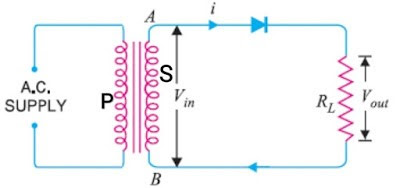
The arrangement for a half-wave rectifier is shown in Fig. The AC input voltage is fed across the primary coil P of a suitable step-down transformer. The secondary coil S of the transformer is connected to the semiconductor p-n junction diode D and a load resistance RL.

Half-wave rectifier

Working Method

Let during the first half of the AC input cycle, the end A of secondary S of the transformer be at positive potential and end B at the negative potential. In this situation, the diode is forward biased and a current flows in the circuit. Consequently, an output voltage across load RL is obtained.

During the second half of AC input, the end A of secondary S of transformer is at negative potential and diode D is in reverse bias. So, no current flows through load RL and there is no output voltage across RL.

In the next positive half-cycle of AC input, we again get the output and so on. Thus, we get output voltage as shown in Fig. Here, the output voltage, though still varying in magnitude, is restricted to only one direction and is said to be rectified. Since the rectified output of the circuit is obtained only for half of the input AC wave, the device is called a half-wave rectifier.

(b) Full-wave rectifier

A full-wave rectifier is a rectifier that rectifies both halves of each AC input cycle and gives a unidirectional output voltage continuously.

Construction

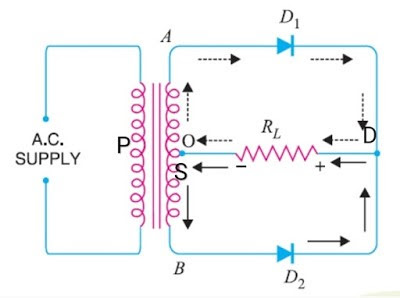
In a full-wave rectifier, we use two semiconductor diodes that operate in a complementary mode. The AC input supply is fed across the primary coil P of a center tap transformer. The two ends A and B of the second S of the transformer are connected to the p-ends of the Diodes D1 and D2 respectively. A load resistance RL is connected between the n-terminal of both the Diodes and the center tapping O of the second of the transformer. The DC output is obtained across load residence RL.

Full-wave rectifier

Working Method

During the first half cycle of the input voltage, the terminal A is positive with respect to O while B is negative with respect to O. Diode first is forward bias and conducts while diode second is reverse bias and does not conduct, the current flow through RL from D To O. During the second half cycle, A is negative and B is positive with respect to O, thus diode first is reverse bias and diode second is forward biased. The current through RL is in the same direction as during the first half cycle. The resulting output current is a continuous series.

As we are getting output in the positive half as well as the negative half of the AC input cycle, the rectifier is called a full-wave rectifier. Obviously, this is a more efficient circuit for getting rectified voltage or current than a half-wave rectifier.

Full-wave rectifier curve | M Physics

Special Purpose p-n Junction Diodes

Junction diodes are of many types and find a wide range of applications in electronics. Some of them are discussed below.

(i). Zener diode

The specially designed junction diodes which can operate in the reverse breakdown voltage region continuously without being damaged, are called Zener diodes. These are generally highly doped Silicon diodes. Silicon is preferred over germanium because of its higher thermal stability. A Zener diode is represented by the symbol shown as.

Symbol of zener diode

Zener diode as a voltage regulator

An important application of the Zener diode is that it can be used as a voltage regulator. The regulating action takes place because of the fact that in the reverse breakdown region, a very small change in voltage produces a very large change in current. In the Zener region, the resistance of the Zener diode drops considerably.

Semiconductor Electronics: Materials, Devices and Simple Circuits Class 12 Physics Notes

Let us consider a Zener diode and a dropping resistor R connected to a fluctuating dc supply such that the Zener diode is reverse biased. When the applied voltage is such that the voltage across Zener is less than Zener voltage, the diode will not conduct. Hence, the output voltage will be proportional to the input voltage and is given by Vout=RLRS+RLVInVout=RLRS+RLVIn, but when the input voltage is such that the voltage developed across the Zener is more than Zener voltage, the diode will conduct and will offer very small resistance.

Hence, it will allow all the extra current, and the output voltage will be equal to Zener voltage i.e., Vout = Vz. But every Zener diode has a certain value of current limit and corresponding power limit. If the current in the Zener diode exceeds this limit, the diode will burn out. Zener diode is always used in reverse bias.

(ii). Photodiode

junction diode made from a photosensitive semiconductor is called a photodiode. In photodiode one region is made so thin that incident light may reach the depletion region.

Semiconductor Electronics: Materials, Devices and Simple Circuits Class 12 Physics Notes

The photodiode is operated under reverse bias. When the photodiode is illuminated with energy greater than the energy gap (Eg) of the semiconductor, then electron-hole pairs are generated. The construction of a photodiode is such that electron-hole pairs are generated in or near the depletion region of the diode.

Inside the diode, the electric field is such that electrons are collected on N-side, and holes are collected on P-side giving rise to an emf. Hence, when external resistance is connected than current flows through it. The photocurrent is proportional to incident light intensity. Photodiodes can be used as a photodetector to detect optical signals.

(iii). Light-Emitting Diode (LED)

A light-emitting diode is a heavily doped p-n junction encapsulated with a transparent cover so that emitted light can come out. When the forward current of the diode is small the intensity of light emitted is small. As the forward current increases, intensity of light increases and reaches a maximum. Further increase in the forward current results in decrease of light intensity. LEDs are biased such that the light-emitting efficiency is maximum.

Semiconductor Electronics: Materials, Devices and Simple Circuits Class 12 Physics Notes

LEDs are used in remote controls, burglar alarm systems, optical communication systems, etc. Advantages of LEDs over low-power conventional incandescent lamps are that they have less operational voltages, less power consumption, fast action with no warm-up time, are nearly monochromatic, have long life and ruggedness, and have quick switching on-off capability.

(iv). Solar cell

In a solar cell, one region is made very thin so that most of the light incident on it reaches the depletion region. In this diode when photons of visible light incident to depletion region, electrons jump from the valence band to the conduction band producing electron-hole pairs. These free electrons under the influence of the barrier electric field move to the n region and holes move to the p region, so the potential of the p region increases, and that of n region decreases. A net potential difference develops across the junction.

Semiconductor Electronics: Materials, Devices and Simple Circuits Class 12 Physics Notes

Junction Transistor

transistor (also called junction transistor) is a three-terminal semiconductor device in which a p-type or n-type semiconductor is fabricated between two n-type or two p-type layers. There are two types of transistors.

  1. p-n-p transistor.
  2. n-p-n transistor.

(i). p-n-p Transistor

It consists of a very thin layer of n-type semiconductors developed between two thick layers of p-type semiconductors. In this symbolic representation, the direction of the arrow shows the direction of the conventional current. The central part (which is very thin) is called the “base” while the left and right parts are known as the emitter and the collector respectively. The emitter-base (p-n) junction is forward-biased and the base-collector (n-p) junction is reverse-biased in case of active operation of the junction transistor.

Semiconductor Electronics: Materials, Devices and Simple Circuits Class 12 Physics Notes

Action of p-n-p transistor

The emitter base of p-n-p transistor is forward-biased by connecting it to positive pole of emitter-base battery VEE and the collector is reverse-biased by connecting it to the negative pole of the collector-base battery VCC.

Semiconductor Electronics: Materials, Devices and Simple Circuits Class 12 Physics Notes

Holes being the majority carriers in emitter are repelled due to forward bias towards the base. As the base is thin and lightly doped, it has a low density of electrons. Therefore, when the holes enter the base region, only about 5% electron-hole combination takes place.

The remaining holes reach the collector under the influence of reverse collector voltage, an electron leaves the negative pole of collector-base battery ECB and neutralizes it. At the same time, an electron from some covalent bond in the emitter enters the positive terminal of EEB, creating a hole in the emitter. Thus, the current in the p-n-p transistor is carried by holes and at the same time, their concentration is maintained as explained above. In this case also,

Ie=Ib+IcIe=Ib+Ic

(ii). n-p-n Transistor

It consists of the thin layer of p-type semiconductors developed between two small n-type semiconductors layers.

Semiconductor Electronics: Materials, Devices and Simple Circuits Class 12 Physics Notes

Action of n-p-n transistor

To understand the action of n-p-n transistor, the n-type emitter is forward – biased by the help of battery VEE and the collector base is reverse-biased by the help of battery VCC.

Semiconductor Electronics: Materials, Devices and Simple Circuits Class 12 Physics Notes

The electrons being majority carriers in the emitter are repelled due to forward bias towards the base. The base contains holes as the majority of carriers and some holes and electrons combine in the base region but the base is lightly doped. Due to this, the probability of electron-hole combination in the base region is very small (< 5%).

The remaining electrons cross into the collector region and enter the positive terminal of the battery VCC connected to the collector. At the same time, an electron enters the emitter from the negative pole of the emitter-base battery VEE. Thus, in n-p-n transistors, the current is carried inside the transistor as well as in the external circuit by the electrons. If Ie, Ib and Ic are the emitter current, the base current, and the collector current, respectively, then

Ie=Ib+IcIe=Ib+Ic

Digital Electronics and Logic Gates

gate is a logic circuit that has one or more inputs but only one output. It follows a logical relationship between input and output voltages and for this reason, they are called logic gates.

Each logic gate has its characteristic symbol and its function is defined either by a truth table or by a Boolean expression. In digital circuits, low and high voltage is often represented by 0 and 1, respectively.

Truth table: It is a table that shows all input/output possibilities for a logic gate. It is also called a table of combinations.

Boolean expression: George Boole invented a different kind of algebra-based on the binary nature of logic. It was first applied to switching circuits, as a switch is a binary device.

There are three basic logic gates:

(i) OR gate (ii) AND gate, and (iii) NOT gate.

(i). NOT Gate

This is the most basic gate, with one input and one output. It produces an inverted version of the input at its output i.e., it produces a ‘1’ output if the input is ‘0’ and vice versa. This is why it is also known as an inverter.

Semiconductor Electronics: Materials, Devices and Simple Circuits Class 12 Physics Notes

(ii). OR Gate

In Boolean algebra, the addition symbol (+) is referred to as OR. The Boolean expression Y = A + B implies Y equals A OR B. The OR gate is a device that combines A with B to give Y as the result. The OR gate is two or more inputs and one output device.

Semiconductor Electronics: Materials, Devices and Simple Circuits Class 12 Physics Notes

(iii). AND Gate

The multiplication sign [dot (.)] is referred to as AND in Boolean algebra. The Boolean expression Y = A . B implies Y equals A AND B. The AND gate is a device that combines A with B to give Y as the result. The AND gate is two or more inputs and one output device.

Semiconductor Electronics: Materials, Devices and Simple Circuits Class 12 Physics Notes

Combination of Gates

(i). The NAND gate

If the output Y’ of AND gate is connected to the input of the NOT gate, the gate so obtained is called the NAND gate. Boolean expression for the NAND gate is Y=¯¯¯¯¯¯¯¯A.BY=A.B¯

Semiconductor Electronics: Materials, Devices and Simple Circuits Class 12 Physics Notes

(ii). The NOR gate

If the output (Y’) of the OR gate is connected to the input of a NOT gate, the gate so obtained is called the NOR gate. Boolean expression for the NOR gate is Y=¯¯¯¯¯¯¯¯¯¯¯A+BY=A+B¯

Semiconductor Electronics: Materials, Devices and Simple Circuits Class 12 Physics Notes

Integrated Circuits

In modern days, many logical gates or circuits are integrated in one single ‘chip’. These ‘chips’ are known as integrated circuits (ICs). An IC consists of many passive components like R and C (not L) and active devices like diodes and transistors on a single block (chip) of a semiconductor. The most widely used technology is the monolithic integrated circuit.

Read More

Chapter 13 Nuclei | class 12th | quick revision notes physics

Chapter 13 Nuclei Hand Written Notes

Class 12 Physics Revision Notes Chapter 13 Nuclei

  • Atomic Number: The number of protons in the nucleus is called the atomic number. It is denoted by Z.
  • Mass number: The total number of protons and neutrons present in a nucleus is called the mass number of the element. It is denoted by A.
  • No. of Protons, Electrons, Nucleons, and Neutrons in an Atom:
  1. Number of protons in an atom = Z
  2. Number of electrons in an atom = Z
  3. Number of nucleons in an atom = A
  4. Number of neutrons in an atom = N = A – Z.
  • Nuclear Mass: The total mass of the protons and neutrons present in a nucleus is called the nuclear mass.
  • Nuclide: A nuclide is a specific nucleus of an atom characterized by its atomic number Z and mass number A. It is represented as, 

Where X = chemical symbol of the element, Z = atomic number and A = mass number

  • Isotopes:
  1. The atoms of an element which have the same atomic number but different mass number are called isotopes.
  2. Isotopes have similar chemical properties but different physical properties.
  • Isobars: The atoms having the same mass number but different atomic number are called isobars.
  • Isotones: The nuclides having the same number of neutrons are called isotones.
  • Isomers: These are nuclei with same atomic number and same mass number but in different energy states.
  • Electron Volt: It is defined as the energy acquired by an electron when it is accelerated through a potential difference of 1 volt and is denoted by eV.
  • Atomic Mass Unit:
  1. It is  of the actual mass of a carbon atom of isotope . It is denoted by amu or just by u.
  2. 1 amu = kg
  3. The energy equivalence of 1 amu is 1 amu = 931 MeV
  • Discovery of Neutrons:
  1. Neutrons were discovered by Chadwick in 1932.
  2. When beryllium nuclei are bombarded by alpha-particles, highly penetrating radiations are emitted, which consists of neutral particles, each having mass nearly that of a proton. These particles were called neutrons.Nuclei Class 12 Notes Physics
  3. A free neutron decays spontaneously, with a half- life of about 900 s, into a proton, electron and an antineutrino.Nuclei Class 12 Notes Physics
  • Size of the Nucleus:
  1. It is found that a nucleus of mass number A has a radius
    1. Nuclei Class 12 Notes Physics
    Where, Nuclei Class 12 Notes Physics
  2. This implies that the volume of the nucleus, which is proportional to R3 is proportional to A.
  • Density of the Nucleus: Density of nucleus is constant; independent of A, for all nuclei and density of nuclear matter is approximately Nuclei Class 12 Notes Physics

which is very large as compared to ordinary matter, say water which is 103 kg m-3.

  • Mass-Energy equivalence: Einstein proved that it is necessary to treat mass as another form of energy. He gave the mass-energy equivalence relation as, E = mc2 Where m is the mass and c is the velocity of light in vacuum.
  • Mass Defect: The difference between the rest mass of a nucleus and the sum of the rest masses of its constituent nucleons is called its mass defect. It is given by-
Nuclei Class 12 Notes Physics
  • Binding Energy:
  1. It may be defined as the energy required to break a nucleus into its constituent protons and neutrons and to separate them to such a large distance that they may not interact with each other.
  2. It may also be defined as the surplus energy which the nucleus gives up by virtue of their attractions which they become bound together to form a nucleus.
  3. The binding energy of a nucleus Nuclei Class 12 Notes Physics is-
Nuclei Class 12 Notes Physics
  • Binding Energy per Nucleon: It is average energy required to extract one nucleon from the nucleus.

It is obtained by dividing the binding energy of a nucleus by its mass number.

Nuclei Class 12 Notes Physics
  • Nuclear Forces:
  1. These are the strong in attractive forces which hold protons and neutrons together in a tiny nucleus.
  2. These are short range forces which operate over very short distance of about 2 – 3 fm of separation between any two nucleons.
  3. The nuclear force does not depend on the charge of the nucleon.
  • Nuclear Density: The density of a nucleus is independent of the size of the nucleus and is given by-
Nuclei Class 12 Notes Physics
  • Radioactivity:
  1. It is the phenomenon of spontaneous disintegration of the nucleus of an atom with the emission of one or more radiations like -particles, -particles or -rays.
  2. The substances which spontaneously emit penetrating radiation are called radioactive substances.
  • Radioactivity Displacement Law: It states that-
  1. When a radioactive nucleus emits an -particle, atomic number decreases by 2 and mass number decreases by 4.
  2. When a radioactive nucleus emits -particle, its atomic number increases by 1 but mass number remains same.
  3. The emission of a -particle does not change the mass number or the atomic number of the radioactive nucleus. The -particle emission by a radioactive nucleus lowers its energy state.
  • Alpha Decay: It is the process of emission of an -particle from a radioactive nucleus. It may be represented as,
Nuclei Class 12 Notes Physics
  • Beta Decay: It is the process of emission of an electron from a radioactive nucleus. It may be represented as,
Nuclei Class 12 Notes Physics
  • Gamma Decay: It is the process of emission of a -ray photon during the radioactive disintegration of a nucleus. It can be represented as,
Nuclei Class 12 Notes Physics
  • Radioactive Decay Law: It states that the number of nuclei disintegrated of undecayed radioactive nuclei present at that instant. It may be written as-
Nuclei Class 12 Notes Physics

WhereN(0) is the number of nuclei at t = 0 and is disintegration constant.

  • Decay or disintegration Constant: It may be defined as the reciprocal or the time interval in which the number of active nuclei in a given radioactive sample reduces to 36.8% of its initial value.
  • Half-life: The half-life of a radioactive substance is the time in which one-half of its nuclei will disintegrate. It is inversely proportional to the decay constant of the radioactive substance.
Nuclei Class 12 Notes Physics
  • Mean Life: The mean-life of a radioactive sample is defined as the ratio of the combined age of all the atoms and the total number of atoms in the given sample. It is given by,
Nuclei Class 12 Notes Physics
  • Rate of Decay or Activity of a Radioactive Sample: It is defined as the number of radioactive disintegrations taking place per second in a given sample. It is expressed as-
Nuclei Class 12 Notes Physics
  • Curie:
  1. It is the SI unit of decay.
  2. One curie is the decay rate of 3.7 X 10¹⁰ disintegrations per second.
  • Rutherford: One Rutherford is the decay rate of 106 disintegrations per second.
  • Natural Radioactivity: It is the phenomenon of the spontaneous emission of ,   and  radiations from the nuclei of naturally occurring isotopes.
  • Artificial or Induced Radioactivity: It is the phenomenon of inducing radioactivity in certain stable nuclei by bombarding them by suitable high energy sub atomic particles.
  • Nuclear Reaction: It is a reaction which involves the change of stable nuclei of one element into the nucleus of another element.
  • Nuclear Fission: It is the process in which a heavy nucleus when excited gets split into two smaller nuclei of nearly comparable masses. For example-
Nuclei Class 12 Notes Physics
  • Nuclear Reactor: It is a device in which a nuclear chain reaction is initiated, maintained and controlled.
  • Nuclear Fusion: It is the process of fusion of two smaller nuclei into a heavier nucleus with the liberation of large amount of energy.
  • Critical size and Critical Mass:
  1. The size of the fissionable material for which reproduction factor is unity is called critical size and its mass is called critical mass of the material.
  2. The chain reaction in this case remains steady or sustained.
  • Moderator:
  1. Any substance which is used to slow down fast moving neutrons to thermal energies is called a moderator.
  2. The commonly used moderators are water, heavy water (D2O) and graphite.
Read More

Chapter 12 Atoms | class 12th | quick revision notes physics | Hand Written notes

Chapter 12 Atoms Class 12 Hand Written notes Physics

Atoms Class 12 notes Physics Chapter 12

Introduction

In this chapter, we will study various atomic models. Initially, J.J. Thomson proposed an atomic model in which he thought of as electrons embedded in between protons. In 1911, his student Earnest Rutherford proposed a nuclear model, on the basis of a scattering experiment. In spite of strong experimental evidence, Rutherford’s model of the atom was rejected on the ground of the classical theory of electromagnetism.

So in order to rectify the shortcomings of Rutherford’s model, in 1913, Niels Bohr combined the classical and early quantum concepts of Einstein and Plank to explain the stability of an atom.

Thomson Model

According to Thomson, “An atom consists of positively charged matter, into which negatively charged particles are embedded randomly”. But this model did not last long as it could not explain the observations of Rutherford’s alpha-particle scattering experiment.

Alpha-Particle Scattering

In 1911, Rutherford, along with his assistants, H. Geiger and E. Marsden, performed the Alpha Particle scattering experiment, which led to the birth of the ‘nuclear model of an atom’.

They took a thin gold foil having a thickness of 2.1×10⁻⁷ m and placed it in the center of a rotatable detector made of zinc sulfide and a microscope. Then, they directed a beam of 5.5MeV alpha particles emitted from a radioactive source at the foil. Lead bricks collimated these alpha particles as they passed through them.

Atoms Class 12 Physics Notes

After hitting the foil, the scattering of these alpha particles could be studied by the brief flashes on the screen. Rutherford and his team expected to learn more about the structure of the atom from the results of this experiment.

Observations

Here is what they found:

  1. Most of the alpha particles passed through the foil without suffering any collisions
  2. Around 1 in 8000 alpha particles deflected by more than 90o

Rutherford’s Nuclear Model

In 1912, Rutherford proposed his nuclear model of the atom. It is also known as Rutherford’s planetary model of the atom. Salient features of Rutherford’s atom model are as follows :

  1. Every atom consists of a tiny central core, named nucleus, in which the entire positive charge and the almost whole mass of the atom are concentrated. The size of the nucleus is typically 10-4 times the size of an atom.
  2. Most of an atom is empty space.
  3. In free space around the nucleus, electrons would be moving in orbits just as the planets do around the sun. The centripetal force needed for the orbital motion of electrons is provided by electrostatic attractive forced experience by electrons due to a positively charged nucleus.
  4. An atom as a whole is electrically neutral. Thus, the total positive charge of the nucleus is exactly equal to the total negative charge of all the electrons orbiting in an atom.

Bohr Model of the Hydrogen Atom

It was Niels Bohr (1885-1962) who used the concept of quantized energy and explained the model of a hydrogen atom in 1913. Bohr combined classical and early quantum concepts and proposed a theory in the form of three postulates. These postulates are:

  1. Postulate I: An electron in an atom could revolve in certain stable orbits without emitting radiant energy. Each atom has certain definite stable orbits. Electrons can exist in these orbits. Each possible orbit has definite total energy. These stable orbits are called the stationary states of the atom.
  2. Postulate II: An electron can revolve around the nucleus in an atom only in those stable orbits whose angular momentum is the integral multiple of h/2π (where h is Planck’s constant). Therefore, the angular momentum (L) of the orbiting electron is quantized.mvr=nh2πmvr=nh2π  where, n = 1, 2, 3, …..
  3. Postulate III: An electron can make a transition from its stable orbit to another lower stable orbit. While doing so, a photon is emitted whose energy is equal to the energy difference between the initial and final states. Therefore, the energy of photon is given by,hυ = Ei – Efwhere Ei and Ef are the energies of the initial and final states.

Ground State and the Excited States

The lowest energy level of an atom is called the “ground state” and higher levels are called “excited states”. The H-atom has the lowest energy in the state for the principal quantum number n = 1. and all other states (i.e, for n = 2, 3, 4…) are excited states. Thus E2, E3, E4 …are called the first, the second, and the third …excited states respectively.

Ionisation Energy and Ionisation Potential

The minimum energy needed to ionize an atom is called “ionisation energy”. The potential difference through which an electron should be accelerated to acquire this much energy is called “ionisation potential”. Hence, ionisation energy of H-atom in the ground state is 13.6 eV and ionisation potential is 13.6 V.

Binding Energy

The binding energy of a system is defined as the minimum energy needed to separate its constituents over large distances. This may also be defined as the energy released when its constituents are brought from infinity to form the system. The binding energy of H-atom in the ground state is 13.6 eV which is the same as its ionization energy.

Excitation Energy and Excitation Potential

The energy needed to take an atom from its ground state to an excited state is called the “excitation energy” of that excited state. The potential through which an electron should be accelerated to acquire this energy is called the “excitation potential”.

The Line Spectra of the Hydrogen Atom

Bohr’s model explains the spectral lines of the hydrogen atomic emission spectrum. While the electron of the atom remains in the ground state, its energy is unchanged. When the atom absorbs one or more quanta of energy, the electron moves from the ground state orbit to an excited state orbit that is further away. When the atom relaxes back to a lower energy state, it releases energy that is again equal to the difference in energy of the two orbits.

Based on the wavelengths of the spectral lines, Bohr was able to calculate the energies that the hydrogen electron would have in each of its allowed energy levels. He then mathematically showed which energy level transitions corresponded to the spectral lines in the atomic emission spectrum.

The general formula for wavelength of emitted radiation is given by

1λ=R(1n21−1n22)1λ=R(1n12-1n22)

where n2 = 2, 3, 4, …. and n2 > n1

R = 1.01 x 10⁷ m-1 = Rydberg constant

Atoms Class 12 Physics Notes

He found that the four visible spectral lines corresponded to transitions from higher energy levels down to the second energy level (n = 2). This is called the Balmer series. Transitions ending in the ground state (n = 1) are called the Lyman series, but the energies released are so large that the spectral lines are all in the ultraviolet region of the spectrum. The transitions called the Paschen series and the Brackett series both result in spectral lines in the infrared region because the energies are too small.

de-Broglie’s Explanation of Bohr’s Second Postulate

de-Broglie explained the second postulate of Bohr’s atomic model by assuming an electron to be a particle wave. Therefore, it should form standing waves under resonance conditions.

Atoms Class 12 Physics Notes

According to de-Broglie, for an electron moving in nth circular orbit of radius r,

2πr = nλ     n = 1, 2, 3, …..

i.e., the circumference of the orbit should be an integral multiple of the de-Broglie wavelength of an electron moving in nth orbit. As we know that de-Broglie wavelength,

λ=hmvλ=hmv

2πr=nhmv2πr=nhmv

mvr=nh2π

Read More

Chapter 11 Dual Nature of Radiation and Matter | class 12th | quick revision notes physics | Hand Written Notes

Chapter-11 Dual Nature of Radiation and Matter Hand Written Notes

Class 12 Physics Revision Notes Chapter-11 Dual Nature of Radiation and Matter

  • Electric Discharge: The passage of an electric current through a gas is called electric discharge.
  • Discharge Tube: A hard glass tube along with the necessary arrangement, which is used to study the passage of electric discharge through gases at low pressure, is called a discharge tube.
  • Cathode Rays: Cathode rays are the stream of negatively charged particles, electrons which are shot out at a high speed from the cathode of a discharge tube at pressure below 0.01 mm of Hg.
  • Work Function: The minimum amount of energy required by an electron to just escape from the metal surface is known as work function of the metal.
  • Electron Emission: The minimum amount of energy required by an electron to just escape from the metal surface is known as work function of the metal.
  • Thermionic Emission: Here electrons are emitted from the metal surface with the help of thermal energy.
  • Field or Cold Cathode Emission: Electrons are emitted from a metal surface by subjecting it to a very high electric field.
  • Photoelectric Emission: Electrons emitted from a metal surface with the help of suitable electromagnetic radiations.
  • Secondary Emission: Electrons are ejected from a metal surface by striking over its fast-moving electrons.
  • Forces Experienced by an Electron in Electric and Magnetic Fields:-
  1. Electric field: The force FE experienced by an electron e in an electric field of strength (intensity) E is given by, FE eE
  2. Magnetic field: The force experienced by an electron e in a magnetic field of strength B weber/m2 is given by,FB=Bev
    where v is the velocity with which the electron moves in the electric field and the magnetic field, perpendicular to the direction of motion.
  3. If the magnetic field is parallel to the direction of motion of electron, then, FB 0.
  • Photoelectric Effect: The phenomenon of emission of electrons from the surface of substances (mainly metals), when exposed to electromagnetic radiations of suitable frequency, is called photoelectric effect and the emitted electrons are called photoelectrons.
  • Maximum K. E of the Photoelectrons Emitted from the Metal Surface:

    (Einstein’s Photoelectric equation)
  • Cut Off or Stopping Potential: The value of the retarding potential at which the photoelectric current becomes zero is called cut off or stopping potential for the given frequency of the incident radiation.
    Dual Nature of Radiation and Matter Class 12 Notes Physics
  • Threshold Frequency: The minimum value of the frequency of incident radiation below which the photoelectric emission stops altogether is called threshold frequency.
  • Laws of Photoelectric Effect:
  1. For a given metal and a radiation of fixed frequency, the number of photoelectrons emitted is proportional to the intensity of incident radiation.
  2. For every metal, there is a certain minimum frequency below which no photoelectrons are emitted, howsoever high is the intensity of incident radiation. This frequency is called threshold frequency.
  3. For the radiation of frequency higher than the threshold frequency, the maximum kinetic energy of the photoelectrons is directly proportional to the frequency of incident radiation and is independent of the intensity of incident radiation.
  4. The photoelectric emission is an instantaneous process.
    Dual Nature of Radiation and Matter Class 12 Notes Physics
Dual Nature of Radiation and Matter Class 12 Notes Physics
  • Einstein’s Theory of Photoelectric Effect:-
  1. Einstein explained photoelectric effect with the help of Planck’s quantum theory.
  2. When a radiation of frequency  is incident on a metal surface, it is absorbed in the form of discrete packets of energy called quanta or photons.
  3. A part of energy  of the photon is used in removing the electrons from the metal surface and remaining energy is used in giving kinetic energy to the photoelectron.
  4. Einstein’s photoelectric equation is,Dual Nature of Radiation and Matter Class 12 Notes Physics
    Where wo is the work function of the metal.
  5. If  is the threshold frequency, then Dual Nature of Radiation and Matter Class 12 Notes Physics
  6. All the experimental observations can be explained on the basis of Einstein’s photoelectric equation.
  • Compton Shift: It is the phenomenon of increase in the wavelength of X-ray photons which occurs when these radiations are scattered on striking an electron. The difference in the wavelength of scattered and incident photons is called Compton shift, which is given by
    Dual Nature of Radiation and Matter Class 12 Notes Physics
    Where  is the angle of scattering of the X-ray photon and m0 is the rest mass of the electron.
  • Charge and Mass of an Electron by Thomson’s Method:
  1. J. J. Thomson devised an experiment to determine the velocity (v) and the ratio of the charge (e) to the mass (m) i.e., Dual Nature of Radiation and Matter Class 12 Notes Physics of cathode rays.
  2. In this method, electric field  and magnetic field  are applied on the cathode rays.
  3. In the region where they are applied perpendicular to each other and to the direction of motion of cathode rays,
    Force due to electric field, FE = Force due to magnetic field FBDual Nature of Radiation and Matter Class 12 Notes Physics
    Also, Dual Nature of Radiation and Matter Class 12 Notes Physics
    Where V = Potential difference between the two electrodes (i.e., P and Q), d = distance between the two electrodes, R = radius of circular arc in the presence of magnetic field B, x = shift of the electron beam on the screen,
    l = length of the field and L = distance between the centre of the field and the screen.
  • Milliken’s Oil Drop Method:
  1. This method helps to determine the charge on the electron.
  2. Let    be the density of oil,   is the density of the medium in which oil drop moves and  the coefficient of viscosity of the medium, then the radius r of the drop isDual Nature of Radiation and Matter Class 12 Notes Physics Where v0 is the terminal velocity of the drop under the effect of gravity alone.
  3. At the terminal velocity v0, the force due to viscosity becomes equal to the weight of the body.
  4. The charge on oil drop isDual Nature of Radiation and Matter Class 12 Notes Physics
    Where v1 is the terminal velocity of the drop under the influence of electric field and gravity and E is the applied electric field.
  • Photocell:
  1. It is an arrangement which converts light energy into electric energy.
  2. It works on the principle of photoelectric effect.
  3. It is used in cinematography for the reproduction of sound.
  • Dual Nature of Radiation: Light has dual nature. It manifests itself as a wave in diffraction, interference, polarization, etc., while it shows particle nature in photoelectric effect, Compton scattering, etc.
  • Dual Nature of Matter:
  1. As there is complete equivalence between matter (mass) and radiation (energy) and the principle of symmetry is always obeyed, de Broglie suggested that moving particles like protons, neutrons, electrons, etc., should be associated with waves known as de Broglie waves and their wavelength is called de Broglie wavelength.
  2. The de Broglie wavelength of a particle of mass m moving with velocity v is given by-
     Where h is Planck’s constant.
  • Davison and Germer Experiment: This experiment help to confirm the existence of de Broglie waves associated with electrons.
  • De Broglie Wavelength of an Electron: The wavelength associated with an electron beam accelerated through a potential.
    Dual Nature of Radiation and Matter Class 12 Notes Physics
  • de Broglie wavelength associated with the particle of momentum p is-

    Dual Nature of Radiation and Matter Class 12 Notes Physics
    Where V is the magnitude of accelerating potential.
  • Heisenberg Uncertainty Principle:  Dual Nature of Radiation and Matter Class 12 Notes Physics Where  is uncertainty in position & Dual Nature of Radiation and Matter Class 12 Notes Physics is uncertainty in momentum
  • Electron Microscope:
  1. It is a device which makes use of accelerated electron beams to study very minute objects like viruses, microbes and the crystal structure of solids.
  2. It has a magnification of .
  • Davisson-Germer Electron Diffraction Arrangement:
    Dual Nature of Radiation and Matter Class 12 Notes Physics
    Dual Nature of Radiation and Matter Class 12 Notes Physics
Read More

Chapter 10 Wave Optics | class 12th | quick revision notes physics | Hand Written notes

Chapter 10 Wave Optics Class 12 notes Physics Hand Written notes

Wave Optics Class 12 notes Physics Chapter 10

Introduction

In this chapter you will get to know that light does not always travel in a straight line, indeed light is a wave. It interferes, it diffracts and it even undergoes polarization. This new branch of Physics that deals with the wave nature of light is called “Wave Optics”.

Models of Light

(i). Corpuscular model

According to this model, a luminous body emits a stream of particles in all directions. The particles are assumed to be very very tiny. It explained the laws of reflection and refraction of light at an interface using concepts of elastic collisions and momentum conservation. Although this law could explain reflection and refraction, this law could not satisfactorily explain a phenomenon like interference, polarization, and diffraction. In 1637, Descartes gave the corpuscular model of light.

(ii). Wave model

The wave theory of light was first put forward by Christian Huygen in 1678. On the basis of his wave theory, Huygen explained satisfactorily the phenomenon of reflection, refraction, and total internal reflection.

Huygens’ Principle

According to this principle,

  1. Each point of a wavefront is a source of secondary disturbance and the wavelets emanating from these points spread out in all directions with the speed of the wave.
  2. The envelope of these wavelets gives the shape of the new wavefront.
  3. If we draw a common tangent to all these spheres, then we obtain an envelope which is again a sphere centered at the point source.
Wave Optics Class 12 Physics Notes

Application of Huygens’ Principle

(i). Reflection of a Plane Wave

Let us consider a plane wave AB incident at an angle ‘i’ on a reflecting surface MN.

Wave Optics Class 12 Physics Notes

Time taken by the wave to advance to point C from point B will be t.

Hence BC = vt

Let EC represent a tangent drawn from C to wavefront from E to the spherical wavefront.

AE = vt

Consider, ΔAEC and ΔABC

AC = AC (Common side)

∠AEC = ∠ABC (Each 90°)

AE = BC (Each vt)

Hence, ΔAEC ≅ ΔABC

∠i = ∠r

which proves the law of reflection.

(ii). Refraction of a Plane Wave

Let v1 and v2 represent the speed of light in medium-1 and medium-2 respectively. Consider a plane wavefront AB propagating in the direction AA’, incident on the medium boundary at point A at an angle of incidence ‘i’. Let t be the time taken to travel from B to C.

Wave Optics Class 12 Physics Notes

BC = v1t

From point A, draw a sphere of radius v2t, let CE represent the forward tangent plane. It is refracted wavefront at t.

AE = v2t

From ΔABC, sini=BCAC=v1tACsini=BCAC=v1tAC …..(i)

From ΔAEC, sinr=AEAC=v2tACsinr=AEAC=v2tAC …..(ii)

Dividing (i) by (ii), we have

sinisinr=v1tv2tsinisinr=v1tv2t

sinisinr=v1v2sinisinr=v1v2

which proves law of refraction.

Wavefront

wavefront is a continuous locus of all those points in a medium that oscillate in the same phase. The physical view of a wavefront is the ripples on a water surface. When a stone is dropped in a water pond, the disturbance travels radially outward and what you see are circular wave-fronts traveling outward.

Types of Wavefront

Depending on the mode of propagation of light or the source, the wave fronts can be converging, diverging, or plane. For a point source, spherical diverging wavefronts are formed. For an extended line source, cylindrical diverging wavefronts are formed. For a source at infinity, a plane wavefront exists.

Wave Optics Class 12 Physics Notes

The Doppler’s Effect

When light-producing source moves away from the observer the frequency as measured by the observer will be smaller than that is actually generated by the source. Astronomers call the increase in wavelength due to the Doppler effect redshift.

When an observer moves toward the source or the source move towards the observer, then apparent wavelength decreases and the visible spectrum appears to be shifted towards a shorter wavelength. Hence, we call this a blue shift.

Coherent and Incoherent Sources of Light

(i). Coherent sources

Two sources of light that continuously emit light waves of the same frequency (or wavelength) with a zero or constant phase difference between them are called coherent sources. Ex- LASER.

(ii). Incoherent sources

Two sources of light that do not emit light waves with a constant phase difference are called incoherent sources. Ex- Two different light sources produce incoherent waves.

Interference of Light Wave

Interference is the phenomenon in which two waves superpose to form the resultant wave of the lower, higher, or same amplitude. When the crest of one wave falls on the crest of another wave such that the amplitude is maximum then interference is called constructive interference. When the crest of one wave falls on the trough of another wave such that the amplitude is minimum then interference is called destructive interference.

Wave Optics Class 12 Physics Notes

Conditions for sustained interference

  1. Two sources of light must be coherent.
  2. The frequencies (or wavelength) of the two waves should be equal.
  3. The light must be monochromatic.
  4. The amplitudes of the interfering waves must be equal or nearly equal.
  5. The two sources must be narrow.

Young’s Double Slit Experiment

In the diagram, S1 and S12 are narrow slits that are parallel to each other. As S is narrow, it diffracts the light that falls on it and illuminates both S1 and S2. Interference occurs in the region where the light from S1 overlaps that from S2. A series of alternately bright and dark bands can be observed on a screen placed in this region of overlap.

Wave Optics Class 12 Physics Notes

For a point P on the screen, the path difference,

S2P−S1P=dsinθS2P-S1P=dsinθ …..(i)

For very small θ,

sinθ≈tanθ=yDsinθ≈tanθ=yD ….(ii)

The phase difference between the waves at P = ф

ф=2πλ[S2P−S1P]ф=2πλ[S2P-S1P] ….(iii)

ф=2πλ(dyD)ф=2πλ(dyD)

For constructive interference,

ф = 2nπ (n = 0, 1, 2, ….)

2πλ(dyD)=2πn2πλ(dyD)=2πn

y=nλDdy=nλDd

Similarly for destructive interference,

y=(2n−1)λDd(n=1,2,….)y=(2n-1)λDd(n=1,2,….)

Fringe width

β=yn+1−ynβ=yn+1-yn

β=λDdβ=λDd

Diffraction

The phenomenon of bending light around the corners of an obstacle is called the diffraction of light.

Wave Optics Class 12 Physics Notes

Difference between Diffraction and Interference

S.No.InterferenceDiffraction
1.Interference may be defined as waves emerging from two different sources, producing different wavefronts.Diffraction, on the other hand, can be termed as secondary waves that emerge from the different parts of the same wave.
2.The intensity of all the points on maxima is of similar intensity in interference.In diffraction, there is a variance of the intensity of positions.
3.It is absolutely dark in the region of minimum intensity, in the case of interference.We see a variance in the intensity of interference in diffraction.
4.The width of the fringes in interference is equal in interference.The width of the fringes is not equal in interference.
5.The sources are referred to as interference sources if the number of sources is as few as two sources.If the number of sources is more than to the sources are referred to as diffraction sources.

Polarisation

If the vibrations of a wave are present in just one direction in a plane perpendicular to the direction of propagation, the wave is said to be polarised or plane polarised. The phenomenon of restricting the oscillations of a wave to just one direction in the transverse plane is called the polarization of waves.

Malus’ Law

It states that the intensity of plane-polarized light that passes through an analyzer varies directly with the square of the cosine of the angle between the plane of the polarizer and the transmission axes of the analyzer.

I=I0cos2θI=I0cos2θ

Polariser

A device that polarises the unpolarised light passed through it is called a polariser.

Optical Activity

When plane polarised light passes through certain substances, the plane of polarization of the light is rotated about the direction of propagation of light through a certain angle. This phenomenon is called optical activity or optical rotation and the substances are optically active.

Methods of producing plane polarised light

(i). Polarisation by reflection

When a light wave is incident on a boundary of a medium, a part of a light wave is reflected back into the medium from which it is incident and a part of the wave is refracted into the other medium.

When unpolarized light is incident on the boundary between two transparent mediums, for an angle of incidence in which the reflected wave travels at a right angle to the refracted wave, the reflected light is polarized while the refracted light is partially polarized.

Wave Optics Class 12 Physics Notes

Brewster’s Law

According to Brewster’s law, When unpolarized light is incident on a transparent substance surface, it experiences maximum plan polarization at the angle of incidence whose tangent is the refractive index of the substance for the wavelength.

n=tanin=tani (where i = incident angle)

Q. Show that reflected and refracted beams are mutually perpendicular when the angle of incidence is equal to the polarizing angle.

By Snell’s Law

n=sinisinrn=sinisinr …..(i)

By Brewster’s Law

n=tanin=tani …..(ii)

From eq. (i) and (ii)

sinisinr=tanisinisinr=tani

sinisinr=sinicosisinisinr=sinicosi

sinr=cosisinr=cosi

sinr=sin(90−i)sinr=sin(90-i)

r=90−ir=90-i

i+r=90i+r=90

(ii). Polarization by Scattering

When light is incident on the small particles of the atmosphere such as dust, and air molecules it is absorbed by the electrons in the molecules, hence electrons start vibrating. These vibrating electrons emit radiations in all directions except in their own line of vibration. The emitted radiations (light) scattered in a direction perpendicular to the direction of incident light are plane polarised. The light in all other directions is partially polarised.

Wave Optics Class 12 Physics Notes
Read More

 Chapter 9 Ray Optics and Optical Instruments | class 12th | quick revision notes physics | Handwritten Notes

Chapter 9 Ray Optics and Optical Instruments Handwritten Notes

Class 12 Physics Revision Notes Chapter 9 Ray Optics and Optical Instruments

  • Reflection: When light is incident on a surface, it is sent back by the surface in the same medium through which it had come. This phenomenon is called ‘reflection of light’ by the surface.
  • Laws of Reflection: The reflection at a plane surface always takes place in accordance with the following two laws:
    (i) The incident ray, the reflected ray and normal to surface at the point of incidence all lie in the same plane.
    (ii) The angle of incidence i is equal to the angle of reflection r, i. e., 
    Ray Optics and Optical Class 12 Notes Physics
  • Formation of Image by the Plane Mirror: The formation of image of a point object O by a plane mirror is represented in figure.
    Ray Optics and Optical Class 12 Notes Physics

The image formed has the following characteristics:-
(i) The size of image is equal to the size of object.
(ii) The object distance = Image distance i.e., OM = MI.
(iii) The image is virtual and erect.
(iv) When a mirror is rotated through a certain angle, the reflected ray is rotated through twice this angle.

Reflection of Light from Spherical Mirror:
a)  A spherical mirror is a part cut from a hollow sphere.
b)  They are generally constructed from glass.
c)  The reflection at spherical mirror also takes place in accordance with the laws of reflection.

  • Sign Convention: Following sign conventions are the new cartesian sign convention:-
    (i) All distances are measured from the pole of the mirror & the distances measured in the direction of the incident light is taken as positive. In other words, the distances measured toward the right of the origin are positive.
    (ii) The distance measured against the direction of the incident light are taken as negative. In other words, the distances measured towards the left of origin are taken as negative.
    (iii) The distance measured in the upward direction, perpendicular to the principal axis of the mirror, are taken as positive & the distances measured in the downward direction are taken as negative.
    Ray Optics and Optical Class 12 Notes Physics
  • Focal Length of a Spherical Mirror:
    a) The distance between the focus and the pole of the mirror is called focal length of the mirror and is represented by f.
    b) The focal length of a concave mirror is negative and that of a convex mirror is positive.
    c) The focal length of a mirror (concave or convex) is equal to half of the radius of curvature of the mirror, i.e., f = .
  • Principal Axis of the Mirror: The straight line joining the pole and the centre of curvature of spherical mirror extended on both sides is called principal axis of the mirror.
  • Mirror Formula: Ray Optics and Optical Class 12 Notes Physics
    Where u = distance of the object from the pole of mirror
    v = distance of the image from the pole of mirror
    f = focal length of the mirror
     Where R is the radius of curvature of the mirror.
  • Magnification: It is defined as the ratio of the size of the image to that of the object.
    Linear magnification, Ray Optics and Optical Class 12 Notes Physics
    Where = size of image and size of obje
  • Magnification, m is positive, implies that the image is real and inverted.
  • Magnification, m is negative, implies that the image is virtual and erect.

Image formation by a concave mirror:-

S.No.Position of objectPosition of imageNature of imageSize of image
1InfinityAt FReal and invertedHighly diminished
2Beyond CBetween F & CReal and invertedDiminished
3At CAt CReal and invertedSame size
4Between C & FBeyond CReal and invertedMagnified
5At FAt infinityReal and invertedHighly magnified
6Between F & PBehind the mirrorVirtual & erectMagnified

Image formation by a convex mirror:-

S.No.Position of objectPosition of imageNature of imageSize of image
1InfinityAt FVirtual & erectHighly diminished
2Between  and PBetween P and FVirtual & erectDiminished
  • Refraction: The phenomenon of the change in the path of light as it passes obliquely from one transparent medium to another is called refraction of light.
  • Laws of Refraction:
    (i) The incident ray, normal at the point of incidence and refracted ray all lies in the same plane.
    (ii) For the same pair of media and the same colour of light, the ratio of the sine of the angle of incidence to the sine of the angle of refraction is constant i.e., 
    Where   is a constant known as Refractive Index of the medium b with respect to the medium a, i is the angle of incidence in medium a and r is the angle of refraction in medium b.
  • Refractive index:- It is defined as the ratio of the speed of light in vacuum to its speed in that medium.
  • Principle of Reversibility of Light: As light follows a reversible path, 

    Multiplying we get,
  • Methods to Determine Refractive Index of a Medium: Refractive index of a medium can also be determined from the following:
    (i)   
    (ii)   
    Where is the critical angle.
  • Critical Angle: The Critical angle is the angle of incidence in a denser medium corresponding to which the refracted ray just grazes the surface of separation.
  • Total internal reflection: The phenomenon in which a ray of light travelling at an abgle of incidence greater than the critical angle from denser to a rarer medium is totally reflected back into the denser medium is called total internal reflection.
  • Apparent Depth of a Liquid: If the object be placed at the bottom of a transparent medium, say water, and viewed from above, it will appear higher than it actually is.
    The refractive index  in this case is:
    Refractive index of the medium,  = 
  • Normal shift: The height through which an object appears to be raised in a denser medium is called normal shift.
  • Refraction through a Single Surface: If  are refractive indices of rare and denser media respectively, R is the radius of curvature of spherical surface.
    When object is in rare medium: 
    When object is in denser medium: 
    where u and v are the distances of the object and the image from the centre of the refracting surface of radius of curvature R respectively.
  • Refraction through a Thin Lens (Lens maker’s formula): If R1 and R2 are radii of curvature of first and second refracting surfaces of a thin lens of focal length f, then lens-makers formula is 
    If the lens is surrounded by air,  and  , then 

Image formation by a convex lens:-

S.No.Position of objectPosition of imageNature of imageSize of image
1InfinityAt FReal and invertedHighly diminished
2Beyond 2FBetween F & 2FReal and invertedDiminished
3At 2FAt 2FReal and invertedSame size
4Between 2F & FBeyond 2FReal and invertedMagnified
5At FAt infinityReal and invertedHighly magnified
6Between F & OSame sideVirtual & erectMagnified

Image formation by a concave lens:-

S.No.Position of objectPosition of imageNature of imageSize of image
1InfinityAt FVirtual & erectHighly diminished
2Between  and OSame sideVirtual & erectDiminished
  • Thin lens formula: 
  • Magnification Produced by a Lens: 

Where I is the size of image and O is the size of object.

  • Power of a Lens: The power of a lens P is its ability to deviate the ray towards axis.
  • Focal Length of Thin Lenses: The focal length () of thin lenses of focal lengths placed in contact of each other is
  • Refraction Through Prism: When a ray of monochromatic light is refracted by a prism, the deviation  produced by the prism is 
    Where i = angle of incidence
    e = angle of emergence
    A = angle of the prism
  • Angle of Deviation: The minimum value of the angle of deviation suffered by a ray on passing through a prism is called the angle of minimum deviation and is denoted by .

  • Dispersion: The splitting of white light into constituent colours is called the dispersion of light. A prism causes deviation as well as dispersion.
  • The pattern of the coloured bands obtained on the screen is called spectrum.
  • Angular dispersion: The angular seperation between the two extreme colours (violet and red) in the spectrum is called the angular dispersion.
  • Dispersive Power: It is defined as the ratio of the angular dispersion to the mean deviation.
  • Optical Instruments: Optical instruments are the devices which help human eye in observing highly magnified images of tiny objects, for detailed examination and in observing very far objects whether terrestrial or astronomical.
  • Human Eye:
    a)   It is the most familiar and complicated optical instrument provided by nature to living beings. In this device, light enters through a curved front surface, called cornea, passes through the pupil – central hole in the iris.
    b)  The light is focused by the eye lens on the retina.
    c)  The retina senses light intensity and colour and transmits the electrical signals via optical nerves to the brain.
    d)  Brain finally processes the information.
  • Accomodation of human eye: It is the ability of the eye lens due to which it can change its focal length so that images of objects at various distances can be formed on the same retina.
  • Microscope:
    a)  A simple microscope is a short focal length convex lens.
    b)  The magnifying power of a simple microscope is 
    c)  The magnifying power, M of a compound microscope when final image is formed at least distance of distinct vision- & when image is formed at infinity- 
    Where Mo and Me denotes the linear magnification of the objective and eye lens.
  • Telescope: It is an optical device which enables us to see distant objects clearly.

a)  The magnifying power, M of refracting telescope is ,    Where L is the length of the telescope.
b)  For the final image is formed at the least distance of distant vision, the magnifying power is 
c)  The resolving power of a telescope 

Where,  = wavelength of light, θ = angle subtended by then point object at the objective and d = diameter of the objective of the telescope.

  • Reflecting telescopes:- 
  1. Newtonian type-
  1. Cassegrain type-
Read More

Chapter 8 Electromagnetic Waves | class 12th | quick revision notes physics | Electromagnetic Waves Handwritten Notes

Chapter 8 Electromagnetic Waves Handwritten Notes Class 12 Physics

Electromagnetic Waves Notes Class 12 Physics Chapter 8

→ Displacement current is a 1 ways equal to charging (for discharging) current and lasts so long as the capacitor (producing varying electric field) is charged or discharged.

→ An accelerated charged particle emits e.m. waves.

→ S→ = E→ × B→ is called Poynting vector acts in a direction perpendicular to the plane of E→ and B→ .

→ The displacement current is named so because it is produced by the displacement of electrons caused by changing electric fields.

→ X-rays have the shortest wavelength (≈ 1 Å).

→ The charging or discharging current is called conduction current.

→ The amplitude of electric and magnetic fields in free space in e.m. waves are related as E = CB

→ Electric vector is called light vector as it is responsible for the optical effect of e.m. wave.

→ The energy of the e.m. wave is shared equally between the electric field vector and the magnetic field vector.

→ Microwaves are very commonly used in radar to locate flying objects like airplanes, jet planes, etc.

→ Tire earth’s atmosphere produces Green House effect. In the absence of the earth’s atmosphere, the temperature on earth during the day will increase and during the night it would decrease.

→ The ozone layer which is present in the stratosphere protects the earth from high-energy radiations coming from outer space.

→ The velocity of em. waves in a medium is given by
v = 1μ0ε0μrεr√=Cμrεr√

→ There is no conduction current in a traveling e.m. wave.

→ Earth’s atmosphere is transparent to visible light and most of the infrared rays are absorbed by the atmosphere.

→ Radio waves were discovered by Hertz and are used in communication.

→ e.m. waves are transverse in nature.

→ e.m. waves exert pressure on the objects on which they fall as they carry energy and momentum.

→ The wavelength range of em. waves are from 10-15 m to 109 m and the frequency range is 1024 Hz to 1 Hz.

→ Green House Effect takes place due to the heating of the earth’s atmosphere due to the trapping of infrared rays by the CO2 layer in the atmosphere.

→ Modified Ampere Circuital law: It states that the line integral of the magnetic field around a closed path is always equal to μ0 times the sum of the conduction dnd displacement currents i.e.,
Electromagnetic Waves Class 12 Notes Physics 1
→ Displacement Current: It is defined as the current produced in a region where a change of electric flux takes place due to the change in electric field intensity in that region.

Important Formulae

→ Amper’s circuital law states that
∫ B→.dl→ = μ0 IC
where IC = conduction current Displacement current is given by

→ Displacement current is given by
ID = ε0 dϕEdt

→ C = E0B0=1μ0ε0√

→ Energy density of electric field, UE = 12 ε0 E2

→ Energy density of electric field, UB = B22μ20

→ Intensity of e.m. wave is given by
I = average energy density × speed of e.m. wave
= 12 ε0E2 × C = ρ/4πr²

→ B→ at a point between the plates of the capacitor at a distance r from its axis is given by.
B = μ0Ir2πR2
Where R = radius of each circular plate of the capacitor.

→ Velocity of e.m. waves is
C = vλ

→ An electromagnetic wave of frequency v, wavelength λ propagating along the z-axis, we have
Electromagnetic Waves Class 12 Notes Physics 2
→ The speed of light or of electromagnetic waves in a material medium is given by
υ = 1με√
where μ is the permeability of the medium and ε is its permittivity.

→ Bmax = μ0ID2πR

Read More

Chapter 7 Alternating Current | class 12th | quick revision notes physics

Chapter 7 Alternating Current Class 12 Physics Hand Written Notes By Ashish Anand Sir

Alternating Current Class 12 notes Physics Chapter 7

Introduction

Currents whose direction does not change with time through a load, are known as direct current (D.C.), whereas currents whose direction changes periodically through a load are known as alternating currents (A.C.) and the voltage is known as alternating voltage (ac voltage).

Electrical energy in a.c. form can be easily transmitted over long distances without much loss. A.C. voltage can be easily converted to other voltages by step up/step down transformers.

Alternating Current

An alternating current changes its direction of flow periodically. For a half cycle, it flows in one direction and for the next half cycle, it flows in opposite direction.

Alternating Current Class 12 Physics Notes

Mean value for half-cycle of AC

Mean value of AC is the total charge that flows through a circuit element in a given time interval divided by the time interval.

Imean=∫T0IdtTImean=∫0TIdtT

For half cycle

Imean=∫T20IdtT2Imean=∫0T2IdtT2

Imean=2T∫T20I0sinωdtImean=2T∫0T2I0sinωdt

Imean=2I0T[−cosωtω]T20Imean=2I0T[-cosωtω]0T2

Imean=2I02π[−cosπ−cos0]Imean=2I02π[-cosπ-cos0] …..(∵ω=2πT∵ω=2πT)

Imean=2I0πImean=2I0π

Note: For complete cycle, mean value = 0

RMS value of alternating supply

I2rms=1T∫T0I2dtIrms2=1T∫0TI2dt

I2rms=1T∫T0I20sin2ωdtIrms2=1T∫0TI02sin2ωdt

I2rms=1T∫T0I20(1−cos2ωtdt)2Irms2=1T∫0TI02(1-cos2ωtdt)2

I2rms=I202T[T−[sin2ωt]T02ω]Irms2=I022T[T-[sin2ωt]0T2ω]

I2rms=I202T[T−(sin2ωT−sin0)2ω]Irms2=I022T[T-(sin2ωT-sin0)2ω]

Irms=I0√2Irms=I02

A.C. Voltage Applied to a Resistor

V = Vm sinωt

Alternating Current Class 12 Physics Notes

The instantaneous power dissipated in the resistor is

p=I2R=I2mRsin2ωtp=I2R=Im2Rsin2ωt

The average value of ‘p’ over a cycle is

¯p=p¯=<I2RI2R> = <I2mRsin2ωtIm2Rsin2ωt> ….<sin2ωtsin2ωt>=12=12

¯p=I2R2p¯=I2R2

Similarly Vrms=Vm√2=0.707VmVrms=Vm2=0.707Vm

To find the value of current through the resistor, we apply ohm’s law

V = IR

Vmsinωt=IRVmsinωt=IR

I=VmRsinωtI=VmRsinωt

Since R is a constant, we can write this equation as

I=ImsinωtI=Imsinωt

Alternating Current Class 12 Physics Notes

In a pure resistor, the voltage and current are in phase. The minima, zero, and maxima occur at the same respective times.

Alternating Voltage Applied to an Inductor

Let the voltage across the source be V = Vm sinωt.

Alternating Current Class 12 Physics Notes

If, there be no resistor in the circuit,

V−LdIdt=0V-LdIdt=0

Vmsinωt−LdIdt=0Vmsinωt-LdIdt=0

dIdt=VmLsinωtdIdt=VmLsinωt

∫dIdtdt=VmL∫sinωtdt∫dIdtdt=VmL∫sinωtdt

I=VmL(−cosωtω)I=VmL(-cosωtω)

I=VmωL(−cosωt)I=VmωL(-cosωt) …..[ XL=ωLXL=ωL ]

I=−VmXLsin(π2−ωt)I=-VmXLsin(π2-ωt)

I=I0sin(ωt−π2)I=I0sin(ωt-π2)

Alternating Current Class 12 Physics Notes

In a pure Inductor, the source voltage and the current show that the current lags the voltage by π/2.

Inductive Reactance (XL)

The opposing nature of the inductor to the flow of current is called Inductive reactance.

XL=ωL=2πfLXL=ωL=2πfL

Where, L = self-inductance

Alternating Voltage Applied to a Capacitor

Let the voltage across the source be V = Vm sinωt to a capacitor only, a purely capacitive ac circuit.

Alternating Current Class 12 Physics Notes

Let q be the charge on the capacitor at any time t. The instantaneous voltage V across the capacitor is

V=qCV=qC

Vmsinωt=qCVmsinωt=qC

q=CVmsinωtq=CVmsinωt

To find the current, we divide the eq. by dt

dqdt=ddt(CVmsinωt)dqdt=ddt(CVmsinωt)

I=CVmcosωt.ωI=CVmcosωt.ω

I=Vm1ωCcosωtI=Vm1ωCcosωt

I=VmXCcosωtI=VmXCcosωt …..[XC=1ωCXC=1ωC]

I=Imsin(ωt+π2)I=Imsin(ωt+π2)

Alternating Current Class 12 Physics Notes

In a pure Inductor, the source voltage and the current show that the current is π/2 ahead of the voltage.

Capacitive Reactance (XC)

The opposing nature of capacitor to the flow of alternating current is called capacitive reactance.

XC=1ωC=12πfCXC=1ωC=12πfC

Where C = capacitance

Power in AC Circuits : The Power Factor

V=VmsinωtV=Vmsinωt

I=Imsin(ωt+ϕ)I=Imsin(ωt+ϕ)

P = V × I

P=Vm.Im.sinωt.sin(ωt+ϕ)P=Vm.Im.sinωt.sin(ωt+ϕ)

P=Vm.Im2.2sinωt.sin(ωt+ϕ)P=Vm.Im2.2sinωt.sin(ωt+ϕ)

P=Vm.Im2.[cos(ωt+ϕ−ωt)−cos(ωt+ωt+ϕ)P=Vm.Im2.[cos(ωt+ϕ-ωt)-cos(ωt+ωt+ϕ)

P=Vm.Im2.[cosϕ−cos(2ωt+ϕ)P=Vm.Im2.[cosϕ-cos(2ωt+ϕ)

P=Vm√2.Im√2.cosϕP=Vm2.Im2.cosϕ

P=Vrms.Irms.cosϕP=Vrms.Irms.cosϕ …..[cosϕ=RZcosϕ=RZ]

As cos(2ωt + Φ) for one complete cycle, is ZERO

The term cosΦ is known as the power factor as it determines the power consumed in the circuit.

  1. Case-1: Purely resistive circuit: Φ = 0º, so cosΦ = 1, the power dissipated is maximum. Thus maximum power consumedPV=IrmsVrmsPV=IrmsVrms
  2. Case-2: Purely Inductive or Capacitive Circuits: The phase difference ϕ=π2ϕ=π2. Thus power factor cosΦ = 0. Thus power consumed is zero. Although current flows through the circuit but power consumed is zero. Such a current is known as wattless current.

AC Voltage Applied to a Series LCR Circuit

If q is the charge in the capacitor and I is the current at time t, then applying Kirchhoff’s loop rule.

Alternating Current Class 12 Physics Notes

LdIdt+IR+qC=VLdIdt+IR+qC=V

The voltage between inductor and capacitor is equal to VC – VL. The total voltage given by

V=√V2R+(VC−VL)2V=VR2+(VC-VL)2

V=√IR2+(IXC−IXL)2V=IR2+(IXC-IXL)2

V=I√R2+(XC−XL)2V=IR2+(XC-XL)2

VI=√R2+(XC−XL)2VI=R2+(XC-XL)2

Z=√R2+(XC−XL)2Z=R2+(XC-XL)2

Z = (impedance = Effective resistance of series LCR circuit)

Phase relationship between V and I

tanϕ=VC−VLVR=XC−XLRtanϕ=VC-VLVR=XC-XLR

Resonance

When XC = XL, it means

1ωC=ωL1ωC=ωL

12πfC=2πfL12πfC=2πfL

f=12π√LCf=12πLC

It is known as resonant frequency.

Choke Coil

choke coil is an inductor having a small resistance. It is a device used in ac circuits to control current without wasting too much power. As it has low resistance, its power factor cosϕcosϕ is low.

LC Oscillations

Let a capacitor of capacitance C is initially charged to a charge qm. This capacitor is connected to an inductor (having inductance L) at t=0 sec. Let at t=t sec, the charge upon capacitor and current through the inductor, are q(t) and I(t) are respectively,

Alternating Current Class 12 Physics Notes

VC=VL⇒qC=LdIdtVC=VL⇒qC=LdIdt …..(i)

Let the charge of the capacitor decrease by dq in the time interval from t = t sec to t = (t + dt) sec. Thus current

I=dqdtI=dqdt …..(ii)

From (i) & (ii),

qC=Lddt[−dqdt]=−Ld2qdt2qC=Lddt[-dqdt]=-Ld2qdt2

d2qdt2=−1LC×qd2qdt2=-1LC×q

d2qdt2+1LC×q=0d2qdt2+1LC×q=0

It is a differential equation of 2nd order which is the equation of SHM in differential form. The LC oscillation is similar to the mechanical oscillation. For a simple harmonic oscillator, charge oscillates with natural frequency (ω0)

ω0=1√LCω0=1LC

Transformers

Transformers are based upon mutual induction which transforms an alternating voltage from one to another of greater or smaller value.

Alternating Current Class 12 Physics Notes

Construction: A transformer consists of two coils wound on a soft iron core, called primary and secondary coils. Let the number of turns in these coils be Np and Ns respectively. The input A.C. voltage is applied across the primary coil whereas the output A.C. voltage is across the secondary coil.

We consider an ideal transformer in which the primary has negligible resistance and all the flux in the core links both the primary and secondary windings. Let Φ be the flux linkage through each of the primary and secondary coils. Then.

Induced emf across the primary coil,

εp=−Npdϕdtεp=-Npdϕdt …(i)

Similarly induced emf across secondary,

εs=−Nsdϕdtεs=-Nsdϕdt …(ii)

From these equations,

AC voltage obtained across secondary / AC voltage applied across primary

=VsVp=εsεp=NsNp=r=VsVp=εsεp=NsNp=r

Where r is called transformation ration. In a transformer, some energy is always lost. The efficiency of a well designed transformer may be upto 95%. If the transformer is assumed to be 100% efficient

p=IpVp=IsVsp=IpVp=IsVs

IpIs=VsVpNsNpIpIs=VsVpNsNp

In actual transformers, small energy losses occur due to the following reasons.

  1. Flux leakage: There is always some flux leakage. Not all the flux due to primary passes through the secondary.
  2. Resistance of the windings: Some energy is lost in the form of heat dissipation. It can be minimized using thick wire in case of high current, low voltage windings.
  3. Eddy currents: The alternating magnetic flux induces eddy currents in the iron core and causes heating. The loss can be minimized using a laminated iron core.
  4. Hysteresis: The magnetization of the core is repeatedly reversed by an alternating magnetic field. The resulting expenditure of energy in the core appears as heat and is kept to a minimum by using a material that has a low magnetic hysteresis loss.

Use of Transformers in Transmission

  1. In electric power transmission, transformers allow transmission of electric power at high voltages, which reduces the loss due to the heating of the wires.
  2. In many electronic devices, a transformer is used to convert voltage from the distribution wiring to convenient values for the circuit requirements.
  3. Signal and audio transformers are used to couple stages of amplifiers and to match devices such as microphones and record players to the input of amplifiers.
  4. Audio transformers allowed telephone circuits to carry on a two-way conversation over a single pair of wires.
  5. Resonant transformers are used for coupling between stages of radio receivers, or in high-voltage Tesla coils.

Summary

  • In a purely resistive AC circuit, voltage and current are in the same phase.
  • In a purely resistive circuit, average power loss = I2rms x R.
  • In a purely inductive circuit, voltage is ahead of current by π/2. In this circuit, average power loss = ZERO.
  • In a purely capacitive AC circuit, The current leads the applied voltage by π/2. The average power loss per cycle is ZERO.
  • For a given LCR circuit, The average power consumed = Vrms × Irms × cosθ where cosθ is the power factor.
  • In the purely inductive or capacitive circuit, cosФ = 0. Average power loss = 0. Although the current is flowing in the circuit. Such a current is known as wattless current.
  • Phase relationship in a.c. circuits are represented by a phasor diagram. A phasor is a vector that relates to the angular velocity ω. The magnitude of the phasor is the peak value of voltage or current.
  • The quality factor is an indicator of the sharpness of the resonance.
  • In a series LCR circuit, at resonance, XL = XC., the impedance Z is minimum and equal to R.
  • step-up transformer converts low ac voltage to high ac voltage but reduces the current.
  • step-down transformer converts high ac voltage to a low ac voltage but increases the currents accordingly.
  • 240 V ac means it is the RMS value of ac voltage. The amplitude of this voltage VM = 240√2 = 340 volt.
  • Power consumed in a circuit is never negative.
  • The constant value of dc which produces the same heat through a resistive element, due to the alternating current, is known as the root mean square value of ac.
  • The only element which dissipates energy in ac circuit is a resistor.
  • The power factor in an LCR circuit is a measure of how close the circuit is to expanding the maximum power.
  • generator converts mechanical energy into electrical energy whereas an electric motor converts electrical energy into mechanical energy.
  • transformer does not violate the conservation of energy. A step-up transformer changes low voltage to high voltage but reduces the current in the same proportion.
Read More