- By school
- 0 Comment
- 15 May 2021
NCERT Solutions for Class 9 Maths Chapter 9 Areas of Parallelograms and Triangles| EduGrown
Exercise 9.1
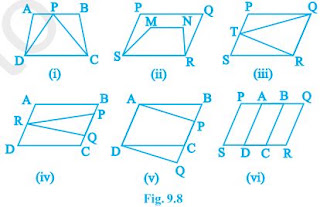
1. Which of the following figures lie on the same base and between the same parallels. In such a case, write the common base and the two parallels.
Answer
(i) Trapezium ABCD and ΔPDC lie on the same DC and between the same parallel lines AB and DC.
(ii) Parallelogram PQRS and trapezium SMNR lie on the same base SR but not between the same parallel lines.
(iv) Parallelogram ABCD and ΔPQR do not lie on the same base but between the same parallel lines BC and AD.
(v) Quadrilateral ABQD and trapezium APCD lie on the same base AD and between the same parallel lines AD and BQ.
(vi) Parallelogram PQRS and parallelogram ABCD do not lie on the same base SR but between the same parallel lines SR and PQ.
Exercise 9.2
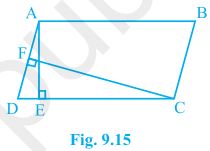
1. In Fig. 9.15, ABCD is a parallelogram, AE ⊥ DC and CF ⊥ AD. If AB = 16 cm, AE = 8 cm and CF = 10 cm, find AD.
Answer
Given,
AB = CD = 16 cm (Opposite sides of a parallelogram)
CF = 10 cm and AE = 8 cm
Now,
Area of parallelogram = Base × Altitude
= CD × AE = AD × CF
⇒ 16 × 8 = AD × 10
⇒ AD = 128/10 cm
⇒ AD = 12.8 cm
2. If E,F,G and H are respectively the mid-points of the sides of a parallelogram ABCD, show that
ar (EFGH) = 1/2 ar(ABCD).
Answer
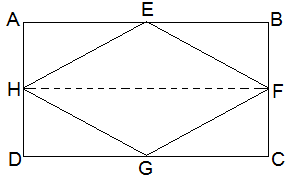
Given,
E,F,G and H are respectively the mid-points of the sides of a parallelogram ABCD.
To Prove,
ar (EFGH) = 1/2 ar(ABCD)
Construction,
H and F are joined.
Proof,
AD || BC and AD = BC (Opposite sides of a parallelogram)
⇒ 1/2 AD = 1/2 BC
Also,
AH || BF and and DH || CF
⇒ AH = BF and DH = CF (H and F are mid points)
Thus, ABFH and HFCD are parallelograms.
Now,
ΔEFH and ||gm ABFH lie on the same base FH and between the same parallel lines AB and HF.
∴ area of EFH = 1/2 area of ABFH — (i)
also, area of GHF = 1/2 area of HFCD — (ii)
Adding (i) and (ii),
area of ΔEFH + area of ΔGHF = 1/2 area of ABFH + 1/2 area of HFCD
⇒ area of EFGH = area of ABFH
⇒ ar (EFGH) = 1/2 ar(ABCD)
3. P and Q are any two points lying on the sides DC and AD respectively of a parallelogram ABCD. Show that ar(APB) = ar(BQC).
Answer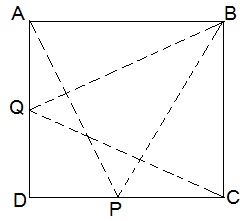
ΔAPB and ||gm ABCD are on the same base AB and between same parallel AB and DC.
Therefore,
ar(ΔAPB) = 1/2 ar(||gm ABCD) — (i)
Similarly,
ar(ΔBQC) = 1/2 ar(||gm ABCD) — (ii)
From (i) and (ii),
we have ar(ΔAPB) = ar(ΔBQC)
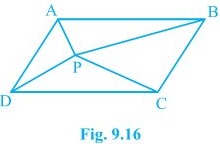
4. In Fig. 9.16, P is a point in the interior of a parallelogram ABCD. Show that
(i) ar(APB) + ar(PCD) = 1/2 ar(ABCD)
(ii) ar(APD) + ar(PBC) = ar(APB) + ar(PCD)
[Hint : Through P, draw a line parallel to AB.]
Answer
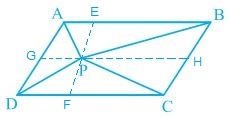
(i) A line GH is drawn parallel to AB passing through P.
In a parallelogram,
AB || GH (by construction) — (i)
Thus,
AD || BC ⇒ AG || BH — (ii)
From equations (i) and (ii),
ABHG is a parallelogram.
Now,
In ΔAPB and parallelogram ABHG are lying on the same base AB and between the same parallel lines AB and GH.
∴ ar(ΔAPB) = 1/2 ar(ABHG) — (iii)
also,
In ΔPCD and parallelogram CDGH are lying on the same base CD and between the same parallel lines CD and GH.
∴ ar(ΔPCD) = 1/2 ar(CDGH) — (iv)
Adding equations (iii) and (iv),
ar(ΔAPB) + ar(ΔPCD) = 1/2 {ar(ABHG) + ar(CDGH)}
⇒ ar(APB) + ar(PCD) = 1/2 ar(ABCD)
(ii) A line EF is drawn parallel to AD passing through P.
In a parallelogram,
AD || EF (by construction) — (i)
Thus,
AB || CD ⇒ AE || DF — (ii)
From equations (i) and (ii),
AEDF is a parallelogram.
Now,
In ΔAPD and parallelogram AEFD are lying on the same base AD and between the same parallel lines AD and EF.
∴ ar(ΔAPD) = 1/2 ar(AEFD) — (iii)
also,
In ΔPBC and parallelogram BCFE are lying on the same base BC and between the same parallel lines BC and EF.
∴ ar(ΔPBC) = 1/2 ar(BCFE) — (iv)
Adding equations (iii) and (iv),
ar(ΔAPD) + ar(ΔPBC) = 1/2 {ar(AEFD) + ar(BCFE)}
⇒ ar(APD) + ar(PBC) = ar(APB) + ar(PCD)
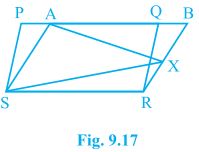
5. In Fig. 9.17, PQRS and ABRS are parallelograms and X is any point on side BR. Show that
(i) ar (PQRS) = ar (ABRS)
(ii) ar (AXS) = 1/2 ar (PQRS)
∴ ar(PQRS) = ar(ABRS) — (i)
(ii) In ΔAXS and parallelogram ABRS are lying on the same base AS and between the same parallel lines AS and BR.
∴ ar(ΔAXS) = 1/2 ar(ABRS) — (ii)
From (i) and (ii),
ar(ΔAXS) = 1/2 ar(PQRS)
Page No: 106
6. A farmer was having a field in the form of a parallelogram PQRS. She took any point A on RS and joined it to points P and Q. In how many parts the fields is divided? What are the shapes of these parts? The farmer wants to sow wheat and pulses in equal portions of the field separately. How should she do it?
Answer
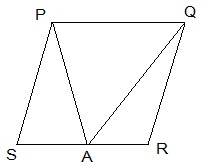
The field is divided into three parts. The three parts are in the shape of triangle. ΔPSA, ΔPAQ and ΔQAR.
Area of ΔPSA + ΔPAQ + ΔQAR = Area of PQRS — (i)
Area of ΔPAQ = 1/2 area of PQRS — (ii)
Triangle and parallelogram on the same base and between the same parallel lines.
From (i) and (ii),
Area of ΔPSA + Area of ΔQAR = 1/2 area of PQRS — (iii)
Clearly from (ii) and (iii),
Farmer must sow wheat or pulses in ΔPAQ or either in both ΔPSA and ΔQAR.
1. In Fig.9.23, E is any point on median AD of a ΔABC. Show that ar (ABE) = ar(ACE).
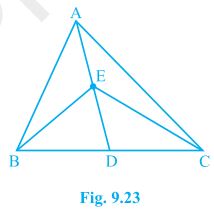
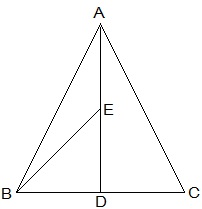
As E is the mid-point of AD,
As AD is the median on side BC of triangle ABC,
Thus, BD = DC
Therefore,
BD = (1/2)BC — (ii)
⇒ ar(BED) = (1/2) × (1/2) ar(ABC)
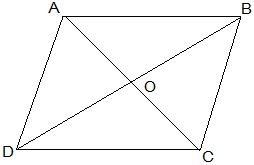
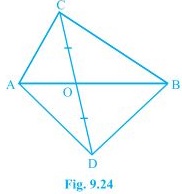
Adding (i) and (ii) we get,
ar(AOC) + ar(BOC) = ar(AOD) + ar(BOD)
⇒ ar(ABC) = ar(ABD)
5. D, E and F are respectively the mid-points of the sides BC, CA and AB of a ΔABC.
Show that
(i) BDEF is a parallelogram. (ii) ar(DEF) = 1/4 ar(ABC)
(iii) ar (BDEF) = 1/2 ar(ABC)
Answer
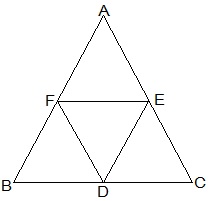
EF || BC and EF = 1/2 BC (by mid point theorem)
also,
BD = 1/2 BC (D is the mid point)
So, BD = EF
also,
BF and DE will also parallel and equal to each other.
Thus, the pair opposite sides are equal in length and parallel to each other.
∴ BDEF is a parallelogram.
(ii) Proceeding from the result of (i),
BDEF, DCEF, AFDE are parallelograms.
Diagonal of a parallelogram divides it into two triangles of equal area.
∴ ar(ΔBFD) = ar(ΔDEF) (For parallelogram BDEF) — (i)
also,
ar(ΔAFE) = ar(ΔDEF) (For parallelogram DCEF) — (ii)
ar(ΔCDE) = ar(ΔDEF) (For parallelogram AFDE) — (iii)
From (i), (ii) and (iii)
ar(ΔBFD) = ar(ΔAFE) = ar(ΔCDE) = ar(ΔDEF)
⇒ ar(ΔBFD) + ar(ΔAFE) + ar(ΔCDE) + ar(ΔDEF) = arar(ΔABC)
⇒ 4 ar(ΔDEF) = ar(ΔABC)
⇒ ar(DEF) = 1/4 ar(ABC)
(iii) Area (parallelogram BDEF) = ar(ΔDEF) + ar(ΔBDE)
⇒ ar(parallelogram BDEF) = ar(ΔDEF) + ar(ΔDEF)
⇒ ar(parallelogram BDEF) = 2× ar(ΔDEF) ⇒ ar(parallelogram BDEF) = 2× 1/4 ar(ΔABC) ⇒ ar(parallelogram BDEF) = 1/2 ar(ΔABC)
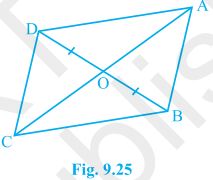
6. In Fig. 9.25, diagonals AC and BD of quadrilateral ABCD intersect at O such that OB = OD.
If AB = CD, then show that:
(i) ar (DOC) = ar (AOB)
(ii) ar (DCB) = ar (ACB)
(iii) DA || CB or ABCD is a parallelogram.
[Hint : From D and B, draw perpendiculars to AC.]
Answer
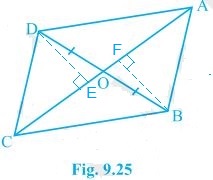
OB = OD and AB = CD
Construction,
DE ⊥ AC and BF ⊥ AC are drawn.
Proof:
(i) In ΔDOE and ΔBOF,
∠DEO = ∠BFO (Perpendiculars)
∠DOE = ∠BOF (Vertically opposite angles)
OD = OB (Given)
Therefore, ΔDOE ≅ ΔBOF by AAS congruence condition.
Thus, DE = BF (By CPCT) — (i)
also, ar(ΔDOE) = ar(ΔBOF) (Congruent triangles) — (ii)
Now,
In ΔDEC and ΔBFA,
∠DEC = ∠BFA (Perpendiculars)
CD = AB (Given)
DE = BF (From i)
Therefore,ΔDEC ≅ ΔBFA by RHS congruence condition.
Thus, ar(ΔDEC) = ar(ΔBFA) (Congruent triangles) — (iii)
Adding (ii) and (iii),
ar(ΔDOE) + ar(ΔDEC) = ar(ΔBOF) + ar(ΔBFA)
⇒ ar (DOC) = ar (AOB)
(ii) ar(ΔDOC) = ar(ΔAOB)
⇒ ar(ΔDOC) + ar(ΔOCB) = ar(ΔAOB) + ar(ΔOCB) (Adding ar(ΔOCB) to both sides) ⇒ ar(ΔDCB) = ar(ΔACB) (iii) ar(ΔDCB) = ar(ΔACB) If two triangles are having same base and equal areas, these will be between same parallels DA || BC — (iv) For quadrilateral ABCD, one pair of opposite sides are equal (AB = CD) and other pair of opposite sides are parallel. Therefore, ABCD is parallelogram.
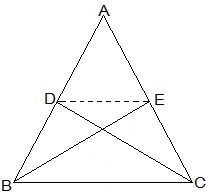
7. D and E are points on sides AB and AC respectively of ΔABC such that ar(DBC) = ar(EBC). Prove that DE || BC.
Answer
8. XY is a line parallel to side BC of a triangle ABC. If BE || AC and CF || AB meet XY at E and F respectively, show that
ar(ΔABE) = ar(ΔAC)
Answer
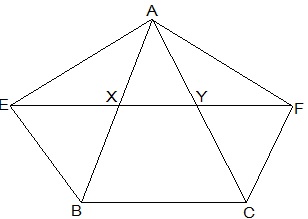
XY || BC, BE || AC and CF || AB
To show,
ar(ΔABE) = ar(ΔAC)
Proof:
EY || BC (XY || BC) — (i)
also,
BE∥ CY (BE || AC) — (ii)
From (i) and (ii),
BEYC is a parallelogram. (Both the pairs of opposite sides are parallel.)
Similarly,
BXFC is a parallelogram.
Parallelograms on the same base BC and between the same parallels EF and BC.
⇒ ar(BEYC) = ar(BXFC) (Parallelograms on the same base BC and between the same parallels EF and BC) — (iii)
Also,
△AEB and parallelogram BEYC are on the same base BE and between the same parallels BE and AC.
⇒ ar(△AEB) = 1/2ar(BEYC) — (iv)
Similarly,
△ACF and parallelogram BXFC on the same base CF and between the same parallels CF and AB.
⇒ ar(△ ACF) = 1/2ar(BXFC) — (v)
From (iii), (iv) and (v),
ar(△AEB) = ar(△ACF)
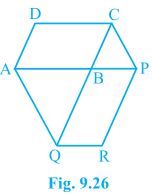
9. The side AB of a parallelogram ABCD is produced to any point P. A line through A and parallel to CP meets CB produced at Q and then parallelogram PBQR is completed (see Fig. 9.26). Show that
ar(ABCD) = ar(PBQR).
[Hint : Join AC and PQ. Now compare ar(ACQ) and ar(APQ).]
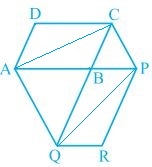
ar(△ACQ) = ar(△APQ) (On the same base AQ and between the same parallel lines AQ and CP)
⇒ ar(△ACQ) – ar(△ABQ) = ar(△APQ) – ar(△ABQ)
⇒ ar(△ABC) = ar(△QBP) — (i)
AC and QP are diagonals ABCD and PBQR. Thus,
ar(ABC) = 1/2 ar(ABCD) — (ii)
ar(QBP) = 1/2 ar(PBQR) — (iii)
From (ii) and (ii),
1/2 ar(ABCD) = 1/2 ar(PBQR)
⇒ ar(ABCD) = ar(PBQR)
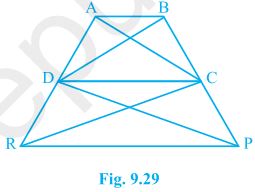
10. Diagonals AC and BD of a trapezium ABCD with AB || DC intersect each other at O. Prove that ar (AOD) = ar (BOC).
Answer
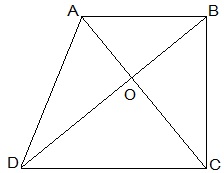
∴ ar(△DAC) = ar(△DBC)
⇒ ar(△DAC) − ar(△DOC) = ar(△DBC) − ar(△DOC)
⇒ ar(△AOD) = ar(△BOC)
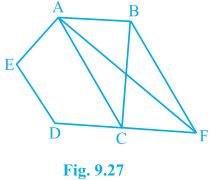
11. In Fig. 9.27, ABCDE is a pentagon. A line through B parallel to AC meets DC produced at F.
Show that
(i) ar(ACB) = ar(ACF)
(ii) ar(AEDF) = ar(ABCDE)
To prove:
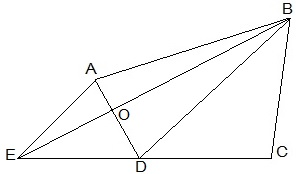
ar(△DEO) = ar(△AOB)
Proof:
△DEB and △DAB lie on the same base BD and between the same parallel lines BD and AE.
ar(△DEB) = ar(△DAB)
⇒ ar(△DEB) – ar△DOB) = ar(△DAB) – ar(△DOB)
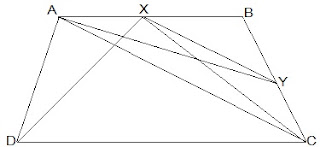
also,
ar(AQC) = ar(PBR).
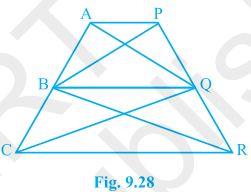
ar(△AQB) + ar(△BQC) = ar(△PBQ) + ar(△BQR)
Answer
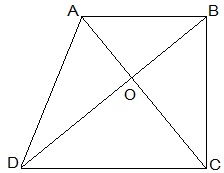
ar(△AOD) = ar(△BOC)
Thus, AB ∥ CD