- By noor arora
- 0 Comment
- 09 Jan 2023
Chapter 11 Three Dimensional Geometry | class 12th | Important Question for Maths
Class 12 Maths Chapter 11 Important Extra Questions Three Dimensional Geometry
Three Dimensional Geometry Important Extra Questions Very Short Answer Type
Question 1.
Find the acute angle which the line with direction-cosines <13√,16√,n> makes with positive direction of z-axis. (C.B.S.E. Sample Paper 2018-19)
Solution:
l2 + m2 + n2 = 1
(13√)2+(16√)2 + n2 = 1
⇒ 13+16 + n2 = 1
n2 = 1 – 12
n2 = 12
n = 12√
Thus, cos α = 12√
Hence, α = 45° or π4
Question 2.
Find the direction-cosines of the line.
x−12=−y=z+12 (C.B.S.E. Sample Paper 2018-19)
Solution:
The given line is x−12=y−1=z+12
Its direction-ratios are <2,-1,2>.
Hence, its direction- cosine are: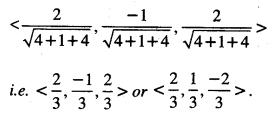
Question 3.
If α, β, γ are direction-angles of a line, prove that cos 2a + cos 2P + cos 2y +1 = 0. (N.C.E.R.T.)
Solution:
Since α, β, γ are direction-angles of a line,
∴ cos2 α + cos2 β + cos2γ = 1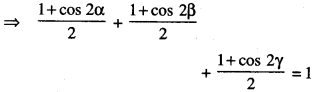
⇒ 1 + cos2α + 1 + cos2β + 1 + cos2γ = 2
⇒ cos 2α + cos 2β + cos 2γ + 1 = 0, which is true.
Question 4.
Find the length of the intercept, cut off by the plane 2x + y – z = 5 on the x-axis. (C.B.S.E. Outside Delhi 2019)
Solution:
The given plane is2x + y – z = 5
⇒ x5/2+y5+z−5=1
Its intercepts are x5/2, 5 and -5.
Hence, the length of the intercept on the x-axis is x5/2
Question 37.
Find the length of the perpendicular drawn from the point P(3, -4,5) on the z-axis.
Solution:
Length of the perpendicular from P(3, -4,5) on the z-axis
= (3)2+(−4)2−−−−−−−−−−√
= 9+16−−−−−√=25−−√ = 5 units.
Question 5.
Find the vector equation of a plane, which is at a distance of 5 units from the origin and whose
normal vector is 2i^−j^+2k^
Solution:
Let n⃗ =2i^−j^+2k^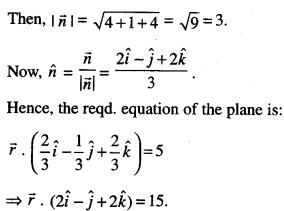
Question 6.
If a line makes angles 90°, 135°, 45° with the x,y and z-axes respectively, find its direction cosines.
Solution:
Direction cosines of the line are :
< cos 90°, cos 135°, cos 45° >
<0, −12√,12√>
Question 7.
Find the co-ordinates of the point where the line through the points A (3,4,1) and B (5,1, 6) crosses the xy-plane.
The equations of the line through A (3,4,1) and B (5,1,6) are: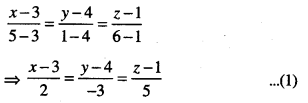
Any point on (1) is (3 + 2k,4- 3k, 1 + 5k) …………. (2)
This lies on xy-plane (z = 0).
∴ 1 + 5k = 0 ⇒ k = −15
Putting in (2), [ 3-25, 4 + 35, 1-1)
i.e. (135, 235, 0)
which are the reqd. co-ordinates of the point.
Question 8.
find the vector equation ofthe line which passes through the point (3,4,5) and is parallel to the vector 2i^+2j^−3k^
Solution:
The vector equation of the line is r⃗ =a⃗ +λm⃗
i.e., r⃗ =(3i^+4j^+5k^)+λ(2i^+2j^−3k^)
Three Dimensional Geometry Important Extra Questions Short Answer Type
Question 1.
Find the acute angle between the lines whose direction-ratios are:
< 1,1,2 > and <-3, -4,1 >.
Solution: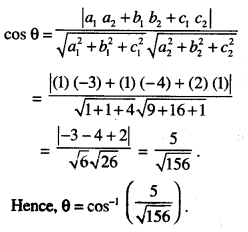
Question 2.
Find the angle between the following pair of lines:
and
−x+2−2=y−17=z+3−3 and x+2−1=2y−84=z−54
and check whether the lines are parallel or perpendicular. (C.B.S.E. 2011)
Solution:
The given lines can be rewritten as :
−x+2−2=y−17=z+3−3 ………….. (1)
x+2−1=2y−84=z−54 ………..(2)
Here < 2,7, – 3 > and < -1,2,4 > are direction- ratios of lines (1) and (2) respectively.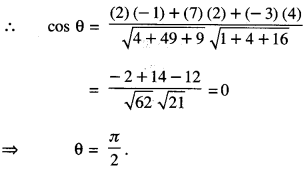
Hence, the given lines aife perpendicular.
Question 3.
Find the vector equation of the line joining (1.2.3) and (-3,4,3) and show that it is perpendicular to the z-axis. (C.B.S.E. Sample Paper 2018-19)
Solution:
Vector equation of the line passing through
(1.2.3) and(-3,4,3)is r⃗ =a⃗ +λ(b⃗ −a⃗ )
where a⃗ =i^+2j^+3k^ and b⃗ =−3i^+4j^+3k^
⇒ r⃗ =(i^+2j^+3k^)+λ(−4i^+2j^) …(1)
Equation of z-axis is r⃗ =μk^ …(2)
Since (−4i^+2j^)⋅k^=0 = 0,
∴ Line (1) is perpendicular to z-axis.
Question 4.
Find the vector equation of the plane, which is 629√ at a distance of
units from the origin and its normal vector from the origin is 2i^−3j^+4k^ . Also, find its cartesian form. (N.C.E.R.T.)
Solution: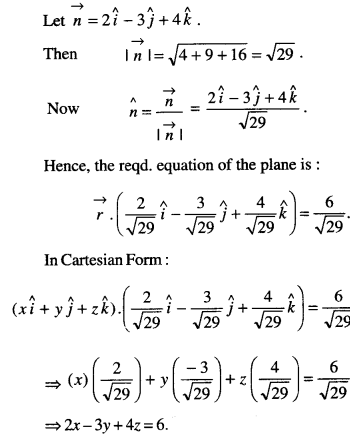
Question 5.
Find the direction-cosines of the unit vector perpendicular to the plane r⃗ ⋅(6i^−3j^−2k^) +1 = 0 through the origin. (N.C.E.R.T.)
Solution:
The given plane is r⃗ ⋅(6i^−3j^−2k^) + 1 = 0
r⃗ ⋅(6i^−3j^−2k^) = 1 ………… (1)
Now |−6i^+3j^+2k^|=36+9+4−−−−−−−−√
=49−−√=7
Dividing (1) by 7,
r⃗ ⋅(−67i^+37j^+27k^)=17
which is the equation of the plane in the form r⃗ ⋅n^=p
Thus, n^=−67i^+37j^+27k^
which is the unit vector perpendicular to the plane through the origin.
Hence, the direction-cosines of n^ are <−67,37,27>
Question 6.
Find the acute angle between the lines
x−43=y+34=z+15 and x−14=y+1−3=z+105
Solution:
Vector in the direction of first line
x−43=y+34=z+15 ,
b⃗ =(3i^+4j^+5k^)
Vector in the direction of second line
x−14=y+1−3=z+105 ,
d⃗ =4i^−3j^+5k^
∴ θ, the angle between two given lines is given by: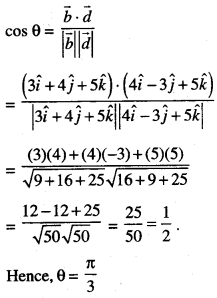
Question 7.
Find the angle between the line:
r⃗ =(i^−j^+k^)+λ(2i^−j^+3k^) and the plane r⃗ ⋅(2i^+j^−k^)=4 Also, find whether the line is parallel to the plane or not .
Solution:
The given line is :
r⃗ =(i^−j^+k^)+λ(2i^−j^+3k^)
and the given plane is r⃗ ⋅(2i^+j^−k^) = 4.
Now the line is parallel to 2i^ – j^ + 3k^ and nor¬mal to the plane 2i^ + i^ – k^
If ‘θ’ is the angle between the line and the plane,
then (π2−θ) is the angle between the line and normal to the plane.
Then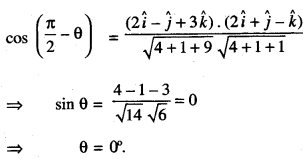
Hence, the line is parallel to the plane.
Question 8.
Find the value of ‘λ’, so that the lines:
1−x3=7y−14λ=z−32 and 7−7×3λ=y−51=6−z5 are at right angles. Also, find whether the lines are intersecting or not
Solution:
(i) The given lines are
1−x3=7y−14λ=z−32 ……………….(1)
and 7−7×3λ=y−51=6−z5 ……….. (2)
These are perpendicular if: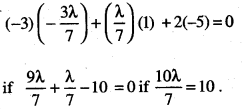
Hence λ = 1.
(ii) The direction cosines ofline(1) are <-3,1,2>
The direction cosines of line (2) are < -3,1, -5 >
Clearly, the lines are intersecting.
Question 9.
Find the angle between the line: x−23=y+1−1=z−3−2 and the plane: 3x + 4y + z + 5 = 0.
x-2 y+1 z-3
Sol. The given line is x−23=y+1−1=z−3−2 ………..(1)
and the given plane is :
3x + 4y + z + 5 = 0 …(2)
If the line (1) makes an angle ‘0’ with the plane (2), then the line (1) will make angle (90° – 0) with the normal to the plane (2).
Now direction-ratios of line (1) are:
<3, -1,-2>
and direction-ratios of normal to plane (2) are <3,4,1>.
∴ cos (90° – θ)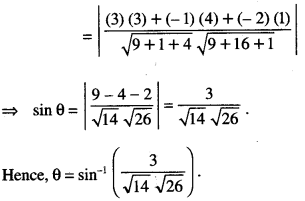
Question 10.
State when the line r⃗ =a⃗ +λb⃗ is parallel to the plane r⃗ ⋅n⃗ =d⃗ . Show that the line r⃗ =i^+j^+λ(2^+j^+4k^) is parafiel to the plane r⃗ ⋅(−2i^+k^) = 5. Also, find the distance between the line and the plane.
Solution:
(i) A line is parallel to the plane if it is perpendicular to the normal to the plane.
The given line is r⃗ =a⃗ +λb⃗
⇒ b⃗ is parallel to the line.
The given plane is r⃗ ⋅n⃗ =d⃗
⇒ n⃗ is normal to the plane.
Thus the line is parallel to the plane when
b⃗ ⋅n⃗ =0.
(ii) Here b⃗ =2i^+j^+4k^ and n⃗ =−2i^+k^
Now b⃗ ⋅n⃗ = (2) (- 2) + (1) (0) + (4) (1)
= -4 + 0 + 4 = 0.
Hence, the given line is parallel to the given plane.
(iii) (1,1,0) is a point on the given line.
Equation of the plane is-2x + z- 5= 0.
∴ Reqd. distance
= ∣∣−2(1)+0−54+0+1√∣∣=75√=75√5units.
Three Dimensional Geometry Important Extra Questions Very Long Answer Type 2
Question 1.
Find the shortest distance between the lines:r⃗ =(4i^−j^)+λ(i^+2j^−3k^) and r⃗ =(i^−j^+2k^)+μ(2i^+4j^−5k^) (C.B.S.E. 2018)
Solution:
Comparing given equations with: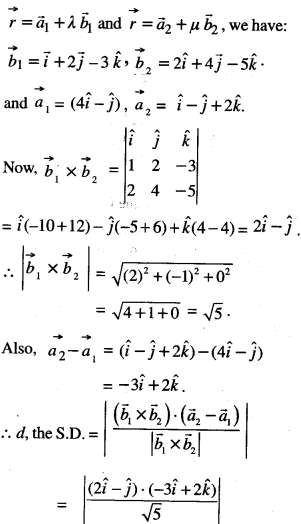
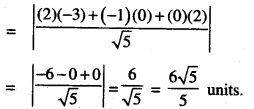
Question 2.
A line makes angles α, β, γ, δ with the four diagonals of a cube, prove that:
cos2 α + cos2 β + cos2 γ + cos2 δ= 43. (N.C.E.R.T.)
Solution:
Let O be the origin and OA, OB, OC (each = a) be the axes.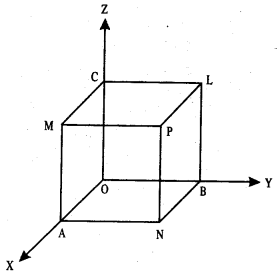
Thus the co-ordinates of the points are :
O (0,0,0), A (a, 0,0), B (0, a, 0), C (0,0, a),
P (a, a, a), L (0, a, a), M (a, 0, a), N (a, a, 0).
Here OP, AL, BM and CN are four diagonals.
Let < l, m, n > be the direction-cosines of the given line.
Now direction-ratios of OP are:
<a-0,a-0,a-0>i.e.<a,a,a>
i.e. < 1,1,1 >,
direction-ratios of AL are:
<0-a, a-0, a-0> i.e. <-a,a,a>
i.e. <-l, 1,1 >,
direction-ratios of BM are:
<a-0,0-a, a-0>
i.e. <a,-a,a> i.e. < 1,-1, 1 >
and direction-ratios of CN are:
<a-0,a-0,0-a> i.e. <a,a,-a>
i.e. < 1,1,-1 >.
Thus the direction-cosines of OP are :
<13√,13√,13√>
the direction-cosines of AL are:
<−13√,13√,13√>
the direction-cosines of BM are :
<13√,−13√,13√>
and the direction-cosines of CN are :
<13√,13√,−13√>
If the given line makes an angle ‘a’ with OP, then :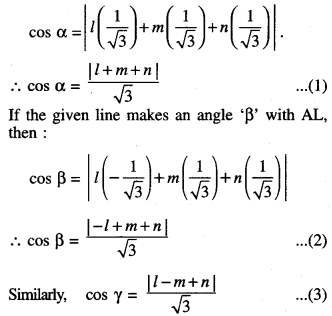
and cos δ = |l+m−n|3√ ………… (4)
Squaring and adding (1), (2), (3) and (4), we get:
cos2 α + cos2 β + cos2 γ + cos2δ
= 13 [(l + m + n)2 + (-l + m + n)2
+ (l-m + n)2 + (l + m — n)2]
= 13 [4(l2 + m2 + n2)] = 13 [4(1)].
Hence,cos2 α + cos2 β + cos2 γ + cos2δ = 43
Question 3.
Find the equation of the plane through the line x−13=y−42=z−4−2 and parallel to the line:
x+12=1−y4=z+21
Hence, find the shortest distance between the lines. (C.B.S.E. Sample Paper 2018-19)
Solution:
The two given lines are:
x−13=y−42=z−4−2 ………… (1)
and x+12=1−y4=z+21 ………….. (2)
Let <a, b, c> be the direction-ratios of the normal to the plane containing line (1).
∴ Equation of the plane is:
a(x- l) + b(y-4) + c(z-4) …(3),
where 3a + 2b – 2c = 0 …(4)
[∵ Reqd. plane contains line (1)] and 2a – 4b + 1.c = 0
[∵ line (1) a parallel to the reqd. plane] Solving (4) and (5),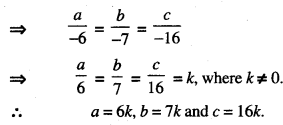
Putting in (3),
6k(x- 1) + 7k(y – 4) + 16k(z – 4) = 0
= 6(x – 1) + 7(y – 4) + 16(z – 4) =0
[∵k ≠ 0]
⇒ 6x + 7y+ 16z-98 = 0,
which is the required equation of the plane.
Now, S.D. between two lines = perpendicular distance of (-1,1, – 2) from the plane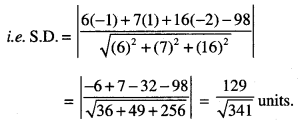
6(—1) + 7(1) +16(-2) – 98
V(6)2+(7)2+(16)2
-6 + 7-32-98 V36 + 49 + 256
Question 4.
Find the Vector and Cartesian equations of the plane passing through the points (2, 2, -1), (3,4,2) and (7,0,6). Also, find the vector equa¬tion of a plane passing through (4,3,1) and parallel to the plane obtained above. (C.B.S.E. 2019)
Solution:
(i) Cartesian equations
Any plane through (2,2, -1) is :
a(x – 2) + b(y- 2) + c(z + 1) = 0 … (1)
Since the plane passes through the points (3,4,2) and (7,0,6),
∴ a(3 – 2) + b(4 – 2) + c(2 +1) = 0
and a(7 – 2) + b(0 – 2) + c(6 + 1) = 0
⇒ a + 2b + 3c = 0 …(2)
and 5a – 2b + 7c = 0 …(3)
Solving (2) and (3),a14+6=b15−7=c−2−10
⇒ a20=b8=c−12
⇒ a5=b2=c−3 = k (say), value k ≠ 0.
∴ a = 5k,b = 2k and c = -3k,
Putting the values of a, b, c in (1), we get:
5k(x – 2) + 2k(y – 2) – 3k(z + 1) = 0
⇒ 5(x-2) + 2(y-2)-3(z+ 1) =0[∵ k ≠ 0]
=» 5x- 10 + 2y-4-3z-3 = 0
=» 5x + 2y-3z-17 = 0, …(4)
which is the reqd. Cartesian equation.
Its vector equation is r⃗ ⋅(5i^+2j^−3k^) =17.
(ii) Any plane parallel to (4) is
5x + 2y – 3z + λ – 0 … (5)
Since it passes through (4, 3,1),
5(4) + 2(3) – 3(1) + λ = 0
⇒ 20 + 6 — 3 + λ = 0
⇒ λ = -23.
Putting in (5), 5x + 2y – 3z – 23 = 0, which is the reqd. equation.
Its vector equation is r⃗ ⋅(5i^+2j^−3k^) = 23.
Question 5.
Find the co-ordinates of the foot of the perpendicular drawn from the point A (1,8,4) to the line joining B (0, -1,3) and C (2,-3,-1). (A.I.C.B.S.E. 2016)
Solution:
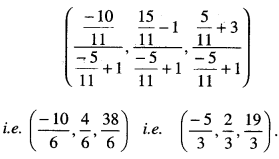
Any point on BC, which divides [BC] in the ratio k: 1,is: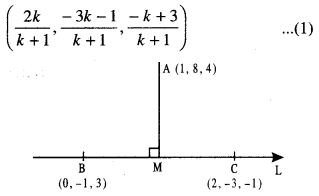
This becomes M, the foot of perp. from A on BC
if AM⊥BC …(2)
But direction-ratios of BC are:
<2-0,- 3 + 1,-1 -3 > i.e. < 2,-2,-4 >
i.e, <1, -1 > -2>
and direction-ratio of AM are:
<2kk+1−1,−3k−1k+1−8,−k+3k+1−4>
i.e. < k- 1,- 11k:-9, -5k— 1 >
∴ Due to (2), (1) (k- 1) + (- 1) (-1 1k-9) + (-2)(-5k- 1) = 0
⇒ k – 1 + 11k + 9 + 10k + 2 = 0
⇒ 22k + 10 = 0
⇒ k = −511
∴ From (1), the co-ordinates of M, the foot of perp. are: