- Home
- CBSE
- ICSE
- NCERT
- Text Book Solutions
- Our Products
- More

1. Answer the following questions briefly:
(a) What is the true shape of the earth?
(b) What is the globe?
(c) What is the latitudinal value of the Tropic of Cancer?
(d) What are the three heat zones of the Earth?
(e) What are parallels of latitude and meridians of longitude?
(f) Why does the Torrid Zone receive the maximum amount of heat?
(g) Why is it 5.30 p.m in India when it is 12.00 noon in London?
Answers:
(a) The true shape of the Earth is geoid-earth like shape. In other words, it is orange shaped.
(b) Globe. Globe is the three dimensional model of the earth.
(c) 2312° N.
(d) (i) Torrid Zone
(ii) Temperate Zone
(iii) Frigid Zone.
(e) Parallels of Latitudes and Meridians of Longitudes:
Parallels of Latitudes:
All the parallel circles from the equator to the poles are called parallels of latitudes.
Meridians of Longitudes:
All the semi-circles which join north pole to south pole are termed as meridians of longitudes.
(f) Torrid Zone receives the maximum amount of heat because of the following reasons:
(g) It is 5.30 p.m. in India when it is 12.00 noon in London because of the following reasons:
2. Tick the correct answer:
(a)The value of the prime meridian is
(i) 90° (ii) 0° (iii) 60°
(b)The frigid zone lies near
(i) the Poles (ii) the Equator (iii) the Tropic of Cancer
(c)The total number of longitudes are
(i) 360 (ii) 180 (iii) 90
(d) The Antarctic Circle is located in
(i) the Northern Hemisphere
(ii) the Southern Hemisphere
(iii) the Eastern Hemisphere
(e) Grid is a network of
(i) parallels of latitudes and meridians of longitudes
(ii) the Tropic of Cancer and the Tropic of Capricorn
(iii) the North Pole and the South Pole
Answers: (a)—(ii), (b)-(i),(c)-(i), (d)-(ii), (e)-(i).
3. Fill in the blanks.
Answers:
Choose the correct option to complete the statements given below:
(i) The globe and the earth are different in …………………..
(a) shape (b) size
(c) continents and oceans (d) none of these.
(ii) The axis is parallel to the ………………….
(a) equator (b) Prime Meridian
(c) latitudes (d) all of these.
(iii) The Tropic of Cancer is located at …………………….
(a) 23 1/2 ° N (b) 66 1/2 ° N
(c) 23 1/2 °S (d) 66 1/2 ° S.
(iv) The heat zone with the coldest climate is the ……………………….
(a) Torrid Zone (b) Northern Temperate Zone
(c) The Frigid Zones (d) either of the Temperate Zones.
(v) From the westernmost point to the easternmost point, the local times of India extend over a time difference of……………………
(a) no difference (b) 30 minutes
(c) 1 hour (d) over 1 hour.
(vi) The time difference between Greenwich and India is …………………….
(a) no difference (b) 3 hours
(c) 5 hours 30 minutes (d) 12 hours 30 minutes.
Answers: (i)—(b), (ii)—(b), (iii)—(a), (iv)—(c), (v)—(d), (vi)—(c).
Fill in the Blanks:
Fill in the blanks with appropriate words given to complete each sentence:
Answers:
True/False:
State whether these sentences are true (T) or false (F).
Answers:
Matching Skill:
Match the items in column A correctly with those given in column B.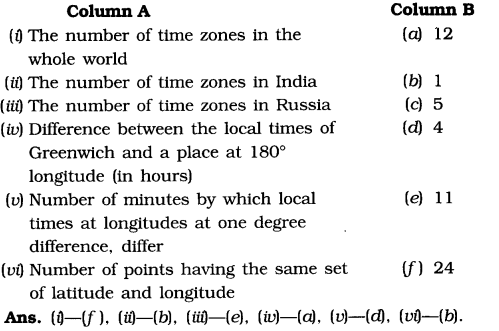
1. What is the globe?
Answer: Globe is a true model of the earth. It shows the earth in a small form.
2. What are the advantages of the globe? [V. Imp.]
Answer: The globe is small in shape, is convenient to carry and use, and depicts all features of the earth.
3. What are the two types of lines needed to locate any point on the earth’s surface? [V. Imp.]
Answer: Latitudes and longitudes are required to locate any point on the earth’s surface.
4. Define latitude.
Answer: One of the imaginary circles parallel to the Equator is called latitude.
5. Define longitude.
Answer: One of the imaginary circles parallel to the Prime Meridian is called longitude.
6. Which place is used as a standard for a time all over the world?
Answer: Greenwich in Britain is used as a standard for a time all over the world.
7. Geographically, what is the time difference between Dwarka in Gujarat and Dibrugarh in Assam? [Imp]
Answer: The time difference between Dwarka and Dibrugarh is of 1 hour 45 minutes.
8. A particular city lies in the time zone-2. What does this mean?
Answer: This means that the city’s local time is 2 hours behind Greenwich.
9. What does the time ‘12 noon’ signify at any place?
Answer: ‘12 noon’ refers to the time when the sun is at the highest point in the sky.
10. Which heat zone does the equator lie in?
Answer: The equator lies in the Torrid Zone.
1. A cricket match begins at 10.30 am on January 10 in New Zealand (time zone of +12). TeU. the time in Greenwich when it is shown live on TV there.
Answer: New Zealand lies in time zone +12, Le. it is 12 hours ahead of Greenwich, or Greenwich is 12 hours behind New Zealand. So when it is 10.30 am on January 10 in New Zealand, it is 10.30 pm on January 9. So the cricket match will be telecast from 10.30 pm on Jan 9 in Greenwich.
2. Why do we have the concept of time zone? [V. Imp.]
Answer: The sun does not shine with the same intensity over all parts of the world at a particular time. If it is overhead at one place (midday), then it does not shine at all (midnight) at the place directly opposite to that place on the earth. So if we have the same time, then 12 noon will mean midday at one place, and midnight at another. To avoid such an awkward system, we have the system of time zones, so that everywhere a particular time means the same stage of the day.
3. Write a short note on Heat Zones. [Imp.]
Answer: Heat zones are the different zones of the earth, where the sun’s rays fall differently, thus causing different climate patterns. These zones are called the Torrid Zone, the two Temperate Zones, and the two Frigid Zones. The Torrid Zone is very hot since the sun shines overhead here. The Temperate Zones maintain a moderate climate, and the Frigid Zones are extremely cold.
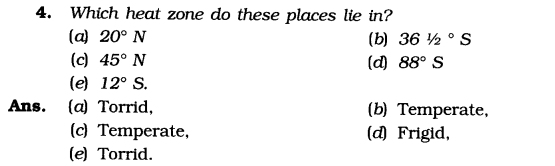
5.How do latitudes and longitudes help in locating a point? Why is only one of them insufficient in doing this?[V. Imp.]
Answer: Latitudes and longitudes form a grid. Two different points may lie on the same latitude or the same longitude. But there exists only one point where latitude and longitude intersect. So a point can be identified with the help of the latitude and longitude on which it lies.