Light as a form of energy
- Light is the energy that enables us to see.
- Light is emitted from a source such as the Sun.
Is Light a Traveler?
Rectilinear propagation of light
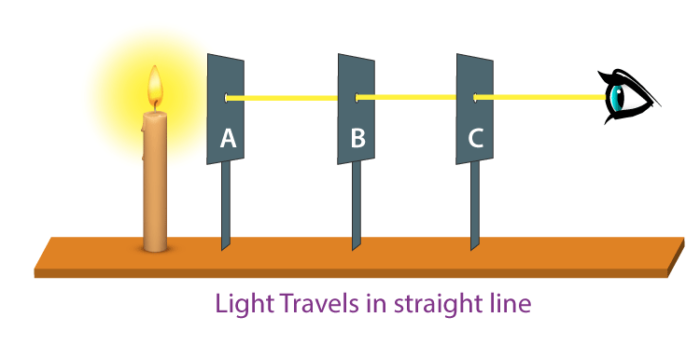
Light takes the quickest path between any two points. Therefore, light travels in a straight line. This is known as a rectilinear propagation of light.
Transparent, Opaque and Translucent Objects
Luminous & Non-luminous objects
- Objects that emit light and heat are known as luminous objects. E.g.: Sun and other stars
- Objects that do not produce their own light but reflect the light emitted by luminous objects are known as non-luminous objects. E.g.: Earth, trees
Transparent, opaque and translucent objects
Objects can be classified based on their interaction with light.
- Transparent objects allow light to pass through them without getting scattered. E.g.: glass
- Translucent objects allow light to pass through them partially. E.g.: Butter paper
- Opaque objects do not allow any light to pass through them. E.g.: a table, a book, etc
What Are Shadows?
Shadow formation
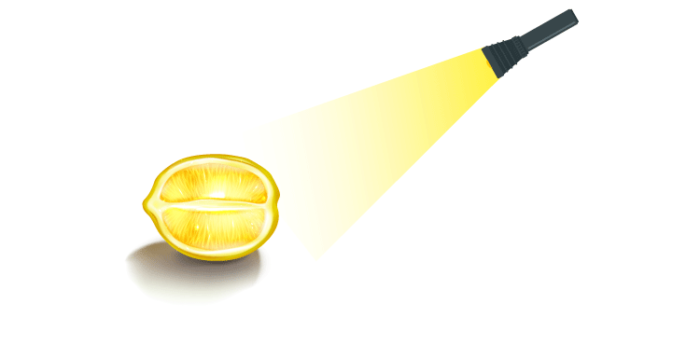
- A shadow is formed when an opaque object comes in the path of light.
- A shadow needs a screen where it is formed, for example, the ground, or walls of a room or even the surfaces of buildings.
- Shadows give us an idea about the shapes of different objects. Or, it can even mislead us about the shape of different objects. E.g. the shadow of a cone appears to be a triangle on the screen.
The Pinhole Camera
Formation of image by pinhole camera
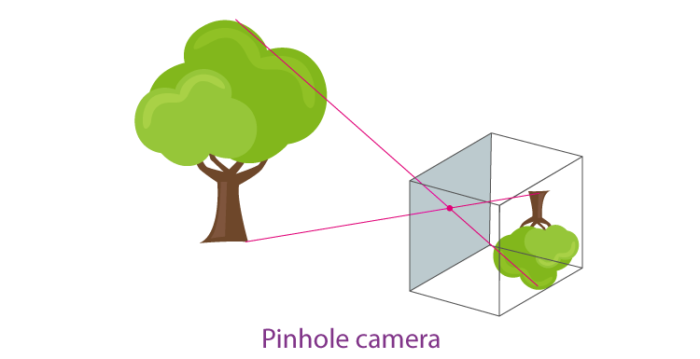
- A pinhole camera is a simple camera that consists of a light-proof box, a thin film for a screen and a small aperture or hole to allow the passage of light rays.
- The light from outside enters through the small hole and forms an image on the screen that is inverted.
Mirrors and Reflection
Mirrors
A mirror is a surface usually consisting of a glass that reflects light incident on it to form clear erect images.
Reflection
When light is incident on a surface, it gets reflected or it bounces back. Any surface that is really well polished or shiny acts like a mirror. The phenomenon of light bouncing off surfaces is called reflection.
Characteristics of images
- Images have colour, unlike shadows. They are formed due to the converging rays of light that comes after reflecting from objects.
- A real image is formed by actual convergence of light rays. Real images always form on a screen.
- A virtual image is the apparent convergence of diverging light rays. Virtual images cannot be obtained on a screen.
Plane mirrors and images formed by them
A plane mirror changes the direction of light that falls on it.
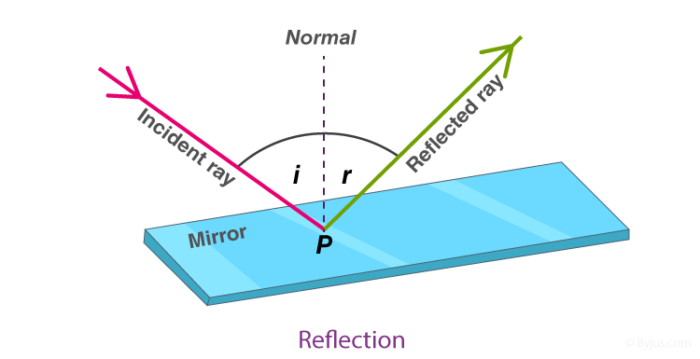
This enables us to see images. Take the example of a comb placed in front of a mirror over a dark coloured paper. Let a beam of light pass through the comb on the mirror using a torch. Then an image is observed similar to the one given :
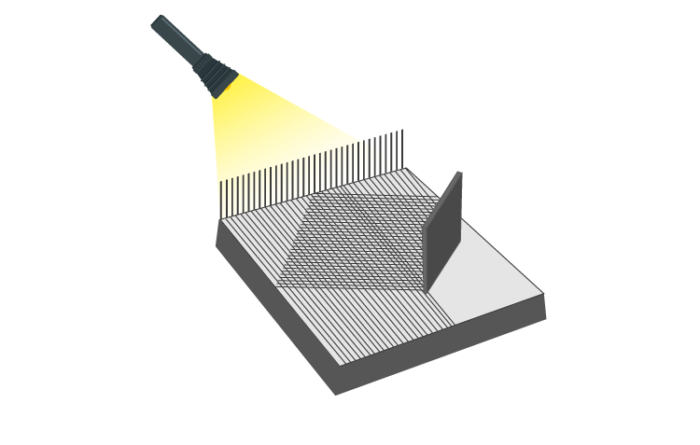
We observe that the light gets reflected from this mirror and it travels in straight lines.