- Home
- CBSE
- ICSE
- NCERT
- Text Book Solutions
- Our Products
- More

Question 1.
What was Tushar doing?
Answer:
Tushar was going from Delhi to Chennai.
Question 2.
How was Tushar going and why was he going?
Answer:
Tushar was going by train to attend his cousin’s wedding.
Question 3.
Do you know when trains were used first of all?
Answer:
Yes, I know that trains were first of all used about 150 years ago.
Question 4.
When were the buses used first of all?
Answer:
The buses were used by the people about 150 years after the trains were introduced.
Question 5.
Write the name given to pre-historic age.
Answer:
Old Stone Age or Palaeolithic Age or Earnest Stone Age.
Question 6.
What is Stone Age?
Or
Define Stone Age.
Answer:
In the pre-historic age or period when mainly tools, weapons and implements made of stone were used, that period is known as Stone Age.
Question 7.
What do you mean by “Neolithic Age”?
Answer:
The word Neo means new and Lithic means stone. We can say the meaning of “Neolithic Age” is New Stone Age.
Question 8.
What is flint?
Answer:
A flint is a hard grey stone that can produce a spark, whenever it is rubbed.
Question 9.
Mention important historical events against the following dates:
(1) 12,000-10,000 years ago
(2) 10,000 years ago
Answer:
| Dates | Events |
| 1. 12,000-10,000 years ago | The Mesolithic period |
| 2. 10,000 years ago | The beginning of the Neolithic Age |
Question 10.
Match the contents of the following columns correctly:
| Column A | Column B |
| 1. Chalcolithic Age | (a) discovery of agriculture |
| 2. Palaeolithic Age | (b) discovery of metal |
| 3. Neolithic Age | (c) considered animal very important |
| 4. Megalithic Age | (d) hard grey stone |
| 5. Flint | (e) discovery of fire by man |
Answer:
1. – (b)
2. – (e)
3. – (a)
4. – (c)
5. – (d).
Question 11.
Take an outline map of the Indian subcontinent and show the following important archaeological sites (with names):
(1) Burzahom
(2) Mehrgarh
(3) Bhimbetka
(4) Mumbai
(5) Inamgaon
(6) Kolkata. (Anythree)
Answer: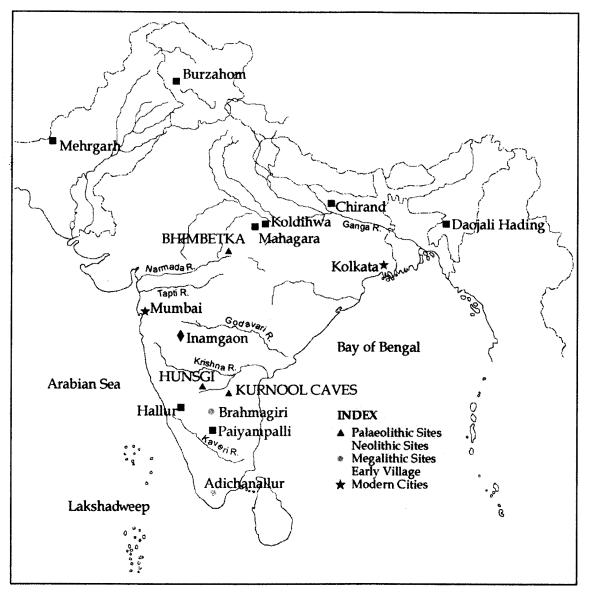
Question 1.
Explain the term “Palaeolithic Age”.
Answer:
Question 2.
Who were the earliest people of the Indian subcontinent? Write a few lines about them.
Answer:
Question 3.
Discuss in short the art of Rock Paintings done by the people of the early stone age.
Answer:
Question 1.
How do we know about hunter-gatherers? Write also about their tools.
Answer:
Question 2.
Discuss living places or sites of hunter-gatherers of the subcontinent.
Answer:
Question 3.
What do you mean by “Factory Sites” and “Habitation-cum-factory”?
Answer:
1. As in Stone Age, stone tools and implements were important. Therefore, the people
(hunter-gatherers) tried to find places where good quality stone was easily available.
2. Usually, we find blocks of stone, tools that were made and perhaps discarded
because they were not perfect and chips of waste stone left behind at these sites (i.efactory sites).
Question 4.
Discuss “Making Stone Tools” by the people of Stone Age.
Answer:
Making Stone Tools. Stone tools were probably made using two different techniques:
1. The first is called stone on stone. Here,
2. Pressure flaking:
Question 5.
What were the main effects of changing environment on rearing of animals and other activities?
Answer:
1. Around 12,000 years ago, there were major climatic changes with a shift to relatively warm conditions.
2. Those who hunted animals now followed them, learning about their food habits and
their breeding seasons.
3. Fishing also became an important activity of the people.
4. This was also a time when several grain bearing grasses, including wheat, barley and rice grew naturally in different parts of the subcontinent.
Question 6.
Explain the following words:
(a) Palaeolithic
(b) Mesolithic and
(c) Neolithic
Answer:
(a) Palaeolithic
(b) Mesolithic
(C) Neolithic
Choose the correct answer:
Question 1.
When were the trains used first?
(a) 200 years ago
(b) 250 years ago
(c) 150 years ago
(d) 300 years ago
Answer:
150 years ago
Question 2.
Why did hunter-gatherers move from place to place?
(a) In search of food
(b) In search of shelters
(c) Both (a) and (b)
(d) None of these
Answer:
Both (a) and (b)
Question 3.
Where is water found?
(a) In lakes
(b) In streams
(c) In rivers
(d) All of these
Answer:
All of these
Question 4.
How did the ancient people travel?
(a) By buses
(b) By trains
(c) By ships
(d) On foot
Answer:
On foot
Question 5.
Who had found the things which were made and used by the hunters?
(a) Astrologists
(b) Archaeologists
(c) Psychologists
(d) None of these
Answer:
Archaeologists
Question 6.
In the ancient times tools were made up of which material?
(a) Stone
(b) Wood
(c) Bone
(d) All of these
Answer:
All of these
Question 7.
For what purpose were the stone tools used?
(a) To cut meat and bone
(b) To chop fruits and roots
(c) To make spears and arrows
(d) All of these
Answer:
All of these
Question 8.
Places where the people made tools are known as
(a) factory sites
(b) residence sites
(c) habitation site
(d) none of these
Answer:
factory sites
Question 9.
By which techniques were the stone tools made?
(a) Stone on stone technique
(b) Pressure flaking
(c) Both (a) and (b)
(d) None of these
Answer:
Both (a) and (b)
Question 10.
What did indicate the finding of ash?
(a) Water
(b) Ice
(c) Fire
(d) All of these
Answer:
Fire
Question 11.
For what purpose did the men, women and children collect the grains?
(a) For food
(b) For growing crops
(c) Both (a) and (b)
(d) None of these
Answer:
Both (a) and (b)
Question 12.
In which state were the eggs of Ostrich found?
(a) Maharashtra
(b) Madhya Pradesh
(c) Delhi
(d) Noida
Answer:
Maharashtra
Question 13.
In which site were a large number of tools used for all sorts of activity, found?
(a) Habitation site
(b) Factory site
(c) Habitation cum factory site
(d) None of these
Answer:
Habitation cum factory site
Question 14.
When was the Mesolithic period?
(a) 6000-7000 years ago
(b) 7000-8000 years ago
(c) 8000-9000 years ago
(d) 12,000-10,000 years ago
Answer:
12,000-10,000 years ago