- By Swati
- 0 Comment
- 18 Dec 2021
Introduction to Macroeconomics and its Concepts NCERT SOLUTION CLASS 12TH Macro Economics | EDUGROWN NOTES
Textbook Question And Answer:
Q.1 Describe the five major sectors in an economy according to the macroeconomic point of view.[3-4 Marks]
ANSWER: An economy may be’ divided into different sectors depending on the nature of study.
- Producer sector engaged in the production of goods and services.
- Household sector engaged in the consumption of goods and services.
Note: Households are taken as the owners of factors of production. - The government sector engaged in activities like taxation and subsidies.
- Rest of the world sector engaged in exports and imports.
- Financial sector (or financial system) engaged in the activity of borrowing and lending.
Q.2 What are the four factors of production and remunerations to each of these called? [ 1 Mark]
ANSWER: 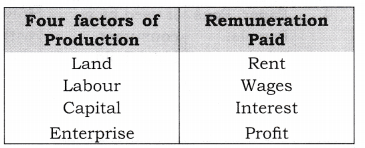
Q.3 What are the important features of a capitalist economy? [3-4 Marks]
ANSWER: Features of capitalist economy are:
- Private ownership of land and capital.
- Profit is the only motive.
- Free play of the market forces of demand and supply.
- Government looks after growth, stability and social justice in the economy.
Q.4 Describe the Great Depression of 1929. [3-4 Marks]
ANSWER: The Great Depression took place in 1929 which adversely affected the developed economies of Europe and North America. It continued for 10 years. There was extreme fall in aggregate demand due to fall in income, which led to a vicious circle of poverty.
Q.5 Distinguish between stock and flow. Between net investment and capital which is a stock and which is a flow? Compare net investment and capital with flow of water into a tank. [3-4 Marks]
ANSWER: 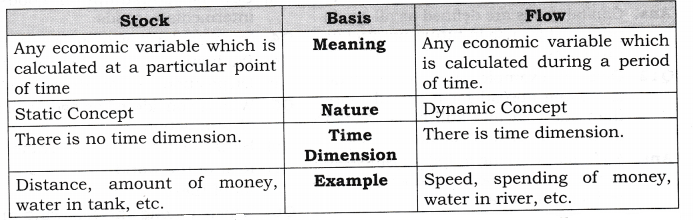
Net investment is a flow whereas capital is a stock. Amount of water in a tank at a particular point of time is a stock concept, whereas amount of water flowing into it is a flow concept.
Very Short Answer Type:
Q.1 What is meant by circular flow of income?
ANSWER: It refers to flow of money income or the flow of goods and services across different sectors of the economy in a circular form.
Q.2 What are the three phases of circular flow of income?
ANSWER: Production Phase, Distribution Phase and Disposition Phase.
Question 3. Give the meaning of factor income.
Ans: Income earned by factor of production by rendering their productive services in the production process is known as Factor Income.
Q.4 What is meant by transfer income?
ANSWER: Income received without rendering any productive services is known as Transfer Income.
Q.5 Out of factor income and transfer income which one is a unilateral concept?
ANSWER: Transfer income.
Q.6 Define current transfers.[CBSE 2003]
ANSWER: Transfers made from the current income of the payer and added to the current income of the recipient (who receive) for consumption expenditure are called current transfers
Q.7 Define capital transfers.
ANSWER: Capital transfers are defined as transfers in cash and in kind for the purpose of investment to recipient made out of the wealth or saving of a donor.
Q.8 What is the meaning of final goods?
ANSWER: These are those which are used for:
- Personal consumption (like bread purchased by consumer household), or
- Investment or capital formation (like building, machinery purchased by a firm)
Q.9 What is meant by intermediate goods?
ANSWER: These are those, which are used for:
- Further processing (like sugar used for making sweets), or
- Resale in the same year (If car purchased by a car dealer for resale).
Q.10 What is meant by consumption goods?
ANSWER: Consumption goods are those goods which satisfy the wants of consumers directly.
Q.11Define capital goods.
ANSWER: Capital goods are defined as all goods produced for use in future productive processes.
Q.12 Give an example of a person who is staying abroad for a period more than one year and still he is treated as normal resident of India.
ANSWER: An Indian working in Indian Embassy in the USA will be treated as normal resident of India.
Short Answer Type Question:
Q.1 Explain the basis of classifying goods into intermediate and final goods. Give suitable examples. Or [CBSE 2010]
Distinguish between intermediate products and final products. Give examples. ‘ [CBSE 2009]
ANSWER: 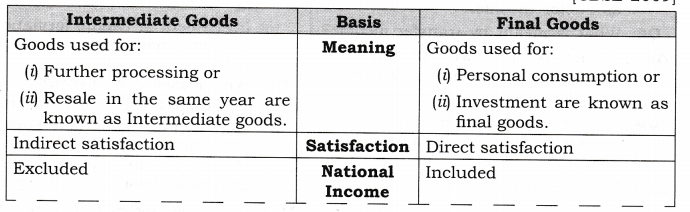

Q.2 Define consumption goods and what are its categories.
ANSWER: Consumption goods are those which satisfy the wants of the consumers directly.
For example, cars, television sets, bread, furniture, air-conditioners, etc. Consumption goods can further be subdivided into the following categories:
- Durable goods: These goods have an expected life time of several years and of relatively high value. They are motor cars, refrigerators, television sets, washing machines, air-conditioners, kitchen equipments, computers, communication equipments etc.
- Semi-durable goods: These goods have an expected life time of use of one year or slightly more. They are not of relatively great value. Examples are clothing, furniture, electrical appliances like fans, electric irons, hot plates and crockery.
- Non-durable goods: Goods which cannot be used again and again, i.e., they lose their identity in a single act of consumption are known as non durable goods. These are food grains, milk and milk products, edible oils, beverages, vegetables, tobacco and other food articles.
goods which satisfy the human wants directly. They cannot be seen or touched, i.e., they are intangible in nature. These are medical care, transport and communications, education, domestic services rendered by hired servants, etc.
Q.3 Define capital goods and its categories.
Or
Define ‘capital goods’.[CBSE Foreign 2011]
ANSWER:
- Capital goods are defined as all goods produced for use in future productive processes.
- For example, All the durable goods like cars, trucks, refrigerators, buildings, air crafts, air-fields and submarines used to produce goods and services for sale in the market are a part of capital goods.
- Stocks of raw materials, semi finished and finished goods lying with the producers at the end of an accounting year are also a part of capital goods.
- Some more examples of capital goods are machinery, equipment, roads and bridges.
- These goods require repair or replacement over time as their value depreciate over a period of time.
Q.4 Distinguish between consumption goods and capital goods. Which of these are final goods? [CBSE Delhi 2010]
ANSWER: 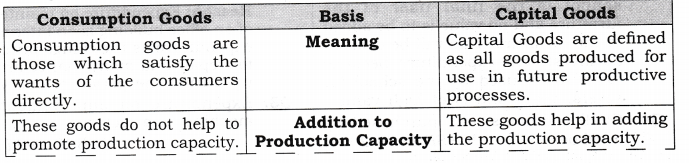

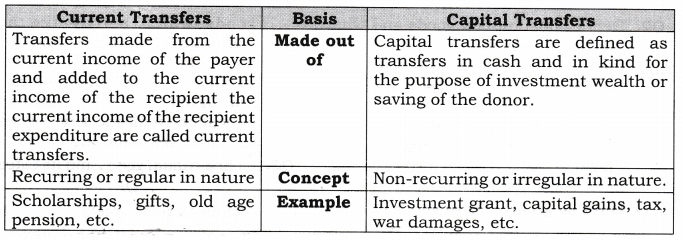
Q.5 Differentiate between Current transfers and Capital Transfers.
ANSWER: