- By noor arora
- 0 Comment
- 23 Dec 2022
Chapter 12 Aldehydes, Ketones and Carboxylic Acids | Class 12th | quick revision notes chemistry
Class 12 Chemistry Revision Notes Chapter 12 Aldehydes, Ketones and Carboxylic acid
Aldehydes: Aldehydes are the organic compounds in which carbonyl group is attached to one hydrogen atom and one alkyl or aryl group.
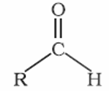
Where R can be an alkyl or aryl group
Preparation of aldehydes:
a) By oxidation of alcohols: Oxidation of primary alcohols in presence of oxidizing agent like K2Cr2O7/H2SO4, KMnO4,CrO3 gives aldehydes.
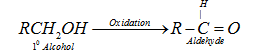
b) By dehydrogenation of alcohols: When the vapours of primary alcohol passed through heated copper at 573 K, it forms aldehyde.
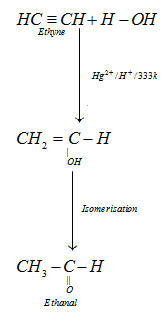
c) By hydration of alkynes: Ethyne on hydration with at 333 K forms acetaldehyde.
d) By Rosenmund reduction: Hydrogenation of acyl chloride over palladium on barium sulphate gives aldehyde.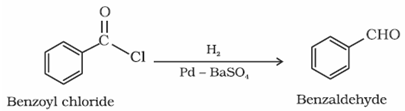
e) By reduction of nitriles:
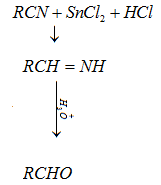
i) Stephen Reaction: Reduction of nitriles in presence of stannous chloride in presence of HCl gives imine which on hydrolysis gives corresponding aldehyde.
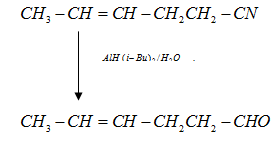
ii) Nitriles are selectively reduced by DIBAL-H (Diisobutylaluminium hydride) to aldehydes.
f) By reduction of ester: Esters are reduced to aldehydes in presence of DIBAL-H (Diisobutylaluminium hydride)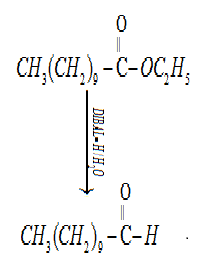
g) From Hydrocarbons:
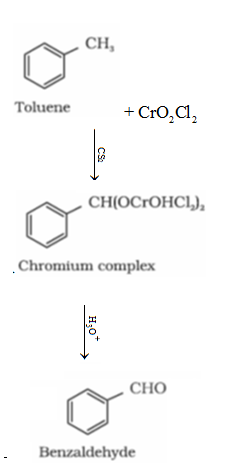
(i) By oxidation of methyl benzene: Etard Reaction: Chromyl chloride oxidizes methyl group to a chromium complex, which on hydrolysis gives corresponding benzaldehyde.
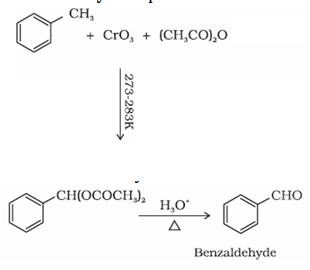
Using chromium oxide: Toluene or substituted toluene is converted to benzaldehyde in presence of chromic oxide in acetic anhydride.
(ii) By side chain chlorination followed by hydrolysis:Halogenation of toluene: Side chain halogenation of toluene gives benzal chloride which on hydrolysis gives Benzaldehyde.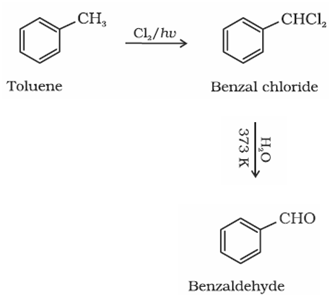
(iii) Gatterman –Koch reaction: Benzene or its derivatives on treatment with carbon monoxide and HCl in presence of anhydrous aluminium chloride or cuprous chloride (CuCl) gives benzaldehyde or substituted benzaldehydes.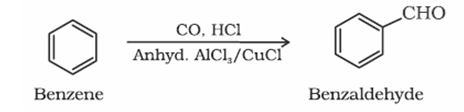
- Ketones: Ketones are the organic compounds in which carbonyl group is attached to two alkyl group or aryl group or both alkyl and aryl group.
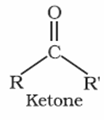
Where R, R’ may be alkyl or aryl. - Preparation of ketones:
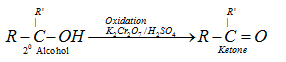
a) By oxidation of alcohols: Oxidation of secondary alcohols in presence of oxidizing agent like,
gives ketones.
b) By dehydrogenation of alcohols: When the vapours of a secondary alcohol are passed over heated copper at 573 K, dehydrogenation takes place and a ketone is formed.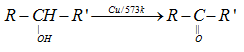
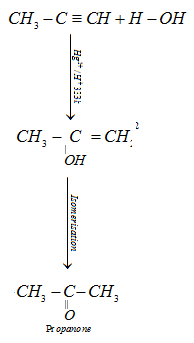
c) By hydration of alkynes: Alkynes on hydration withat 333 K form ketones.
d) From acyl chloride: Acyl chloride on treatment with dialkyl cadmium (prepared by reaction of cadmium chloride with Grignard reagent) gives ketone.

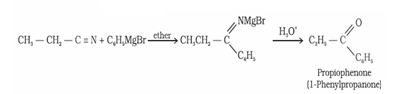
e) From nitriles: Nitriles on treatment with Grignard reagent followed by hydrolysis give ketones.
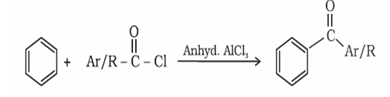
f) By Friedel Crafts acylation reaction: Benzene or substituted benzene on treatment with acid chloride in presence of anhydrous aluminium chloride forms ketone.
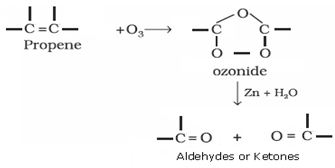
g) Preparation of aldehydes and ketones by ozonolysis of alkenes:
- Reactions of aldehydes and ketones:
- Aldehydes are generally more reactive than ketones in nucleophilic addition reactions due to steric and electronic reasons (or inductive effect).
- Electronic Effect: Relative reactivities of aldehydes and ketones in nucleophilic addition reactions is due the positive charge on carbonyl carbon. Greater positive charge means greater reactivity. Electron releasing power of two alkyl groups in ketones is more than one in aldehyde. Therefore positive charge is reduced in ketones as compared to aldehydes. Thus ketones are less reactive than aldehydes.
- Stearic Effect: As the number and size of alkyl group increase, the hindrance to the attack of nucleophile also increases and reactivity decreases. In aldehydes there is one alkyl group and one hydrogen atom, whereas in ketones there are two alkyl groups (same or different).
- Nucleophilic addition reactions of aldehydes and ketones:
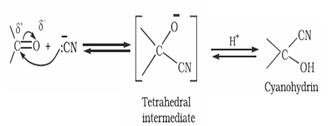
(a) Addition of hydrogen cyanide (HCN) to form cyanohydrins
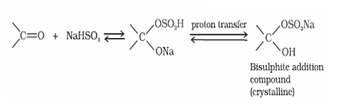
(b) Addition of sodium hydrogensulphiteto form bisulphate addition compound
(c) Addition of Grignard reagent (RMgX) to form alcohol

(d) Addition of alcohol:
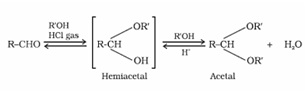
(i) Aldehydes on addition of monohydric alcohol in presence of dry HCl forms hemiacetal and acetal.
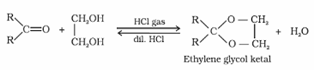
(ii) Ketones do not react with monohydric alcohols. Ketones react with ethylene glycol under similar conditions to form cyclic products known as ethylene glycol ketals.
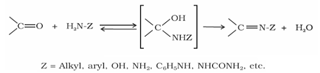
(e) Addition of ammonia and its derivatives:
- Reduction of aldehydes and ketones:
(a) Reduction to alcohols:
Aldehydes and ketones on catalytic hydrogenation in presence of Ni, Pt or Pd by using lithium aluminium hydride or sodium borohydride
forms primary and secondary alcohols respectively.
(b) Reduction to hydrocarbons:
(i) Clemmensen reduction: Carbonyl group of aldehydes and ketones is reduced to group on treatment with zinc amalgam and concentrated hydrochloric acid.
(ii) Wolff-Kishner reduction: Carbonyl group of aldehydes and ketones is reduced to group on treatment with hydrazine followed by heating with sodium or potassium hydroxide in high boiling solvent such as ethylene glycol.
(iii)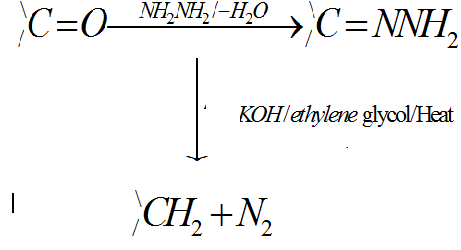
- Oxidation of aldehydes and ketones:
(i) Aldehydes are oxidized to acids in presence of mild oxidising agents HNO3, K2Cr2O7, KMnO4.
(ii) Ketones are oxidized under drastic conditions i.e. with powerful oxidising agents like at higher temperature.
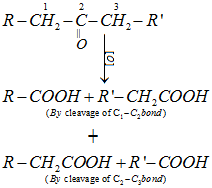
In case of unsymmetrical ketones cleavage occurs in such a way that keto group stays with smaller alkyl group. This is known as Popoff’s rule.
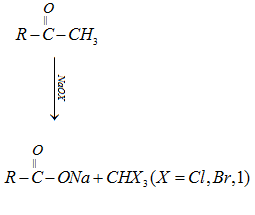
(iii)Haloform reaction: Aldehydes and ketones having at least one methyl group linked to the carbonyl carbon atom i.e. methyl ketones are oxidised by sodium hypohalite to sodium salts of corresponding carboxylic acids having one carbon atom less than that of carbonyl compound. The methyl group is converted to haloform.
- Reactions of aldehydes and ketones due to -hydrogen:
(i) Aldol condensation: Aldehydes and ketones having at least one -hydrogen undergo a self condensation in the presence of dilute alkali as catalyst to form -hydroxy aldehydes (aldol) or -hydroxy ketones (ketol), respectively.
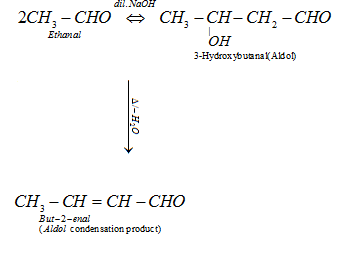
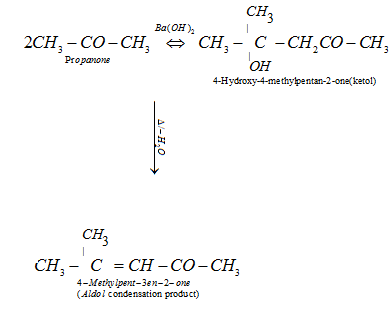
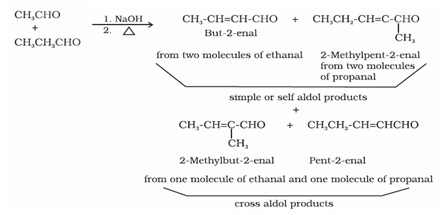
(ii) Cross aldol condensation: Aldol condensation between two different aldehydes and ketones is called aldol condensation. If both of them contain -hydrogen atoms, it gives a mixture of four products.
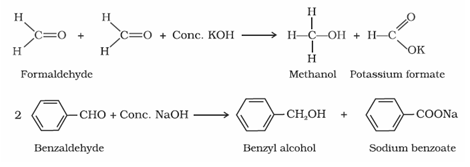
- Canizzaro reaction: Aldehydes which do not have an -hydrogen atom undergo self-oxidation and reduction (disproportionation) reaction on treatment with concentrated alkali to form alcohol and salt of acid.
- Test to distinguish aldehydes and ketones:
- Tollen’s test: When an aldehyde is heated with Tollen’s reagent it forms silver mirror. Tollen’s reagent is ammoniacal solution of

Ketones do not form silver mirror and hence do not give this test. - Fehling’s test: When an aldehyde is heated with Fehling’s reagent it formsreddish brown precipitates of cuprous oxide.Fehling’s reagent: Fehling solution A (aqueous solution of
) + Fehling solution B (alkaline solution of sodium potassium tartarate)

Ketones do not give this test.
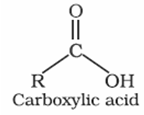
- Carboxylic Acids:Carboxylic acids are the compounds containing the carboxylfunctional group (-COOH).
- Preparation of carboxylic acid:
(i) From alcohols: Primary alcohols are readily oxidised to carboxylic acids with common oxidising agents such as potassium permanganate in neutral, acidic or alkaline media or by potassium dichromate (K2Cr2O7) and chromium trioxide
in acidic media.
a)
b)
(ii) From aldehydes: Oxidation of aldehydes in presence of mild oxidizing agents like Tollen’s reagent (ammoniacal solution of ) or Fehling reagent (Fehling solution A (aqueous solution of
) + Fehling solution B (aqueous solution of sodium potassium tartarate)) forms carboxylic acids.
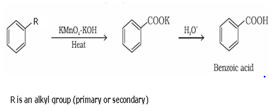
(iii) From alkylbenzenes: Aromatic carboxylic acids can be prepared by vigorous oxidation of alkyl benzenes with chromic acid or acidic or alkaline potassium permanganate.
(iv) From alkenes: Suitably substituted alkenes are oxidised to carboxylic acids on oxidation with acidic potassium permanganate or acidic potassium dichromate.
(v) From Nitriles: Nitriles on hydrolysis in presence of dilute acids or bases forms amide which on further hydrolysis gives carboxylic acid.

(vi) From Grignard reagent: Grignard reagents react with carbon dioxide (dry ice) to form salts of carboxylic acids which on hydrolysis forms carboxylic acids.

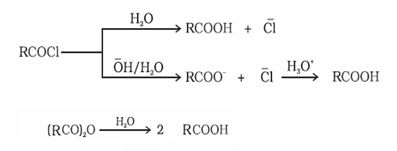
(vii) From acyl halides and anhydrides: Acid chlorides when hydrolysed with water give carboxylic acids .On basic hydrolysis carboxylate ions are formed which on further acidification forms corresponding carboxylic acids. Anhydrides on hydrolysis forms corresponding acid(s)
(viii) From esters: Acidic hydrolysis of esters gives directly carboxylic acids while basic hydrolysis gives carboxylates, which on acidification give corresponding carboxylic acids.
- Physical properties of carboxylic acids:
(i) Solubility: As the size of alky group increases solubility of carboxylic acid decreases because non-polar part of the acid increases
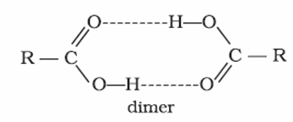
(ii) Boiling points: Carboxylic acids are higher boiling liquids than aldehydes, ketones and even alcohols of comparable molecular masses. This is due to extensive association of carboxylic acid molecules through intermolecular hydrogen bonding.
- Acidity of carboxylic acids:
Carboxylic acids are more acidic than phenols. The strength of acid depends on extent of ionization which in turn depends on stability of anion formed.
(i) Effect of electron donating substituents on the acidity of carboxylic acids: Electron donating substituent decreases stability of carboxylate ion by intensifying the negative charge and hence decreases acidity of carboxylic acids.
(ii) Effect of electron withdrawing substituent on the acidity of carboxylic acids: Electron withdrawing group increases the stability of carboxylate ion by delocalizing negative charge and hence, increases acidity of carboxylic acid. The effect of the following groups in increasing acidity order is Ph< I < Br <cl< f=””>2 < CF3</cl<>
(a) Effect of number of electron withdrawing groups: As the number of electron withdrawing groups increases –I effect increases, increasing the acid strength
(b) Effect of position of electron withdrawing group: As the distance between electron withdrawing group and carboxylic group increases, electron withdrawing influence decreases.
- Reaction of carboxylic acids:
Reactions involving cleavage of C-OH bond:
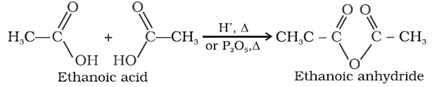
Carboxylic acids on heating with mineral acids such as or with
give corresponding anhydride.
(i) Anhydride formation:
(ii) Esterification: Carboxylic acids are esterified with alcohols in the presence of a mineral acid such as concentrated or HCl gas as a catalyst.

(iii) Carboxylic acids react with PCl5, PCl3 and SOCl2 to form acyl chlorides.
(iv) Reaction with ammonia (NH3): Carboxylic acids react with ammonia to give ammonium salt which on further heating at high temperature gives amides.
i)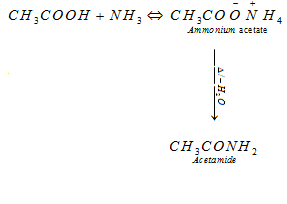
ii)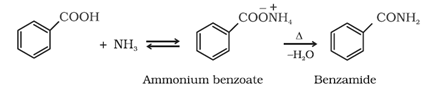
Reactions involving COOH group:
(i) Reduction: Carboxylic acids are reduced to alcohols in presence of LiAlH4 or B2H6.
(ii) Decarboxylation : Sodium or potassium salts of carboxylic acids on heating with soda lime (NaOH + CaO in ratio of 3:1) gives hydrocarbons which contain one carbon less than the parent acid.
(c) Reactions involving substitution reaction in hydrocarbon part:
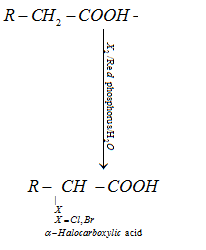
(i) Hell-Volhard-Zelinsky reaction: Carboxylic acids having an -hydrogen are halogenated at the -position on treatment with chlorine or bromine in the presence of small amount of red phosphorus to give -halocarboxylic acids)
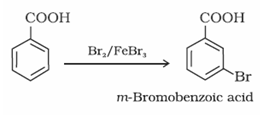
(ii) Ring substitution in aromatic acids: Aromatic carboxylic acids undergo electrophilic substitution reactions. Carboxyl group in benzoic acid is electron withdrawing group and is meta directing.
i)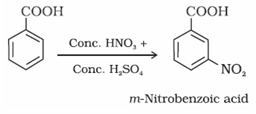
ii)