Here students can get info about NCERT Solutions for Class 6 Science so that they can get to know the answers to the questions in case they are not able to find it. You can find the best Class 6th Science NCERT Solutions explained in conformance with the CBSE curriculum for Class 6.
NCERT Solutions for Class 6 Science Chapter 15 Air Around Us
1. What is the composition of air? Ans: Air is mixture of nitrogen, oxygen, carbon dioxide, water vapour and a few other gases. Some dust particles may also be present in it.
2. Which gas in the atmosphere is essential for respiration? Ans: Oxygen.
3. How will you show that air supports burning? Ans: Take a small burning candle. Cover the burning candle with a glass jar. After few minutes the candle is extinguished. As the supply of air is stopped due to glass jar the burning of candle is also stopped. This experiment proves that air supports burning
4. How will you show that air is dissolved in water? Ans: Take some water in a glass vessel or beaker. Heat it slowly on a tripod stand. Before the water begins to boil, look carefully at the inner surface of the vessel. You will see tiny bubbles on the inside. On heating, air dissolved in water escapes in the form of these bubbles.
5. Why does a lump of cotton wool shrink in water? Ans: Lump of cotton wool has air among gaps of cotton fibres. When water replaces the air from these gaps, the cotton lump becomes heavy and also shrinks due to removal of air gaps.
6. The layer of air around the earth is known as…………………. Ans: Atmosphere
7. The component of air used by green plants to make their food, is…………………. Ans: Carbon dioxide.
8. List five activities that are possible due to presence of air. Ans: The activities that are possible due to the presence of air, are: (a) To make a simple firki (b) To make a weather cock (c) To breathe for survival (d) For burning of substance (e) For photosynthesis
9. How do plants and animals help each other in exchange of gases in the atmosphere? Ans: Animals and plants use oxygen from air during respiration and release carbon dioxide gas in air. But green plants also release oxygen gas by using carbon dioxide during photosynthesis. Thus, we can say that animals and plants help each other in exchange of gases.
Class 6 Science Chapter 15 VERY SHORT ANSWER TYPE QUESTIONS
1. Name the main component of air. Ans: Nitrogen gas
2. What is the source of oxygen gas in air? Ans: Photosynthesis by green plants is source of oxygen gas in air.
3. What is the percentage of nitrogen in air? Ans: 78.1%
4. What is the percentage of oxygen in air? Ans: 20.9%
5. What is the source of carbon dioxide in air? Ans: Respiration by animals and plants and burning of fuel.
6. Mention one necessary condition for the combustion to take place. Ans: Presence of air.
Class 6 Science Chapter 15 SHORT ANSWER TYPE QUESTIONS
1. Why is air considered as a mixture? Ans: Air contains oxygen and nitrogen as its major constituents of air. These gases retain their properties in air. So the air is called a mixture.
2. Name the major gas present in the (a) inhaled air (b) exhaled air. Ans: (a) Oxygen (b) Carbon dioxide.
3. Write the necessary conditions for rusting of iron to take place. Ans: Rusting of iron takes place in the presence of moisture and air. So the presence of air and water vapour in air are two necessary conditions for rusting of iron.
4. Name a device which uses wind energy to generate electricity. Ans: Windmills use the wind energy to convert wind energy into electrical energy
5. What is wind energy? Mention its two advantages. Ans: Blowing air is called wind. Wind possesses kinetic energy. The kinetic energy possessed by wind is called wind energy. Uses of Wind Energy are: (i) Wind energy is used to pump the ground water. (ii) Wind energy is used to generate electricity with the help of windmills.
6. Mention two uses of air. Ans: The two uses of air are as below: (a) For respiration all organisms need air. (b) For burning of any substance air is needed.
7. Describe balance of oxygen in the air. Ans: The oxygen in air is used by the organisms present in air, water or soil or on earth for their respiration. During respiration carbon dioxide gas is released to air. But green plants during photosynthesis use carbon dioxide of air for preparing food and they release oxygen gas in the air. Thus the balance of oxygen in air is maintained.
8. What happens if the percentage of oxygen in the air reaches to 70%? Ans: If any substance catches fire it will become difficult to extinguish the fire, as oxygen supports combustion.
9. What happens if the percentage of carbon-dioxide increases in the air? Ans: The increased percentage of carbon-dioxide will cause green house effect, i.e. it will not allow the hot rays of sun to escape from the atmosphere after reflection once they enter the earth’s atmosphere, thereby increasing the temperature of earth, ice on mountains will melt and water level will rise.
10. You must have seen during rainy season, when it rains the animals like earthworm, snakes, snails etc. are commonly seen. Explain why? Ans: All these animals live in underground burrows or remain buried in the soil. They get oxygen from air that enters into the burrow through entrance of burrow or through pores in the soil. But when it rains, the water gets filled in their dwelling places and pores of the soil. So, they come out in search of air.
11. Why is carbon-dioxide gas used to extinguish fire? Ans: It is because carbon-dioxide does not support combustion. When sprayed on burning object it stops the supply of oxygen and extinguishes fire.
12. How will you prove that soil contains air in it? Ans: Take a glass tumbler add some soil in it, then pour some water on the soil slowly, the air-bubbles comes out of the soil. This proves that soil holds air in it.
13. Why do we see the sky and air clear and clean after rainfall? Ans: The dust particles which remain suspended in air get loaded and come down on the ground due to rainfall, this is the reason that the sky and the air look clean and clear after rainfall.
14. Explain why mountaineers carry oxygen cylinders with them? Ans: As you go up, above the sea-level the atmospheric pressure goes on decreasing and the amount of oxygen also decreases at higher altitude.
15. Explain why during an incident of fire, one is advised to wrap a woollen blanket over a burning object. Ans: Blanket cuts the supply of oxygen to the object that is burning, thereby prevents it from further burning.
Class 6 Science Chapter 15 LONG ANSWER TYPE QUESTIONS
1. What is air? Name the major constituents of air. Also give their volume proportions in air. Ans: Air is a mixture of gases. The major constituents of air are nitrogen, oxygen, carbon dioxide and argon. The percentage composition of constituents of air are as given below: Other components of air are water vapour and dust particles.
2. Demonstrate through a simple experiment that the air mainly contains nitrogen and oxygen in the volume ratio of 4: 1. Ans: Aim of experiment: To show that air contains nitrogen and oxygen in the ratio 4 : 1 by volume: Procedure: Take a glass container and fix a candle at its centre. Put some quantity of water in the container. Place an empty, dry gas jar over it. Mark five marks above water surface on the jar at equal distances shown in the figure given below. The candle is lightened and is covered with the gas jar. After some time the candle is extinguished and the water level is raised in gas jar. The raised level in water is 1 / 5 of the volume of air in the gas jar. This proves that one part of the air of the jar is a gas which supports combustion, i.e., oxygen. Hence, 1/5 by volume is oxygen in air.
3. Air is a mixture. Prove this statement. Ans: The components of mixture can be easily separated and they retain their properties. The components of air are: oxygen, nitrogen, water vapour and carbon-dioxide, all these gases can be easily separated and they retain their properties.
In This Post we are providing CHAPTER 16 WATER RESOURCES NCERT MOST IMPORTANT QUESTIONS for Class 12 GEOGRAPHY INDIA- PEOPLE AND ECONOMY which will be beneficial for students. These solutions are updated according to 2021-22 syllabus. These MCQS can be really helpful in the preparation of Board exams and will provide you with a brief knowledge of the chapter
NCERT MOST IMPORTANT QUESTIONSON WATER RESOURCES
Question 1. Why is the demand of water for irrigation increasing day by day in India ? Explain any three reasons. Answer: In agriculture, water is mainly used for irrigation.
Irrigation is needed due to variable rainfall in India.
Drought prone areas like N-W India and Deccan needs irrigation.
Dry seasons of winter and summer need irrigation for agriculture.
Irrigation is needed during dry season.
Certain crops like rice, sugarcane, jute require large water supply.
Multiple cropping needs irrigation.
HYV crops need regular water supply.
Success of green revolution depends upon irrigation.
Question 2. Give examples of Recycling and Reuse of Water. Answer: Recycle and Reuse of Water. Another way through which we can improve fresh water availability is by recycle and reuse. Use of water of lesser quality such as reclaimed waste-water would be an attractive option for industries for cooling and fire fighting to reduce their water cost. Similarly, in urban areas water after bathing and washing utensils can be used for gardening.
Water used for washing vehicle can also be used for gardening. This would conserve better quality of water for drinking purposes. Currently, recycling of water is practised on a limited scale. However, there is enormous scope for replenishing water through recycling.
Question 3. What are the two water problems in India ? Explain with suitable examples. Or Why is the quality of water deteriorating in India? Explain with ‘ examples. Answer: Due to increase in population, the availability of water is decreasing. The two main water problems are: (i) Deterioration of Water Quality : Quality refers to purity of water, or water without unwanted foreign substances. Water gets polluted by foreign matters such as micro-organisms, chemical, industrial and other wastes. Such matters deteriorate the quality of water and render it unfit for human use.
When toxic substances enter lakes, streams, rivers, oceans and other water bodies, they get dissolved or lie suspended in water. This results in pollution of water whereby quality of water deteriorates affecting aquatic systems. Sometimes, these pollutants also seep into earth and pollute groundwater. The Ganga and the Yamuna are the two highly polluted rivers in the country.
(ii) Water Conservation and Management : Since there is a declining availability of fresh water and increasing demand, the need has arisen to conserve and effectively manage this precious life giving resource for sustainable development. Given that water availability from sea/ocean, due to high cost of desalinisation, is considered negligible, India has to take quick steps and make effective policies and laws, and adopt effective measures for its conservation.
Besides developing water saving technologies and methods, attempts are also to be made to prevent the pollution. There is need to encourage watershed development, rainwater harvesting, water recycling and reuse, and conjunctive use of water for sustaining water supply in long run.
Question 4. Describe the main features of India’s National Water Policy. Answer: Highlights of India’s National Water Policy, 2002 : The National Water Policy, 2002 stipulates water allocation priorities broadly in the following order: drinking water, irrigation, hydro-power, navigation, industrial and other uses. The policy stipulates progressive new approaches to water management. Key features include:
(1) Irrigation and multi-purpose projects should invariably include drinking water component, wherever there is no alternative source of drinking water. (2) Providing drinking water to all human beings and animals should be the first priority. (3) Measures should be taken to limit and regulate the exploitation of groundwater. (4) Both surface and groundwater should be regularly monitored for quality. A phased programme should be undertaken for improving water quality. (5) The efficiency of utilisation in all the diverse uses of water should be improved. (6) Awareness of water as a scarce resource should be fostered. (7) Conservation consciousness should be promoted through education, regulation, incentives and disincentives.
Question 5. Describe the methods and effects of Rainwater Harvesting. Answer: Rainwater Harvesting. Rainwater harvesting is a method of capturing and storing rainwater for various uses. It is also used to recharge groundwater aquifers.
It is a low cost and eco¬friendly technique for preserving every drop of water by guiding the rain water to bore well, pits and wells.
Rainwater harvesting increases water availability.
It checks the declining ground water table.
It improves the quality of groundwater through dilution of contaminants like fluoride and nitrates.
It prevents soil erosion, and flooding and arrests salt water intrusion in coastal areas if used to recharge aquifers.
Methods. Rainwater harvesting has been practised through various methods by different communities in the country for a long time. Traditional rainwater harvesting in rural areas is done by using surface storage bodies like lakes, ponds, irrigation tanks, etc.
In Rajasthan, rainwater harvesting structures locally known as Kund or Tanka (a covered underground tank) are constructed near or in the house or village to store harvested rainwater to understand various ways of rainwater harvesting.
Effects. There is a wide scope to use rainwater harvesting technique to conserve precious water resource. It can be done by harvesting rainwater on rooftops and open spaces. Harvesting rainwater also decreases the community dependence on groundwater for domestic use.
Besides bridging the demand supply gap, it can also save energy to pump groundwater as recharge leads to rise in groundwater table. These days rainwater harvesting is being taken up on massive scale in many states in the country. Urban areas can specially benefit from rainwater harvesting as water demand has already outstripped supply in most of the cities and towns.
Question 6. What is Water Pollution ? Discuss- the methods and rules to check it. ; Answer: Prevention of Water Pollution. Available water resources are degrading rapidly. (1) The major rivers of the country generally retain better water quality in less densely populated upper stretches in hilly areas.
(2) In plains, river water is used intensively for irrigation, drinking, domestic and industrial purposes. The drains carrying agricultural (fertilisers and insecticides), domestic (solid and liquid wastes), and industrial effluents join the rivers.
(3) The concentration of pollutants in rivers, especially remains very high during the summer season when the flow of water is low.
Polluted Rivers. The Central Pollution Control Board (CPCB) in collaboration with State Pollution Control Boards has been monitoring water quality of national aquatic resources at 507 stations. The data obtained from these stations show that organic and bacterial contamination continues to be the main source of pollution in rivers.
The Yamuna river is the most polluted river in the country between Delhi and Etawah. Other severely polluted rivers are : the Sabarmati at Ahmedabad, the Gomti at Lucknow, the Kali, the Adyar, the Cooum (entire stretches), the Vaigai at Madurai and the Musi of Hyderabad and the Ganga at Kanpur and Varanasi. Groundwater pollution has occurred due to high concentrations of heavy/toxic metals, fluoride and nitrates at different parts of the country.
Question 7. Examine the success of watershed management in Jhabua District of Madhya Pradesh. Answer: A case study for Water Shed Management Location: Jhabua district is located in the westernmost agro-climatic zone in Madhya Pradesh. It is, in fact, one of the five most backward districts of the country. It is characterised by high concentration of tribal population (mostly Bhils).
Problems: The people suffer due to poverty which has been accentuated by the high rate of resource degradation, both forest and land. The watershed management programmes funded by both the ministries of “Rural Development” and “Agriculture”, Government of India, have been successfully implemented in Jhabua district which has gone a long way in preventing land degradation and improving soil quality.
Programmes: Watershed Management Programmes acknowledge the linkage between land, water and vegetation and attempts to improve livelihoods of people through natural resource management and community participation. In the past five years, the programmes funded by the Ministry of Rural Development alone (implemented by Rajiv Gandhi Mission for Watershed Management) has treated 20 per cent of the total area under Jhabua district.
The Petlawad block of Jhabua is located in the northernmost part of the district and represents an interesting and successful case of Government-NGO partnership and community participation in managing watershed programmes. The Bhils in Petlawad block, for example (Sat Rundi hamlet of Karravat village), through their own efforts, have revitalised large parts of common property resources. Each household planted and maintained one tree on the common property.
They also have planted fodder grass on the pasture land and adopted social-fencing of these lands for at least two years. Even after that, they say, there would be no open grazing on these lands, but stall feeding of cattle, and they are thus confident that the pastures they have developed would sustain their cattle in future.
Question 8. Explain any three factors responsible for depletion of water resources. Examine any two legislative measures for controlling water pollution in India. Answer: Depletion of water resources:
Water resources in India are very rapidly decreasing. It is due to the following reasons:
The use of water is increasing due to increasing population.
The Industrial sector is using water resources at a fast rate.
Water is used for irrigation to increase the agricultural productivity.
Water pollution is increasing.
Legislative measures : (i) The legislative provisions such as the Water (Prevention and Control of Pollution) Act 1974 and Environment Protection Act 1986, have not been implemented effectively.
(ii) The Water Cess Act 1977, meant to reduce pollution has also made marginal impacts. There is a strong need to generate public awareness about the importance of water and the impacts of water pollution. The public awareness and action can be very effective in reducing the pollutants from agricultural activities, domestic and industrial discharge.
Question 9. Analyse the economic and social values of rainwater harvesting. Answer: Economic and Social values of rainwater.
It meets the ever increasing demand of water.
It prevents the flooding of roads.
It help to save energy.
It helps in the economic development of a country.
It reduces groundwater pollution.
Question 10. Describe the Jal Kranti Abhiyan. Answer: In 2015-16 the Government of India launched the Jal Kranti Abhiyan with an aim to ensure water security through per capita availability of water in our country. In different regions of India people had practised their traditional knowledge of water conservation to ensure water availability. This Abhiyan aims at involving local bodies, NGO, etc. regarding its objectives.
Following are some activities of this Abhiyan:
One water stressed village is selection in each 672 districts of the country to generate a Jal Gram.
Here students can get info about NCERT Solutions for Class 6 Science so that they can get to know the answers to the questions in case they are not able to find it. You can find the best Class 6th Science NCERT Solutions explained in conformance with the CBSE curriculum for Class 6.
NCERT Solutions for Class 6 Science Chapter 14 Water
1. Fill up the blanks in the following: (a) The process of changing of water into its vapour is called_______________ . (b) The process of changing water vapour into water is called_____________ . (c) No rainfall for a year or more may lead to _____________ in that region. (d) Excessive rains may cause__________ . Ans: (a) evaporation or vaporisation (b) condensation (c) droughts (d) flood
2. State for each of the following whether it is due to evaporation or condensation: (a) Water drops appear on the outer surface of a glass containing cold water. (b) Steam rising from wet clothes while they are ironed. (c) Fog appearing on a cold winter morning. (d) Blackboard dries up after wiping it. (e) Steam rising from a hot girdle when water is sprinkled on it. Ans: (a) condensation (b) evaporation (c) condensation (d) evaporation (e) evaporation.
3. Which of the following statements are “true”? (a) Water vapour is present in air only during the monsoon. (b) Water evaporates into air from oceans, rivers and lakes but not from the soil. (c) The process of water changing into its vapour is called evaporation. (d) The evaporation of water takes place only in sunlight
(e) Water vapour condenses to form tiny droplets of water in the upper layers of air where it is cooler. Ans: (a) False (b) False (c) True (d) False (e) True.
4. Suppose you want to dry your school uniform quickly. Would spreading it near an anghiti or heater help you? If yes, how? Ans: Yes, to dry the school uniform quickly, the uniform is spread near an anghiti or heater because evaporation is rapid at higher temperature. Higher the temperature faster is the rate of evaporation. So the uniform is dried up quickly.
5. Take out a cooled bottle of water from refrigerator and keep it on a table. After some time you notice a puddle of water around it. Why? Ans: The cooled water bottle has very cold exposed surface. Due to cool surface there is condensation of water-vapour from air on the surface of water bottle because water vapour is present in atmosphere. The condensed water molecules spread around the bottle. So a puddle of water is noticed after sometime.
6.To clean their spectacles, people often breathe out on glasses to make them wet. Explain why the glasses become wet? Ans: The breathe out gases contain water-vapour. The water-vapour condenses at spectacles so glass becomes wet and with the help of small amount of water, it is easy to clean the spectacles.
7. How are clouds formed? Ans: The water present on the earth evaporates due to heating by the sun. The water vapour in the air condenses to form tiny droplets of water at high altitude, which appears as clouds. Thus clouds are formed by the condensation of water vapours present in air at high altitude.
8. When does a drought occur? Ans: If there is no rain for a long period or for many years then there is scarcity of water in that region. This leads to drought.
Class 6 Science Chapter 14 VERY SHORT ANSWER TYPE QUESTIONS
1. Write the sources of water on the earth. Ans: Sources of water on the earth are: Seas, Oceans, Rivers, Springs, Tubewells, etc.
2. In which forms, water exists on the earth? Ans: Water exists on the earth in all three physical forms: ice, water and water vapour.
3. What is transpiration? Ans: Loss of water in the form of water vapour through stomata of leaves is called transpiration.
4. How are the clouds formed? Ans: Clouds are formed by the condensation of water vapour at high altitude.
5. What is meant by the conservation of water? Ans: Careful, economical and wise use of water and avoiding the wastage of water is called conservation of water.
Class 6 Science Chapter 14 SHORT ANSWER TYPE QUESTIONS
1. Mention two main functions of water for living organisms. Ans: Two main functions of water for living organisms are: 1. Water is essential for the germination of seeds, growth of plants and in photosynthesis. 2. Water is used for the transportation of people and goods.
2. Why is ocean water not suitable for domestic use? Ans: Sea and ocean water contains large amounts of various salts. It is due to these salts the ocean water is salty and cannot be used for drinking, washing and for irrigation purposes.
3. Why does the water split on the floor disappear after some time? Ans: Due to evaporation the water split is changed into water vapour. So it disappears after some time.
4. How does heavy rain affect us? Ans: Heavy rains may cause: 1. A rise of water level in dams, rivers, lakes, etc. 2. Waterlogging and floods. 3. Floods cause damage to property, crops and animals.
5. How does the failure of rainfall affect people on the earth? Ans: The failure of rainfall can cause the following: 1.The soil becomes dry. 2. Water level in rivers, lakes, dams, etc. may fall. Ponds and canals may even dry up. 3. The ground water level falls.
6. Name two processes responsible for the formation of clouds. Ans: Evaporation and transpiration.
There are 4 containers A, B, C and D with same amount of water in each. Answer the following based on them. (a) Name the container in which water will evaporate faster than all others. (b) Name the container in which water will evaporate very slowly. Give reason for your answer. Ans. (a) C – More is the exposed surface area, more will be evaporation of water. (b) B – As it is closed, no evaporation takes place.
8. During winters why do we see more fog in close areas where there are lots of .trees? Ans: Due to lots of trees, air at that place contains much more water vapour during winters. These vapour condense on dust or smoke particles forming thick fog.
Class 6 Science Chapter 14 LONG ANSWER TYPE QUESTIONS
1. What is meant by conservation of water? Suggest three methods to conserve water. Ans: Careful and economical use of water and avoiding its wastage is called conservation of water. Suggestions for conserving water:
Use only the required quantity of water.
Trees and forests help in causing rainfall. So to conserve water, we should plant more and more trees.
By collecting rainwater in tanks, ponds or by constructing check dams.
2. What is rainwater harvesting? Describe the method of rainwater harvesting. Ans: Rainwater harvesting is the collection of rainwater and storing for future use. In this system rainwater in collected from the rooftops by means of pipes into storage tank for later use. Methods of Rainwater Harvesting:
Rooftop rainwater harvesting. In this system, the rainwater from the rooftop is collected in a storage tank, through pipes.
Another method, a big pit is dug near house for collecting rainwater. This pit is filled with different layers of bricks, coarse gravels and sand or granite pieces.
In This Post we are providing CHAPTER 15 LAND RESOURCES AND AGRICULTURE NCERT MOST IMPORTANT QUESTIONS for Class 12 GEOGRAPHY INDIA- PEOPLE AND ECONOMY which will be beneficial for students. These solutions are updated according to 2021-22 syllabus. These MCQS can be really helpful in the preparation of Board exams and will provide you with a brief knowledge of the chapter
NCERT MOST IMPORTANT QUESTIONSON LAND RESOURCES AND AGRICULTURE
Question 1. Discuss the geographical conditions favouring the cultivation of wheat. Describe production and areas of cultivation in India. Answer: Wheat is one of the master grains of the world. It is the ‘staple food’ for 1/3 people of the world. It is a valuable cereal due to high gluten content. It has been grown since pre-historic times. It was originally grown in Mediterranean lands.
Conditions of Growth. Wheat is a plant of temperate latitudes. It is grown in a variety of climates. The cultivation of wheat is widespread in the world. Every month, wheat is being seeded or being harvested in some part of the world.
(i) Temperature. Wheat requires a minimum temperature of 10°C in the growing period and a maximum temperature of 20°C in the harvesting period. A frost-free period of 100 days is required for wheat.
(ii) Rainfall. The wheat lands generally need a moderate rainfall between 50 to 100 cms. annually. Wheat needs a cool and wet growing season, but a warm and a dry harvesting season.
(iii) Irrigation. Means of irrigation are used in areas of low rainfall as in Indus and Punjab. Dry farming methods are also used.
(iv) Soil. Light clay or heavy loamy soil is the best soil for wheat.
(v) Land. Wheat needs well-drained level land. It suits the use of machinery and means of irrigation.
(vi) Economic Factors: Wheat is a soil exhausting crop. Better seeds, chemical fertilisers and new varieties are used to increase the yield per hectare. It is a mechanised agriculture.Machines like tractors, combines, harvesters are often used. Huge stores are required to store wheat.
Production in India: India ranks as the second largest producer of wheat in the world (12% production). Wheat is a winter crop and India produces about 67 million metric tons of wheat. India has become self-sufficient in wheat production due to Green Revolution, yield per hectare is 2618 kg.
Area of cultivation: Wheat is grown in most of the Sutlej-Ganga plain (N.W. India). Spring wheat is grown in hilly areas of Lahaul-Spiti (Himachal Pradesh), Ladakh, Sikkim in the Sub-Himalayan region, upto a height of 2700 metres. Wheat is grown on 14% of Net Sown area. Uttar Pradesh, Punjab, Haryana, Madhya Pradesh and Rajasthan are the main wheat producing areas. These regions have the favourable conditions of fertile soils, winter rain, irrigation facilities.
Question 2. Describe the conditions of growth, production and major area of cultivation of rice in India. Answer: Rice had been cultivated since pre-historic times. China and India are regarded as the birthplace of rice. Rice is the staple food of millions of people in monsoon Asia. Rice is also called ‘Gift of Asia’.
Types of rice: There are many varieties of rice but rice is broadly divided into two types (i) Upland Rice. This rice is grown in hilly areas and has low yields. (ii) Lowland Rice. This rice is grown on the lowland areas of river valleys and deltas and has high yields.
Methods of cultivation: Rice is sown by three methods: (i) Drilling method (ii) Broadcasting method. (iii) Transplanting method.
Conditions of growth: Rice is a crop of hot-wetland of the tropics. Rice cultivation is concentrated in Monsoon Asia. (i) Temperature. Rice needs a temperature of 20°C during the growing season and a temperature of 27°C during the harvesting period. Due to uniformly high temperature, 3 crops of rice a year are produced in West Bengal.
(ii) Rainfall. Rice is a plant of wet areas with an annual rainfall between 100 to 200 cms. Rice is grown in flooded fields. Irrigation is used in areas of low rainfall as in Punjab.
(iii) Land. Rice needs level land so that the fields can be flooded. Rice is grown on hilly slopes with Terraced Agriculture upto a height of 2000 metres.
(iv) Soils. Heavy clay or loamy soil is the ideal soil for rice. River valleys, delta and coastal plains are most suited for rice cultivation.
(v) Cheap Labour. Rice needs large supply of cheap human labour. It is labour intensive crop because most of the work in the fields is done by hand. It is also called ‘Hoe-culture’. The densely populated areas supply cheap plentiful labour.
In brief we can say ‘Rice needs plenty of heat, plenty of water, plenty of alluvium, plenty of labour to produce plenty of rice for plenty of people. ’
India. India is the second largest producer of rice in the world. About 24% (22%) of the (40 million hect.) cultivated land is under rice. India produces about 86 million metric tons of rice. Over large areas, only one crop of rice is grown every year. The yield per hectare is not high. High-yielding varieties are being used to increase the production. Yield per hectare is 1562 kg.
West Bengal is the largest producer of rice in India. Due to hot and wet climate, 3 crops are grown on the same land in a year. Aman, Aus and Boro are the three types of rice crops. Rice is grown throughout the Sutlej-Ganges plain in Punjab, Haryana (with irrigation), Uttar Pradesh and Bihar and coastal plains.
Question 3. Describe the conditions of growth, production, areas of cultivation of cotton in India. Answer: Cotton is the leading fibre crop of the world. Of all the fibres, cotton is produced in the largest quantity. It is known from the writing of Herodotus that cotton has been in use in India since 3000 BCE. It is a universal fibre. Now-a-days many synthetic fibres are being used, but the cheapness and lightness of cotton make it an ideal fibre for clothing.
Conditions of Growth. Cotton is a plant of tropical and subtropical areas. (i) Temperature. Cotton needs uniformly high summer temperatures between 22°C to 32°C. It requires a warm climate with bright sunshine. Frost is harmful to cotton plant. A growing period of 210 frost free days is necessary. It is grown as an annual crop. Sea breezes increase the lustre and length of the cotton fibre.
(ii) Rainfall. Cotton needs light to moderate rainfall between 50 to 100 cms. It needs light showers during the growing period and a dry sunny picking period.
(iii) Irrigation. In arid areas, irrigation is used. It increases the yield per hectare as in Punjab.
(iv) Soils. Cotton grows best on rich,well-drained loamy soils. Lava soil is capable of retaining moisture and is highly suitable for the cultivation of cotton. Regular use of fertilisers is required to maintain the fertility of the soil.
(v) Cheap Labour. Cotton is picked by hand. Generally women labour is used. The presence of large, cheap and hard-working labour is necessary.
(vi) Land. Cotton is grown best on flat, or rolling lands. These are well-drained areas. Machinery can be used in such areas.
(vii) Absence of Diseases. The control of pests and diseases is necessary. India. India is the fourth largest producer (8.3%) of cotton in the world. India has the largest acreage under cotton cultivation. India is the oldest cotton- producing country in the world. The Cotton Textile Industry depends on Indian cotton. India has low yield of cotton.
Mostly short staple cotton is produced. Long staple cotton is imported from Egypt, Sudan and Pakistan. About 65 lakh hectare area (4.7% area) is under cotton cultivation. The total production is 20 lakh tonnes.
Areas of Cultivation. Due to a great diversity in climate and soil the cotton producing areas are found scattered over India. Southern India produces more cotton than Northern India.
(i) Black Cotton Soil Region. This is chief cotton growing area of India on the lava soils of North-West Deccan. Gujarat, Maharashtra and Madhya Pradesh are the major cotton-producing states.
(ii) Red Soil Region. Medium staple cotton is grown in the red soil area including the states of Tamilnadu, Karnataka and Andhra Pradesh.
(iii) Alluvial Soil Region. Long staple cotton (Narma) is grown on the Alluvial soils of Northern plain. The states of Punjab, Haryana and Rajasthan are the important producers of cotton. Punjab has the highest yield per hectare due to wrarm climate, fertile soil and facilities of irrigation.
Question 4. Describe the geographical conditions required for the cultivation of Tea. Describe its production and distribution in India. Answer: Tea is the most popular and stimulating drink in the world. Assam (India) and China are the native places of tea. Tea plantations were started by the Europeans. Tea is made from the leaves of a tropical bush. It contains a stimulating substance called Theme’or ‘Tannic acid.’
Types of Tea. Different varieties of Tea fall into four main types:
Black Tea.
Green Tea.
Brick Tea.
Oolong Tea.
Conditions of Growth. Tea is a plant of both tropical and temperate areas. (i) Temperature. Tea requires uniformly high temperature (20°C – 30°C) throughout the year. More pickings can be done due to warm summers. Frost is harmful for tea leaves.
(ii) Rainfall. An annual rainfall of 150 cms. is essential for the growth of tea. Rainfall should be uniform and in frequent showers. Long-dry season is harmful for tea. Shady trees protect tea-bushes from strong sunlight. Irrigation is also used.
(iii) Soil. Tea requires a deep and fertile soil. Soil should be acidic to give better flavour. A content of iron and potash is helpful.
(iv) Land. Tea is grown on gently sloping, well- drained hilly slopes and valley-sides. Tea plantations are most suited upto a height of 300 metres above sea level.
(v) Labour. Tea is a labour intensive crop. It requires a cheap, skilled labour for picking tea leaves. Picking is done by hand. Mostly women labour is used for picking.
(vi) Management. A successful tea plantation requires a good management and huge capital.
(vii) Weather. Heavy fog, high humidity and morning dew favour the growth of tea leaves.
Major Producing Areas:
India. Tea is a commercial crop in India. India is the largest producer of Tea (28%) of the world. India is the third largest exporter of tea in the world, earning a foreign exchange of ? 1100 crores. There are about 12000 tea estates managed by 700 tea companies. The total production is 81 crore kg. Areas of Cultivation. More tea is produced in Northern India than Southern India.
(a) Assam. Assam is the largest producer of tea in India. Tea is grown on the valley-sides of Brahmputra and in Duar region. Hot-Wet Monsoon climate, cheap labour, fertile land and good management are favourable factors.
(b) West Bengal. Tea is grown in Darjeeling and Jalpaiguri districts in West Bengal. Darjeeling tea has a special flavour. This flavour is due to slow growth under high humidity and low temperature due to high altitude.
(c) Southern India. Tea is grown on the slopes of Nilgiris, Cardamom and Anamalai hills. Coimbatore (Tamil Nadu), Malabar coast (Kerala), Coorg region (Karnataka) and Ratnagiri (Maharashtra) are important areas of tea production.
(d) Other Areas.
Ranchi Plateau in Jharkhand.
Palampur in Himachal Pradesh.
Kumaon and Garhwal hills in Uttarakhand.
Tripura Region.
Question 5. Describe the conditions of growth, production and distribution of coffee in India. Answer: Coffee. Coffee is a plantation crop. It is a powder obtained from the seeds of berries of a tree. It contains a stimulating substance called “Caffeine”. Next to tea, coffee is the most popular drink in the world. It is prized for its flavour. Conditions of Growth. Coffee is a plant of tropical and sub-tropical regions.
(i) Temperature. Coffee requires uniformly high temperature (22 °C), throughout the year. Strong winds and frost are harmful. Therefore, coffee is planted on the protected hill slopes.
(ii) Rainfall. Coffee needs an annual rainfall of 100 to 150 cms. Coffee needs a hot-wet growing season, but a cool dry harvesting season. Irrigation is also used in dry season.
(iii) Shady Trees. Coffee can’t stand direct sunshine. Therefore coffee trees are planted under shady trees such as bananas.
(iv) Soils. Coffee needs deep, fertile soil. It should contain iron, potash and organic content. Lava soils and deep loams are suitable.
(v) Land. Coffee grows best on well-drained hill slopes. Most of coffee is grown at height up to 1000 metres.
(vi) Cheap Labour. Coffee has to be hand picked. Therefore a large, cheap labour is required. The transplanting, pruning, harvesting and processing of coffee need a large supply of human labour.
(vii) Absence of disease. Most of the coffee plantations have been destroyed due to insects like beetle. So plant protection from diseases is necessary.
India. Coffee was introduced by a Muslim faqir named Baba Boodan’. Coffee plantations were started in 1830 in Chick-mangloor district (Karnataka). India produces about two lakh tonne coffee on the area of 2 lakh hectares. About 60% of the total production is exported through the ports of Kozhi-Kode, Chennai
and Mangaluru. India earns a foreign exchange of about ₹ 1500 crores by this export.
Areas of Cultivation: Cool climate doesn’t encourage coffee cultivation in Northern India. Coffee is mostly grown in the hills and plateaus of Southern India in Shimoga, Kadoor, Hassan and Coorg districts (Nilgiris in Karnataka).
Question 6. Analyse the geographical conditions required for the cultivation of Sugarcane. Describe the major producing areas of Sugarcane in India. Answer: Sugar is an important item in man’s food. Sugar is most widely liked and used in the world. This luxury item has a universal demand. The two main sources of sugar are sugarcane and sugar beet. About 5% sugar of the world is obtained from sugarcane. It is a commercial and industrial crop. Many products like Gur, Molasses, Paper, Wax and Fertilizers are prepared from sugarcane. India is considered the native place of sugarcane.
Conditions of Growth. Sugarcane is a plant of hot and wet tropical region. (i) Temperature. High temperatures between 21°C and 27°C are required throughout the year. It is grown in a long sunny growing season. Frost and cloudiness are harmful for sugarcane.
(ii) Rainfall. A rainfall of 100 to 175 cms. is required. The harvesting period should be dry. Sugarcane is grown under irrigation in dry areas.
(iii) Soils. Sugarcane is grown well on deep, fertile soils which can retain moisture. Alluvial soils, volcanic soils and calcareous (Limestone) soils are best suited for the growth of sugarcane.
(iv) Cheap Labour. Large supply of cheap labour is required mainly at the harvest time.
(v) Land. Sugarcane is cultivated on level, well- drained low lands. Such areas provide easy transportation, irrigation and use of machines.
(vi) Sea-Breezes. In coastal areas, sea breezes are useful. These increase the sugar content.
(vii) Use of fertilisers. Soils are kept fertile with the use of fertilisers. It gives high yields.
Major Sugarcane Producing Areas:
India. India is the second largest and the oldest sugarcane producer (23%) in the world. India has the largest acreage (33%) under sugarcane in the world. But the yield is low. In India, favourable conditions are found in Southern India. This region with hot- wet climate gives better yield. About 60% of sugarcane is produced in Northern plain due to fertile soils. India produces about 2900 lakh metric ton sugarcane on an area of 33 lakh hectares.
Areas of Cultivation: The sugar belt of India extends from Gurdaspur (Punjab) to Darbhanga (Bihar), Uttar Pradesh with a production of 88 lakh tonnes, is the largest producer of sugarcane in India. It is grown in Doab, Terai and Gorakhpur region. Andhra Pradesh, Tamil Nadu, Maharashtra, Punjab and Bihar are other main producers of sugarcane.
Question 7. Describe the conditions of growth, production and distribution of Millets in India. Answer: Millets (i) Jowar. Jowar ranks third in area among foodgrains. Jowar can be grown in semi-arid and arid having rainfall under 45 cms. High temperature is necessary for its growth. It is generally grown on poor soils and in precarious rainfall zones. Jowar is both kharif and rabi crop. About 7.0 million hectares (5.3%) are devoted to this crop in India. Thanks to the hybrid seeds, its production increased.
Jowar is grown throughout the peninsular India but its notable concentration is on heavy or medium black soils and in regions with annual rainfall under 100 cms. Half (50.1%) of the jowar cropped area of the country is in Maharashtra. Karnataka (21.2%), Andhra Pradesh, Tamil Nadu and Madhya Pradesh are also major jowar producers.
(ii) Bajra. Bajra, an inferior millet crop, is grown on lighter soils and drier conditions than jowar, and therefore, does well on well-drained sandy, loamy soils and shallow black soils. Marusthali and Aravalli hills of Rajasthan, south-western Haryana, Chambal basin, south-western Uttar Pradesh; Kachchh, Kathiawar and northern Gujarat, and rain shadow area of Western Ghats of Maharashtra are important areas of bajra cultivation. It is also a rainfed kharif crop.
Bajra occupies 7.6 million hectares (about 5.0%) of cropped area of the country. Its production increased to 4.6 million tonnes. Rajasthan, is the largest bajra producing state in the country. Uttar Pradesh Maharashtra, Gujarat, and Haryana are other important producers of bajra.
(iii) Maize. Maize occupies 3.6 per cent of the cropped area of the country. Its production was 10.3 million tonnes. Both the area and production have increased rapidly. Use of yield raising hybrid strains, fertilisers, and irrigation helped in enhancing productivity. Production of maize has increased ten times between 1951 and 2001.
Maize is cultivated throughout the country. Karnataka ranks first in production, followed by Uttar Pradesh, Bihar and Andhra Pradesh. Madhya Pradesh, Rajasthan, Gujarat, and Himachal Pradesh are other producers.
(iv) Pulses. Pulses are the main source of protein in Indian diet. They are leguminous crops and enhance soil fertility by fixing. Nitrogen Pulses need less moisture and survive even in dry conditions. Tur (pigeonpea), urd (black gram), moong (green gram), and moth (brown gram) are major kharif crops and gram, peas, tur, masoor (lentil) and urd are rabi crops. Their production rose from 8.4 million tonnes to 11.4 million tonnes.
(v) Gram is the principal pulse crop in the country. The major gram growing areas are the Malwa plateau of Madhya Pradesh, north-eastern Rajasthan and southern Uttar Pradesh. Madhya Pradesh produces more than two-fifths (40.8%) of the total gram output in the country, Uttar Pradesh is next to it (19.6%).
Tur is another important pulse crop. Major tur producers are Maharashtra and Uttar Pradesh. The distribution of other pulse crops varies widely. Uttar Pradesh produced 2.2 million tonnes (20.3%) of pulses, and thus was the largest producer of pulses in the country. Madhya Pradesh (19.5%), and Maharashtra (15.3%) are other major pulse producing states.
Question 8. What is Green Revolution ? What are its effects ? Answer: Green Revolution. Since the 1960s a new strategy has beer used for the intensive agricultural development in India. It has led to a rapid increase in the production of foodgrains in the country. A revolution has taken place in the agricultural methods and technology.
This revolution is known as Green Revolution. It includes the use of better quality seeds, high yielding varieties, chemical fertilisers, agricultural machinery, and to provide irrigation facilities. It has led to a complete modernisation of Indian agriculture.
This strategy was introduced to do away with food shortage and import of foodgrains. In 1965, the total production of foodgrains was 90 million tonnes. It became essential to increase the cropped area total production and yield per hectare. Wonderful results were achieved through Green Revolution. The total production of foodgrains in 2005-2006 has increased to above 230 million tonnes. In fact, Green Revolution has been a grain revolution.
It is clear from the following table :
Year
Foodgrains production (Million tonnes)
1966—67
74
1970—71
107
1977—78
110
1980—81
111
1984—35
150
1989—90
175
2005—06
230
2015—16
280
The adoption of Green Revolution has given a boost to agricultural development in many aspects such as— (i) The cropped area has increased due to multiple cropping.
(ii) The use of high yielding varieties of wheat and rice like Kalyan, Sonalika, Jaya, Ratna, etc. has led to increased yields per hectare. The yield of wheat rose from 13 quintal per hectare to 33 quintal per hectare in Punjab. In case of rice, a 45% increase in productivity was obtained in Andhra Pradesh.
(iii) The use of extensive irrigation increased the total production of foodgrains.
(iv) Use of chemical fertilisers led to higher yield per hectare.
(v) Massive programme of farm mechanisation, use of better quality seeds, and pesticides, use of agricultural implements has led to the success of Green Revolution.
Social effects: The standard of living of farmers has risen due to increase in per capita income. Tractor is a common asset in Punjab. Literacy has risen among the farmers. Recreation facilities are increasing due to Green Revolution.
It has not been possible to apply Green Revolution all over the country. Due to inadequate facilities of irrigation, fertilisers, lack of capital to purchase machinery, uneconomic size of land holdings, the sm all farmers could not take the advantage of Green Revolution.
Question 9. ‘Inspite of significant I development, Indian Agriculture suffers from some problems? Explain. Or “Erratic monsoons and indebtness” are the major problems of Indians for agricultureSuggest and explain the measures to overcome these problems. Or Describe the major challenges of I agriculture in present india. Or “Lack of Land reforms and degradation I of cultivable land are the major problems of Indian agriculture.” Substantiate the ; statement. Or “Erratic monsoon and low productivity are the major problems of Indian ; agriculture.” Substantiate the ; statement. Answer: Problems of Indian Agriculture. Though Herculean efforts are being made for agricultural development, productivity of crops, however, is still low in comparison to the developed countries of the world. This situation is the result of the interplay of several factors. These are grouped into four classes: (i) environmental (ii) economic (iii) institutional, and (iv) technological.
(i) Environmental Factors. The most serious problem is the erratic nature of the monsoon. Temperature remains high throughout the year. Therefore, crops can be grown all the year round if sufficient water could be supplied regularly. But it is not possible because major portion of the country receives rainfall during 3-4 months and rainfall amount and its seasonal and regional distribution are highly variable.
This situation affects the agricultural development. Major part of the country is sub-humid, sub-arid and arid as far as amount of rainfall is concerned. These regions suffer from frequent occurrences of droughts. Development of irrigation and water harvesting can raise productivity of these regions.
(ii) Economic factors. Investment in agriculture, use of inputs such as HYV, fertilisers etc. and transport facilities constitute economic factors. On account of lack of marketing facilities or non availability of loan on fair rate of interest, the cultivators are not able to invest the requisite resources in agriculture. This results in low productivity. In fact the pressure of population on land is continuously increasing. Consequently, per capita cropped land has declined from 0.444 hectare in 1921 to 0.296 hectare in 1961 and 0,219 hectare in 1991. The land holdings being small, the capacity to invest is also low.
(iii) Institutional factors. Increasing pressure of population is responsible for the sub-division and fragmentation of holdings. In 1961-62, about 52% of total holdings were marginal and small (below 2 ha. in size). In 1990-91, the percentage reached to 78% of the total holdings. Most of these holdings are also fragmented into a number of tiny plots. The uneconomic size of holdings is one of the major obstacles in the way of modernisation of agriculture. Land tenure system also does not favour large scale investment by tenants because of the insecurity of tenure.
(iv) Technological factors. Agricultural techniques are old and inefficient. Wooden plough and bullocks are still used by a majority of farmers. Mechanization is very limited. Use of fertilisers and HYV of seeds are also limited. Only one-third of the cropped area could be provided irrigation facilities. Its distribution is not in accordance with the deficit
Question 10. Review any five measures adopted to solve the problems of Indian agriculture. Answer: Agriculture is a very important sector of Indian economy. In spite of the phenomenal progress particularly since the 1960s, Indian agriculture still suffers from several serious problems, such as :
(1) Dependence on Erratic Monsoon : Unfortunately, most parts of the India receive rainfall in 3 – 4 months of the rainy season and rest of the year is practically dry, large (parts) of the country do not receive sufficient amount of rainfall. Such areas can give high agricultural productivity if sufficient arrangements for irrigation and water harvesting are made.
(2) Low Productivity : Yields of almost all the crops in India is very low. High pressure of population results in low labour productivity. We have to use HYV seeds and fertilizes to increase the productivity.
(3) Small Farm Size: Small land holdings is major obstacle in the way of modernisation of agriculture. These are some states where consolidation of holding has not yet been carried out even once.
(4) Lack of Commercialisation : Indian agriculture is still of subsistence type. Foodgrains produced by small and marginal farmers are just sufficient to meet the requirement of the family members of the farmers. Irrigation and modern farm techniques has spread to the country at a rapid pace.
(5) Lack of development of rural infrastructure, withdrawal of subsidies and price support and crop rotation etc., reduce the regional imbalances if these implement properly.
Here students can get info about NCERT Solutions for Class 6 Science so that they can get to know the answers to the questions in case they are not able to find it. You can find the best Class 6th Science NCERT Solutions explained in conformance with the CBSE curriculum for Class 6.
NCERT Solutions for Class 6 Science Chapter 13 Fun with Magnets
1. Fill in the blanks in the following: (i) Artificial magnets are made in different shapes such as_________ ,_______ and (ii) The materials which are attracted towards a magnet are called_________ (iii) Paper is not a________ (iv) In olden days, sailors used to find direction by suspending a piece of (v) A magnet always has ________poles. Ans: (i) bar magnet, horse-shoe magnet and cylindrical magnet (ii) magnetic materials (iii) magnetic (iv) bar magnet or lode stone (v) two or a pair of
2. State whether the following statements are true or false: (i) A cylindrical magnet has only one pole. (ii) Natural magnets were discovered in Greece. (iii) Similar poles of a magnet repel each other. (iv) Maximum iron filings stick in the middle of a bar magnet when it is brought near them. (v) Bar magnets always point towards North-South direction when suspended freely in air. (vi) A compass can be used to find East-West direction at any place. (vii) Rubber is a magnetic material. Ans: (i) False (ii) True (iii) True (iv) False (v) True (vi) True (vii) False
3. It was observed that a pencil sharpener gets attracted by both the poles of a magnet although its body is made of plastic. Name a material that might have been used to make some part of it. Ans: Iron is used to make some part of sharpener due to which it is attracted toward magnet.
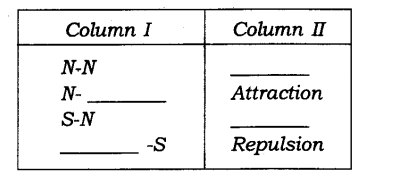
4. Column I shows different positions in which one pole of a magnet is placed near that of the other. Column II indicates the resulting action between them for each situation. Fill in the blanks. Ans:
5. Write any two properties of a magnet. Ans: Two properties of magnets are: (i) A magnet has two poles: North pole and South pole. (ii) Like poles repel each other and unlike poles attract each other.
6. Where are poles of a bar magnet located? Ans: Poles are located at the ends of bar magnet just before the ends. These are north and south poles.
7. A bar magnet has no markings to indicate its poles. How would you find out near which end is its north pole located? Ans: Take the bar magnet and suspend it freely with the help of a thread, the end that points towards north pole will be regarded as north end of the magnet. Take a bar magnet with known/marked poles on it. Let the north pole of the magnet be brought closer to the suspended magnet at the end that is pointing towards north, if it shows repulsion than it is confirmed.
8. You are given iron strip. How will you make it into a magnet? Ans: Making a magnet: Take an iron strip and place it on the table. Now take a bar magnet and place one of its poles near one edge of the strip of iron. Without lifting it move it along the length of the iron strip till you reach the other end. Now lift the magnet and bring the pole to the same point of strip from where yob began. Repeat this process about 30-40 times. Bring some iron fillings near the strip and observe that the strip attracts the fillings. This indicates that the iron strip becomes magnet.
Remember that the pole of magnet and direction of its movement should not change.
9. How is compass used to find direction? Ans: A compass is a small case of glass. A magnetised needle is pivoted inside the box. The needle can rotate freely. Compass also has a dial with directions marked on it. The compass is kept at the place where we want to know the directions. When the needle comes to rest it indicates north-south direction. The compass is then rotated until the north and south marked on the dial are at the two ends of the needle. Usually different colours are used to point the ends of needle to identify the north and the south poles.
10. A magnet was brought from different directions towards a toy boat that has been floating in water in a tub. Effect observed in each case is stated in Column I. Possible reason for the observed effects are mentioned in Column II. Match the statements given in Column I with those in Column II. Ans:
Class 6 Science Chapter 13 VERY SHORT ANSWER TYPE QUESTIONS
1. Name the compound of iron contained in lode stone. Ans: The compound of iron is iron oxide or magnetite.
2. Name the shepherd after which magnet was named. Ans: Magnets.
3. How can you separate a magnetic substance from a mixture? Ans: By using a bar magnet, the magnetic substance is separated from mixture.
4. At which place on a magnet, its magnetic force is maximum? Ans: At poles.
5. In which direction does a suspended magnet come to rest? Ans: Magnet comes to rest in N-S (north-south) direction.
6. What happens when N-pole of a magnet is brought near the N-pole of a suspended magnet? Ans: There is repulsion between these two magnets as there is repulsion between like poles.
Class 6 Science Chapter 13 SHORT ANSWER TYPE QUESTIONS
1. Draw the diagram of (a) Bar magnet (b) Horse-shoe magnet. Ans:
2.Identify magnetic and non-magnetic substances from the list given below: Iron, Steel, Nickel, Plastic, Wood, Copper and a Stainless Steel spoon Ans:
3. Draw a diagram of a magnetic compass. Ans:
4. Write main properties of a magnet. Ans: (i) Magnet has two poles—south pole and north pole. (ii) Poles of magnet cannot be isolated. (iii) Like poles repel each other and unlike poles attract each other. (iv) Freely suspended magnet aligns in N-S direction.
5.Write two methods by which a magnet can be demagnetised. Ans: (1) By hammering the magnet strongly. (2) By heating a magnet strongly and keeping it in the east-west direction.
6. It is advised to keep the magnets away from television, mobiles, CD and computers Explain why? Ans: Television, mobiles, CD, computers and many more devices are made up of magnetic materials and magnets in it. If you bring a magnet closer to it then it will spoil these devices.
7. Few iron nails and screws got mixed with the wooden shavings while a carpenter was working with them.How can you help him in getting the nails and screws back from the scrap without wasting his time in searching with his hands? Ans: With the help of a magnet we can attract all iron nails and screws and can separate them from the wooden shavings. As iron nails and screws are magnetic materials and will get attracted to the magnet,whereas wooden shavings are non-magnetic.
8. It is said that repulsion is a sure test for magnetism. Why is it so? Ans: To identify the magnet, repulsion (like poles of two magnets repel) is the only test which will let you know whether the given rod is an iron rod or a bar magnet. Because a magnet attracts an iron object and unlike poles of magnets also attract each other.
9. A given bar magnet was broken into pieces. Where will be its North and South pole? Ans: If you cut a bar magnet into pieces then the end labelled as North remains north and the other end formed will be south. Similarly the end that was pointing south will be south pole and its opposite end will be the new north pole.
10. You are given two rods. Out of these, one is an iron rod and the other one is magnet, how will you identify these rods? Ans: Take both the rods and suspend them separately. Bring one end of a bar magnet close to both the ends of the suspended rod. If it shows attraction at both the ends then it is an iron rod. If it shows attraction at one end and repulsion at the other end then it is a bar magnet.
Class 6 Science Chapter 13 LONG ANSWER TYPE QUESTIONS
1. Show that a magnet has two poles. What are the properties of the poles of a magnet? Ans. We know that pole is the point where the strength of the magnet is maximum. So more and more iron particles will be attracted at poles of a magnet when we bring a magnet near the iron particles. We will observe the crowdness of particles at the ends of magnet. This indicates the presence of two poles in a magnet. Hence poles are present in a magnet in pair. If a magnet is divided into two parts, each part also possesses a pair of poles.
In This Post we are providing CHAPTER 14 HUMAN SETTLEMENTNCERT MOST IMPORTANT QUESTIONS for Class 12 GEOGRAPHY INDIA- PEOPLE AND ECONOMY which will be beneficial for students. These solutions are updated according to 2021-22 syllabus. These MCQS can be really helpful in the preparation of Board exams and will provide you with a brief knowledge of the chapter
NCERT MOST IMPORTANT QUESTIONSON HUMAN SETTLEMENT
Question 1. Describe any five patterns of rural settlements in the world on the basis of forms and shapes. OR Explain any five patterns of rural settlements in the world with the help of suitable diagram OR Name five patterns of rural settlements on the basis of forms or shapes developed in different regions of the world. Write one characteristic of each. Answer: Patterns of rural settlements reflect the way the houses are sited in relation to each other. The site of the village, the surrounding topography and terrain influence the size and shape of a village.
The patterns of rural settlements on the basis of forms and shapes are: Linear Pattern In such settlements, houses are located along a road, river, canal edge of a valley or along a levee. Rectangular/ Cross-shape Pattern Such patterns of rural settlements are found in the plain areas or wide intermontane valleys. The roads are rectangular and cut each other at right angles. Circular Pattern Circular villages develop around lakes, tanks and some times the village is planned in such a way that the central part remains open and is used for keeping the animals to protect them from wild animals. Star-like Pattern Where several roads converge, star-shaped settlements develop by the houses built along the roads. T-Shaped, Y-shaped, Cross-Shaped or Cruciform Settlements T-shaped settlements develop at tri-junction of the roads while Y-shaped settlements emerge as the places where two roads converge on the third-one and houses are built along these roads. Cruciform settlements develop on the crossroads and houses extend in all the four directions. Double Village These settlements extend on both sides of a river where there is a bridge or a ferry.
Question 2. Explain any five major problems of the rural settlements in the developing countries of the world. OR Explain the meaning of rural settlements. Describe any four problems related to rural settlements of the world. Answer: Rural settlements are closely and directly related settlements to land. The primary occupation of these settlements is dominated by agriculture, animal husbandry, fishing, etc.
Rural settlements are now facing various problems which are as follows: Scarcity of Water The villages of developing countries lacks proper water supply. Particularly, people from the mountainous area have to bring drinking water from long distances. Waterborne diseases like cholera and jaundice are prevalent in the villages of developing countries.
Improper Housing Facilities Houses in the rural areas of the developing countries are not properly ventilated. They are designed in such a way that animal sheds along with its fodder are kept within the houses. Pattern design and building materials are not according to ecological requirement. For instance, houses in areas prone to heavy rainfalls and flood are made up of mud, wood and thatch. Lack of General Facilities Lack of sanitation facilities (i.e. toilet facilities garbage disposal facilities, etc) which cause health-related problems.
Lack of Connectivity Road networks is very primitive because roads are unmetalled and lack in a modem communication network. Due to lack of road network, rainy season cuts off the settlement and causes difficulties in providing emergency services.
Lack of Infrastructure Most of the villages has to face serious problems due to poor villagisation and extension of villages over a large area but in a scattered manner. South Asian villages face the situation like flood and drought which also affect the crop cultivation due to lack of irrigation facilities. In the developing countries, rural settlements lack proper infrastructure which causes great challenge and opportunity for planners.
Question 3. Explain any five factors that affect the location of rural settlements of the World. Answer: The location of moral settlements is affected by the following factors: Water Supply Generally, settlements are founded near water bodies like rivers, lakes and springs for water availability as water is needed for drinking, cooking, irrigation, etc. Water bodies provide fish as a food source and they are navigable too.
Land Fertile land is preferred by the people for the settlements because fertile lands are best suited for agriculture in Europe. Villages are found near the rolling country, avoiding swampy, low lying land whereas, in South-East Asia, people are located near low lying river valleys and coastal plains, best suited for rice cultivation.
Upland It is chosen for settlement because it prevents damage to houses and loss of life by a flood. It is a basically drypoint which prefers to settle on terraces and levees. People in tropical countries make their houses on stilts near marshy lands to avoid flood, insects and animal pests.
Building Material Wood and stone used as building material possess another advantage of settlements. Earlier, these villages grew after forest clearing. For instance, cave-dwelling were important in loess (sediment) areas of China. Houses in Africa are made up of mud bricks. Similarly, polar regions have Eskimos who build their houses by ice blocks i.e. igloos.
Defence At the time of political instability, war, the hostility of neighbouring groups, villages were built on hills and island for adherence of defence, e.g. upstanding inselbergs in Nigeria formed good defensive sites. Most of the forts in India are located on highland or hills.
Question 4. Classify urban settlements on the basis of size, functions and services available into five categories and explain an important characteristic of each type. OR Name the five types of urban settlements in the world. Write one main feature of each type. Answer: Urban centres are chosen as a town, city, conurbation, megalopolis, million cities on the basis of size, availability of services and functions. These are the features of urban centres too.
The five types of urban settlements in the world and their main features are as follows: Town The concept of ‘town’ can be understood with the act of looking at a village. They specialised in functions such as manufacturing, retail, wholesale, trade and professional services. City A leading town which has transformed multi-functions regarded as a city which has become better, greater or larger than local or regional rivals. They foster to have transport terminals, major financial institutions and regional administration offices.
Conurbation In 1915, Patrick Geddes coined the term conurbation which means separated large area or urban development joining towns or cities. For instance, Greater London Manchester, Chicago and Tokyo.
Megalopolis In 1957, Jean Gottman popularised the term megalopolis which is a Greek word meaning great city. The term shows the extension of the super metropolitan region as a union of the conurbation. For instance, an urban landscape which is stretching from Boston in the North to the South of Washington in the USA is the best example of a megalopolis.
Million City The cities in the world are moving and growing day-by-day as never before. For instance, in 1800, London reached the million mark, Paris in 1850, New York in 1860 and in 1950 there was the number of cities crossing the million mark (i.e. 80 such cities). The number of million cities growing with the rate of increase which has been seen in three fold in every three decades.
Question 5. Classify human settlements of the world into two types by their shapes. Explain any two features of each. OR What is a settlement? Classify settlements of the world on the basis of their shape into two categories. Mention any three characteristics of each. Answer: Human settlement refers to the cluster or group of human houses. These houses may vary from a small hut to a large house of any type or size.
They can be a temporary or permanent inhabited place which might be designed or redesigned. Every settlement is different from other in size, type and function but settlements are moving in continuity with time and space.
Settlements can be divided into two types on the basis of shape: Compact/Nucleated Settlements Characteristics of the nucleated/compact settlement are:
In this type of settlement, houses are built very close to each other.
It is found along river valleys and in fertile plains.
People in communities are tied or linked together and share their common occupations.
Dispersed Settlements Characteristics of dispersed settlements are:
Houses in this settlement are spaced far apart and often interspersed with fields.
These are dispersed but binds the settlement together through cultural features such as a place of worship or a market.
The dispersed settlements are found in the form of few huts in remote jungles, hills with farms or pastures.
Question 6. What are rural settlements? What are the two types of rural settlements in the world? How are they different from each other? Give three points of distinction. Answer: Rural settlements consist of villages in which most of the people are closely and directly related to land. They are dominated by primary activities. The two types of rural settlements in the world are compact or nucleated settlement and dispersed settlement.
Differences between compact settlements and dispersed settlements are as follows:
Compact Settlements
Dispersed Settlements
Spacing between houses is less as compared to dispersed settlements.
Spacing between houses is more as compared to compact settlements.
Fertile plains and river valleys are ideal for the development of this type of settlements.
Forested areas and areas having extreme temperature are ideal for the development of this type of settlements.
Compact and congested houses with a narrow street pattern are some features of this type of settlements.
Houses can be seen as isolated huts in remote jungle and hills with large farm and pastures.
Usually, people practise cultivation.
Usually, people rear their animals.
The population is more and it creates high pressure on available cultivable land.
The population is less and their pressure on land is negligible.
Question 7. Explain any five major environmental problems related to urban settlements > in the developing countries. (Delhi 2009) Answer: Environmental problems related to urban settlements are as follows:
The large urban population in developing countries not only uses but also disposes of a huge quantity of water and all types of waste materials.
The massive use of traditional fuel in domestic and industrial sectors severely pollutes the air.
An improper sewerage system creates unhealthy conditions.
The domestic and industrial wastes are either let into the general sewerage or dumped without treatment at unspecified locations.
Huge concrete structures created to accommodate the population also generate a lot of heat, thus creating environmental problems.
Question 8. Classify human settlements of the world into two categories. Mention four characteristics of each category. (All Indio 2009) Answer: There are two categories of human settlement, which are described below:
Rural Settlements They are close to land and have direct contact with the natural environment. Dwellers are mostly engaged in primary activities such as agriculture, fishing and mining. The pressure of population on land is less.
Characteristics of rural settlements are as follows:
The main economic activities of dwellers are cultivation, fishing, animal husbandry, forestry and other primary activities.
Houses are built far from each other i.e. spacing between the houses is more.
Agriculture and other products in rural area support industries of urban areas. Rural area not only supports its population but also of urban areas in terms of food requirement.
Social bonds in rural areas are one and life is simple.
Urban Settlements Urban settlements are centres of industries and services. Most of the dwellers i.e. about 75% are engaged in these activities. The pressure of population is more on land as they have a high density of population. Towns, cities, etc are examples of urban settlements Characteristics of urban settlements are as follows:
(z) Unlike rural dwellers, urban people are engaged in secondary, tertiary and quaternary activities such as manufacturing, trade, transport, services, research and development.
Industries in urban areas are run by the raw material provided by rural areas and in return, they provide finished products and their services to rural people.
Houses are closely built to each other i.e. spacing between the houses is less.
Social bonds in urban areas are formal and life is complex, fast and surrounded by various problems.
Map-Based Questions
Question 9. Identify the following on the given political map of the world. (i) A megacity. (Delhi 2016) (ii) A megacity, (All India 2016) (iii) A megacity, (AH India 2015) (iv) A megacity. (Delhi 2015) (v) A megacity. (Delhi 2011) (vi) The important mega city of Pakistan. (Delhi 2009) Answer:
Question 10. Identify the following on the given political map of the world, (i) A megacity. (Delhi 2012.2008) (ii) A megacity, (AH India 2011) (iii) A megacity, (AH Indio 2010) (iv) The megacity. (Delhi 2010) (v) The important mega city of Iran. (All India 2009) Answer:
Here students can get info about NCERT Solutions for Class 6 Science so that they can get to know the answers to the questions in case they are not able to find it. You can find the best Class 6th Science NCERT Solutions explained in conformance with the CBSE curriculum for Class 6.
NCERT Solutions for Class 6 Science Chapter 12 Electricity and Circuits
1. Fill in the blanks: (a) A device that is used to break an electric circuit is called_______________ (b) An electric cell has___________ Ans: (a) switch (b) two
2. Mark ‘True’ or ‘False’ for the following statements: (a) Electric current can flow through metals. (b) Instead of metal wires, a jute string can be used to make a circuit. (c) Electric current can pass through a sheet of thermocol. Ans: (a) True (b) False (c) False.
3.Explain why the bulb would not glow in the arrangement shown in fig Ans: The bulb would not glow in the arrangement shown in figure because the one end of tester/screw driver is made up of plastic which does not allow the electric current to flow through it.
4. Complete the drawing shown in Fig. 12.9 to indicate where the free ends of the two wires should be joined to make the bulb glow. Ans:
5. What is the purpose of using an electric switch? Name some electrical gadgets that have switches built into them. Ans: Electric switch is used to make electric circuit open or closed for a particular appliance and hence with the help of a switch we can use an appliance according
6. Would the bulb glow after completing the circuit shown in Fig. 12.9 if instead of safety pin we use an eraser? Ans: No, since eraser is an insulator so it does not allow the current to pass. Hence the bulb will not glow.
7. Would the bulb glow in the circuit shown in Fig. 12.11. Ans: Yes, the electric circuit is closed so the bulb will glow.
8. Using the“conduction tester” on an object it was found that the bulb begins to glow. Is that object a conductor or an insulator? Explain. Ans: Yes, if the object is good conductor of electricity then current will pass through conduction tester and the bulb will glow. Hence the object will be a conductor of electricity.
9. Why should an electrician use rubber gloves while repairing an electric switch at your home? Explain. Ans: Our body is good conductor of electricity and rubber is insulator. During repairing work if the body comes in contact with current carrying wire then there will not be any accident as rubber does not allow the passage of current through it. Hence electrician uses rubber gloves while repairing an electric switch.
10. The handles of the tools like screwdrivers and pliers used by electricians for repair work usually have plastic or rubber covers on them. Can you explain why? Ans: Plastic or rubber is an insulator which does not allow electric current to pass through it. The handles of the tools like screwdrivers and pliers used by electricians for repair have covering of plastic or rubber so that electric current may not pass through these tools to the body of the electrician to harm him.
Class 6 Science Chapter 12 VERY SHORT ANSWER TYPE QUESTIONS
1. What is the direction of flow of current in a dry cell? Ans: . The current flows in closed circuit from +ve to -ve terminal of cell.
2. Name the +ve terminal of dry cell. Ans:. Carbon rod with a metal cap on it.
3. Name the -ve terminal of a dry cell. Ans: Zinc metal plate.
4. What is dry cell? Ans: It is a device which converts chemical energy into electrical energy.
5. What is solar cell? Ans: A device which converts solar energy into electrical energy.
6. What is open circuit? Ans: An electric circuit in which electrical contact at any point is broken is called open circuit.
7. Write one use of insulators. Ans: Insulators are used in making switchboard, handles of testers, screw drivers.
8. What is the name of thin wire in the electric bulb? Ans: Filament.
Class 6 Science Chapter 12 SHORT ANSWER TYPE QUESTIONS
1. Mention two advantages of a dry cell. Ans: 1. It converts chemical energy into electrical energy. 2. It is light and small in size.
2. Draw a diagram showing the two terminals of a bulb. Ans:
3. Draw the circuit diagram for operating a bulb with the help of a dry cell. Ans:
4. Define conductors and insulators. Give one example of each. Ans: A conductor is that which easily allows the passage of current through it. Example: Aluminium or any metal. An insulator is that which does not allow the passage of current through it. Example: Rubber.
5. Identify conductors and insulators from the following:Eraser, paper, matchstick, copper wire, pencil lead, polythene Ans: Conductors: Copper wire, pencil lead. Insulator. Eraser, paper, matchstick, polythene.
6. Name the scientist who invented electric cell and the scientist who invented electric bulb. Ans: Electric cell: Alessandro Volta. Electric bulb: Thomas Alva Edison.
7. Give one activity to prove that air is an insulator. Ans: Take an electric circuit, keep the terminals unconnected in the air. The bulb do not glow, as air is an insulator and does not allow the current to flow through it.
8. In any electric circuit, when the switch is on and the current flows through it why do the wire, switches, bulb or devices become hot? Ans.: This is because electric energy changes into heat energy.
9.The headlights of a car have reflectors behind the bulb. What is the function of reflectors? Ans: The reflector helps in reflecting the light into a focussed area.
10.If you touch an electric wire carrying current you get a shock, but if on the same wire the birds sit they do not get any shock/current. Explain why? Ans: When we hold the wire carrying current then the circuit is closed and the current flows from our body and enters earth but the birds sitting on the same wire do not get any current as the circuit is not complete. If the bird touches the earth wire, it will also die due to electric shock.
Class 6 Science Chapter 12 LONG ANSWER TYPE QUESTIONS
1.(1)What is electric circuit? (2)How many types of electric circuit are there? Define them. (3)Draw a diagram to show the closed circuit for switch, bulb and dry cell. Ans: (1)The diagram that shows the path of electric current is called electric circuit. (2)There are two types of electric circuit: (a) Open electric circuit (b) Closed electric circuit (a)Open electric circuit: The circuit in which electrical contact at any point is broken is called open electric circuit. (b)Closed electric circuit: The circuit in which electric current flows from one terminal of a cell or battery to the other is called a closed circuit.
Here students can get info about NCERT Solutions for Class 6 Science so that they can get to know the answers to the questions in case they are not able to find it. You can find the best Class 6th Science NCERT Solutions explained in conformance with the CBSE curriculum for Class 6.
NCERT Solutions for Class 6 Science Chapter 11 Light Shadows and Reflection
1. Rearrange the boxes given below to make a sentence that helps us understand opaque objects. Ans:
2. Classify the objects or materials given below as opaque, transparent or translucent and luminous or non-luminous: Air, water, a piece of rock, a sheet of aluminium, a mirror, a wooden board, a sheet of polythene, a CD, smoke, a sheet of plane glass, fog, a piece of red hot iron, an umbrella, a lighted fluorescent tube, a wall, a sheet of carbon paper, the fame of a gas burner, a sheet of cardboard, a lighted torch, a sheet of cellophane, a wire mesh, kerosene stove, sun, firefly, moon. Ans:
3. Can you think of creating a shape that would give a circular shadow if held in one way and a rectangular shadow if held in another way? Ans: Yes, there are many things which give a circular shadow if held in one way and a rectangular shadow if held in another way. For example: a cylinder, a circular disc etc.
4. In a completely dark room, if you hold up a mirror in front of you, will you see a reflection of yourself in the mirror? Ans: No, in a completely dark room no image will be formed because there is no light in the room so no reflection of light takes place and no image will be formed.
Class 6 Science Chapter 11 VERY SHORT ANSWER TYPE QUESTIONS
1. Whether the moon is luminous or non-luminous body? Ans: Moon is non-luminous body.
2. What is umbra? Ans: Umbra is the dark region behind object facing light which does not receive light at all.
3. How does a light ray travel? Ans: Light ray travels in a straight line.
4. Give one natural source of light. Ans: Sun is a natural source of light.
5. What is shadow? Ans: Shadow is the dark space behind an opaque object where light does not reach.
6. What is penumbra? Ans: The less darker shadow formed penumbra.on the periphery of dark shadow is called penumbra.
Class 6 Science Chapter 11 SHORT ANSWER TYPE QUESTIONS
1. State difference between a luminous and a non-luminous body. Ans: The bodies which emit light are called luminous bodies. Example: sun, stars, burning candle etc. The bodies which does not emit light are called non-luminous bodies. Example: moon, earth, blackboard.
2. Why is the moon not considered as a luminous body? Ans: Moon is non-luminous body because it shines by reflecting the sunlight falling on it.
3. What is an incandescent body? Give example. Ans: The bodies which emit light when heated to a very high temperature are called incandescent bodies. Example: electric bulb.
4. When does a shadow form? Ans: Shadow is formed when light does not reach behind the opaque object kept in the path of light
5. Draw a diagram to illustrate the formation of umbra and penumbra. Ans:
6. What are the essential conditions for the formation of shadow? Ans: (1) There should be an opaque material. (2) There should be a source of light and screen. The object must be placed in the path of light. Then shadow is formed on the screen.
7. Define reflection of light. Ans: When light rays after striking the smooth and shiny surface return to same medium, this phenomenon is called reflection of light.
8. Write difference between shadow and image. Ans:
9. How will you convert a glass sheet into a translucent sheet? Ans: There are following two methods to convert glass sheet into a translucent sheet: (i) By smearing a thin layer of oil on glass sheet. (ii) By covering a side of sheet by butter paper.
10. What is shadow? How does the colour of an opaque object affects the colour of the shadow? Ans: A dark outline or patch formed by an opaque object that blocks light coming from a source of light is called shadow. The colour of an opaque object does not affect the colour of the shadow.
11. Write the differences between umbra and penumbra. Ans:
12. What do we need in order to see a shadow? Ans: We need: (i) A source of light (ii) a screen (in) an opaque object.
13. What do you mean by scattering of light? Ans: When a beam of light falls on a rough surface it is turned back in different directions. It is called scattering of light.
14. A and B are facing the mirror and standing in such a way that A can see B and B can see A. Explain this phenomenon. Ans: The light rays from A falls on the mirror and gets reflected and reaches B, the light from B falls on the mirror and reflects to reach A. The path of light is just reversed as shown.
15. ‘X’ is 20 cm away from the mirror. If he moves few steps closer to the mirror what will happen to the image Ans: The size of the image will be same as the size of the object.
16.Write the mirror image of ‘SMART’? Ans: THAM8
17. Have you ever seen an ambulance? It is written in the form of mirror image on vehicles. Explain why it is done so and give the mirror image of AMBULANCE. Ans: The mirror image of AMBULANACE is aovt/yuaMA. It is written so on the vehicles for the people to see in their rear view mirrors, read it correctly and immediately give way to the vehicle as it carries patients who need urgent medication.
18. You have to cost the shadow of your pencil on the wall with the help of candle in a dark room. How can you obtain the shadow of same size, small size and big size of the same pencil? Ans: (a)The shadow of the pencil will be small when the pencil is taken close to the wall and away from the candle. (b)The shadow will be big in size when the pencil is taken closer to the candle. (c)To get the same sized shadow as the pencil is, adjust the distance between the wall, pencil and candle at equal distances.
Class 6 Science Chapter 11 LONG ANSWER TYPE QUESTIONS
1. What is reflection of light? Explain reflection of light with the help of an activity. Ans: When light rays fall on a highly polished (e.g. mirror) smooth surface and return to the same medium, it is called reflection of light. Activity to show reflection of light: This activity should be done at night or in a dark room. Ask your friend to hold a mirror in his hand at one corner of the room. Stand at another comer with a torch in your hand. Cover the glass of torch with your fingers and switch it on. There should be small gap between your fingers. Direct the beam of torch-light on to the mirror that your friend is holding. Adjust the direction of torch so that patch of light falls on your friend standing in the room. This activity shows the reflection of light also that light travels in straight line.
2. Explain the manner in which light travels with the help of an activity. Ans: Take a comb and fix it on one side of a thermacol sheet. Fix a mirror on the other side as shown in figure. Spread a dark coloured sheet of paper between the mirror and the comb. Send a beam of light from a torch through the comb. You get a pattern of light similar to that shown in figure. This activity explains the manner in which light travels and gets reflected from a mirror.
3. Explain that light has the property of rectilinear propagation. Ans: We take three pieces of cardboard. Place them one on the top of one another and make a hole in the middle of each cardboard by using a thick nail. Erect these cards up on the table at a short distance away from each other. Take a candle which is of the same height as the holes in the cards. Light the candle and place it in front of the cards. We see that the light of candle is visible only when the holes on cards lie in a straight line. If we disturb them the light of candle disappears. This experiment shows that light propagates in a straight line.
Here students can get info about NCERT Solutions for Class 6 Science so that they can get to know the answers to the questions in case they are not able to find it. You can find the best Class 6th Science NCERT Solutions explained in conformance with the CBSE curriculum for Class 6.
NCERT Solutions for Class 6 Science Chapter 10 Motion and Measurement of Distances
1. Give two examples each of modes of transport used on land, water and air. Ans: (i) Land—Bus, truck, train. (ii) Water—Ship, boat. (iii) Air—Aeroplane, Helicopter.
2. Fill in the blanks: (i) One metre is___________ (ii) Five kilometre is___________ (iii) Motion of a child on a swing is_____________ . (iv) Motion of the needle of a sewing machine is_______________ . (v) Motion of wheel of a bicycle is_____________ . Ans: (i) 100 (ii) 5000 (iii) periodic (oscillatory) motion (iv) periodic oscillatory (v) circular.
3. Why can a pace or a footstep not be used as a standard unit of length? Ans: Because a pace or a footstep of each and every person is not equal.
4. Arrange the following lengths in their increasing magnitude : 1 metre, 1 centimetre, 1 kilometre, 1 millimetre. Ans: Ascending order of length: 1 millimetre < 1 centimetre < 1 metre < 1 kilometre
5. The height of a person is 1.65 m. Express it in cm and mm. Ans: (a) 1.65 m, as one metre = 100 cm = 1.65 x 100 cm = 165 cm (b)65 x 100 x 10 mm = 1650 mm.
6. The distance between Radha’s home and her school is 3250 ,m. Express this distance in km. Ans:
7. While measuring the length of a knitting needle, the reading of the scale at one end is 3.0 cm and at the other end is 33.1 cm. What is the length of the needle? Ans: Length of the needle = 33.1 cm – 3.0 cm = 30.1 cm.
8. Write the similarities and differences between the motion of a bicycle and a ceiling fan that has been switched on. Ans: (i) Similarity: Both the wheel of a bicycle and a ceiling fan exhibit motion on a fixed axis. (ii) Dissimilarity: Bicycle moves forward thus executes rectilinear motion but fan does not show such motion.
9. Why could you not use an elastic measuring tape to measure distance? What would be some of the problems you would meet in telling someone about a distance you measured with an elastic tape? Ans: An elastic measuring tape gives incorrect length of the distance between two points. Reasons: (i) The length of the elastic tape varies and depends upon the force by which it is stretched. (ii) Measurement would vary between 2 or 3 readings even when measured by the same person and by the same elastic tape. (iii) Measurement would also vary if different persons measure the same distance.
10. Give two examples of periodic motion. Ans: (i) Oscillations of a pendulum. (ii) Motion of swing/motion of earth round the sun.
Class 6 Science Chapter 10 VERY SHORT ANSWER TYPE QUESTIONS
1. Are senses reliable for accurate measurement? Ans: Our senses are not reliable for accurate measurement.
2. Why can hand span and arm length not be used as standard units of length? Ans: because these vary from person to person.
3. How many centimetres are there in 1 m? Ans: 100 cm.
4. Name the measuring device which can be used for measuring the girth of a tree. Ans: Measuring tape.
5. Give one example of linear motion. Ans: Motion of stone falling from a certain height.
6. Give an example of circular motion. Ans: Motion of arms of watch.
7. Name the types of motion in which a body moves along a straight path Ans: Rectilinear or linear motion.
8.Find the length and breadth of given rectangle in mm and cm. Ans: Using measuring scale (15 cm scale), Length AB = 3 cm and breadth BC = 2 cm. AB = 3 x 10 = 30 mm BC = 2 x 10 = 20 mm.
9.Give the unit for measuring the following: (a) Distance between Delhi and Jaipur. (b) Thickness of a coin. (c) Length of your eraser. (d) Length of your shoe lace. Ans: (a) Kilometre (b) Millimetre (c) Centimetre (d) Centimetre
10. Name the device used to measure the following: (a) Size of your shoulder. (b) Size of your wrist. (c) Your height. (d) Your weight. (e) Cloth for curtain. (f) Circumference of round table. Ans: (a) Measuring tape (b) Measuring tape (c) Measuring tape (d) Weighing balance (e) Metre scale or measuring tape (f) A long thread or measuring tape.
Class 6 Science Chapter 10 SHORT ANSWER TYPE QUESTIONS
1. State two precautions to be observed while measuring length with the help of a metre scale. Ans: Two precautions are: (i) The initial point of distance must coincide with the zero reading of metre scale. (ii) The eye should be kept in line with the point of measurement.
2. Define rest and motion. Ans: The objects which do not change their positions with time are said to be at rest. The objects which change their positions with time are said to be in motion.
3. Define the term standard unit. Ans: The unit that could be used everywhere as a basic unit of measurement is called a standard unit.
4. How can a measured length be expressed? Ans: Each measurement has: (i) A number describing the numerical value. (ii) The unit in which that quantity is measured.
5. Give one example each of the following types of motion: (a) Linear (b) Translation (c) Circular (d) Periodic. Ans: Types of motion Example (a) Linear motion of stone falling (b) Translatory buses (c) Circular ceiling fan (d) Periodic pendulum of clock
Class 6 Science Chapter 10 LONG ANSWER TYPE QUESTIONS
1. Why do we need standard unit for measurement? Ans: We need standard unit for measurement to make our judgement more reliable and accurate. For proper dealing, measurement should be same for everybody. Thus there should be uniformity in measurement. For the sake of uniformity we need a common set of units of measurement, which are called standard units. Nowadays SI units are used in science and technology almost universally.
2. What type of motion do the following objects have? (a) the galloping of a horse (b) the needle of a sewing machine (c) the movements of a mosquito (d) the blades of an electric fan (e) the smoke from a lighted dhoopbatti (f) wheels of moving car. Ans: (a) The galloping of a horse: Linear motion. (b) The needle of a sewing machine: Periodic motion. (c) Movement of a mosquito: Random motion. (d) Blade of an electric fan: Circular motion. (e) The smoke from a lighted dhoopbatti: Random motion. (f) Wheels of moving car: Linear motion and Rotational motion.
3. Give two examples for each of the following motions: (i) Linear motion (ii) Spinning motion (iii) Oscillatory motion (iv) Periodic motion (v) Vibrational motion (vi) Circular motion (vii) Random motion Ans: (i) Linear motion: (a) Rolling of ball on ground, (b) Moving of bicycle on road, (ii) Spinning motion: (a) Rotating fan, (b) Wheel of sewing machine. (iii) Oscillatory motion: (a) Pendulum of clock, (b) Motion of a child on a swing, (iv) Periodic motion: (a) Pendulum of clock, (b) Motion of a swing, heartbeat. (v) Vibrational motion: (a) String of a guitar, (b) Surface of drums. (vi) Circular motion: (a) Rotation of fan, (b) Bicycle wheel. (vii) Random motion: (a) Motion of football players, (b) Movement of mosquito.
Here students can get info about NCERT Solutions for Class 6 Science so that they can get to know the answers to the questions in case they are not able to find it. You can find the best Class 6th Science NCERT Solutions explained in conformance with the CBSE curriculum for Class 6.
NCERT Solutions for Class 6 Science Chapter 9 The Living Organisms and Their Surroundings
1. What is a habitat? Ans: The surroundings where animals live is called their habitat. The organisms depend on their habitat for their food, water, air, shelter and other needs. Habitat means a dwelling place.
2. How are cactus adapted to survive in a desert? Ans: Cactus are adapted to survive in a desert as they have (i) No leaves or spiny leaves to prevent water loss through transpiration. (ii) Stem is modified in such a way that it performs photosynthesis and conserves water. (iii) Their roots go very deep into the soil for absorbing water.
3. Fill in the blanks: (a) The presence of specific features which enables a plant or an animal to live in a particular habitat is called___________ . (b) The habitats of the plants and animals that live on land are called _________________ habitats. (c)The habitats of plants and animals that live in water are called ____________________ habitats.
(d) Soil, water and air are the____________ factors of a habitats. (e) Changes in our surroundings that make us respond to them are called Ans: (a) adaptation (b) terrestrial (c) aquatic (d) abiotic (e) stimuli
4. Which of the things in the following list are non-living? Ans: Plough, Mushrooms, Sewing machine, Radio, Boat, Water, Hyacinth, Earthworm. Plough, Sewing machine, Radio, Boat and water are non-living.
5. Give an example of a non-living thing which shows any two characteristics of living thing. Ans: Example of non-living thing is cloud which shows following two characteristics of living things: (i) It grows in size (ii) It shows movement.
6. Which of the following non-living things were once part of a living thing? Butter, Leather, Soil, Wool, Electric Bulb, Cooking Oil, Salt, Apple, Rubber. Ans: Butter, Leather, Wool, Cooking oil, Apple and Rubber are the non-living things which were once part of a living thing.
7. List the common characteristics of living things. Ans: Some common characteristics of living things are:
Growth
Movement
Reproduction
Respiration
Responsiveness
Excretion
8. Explain why speed is important for survival in the grasslands for animals that live there. (Hint: There are few trees or places for animals to hide in grasslands habitats). Ans: In grasslands habitats, there are few trees or places for animals to hide. When their enemy attacks they have to run faster so as to reach a safe place. If they fail, they lose their life. So, the speed is very important for survival of grassland animals.
Class 6 Science Chapter 9 VERY SHORT ANSWER TYPE QUESTIONS
1. Name some plants found on mountains. Ans: Oaks, Pinus and Deodars.
2. What is habitat? Ans:. The place where organisms live and which provide food and safety for them is ‘called habitat.
3. Name a few habitats. Ans: Forests, grassland, mountains, ponds and oceans etc.
4. Name two organisms that live in deserts. Ans: Cactus, camel, desert rat.
5. Name a few plants that live in ponds. Ans: Hydrilla, lotus, hyacinth etc.
6. Name the habitat where various types of fish live. Ans: Pond, river, sea.
7. Name a common thing in all fishes. Ans: Gills, streamlined body, fins, tail.
8. What is the function of gill? Ans: Gills help the fish to absorb oxygen dissolved in water.
9. Name the animal which is called the ship of desert. Ans: Camel
10. Name various types of habitat. Ans: (i) Terrestrial Habitats (ii) Aquatic Habitats (iii) Aerial Habitat
11. Name two aquatic animals. Ans: (i) Fish (ii) Tortoise
12. Name two terrestrial organisms. Ans: (i) Cat (ii) Dog
13. Name two examples of aerial habitat animals. Ans: (i) Birds (ii) Mosquitoes
14. Name the types of components of habitat. Ans: Components of habitat are: (i) Biotic components (ii) Abiotic components
15. Give two examples of each biotic and abiotic components. Ans: Plants and animals are biotic components, air and water are abiotic components.
16. What do you mean by germination of seeds? Ans: The beginning of a new plant from the seeds is called germination.
17. Does adaptation take place in a short time? Ans: No, adaptation does not take place in a short time. It takes place in thousands of years.
18. Name few terrestrial habitats. Ans: Deserts, mountains and grassland.
19. Name some aquatic habitats. Ans:Oceans, ponds and lakes.
20. What are predators? Ans: The animals which kill other animals for their food are called predators.
21. What is a prey? Ans: The animals which are killed by predators for their food are called prey.
22. Name two aquatic animals which have no gills. Ans: Dolphin and whales.
23. What are blowholes? Ans: The organs by which dolphin or whales breathe are called blowholes or nostrills.
24. What is photosynthesis? Ans: The process by which plants make their own food with the help of chlorophyll,sunlight, carbon dioxide and water is called photosynthesis.
25.What is the main Junction of food? Ans: Food gives energy to the organism which helps them in growth and development.
26. What is breathing? Ans: The process of taking in oxygen and giving out carbon-dioxide (inhalation and exhalation of air) is called breathing.
27. What is respiration? Ans: The process in which oxygen is used by the living bodies to break down food to get energy, water and carbon dixode is produced is called respiration.
28. What is stimuli? Ans: The changes in our surroundings that makes us respond to them are called stimuli.
29. What is excretion? Ans: The process of getting rid of the waste by the living organisms is known as excretion.
30. Do plants also excrete? Ans: Yes, plants also excrete.
31. What is reproduction? Ans: The process by which living organisms produce more of their own kind is called reproduction.
32. Do animals move? Ans: Yes, animals move from one place to another.
33. Do plants also move? Ans: Plants are generally fixed in the soil so they do not move from one place to another.
Class 6 Science Chapter 9 SHORT ANSWER TYPE QUESTIONS
1. What are the differences in the desert and sea regions? Ans: In the sea, plants and animals are surrounded by salty water. Most of them use the air dissolved in water for breathing. In desert, a very little amount of water is available. It is very hot in the day time and very cold at night. The organisms breathe air from the surroundings.
2. What do you mean by term adaptation? Ans: The presence of specific features or certain habits which enable a plant or an animal to live in its surroundings is called adaptation.
3. Explain the features offish which help it to adapt to live in water. Ans: (i) The shape of the fish is streamlined which help in the movement. (ii) The slippery scales/skin on their bodies to protect them. (iii) They have flat fins and tails which help them to swim, change direction and to keep the body balanced. (iv) They have gills which help in breathing in water.
4. How are camels adapted to live in desert? Ans: (i) The feet of the camels have thick, flat large soles which help them in the movement on sand. (ii) They can live without water for a long time. When water is available, it drinks large amount of water at a time. (iii) They release very little urine to prevent loss of water. (iv) Their dung is also dry which also helps to prevent loss of water. (v) The long legs of camel helps to keep the body away from the heat of the sand.
5. What do you mean by acclimatisation? Ans: The small changes which take place in the body of a single organism over short periods to overcome small problems due to changes in the surroundings are called acclimatisation.
6. Why do we need abiotic factors? Ans: The abiotic factors like air, water, light and heat are very important for the growth of plants. These abiotic factors are also very important for the growth and the development of animals.
7. How are some animals adapted to live in desert? Ans: Some animals like rats and snakes do not have the long legs like camels to stay away from the effect of heat during the day. They stay in burrows deep in the sand. They come out only during the night.
8. Write the features of desert plants. Ans: (i) The leaves in desert plants are either absent or very small. (ii) Leaves are converted into spines which help to reduce loss of water. (iii) The stems become thick, flat and green which help in photosynthesis. (iv) The stem is covered with waxy layer which helps to retain water. In some plants stem is spongy and stores water. (v) The roots go very deep in the soil to absorb water.
9. Explain the adaptation of trees to live in mountain regions. Ans: (i) The shape of the trees is of normally cone type. (ii) Branches are sloping. (iii) The leaves of these trees are needle like. (iv) These structures prevent accumulation of rainwater and snow over them.
10. Explain the adaptation of animals to live in mountain region. Ans: (i) The animals have thick skin or fur to protect them from the cold. (ii) Some animals have thick fur on their body, feet and toes which protect them from cold on walking in the snow. (iii) The goats have strong hooves for running up on rocky slopes.
11. Explain the adaptation of plants to live in water. Ans: (i) Roots are reduced in size which hold the plant. (ii) Stems are long, hollow and light. (iii) Stems grow up to the surface of water. (iv) Leaves and flowers float on the surface of water. (v) The leaves are covered by the waxy layer which protects the leaves from excessive water.
12.What kind of movement do we see in plants? Ans: (i) Opening and closing of a flower. (ii) Growth of a stem and leaves. (iii) Movement of water, minerals and food from one part of the plant to other. (iv) Movement of stem towards sunlight and root towards water in the soil.
13. Frogs can live both on land and in water, name the adaptations seen in these animals. Ans: Frogs have strong back legs that help them in leaping and catching their prey. They have webbed feet which help them to swim in water.
Class 6 Science Chapter 9 LONG ANSWER TYPE QUESTIONS
1.Explain the characteristics oflimng organisms. Ans. There are following characteristics of living organisms (i) All living organisms require food. The food gives energy for growth and to maintain other life processes. (ii) All living organisms show growth. Young ones of animals grow into adults. Plants also grow. (iii) All living organisms respire. In respiration oxygen is used for the oxidftion of food and carbon dioxide is produced. (iv) All living organisms respond to stimuli. All plants and animal respond to light, heat and the changes around them. (v) All living organisms show excretion. The process of getting rid of waste product by the living organisms is called excretion. Plants also remove their wastes. (vi) All living organisms reproduce. The process by which plants and animals produce their own kind is called reproduction.
2.Write the difference between living and non-living things. Ans.