Class 11th Chapter -1 Physical World| NCERT Physics Solution | NCERT Solution | Edugrown

NCERT Solutions for Class 11 Physics Physics Chapter 1 Physical World includes all the important topics with detailed explanation that aims to help students to understand the concepts better. Students who are preparing for their Class 11 Physics exams must go through NCERT Solutions for Class 11 Physics Chapter 1 Physical World. Going through the solutions provided on this page will help you to know how to approach and solve the problems.

Students can also find NCERT intext, exercises and back of chapter questions. Also working on Class 11 Physics Physics Chapter 1 Physical World NCERT Solutions will be most helpful to the students to solve their Homeworks and Assignments on time.

Class 11th Chapter -1 Physical World | NCERT PHYSICS SOLUTION |

 Page no. 13

NCERT Exercises

Question 1.
Some of the most profound statements on the nature of science have come from Albert Einstein, one of the greatest scientists of all time. What do you think did Einstein mean when he said :”The most incomprehensible thing about the world is that it is comprehensible”?
Answer:
The physical world, when seen by a layman, presents us with such a wide diversity of things. It seems incomprehensible, i.e., as if it cannot be understood. On study and analysis, the scientists find that the physical phenomena from atomic to astronomical ranges can be understood in terms of only a few basic concepts, i.e., the physical world becomes comprehensible. This is what is meant by Einstein’s statement made above.

Question 2.
“Every great physical theory starts as a heresy and ends as a dogma”. Give some examples from the history of science of the validity of this incisive remark.
Answer:
Anything against the established belief is called heresy and an established belief, which is questioned by only a few is called dogma.

Since the earliest of times, the motion of planets has been the subject of attention for the astronomers. The physical theory for the planetary motion started as a heresy and ended
as a dogma.

About 2,000 years ago, Ptolemy proposed the geocentric model for the planetary motion, according to which the stars, the sun and all the planets revolved around the stationary earth. A thousand years later, a Polish monk Nicolas Copernicus proposed heliocentric model for the planetary motion, according to which all the planets along with the earth revolved around the stationary sun. His theory was discredited by the Pope as this concept was considered to be against the religious belief. The Italian scientist Galileo, who supported this theory, was even prosecuted by the state authorities. Today, it is a well settled theory.

Question 3.
“Politics is the art of the possible”. Similarly, “Science is the art of the soluble”. Explain this beautiful aphorism on the nature and practice of science.
Answer:
Nothing is impossible in politics and the politics is the art of possible. It is a well known fact that to win over votes, politicians make anything and everything possible even when they are least sure of the same. In politics, ministry may change overnight, but in science universal laws do not change overnight. Science is a systematised study of observations. A scientist patiently analyses these observations and comes out with certain laws. e.g. Tycho Brahe worked for twenty long years to make observations on planetary motions. J. Kepler formulated his three famous laws of planetary motion from this huge reservoir of observations. Thus the statement that science is the art of the soluble means that a wide variety of physical processes are understood in terms of only a few basic concepts, i.e. there appears to be unity in diversity as if widely different phenomena are soluble and can be explained in terms of only a few fundamental laws. Newton’s laws of gravitation are applicable throughout the universe. They are same for two small bodies as well as for the solar system. Whole of the universe can be dissolved into certain laws i.e. we can study the universe on the basis of a few laws.

Question 4.
Though India now has a large base in science and technology, which is fast expanding, it is still a long way from realising its potential of becoming a world leader in science. Name some important factors, which in your view have hindered the advancement of science in India.
Answer:
In my view, some important factors which have hindered the advancement of science in India are :

  1. Lack of education,
  2. Poverty, which leads to lack of resources and lack of infrastructure,
  3. Pressure of increasing population,
  4. Lack of scientific planning,
  5. Lack of development of work culture and self discipline.

Question 5.
No physicist has ever”seen”an electron. Yet, all physicists believe in the existence of electrons. An intelligent but superstitious man advances this analogy to argue that ‘ghosts’ exist even though no one has ‘seen’ one. How will you refute his argument?
Answer:
The existence of an electron is a fact though nobody has ever seen as electron because many phenomena have been actually observed in our daily life which depend upon the existence of an electron. On the other hand, ghosts are also not seen but there is not a single phenomenon which can explain the existence of ghosts and there is no phenomenon which can be explained on the basis of the existence of ghosts. Hence clearly, the comparison between the two cases is meaningless.

Question 6.
The shells of crabs found around a particular coastal location in Japan seem mostly to resemble the legendary face of a Samurai. Given below are two explanations of this observed fact. Which of these strikes you as a scientific explanation?
(a) A tragic sea accident several centuries ago drowned a young Samurai. As a tribute to his bravery, nature through its inscrutable
ways immortalised his face by imprinting it on the crab shells in that area.
(b) After the sea tragedy, fishermen in that area, in a gesture of honour to their dead hero, let free any crab shell caught by them which accidentally had a shape resembling the face of a Samurai. Consequently, the particular shape of the crab shell survived longer and therefore in course of time the shape was genetically propagated. This is an example of evolution by artificial selection.
Answer:
Explanation: (b) is a scientific explanation of the observed fact.

Question 7.
The industrial revolution in England and Western Europe more than two centuries ago was triggered by some key scientific and technological advances. What were these advances?
Answer:
The following are the key scientific and technological outstanding contributions that triggered industrial revolution in England and Western Europe during that period i.e. from 1750 A.D. to 1870 A.D:
(1) Steam engine formed on the application of heat and thermodynamics. British inventor, James Watt in 1769 A.D. invented it and it made possible setting of industries in interior of country, far away from river bank. Machines were then driven by steam power.
(2) Blast furnace which converts low grade iron into steel cheaply.
(3) Cotton gin or spinning genny which separates the seeds from cotton three hundred times faster than by the hand.
(4) Discovery of electricity helped in designing dynamos and motors.
(5) Discovery of explosives not only helped army but also mineral exploration.
(6) Study of motion and making guns/ canons was led by the study of gravitation.
(7) Invention of power loom which used steam power was used for spinning and weaving.
(8) Safety lamp which was used safely in mines.

Question 8.
It is often said that the world is witnessing now a second industrial revolution, which will transform the society as radically as did the first. List some key contemporary areas of science and technology, which are responsible for this revolution.
Answer:
Following are some contemporary areas of science and technology, which ‘ may be responsible for a second industrial revolution:

1. Developing superconducting materials at room temperature, so that transmission of electrical energy may be made without any loss of energy.
2. Advancement in biochemistry, as that new safe drugs in place of steroids may be developed.
3. Advancement in biotechnology, so as to develop alternative energy resources.
4. Developing robots, so that the tasks which involve risk to human lives may be accomplished safely and efficiently.
5. Developing superfast computers, so that data may be transferred from one place to L the other at a faster rate.
6. Further advancement in information technology.

Question 9.
Write in about 1000 words a fiction piece based on your speculation on the science and technology of the twenty-second century.
Answer:
Imagine a space ship heading towards a star about 100 light years away. It is propelled by electric current generated by
electromagnetic induction, as the space ship crosses the magnetic fields in space. The current is given to an electric motor made of superconducting wires. Thus, no energy would be required to propagate the space ship over its entire journey.

In a particular region of the space, suppose the temperature becomes so high that the superconducting property of the wires of the motor is destroyed. This causes a panic in the space ship because no power is generated by the motor.

In a split second, another space ship filled with matter and antimatter stored in different compartments to produce energy for the first ship comes to its rescue. And the first ship continues its onward journey.

Question 10.
Attempt to formulate your’moral’views on the practice of science. Imagine yourself stumbling upon a discovery, which has great academic interest but is certain to have nothing but dangerous consequences for the human society. How, if at all, will you resolve your dilemma?
Answer:
A scientist aims at truth. A scientific discovery reveals truth of nature. Thus, any discovery good or bad for human society must be made public, although moral and ethical values may have a conflict with the practice of science. A discovery which appears dangerous today may become useful to mankind sometimes later. We must build up a strong public opinion in order to prevent the misuse of scientific technology.
Thus scientists in fact should take up two roles:
(1) to discover truth and make it public.
(2) to prevent its misuse, e.g. cloning of animals like sheep ‘Dolly’ is applied to mankind then it will be against ethical values as it will require no man and woman for recreation. But as a scientific truth it is made public. If I stumble on such a thing as a scientist. I will least bother about morality and keep on the truth to become public.

Question 11.
Science, like any knowledge, can be put to good or bad use, depending on the user. Given below are some of the applications of science. Formulate your views on whether the particular application is good, bad or something that cannot be so clearly categorised:
(a) Mass vaccination against small pox to curb and finally eradicate this disease from the population. (This has already been successfully done in India).
(b) Television for eradication of illiteracy and for mass communication of news and ideas.
(c) Prenatal sex determination
(d) Computers for increase in work efficiency
(e) Putting artificial satellites into orbits around the Earth
(f) Development of nuclear weapons
(g) Development of new and powerful techniques of chemical and biological warfare.
(h) Purification of water for drinking
(i) Plastic surgery
(j) Cloning
Answer:
(a) Mass vaccination is good.
(b) Television for eradication of illiteracy and for mass communication of news and ideas is really good.
(c) Prenatal sex determination is not bad, but people are misusing it. They must be educated to avoid its misuse in creating imbalance between the male and female population.
(d) Computers for increase in work efficiency are good.
(e) Putting artificial satellites into orbits around the earth is a good development.
(f) Development of nuclear weapons is bad as they are the weapons of mass destruction.
(g) Development of new and powerful techniques of chemical and biological warfare is really bad as these weapons are for destruction of mankind.
(h) Purification of water for drinking is good.
(i) Plastic surgery is good.
(j) Cloning is also good.

Question 12.
India has had a long and unbroken tradition of great scholarship – in mathematics, astronomy, linguistics, logic and ethics. Yet, in parallel with this, several superstitious and obscurantistic attitudes and practices flourished in our society and unfortunately continue even today – among many educated people too. How will you use your knowledge of science to develop strategies to counter these attitudes?
Answer:
To get rid of superstitious and obscurantistic attitudes and practices flourishing in our society, there is a dire need to educate a common man about the advancements, the scene has made. The media, such as newspapers, radio, television, etc can play a vital role for this purpose. Further, the teachers in class-rooms can prove quite effective to acquaint the young minds about these advancements.

Question 13.
Though the law gives women equal status in India, many people hold unscientific views on a woman’s innate nature, capacity and intelligence, and in practice give them a secondary status and role. Demolish this view using scientific arguments, and by quoting examples of great women in science and other spheres; and persuade yourself and others that, given equal opportunity, women are on par with men.
Answer:
The nature had made a little difference in the anatomy and feelings of man and woman.
There is no difference in the capacity of the woman in:

  1. Decision making,
  2. owning responsibility,
  3. work and
  4. intelligence.

It is biological fact that the development of human brain does not depend upon the sex but on the nutrition contents and heredity. She is endowed with fore-bearence and withstanding stress as additional qualities as compared to man. Hence she is more suitable for administrative and public relation work. She has a persuasive power that makes her an excellent teacher. The exam results of various boards, universities and public exams indicate that girls always excel boys which is a clear scientific evidence that woman is not inferior to man in any sphere of activity like, sports, scaling of mountains as Himalaya or treatment of patients as being a doctor.
We can quote examples of successful women in science and other spheres. The names of Madam Curie, Sarojini Naidu, Indira Gandhi, Mrs. Benazir Bhutto, Mrs. Bhandamaik, Mother Teresa, Margret Thacher, Lata Mangeshker drawn from field varying from science to management and Rani Jhansi as the warrior queen are very well known to the world who proved to be far superior than men. Hence we can say that scientifically women are on par with men.
Moreover the nutrition content of pre-natal and post-natal diet contributes a lot towards the development of human mind. If equal opportunities are given to both men and women, then the female mind will be efficient as male mind.

Question 14.
“It is more important to have beauty in the equations of physics than to have them agree with experiments”. The great British physicist P.A.M. Dirac held this view. Criticize this statement. Look out for some equations and results in this book which strike you as
beautiful.
Answer:
The statement of great British Physicist P.A.M. Dirac is partially true.
For example : F = ma; E = mc2 are some of the simple and beautiful equations of Physics which have universal application. However, this is not the case always. The equations involved in general theory of relativity and some of the latest works of higher Physics are neither simple nor beautiful.They are rather difficult to understand.

Question 15.
Though the statement quoted above may be disputed, most physicists do have a feeling  that the great laws of physics are at once simple and beautiful. Some of the notable
physicists, besides Dirac, who have articulated .this feeling, are : Einstein, Bohr, Heisenberg,Chandrasekhar and Feynman. You are urged to make special efforts to get access to the general books and writings by these and other great masters of physics.
Answer:
It is quite true that the great laws of physics are at once simple and beautiful. For instructive and entertaining general reading on science, the students are advised to read
some of the following books :

1. Surely You’re Joking, Mr. Feynman – by R.P. Feynman.
2. One, Two, Three… Infinity – by G. Gamow
3. Physics can be Fun – by Y. Perelman.
4. The Meaning of Relativity – by A. Einstein.

Question 16.
Textbooks on science may give you a wrong impression that studying science is dry and all too serious and that scientists are absent- minded introverts who never laugh or grin. This image of science and scientists is patently false. Scientists, like any other group of humans, have their share of humorists, and many have led their lives with a great sense of fun and adventure, even as they seriously pursued their scientific work. Two great physicists of this genre are Gamow and Feynman. You will enjoy reading their books.
Answer:
It is not an exercise as such but is a statement of fact. We can add the name of other scientist who were humorists along with being Physicists. They are C.V. Raman, Homi Jahangir Bhabha, Einstein and Bohr. India have several politicians like M.M. Joshi, V.P. Singh etc. who are Physicists. Former President Dr. A.P.J. Abdul Kalam was also great nuclear scientist.

Now that you are provided all the necessary information regarding NCERT Solutions for Class 11 Physics Physics Chapter 1 Physical World and we hope this detailed NCERT Solutions are helpful.

Read More

NCERT MCQ CLASS-9 CHAPTER-9 | FORCE AND LAWS OF MOTION | EDUGROWN

NCERT MCQ ON FORCE AND LAWS OF MOTION

1. A goalkeeper in a game of football pulls his hands backwards after holding the ball shot at the goal. This enables the goalkeeper to

(a) Exert large force on the ball

(b) Increases the force exerted by the ball on hands

(c) Increase the rate of change of momentum

(d) Decrease the rate of change of momentum

Answer:(d) Decrease the rate of change of momentum

2. An object of mass 2 kg is sliding with a constant velocity of 4 m/s on a friction less horizontal table. The force required to keep the object moving with the same velocity is:

(a) 32 N                                                               

(b) 0 N

(c) 2 N                                                  

(d) 8 N

Answer:(b) 0 N

3. Newton’s third law of motion explains the two forces namely ‘action’ and ‘reaction’ coming into action when the two bodies are in contact with each other. These two forces:

CBSE Class 9 Science MCQs Chapter 9 Force and Laws of Motion

(a) Always act on the same body

(b) Always act on the different bodies in opposite directions

(c) Have same magnitude and direction

(d) Acts on either body at normal to each other

Answer:(b) Always act on the different bodies in opposite directions

4. In a rocket, a large volume of gases produced by the combustion of fuel is allowed to escape through its tail nozzle in the downward direction with the tremendous speed and makes the rocket to move upward.

Which principle is followed in this take off of the rocket?

(a) Moment of inertia                   

(b) Conservation of momentum

(c) Newton’s third law of motion             

(d) Newton’s law of gravitation

Answer:(b) Conservation of momentum

5. A water tank filled upto 2/3 of its height is moving with a uniform speed. On sudden application of the brake, the water in the tank would

(a) Move backward                        

(b) Move forward

(c) Come to the rest                      

(e) Be unaffected

Answer: (b) Move forward

6. Velocity versus time graph of a ball of mass 50 g rolling on a concrete floor is shown in the figure below. What will be the frictional force of the floor on the ball?

CBSE Class 9 Science MCQs Chapter 9 Force and Laws of Motion

(a) 0.5 N                                              

(b) 50 N

(c) 5 N                                                  

(d) 0.05 N

Answer:(a) 0.5 N

7. The seat belts are provided in the cars so that if the car stops suddenly due to an emergency braking, the persons sitting on the front seats are not thrown forward violently and saved from getting injured. Can you guess the law due to which a person falls in forward direction on the sudden stopping of the car?

(a) Newton’s first law of motion                              

(b) Newton’s second law of motion

(c) Newton’s third law of motion                             

(d) Newton’s law of gravitation

Answer:(a) Newton’s first law of motion

8. When a balloon held between the hands is pressed, its shape changes. This happens because:

(a) Balanced forces act on the balloon   

(b) Unbalanced forces act on the balloon

(c) Frictional forces act on the balloon   

(d) Gravitational force acts on the balloon

Answer:(a) Balanced forces act on the balloon

9. Which of the following situations involves the Newton’s second law of motion?

(a) A force can stop a lighter vehicle as well as a heavier vehicle which are moving

(b) A force exerted by a lighter vehicle on collision with a heavier vehicle results in both the (vehicles coming to a standstill

(c) A force can accelerate a lighter vehicle more easily than a heavier vehicle which are moving

(d) A force exerted by the escaping air from a balloon in the downward direction makes the balloon to go upwards

Answer:(c) A force can accelerate a lighter vehicle more easily than a heavier vehicle which are moving

10. The speed of a car weighing 1500 kg increases from 36 km/h to 72 km/h uniformly. What will be the change in momentum of the car?

(a) 15000 kg km/h                           

(b) 15000 kg m/s

(c) 54000 kg m/s                                              

(d) 54000 g m/s

Answer:(b) 15000 kg m/s

11. A passenger in a moving train tosses a coin which falls behind him. Observing this statement what can you say about the motion of the train?

(a) Accelerated                                                

(b) Retarded

(c) Along circular tracks                 

(d) Uniform

Answer:(a) Accelerated

12. Newton’s first law of motion says that a moving body should continue to move forever , unless some external forces act on it. But a moving cycle comes to rest after some time if we stop pedaling it. Can you choose the correct reason for the stoppage of cycle?

i. Air resistance

ii. Gravitational pull of the earth

iii. Friction of the road                                   

iii. Heat of the environment

Choose the correct option:

(a) (iii) and (iv)

(b) (i) and (iii)

(c) (i) and (ii)

(d) (ii) and (iii)

Answer:(b) (i) and (iii)

13. A man wearing a bullet-proof vest stands on roller skates. The total mass is 80 kg. A bullet of mass 20 g is fired at 400 m/s. It is stopped by the vest and falls to the ground. What is then the velocity of the man?

(a) 1 m/s                                             

(b) 0.1 m/s

(c) 0.01 m/s                                       

(d) 0 m/s

Answer:(b) 0.1 m/s

14. The unit of measuring the momentum of a moving body is:

(a) m/s                                                

(b) kg.m/s

(c) kg.m/s2                                         

(d) N m2/kg2

Answer:(b) kg.m/s

15. The inertia of a moving object depends on:

i. Mass of the object

ii. Momentum of the object

iii. Speed of the object                 

iv. Shape of the object

Choose the correct option:

(a) (i) and (ii)

(b) only (i)

(c) only (ii)

(d) (iii) and (iv)

Answer:(b) only (i)

Read More

NCERT MCQ CLASS-9 CHAPTER-8 | MOTION | EDUGROWN

NCERT MCQ ON MOTION

Question 1.
A particle is moving in a circular path of radius r. The displacement after half a circle would be:

(a) Zero
(b) πr
(c) 2r
(d) 2πr

Answer: (c) 2r

Question 2.
A body is thrown vertically upward with velocity u, the greatest height h to which it will rise is,
(a) ulg
(b) u2l2g
(c) u2lg
(d) ul2g

Answer: (b) u2l2g

Question 3.
The numerical ratio of displacement to distance for a moving object is

(a) always less than 1
(b) always equal to 1
(c) always more than 1
(d) equal or less than 1

Answer: (d) equal or less than 1

Question 4.
If the displacement of an object is proportional to square of time, then the object moves with
(a) uniform velocity
(b) uniform acceleration
(c) increasing acceleration
(d) decreasing acceleration

Answer: (b) uniform acceleration

Question 5.
From the given υ – t graph, it can be inferred that the object is
MCQ Questions for Class 9 Science Chapter 8 Motion with Answers 1

(a) in uniform motion
(b) at rest
(c) in non-uniform motion
(d) moving with uniform acceleration

Answer: (a) in uniform motion

Question 6.
Suppose a boy is enjoying a ride on a merry-go-round which is moving with a constant speed of 10 ms-1 It implies that the boy is
(a) at rest
(b) moving with no acceleration
(c) in accelerated motion
(d) moving with uniform velocity

Answer: (c) in accelerated motion

Question 7.
Area under a υ -1 graph represents a physical quantity which has the unit

(а) m2
(b) m
(c) m3
(d) ms-1

Answer: (b) m

Question 8.
Four cars A, B, C and D are moving on a levelled road. Their distance versus time graphs are shown in the adjacent figure. Choose the correct statement.

MCQ Questions for Class 9 Science Chapter 8 Motion with Answers 2
(a) Car A is faster than car D.
(b) Car B is the slowest.
(c) Car D is faster than car C.
(d) Car C is the slowest.

Answer: (b) Car B is the slowest.

Question 9.
Which of the following figures correctly represents uniform motion of a moving object?

MCQ Questions for Class 9 Science Chapter 8 Motion with Answers 3Answer

Answer: (a)

Question 10.
Slope of a velocity-time graph gives

(a) the distance
(b) the displacement
(c) the acceleration
(d) the speed

Answer: (c) the acceleration

Question 11.
In which of the following cases of motions, the distance moved and the magnitude of displacement are equal?
(a) If the car is moving on a straight road
(b) If the car is moving in Circular path
(c) The pendulum is moving to and fro
(d) The earth is revolving around the sun.

Answer: (a) If the car is moving on a straight road

Question 12.
A boy goes from A to B with a velocity of 20 m/min and comes back from B to A with a velocity of 30 m/min. The average velocity of the boy during the whole journey is

(a) 24 m/min
(b) 25 m/s
(c) Zero
(d) 20 m/min

Answer: (a) 24 m/min

Question 13.
Velocity-time graph of an object is given below. The object has

MCQ Questions for Class 9 Science Chapter 8 Motion with Answers 4
(a) Uniform velocity
(b) Uniform speed
(c) Uniform retardation
(d) Variable acceleration

Answer: (c) Uniform retardation

Question 14.
Which one of the following graphs shows the object to be stationary?

MCQ Questions for Class 9 Science Chapter 8 Motion with Answers 5

Answer: (b)

Question 15.
A body is projected vertically upward from the ground. Taking vertical upward direction as positive and point of projection as origin, the sign of displacement of the body from the origin when it is at height h during upward and downward journey will be

(a) Positive, positive
(b) Positive, negative
(c) Negative, negative
(d) Negative, positive

Answer: (a) Positive, positive


Read More

Class 11th Chapter -16 Probability| NCERT Maths Solution | NCERT Solution | Edugrown

In This Post we are providing Chapter -15 |PROBABILITY |NCERT Solutions for Class 11 Maths which will be beneficial for students. These solutions are updated according to 2021-22 syllabus. These Class 11 can be really helpful in the preparation of PROBABILITY Board exams and will provide you with in depth detail of the chapter.

We have solved every question stepwise so you don’t have to face difficulty in understanding the solutions. It will also give you concepts that are important for overall development of students. Class 11 Maths PROBABILITY NCERT Written Solutions  will be useful in higher classes as well because variety of questions related to these concepts can be asked so you must study and understand them properly.

Class 11th Chapter -16 PROBABILITY | NCERT MATHS SOLUTION |

In each of the following Exercises 1 to 7, describe the sample space for the indicated experiment.

Ex 16.1 Class 11 Maths Question 1.
A coin is tossed three times.
Solution:
When one coin is tossed three times, The sample space of the experiment is given by S = {HHH, HHT, HTH, THH, TTH, THT, HTT, TTT}.

Ex 16.1 Class 11 Maths Question 2.
A die is thrown two times.
Solution:
When a die is thrown two times. The sample space S for this experiment is given by
S = {(1, 1), (1, 2),(1, 6), (2, 1), (2, 2), … (2, 6), …, (6, 1),…, (6, 6)}.

Ex 16.1 Class 11 Maths Question 3.
A coin is tossed four times.
Solution:
When a coin is tossed four times. The sample space S for this experiment is given by
S = {HHHH, HHHT, HHTH, HHTT, HTHH, HTHT, HTTH, HTTT, THHH, THHT, THTH, THTT, TTHH, TTHT, TTTH, TTTT}.

Ex 16.1 Class 11 Maths Question 4.
A coin is tossed and a die is thrown.
Solution:
When a coin is tossed and a die is thrown. The sample space S for the experiment is given by
S = {H1, H2, H3, H4, H5, H6, T1, T2, T3, T4, T5, T6}.

Ex 16.1 Class 11 Maths Question 5.
A coin is tossed and then a die is rolled only in case a head is shown on the coin.
Solution:
When a coin is tossed and a die is rolled only in case if head is shown on the coin. The sample space S for the experiment is given by
S = {H1, H2, H3, H4, H5, H6, T}.

Ex 16.1 Class 11 Maths Question 6.
2 boys and 2 girls are in Room X, and 1 boy and 3 girls in Room Y. Specify the sample space for the experiment in which a room is selected and then a person.
Solution:
Let B1, B2 and G1, G2 are the boys and girls respectively in room X, B3 and G3, G4, G5 are the boy and girls respectively in room Y. The sample space S for the experiment is given by
S = {XB1, XB2, XG1, XG2, YB3, YG3, YG4, YG5).

Ex 16.1 Class 11 Maths Question 7.
One die of red colour, one of white colour and one of blue colour are placed in a bag. One die is selected at random and rolled, its colour and the number on its uppermost face is noted. Describe the sample space.
Solution:
Let R, W and B denote the red, white and blue dice respectively. The sample space S, for this experiment is given by
S = {R1, R2, R3, R4, R5, R6, W1, W2, W3, W4, W5, W6, B1, B2, B3, B4, B5, B6}.

Ex 16.1 Class 11 Maths Question 8.
An experiment consists of recording boy-girl composition of families with 2 children.
(i) What is the sample space if we are interested in knowing whether it is a boy or girl in the order of their births?
(ii) What is the sample space if we are interested in the number of girls in the family?
Solution:
(i) The sample space S, in knowing whether it is a boy or a girl in the order of their births in composition of families with two children is S = {BB, BG, GB, GG}.
(ii) The sample space S, in knowing the number of girls in a family is S = {0,1, 2}.

Ex 16.1 Class 11 Maths Question 9.
A box contains 1 red and 3 identical white balls. Two balls are drawn at random in succession without replacement. Write the sample space for this experiment.
Solution:
There are 1 red and 3 identical white balls in a box. The sample space S for this experiment is given by S = {RW, WR, WW}.

Ex 16.1 Class 11 Maths Question 10.
An experiment consists of tossing a coin and then throwing it second time if a head occurs. If a tail occurs on the first toss, then a die is rolled once. Find the sample space.
Solution:
The sample space S, for tossing a coin and then tossing it second time if a head occurs; if a tail occurs on the first toss, the die is tossed once is given by S = {HH, HT, T1, T2, T3, T4, T5, T6}.

Ex 16.1 Class 11 Maths Question 11.
Suppose 3 bulbs are selected at random from a lot. Each bulb is tested and classified as defective (D) or non-defective (N). Write is the sample space of this experiment?
Solution:
The sample space S for selecting three bulbs at random from a lot is
S = {DDD, DDN, DND, NDD, DNN, NDN, NND, NNN}.

Ex 16.1 Class 11 Maths Question 12.
A coin is tossed. If the out come is a head, a die is thrown. If the die shows up an even number, the die is thrown again. What is the sample space for the experiment?
Solution:
An experiment consists of tossing a coin. If the result is a head, a die is thrown. If the die shows up an even number, the die is thrown again. The sample space S for this experiment is
S = {T, H1, H3, H5, H21, H22, H23, H24, H25, H26, H41, H42, H43, H44, H45, H46, H61, H62, H63, H64, H65, H66}.

Ex 16.1 Class 11 Maths Question 13.
The numbers 1,2,3 and 4 are written separately on four slips of paper.The slips are put in a box and mixed thoroughly. A person draws two slips from the box, one after the other, without replacement. Describe the sample space for the experiment.
Solution:
Four slips marked as 1,2,3 and 4 are put in a box. Two slips are drawn from it one after the other without replacement. The sample space S, for the experiment is S = {(1, 2), (1, 3), (1, 4), (2,1), (2, 3), (2, 4), (3,1), (3, 2), (3, 4), (4,1), (4, 2), (4, 3)}.

Ex 16.1 Class 11 Maths Question 14.
An experiment consists of rolling a die and then tossing a coin once if the number on the die is even. If the number on the die is odd, the coin is tossed twice. Write the sample space for this experiment.
Solution:
An experiment consists of rolling a die and then tossing a coin once if the number on the die is even. If the number is odd, the coin is tossed twice. The sample space S for this experiment is given by S = {1HH, 1TH, 1HT, 1TT, 2H, 2T, 3HH, 3HT, 3TH, 3TT, 4H, 4T, 5HH, 5HT, 5TH, 5TT, 6H, 6T}.

Ex 16.1 Class 11 Maths Question 15.
A coin is tossed. If it shows a tail, we draw a ball from a box which contains 2 red and 3 black balls. If it shows head, we throw a die. Find the sample space for this experiment.
Solution:
An experiment consists of tossing a coin. If it shows a tail, a ball is drawn from a box which contains 2 red and 3 black balls. If it shows head, a die is thrown. Then the sample S for this experiment is given by
S = {TR1, TR2, TB1, TB2, TB3, H1, H2, H3, H4, H5, H6)

Ex 16.1 Class 11 Maths Question 16.
A die is thrown repeatedly until a six comes up. What is the sample space for this experiment?
Solution:
An experiment consists of rolling a die.
∴ Sample space = {6, (1, 6), (2, 6), (3, 6), (4, 6), (5, 6), (1, 1, 6), (1, 2, 6), (1, 3, 6),…, (1, 5, 6), (2, 1, 6), (2, 2, 6),…, (2, 5, 6),…, (5, 1, 6), (5, 2, 6),…}.

We hope the NCERT Solutions for Class 11 Maths Chapter 16 Probability Ex 16.1 help you. If you have any query regarding NCERT Solutions for Class 11 Maths Chapter 16 Probability Ex 16.1, drop a comment below and we will get back to you at the earliest.

Ex 16.2 Class 11 Maths Question 1.
A die is rolled. Let E be the event “die shows 4” and F be the event “die shows even number”. Are E and F mutually exclusive?
Solution:
An experiment consists of rolling a die.
∴ S = {1, 2, 3, 4, 5, 6}
E: die shows 4 = {4}
F : die shows an even number = {2, 4, 6}
∴ E ∩F={4} ⇒ E∩F ≠ ⏀
⇒ E and F are not mutually exclusive.

Ex 16.2 Class 11 Maths Question 2.
A die is thrown. Describe the following events:
(i) A: a number less than 7
(ii) 8: a number greater than 7
(iii) C: a multiple of 3
(iv) D: a number less than 4
(v) E: an even number greater than 4
(vi) F: a number not less than 3
Also find A ∪ B, A ∩ B, B ∪ C, E ∩ F, D ∩ E, A – C, D- E, E ∩ F’, F’.
Solution:
An experiment consists of rolling a die.
S = {1, 2, 3, 4, 5, 6}
(i) A: a number less than 7 = {1, 2, 3, 4, 5, 6}
(ii) B: a number less than 7 = ⌽
(iii) C: a multiple of 3 = {3, 6}
(iv) D : a number less than 4 = {1, 2, 3}
(v) E : an even number greater than 4 = {6}
(vi) F : a number not less than 3 = {3, 4, 5, 6}
A ∪ B = {1, 2, 3, 4, 5, 6) ∩ ⌽
= {1, 2, 3, 4, 5, 6!
A ∩ B = {1, 2,3,4, 5, 6) ∩ ⌽ = ⌽
B ∪C = ⌽∪{3,6} = {3,6}
E ∩ F = {6} ∩ {3, 4, 5, 6) = {6}
D ∩ E = {1,2, 3} ∩ (6} = ⌽
A – C = (1, 2, 3, 4, 5, 6) – {3, 6} = {1, 2, 4, 5}
D – E = {1, 2, 3} – {6} = {1, 2, 3}
F’ = {1, 2, 3, 4, 5, 6) – {3, 4, 5, 6) = {1, 2)
E ∩F’=(6)∩{l, 2}= ⌽

Ex 16.2 Class 11 Maths Question 3.
An experiment involves rolling a pair of dice and recording the numbers that come up. Describe the following events:
A: the sum is greater than 8.
B: 2 occurs on either die.
C: the sum is at least 7 and a multiple of 3.
Which pairs of these events are mutually exclusive?
Solution:
An experiment consists of rolling a pair of dice.
∴ Sample space consists 6 x 6 = 62 = 36 possible outcomes.
S = {(1, 1), (1, 2), (1, 3), (1, 4), (1, 5), (1, 6), (2, 1), (2, 2), (2, 3), (2, 4), (2, 5), (2, 6), (3, 1), (3, 2),
(3, 3), (3, 4), (3, 5), (3, 6), (4, 1), (4, 2), (4, 3), (4, 4), (4, 5), (4, 6), (5, 1), (5, 2), (5, 3), (5, 4), (5, 5), (5, 6), (6, 1), (6, 2), (6, 3), (6, 4), (6. 5), (6, 6)}
Now, A : the sum is greater than 8
= {(3, 6), (4, 5), (4, 6), (5, 4), (5, 5), (5, 6), (6, 3), (6, 4), (6, 5), (6, 6)}
B : 2 occurs on either die = {(1, 2), (2, 1), (2, 2), (2, 3), (2, 4), (2, 5), (2, 6), (3, 2), (4, 2), (5, 2), (6, 2)}
C : The sum is at least 7 and a multiple of 3 = {(3, 6), (4, 5), (5, 4), (6, 3), (6, 6)}
A∩B =⌽, B∩C = ⌽
Thus above shows that A and B; B and C are mutually exclusive events.

Ex 16.2 Class 11 Maths Question 4.
Three coins are tossed once. Let A denote the event “three heads show, B denote the event “two heads and one tail show”, C denote the event “three tails show” and D denote the event “a head shows on the first coin”. Which events are
(i) Mutually exclusive?
(ii) Simple?
(iii) Compound?
Solution:
An experiment consists of tossing threecoins:
∴ S = {HHH, HHT, HTH, THH, HTT, THT, TTH, TTT}
∴ A : Three heads show = {HHH}
B : Two heads and one tail show = {HHT, HTH, THH}
C : Three tail show = {TTT}
D : A head show on the first coin = {HHH, HHT, HTH, HTT}
(i) Since A∩B = ⌽, A∩C = ⌽, B ∩ C = ⌽,
C ∩ D = ⌽.
⇒ A and B; A and C; B and C; C and D are mutually exclusive events.
(ii) A and C are simple events.
(iii) B and D are compound events.

Ex 16.2 Class 11 Maths Question 5.
Three coins are tossed. Describe
(i) Two events which are mutually exclusive.
(ii) Three events which are mutually exclusive and exhaustive.
(iii) Two events, which are not mutually exclusive.
(iv) Two events which are mutually exclusive but not exhaustive.
(v) Three events which are mutually exclusive but not exhaustive.
Solution:
An experiment consists of tossing three coins then the sample space S is S = {HHH, HHT, HTH, HTT, THH, THT, TTH, TTT}
(i) Two events A and B which are mutually exclusive are
A : “getting atmost one head” and B: “getting atmost one tail”

(ii) Three events A, B and C which are mutually exclusive and exhaustive are
A : “getting atleast two heads”
B : “getting exact two tails” and C: “getting exactly three tails”

(iii) Two events A and B which are not mutually exclusive are
A : “getting exactly two tails” and B: “getting atmost two heads”

(iv) Two events A and B which are mutually exclusive but not exhaustive are
A : “getting atleast two heads” and B: “getting atleast three tails”

(v) Three events A, B and C which are mutually exclusive but not exhaustive are
A : “getting atleast three tails”
B : “getting atleast three heads”
C : “getting exactly two tails”

Ex 16.2 Class 11 Maths Question 6.
Two dice are thrown. The events A, B and C are as follows:
A: getting an even number on the first die.
B: getting an odd number on the first die.
C: getting the sum of the numbers on the dice ≤ 5.
Describe the events
(i) A’
(ii) not B
(iii) A or B
(iv) A and B
(v) A but bot C
(vi) B or C
(vii) B and C
(viii) A ∩ B’ ∩C’
Solution:
An experiment consists of rolling two dice Sample space consists 6 x 6 = 36 outcomes.
S = {(1, 1), (1, 2), (1, 3), (1, 4), (1, 5), (1, 6), (3, 3), (3, 4), (3, 5), (3, 6), (4, 1), (4, 2), (4, 3), (4, 4), (4, 5), (4, 6), (5, 1), (5, 2), (5, 3), (5, 4), (5, 5), (5, 6), (6,1), (6, 2), (6, 3), (6, 4), (6, 5), (6, 6)}
A : getting an even number on the first die = {(2, 1), (2, 2), (2, 3), (2, 4), (2, 5), (2, 6), (4, 1), (4, 2), (4, 3), (4, 4), (4, 5), (4, 6), (6,1), (6, 2), (6, 3), (6, 4), (6, 5), (6, 6)}.
B : getting an odd number on the first die = {(1, 1), (1, 2), (1, 3), (1, 4), (1, 5), (1, b), (3, 1), (3, 2), (3, 3), (3, 4), (3, 5), (3, b), (5,1), (5, 2), (5, 3), (5,4), (5, 5), (5,6))
C: getting the sum of the numbers on the dice ≤5 = {(1, 1), (1, 2), (1, 3), (1, 4), (2, 1), (2, 2), (2, 3),
(3, 1), (3, 2), (4, 1)}
(i) A’: getting an odd number on the first die=B
(ii) not B : getting an even number on the first die = A
(iii) A or B = A∪B = S
∴ A ∪B = {(1, 1), (1, 2), (1, 3), (1, 4), (1, 5), (1, 6), (3, 1), (3, 2), (3, 3), (3, 4 ), (3, 5), (3, 6), (5, 1), (5, 2), (5, 3), (5, 4), (5, 5), (5, 6), (2, 1), (2, 2), (2, 3), (2, 4), (2, 5), (2, 6), (4, 1), (4, 2), (4, 3), (4, 4), (4, 5), (4, 6), (6, 1), (6, 2), (6, 3), (6, 4), (6, 5), (6, 6)}}
(iv) A and B = A ∩ B = ⌽
(v) A but not C = A – C = {(2, 4), (2, 5), (2, 6), (4, 2), (4, 3), (4, 4), (4, 5), (4, 6), (6, 1),(6, 2), (6, 3), (6, 4), (6, 5), (6, 6)}
(vi) B or C = BuC = {(1,1), (1, 2), (1, 3), (1, 4), (1,5), (1,6), (2,1), (2,2), (2,3), (3,1), (3,2), (3,3), (3, 4), B or C = BuC = {(1,1), (1, 2), (1, 3), (1, 4), (1,5), (1,6), (2,1), (2,2), (2,3), (3,1), (3,2), (3,3), (3, 4), (3, 5), (3, 6), (4,1), (5,1), (5, 2), (5, 3), (5, 4), (5, 5), (5, 6)}
(vii) B and C = B∩C = {(1,1), (1, 2), (1, 3), (1, 4), (3, 1), (3, 2)}
(viii) A : getting an even number on the first die = B’
B’: getting an even number on the first die = {(2, 1), (2, 2), (2, 3), (2, 4), (2, 5), (2, 6), (4, 1), (4, 2), (4, 3), (4, 4), (4, 5), (4, 6), (6,1), (6, 2), (6,3), (6,4), (6, 5), (6, 6)}
C : getting the sum of numbers on two dice > 5. {(l, 5), (1, 6), (2, 4), (2, 5), (2, 6), (3, 3), (3, 4), (3, 6), (4, 2), (4, 3), (4, 4), (4, 5), (4, 6), (5, 1), (5, 2), (5, 3), (5, 4), (5, 5), (5, 6), (6,1), (6, 2), (6, 3), (6, 4), (6, 5), (6, 6)}
∴ A ∩ B’∩ C = {(2,4), (2,5), (2,6), (4,2), (4,3), (4, 4), (4, 5), (4, 6), (6,1), (6, 2), (6, 3), (6, 4), (6, 5), (6, 6)}

Ex 16.2 Class 11 Maths Question 7.
Refer to question 6 above, state true or false : (give reason for your answer).
(i) A and B are mutually exclusive
(ii) A and 6 are mutually exclusive and exhaustive
(iii) A = B’
(iv) A and C are mutually exclusive
(v) A and S’ are mutually exclusive.
(vi) A’, B’, C are mutually exclusive and exhaustive.
Solution:
(i) True.
A = getting an even number on the first die.
B = getting an odd number on the first die. There is no common elements in A and B.
⇒ A ∩ B = ⌽
∴ A and B are mutually exclusive.

(ii) True.
From (i), A and B are mutually exclusive.
A ∪ B = {(1, 1), (1, 2) (1, 6), (2,1), (2, 2), (2, 6),…, (6,1), (6, 2), …, (6, 6) = S
∴ A∪B is mutually exhaustive.

(iii) True.
B = getting an odd number on the first die.
B’ = getting an even number on first die = A.
∴ A = B’

(iv) False.
Since A ∩ C={(2, 1), (2, 2), (2, 3), (4, 1)}

(v) False.
Since B’ = A [from (iii)]
∴ A∩B’=A∩A = A ≠ ⌽

(vi) False.
Since A’ = B and B’=A, A’ ∩ B’ = ⌽
B ∩ C = {(1,1), (1,2), (1, 3), (1,4), (3,1), (3, 2)} ≠ ⌽
A ∩ C = {(2, 1), (2, 2), (2, 3), (4,1)} ≠ ⌽
Thus A’, B’ and C are not mutually exclusive.

We hope the NCERT Solutions for Class 11 Maths Chapter 16 Probability Ex 16.2 help you. If you have any query regarding NCERT Solutions for Class 11 Maths Chapter 16 Probability Ex 16.2, drop a comment below and we will get back to you at the earliest.


Ex 16.3 Class 11 Maths Question 1.
Which of the following cannot be valid assignment of probabilities for outcomes of sample space
S = {⍵1, ⍵2, ⍵3, ⍵4, ⍵5, ⍵6, ⍵7}
NCERT Solutions for Class 11 Maths Chapter 16 Probability Ex 16.3 1
Solution:
(a) Sum of probabilities = 0.1 + 0.01 + 0.05 + 0.03 + 0.01 + 0.2 + 0.6 = 1.00
∴ Assignment of probabilities is valid.
(b) Sum of probabilities
=\frac { 1 }{ 7 } +\frac { 1 }{ 7 } +\frac { 1 }{ 7 } +\frac { 1 }{ 7 } +\frac { 1 }{ 7 } +\frac { 1 }{ 7 } +\frac { 1 }{ 7 } =\frac { 7 }{ 7 } =1
∴ Assignment of probabilities is valid.
(c) Sum of probabilities
= 0.1 + 0.2 + 0.3 + 0.4 + 0.5 + 0.6 + 0.7 = 2.8
Sum of probabilities is greater than 1.
∴ This assignment of probabilities is not valid.
(d) Probability of any event cannot be negative. Therefore, this assignment of probabilities is not valid.
(e) The last probability \frac { 15 }{ 14 }  is greater than 1.
∴ This assignment of probabilities is not valid.

Ex 16.3 Class 11 Maths Question 2.
A coin is tossed twice, what is the probability that atleast one tail occurs?
Solution:
An experiment consists of tossing a coin twice.
The sample space of the given experiment is given by
S = {HH, HT, TH, TT}
Let E be the event of getting atleast one tail.
Then, E = {HT, TH, TT}
∴ P\left( E \right) =\frac { n\left( E \right) }{ n\left( S \right) } =\frac { 3 }{ 4 }

Ex 16.3 Class 11 Maths Question 3.
A die is thrown, find the probability of following events:
(i) A prime number will appear;
(ii) A number greater than or equal to 3 will appear;
(iii) A number less than or equal to one will appear;
(iv) A number more than 6 will appear;
(v) A number less than 6 will appear.
Solution:
An experiment consists of throwing a die.
∴ The sample space of the experiment is given by S = {1, 2, 3, 4, 5, 6}
(i) Let E be the event that a prime number will appear.
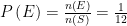
∴ P\left( E \right) =\frac { n\left( E \right) }{ n\left( S \right) } =\frac { 3 }{ 6 } =\frac { 1 }{ 2 }

(ii) Let F be the event that a number ≥ 3 will appear.
F ={3, 4, 5, 6}
∴ P\left( E \right) =\frac { n\left( F \right) }{ n\left( S \right) } =\frac { 4 }{ 6 } =\frac { 2 }{ 3 }

(iii) Let G be the event that a number ≤ 1 will appear.
G={l}.
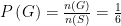
∴ P\left( G \right) =\frac { n\left( G \right) }{ n\left( S \right) } =\frac { 1 }{ 6 }

(iv) Let H be the event that a number more than 6 will appear.
H = ⌽
∴ P\left( H \right) =\frac { n\left( H \right) }{ n\left( S \right) } =\frac { 0 }{ 6 } =0

(v) Let I be the event that a number less than 6 will appear.
I = (1, 2, 3, 4, 5}
∴ P\left( I \right) =\frac { n\left( I \right) }{ n\left( S \right) } =\frac { 5 }{ 6 }

Ex 16.3 Class 11 Maths Question 4.
A card is selected from a pack of 52 cards.
(a) How many points are there in the sample space?
(b) Calculate the probability that the card is an ace of spades.
(c) Calculate the probability that the card is
(i) an ace
(ii) black card.
Solution:
(a) There are 52 cards in a pack.
⇒ Number of points in the sample space S = n(S) = 52
(b) Let E be the event of drawing an ace of spades.
There is only one ace of spade n(E) = 1 and n(S) = 52
∴ [P\left( E \right) =\frac { n\left( E \right) }{ n\left( S \right) } =\frac { 1 }{ 52 }
(c)
(i) Let F be the event of drawing an ace. There are 4 aces in a pack of 52 cards. n(F) = 4, n(S) = 52
∴ P\left( F \right) =\frac { n\left( F \right) }{ n\left( s \right) } =\frac { 4 }{ 52 } =\frac { 1 }{ 13 }
(ii) Let G be the event of drawing a black card. There are 26 black cards. n(G) = 26, n(S) = 52
∴ P\left( G \right) =\frac { n\left( G \right) }{ n\left( S \right) } =\frac { 26 }{ 52 } =\frac { 1 }{ 2 }

Ex 16.3 Class 11 Maths Question 5.
A fair coin with 1 marked on one face and 6 on the other and a fair die are both tossed.
Find the probability that the sum of numbers that turn up is
(i) 3
(ii) 12.
Solution:
An experiment consists of tossing a coin marked 1 and 6 on either faces and rolling a die.
∴ The sample space of the experiment is given by
S = {(1, 1), (1, 2), (1, 3), (1, 4), (1, 5), (1, 6), (6, 1), (6, 2), (6, 3), (6, 4), (6, 5), (6, 6)}
(i) Let E be the event that sum of number is 3.
E = {(1,2)} ⇒ n(E) = 1
n(S)= 12
∴ P\left( E \right) =\frac { n\left( E \right) }{ n\left( S \right) } =\frac { 1 }{ 12 }
(ii) Let F be the event that sum of number is 12.
∴ F = {(6, 6)} ⇒ n(F) = 1 and n(S) = 12
⇒ P\left( E \right) =\frac { n\left( F \right) }{ n\left( S \right) } =\frac { 1 }{ 12 }

Ex 16.3 Class 11 Maths Question 6.
There are four men and six women on the city council. If one council member is selected for a
committee at random, how likely is it that it is a woman?
Solution:
There are 6 women and 4 men.
An experiment consists of selecting a council member at random.
∴ n(S) = 10
Let E be the event that the selected council member will be a woman.
n(E) = 6
∴ P\left( E \right) =\frac { n\left( E \right) }{ n\left( S \right) } =\frac { 6 }{ 10 } =\frac { 3 }{ 5 }

Ex 16.3 Class 11 Maths Question 7.
A fair coin is tossed four times, and a person win Re. 1 for each head and lose Rs. 1.50 for each tail that turns up.
From the sample space calculate how many different amounts of money you can have after four tosses and the probability of having each of these amounts.
Solution:
An experiment consists of tossing a fair coin four times. Therefore, the sample space of the given experiment is given by S = {HHHH, HHHT, HHTH, HTHH, THHH, HHTT, HTTH, HTHT, THTH, TTHH, THHT, HTTT, THTT, TTHT, TTTH, TTTT}
∴ n(S) = 16
According to question, we have
NCERT Solutions for Class 11 Maths Chapter 16 Probability Ex 16.3 2

Ex 16.3 Class 11 Maths Question 8.
Three coins are tossed once.Find the probability of getting
(i) 3 heads
(ii) 2 heads
(iii) atleast 2 heads
(iv) atmost 2 heads
(v) no head
(vi) 3 tails
(vii) exactly two tails
(viii) no tail
(ix) atmost two tails
Solution:
An experiment consists of tossing 3 coins
∴ The sample space of the given experiment is given by
S = {HHH, HHT, HTH, THH, TTH, THT, HU ITT}
∴ n(S) = 8
NCERT Solutions for Class 11 Maths Chapter 16 Probability Ex 16.3 3
NCERT Solutions for Class 11 Maths Chapter 16 Probability Ex 16.3 4
NCERT Solutions for Class 11 Maths Chapter 16 Probability Ex 16.3 5

Ex 16.3 Class 11 Maths Question 9.
If \frac { 2 }{ 11 }  is the probability of an event, what is the probability of the event’not A’.
Solution:
Let P(A) = \frac { 2 }{ 11 }
P(not A) = 1 – P(A) = 1-\frac { 2 }{ 11 } =\frac { 9 }{ 11 } .

Ex 16.3 Class 11 Maths Question 10.
A letter is chosen at random from the word ‘ASSASSINATION’. Find the probability that letter is
(i) a vowel
(ii) a consonant.
Solution:
An experiment consists of a letter chosen at random from the word ‘ASSASSINATION’ which consists 13 letters,
(6 vowels and 7 consonants).
∴ Sample points are 13.
(i) Let E be the event that chosen letter is a vowel
E = {A, A, A, I, I, O}
∴ n(E) = 6
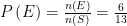
⇒ P\left( E \right) =\frac { n\left( E \right) }{ n\left( S \right) } =\frac { 6 }{ 13 } .
(ii) Let E be the event that chosen letter is a consonant
∴ F = {S, S, S, S, N, N, T}
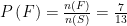
⇒ P\left( F \right) =\frac { n\left( F \right) }{ n\left( S \right) } =\frac { 7 }{ 13 }

Ex 16.3 Class 11 Maths Question 11.
In a lottery, a person chosen six different natural numbers at random from 1 to 20, and if these six numbers match with the six numbers already fixed by the lottery committee, he wins the prize. What is the probability of winning the prize in the game? [Hint: Order of the numbers is not important]
Solution:
An experiment consists of a lottery, a person chose six different natural numbers at random from 1 to 20.
∴ Sample points
26C6 = \frac { 20\times 19\times 18\times 17\times 16\times 15 }{ 1\times 2\times 3\times 4\times 5\times 6 } =38760
Let E be the event that chosen six numbers match with the six numbers already fixed by the lottery committee, i.e. Winning the prize, in the game
n(E) = 6C6 = 1
∴ P\left( E \right) =\frac { n\left( E \right) }{ n\left( S \right) } =\frac { 1 }{ 38760 }

Ex 16.3 Class 11 Maths Question 12.
Check whether the following probabilities P(A) and P(B) are consistently defined.
(i) P(4) = 0.5, P(B) = 0.7, P(A∩B) = 0.6
(ii) P(A) = 0.5, P(S) = 0.4, P(A ∪ B) = 0.8
Solution:
(i) P(A ∩ B) must be less than or equal to P(A) and P(B)
∴ P(A ∩ B) = 0.6 > 0.5 = P(A)
∴ P(A) and P(B) are not defined consistently.
(ii) P(A ∩ B) = P(A) + P(B) – P(A ∪ B)
= 0.5 + 0.4 – 0.8
= 0.9 – 0.8 = 01
∴ P(A ∩B) = 0.1 < 0.5 = P(A)
and P(A ∩ B) = 0.1 < 0.4 = P(B)
Thus, P(A) and P(B) are consistently defined.

Ex 16.3 Class 11 Maths Question 13.
Fill in the blanks in following table:
NCERT Solutions for Class 11 Maths Chapter 16 Probability Ex 16.3 6
Solution:
(i) P(A ∪B) = P(A) + P(B) – P(A∩B)
\frac { 1 }{ 3 } +\frac { 1 }{ 5 } -\frac { 1 }{ 15 } =\frac { 5+3-1 }{ 15 } =\frac { 7 }{ 15 }
(ii) P(A∪B) = P(A) + P(B) – p(A ∩B)
⇒ 0.6 = 0.35 + P(B) – 0.25
∴P(B) = 0.6 – 0.35 + 0.25 = 0.5
(iii) P(A∪B) = P(A) +P(B) – P(A∩B)
⇒ 0.7 = 0.5 + 0.35 – P(A∩B)
∴P(A∩B) = 0.5 + 0.35 – 0.7 = 0.15

Ex 16.3 Class 11 Maths Question 14.
Given P(4) = \frac { 3 }{ 5 }  and P(B) = \frac { 1 }{ 5 }  Find P{A or B), if A and B are mutually exclusive events.
Solution:
When A and B are mutually exclusive events.
⇒ A ∩ B = ⌽
⇒ P(A ∩ B) = 0
∴ P(A∪B) = P(A) + P(B) = \frac { 3 }{ 5 } +\frac { 1 }{ 5 } =\frac { 4 }{ 5 }

Ex 16.3 Class 11 Maths Question 15.
If E and Fare events such that P(E) = \frac { 1 }{ 4 } , P(F) = \frac { 1 }{ 2 }  and
P(E andF) = \frac { 1 }{ 8 } , find
(i) P(E or F),
(ii) P(not E and not F).
Solution:
(i) P(E or F) = P(E ∪F)
= P(E) + P(F) – P(E ∩F)
=\frac { 1 }{ 4 } +\frac { 1 }{ 2 } -\frac { 1 }{ 8 } =\frac { 2+4-1 }{ 8 } =\frac { 5 }{ 8 }
(ii) not E and not F = E’ ∩ F’ = (E ∩ F)’
(De Morgan’s Law)
∴ P(not E and not F) = P(E ∪ F)’
=1 – P(E∪F) = 1-\frac { 5 }{ 8 } =\frac { 3 }{ 8 }

Ex 16.3 Class 11 Maths Question 16.
Events E and F are such that P(not E or not F) = 0.25. State whether E and F are mutually exclusive.
Solution:
not E or not F = E’ ∪ F’ = (E ∩ F)’
(De Morgan’s Law)
∴ P(not E or not F) = P(E ∩ F)’ = 1 – P (E ∩ F)
⇒ 0.25 = 1 – P(E ∩ F)
⇒ P(E ∩ F) = 1 – 0.25 = 0.75 ≠ 0
∴ Events E and F are not mutually exclusive.

Ex 16.3 Class 11 Maths Question 17.
A and B are events such that P(A) = 0.42, P(B) = 0.48 and P(A and B) = 0.16. Determine
(i) P(not A),
(ii) P(not B) and
(iii) P(A or B)
Solution:
(i) P(not A) = P(A) = 1 -P(A) = 1 -0.42 = 0.58
(ii) P(not B) = P(B’) = 1 – P(B) = 1 – 0.48 = 0.52
(iii) P(A or B) = P(A∪B)
= P(A) + P(B) – P(A ∩ B) = 0.42 + 0.48 – 0.16 = 0.74.

Ex 16.3 Class 11 Maths Question 18.
In Class XI of a school 40% of the students study Mathematics and 30% study Biology. 10% of the class study
both Mathematics and Biology. If a student is selected at random from the class, find’the probability that he will be studying Mathematics or Biology.
Solution:
Let E and F be the events that students study Mathematics and Biology respectively. Probability
that students study Mathematics i.e.,
P\left( E \right) =\frac { 40 }{ 100 } =0.4
Probability that students study Biology i.e.,
P\left( F \right) =\frac { 30 }{ 100 } =0.3
Probability that students study both Math-ematics and Biology i.e.,
P\left( E\cap F \right) =\frac { 10 }{ 100 } =0.1
We have to find the probability that a student studies Mathematics or Biology, i.e., P(E ∪ F)
Now, P(E ∪ F) = 0.4 + 0.3 – 0.1 = 0.6

Ex 16.3 Class 11 Maths Question 19.
In an entrance test that is graded on the basis of two examinations, the probability of a randomly chosen student passing the first examination is 0.8 and the probability of passing the second examination is 0.7.
The probability of passing atleast one of them is 0.95. What is the probability of passing both?
Solution:
Let E be the event that the student passes the first examination and F be the event that the student passes the second examination. Then P(E) = 0.8, P(F) = 0.7, and P(E u F) = 0.95 We know that
P(E ∪F) = P(E) + P(F) – P(E ∩ F)
⇒ 0.95 = 0.8 + 0.7 -P(E∩F)
⇒ 0.95 = 1.5 – P(E∩F)
∴ P(E∩F) = 1.5 – 0.95 = 0.55.

Ex 16.3 Class 11 Maths Question 20.
The probability that a student will pass the final examination in both English and Hindi is 0.5 and the probability of passing neither is 0.1. If the probability of passing the English examination is 0.75, what is the probability of passing the Hindi examination?
Solution:
Let E be the event that student passes English examination and F be the event that the student passes Hindi examination.
NCERT Solutions for Class 11 Maths Chapter 16 Probability Ex 16.3 7

Ex 16.3 Class 11 Maths Question 21.
In a class of 60 students, 30 opted for NCC, 32 opted for NSS and 24 opted for both NCC and NSS.
If one of these students is selected at random, find the probability that
(i) The student opted for NCC or NSS.
(ii) The student has opted neither NCC nor NSS.
(iii) The student has opted NSS but not NCC.
Solution:
Here total number of students, n(S) = 60 Let E be the event that student opted for
NCC and F be the event that the student opted for NSS.
Then n(E) = 30, n(F) = 32 and n(E ∩ F) = 24
NCERT Solutions for Class 11 Maths Chapter 16 Probability Ex 16.3 8

We hope the NCERT Solutions for Class 11 Maths Chapter 16 Probability Ex 16.3 help you. If you have any query regarding NCERT Solutions for Class 11 Maths Chapter 16 Probability Ex 16.3, drop a comment below and we will get back to you at the earliest.


Read More

NCERT MCQ CLASS-9 CHAPTER-7 | DIVERSITY IN LIVING ORGANISMS | EDUGROWN

NCERT MCQ ON DIVERSITY IN LIVING ORGANISMS

Q1.Whittaker proposed the classification of organisms into ?
1. Five kingdom
2.One kingdom
3.Nine kingdom
4.Zero kingdom

Answer. Five kingdom

Q2.Five kingdom classification, was proposed by ?
1.Huxley
2.Linnaeus
3.Whittaker
4.Haeckel

Answer. Whittaker

Q3.In Whittaker’s classification the unicellular organisms having various cell organelles included in kingdom of
1.Fungi
2. Bacteria
3. Plant tea
4.Protista

Answer. Protista

Q4.In five kingdom classification, the blue green algae, nitrogen fixing bacteria and archaebacteria are included in the kingdom of ?
1. Algae
2. Bacteria
3. Fungi
4.Monera

Answer. Monera

Q5. The five kingdom classification is based on complexity of ?
1. Cell structure
2. Body of organisms
3. Body body structure
4. Body structure and cell structure

Answer. Body of organisms

Q6. Which one of the following hierarchical categories is the top taxonomic category?
1. Class
2. Kingdom
3. gems
4. Organism

Answer. Class

Q7. Which is the fundamental basic taxonomic unit of classification is
1.Organism
2.Order
3.Species
4. Defined organelles

Answer. Species

Q8. In which one of the following charter members of the monera kingdom differ from other kingdoms ?
1. Defined nucleus
2 Defined organelles
3. Defined body
4. None of these

Answer. Defined organelles

Q9. Fern is an example of
1. Thallophyta
2. Protein
3. Nuclear
4.Pteridophyta

Answer. Pteridophyta

Q10.Which one of the following is a gymnosperm ?
1.Cycas
2.Hydra
3.Bryophyta
4.Moss

Answer. Cycas

Q11.An eukaryotic cell does not has:
1.Cell membrane
2.Plasma membrane
3.Nucleus not surrounded by a membrane
4.Single-cell

Answer. Nucleus not surrounded by a membrane

Q12.Who introduced binomial nomenclature?
1.Cell membrane
2.Linnaeus
3.Genus
4. Single-cell

Answer. Linnaeus

Q13. In scientific naming which, one is right in capital letters ?
1.Name of the specific
2. Names of the genus
3. Name of kingdom
4. None of this

Answer. Names of the genus

Q14. Which one of the following is the example of Thallophyta ?
1.Moss
2.Ulothrix
3. Both (a)and(b)
4. Fungi

Answer. Ulothrix

Q.15. Plant bodies do not different into root, system and leave in terms as ?
1. Thallophyta
2.Herb
3.Thallus
4.Hyphae

Answer. Thallus

Read More

NCERT MCQ CLASS-9 CHAPTER-6 | ANIMAL TISSUE | EDUGROWN

NCERT MCQ ANIMAL TISSUE

1.) ………….is a single cell organism

a) Human being

b) Cactus

c) Amoeba

d) Rat

Answer –Amoeba

2.) ……………… cell carry message in our body to brain and brain to body

a) Liver cell

b) Ovum

c) Nephron

d) Nerve cell

Answer-Nerve cell

3.) In plants, ……………… tissues conduct food and water from one part of the plant to other parts

a) Transport

b) Circulatory

c) Vascular

d) None of them

Answer-Vascular

4.) Cluster of cell called

a) Cells

b) Tissues

c) Organ

d) None of them

Answer-Tissues

5.) Phloem and muscles are all example of

a) Cells

b) Tissues

c) Organ

d) None of them

Answer-Tissues

6.) Dividing tissues present in plant called

a) Parenchyma tissue

b) Meristematic tissue

c) Cell

d) None of them

Answer-Meristematic tissue

7.) ………………….. is present at the growing tips of stem and roots and increases its length

a) Parenchyma tissue

b) Meristematic tissue

c) Apical meristem

d) Roots

Answer-Apical meristem

8.) …………………. seen in some plants is located near the node

a) Apical meristem

b) Intercalary meristem

c) Paranchyama tissues

d) Roots

Answer-Intercalary meristem

9.) Meristematic tissues having dense

a) Cytoplasm

b) Root

c) Nucleus

d) Chromosomes

Answer-Cytoplasm

10.) Differentiation leads to the development of various types of

a) Parenchyma tissue

b) Meristematic tissue

c) Permanent tissue

d) None of them

Answer-Permanent tissue

11.) ……………… tissues are loosely held and stores food in plant

a) Parenchyma tissue

b) Meristematic tissue

c) Permanent tissue

d) None of them

Answer-Permanent tissue

12.) In aquatic plants large air cavities are present in paranchyama, this called as

a) Chlorenchyma

b) Aerenchyma

c) Sclerenchyma

d) Merstimatic tissue

Answer-Aerenchyma

13.) Which tissue responsible makes plant hard and stiff

a) Chlorenchyma

b) Aerenchyma

c) Sclerenchyma

d) Merstimatic tissue

Answer-Sclerenchyma

14.) Sclerenchyma tissue are long, narrow and thickened due to

a) Stroma

b) Lignin

c) Thick walls

d) None of them

Answer-Lignin

15.) Outermost layer of cells in plant called

a) Stroma

b) Lignin

c) Thick walls

d) Epidermis

Answer-Epidermis

Read More

NCERT MCQ CLASS-9 CHAPTER-6 | PLANT TISSUES | EDUGROWN

NCERT MCQ ON PLANT TISSUES

Question 1.
Which of the following tissues has dead cells?

(a) Parenchyma
(b) Sclerenchyma
(c) Collenchyma
(d) Epithelial tissue

Answer: (b) Sclerenchyma

Question 2.
Find out incorrect sentence.

(a) Parenchymatous tissues have intercellular spaces.
(b) Collenchymatous tissues are irregularly thickened at corners.
(c) Apical and intercalary meristems are permanent tissues.
(d) Meristematic tissues, in its early stage, lack vacuoles.

Answer: (c) Apical and intercalary meristems are permanent tissues.

Question 3.
Girth of stem increases due to

(a) apical meristem
(b) lateral meristem
(c) intercalary meristem
(d) vertical meristem

Answer: (b) lateral meristem

Question 4.
Which cell does not have perforated cell wall?

(a) Tracheid’s
(b) Companion cells
(c) Sieve tubes
(d) Vessels

Answer: (b) Companion cells

Question 5.
Intestine absorbs the digested food materials. What type of epithelial cells are responsible for that?
(a) Stratified squamous epithelium
(b) Columnar epithelium
(c) Spindle fibers
(d) Cuboidal epithelium

Answer: (b) Columnar epithelium

Question 6.
A person met with an accident in which two long bones of the
hand were dislocated. Which among the following may be the possible reason?
(a) Tendon break
(b) Break of skeletal muscle
(c) Ligament break
(d) Areolar tissue break

Answer: (c) Ligament break

Question 7.
While doing work and running, you move your organs Like hands, legs etc. Which among the following is correct?

(a) Smooth muscles contract and pull the ligament to move the bones.
(b) Smooth muscles contract and pull the tendons to move the bones.
(c) Skeletal muscles contract and pull the ligament to move the bones.
(d) Skeletal muscles contract and pull the tendon to move the bones.

Answer: (d) Skeletal muscles contract and pull the tendon to move the bones.

Question 8.
Which muscles act involuntarily?

(i) Striated muscles
(ii) Smooth muscles
(iii) Cardiac muscles
(iv) Skeletal muscles
(a) (i) and (ii)
(b) (ii) and (iii)
(c) (iii) and (iv)
(d) (i) and (iv)

Answer: (b) (ii) and (iii)

Question 9.
Meristematic tissues in plants are

(a) localized and permanent
(b) not limited Lo certain regions
(c) localized and dividing cells
(d) growing in volume

Answer: (c) localized and dividing cells

Question 10.
Which is not a function of epidermis?

(a) Protection from adverse condition
(b) Gaseous exchange
(c) Conduction of water
(d) Transpiration

Answer: (c) Conduction of water

Question 11.
Select the incorrect sentence.

(a) Blood has a matrix containing proteins, salts and hormones
(b) Two bones are connected by ligament
(c) Tendons are non-fibrous tissue and fragile
(d) Cartilage is a form of connective tissue

Answer: (c) Tendons are non-fibrous tissue and fragile

Question 12.
Cartilage is not found in

(a) nose
(b) ear
(c) kidney
(d) larynx

Answer: (c) kidney

Question 13.
Fats are stored in human body as

(a) Cuboidal epithelium
(b) Adipose tissue
(c) Bones
(d) Cartilage

Answer: (b) Adipose tissue

Question 14.
Bone matrix is rich in

(a) Fluoride and calcium
(b) Calcium and phosphorus
(c) Calcium and potassium
(d) Phosphorus and potassium

Answer: (b) Calcium and phosphorus

Question 15.
Contractile proteins are found in

(a) bones
(b) blood
(c) muscles
(d) cartilage

Answer: (c) muscles


Footer

Read More

Class 11th Chapter -15 Statistics| NCERT Maths Solution | NCERT Solution | Edugrown

In This Post we are providing Chapter -15 |STATISTICS |NCERT Solutions for Class 11 Maths which will be beneficial for students. These solutions are updated according to 2021-22 syllabus. These Class 11 can be really helpful in the preparation of  STATISTICS Board exams and will provide you with in depth detail of the chapter.

We have solved every question stepwise so you don’t have to face difficulty in understanding the solutions. It will also give you concepts that are important for overall development of students. Class 11 Maths STATISTICS NCERT Written Solutions  will be useful in higher classes as well because variety of questions related to these concepts can be asked so you must study and understand them properly.

Class 11th Chapter -15 STATISTICS | NCERT MATHS SOLUTION |


Find the mean deviation about the mean for the data in Exercises 1 and 2.

Ex 15.1 Class 11 Maths Question 1.
4, 7, 8, 9, 10, 12, 13, 17
Solution:
Mean of the given data is
NCERT Solutions for Class 11 Maths Chapter 15 Statistics Ex 15.1 1

Ex 15.1 Class 11 Maths Question 2.
38, 70, 48, 40, 42, 55, 63, 46, 54, 44
Solution:
Mean of the given data is
NCERT Solutions for Class 11 Maths Chapter 15 Statistics Ex 15.1 2
NCERT Solutions for Class 11 Maths Chapter 15 Statistics Ex 15.1 3

Ex 15.1 Class 11 Maths Question 3.
13, 17, 16, 14, 11, 13, 10, 16, 11, 18, 12, 17
Solution:
Arranging the data in ascending order, we have
10, 11, 11, 12, 13, 13, 14, 16, 16, 17, 17, 18
Here n = 12 (which is even)
So median is the average of 6th and 7th observations
NCERT Solutions for Class 11 Maths Chapter 15 Statistics Ex 15.1 4
NCERT Solutions for Class 11 Maths Chapter 15 Statistics Ex 15.1 5

Ex 15.1 Class 11 Maths Question 4.
36, 72, 46, 42, 60, 45, 53, 46, 51, 49
Solution:
Arranging the data in ascending order, we have 36, 42, 45, 46, 46, 49, 51, 53, 60, 72
Here n = 10 (which is even)
So median is the average of 5th and 6th observations
NCERT Solutions for Class 11 Maths Chapter 15 Statistics Ex 15.1 6

Find the mean deviation about the mean for the data in Exercises 5 and 6.

Ex 15.1 Class 11 Maths Question 5.
NCERT Solutions for Class 11 Maths Chapter 15 Statistics Ex 15.1 7
Solution:
NCERT Solutions for Class 11 Maths Chapter 15 Statistics Ex 15.1 8

Ex 15.1 Class 11 Maths Question 6.
NCERT Solutions for Class 11 Maths Chapter 15 Statistics Ex 15.1 9
Solution:
NCERT Solutions for Class 11 Maths Chapter 15 Statistics Ex 15.1 10

Find the mean deviation about the median for the data in Exercises 7 and 8.

Ex 15.1 Class 11 Maths Question 7.
NCERT Solutions for Class 11 Maths Chapter 15 Statistics Ex 15.1 11
Solution:
NCERT Solutions for Class 11 Maths Chapter 15 Statistics Ex 15.1 25

Ex 15.1 Class 11 Maths Question 8.
NCERT Solutions for Class 11 Maths Chapter 15 Statistics Ex 15.1 13
Solution:
NCERT Solutions for Class 11 Maths Chapter 15 Statistics Ex 15.1 14

Find the mean deviation about the mean for the data in Exercises 9 and 10.

Ex 15.1 Class 11 Maths Question 9.
NCERT Solutions for Class 11 Maths Chapter 15 Statistics Ex 15.1 15
Solution:
NCERT Solutions for Class 11 Maths Chapter 15 Statistics Ex 15.1 16

Ex 15.1 Class 11 Maths Question 10.
NCERT Solutions for Class 11 Maths Chapter 15 Statistics Ex 15.1 17
Solution:
NCERT Solutions for Class 11 Maths Chapter 15 Statistics Ex 15.1 18
NCERT Solutions for Class 11 Maths Chapter 15 Statistics Ex 15.1 19

Ex 15.1 Class 11 Maths Question 11.
Find the mean deviation about median for the following data:
NCERT Solutions for Class 11 Maths Chapter 15 Statistics Ex 15.1 20
Solution:
NCERT Solutions for Class 11 Maths Chapter 15 Statistics Ex 15.1 21

Ex 15.1 Class 11 Maths Question 12.
Calculate the mean deviation about median age for the age distribution of 100 persons given below:
NCERT Solutions for Class 11 Maths Chapter 15 Statistics Ex 15.1 22
NCERT Solutions for Class 11 Maths Chapter 15 Statistics Ex 15.1 23
[Hint: Convert the given data into continuous frequency distribution by subtracting 0.5 from lower limit and adding 0.5 to the upper limit of each class interval]
Solution:
NCERT Solutions for Class 11 Maths Chapter 15 Statistics Ex 15.1 24


We hope the NCERT Solutions for Class 11 Maths Chapter 15 Statistics Ex 15.1 help you. If you have any query regarding NCERT Solutions for Class 11 Maths Chapter 15 Statistics Ex 15.1, drop a comment below and we will get back to you at the earliest.

Find the mean and variance for each of the data in Exercises 1 to 5.

Ex 15.2 Class 11 Maths Question 1.
6, 7, 10, 12, 13, 4, 8, 12
Solution:
Here xi = 6, 7, 10, 12, 13, 4, 8, 12
∴ Σxi = 6 + 7 + 10 + 12 + 13 + 4 + 8 + 12 = 72
n = 8
NCERT Solutions for Class 11 Maths Chapter 15 Statistics Ex 15.2 1
NCERT Solutions for Class 11 Maths Chapter 15 Statistics Ex 15.2 2

Ex 15.2 Class 11 Maths Question 2.
First n natural numbers
Solution:
Here xi = 1, 2, 3, 4, ……….n
NCERT Solutions for Class 11 Maths Chapter 15 Statistics Ex 15.2 3

Ex 15.2 Class 11 Maths Question 3.
First 10 multiples of 3
Solution:
Here xi = 3, 6, 9, 12, 15, 18, 21, 27, 30,
Σxi = 3 + 6 + 9 + 12 + 15 + 18 + 21 + 24 + 27 + 30 = 165
n = 10
NCERT Solutions for Class 11 Maths Chapter 15 Statistics Ex 15.2 4

Ex 15.2 Class 11 Maths Question 4.
NCERT Solutions for Class 11 Maths Chapter 15 Statistics Ex 15.2 5
Solution:
NCERT Solutions for Class 11 Maths Chapter 15 Statistics Ex 15.2 6

Ex 15.2 Class 11 Maths Question 5.
NCERT Solutions for Class 11 Maths Chapter 15 Statistics Ex 15.2 7
Solution:
NCERT Solutions for Class 11 Maths Chapter 15 Statistics Ex 15.2 8

Ex 15.2 Class 11 Maths Question 6.
Find the mean and standard deviation using short-cut method
NCERT Solutions for Class 11 Maths Chapter 15 Statistics Ex 15.2 9
Solution:
NCERT Solutions for Class 11 Maths Chapter 15 Statistics Ex 15.2 10
NCERT Solutions for Class 11 Maths Chapter 15 Statistics Ex 15.2 11

Find the mean and variance for the following frequency distributions in Exercises 7 and 8.

Ex 15.2 Class 11 Maths Question 7.
NCERT Solutions for Class 11 Maths Chapter 15 Statistics Ex 15.2 12
Solution:
NCERT Solutions for Class 11 Maths Chapter 15 Statistics Ex 15.2 13

Ex 15.2 Class 11 Maths Question 8.
NCERT Solutions for Class 11 Maths Chapter 15 Statistics Ex 15.2 14
Solution:
NCERT Solutions for Class 11 Maths Chapter 15 Statistics Ex 15.2 15
NCERT Solutions for Class 11 Maths Chapter 15 Statistics Ex 15.2 16

Ex 15.2 Class 11 Maths Question 9.
Find the mean, variance and standard deviation using short-cut method.
NCERT Solutions for Class 11 Maths Chapter 15 Statistics Ex 15.2 17
Solution:
NCERT Solutions for Class 11 Maths Chapter 15 Statistics Ex 15.2 18
NCERT Solutions for Class 11 Maths Chapter 15 Statistics Ex 15.2 19

Ex 15.2 Class 11 Maths Question 10.
The diameters of circles (in mm) drawn in a design are given below:
NCERT Solutions for Class 11 Maths Chapter 15 Statistics Ex 15.2 20
Calculate the standard deviation and mean diameter of the circles.
[Hint: First make the data continuous by making the classes as 32.5 – 36.5, 36.5 – 40.5, 40.5 – 44.5, 44.5 – 48.5, 48.5 – 52.5 and then proceed.]
Solution:
NCERT Solutions for Class 11 Maths Chapter 15 Statistics Ex 15.2 21

We hope the NCERT Solutions for Class 11 Maths Chapter 15 Statistics Ex 15.2 help you. If you have any query regarding NCERT Solutions for Class 11 Maths Chapter 15 Statistics Ex 15.2, drop a comment below and we will get back to you at the earliest.

Ex 15.3 Class 11 Maths Question 1.
From the data given below state which group is more variable, A or B?
NCERT Solutions for Class 11 Maths Chapter 15 Statistics Ex 15.3 1
Solution:
For Group A :
NCERT Solutions for Class 11 Maths Chapter 15 Statistics Ex 15.3 2
NCERT Solutions for Class 11 Maths Chapter 15 Statistics Ex 15.3 3
NCERT Solutions for Class 11 Maths Chapter 15 Statistics Ex 15.3 4

Ex 15.3 Class 11 Maths Question 2.
From the prices of shares X and Y below, find out which is more stable in value:
NCERT Solutions for Class 11 Maths Chapter 15 Statistics Ex 15.3 5
Solution:
NCERT Solutions for Class 11 Maths Chapter 15 Statistics Ex 15.3 6
NCERT Solutions for Class 11 Maths Chapter 15 Statistics Ex 15.3 7

Ex 15.3 Class 11 Maths Question 3.
An analysis of monthly wages paid to workers in two firms A and B, belonging to the same industry, gives the following results:
NCERT Solutions for Class 11 Maths Chapter 15 Statistics Ex 15.3 8
(i) Which firm A or B pays larger amount as monthly wages?
(ii) Which firm, AorB, shows greater variability in individual wages?
Solution:
(i) Firm A :
Number of wage earners (n1) = 586
Mean of monthly wages (\overline { { x }_{ 1 } } ) = Rs.5253
∴ Total monthly wages = 5253 x 586
= Rs. 3078258
Firm B :
Number of wage earners (n2) = 648
Mean of monthly wages (\overline { { x }_{ 2 } } ) = Rs.5253
∴ Total monthly wages = 5253 x 648
= Rs. 3403944
Hence, Firm B pays larger amount as monthly wages.

(ii) Since both the firms have same mean of monthly wages, so the firm with greater variance will have more variability in individual wages. Thus firm B will have more variability in individual wages.

Ex 15.3 Class 11 Maths Question 4.
The following is the record of goals scored by team A in a football session:
NCERT Solutions for Class 11 Maths Chapter 15 Statistics Ex 15.3 9
For the team B, mean number of goals scored per match was 2 with a standard deviation 1.25 goals. Find which team may be considered more consistent?
Solution:
For team A:
NCERT Solutions for Class 11 Maths Chapter 15 Statistics Ex 15.3 10

Ex 15.3 Class 11 Maths Question 5.
The sum and sum of squares corresponding to length x (in cm) and weight y (in gm) of 50 plant products are given below:
NCERT Solutions for Class 11 Maths Chapter 15 Statistics Ex 15.3 11
Which is more varying, the length or weight?
Solution:
NCERT Solutions for Class 11 Maths Chapter 15 Statistics Ex 15.3 12
NCERT Solutions for Class 11 Maths Chapter 15 Statistics Ex 15.3 13

We hope the NCERT Solutions for Class 11 Maths Chapter 15 Statistics Ex 15.3 help you. If you have any query regarding NCERT Solutions for Class 11 Maths Chapter 15 Statistics Ex 15.3, drop a comment below and we will get back to you at the earliest.

Read More

Class 11th Chapter -14 Mathematical Reasoning | NCERT Maths Solution | NCERT Solution | Edugrown

In This Post we are providing Chapter -14 |Mathematical Reasoning |NCERT Solutions for Class 11 Maths which will be beneficial for students. These solutions are updated according to 2021-22 syllabus. These Class 11 can be really helpful in the preparation of  Mathematical Reasoning Board exams and will provide you with in depth detail of the chapter.

We have solved every question stepwise so you don’t have to face difficulty in understanding the solutions. It will also give you concepts that are important for overall development of students. Class 11 Maths Mathematical Reasoning NCERT Written Solutions  will be useful in higher classes as well because variety of questions related to these concepts can be asked so you must study and understand them properly.

Class 11th Chapter -14 MATHEMATICAL REASONING | NCERT MATHS SOLUTION |

Ex 14.1 Class 11 Maths Question 1.
Which of the following sentences are statements? Give reasons for your answer.
(i) There are 35 days in a month.
(ii) Mathematics is difficult.
(iii) The sum of 5 and 7 is greater than 10.
(iv) The square of a number is an even number.
(v) The sides of a quadrilateral have equal length.
(vi) Answer this question.
(vii) The product of (-1) and 8 is 8.
(viii) The sum of all interior angles of a triangle is 180°.
(ix) Today is a windy day.
(x) All real numbers are complex numbers.
Solution:
(i) This sentence is false since the maximum number of days in a month can never exceed 31. Therefore, this sentence is a statement.
(ii) This sentence is subjective in the sense that for those who hate mathematics, it is difficult but for others it may not be. This means that this sentence is not always true. Hence it is not a statement.
(iii) This sentence is true as sum of 5 and 7 is greater than 10. Hence it is a statement.
(iv) This sentence is subjective in the sense that it depends on the number that is being squared. Hence it is not a statement.
(v) This sentence is sometimes true and sometimes false since sides in squares and rhombuses have equal length whereas rectangles and trapeziums have unequal length. Hence it is not a statement.
(vi) This sentence is an order and so, it is not a statement.
(vii) This sentence is false as product of (-1) and 8 is -8. So, it is a statement.
(viii) This sentence is true and therefore it is a statement.
(ix) It is not clear from the context which day is referred. Therefore, it is not a statement.
(x) All real numbers can be written in the form of complex numbers. So, this sentence is true and it is a statement.

Ex 14.1 Class 11 Maths Question 2.
Give three examples of sentences which are not statements. Give reasons for the answers.
Solution:
(i) Who are you?
This sentence is an interrogative sentence. Hence, it is not a statement.
(ii) May God bless you!
This sentence is an exclamatory sentence. Hence, it is not a statement.
(iii) How are you?
This sentence is an interrogative sentence. Hence, it is not a statement.


We hope the NCERT Solutions for Class 11 Maths Chapter 14 Mathematical Reasoning Ex 14.1 help you. If you have any query regarding NCERT Solutions for Class 11 Maths Chapter 14 Mathematical Reasoning Ex 14.1, drop a comment below and we will get back to you at the earliest.

 Ex 14.2 Class 11 Maths Question 1.
Write the negation of the following statements:
(i) Chennai is the capital of Tamil Nadu.
(ii) \sqrt { 2 }  is not a complex number.
(iii) All triangles are not equilateral triangle.
(iv) The number 2 is greater than 7.
(v) Every natural number is an integer.
Solution:
(i) Negation of statement is: Chennai is not the capital of Tamil Nadu.
(ii) Negation of statement is: \sqrt { 2 }  is a complex number.
(iii) Negation of statement is: All triangles are equilateral triangles.
(iv) Negation of statement is: The number 2 is not greater than 7.
(v) Negation of statement is: Every natural number is not an integer.

Ex 14.2 Class 11 Maths Question 2.
Are the following pairs of statements negations of each other:
(i) The number x is not a rational number.
The number x is not an irrational number.
(ii) The number x is a rational number.
The number x is an irrational number.
Solution:
(i) Let p: The number x is not a rational number.
q: The number x is not an irrational number.
Now, ~p: The number x is a rational number. ~q: The number x is an irrational number.
∴ ~p = q and ~q = p
Thus, p and q are negations of each other.

(ii) Let p: The number x is a rational number.
q: The number x is an irrational number.
Now, ~p: The number x is not a rational number.
~q: The number x is not an irrational number.
∴ ~p = q and ~q = p
Thus, p and q are negations of each other.

Ex 14.2 Class 11 Maths Question 3.
Find the component statements of the following compound statements and check whether they are true or false.
(i) Number 3 is prime or it is odd.
(ii) All integers are positive or negative.
(iii) 100 is divisible by 3,11 and 5.
Solution:
(i) The component statements are:
p: Number 3 is prime
q: Number 3 is odd.
Both the component statements p and q are true.

(ii) The component statements are:
p: All integers are positive.
q: All integers are negative.
Both the component statements p and q are false.

(iii) The component statements are:
p: 100 is divisible by 3.
q: 100 is divisible by 11.
r: 100 is divisible by 5.
The component statements p and q are false whereas r is true.

We hope the NCERT Solutions for Class 11 Maths Chapter 14 Mathematical Reasoning Ex 14.2 help you. If you have any query regarding NCERT Solutions for Class 11 Maths Chapter 14 Mathematical Reasoning Ex 14.2, drop a comment below and we will get back to you at the earliest.

 Ex 14.3 Class 11 Maths Question 1.
For each of the following compound statements first, identify the connecting words and then break it into component statements.
(i) All rational numbers are real and all real numbers are not complex.
(ii) Square of an integer is positive or negative.
(iii) The sand heats up quickly in the Sun and does not cool down fast at night.
(iv) x = 2 and x = 3 are the roots of the equation 3x2 – x – 10 = 0.
Solution:
(i) The compound statement has the connecting word ‘and’. Component statements are
p: All rational numbers are real.
q: All real numbers are not complex.

(ii) The compound statement has the connecting word ‘or’. Component statements are:
p: Square of an integer is positive.
q: Square of an integer is negative.

(iii) The compound statement has the connecting word ‘and’. Component statements are:
p: The sand heats up quickly in the sun.
q: The sand does not cool down fast at night.

(iv) The compound statement has the connecting word ‘and’. Component statements are:
p: x- 2 is a root of the equation 3x2 – x – 10 = 0.
q: x = 3 is a root of the equation 3x2 – x – 10 = 0.

Ex 14.3 Class 11 Maths Question 2.
Identify the quantifier in the following statements and write the negation of the statements.
(i) There exists a number which is equal to its square.
(ii) For every real number x, x is less than x + 1.
(iii) There exists a capital for every state in India.
Solution:
(i) Here the quantifier is ‘there exists’.
The negation of statement is: There does not exist a number which is equal to its square.
(ii) Here the quantifier is ‘for every’
The negation of statement is: For at least one real number x, x is not less than x + 1.
(iii) Here the quantifier is ‘there exists’
The negation of statement is: There exists a state in India which does not have a capital.

Ex 14.3 Class 11 Maths Question 3.
Check whether the following pair of statements is negation of each other. Give reasons for your answer.
(i) x + y = y + x is true for every real numbers x and y.
(ii) There exists real numbers x and y for which x + y = y + x.
Solution:
Let p: x + y = y + x is true for every real numbers x and y.
q: There exists real numbers x and y for which
x+y=y + x.
Now, ~p: There exists real numbers x and y for which x + y ≠ y + x.
Thus, ~p ≠ q.

Ex 14.3 Class 11 Maths Question 4.
State whether the “Or” used in the following statements is “exclusive” or “inclusive”. Give reasons for your answer.
(i) Sunrises or Moon sets.
(ii) To apply for a driving license, you should have a ration card or a passport.
(iii) All integers are positive or negative.
Solution:
(i) This statement makes use of exclusive “or”. Since when sun rises, moon does not set during day-time.
(ii) This statement makes use of inclusive ‘or’. Since you can apply for a driving license even if you have a ration card as well as a passport.
(iii) This statement makes use of exclusive ‘or’. Since a integer is either positive or negative, it cannot be both.

We hope the NCERT Solutions for Class 11 Maths Chapter 14 Mathematical Reasoning Ex 14.3 help you. If you have any query regarding NCERT Solutions for Class 11 Maths Chapter 14 Mathematical Reasoning Ex 14.3, drop a comment below and we will get back to you at the earliest.

Ex 14.4 Class 11 Maths Question 1.
Rewrite the following statement with “if-then” in five different ways conveying the same meaning. If a natural number is odd, then its square is also odd.
Solution:
(i) A natural number is odd implies that its square is odd.
(ii) A natural number is odd only if its square is odd.
(iii) For a natural number to be odd it is necessary that its square is odd.
(iv) For the square of a natural number to be odd, it is sufficient that the number is odd.
(v) If the square of a natural number is not odd, then the natural number is not odd.

Ex 14.4 Class 11 Maths Question 2.
Write the contrapositive and converse of the following statements.
(i) If x is a prime number, then x is odd.
(ii) If the two lines are parallel, then they do not intersect in the same plane.
(iii) Something is cold implies that it has low temperature.
(iv) You cannot comprehend geometry if you do not know how to reason deductively.
(v) x is an even number implies that x is divisible by 4.
Solution:
(i) The contra positive of given statement is:
If a number x is not odd, then x is not a prime number.
The converse of given statement is:
If x is an odd number, then x is a prime number.

(ii) The contra positive of given statement is:
If two lines intersect in the same plane, then they are not parallel.
The converse of given statement is:
If two lines do not intersect in the same plane, then they are parallel.

(iii) The contra positive of given statement is:
If something is not at low temperature, then it is not cold.
The converse of given statement is:
If something is at low temperature, then it is cold.

(iv) The contra positive of given statement is:
If you know how to reason deductively, then you can comprehend geometry.
The converse of given statement is:
If you do not know how to reason deductively, then you cannot comprehend geometry.

(v) The contra positive of given statement is:
If x is not divisible by 4, then x is not an even number.
The converse of given statement is:
If x is divisible by 4, then x is an even number.

Ex 14.4 Class 11 Maths Question 3.
Write each of the following statements in the form “if-then”
(i) You get a job implies that your credentials are good.
(ii) The Banana trees will bloom if it stays warm for a month.
(iii) A quadrilateral is a parallelogram if its diagonals bisect each other.
(iv) To get an A+ in the class, it is necessary that you do all the exercises of the book.
Solution:
(i) If you get a job, then your credentials are good.
(ii) If the banana tree stays warm for a month, then it will bloom.
(iii) If the diagonals of a quadrilateral bisect each other, then it is a parallelogram.
(iv) If you get A+ in the class, then you do all the exercises in the book.

Ex 14.4 Class 11 Maths Question 4.
Given statements in (a) and (b). Identify the statements given below as contrapositive or converse of each other.
(a) If you live in Delhi, then you have winter clothes.
(i) If you do not have winter clothes, then you do not live in Delhi.
(ii) If you have winter clothes, then you live in Delhi.

(b) If a quadrilateral is a parallelogram, then its diagonals bisect each other.
(i) If the diagonals of a quadrilateral do not bisect each other, then the quadrilateral is not a parallelogram.
(ii) If the diagonals of a quadrilateral bisect each other, then it is a parallelogram.
Solution:
(a)
(i) contrapositive
(ii) converse

(b)
(i) contrapositive
(ii) converse

We hope the NCERT Solutions for Class 11 Maths Chapter 14 Mathematical Reasoning Ex 14.4 help you. If you have any query regarding NCERT Solutions for Class 11 Maths Chapter 14 Mathematical Reasoning Ex 14.4, drop a comment below and we will get back to you at the earliest.

Ex 14.5 Class 11 Maths Question 1.
Show that the statement
p: “If x is a real number such that x3 + 4x = 0, then x is 0″ is true by
(i) direct method,
(ii) method of contradiction,
(iii) method of contrapositive.
Solution:
The given compound statement is of the form “if p then q”
p: x ϵ R such that x3 + 4x = 0
q: x = 0
(i) Direct method:
We assume that p is true, then
x ϵ R such that x3 + 4x = 0
⇒ x ϵ R such that x(x2 + 4) = 0
⇒ x ϵ R such that x = 0 or x2 + 4 = 0
⇒ x = 0 => q is true.
So, when p is true, q is true.
Thus, the given compound statement is true.

(ii) Method of contradiction :
We assume that p is true and q is false, then
x ϵ R such that x3 + 4x = 0
⇒ x ϵ R such that x(x2 + 4) = 0
⇒ x ϵ R such that x = 0 or x2 + 4 = 0
⇒ x = 0.
which is a contradiction. So, our assumption that x ≠ 0 is false. Thus, the given compound statement is true.

(iii) Method of contrapositive: We assume that q is false, then x ≠ 0
x ϵ R such that x3 + 4x = 0
⇒ x ϵ R such that x = 0 or x2 + 4 = 0
∴ statement q is false, so x ≠ 0. So, we have,
x ϵ R such that x2 = -2
Which is not true for any x ϵ R.
⇒ p is false
So, when q is false, p is false.
Thus, the given compound statement is true.

Ex 14.5 Class 11 Maths Question 2.
Show that the statement” For any real numbers a and b, a2 = b2 implies that a = b” is not true by giving a counter-example.
Solution:
The given compound statement is of the form “if p then q”
We assume that p is true, then a, b ⍷ R such that a2 = b2
Let us take a = -3 and b = 3
Now, a2 = b2, but a ≠ b
So, when p is true, q is false.
Thus, the given compound statement is not true.

Ex 14.5 Class 11 Maths Question 3.
Show that the following statement is true by the method of contrapositive.
p: If x is an integer and x2 is even, then x is also even.
Solution:
The given compound statement is of the form “if p then q”
p: x ϵ Z and x2 is even.
q: x is an even integer.
We assume that q is false, then x is not an even integer.
⇒ x is an odd integer.
⇒ x2 is an odd integer.
⇒ p is false
So, when q is false, p is false.
Thus, the given compound statement is true.

Ex 14.5 Class 11 Maths Question 4.
By giving a counter example, show that the following statements are not true.
(i) p: If all the angles of a triangle are equal, then the triangle is an obtuse angled triangle.
(ii) q: The equation x2 – 1 = 0 does not have a root lying between 0 and 2.
Solution:
(i) Since the triangle is an obtuse angled triangle then 0 > 90°.
Let 0 = 100°
Also, all the angles of the triangle are equal.
∴ Sum of all angles of the triangle is 300°, which is not possible.
Thus, the given compound statement is not true,

(ii) We see that x = 1 is a root of the equation x2 – 1 = 0, which lies between 0 and 2. Thus, the given compound statement is not true.

Ex 14.5 Class 11 Maths Question 5.
Which of the following statements are true and which are false? In each case give a valid reason for saying so.
(i) p. Each radius of a circle is a chord of the circle.
(ii) q: The center of a circle bisects each chord of the circle.
(iii) r. Circle is a particular case of an ellipse.
(iv) s: If x and y are integers such that x > y, then -x < -y.
(v) t. \sqrt { 11 }  is a rational number.
Solution:
(i) A chord of a circle is a line whose two endpoints lie on the circle and all the points on the line lie inside the circle. So, the radius of a circle is not a chord of the circle.Thus, the given statement is false.
(ii) The center of a circle bisects chord of circle when the chord is diameter of circle. When the chord is other than diameter then center of circle does not lie on the chord. Thus, the given statement is false.
(iii) In the equation of an ellipse if we put a = b, then we get an equation of circle.
Thus, the given statement is true.
(iv) It is given that x, y ϵ Z such that x > y. Multiplying both sides by negative sign, we have
x, y ϵ Z such that -x < -y.
Thus, the given statement is true.
(v) Since \sqrt { 11 }  cannot be expressed in the form \frac { a }{ b } , where a and b are integers and b ≠ 0. Thus, the given statement is false.

We hope the NCERT Solutions for Class 11 Maths Chapter 14 Mathematical Reasoning Ex 14.5 help you. If you have any query regarding NCERT Solutions for Class 11 Maths Chapter 14 Mathematical Reasoning Ex 14.5, drop a comment below and we will get back to you at the earliest.

Read More

Class 11th Chapter -13 Limits and Derivatives | NCERT Maths Solution | NCERT Solution | Edugrown

In This Post we are providing Chapter -12 |Limits and Derivatives |NCERT Solutions for Class 11 Maths which will be beneficial for students. These solutions are updated according to 2021-22 syllabus. These Class 11 can be really helpful in the preparation of Limits and Derivatives Board exams and will provide you with in depth detail of the chapter.

We have solved every question stepwise so you don’t have to face difficulty in understanding the solutions. It will also give you concepts that are important for overall development of students. Class 11 Maths  Limits and Derivatives NCERT Written Solutions  will be useful in higher classes as well because variety of questions related to these concepts can be asked so you must study and understand them properly.

Class 11th Chapter -13 LIMITS AND DERIVATIVES | NCERT MATHS SOLUTION |

Evaluate the following limits in Exercises 1 to 22.

Ex 13.1 Class 11 Maths Question 1.
NCERT Solutions for Class 11 Maths Chapter 13 Limits and Derivatives Ex 13.1 1
Solution:
NCERT Solutions for Class 11 Maths Chapter 13 Limits and Derivatives Ex 13.1 2

Ex 13.1 Class 11 Maths Question 2.
NCERT Solutions for Class 11 Maths Chapter 13 Limits and Derivatives Ex 13.1 3
Solution:
NCERT Solutions for Class 11 Maths Chapter 13 Limits and Derivatives Ex 13.1 4

Ex 13.1 Class 11 Maths Question 3.
NCERT Solutions for Class 11 Maths Chapter 13 Limits and Derivatives Ex 13.1 5
Solution:
NCERT Solutions for Class 11 Maths Chapter 13 Limits and Derivatives Ex 13.1 6

Ex 13.1 Class 11 Maths Question 4.
NCERT Solutions for Class 11 Maths Chapter 13 Limits and Derivatives Ex 13.1 7
Solution:
NCERT Solutions for Class 11 Maths Chapter 13 Limits and Derivatives Ex 13.1 8

Ex 13.1 Class 11 Maths Question 5.
NCERT Solutions for Class 11 Maths Chapter 13 Limits and Derivatives Ex 13.1 9
Solution:
NCERT Solutions for Class 11 Maths Chapter 13 Limits and Derivatives Ex 13.1 10

Ex 13.1 Class 11 Maths Question 6.
NCERT Solutions for Class 11 Maths Chapter 13 Limits and Derivatives Ex 13.1 11
Solution:
NCERT Solutions for Class 11 Maths Chapter 13 Limits and Derivatives Ex 13.1 12
NCERT Solutions for Class 11 Maths Chapter 13 Limits and Derivatives Ex 13.1 13

Ex 13.1 Class 11 Maths Question 7.
NCERT Solutions for Class 11 Maths Chapter 13 Limits and Derivatives Ex 13.1 14
Solution:
NCERT Solutions for Class 11 Maths Chapter 13 Limits and Derivatives Ex 13.1 15

Ex 13.1 Class 11 Maths Question 8.
NCERT Solutions for Class 11 Maths Chapter 13 Limits and Derivatives Ex 13.1 16
Solution:
NCERT Solutions for Class 11 Maths Chapter 13 Limits and Derivatives Ex 13.1 17

Ex 13.1 Class 11 Maths Question 9.
NCERT Solutions for Class 11 Maths Chapter 13 Limits and Derivatives Ex 13.1 18
Solution:
NCERT Solutions for Class 11 Maths Chapter 13 Limits and Derivatives Ex 13.1 19

Ex 13.1 Class 11 Maths Question 10.
NCERT Solutions for Class 11 Maths Chapter 13 Limits and Derivatives Ex 13.1 20
Solution:
NCERT Solutions for Class 11 Maths Chapter 13 Limits and Derivatives Ex 13.1 21

Ex 13.1 Class 11 Maths Question 11.
NCERT Solutions for Class 11 Maths Chapter 13 Limits and Derivatives Ex 13.1 22
Solution:
NCERT Solutions for Class 11 Maths Chapter 13 Limits and Derivatives Ex 13.1 23

Ex 13.1 Class 11 Maths Question 12.
NCERT Solutions for Class 11 Maths Chapter 13 Limits and Derivatives Ex 13.1 24
Solution:
NCERT Solutions for Class 11 Maths Chapter 13 Limits and Derivatives Ex 13.1 25

Ex 13.1 Class 11 Maths Question 13.
NCERT Solutions for Class 11 Maths Chapter 13 Limits and Derivatives Ex 13.1 26
Solution:
NCERT Solutions for Class 11 Maths Chapter 13 Limits and Derivatives Ex 13.1 27
NCERT Solutions for Class 11 Maths Chapter 13 Limits and Derivatives Ex 13.1 28

Ex 13.1 Class 11 Maths Question 14.
NCERT Solutions for Class 11 Maths Chapter 13 Limits and Derivatives Ex 13.1 29
Solution:
NCERT Solutions for Class 11 Maths Chapter 13 Limits and Derivatives Ex 13.1 30

Ex 13.1 Class 11 Maths Question 15.
NCERT Solutions for Class 11 Maths Chapter 13 Limits and Derivatives Ex 13.1 31
Solution:
NCERT Solutions for Class 11 Maths Chapter 13 Limits and Derivatives Ex 13.1 32

Ex 13.1 Class 11 Maths Question 16.
NCERT Solutions for Class 11 Maths Chapter 13 Limits and Derivatives Ex 13.1 33
Solution:
NCERT Solutions for Class 11 Maths Chapter 13 Limits and Derivatives Ex 13.1 34

Ex 13.1 Class 11 Maths Question 17.
NCERT Solutions for Class 11 Maths Chapter 13 Limits and Derivatives Ex 13.1 35
Solution:
NCERT Solutions for Class 11 Maths Chapter 13 Limits and Derivatives Ex 13.1 36
NCERT Solutions for Class 11 Maths Chapter 13 Limits and Derivatives Ex 13.1 37

Ex 13.1 Class 11 Maths Question 18.
NCERT Solutions for Class 11 Maths Chapter 13 Limits and Derivatives Ex 13.1 38
Solution:
NCERT Solutions for Class 11 Maths Chapter 13 Limits and Derivatives Ex 13.1 39

Ex 13.1 Class 11 Maths Question 19.
NCERT Solutions for Class 11 Maths Chapter 13 Limits and Derivatives Ex 13.1 40
Solution:
NCERT Solutions for Class 11 Maths Chapter 13 Limits and Derivatives Ex 13.1 41

Ex 13.1 Class 11 Maths Question 20.
NCERT Solutions for Class 11 Maths Chapter 13 Limits and Derivatives Ex 13.1 42
Solution:
NCERT Solutions for Class 11 Maths Chapter 13 Limits and Derivatives Ex 13.1 43

Ex 13.1 Class 11 Maths Question 21.
NCERT Solutions for Class 11 Maths Chapter 13 Limits and Derivatives Ex 13.1 44
Solution:
NCERT Solutions for Class 11 Maths Chapter 13 Limits and Derivatives Ex 13.1 45

Ex 13.1 Class 11 Maths Question 22.
NCERT Solutions for Class 11 Maths Chapter 13 Limits and Derivatives Ex 13.1 46
Solution:
NCERT Solutions for Class 11 Maths Chapter 13 Limits and Derivatives Ex 13.1 47

Ex 13.1 Class 11 Maths Question 23.
NCERT Solutions for Class 11 Maths Chapter 13 Limits and Derivatives Ex 13.1 48
Solution:
NCERT Solutions for Class 11 Maths Chapter 13 Limits and Derivatives Ex 13.1 49

Ex 13.1 Class 11 Maths Question 24.
NCERT Solutions for Class 11 Maths Chapter 13 Limits and Derivatives Ex 13.1 50
Solution:
NCERT Solutions for Class 11 Maths Chapter 13 Limits and Derivatives Ex 13.1 51

Ex 13.1 Class 11 Maths Question 25.
NCERT Solutions for Class 11 Maths Chapter 13 Limits and Derivatives Ex 13.1 52
Solution:
NCERT Solutions for Class 11 Maths Chapter 13 Limits and Derivatives Ex 13.1 53

Ex 13.1 Class 11 Maths Question 26.
NCERT Solutions for Class 11 Maths Chapter 13 Limits and Derivatives Ex 13.1 54
Solution:
NCERT Solutions for Class 11 Maths Chapter 13 Limits and Derivatives Ex 13.1 55
NCERT Solutions for Class 11 Maths Chapter 13 Limits and Derivatives Ex 13.1 56

Ex 13.1 Class 11 Maths Question 27.
NCERT Solutions for Class 11 Maths Chapter 13 Limits and Derivatives Ex 13.1 57
Solution:
NCERT Solutions for Class 11 Maths Chapter 13 Limits and Derivatives Ex 13.1 58

Ex 13.1 Class 11 Maths Question 28.
NCERT Solutions for Class 11 Maths Chapter 13 Limits and Derivatives Ex 13.1 59
Solution:
NCERT Solutions for Class 11 Maths Chapter 13 Limits and Derivatives Ex 13.1 60
Adding (ii) and (iii), we get 2b = 8 ⇒ b = 4
Subtituting the value of b in (iii), we get
4 – a = 4 ⇒ a = 0
Thus a = 0 and b = 4.

Ex 13.1 Class 11 Maths Question 29.
NCERT Solutions for Class 11 Maths Chapter 13 Limits and Derivatives Ex 13.1 61
Solution:
NCERT Solutions for Class 11 Maths Chapter 13 Limits and Derivatives Ex 13.1 62

Ex 13.1 Class 11 Maths Question 30.
NCERT Solutions for Class 11 Maths Chapter 13 Limits and Derivatives Ex 13.1 63
Solution:
NCERT Solutions for Class 11 Maths Chapter 13 Limits and Derivatives Ex 13.1 64
NCERT Solutions for Class 11 Maths Chapter 13 Limits and Derivatives Ex 13.1 65

Ex 13.1 Class 11 Maths Question 31.
NCERT Solutions for Class 11 Maths Chapter 13 Limits and Derivatives Ex 13.1 66
Solution:
NCERT Solutions for Class 11 Maths Chapter 13 Limits and Derivatives Ex 13.1 67

Ex 13.1 Class 11 Maths Question 32.
NCERT Solutions for Class 11 Maths Chapter 13 Limits and Derivatives Ex 13.1 68
Solution:
NCERT Solutions for Class 11 Maths Chapter 13 Limits and Derivatives Ex 13.1 69

We hope the NCERT Solutions for Class 11 Maths Chapter 13 Limits and Derivatives Ex 13.1 help you. If you have any query regarding NCERT Solutions for Class 11 Maths Chapter 13 Limits and Derivatives Ex 13.1, drop a comment below and we will get back to you at the earliest.

Ex 13.2 Class 11 Maths Question 1.
Find the derivative of x2 – 2 at x = 10.
Solution:
let f(x) = x2 – 2
Differentiating (i) with respect to x, we get
f'(x) = 2x
At x = 10, f'(10) = 2(10) = 20.

Ex 13.2 Class 11 Maths Question 2.
Find the derivative of 99x at x = 10.
Solution:
let f(x) = 99x
Differentiating (i) with respect to x, we get
f'(x) = 90
At x = 100, f'(100) = 99.

Ex 13.2 Class 11 Maths Question 3.
Find the derivative of x at x = 10.
Solution:
let f(x) = x
Differentiating (i) with respect to x, we get
f'(x) = 1
At x = 1, f'(1) = 1.

Ex 13.2 Class 11 Maths Question 4.
Find the derivative of the following functions from first principle.
(i) x3 – 27
(ii) (x – 1)(x – 2)
(iii) \frac { 1 }{ { x }^{ 2 } }
(iv) \frac { x+1 }{ x-1 }
Solution:
NCERT Solutions for Class 11 Maths Chapter 13 Limits and Derivatives Ex 13.2 1
NCERT Solutions for Class 11 Maths Chapter 13 Limits and Derivatives Ex 13.2 2
NCERT Solutions for Class 11 Maths Chapter 13 Limits and Derivatives Ex 13.2 3
NCERT Solutions for Class 11 Maths Chapter 13 Limits and Derivatives Ex 13.2 4
NCERT Solutions for Class 11 Maths Chapter 13 Limits and Derivatives Ex 13.2 5

Ex 13.2 Class 11 Maths Question 5.
For the function
NCERT Solutions for Class 11 Maths Chapter 13 Limits and Derivatives Ex 13.2 6
Prove that f'(1) = 100f'(0)
Solution:
We have
NCERT Solutions for Class 11 Maths Chapter 13 Limits and Derivatives Ex 13.2 7

Ex 13.2 Class 11 Maths Question 6.
Find the derivative of xn + axn-1 + a2xn-2+
…. + an-1x + an for some fixed real number a.
Solution:
Let f(x) = xn + axn-1 + a2xn-2+
…. + an-1x + an
Differentiating (i) with respect to x, we get
f'(x) = nxn-1 + (n – 1)axn-2 + …… + an-1

Ex 13.2 Class 11 Maths Question 7.
For some constants a and b, find the derivative of
(i) (x – a)(x – b)
(ii) (ax2 + b)2
(iii) \frac { x-a }{ x-b }
Solution:
(i) Let f(x) = (x – a)(x – b) ….(1)
Differentiating (1) with respect to x, we get
f'(x) = (x – a)(x – b)’ + (x – a)’ (x – b)
⇒ f'(x) = (x – a) + (x – b) = 2x – a – b
NCERT Solutions for Class 11 Maths Chapter 13 Limits and Derivatives Ex 13.2 8

Ex 13.2 Class 11 Maths Question 8.
Find the derivative \frac { { x }^{ n }-{ a }^{ n } }{ x-a }  for some constant a.
Solution:
Let f(x) = \frac { { x }^{ n }-{ a }^{ n } }{ x-a }  ….(i), where a is a constant.
Differentiating (i) with respect to x, we get
NCERT Solutions for Class 11 Maths Chapter 13 Limits and Derivatives Ex 13.2 9

Ex 13.2 Class 11 Maths Question 9.
Find the derivative of
NCERT Solutions for Class 11 Maths Chapter 13 Limits and Derivatives Ex 13.2 10
Solution:
(i) Let f(x) = 2x-\frac { 3 }{ 4 }  …(1)
Differentiating (i) with respect to x, we get
f'(x) = 2·1 – 0 ⇒ f'(x) = 2.
(ii) Let f(x) = 5x3 + 3x – 1)(x – 1)
NCERT Solutions for Class 11 Maths Chapter 13 Limits and Derivatives Ex 13.2 11
NCERT Solutions for Class 11 Maths Chapter 13 Limits and Derivatives Ex 13.2 12
NCERT Solutions for Class 11 Maths Chapter 13 Limits and Derivatives Ex 13.2 13

Ex 13.2 Class 11 Maths Question 10.
Find the derivative of cos x from first principle.
Solution:
Let f(x) = cos x
NCERT Solutions for Class 11 Maths Chapter 13 Limits and Derivatives Ex 13.2 14
NCERT Solutions for Class 11 Maths Chapter 13 Limits and Derivatives Ex 13.2 15

Ex 13.2 Class 11 Maths Question 11.
Find the derivative of the following functions:
(i) sin x cos x
(ii) secx
(iii) 5 secx + 4 cosx
(iv) cosecx
(v) 3 cotx + 5 cosecx
(vi) 5sinx – 6 cosx + 7
(vii) 2 tanx – 7 secx.
Solution:
(i) Let f(x) = sin x cos x … (1)
Differentiating (1) with respect to x, we get
NCERT Solutions for Class 11 Maths Chapter 13 Limits and Derivatives Ex 13.2 16
NCERT Solutions for Class 11 Maths Chapter 13 Limits and Derivatives Ex 13.2 17
NCERT Solutions for Class 11 Maths Chapter 13 Limits and Derivatives Ex 13.2 18

We hope the NCERT Solutions for Class 11 Maths Chapter 13 Limits and Derivatives Ex 13.2 help you. If you have any query regarding NCERT Solutions for Class 11 Maths Chapter 13 Limits and Derivatives Ex 13.2, drop a comment below and we will get back to you at the earliest.

Read More