NCERT MCQ CLASS-9 CHAPTER-3 | SOCIAL SCIENCE IMPORTANT MCQ | | GEOGRAPHY IMPORTANT QUESTIONS | | DRAINAGE | EDUGROWN

NCERT MCQ ON DRAINAGE

1. Which one of the following is not a lake created by human beings?

(a) Gobind Sagar

(b) Nizam Sagar

(c) Barapani

(d) Hirakud

Answer  (c) Barapani

2. Which of the following states is not drained by the Godavari river?

(a) Maharashtra

(b) Himachal Pradesh

(c) Andhra Pradesh

(d) Chhattisgarh

Answer  (b) Himachal Pradesh

3. Which of the following affects the self-cleansing capacity of the river?

(a) Aquatic organisms

(b) Drawing of water for irrigation

(c) Hydroelectricity generation

(d) Pollution

Answer   (d) Pollution

4. Which of the following rivers is not a tributary of river Godavari?

(a) Purna

(b) Ghatprabha

(c) Wardha

(d) Pranhita

Answer   (b) Ghatprabha

5. Which one of the following lakes is a salt water lake?           

(a) Sambhar

(b) Dal

(c) Wular

(d) Gobind Sagar

Answer   (a) Sambhar

6. Where are most of the freshwater lakes located ?       

(a) Himalayan region

(b) Rajasthan

(c) Peninsular region

(d) All of the above

Answer   (a) Himalayan region

7. Why have the river banks attracted settlers from ancient times?

(a) Water is a basic natural resource

(b) Rivers provide water for irrigation

(c) Rivers provide facilities for inland navigation

(d) All of the above

Answer   (d) All of the above

8. A river along with its tributaries is known as _______ .

(a) River system

(b) Delta

(c) George

(d) Estuaries

  Answer  (a) River system

9. Which one of the following freshwater lakes is the largest?

(a) Wular

(b) Loktak

(c) Nainital

(d) Dal

  Answer  (a) Wular

10. The river Narmada has its source at

(a) Amarkantak

(b) Vindhya range 

(c) Satpura range

(c) Nainital

(d) All of the above

Answer   (a) Amarkantak

11. Where does the river Indus rise?

(a) Tibet

(b) Himalayan

(c) Kailash

(d) All of the above

Answer  (a) Tibet

12. The Dibang and the Lohit are the tributaries of the river

(a) Mahanadi

(b) Narmada

(c) Godavari

(d) Brahmaputra

Answer   (d) Brahmaputra

13. Lakes are of great value to human beings. Which of the following statements about lakes given below is incorrect?

(a) Helps to regulate the flow of rivers

(b) It results in flooding

(c) Can be used for developing hydel power

(d) Enhances natural beauty

Answer   (b) It results in flooding

14. Which of the following is an artificial lake located in Andhra Pradesh?

(a) Kolleru

(b) Nagarjuna Sagar

(c) Krishnaraja Sagar

(d) Vembanad

  Answer  (b) Nagarjuna Sagar

15. Which of the following is the description of the term drainage?

(a) The area drained by a single river system

(b) The river system of an area

(c) An upland that separates two drainage basins

(d) None of the above

Answer (b) The river system of an area

Read More

NCERT MCQ CLASS-9 CHAPTER-2 | SOCIAL SCIENCE IMPORTANT MCQ | | GEOGRAPHY IMPORTANT QUESTIONS | | PHYSICAL FEATURES OF INDIA | EDUGROWN

NCERT MCQ ON PHYSICAL FEATURES OF INDIA

Question 1.
Which islands of India are called Coral Islands?

(a) Lakshadweep
(b) Andaman and Nicobar
(c) both
(d) None of these

Answer: (a) Lakshadweep

Question 2.
The largest delta in the world is:

(a) Ganga Delta
(b) Mahanadi Delta
(c) Sunderban Delta
(d) Godavari

Answer: (c) Sunderban Delta

Question 3.
In which division of the Himalayas are
the famous valleys of Kashmir, Kangra and Kullu located?
(a) The Himadri
(b) The Himachal
(c) The Shivaliks
(d) The Duns

Answer: (b) The Himachal

Question 4.
Which of the following is not
a mountain pass in the Great Himalayas?
(a) Bara Lapcha La and Shipkila
(b) Nathula
(c) Khyber pass
(d) Jojila and Lipu Lekh

Answer: (c) Khyber pass

Question 5.
Which of the following is the highest peak in India?
(a) Mt. Everest
(b) Kanchenjunga
(c) Nanga Parbat
(d) Nandadevi

Answer: (b) Kanchenjunga

Question 6.
The Himalayan uplift out of the Tethys Sea and subsidence of the northern flank of the peninsular plateau resulted in the formation of a large basin. Which of the following physical divisions of India was formed due to filling up of this depression?

(a) The Himalayas
(b) The Northern Plains
(c) The Peninsular Plateau
(d) The Coastal Plains

Answer: (b) The Northern Plains

Question 7.
The Himalayas consist of three parallel ranges in its longitudinal extent. Which of the following is the name of the northern-most range?

(a) The Himadri
(b) The Himachal
(c) The Shivaliks
(d) The Purvanchal

Answer: (a) The Himadri

Question 8.
A landmass bounded by sea on three sides is referred to as _______.

(a) Coast
(b) Island
(c) Peninsula
(d) None of the above

Answer: (c) Peninsula

Question 9.
Which of the following divisions of India has the oldest landmass?

(a) The Himalayas
(b) The Northern Plains
(c) The Peninsular Plateau
(d) The Indian Desert

Answer: (c) The Peninsular Plateau

Question 10.
According to the ‘Theory of Plate Tectonics,’ when some plates come
towards each other, which of the following is formed?
(a) Convergent boundary
(b) Divergent boundary
(c) Transform boundary
(d) Colliding boundary

Answer: (a) Convergent boundary

Question 11.
According to the ‘Theory of Plate Tectonics,’ the movement of the plates result in some geological activity. Which one of the following is not such a geological activity?

(a) Volcanic activity
(b) Folding
(c) Faulting
(d) Glaciation

Answer: (d) Glaciation

Question 12.
Which of the following is a plausible theory presented by Earth scientists to explain the formation of continents and oceans and the various landforms?

(a) Theory of Motion
(b) Theory of Plate Tectonics
(c) Theory of Evolution
(d) Theory of Relativity

Answer: (b) Theory of Plate Tectonics

Question 13.
The longitudinal valleys lying between lesser Himalayas and Shivaliks are known as _______.

(a) Kangra Valley
(b) Patkoi Bum
(c) Passes
(d) Duns

Answer: (d) Duns

Question 14.
A narrow gap in a mountain range providing access to the other side is:
(a) Mound
(b) Pass
(c) Strait
(d) Valley

Answer: (b) Pass

Question 15.
Which two hills are located in the south-east of Eastern Ghats?

(a) Mizo Hills and Naga Hills
(b) Javadi Hills and Shevroy Hills
(c) Patkoi Hills and Manipuri Hills
(d) Mizo Hills and Patkoi Hills

Answer: (b) Javadi Hills and Shevroy Hills


Read More

CLASS 11th CHAPTER -9 Hydrogen |Chemistry | NCERT SOLUTION| EDUGROWN

NCERT Solutions for Class 11 Chemistry Chapter -9 Hydrogen includes all the important topics with detailed explanation that aims to help students to understand the concepts better. Students who are preparing for their Class 11 Chemistry exams must go through NCERT Solutions for Class 11 Chemisrty Chapter -9 Hydrogen. NCERT Solutions will make you understand the topics in most simple manner and grasp it easily to perform better.

NCERT Solutions for Class 11 Chemistry Part 2

There are seven chapters in Class 11 Chemistry Part 2 textbook which will make you well versed in variety of topics and allows students to cover the entire syllabus effectively without any frustration. These NCERT Solutions are curated by the experts in a comprehensive which can be helpful in clearing your doubts instantly.

Class 11th Chapter -9 Hydrogen | NCERT CHEMISRTY SOLUTION |

NCERT Exercises

Question 1.
Justify the position of hydrogen in the periodic table on the basis of its electronic configuration.
Solution.
Hydrogen has electronic configuration 1s1. Its electronic configuration is similar to the outer electronic configuration (ns1) of alkali metals, which belong to the first group of the periodic table.

Question 2.
Write the names of isotopes of hydrogen. What is the mass ratio of these isotopes?
Solution.
Hydrogen has three isotopes :
NCERT Solutions for Class 11 Chemistry Chapter 9 Hydrogen 1
The mass ratio of hydrogen isotopes is 1 : 2 : 3.

Question 3.
Why does hydrogen occur in a diatomic form rather than in a monoatomic form under normal conditions?
Solution.
In monoatomic form hydrogen atom has only one electron in K-shell (1s1) while in diatomic form, the K-shell is complete (1s2). This means that in diatomic form, hydrogen (H2) has acquired the configuration of nearest noble gas, helium. It is therefore, quite stable.

Question 4.
How can the production of dihydrogen, obtained from ‘coal gasification’, be increased?
Solution.
The process of producing ‘syngas’ from coal is called “coal gasification”.
NCERT Solutions for Class 11 Chemistry Chapter 9 Hydrogen 2
The production of dihydrogen can be increased by reacting carbon monoxide of syngas mixtures with steam in the presence of iron chromate as catalyst.
NCERT Solutions for Class 11 Chemistry Chapter 9 Hydrogen 3
This is called water-gas shift reaction.

Question 5.
Describe the bulk preparation of dihydrogen by electrolytic method. What is the role of an electrolyte in this process?
Solution.
Dihydrogen is prepared by the electrolysis of water using platinum electrodes in the presence of a small amount of acid or alkali.
NCERT Solutions for Class 11 Chemistry Chapter 9 Hydrogen 4
During electrolysis, the reactions that take place are :
NCERT Solutions for Class 11 Chemistry Chapter 9 Hydrogen 5

Question 6.
Complete the following reactions.
NCERT Solutions for Class 11 Chemistry Chapter 9 Hydrogen 6
Solution.
NCERT Solutions for Class 11 Chemistry Chapter 9 Hydrogen 7

Question 7.
Discuss the consequences of high enthalpy of H — H bond in terms of chemical reactivity of dihydrogen.
Solution.
Dihydrogen is quite stable and dissociates into hydrogen atoms only when heated at about 2000 K.
NCERT Solutions for Class 11 Chemistry Chapter 9 Hydrogen 8
Above 2000 K, the dissociation of hydrogen into atoms is only 0.081% which increases to 95.5% at 5000 K. Its bond dissociation energy is very high.
NCERT Solutions for Class 11 Chemistry Chapter 9 Hydrogen 9
Due to its high bond dissociation energy it is not very reactive.

Question 8.
What do you understand by

  1.  electron- deficient,
  2.  electron-precise and
  3.  electron- rich compounds of hydrogen?

Provide justification with suitable examples.
Solution.

  1.  Electron-deficient hydrides : The hydrides of group 13 elements have an incomplete octet and hence are electron deficient molecules. They act as Lewis acids e.g., B2H6
  2.  Electron-precise hydrides : These compounds have the required number of electrons to write their conventional Lewis structures. All elements of group 14 form such compounds (e.g., CH4) which have tetrahedral structure.
  3.  Electron rich compounds of hydrogen : These compounds have excess electrons which are present as lone pairs, elements of group 15-17 form such compounds, e.g., NH3 has one lone pair, H2O has two lone pairs and HF has three lone pairs.

Question 9.
What characteristics do you expect from an electron-deficient hydride with respect to its structure and chemical reactions?
Solution.
It is expected to be a Lewis acid. For example, diborane B2H6 (dimer of BH3) forms complex with LiH which gives H ion (Lewis base).
NCERT Solutions for Class 11 Chemistry Chapter 9 Hydrogen 10

Question 10.
Do you expect the carbon hydrides of the type (CnH2n + 2) to act as Lewis acid or base? Justify your answer.
Solution.
The type (CnH2n + 2) is not a Lewis acid or a Lewis base because carbon atoms have a complete octet, therefore, hydrides behave as normal covalent hydrides.

Question 11.
What do you understand by the term ‘non-stoichiometric hydrides’? Do you expect this type of the hydrides to be formed by alkali metals? Justify your answer.
Solution.
Hydrides of d-block (Group No. 3, 4, 5 and 6) and f-block are metallic or interstitial hydrides because in these hydrides, hydrogen occupies some interstitial sites in the metal lattice producing distortion. These hydrides are also called non-stoichiometric hydrides as, the law of constant composition does not hold good for them, e.g., LaH2.87, YbH2.55, TiH1.5-1.8, ZrH1.3-1.75, vH0.56, NiH0.6-0.7, PdH0.6-0.8 etc. Alkali metals do not form these types of hydrides because alkali metals donate lone pair of electrons to hydrogen which forms H ion. As H ion is formed by complete transfer of electrons so, alkali metal and H atom are in fixed stoichiometric ratio.

Question 12.
How do you expect the metallic hydrides to be useful for hydrogen storage? Explain.
Solution.
Some metals like palladium (Pd), platinum (Pt) have a tendency to adsorb very large volume of hydrogen and therefore, can be used as its storage media. This property has high potential for hydrogen storage and as a source of energy.

Question 13.
How does the atomic hydrogen or oxy-hydrogen torch function for cutting and welding purposes? Explain.
Solution.
Atomic hydrogen torch : When molecular hydrogen is passed through tungsten electric arc ~ 3000°C, at lowr pressure, it dissociates to form atoms of hydrogen known as atomic hydrogen.
NCERT Solutions for Class 11 Chemistry Chapter 9 Hydrogen 11
When the atoms of hydrogen produced as above are made to fall at some metal surface, they combine to form molecular hydrogen again along with the liberation of large amount of heat energy. The temperature rises to 4000-5000°C. This is the principle of atomic hydrogen torch which is used for welding purposes.
Oxy-hydrogen torch : When hydrogen is burnt in oxygen, the reaction is highly exothermic in nature. A temperature ranging between 2800°C to 4000°C is generated. This temperature can be employed for welding purpose in the form of oxy-hydrogen torch.

Question 14.
Among NH3, H2O and HF, which would you expect to have highest magnitude of hydrogen bonding and why?
Solution.
The strength of H-bonding depends upon the magnitude of the polarity of the bond. Since H-F bond has maximum polarity (F is the most electronegative element) hydrogen bonding is maximum in HF molecules.
NCERT Solutions for Class 11 Chemistry Chapter 9 Hydrogen 12

Question 15.
Saline hydrides are known to react with water violently producing fire. Can CO2, a well-known fire extinguisher, be used in this case? Explain.
Solution.
When saline hydrides react with water, the reaction is highly exothermic, the evolved hydrogen catches fire, e.g.,
NCERT Solutions for Class 11 Chemistry Chapter 9 Hydrogen 13

Question 16.
Arrange the following :
(i) CaH2, BeH2 and TiH2 in order of increasing electrical conductance.
(ii) LiH, NaH and CsH in order of increasing ionic character.
(iii) H – H, D – D and F – F in order of increasing bond dissociation enthalpy.
(iv) NaH, MgH2 and H2O in order of increasing reducing property.
Solution.
(i) BeH2 is significantly covalent, CaH2 is ionic and TiH2 is metallic hydride. Hence, increasing electrical conductance : BeH2<CaH2<TiH2
(ii) Electronegativity decreases as Li > Na > Cs. Thus, increasing ionic character :
LiH < NaH < CsH.
(iii) Due to lone pairs of F, bond pairs experience repulsion, hence, F-F has low bond dissociation energy. In D-D, due to higher nuclear attraction bond dissociation energy is geater than H- H. Increasing bond dissociation enthalpy : F-F < H-H < D-D.
(iv) NaH is ionic hydride. MgH2 and H2O are covalent hydrides but OH bond in H2O is more stronger. Hence, increasing reducing power :
H2O < MgH2 < NaH.

Question 17.
Compare the structures of H2O and H2O2.
Solution.
In H2O molecule, the oxygen is sp3-hybridised. Two half-filled sp3-orbitals form O – H σ-bonds, while the other two contain lone pairs of electrons. The expected ∠HOH is 109.5°, but the experimental value is 104.5°. This is because lp-lp repulsion > bp-bp repulsion.
NCERT Solutions for Class 11 Chemistry Chapter 9 Hydrogen 14

On the other hand, H2O2 is a non-planar molecule. The dihedral angle between two planes is 111.5° and ∠OOH is 94.8°. (Gas phase)
NCERT Solutions for Class 11 Chemistry Chapter 9 Hydrogen 15

Question 18.
What do you understand by the term ‘auto-protolysis’ of water? What is its significance?
Solution.
The reaction in which two water molecules react to give ions with proton transfer is called auto-protolysis of water or k self ionization of water. A proton from one H2O molecule is transferred to another water molecule leaving behind OH ion and forming a H3O+ ion.
H2O(l) + H2O(l) ⇌ H3O+(aq) + OH(aq)
Significance : Auto-protolysis proves that water is amphoteric in nature.

Question 19.
Consider the reaction of water with F2 and suggest, in terms of oxidation and reduction, which species are oxidised/reduced?
Solution.
2F2(g) + 2H2O(l) ➝ 4H+(aq) + 4F (aq) + O2(g)
In this reaction, H2O is oxidised to oxygen by F2. Fluorine has been reduced to F ion.

Question 20.
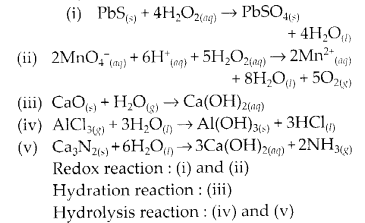
Complete the following chemical reactions.
NCERT Solutions for Class 11 Chemistry Chapter 9 Hydrogen 16
Classify the above into
(a) hydrolysis,
(b) redox and
(c) hydration reactions.
Solution.
NCERT Solutions for Class 11 Chemistry Chapter 9 Hydrogen 17

Question 21.
Describe the structure of the common form of ice.
Solution.
Water molecule in solid form is in a perfect tetrahedral shape when each oxygen atom is tetrahedrally (sp3 hybridization) surrounded by four hydrogen atoms, two of which are covalently joint with oxygen and rest of the two form hydrogen bonds with oxygen. This gives ice an open cage-like structure in which each oxygen atom is in contact with four hydrogen atoms and each hydrogen atom is attached to two oxygen atoms (covalently with one and through hydrogen bonding by the other).

Question 22.
What causes temporary and permanent hardness of water?
Solution.
Temporary hardness of water is due to the presence of magnesium and calcium hydrogen carbonates. It can be very easily removed by simply boiling the hard water for sometime. Permanent hardness of water is due to the presence of soluble salts of magnesium and calcium in the form of chlorides and sulphates in water. It cannot be easily removed.

Question 23.
Discuss the principle and method of softening of hard water by synthetic ion-exchange resins.
Solution.
Hard water is made soft by a very common ion exchange resin method. In this the hard water is allowed to pass over a zeolite bed [zeolites are sodium aluminium silicates (Na2Al2Si2O8.xH2O)] during which the Na+ ions from zeolite are replaced by Ca2+ and Mg2+ ions.
Na2Z + Ca2+➝ CaZ + 2Na+
Na2Z + Mg2+ ➝ MgZ + 2Na+
When whole of the Na+ ions of the zeolite have been exchanged, the zeolite is regenerated by treating it with strong (or saturated) solution of NaCl.
MZ + 2NaCl ➝ Na2Z + MCl2 (M = Mg, Ca)

Question 24.
Write chemical reactions to show the amphoteric nature of water.
Solution.
Water is amphoteric in nature because it can behaves both as an acid and base.
NCERT Solutions for Class 11 Chemistry Chapter 9 Hydrogen 18

Question 25.
Write chemical reactions to justify that
hydrogen peroxide can function as an oxidising as well as reducing agent.
Solution.
H2O2 acts as oxidising and reducing agent in both acidic as well as in basic medium.
NCERT Solutions for Class 11 Chemistry Chapter 9 Hydrogen 19

Question 26.
What is meant by ‘demineralised’ water and how can it be obtained?
Solution.
NCERT Solutions for Class 11 Chemistry Chapter 9 Hydrogen 20

Question 27.
Is demineralised or distilled water useful for drinking purposes? If not, how can it be made useful?
Solution.
No, demineralised water is not always useful for drinking purposes. It is usually tasteless. Moreover, some ions such as Na+, K+ and Mg2+, etc. are essential to the body.
In order to make demineralised water more useful, proper amount of additional salts of sodium and potassium etc. must be dissolved in it.

Question 28.
Describe the usefulness of water in biosphere and biological systems.
Solution.
A major part of all living organisms is made up of water. It is a crucial compound for the survival of all forms of life. It is a solvent of great importance.
Liquid water is found in water bodies, such as ocean, sea, lake, river, stream, canal, pond, or puddle. The majority of water on the Earth is ocean water. Water is important in both chemical and physical weathering processes at the Earth’s surface. Water exists as vapours in the atmosphere.
All known forms of life depend on water. Water is vital both as a solvent in which many of the body’s solutes dissolve and as an essential part of many metabolic processes within the body.

Question 29.
What properties of water make it useful as a solvent? What types of compound can it
(i) dissolve, and
(ii) hydrolyse?
Solution.
Water is useful as a solvent rather excellent solvent due to the following properties :
(a) It is a liquid over a wide range of temperature (0° to 100°C).
(b) It has high enthalpv of vapourisation and heat capacitv.
(c) It is polar in nature and has a high dielectric constant (78.39).
(i) It can dissolve polar substances and also some organic compounds due to hydrogen bonding.
(ii) Water can hydrolyse oxides, halides, phosphides, nitrides, etc due to interionic attraction between them.

Question 30.
Knowing the properties of H2O and D2O, do you think that D2O can be used for drinking purposes?
Solution.
No, heavy water (D2O) cannot be used for drinking purposes because it is injurious to health due to presence of D+ ions. Heavy water of high concentration retards the growth of plants and animals. Heavy water has germicide and bactericide properties.

Question 31.
What is the difference between the term ‘hydrolysis’ and ‘hydration’?
Solution.
When H+ and OH ions of H2O interacts with anion and cation of the salt respectively of give the original acid and base then the reaction is called hydrolysis. It results in the change of pH of solution.
When H2O is added to ion or molecule to give hydrated ion or compound then the reaction is called hydration.

Question 32.
How can saline hydrides remove traces of water from organic compounds?
Solution.
Saline hydrides such as NaH release H ions which act as strong Bronsted base whereas H2O is a weak Bronsted acid. They combine with water to liberate hydrogen gas.
NaH + H2O ➝NaOH + H2
As a result, these hydrides can be used to remove traces of water from organic compounds.

Question 33.
What do you expect the nature of hydrides is, if formed by elements of atomic numbers 15, 19, 23 and 44 with dihydrogen? Compare their behaviour towards water.
Solution.
The elements with atomic numbers 15, 19, 23 and 44 are phosphorus (P), potassium (K), vanadium (V) and ruthenium (Ru) respectively. The nature of their respective hydrides is :
PH3 (Molecular hydride), KH (Ionic), interstitial or metallic hydrides with vanadium (V). Ruthenium being a transition metal of group 8 does not form hydride. PH3 acts as a weak base with water. KH reacts violenty with water to give KOH and H2.

Question 34.
Do you expect different products in solution when aluminium(III) chloride and potassium chloride are treated separately with
(i) normal water
(ii) acidified water, and
(iii) alkaline water?
Write equations wherever necessary.
Solution.
Both the compounds are salts and they react differently with water.
Aluminium (III) chloride or A1C13 will react with water as follows :
AlCl3 + 3H2O ➝ Al(OH)3 + 3HCl.
The reaction is known as hydrolysis.
(i) In normal water, both Al(OH)3 and HCl will be present.
NCERT Solutions for Class 11 Chemistry Chapter 9 Hydrogen 21

Question 35.
How does H2O2 behave as a bleaching agent?
Solution.
H2O2 acts as bleaching agent due to the release of nascent oxygen.
H2O2 ➝ H2O + [O]
Thus, the bleaching action of hydrogen peroxide is permanent and is due to oxidation. It oxidises the colouring matter to a colourless product.
NCERT Solutions for Class 11 Chemistry Chapter 9 Hydrogen 22

Question 36.
What do you understand by the terms:

  1.  hydrogen economy
  2.  hydrogenation
  3.  syngas
  4.  water-gas shift reaction
  5.  fuel-cell ?

Solution.

  1.  Hydrogen economy : The energy is transported and stored in the form of liquid or gaseous hydrogen is the principle due to which hydrogen is considered to be a possible source of clean energy. This proposal to use hydrogen as fuel is called hydrogen economy.
  2.  Hydrogenation : The process of addition of hydrogen to unsaturated hydrocarbons is known as hydrogenation.
    NCERT Solutions for Class 11 Chemistry Chapter 9 Hydrogen 23
  3.  Syngas : The mixture of CO and H2 is used for the synthesis of methanol and a number of hydrocarbons, it is also called synthesis gas or syngas. Nowadays, syngas is produced from sewage, saw dust, scrap wood, newspapers, etc.
  4.  Water-gas shift reaction: The production of dihydrogen can be increased by reacting CO of syngas mixtures with steam in the presence of iron chromate as catalyst.
    NCERT Solutions for Class 11 Chemistry Chapter 9 Hydrogen 24
    This is called water-gas shift reaction.
  5.  Fuel cell: It is a commercial cell in which the chemical energy produced during the combustion of fuel is converted directly into electricity, e.g., H2 – O2 fuel cell. A fuel cell is used as a source of electrical energy in the space vehicles.
Read More

CLASS 11th CHAPTER -8 Redox Reactions |Chemistry | NCERT SOLUTION| EDUGROWN

NCERT Solutions for Class 11 Chemistry Chapter -8 Redox Reactions includes all the important topics with detailed explanation that aims to help students to understand the concepts better. Students who are preparing for their Class 11 Chemistry exams must go through NCERT Solutions for Class 11 Chemisrty Chapter -8 Redox Reactions. NCERT Solutions will make you understand the topics in most simple manner and grasp it easily to perform better.

NCERT Solutions for Class 11 Chemistry Part 2

There are seven chapters in Class 11 Chemistry Part 2 textbook which will make you well versed in variety of topics and allows students to cover the entire syllabus effectively without any frustration. These NCERT Solutions are curated by the experts in a comprehensive which can be helpful in clearing your doubts instantly.

Class 11th Chapter -8 Redox Reactions | NCERT CHEMISRTY SOLUTION |

NCERT Exercises

Question 1.
Assign oxidation number to the underlined elements in each of the following species :
(a) NaH2PO4
(b) NaHSO4
(c) H4P2O7
(d) K2MnO4
(e) CaO2
(f) NaBH4
(g) H2S2O7
(h) KAI(SO4)2.12H2O
Solution.
Let the oxidation no. of underlined element in all the given compounds = x
NCERT Solutions for Class 11 Chemistry Chapter 8 Redox Reactions 1
NCERT Solutions for Class 11 Chemistry Chapter 8 Redox Reactions 2

Question 2.
What are the oxidation number of the underlined elements in each of the following and how do you rationalise your results?
(a) KI3
(b) H2S4O6
(c) Fe3O4
(d) CH3CH2OH
(e) CH3COOH
Solution.
(a) In KI3, since the oxidation number of K is +1, therefore, the average oxidation number of iodine = -1/3. In the structure, K+[I – I <— I], a coordinate bond is formed between I2 molecule and I ion. The oxidation number of two iodine atoms forming the I2 molecule is zero while that of iodine ion forming the coordinate bond is -1. Thus, the O.N. of three iodine atoms in KI3 are 0, 0 and -1 respectively.
NCERT Solutions for Class 11 Chemistry Chapter 8 Redox Reactions 3
NCERT Solutions for Class 11 Chemistry Chapter 8 Redox Reactions 4

Question 3.
Justify that the following reactions are redox reactions:
(a) CuO(s) + H2(g) ➝ Cu(5) + H2O(g)
(b) Fe2O3(s) + 3CO(g) ➝ 2Fe(s) + 3CO2(g)
(c) 4BCI3(g) + 3LiAIH4(s) ➝ 2B2H6(g) + 3LiCI(s) + 3AICI3(s)
(d) 2K(s) + F2(g) ➝ 2K+F(s)
(e) 4NH3(g) + 5O2(g) ➝ 4NO(g) + 6H2O(g)
Solution.

NCERT Solutions for Class 11 Chemistry Chapter 8 Redox Reactions 5NCERT Solutions for Class 11 Chemistry Chapter 8 Redox Reactions 6

Question 4.
Fluorine reacts with ice and results in the change:
H2O(s) + F2(g) ➝ HF(g) + HOF(g)
Justify that this reaction is a redox reaction.
Solution.
NCERT Solutions for Class 11 Chemistry Chapter 8 Redox Reactions 7

Question 5.
Calculate the oxidation number of sulphur, chromium and nitrogen in H2SO5, Cr2O72- and NO3. Suggest structure of these compounds. Count for the fallacy.
Solution.
NCERT Solutions for Class 11 Chemistry Chapter 8 Redox Reactions 8
NCERT Solutions for Class 11 Chemistry Chapter 8 Redox Reactions 9

Question 6.
Write formulas for the following compounds:
(a) Mercury(II) chloride
(b) Nickel(II) sulphate
(c) Tin(IV) oxide
(d) Thallium(I) sulphate
(e) Iron(III) sulphate
(f) Chromium(III) oxide
Solution.
(a) HgCl2
(b) NiSO4
(c) SnO2
(d) Tl2SO4
(e) Fe2(SO4)3
(f) Cr2O3

Question 7.
Suggest a list of the substances where carbon can exhibit oxidation states from -4 to +4 and nitrogen from -3 to +5.
Solution.
NCERT Solutions for Class 11 Chemistry Chapter 8 Redox Reactions 10

Question 8.
While sulphur dioxide and hydrogen peroxide can act as oxidising as well as reducing agents in their reactions, ozone and nitric acid act only as oxidants. Why?
Solution.
The oxidation state of sulphur in sulphur dioxide is +4. It can be oxidised to +6 oxidation state or reduced to +2. Therefore, sulphur dioxide acts as a reducing agent as well as oxidising agent. Similarly, the oxidation state of oxygen in hydrogen peroxide is -1. It can be oxidised to O2 (zero oxidation state) or reduced to H2O or OH (-2 oxidation state) and therefore, acts as reducing as well as oxidising agents.
However, both ozone and nitric acid can only decrease their oxidation number and therefore, act only as oxidising agents.
NCERT Solutions for Class 11 Chemistry Chapter 8 Redox Reactions 11

Question 9.
Consider the reactions :
(a) 6CO2(g) + 6H2O(l) ➝ C6H12O6(ag) + 6O2(g)
(b) O3(g) + H2O2(l) ➝ H2O(l) + 2O2(g)
Also suggest a technique to investigate the path of the above (a) and (b) redox reactions.

Solution.
NCERT Solutions for Class 11 Chemistry Chapter 8 Redox Reactions 12NCERT Solutions for Class 11 Chemistry Chapter 8 Redox Reactions 13
Question 10.
The compound AgF2 is unstable compound. However, if formed, the compound acts as a very strong oxidising agent. Why ?
Solution.
In AgF2 oxidation state of Ag is +2 which is very unstable. Therefore, it quickly, accepts an electron to form the more stable +1 oxidation state.
Ag2+ + e ➝ Ag+
Therefore, AgF2, if formed, will act as a strong oxidising agent.

Question 11.
Whenever a reaction between an oxidising agent and a reducing agent is carried out, a compound of lower oxidation state is formed if the reducing agent is in excess and a compound of higher oxidation state is formed if the oxidising agent is in excess. Justify this statement giving three illustrations.
Solution.
(i) C is a reducing agent while O2 is an oxidising agent. If excess of carbon is burnt in a limited supply of O2, CO is formed in which oxidation state of C is +2 but when O2 is in excess CO formed gets oxidised to CO2 in which oxidation state of C is + 4.
NCERT Solutions for Class 11 Chemistry Chapter 8 Redox Reactions 14
NCERT Solutions for Class 11 Chemistry Chapter 8 Redox Reactions 15

Question 12.
How do you count for the following observations ?
(a) Though alkaline potassium permanganate and acidic potassium permanganate both are used as oxidants, yet in the manufacture of benzoic acid from toluene we use alcoholic potassium permanganate as an oxidant. Why? Write a balanced redox equation for the reaction.
(b) When concentrated sulphuric acid is added toaninorganicmixture containing chloride, we get colourless pungent smelling gas HCI, but if the mixture contains bromide then we get red vapour of bromine. Why?
Solution.
(a) In neutral medium, KMnO4 acts as an oxidant as follows :
MnO4 + 2H2O + 3e ➝ MnO2 + 40H
In laboratory, alkaline KMnO4 is used to oxidise toluene to benzoic acid.
NCERT Solutions for Class 11 Chemistry Chapter 8 Redox Reactions 16
NCERT Solutions for Class 11 Chemistry Chapter 8 Redox Reactions 17

Question 13.
Identify the substance oxidised, reduced, oxidising agent and reducing agent for each of the following reactions:
Solution.
NCERT Solutions for Class 11 Chemistry Chapter 8 Redox Reactions 18

Question 14.
Consider the reactions:
NCERT Solutions for Class 11 Chemistry Chapter 8 Redox Reactions 19
Why does the same reductant, thiosulphate react differently with iodine and bromine?
Solution.
NCERT Solutions for Class 11 Chemistry Chapter 8 Redox Reactions 20

Question 15.
Justify giving reactions that among halogens, fluorine is the best oxidant and among hydrohalic compounds, hydroiodic acid is the best reductant.
Solution.
The halogens (X2) have strong electron accepting tendency and have positive standard oxidation potential values. They are therefore, powerful oxidising agents. The decreasing order of oxidising powers of halogens is :
NCERT Solutions for Class 11 Chemistry Chapter 8 Redox Reactions 21

Question 16.
Why does the following reaction occur ?
NCERT Solutions for Class 11 Chemistry Chapter 8 Redox Reactions 22
Solution.
NCERT Solutions for Class 11 Chemistry Chapter 8 Redox Reactions 23

Question 17.
Consider the reactions :
NCERT Solutions for Class 11 Chemistry Chapter 8 Redox Reactions 24

Solution.

NCERT Solutions for Class 11 Chemistry Chapter 8 Redox Reactions 25

Question 18.
Balance the following redox reactions by ion – electron method:
Solution.

NCERT Solutions for Class 11 Chemistry Chapter 8 Redox Reactions 26NCERT Solutions for Class 11 Chemistry Chapter 8 Redox Reactions 27NCERT Solutions for Class 11 Chemistry Chapter 8 Redox Reactions 28NCERT Solutions for Class 11 Chemistry Chapter 8 Redox Reactions 29NCERT Solutions for Class 11 Chemistry Chapter 8 Redox Reactions 30

Question 19.
Balance the following equations in basic medium by ion-electron method and oxidation number methods and identify the oxidising agent and the reducing agent.
NCERT Solutions for Class 11 Chemistry Chapter 8 Redox Reactions 26
Solution.
NCERT Solutions for Class 11 Chemistry Chapter 8 Redox Reactions 27
NCERT Solutions for Class 11 Chemistry Chapter 8 Redox Reactions 28
NCERT Solutions for Class 11 Chemistry Chapter 8 Redox Reactions 29
NCERT Solutions for Class 11 Chemistry Chapter 8 Redox Reactions 30NCERT Solutions for Class 11 Chemistry Chapter 8 Redox Reactions 31

Question 20.
What sorts of informations can you draw from the following reaction?
(CN)2(g) + 2OH(aq) ➝ CN(aq) + CNO(aq) + H2O(l)
Solution.
NCERT Solutions for Class 11 Chemistry Chapter 8 Redox Reactions 32

Question 21.
The Mn3+ ion is unstable in solution and undergoes disproportionation to give Mn2+, MnO2, and H+ ion. Write a balanced ionic equation for the reaction.
Solution.
NCERT Solutions for Class 11 Chemistry Chapter 8 Redox Reactions 33

Question 22.
Consider the elements: Cs, Ne, I and F
(a) Identify the element that exhibits only negative oxidation state.
(b) Identify the element that exhibits only positive oxidation state.
(c) Identify the element that exhibits both positive and negative oxidation states.
(d) Identify the element which exhibits neither the negative nor does the positive oxidation state.
Solution.
(a) F: Fluorine is the most electronegative element and shows only -1 oxidation state.
(b) Cs : Because of the presence of single electron in the valence shell, (alkali metals) Cs exhibits an oxidation state of +1 only.
(c) I: Because of the presence of seven electrons in the valence shell, I shows an oxidation state of-1 in compounds with more electropositive elements (such as H, Na, K, Ca, etc.) and oxidation states of +3, +5, +7 in compounds of I with more electronegative elements (such as, O, F, etc.)
(d) Ne: It is an inert gas (with high ionization enthalpy and highly positive electron gain enthalpy) and hence, it exhibits neither negative nor positive oxidation states.

Question 23.
Chlorine is used to purify drinking water. Excess of chlorine is harmful. The excess of chlorine is removed by treating with sulphur dioxide. Present a balanced equation for this redox change taking place in water.
Solution.
NCERT Solutions for Class 11 Chemistry Chapter 8 Redox Reactions 34

Question 24.
Refer to the periodic table given in your book and now answer the following questions:
(a) Select the possible non metals that can show disproportionation reaction.
(b) Select three metals that can show disproportionation reaction.
Solution.
NCERT Solutions for Class 11 Chemistry Chapter 8 Redox Reactions 35

Question 25.
In Ostwald’s process for the manufacture of nitric acid, the first step involves the oxidation of ammonia gas by oxygen gas to give nitric oxide gas and steam. What is the maximum weight of nitric oxide that can be obtained starting only with 10.00 g of ammonia and 20.00 g of oxygen?
Solution.
The reaction involved in the manufacturing process is :
NCERT Solutions for Class 11 Chemistry Chapter 8 Redox Reactions 36

Question 26.
Using the standard electrode potentials, predict if the reaction between the following is feasible:
NCERT Solutions for Class 11 Chemistry Chapter 8 Redox Reactions 37
Solution.
NCERT Solutions for Class 11 Chemistry Chapter 8 Redox Reactions 38NCERT Solutions for Class 11 Chemistry Chapter 8 Redox Reactions 39NCERT Solutions for Class 11 Chemistry Chapter 8 Redox Reactions 40NCERT Solutions for Class 11 Chemistry Chapter 8 Redox Reactions 41

Question 27.
Predict the products of electrolysis in each of the following:
(i) An aqueous solution of AgNO3 with silver electrodes.
(ii) An aqueous solution of AgNO3 with platinum electrodes.
(iii) A dilute solution of H2SO4 with platinum electrodes.
(iv) An aqueous solution of CuCl2 with platinum electrodes.
Solution.

(1) An aqueous solution of AgNO3 using platinum electrodes :     (P.I.S.A. Based)
Both AgNO3 and water will ionise in aqueous solution
NCERT Solutions for Class 11 Chemistry Chapter 8 Redox Reactions 42
At cathode : Ag+ ions with less discharge potential are reduced in preference to H+ ions which will remain in solution. As a result, silver will be deposited at cathode.
Ag+ (aq) + e → Ag (deposited)
At anode : An equivalent amount of silver will be oxidised to Ag+ ions by releasing electrons.
NCERT Solutions for Class 11 Chemistry Chapter 8 Redox Reactions 43
As result of electrolysis, Ag from silver anode dissolves as Ag+(aq) ions while an equivalent amount of Ag+(aq) ions from the aqueous AgNO3 solution get deposited on the cathode.

(2) An aqueous solution of AgNO3 using platinum electrodes :

In the case, the platinum electrodes are the non-attackable electrodes. On passing current the following changes will occur at the electrodes.
At cathode : Ag+ ions will be reduced to Ag which will get deposited at the cathode.
At anode : Both NO3 and OH ions will migrate. But OH ions with less discharge potential will be oxidised in preference to NO3 ions which will remain in solution.
OH- (aq) → OH + e; 4OH → 2H2O(l) + O2 (g)
Thus, as a result of electrolysis, silver is deposited on the cathode while O2 is evolved at the anode. The solution will be acidic due to the presence of HNO3.

(3) A dilute solution of H2SO4 using platinum electrodes :
On passing current, both acid and water will ionise as follows :
NCERT Solutions for Class 11 Chemistry Chapter 8 Redox Reactions 44
At cathode :
H+ (aq) ions will migrate to the cathode and will be reduced to H2.
H+ (aq) + e-→ H ; H + H→ H2 (g)
Thus, H2 (g) will evolve at cathode.
At anode : OH ions will be released in preference to SO2-ions because their discharge potential is less. They will be oxidised as follows :
OH (aq) → OH + e ; 4OH → 2H2O(l) + O2 (g)
Thus, O2 (g) will be evolved at anode. The solution will be acidic and will contain H2SO4.

(4) An aqueous solution of CuCl2 using platinum electrodes :

The electrolysis proceeds in the same manner as discussed in the case of AgNO3 solution. Both CuCl2 and H2O will ionise as follows :
NCERT Solutions for Class 11 Chemistry Chapter 8 Redox Reactions 45
At cathode :  Cu2+ ions will be reduced in preference to H+ ions and copper will be deposited at cathode.
Cu2+ (aq) + 2e → Cu (deposited)
At anode : Cl ions will be discharged in preference to OH ions which will remain in solution.
Cl→Cl+ e ; Cl + Cl → Cl2 (g) (evolved)
Thus, Cl2 will evolve at anode.

Question 28.
Arrange the following metals in the order in which they displace each other from the solution of their salts. Al, Cu, Fe, Mg and Zn.
Solution.
NCERT Solutions for Class 11 Chemistry Chapter 8 Redox Reactions 46
Since a metal with lower electrode potential is a stronger reducing agent, therefore, Mg can displace all the above metals from their aqueous solutions, Al can displace all metals except Mg from the aqueous solutions of their salts. Zn can displace all metals except Mg and Al from the aqueous solutions of their salts while Fe can displace only Cu from the aqueous solution of its salts. Thus, the order in which they can displace each other from the solution of their salts is Mg, Al, Zn, Fe, Cu.

Question 29.
Given the standard electrode potentials,
NCERT Solutions for Class 11 Chemistry Chapter 8 Redox Reactions 47
Solution.
NCERT Solutions for Class 11 Chemistry Chapter 8 Redox Reactions 48

Question 30.
Depict the galvanic cell in which the reaction,
Zn(s) + 2Ag+(aq) ➝ zn2+(aq) + 2Ag(s) takes place. Further show:
(i) which of the electrode is negatively charged,
(ii) the carriers of current in the cell and
(iii) individual reaction at each electrode.
Solution.
The given redox reaction is
NCERT Solutions for Class 11 Chemistry Chapter 8 Redox Reactions 49

Read More

CLASS 11th CHAPTER – 7 Equilibrium |Chemistry | NCERT SOLUTION| EDUGROWN

NCERT Solutions for Class 11 Chemistry Chapter -7 Equilibrium includes all the important topics with detailed explanation that aims to help students to understand the concepts better. Students who are preparing for their Class 11Chemistry exams must go through NCERT Solutions for Class 11 Chemisrty Chapter -7 Equilibrium. NCERT Solutions will make you understand the topics in most simple manner and grasp it easily to perform better.

NCERT Solutions for Class 11 Chemistry Part 1

Chemistry Part 1 Class 11 will introduce you to basic concepts of subjects, about atoms, chemical bonding and other topics. There are 7 chapters through which learners can study in an organized manner and improve their studying habits.

Class 11th Chapter -7 Equilibrium | NCERT CHEMISRTY SOLUTION |

NCERT Exercises

Question 1.
A liquid is in equilibrium with its vapour in a sealed container at a fixed temperature. The
volume of the container is suddenly increased.
(a) What is the initial effect of the change on vapour pressure?
(b) How do rates of evaporation and condensation change initially?
(c) What happens when equilibrium is restored finally and what will be the final vapour pressure?
Solution.
(a) Vapour pressure decreases since equilibrium is disturbed and the rate of condensation falls considerably.
(b) Rate of evaporation increases while that of condensation falls initially.
(c) On restoration of the equilibrium again, the vapour pressure becomes the same.

Question 2.
What is Kc for the following equilibrium when the equilibrium concentration of each substance is : [SO2] = 0.60 M, [O2] = 0.82 M and [SO2] = 1.90 M
2SO2(g) + O2(g) ⇌ 2SO3(g)
Solution.
2SO2(g) + O2(g) ⇌ 2SO3(g)
Applying law of chemical equilibrium,
{ K }_{ c }=\frac { { \left[ { SO }_{ 3 } \right] }^{ 2 } }{ { \left[ { SO }_{ 2 } \right] }^{ 2 }\left[ { O }_{ 2 } \right] } =\frac { { (1.9) }^{ 2 } }{ { (0.6) }^{ 2 }{ (0.82) } } =12.229L\quad { mol }^{ -1 }

Question 3.
At a certain temperature and total pressure of 105 Pa, iodine vapour contains 40% by volume of I atoms. I2(g) ⇌ 2l(g)Calculate Kp for the equilibrium.
Solution.
NCERT Solutions for Class 11 Chemistry Chapter 7 Equilibrium 1
NCERT Solutions for Class 11 Chemistry Chapter 7 Equilibrium 2

Question 4.
Write the expression for the equilibrium constant, Kc for each of the following reactions:
NCERT Solutions for Class 11 Chemistry Chapter 7 Equilibrium 3
Solution.
NCERT Solutions for Class 11 Chemistry Chapter 7 Equilibrium 4
NCERT Solutions for Class 11 Chemistry Chapter 7 Equilibrium 5

Question 5.
Find out the value of Kcof each of the following equilibria from the value of Kp:
NCERT Solutions for Class 11 Chemistry Chapter 7 Equilibrium 6
Solution.
NCERT Solutions for Class 11 Chemistry Chapter 7 Equilibrium 7

Question 6.
For the following equilibrium, Kc= 6.3 x 10¹⁴ at 1000 K. NO(g) + O3(g) ⇌ NO2(g) + O2(g) the forward and reverse reactions in the equilibrium are elementary bimolecular reactions. What is Kc, for the reverse reaction?
Solution.
NO(g) + O3(g) ⇌ NO2(g) + O2(g)
{ K }_{ c }=\frac { \left[ { NO }_{ 2 } \right] \left[ { O }_{ 2 } \right] }{ \left[ NO \right] \left[ { O }_{ 3 } \right] } =6.3\times { 10 }^{ 14 }
For the reverse reaction,
{ K }_{ c }^{ ` }=\frac { \left[ NO \right] \left[ { O }_{ 3 } \right] }{ \left[ { NO }_{ 2 } \right] \left[ { O }_{ 2 } \right] } =\frac { 1 }{ { K }_{ c } } =\frac { 1 }{ 6.3\times { 10 }^{ 14 } } =1.587\times { 10 }^{ -15 }

Question 7.
Explain why pure liquids and solids can be ignored while writing the equilibrium constant expression.
Solution.
For the concentration of pure solid or pure liquid,
Molar\quad conc.=\frac { Moles\quad of\quad the\quad substance }{ Volume\quad of\quad the\quad substance }
=\frac { Mass/Molar\quad mass }{ Volume } =\frac { Mass }{ Volume } \times \frac { 1 }{ Molar\quad mass } =\frac { Density }{ Molecular\quad mass }
Since density of pure solid or liquid is constant at constant temperature and molar mass is also constant therefore, their molar concentrations are constant and are included in the equilibrium constant.

Question 8.
Reaction between N2 and O2 takes place as follows:
2N2(g) + O2(g) ⇌ 2N2O(g)
If a mixture of 0.482 mol of N2 and 0.933 mol of O2 is placed in a 10 L reaction vessel and allowed to form N2O at a temperature for which Kc = 2.0 x 10-37, determine the composition of equilibrium mixture.
Solution.
NCERT Solutions for Class 11 Chemistry Chapter 7 Equilibrium 8

Question 9.
Nitric oxide reacts with Br2 and gives nitrosyl bromide as reaction given below:
2NO(g) + Br2(g) ⇌ 2NOBr(g) When 0.087 mol of NO and 0.0437 mol of Br2 are mixed in a closed container at constant temperature, 0.0518 mol of NOBr is obtained at equilibrium. Calculate equilibrium amount of NO and Br2.
Solution.
NCERT Solutions for Class 11 Chemistry Chapter 7 Equilibrium 9

Question 10.
At 450 K, Kp = 2.0 x 1010.bar for the given reaction at equilibrium.
2SO2(g)+ O2(g) ⇌ 2SO3(g)
What is Kc at this temperature?
Solution.
NCERT Solutions for Class 11 Chemistry Chapter 7 Equilibrium 10

Question 11.
A sample of HI(g) is placed in a flask at a pressure of 0.2 atm. At equilibrium partial pressure of HI(g) is 0.04 atm. What is Kp for the given equilibrium ?
2HI(g) \rightleftharpoons  H2(g) + I2(g)
Solution.
NCERT Solutions for Class 11 Chemistry Chapter 7 Equilibrium 11

Question 12..
AA mixture of 1.57 mol of N2, 1.92 mol of H2 and 8.13 mol of NH3 is introduced into a 20 L reaction vessel at 500 K. At this temperature, the equilibrium constant Kc for the reaction given as follows :
N2(g) + 3H2(g) \rightleftharpoons  2NH3(g) is 1.7 × 10⁻².
Is this reaction at equilibrium ? If not, what is the direction of net reaction ?
Solution.
NCERT Solutions for Class 11 Chemistry Chapter 7 Equilibrium 12

Question 13.
The equilibrium constant expression for a gas reaction is,
NCERT Solutions for Class 11 Chemistry Chapter 7 Equilibrium 13
Write the balanced chemical equation corresponding to this expression.
Solution.
Balanced chemical equation for the reaction is
4 NO(g) + 6 H2O(g) \rightleftharpoons  4NH3(g) + 5 O2(g)

Question 14.
If 1 mole of H2O and 1 mole of CO are taken in a 10 litre vessel and heated to 725 K, at equilibrium point 40 percent of water (by mass) reacts with carbon monoxide according to equation,
H2O(g) + CO(g) \rightleftharpoons  H2(g) + CO2(g)
Calculate the equilibrium constant for the reaction.
Solution.
NCERT Solutions for Class 11 Chemistry Chapter 7 Equilibrium 14

Question 15.
At 700 K, the equilibrium constant for the reaction H2(g) + I2(g) \rightleftharpoons  2HI(g) is 54.8. If 0.5 mol L-1 of HI(g) is present at equilibrium at 700 K, what are the concentration of H2(g) and I2(g) ? Assume that we initially started with HI(g) and allowed it to reach equilibrium at 700 K.
Solution.
NCERT Solutions for Class 11 Chemistry Chapter 7 Equilibrium 15

Question 16.
What is the equilibrium concentration of each of the substances in the equilibrium when the initial concentration of ICl was 0.78 M ?
2ICl(g) \rightleftharpoons  I2(g) + Cl2(g) ; Kc = 0.14
Solution.
NCERT Solutions for Class 11 Chemistry Chapter 7 Equilibrium 16NCERT Solutions for Class 11 Chemistry Chapter 7 Equilibrium 17

Question 17.
Kp = 0.04 atm at 898 K for the equilibrium shown below. What is the equilibrium concentration of C2H6 when it is placed in a flask at 4 atm pressure and allowed to come to equilibrium.
C2H6(g) \rightleftharpoons  C2H4(g) + H2(g)
Solution.
NCERT Solutions for Class 11 Chemistry Chapter 7 Equilibrium 18

Question 18.
The ester, ethyl acetate is formed by the reaction of ethanol and acetic acid and the equilibrium is represented as :
CH3COOHl + C2H5OHl \rightleftharpoons  CH3COOC2H5l + H2Ol
(i) Write the concentration ratio (concentration quotient) Q for this reaction. Note that water is not in excess and is not a solvent in this reaction.
(ii) At 293 K, if one starts with 1.000 mol of acetic acid and 0.180 mol of ethanol, there is 0.171 mol of ethyl acetate in the final equilibrium mixture. Calculate the equilibrium constant.
(iii) Starting with 0.50 mol of ethanol and 1.000 mol of acetic acid and maintaining it at 293 K, 0.214 mol of ethyl acetate
is found after some time. Has equilibrium been reached ?
Solution.
NCERT Solutions for Class 11 Chemistry Chapter 7 Equilibrium 19NCERT Solutions for Class 11 Chemistry Chapter 7 Equilibrium 20
NCERT Solutions for Class 11 Chemistry Chapter 7 Equilibrium 21

Question 19.
A sample of pure PCl5 was introduced into an evacuated vessel at 473 K. After equilibrium was reached, the concentration of PCl5 was found to be 0.5 x 10⁻¹ mol L-1. If Kc is 8.3 × 10⁻³, what are the concentrations of PCl3 and Cl2 at the equilibrium ?
NCERT Solutions for Class 11 Chemistry Chapter 7 Equilibrium 22
Solution.
NCERT Solutions for Class 11 Chemistry Chapter 7 Equilibrium 23

Question 20.
One of the reactions that takes place in producing steel from iron ore is the reduction of iron (II) oxide by carbon monoxide to give iron metal and CO2
FeO(s) + CO(g) \rightleftharpoons  Fe(s) + CO2(g); Kp = 0.265 atm at 1050 K
What are the equilibrium partial pressures of CO and CO2 at 1050 K if the initial pressures are :Pco = 1.4 atm and Pco2 = 0.80 atm ?
Solution.
NCERT Solutions for Class 11 Chemistry Chapter 7 Equilibrium 24

Question 21.
Equilibrium constant Kc for the reaction, N2(g) + 3H2(g) \rightleftharpoons  2NH3(g) at 500 K is 0.061. At particular time, the analysis shows that the composition of the reaction mixture is : 3.0 mol L-1 of N2 , 2.0 mol L-1 of H2,0.50 mol L-1 of NH3. Is the reaction at equilibrium ? If not, in which direction does the reaction tend to proceed to reach the equilibrium ?
Solution.
NCERT Solutions for Class 11 Chemistry Chapter 7 Equilibrium 25

Question 22.
Bromine monochloride (BrCl) decomposes into bromine and chlorine and reaches the equilibrium :
2BrCl(g) \rightleftharpoons  Br2(g) + Cl2(g)
For which Kc is 32 at 500 K. If initially pure BrCl is present at a concentration of 3.3× 10⁻³ mol L-1, what is its molar concentration in the mixture at equilibrium ?
Solution.
NCERT Solutions for Class 11 Chemistry Chapter 7 Equilibrium 26
NCERT Solutions for Class 11 Chemistry Chapter 7 Equilibrium 27

Question 23.
At 1127 K and 1 atmosphere pressure, a gaseous mixture of CO and CO2 in equilibrium with solid carbon has 90.55% by mass.
C(s) + CO2(g) \rightleftharpoons  2CO(g)
Calculate Kc for the reaction at the above temperature.
Solution.
NCERT Solutions for Class 11 Chemistry Chapter 7 Equilibrium 28

Question 24.
NCERT Solutions for Class 11 Chemistry Chapter 7 Equilibrium 29
Solution.
NCERT Solutions for Class 11 Chemistry Chapter 7 Equilibrium 30

Question 25.
Does the number of moles of reaction products increase, decrease or remain same when each of the following equilibria is subjected to a decrease in pressure by increasing the volume ?
(a) PCl5(g) \rightleftharpoons  PCl3(g) + Cl2
(b) CaO(s) + CO2(g) \rightleftharpoons  CaCO3(s)
(c) 3Fe(s) + 4H2O(g) \rightleftharpoons  Fe3O4(s) + 4H2(g)
Solution.
Applying Le Chatelier’s principle, on decreasing the pressure, equilibrium shifts to the direction in which pressure increases, i.e., number of moles of gaseous substances is more. Thus, moles of reaction products will increase in reaction (a), decrease in reaction (b) and remain same (np, = nr gaseous) in reaction (c).

Question 26.
Which of the following reactions will get affected by increase in pressure ? Also mention whether the change will cause the reaction to go in the forward or backward direction.
NCERT Solutions for Class 11 Chemistry Chapter 7 Equilibrium 31
Solution.
NCERT Solutions for Class 11 Chemistry Chapter 7 Equilibrium 32

Question 27.
The equilibrium constant for the following reaction is 1.6 x 10⁵ at 1024 K.
H2(g) + Br2(g) \rightleftharpoons  2HBr(g)
Find the equilibrium pressure of all gases if 10.0 bar of HBr is introduced into a sealed container at 1024K.
Solution.
NCERT Solutions for Class 11 Chemistry Chapter 7 Equilibrium 33

Question 28.
Dihydrogen gas is obtained from the natural gas by partial oxidation with steam as per following endothermic reaction :
CH4(g) + H2O(g) \rightleftharpoons  CO(g) + 3H2(g)
(a) Write the expression for Kp for the above reaction
(b) How will the value of Kp and composition of equilibrium mixture be affected by :
(i) increasing the pressure
(ii) increasing the temperature
(iii) using a catalyst ?
Solution.
NCERT Solutions for Class 11 Chemistry Chapter 7 Equilibrium 34
(b)

  1. By Le Chatelier’s principle, on increasing pressure, equilibrium will shift in the backward direction where number of moles decreases.
  2. As the given reaction is endothermic, by Le Chatelier ‘sprinciple, equilibrium will shift in the forward direction with increasing temperature.
  3. Equilibrium composition will not be disturbed by the presence of catalyst but equilibrium will be attained quickly.

Question 29.
Describe the effect of :
(a) addition of H2
(b) addition of CH3OH
(c) removal of CO
(d) removal of CH3OH on the equilibrium of the reaction:
2H2(g) + CO(g) \rightleftharpoons  CH3OH ?
Solution.
2H2(g) + CO(g) \rightleftharpoons  CH3OH Effect of
(a) addition of H2 : The equilibrium will shift in the forward direction.
(b) addition of CH3OH : The equilibrium will shift in the backward direction.
(c) removal of CO : The equilibrium will shift in the backward direction.
(d) removal of CH3OH : The equilibrium will shift in the forward direction.

Question 30.
At 473 K, the equilibrium constant Kc for the decomposition of phosphorus pentachloride (PCl5) is 8.3 × 10⁻³. If decomposition proceeds as :
PCl5(g) \rightleftharpoons  PCl3(g) + Cl2(g) ; ∆H = + 124.0 kJ mol-1
(a) Write an expression for Kc for the reaction.
(b) What is the value of Kc for the reverse reaction at the same temperature ?
What would be the effect on Kc if
(i) more PCl5 is added

(ii) pressure is increased
(iii) the temperature is increased?
Solution.
NCERT Solutions for Class 11 Chemistry Chapter 7 Equilibrium 35

Question 31.
Dihydrogen gas used in Haber’s process is produced by reacting methane from natural gas with high temperature steam. The first stage of two stage reaction involves the formation of CO and H2. In second stage, CO formed in first stage is reacted with more steam in water gas shift reaction.
CO(g) + H2O(g) \rightleftharpoons  CO2(g) + H2(g)
If a reaction vessel at 400°C is charged with an equimolar mixture of CO and steam so that pco = PH2O = 4.0 bar, what will be the partial pressure of H2 at equilibrium ? Kp = 0.1 at 400°C.
Solution.
NCERT Solutions for Class 11 Chemistry Chapter 7 Equilibrium 38

Question 32.
Predict which of the following will have appreciable concentration of reactants and products :
(a) Cl2(g) \rightleftharpoons  2Cl(g) ; Kc = 5 ×10-39
(b) Cl2(g) + 2NO(g) \rightleftharpoons  2NOCl(g) ; Kc = 3.7 × 10⁸
(c) Cl2(g) + 2NO2 (g) \rightleftharpoons  2NO2Cl(g) ; Kc = 1.8.
Solution.
(a) Since the value of Kc is very small
∴ There will be appreciable concentration of the reactants.
(b) Since Kc is very large.
∴ There will be appreciable concentration of the products.
(c) Since Kc = 1.8, the concentration of reactants and products will be in comparable amounts.

Question 33.
The value of Kc for the reaction 3O2(g) \rightleftharpoons  2O3(g) is 2.0 × 1 x 10-50 at 25°C. If equilibrium concentration of O2 in air at 25°C is 1.6 × 10⁻², what is the concentration of O2 ?
Solution.
NCERT Solutions for Class 11 Chemistry Chapter 7 Equilibrium 39

Question 34.
The reaction CO(g) + 3H2(g) \rightleftharpoons  CH4(g) + H2O(g) is at equilibrium at 1300 K in a 1L flask. It also contain 0.30 mol of CO, 0.10 mol of H2 and 0.02 mol of H2O and an unknown amount of CH4 in the flask. Determine the concentration of CH4 in the mixture. The equilibrium constant, Kc for the reaction at the given temperature is 3.90.
Solution.
NCERT Solutions for Class 11 Chemistry Chapter 7 Equilibrium 40

Question 35.
What is meant by conjugate acid-base pair ? Find the conjugate acid/base for the following species :
HNO2,CN,HClO4,OH,CO32-,S2-.
Solution.
NCERT Solutions for Class 11 Chemistry Chapter 7 Equilibrium 41

Question 36.
Which of the following are Lewis Acids ?
H2O, BF3, H+ and NH4+
Solution.
BF3, H+ and NH4+ are Lewis acids because they can accept a lone pair of electrons.

Question 37.
What will be the conjugate bases for the Bronsted acids ? HF, H2SO4 and { HCO }_{ 3 }^{ - } ?
Solution.
NCERT Solutions for Class 11 Chemistry Chapter 7 Equilibrium 42

Question 38.
Write the conjugate acids for the following Bronsted acids.
{ NH }_{ 2 }^{ - }, NH3 and HCOO
Solution.
NCERT Solutions for Class 11 Chemistry Chapter 7 Equilibrium 43

Question 39.
The species H2O, HCO3, HSO4 and NH3 can act both as Bronsted acid and base. For each case, give the corresponding conjugate acid and base.
Solution.
NCERT Solutions for Class 11 Chemistry Chapter 7 Equilibrium 44

Question 40.
Classify the following species into Lewis acids and Lewis bases and show how these can act as Lewis acid/Lewis base ?
(a) OH
(b) F
(c) H+
(d) BCl3
Solution.
(a) OH : OH is a Lewis base because it can donate lone pair of electrons.
(b) F : F is a Lewis base because it can donate lone pair of electrons.
(c) H+ : H+is a Lewis acid because it can accept lone pair of electrons.
(d) BCl3 : is a Lewis acid because it is electron deficient and can accept a lone pair of electrons.

Question 41.
The concentration of hydrogen ions in a sample of soft drink is 3.8 × 10⁻³ M. What is its pH value ?
Solution.
NCERT Solutions for Class 11 Chemistry Chapter 7 Equilibrium 45

Question 42.
The pH of soft drink is 3.76. Calculate the concentration of hydrogen ions in it.
Solution.
NCERT Solutions for Class 11 Chemistry Chapter 7 Equilibrium 46

Question 43.
The ionisation constants of HF, HCOOH and HCN at 298 K are 6.8 x 10⁻⁴, 1-8 × 10⁻⁴ and 4.8 × 10⁻⁹ respectively. Calculate the ionisation constant of the corresponding congugate bases.
Solution.
NCERT Solutions for Class 11 Chemistry Chapter 7 Equilibrium 47

Question 44.
The ionisation constant of phenol is 1.0 x 10⁻¹⁰. What is the concentration of phenate ion in 0.05 M solution of phenol and pH of solution ? What will be the degree of ionisation if the solution is also 0.01 M in sodium phenate ?
Solution.
NCERT Solutions for Class 11 Chemistry Chapter 7 Equilibrium 48

Question 45.
The first dissociation constant H2S is 9.1 × 10⁻⁸. Calculate the concentration of HS ions in its 0.1 M solution and how much will this concentration be affected if the solution is 0.1 M in HCl also. If the second dissociation constant of H2S is 1.2 × 10⁻¹³, calculate the concentration of S2- ions under both the conditions.
Solution.
NCERT Solutions for Class 11 Chemistry Chapter 7 Equilibrium 49
NCERT Solutions for Class 11 Chemistry Chapter 7 Equilibrium 50

Question 46.
The ionization constant of acetic acid is 1.74 × 10⁻⁵. Calculate the degree of dissociation of acetic acid in 0.05 M solution. Calculate the concentration of acetate ions in solution and the pH of the solution.
Solution.
NCERT Solutions for Class 11 Chemistry Chapter 7 Equilibrium 51

Question 47.
It has been found that the pH of 0.01 M solution of organic acid is 4.15. Calculate the concentration of the anion, ionization constant of the acid and the pKa.
Solution.
NCERT Solutions for Class 11 Chemistry Chapter 7 Equilibrium 52

Question 48.
Assuming complete dissociation, calculate the pH of the following solutions :
(a) 0.003 M HCl
(b) 0.005 M NaOH
(c) 0.002 M HBr
(d) 0.002 M KOH.
Solution.
NCERT Solutions for Class 11 Chemistry Chapter 7 Equilibrium 53

Question 49.
Calculate the pH of the following solutions :
(a) 2 g of TIOH dissolved in water to give 2 litre of solution.
(b) 0.3 g of Ca(OH)2 dissolved in water to give 500 mL of solution.
(c) 0.3 g of NaOH dissolved in water to give 200 mL of solution.
(d) 1 mL of 13.6 M HCl diluted with water to give 1 litre of solution.
Solution.
NCERT Solutions for Class 11 Chemistry Chapter 7 Equilibrium 54

Question 50.
The degree of ionization of 0.1 M bromoacetic acid solution is 0.132. Calculate the pH of the solution and pKa of bromoacetic acid.
Solution.
NCERT Solutions for Class 11 Chemistry Chapter 7 Equilibrium 55

Question 51.
The pH of 0-005 M codeine (C18H21NO3) solution is 9.95. Calculate its ionizationconstant and pKb.
Solution.
NCERT Solutions for Class 11 Chemistry Chapter 7 Equilibrium 56

Question 52.
What is the pH of 0.001 M aniline solution ? The ionization constant of aniline is 4.27 × 10⁻¹⁰. Calculate the degree of ionization of aniline in the solution. Also calculate the ionization constant of the conjugate acid of aniline.
Solution.
NCERT Solutions for Class 11 Chemistry Chapter 7 Equilibrium 57

Question 53.
Calculate the degree of ionization of 0.05 M acetic acid if its pKa value is 4.74. How is degree of dissociation affected when the solution contains (a) 0.01 M HCl (b) 0.1 M HCl ?
Solution.
NCERT Solutions for Class 11 Chemistry Chapter 7 Equilibrium 58
NCERT Solutions for Class 11 Chemistry Chapter 7 Equilibrium 59

Question 54.
The ionization constant of dimethylamine is 5.4 × 10⁻⁴. Calculate the degree of ionization of its 0.02 M solution. What percentage of dimethylamine is ionized if the solution is also 0.01 M NaOH ?
Solution.
NCERT Solutions for Class 11 Chemistry Chapter 7 Equilibrium 60

Question 55.
Calculate the hydrogen ion concentration in the following biological fluids whose pH values are as follows :
(a) Human muscles fluid 6.83
(b) Human stomach fluid 1.2.
(c) Human blood 7.38
(d) Human saliva 6.4
Solution.
NCERT Solutions for Class 11 Chemistry Chapter 7 Equilibrium 61

Question 56.
The pH of milk, black coffee, tomato juice, lemon juice and egg white are 6.8, 5.0, 4.2, 2.2 and 7.8 respectively. Calculate corresponding hydrogen ion concentration in each case.
Solution.
NCERT Solutions for Class 11 Chemistry Chapter 7 Equilibrium 62

Question 57.
0.561 g KOH is dissolved in water to give 200 mL of solution at 298K. Calculate the concentration of potassium, hydrogen and hydroxyl ions. What is the pH of the solution ?
Solution.
NCERT Solutions for Class 11 Chemistry Chapter 7 Equilibrium 63

Question 58.
The solubility of Sr(OH)2 at 298 K is 19.23 g/L of solution. Calculate the concentrations of strontium and hydroxyl ions and the pH of the solution.
Solution.
NCERT Solutions for Class 11 Chemistry Chapter 7 Equilibrium 64

Question 59.
The ionisation constant of propionic acid is 1.32 × 10⁻⁵. Calculate the degree of ionisation of acid in its 0.05 M solution and also its pH. What will be its degree of ionisation if the solution is 0.01 M in HCl also ?
Solution.
NCERT Solutions for Class 11 Chemistry Chapter 7 Equilibrium 65

Question 60.
The pH of 0.1M solution of cyanic acid (HCNO) is 2.34. Calculate ionisation constant of the acid and also its degree of dissociation in the solution.
Solution.
NCERT Solutions for Class 11 Chemistry Chapter 7 Equilibrium 66

Question 61.
The ionisation constant of nitrous acid is 4.5 × 10⁻⁴. Calculate the pH value of 0.04 M NaNO2 solution and also its degree of hydrolysis.
Solution.
NCERT Solutions for Class 11 Chemistry Chapter 7 Equilibrium 67

Question 62.
A 0.02 M solution of pyridinium hydrochloride has pH = 3.44. Calculate the ionisation constant of pyridine.
Solution.
NCERT Solutions for Class 11 Chemistry Chapter 7 Equilibrium 68

Question 63.
Predict if the solutions of the following salts are neutral, acidic or basic :
NaCl, KBr, NaCN, NH4NO3, NaNO2, and KF
Solution.
NCERT Solutions for Class 11 Chemistry Chapter 7 Equilibrium 69

Question 64.
The ionisation constant of chloroacetic acid is 1.35 × 10⁻³. What will be the pH of 0.1 M acid solution and of its 0.1 M sodium salt solution ?
Solution.
NCERT Solutions for Class 11 Chemistry Chapter 7 Equilibrium 70

Question 65.
The ionic product of water at 310 K is 2.7 × 10⁻¹⁴. What is the pH value of neutral water at this temperature ?
Solution.
NCERT Solutions for Class 11 Chemistry Chapter 7 Equilibrium 71

Question 66.
Calculate the pH of the resultant mixtures:
(a) 10 mL. of 0.2 M Ca(OH)2 + 25 mL of 0.1 M HCl
(b) 10 mL of 0.01 M H2SO4 + 10 mL of 0.01 M Ca(OH)2
(c) 10 mL of 0.1 M H2SO4 + 10 mL of 0.1 M KOH.
Solution.
NCERT Solutions for Class 11 Chemistry Chapter 7 Equilibrium 72NCERT Solutions for Class 11 Chemistry Chapter 7 Equilibrium 73

Question 67.
Determine the solubilites of silver chromate, barium chromate and ferric hydroxide at 289 K from their solubility product constants. Determine also the molarities of the individual ions.
NCERT Solutions for Class 11 Chemistry Chapter 7 Equilibrium 74
Solution.
NCERT Solutions for Class 11 Chemistry Chapter 7 Equilibrium 75
NCERT Solutions for Class 11 Chemistry Chapter 7 Equilibrium 76

Question 68.
The solubility product constants of Ag2CrO4 and AgBr are 1.1 × 10⁻¹² and 5.0 × 10⁻¹³ respectively. Calculate the ratio of the molarities of their saturated solutions.
Solution.
NCERT Solutions for Class 11 Chemistry Chapter 7 Equilibrium 77

Question 69.
Equal volumes of 0.002 M solutions of sodium iodate and copper chlorate are mixed together. Will it lead to the precipitation of copper iodate ? (For copper iodate Ksp = 7.4 × 10⁻⁸).
Solution.
NCERT Solutions for Class 11 Chemistry Chapter 7 Equilibrium 78

Question 70.
The ionization constant of benzoic acid is 6.46 × 10⁻⁵ and Ksp for silver benzoate is 2.5 × 10⁻¹³. How many times is silver benzoate more soluble in a buffer of pH 3.19 compared to its solubility in pure water ?
Solution.
NCERT Solutions for Class 11 Chemistry Chapter 7 Equilibrium 79

Question 71.
What is the maximum concentration of equimolar solutions of ferrous sulphate and sodium sulphide so that when mixed in equal volumes, there is no precipitation of iron sulphide ? (For iron sulphide, Ksp = 6.3 × 10⁻¹⁸).
Solution.
NCERT Solutions for Class 11 Chemistry Chapter 7 Equilibrium 80

Question 72.
What is the minimum volume of water required to dissolve 1 g of calcium sulphate at 298 K. For calcium sulphate Ksp = 9.1 × 10⁻⁶?
Solution.
NCERT Solutions for Class 11 Chemistry Chapter 7 Equilibrium 81

Question 73.
The concentration of sulphide ion in 0.1 M HCl solution saturated with hydrogen sulphide is 1.0 × 10⁻¹⁹ M. If 10 mL of this solution is added to 5 mL of 0.04 M solution of FeSO4, MnCl2, ZnCl2 and CaCl2, in which solutions precipitation will take place ?
Given Ksp for
FeS = 6.3 × 10⁻¹⁸,
MnS = 2.5 × 10⁻¹³,
ZnS = 1.6 × 10⁻²⁴ and
CdS = 8.0 × 10⁻²⁷.
Solution.
NCERT Solutions for Class 11 Chemistry Chapter 7 Equilibrium 82

Read More

CLASS 11th CHAPTER -6 Thermodynamics |Chemistry | NCERT SOLUTION| EDUGROWN

NCERT Solutions for Class 11 Chemistry Chapter 6 Thermodynamics includes all the important topics with detailed explanation that aims to help students to understand the concepts better. Students who are preparing for their Class 11 Chemistry exams must go through NCERT Solutions for Class 11 Chemisrty Chapter 6 Thermodynamics. NCERT Solutions will make you understand the topics in most simple manner and grasp it easily to perform better.

NCERT Solutions for Class 11 Chemistry Part 1

Chemistry Part 1 Class 11 will introduce you to basic concepts of subjects, about atoms, chemical bonding and other topics. There are 7 chapters through which learners can study in an organized manner and improve their studying habits.

Class 11th Chapter -6 Thermodynamics | NCERT CHEMISRTY SOLUTION |

NCERT Exercises

Question 1.
Choose the correct answer. A thermodynamic state function is a quantity
(a) used to determine heat changes
(b) whose value is independent of path
(c) used to determine pressure volume work
(d) whose value depends on temperature only.
Answer.
(b): State function is a property of the system whose value depends only upon the state of the system and is independent of the path or the manner by which the state is reached.

Question 2.
For the process to occur under adiabatic conditions, the correct condition is
(a) ΔT = 0
(b) Δp = 0
(c) g = 0
(d) w=0
Answer..
(c): Adiabatic system does not exchange heat with the surroundings.

Question 3.
The enthalpies of all elements in their standard states are
(a) unity
(b) zero
(c) <0
(d) different for each element.
Answer.
(b) : By convention, the standard enthalpy of formation of every element in its standard state is zero.

Question 4.
ΔU° of combustion of methane is – X kJ mol-1. The value of ΔH° is
(a) = ΔU°
(b) >ΔU°
(c) <ΔU°
(d) =0
Answer.
(c) : CH4(g)+2O2 → CO2(g)+2H2Ol
Δn = 1 – 3 = -2. ‘
ΔH° = ΔU° + ΔnRT = -X- 2RT

Question 5.
The enthalpy of combustion of methane, graphite and dihydrogen at 298 K are, -890.3 kJ mol-1,-393.5 kJ mol-1 and-285.8 kJ mol-1 respectively. Enthalpy of formation of CH4(g) will be
(a) -74.8 kJ mol-1
(b) -52.27 kJ mol-1
(c) +74.8 kJ mol-1
(d) +52.26 kJ mol-1
Solution.
NCERT Solutions for Class 11 Chemistry Chapter 6 Thermodynamics 1

Question 6.
A reaction, A + B → C + D + q is found to have a positive entropy change. The reaction will be
(a) possible at high temperature
(b) possible only at low temperature
(c) not possible at any temperature
(d) possible at any temperature
Solution.
(d): A + B → C + D + q, ΔS = +ve
Here, ΔH = -ve
ΔG = ΔH – TΔS
For reaction to be spontaneous, ΔG should be -ve. As ΔH = -ve and ΔS is +ve, ΔG will be -ve at any temperature.

Question 7.
In a process, 701 J of heat is absorbed by a system and 394 S of work is done by the system. What is the change in internal energy for the process?
Solution.
Heat absorbed by the system (q) = 701 J
Work done by the system (w) = -394 J
According to first law of thermodynamics,
ΔU = q + w = 701 + (-394) = 701 – 394 = 307 J

Question 8.
The reaction of cyanamide, NH2CN(g), with dioxygen was carried out in a bomb calorimeter, and AU was found to be -742.7 kJ mol 1 at 298 K. Calculate enthalpy change for the reaction at 298 K.
NH2CN(g) + \frac { 3 }{ 2 } { O }_{ 2(g) } → N2+CO2(g)+H2Ol
Solution.
NCERT Solutions for Class 11 Chemistry Chapter 6 Thermodynamics 2

Question 9.
Calculate the number of kJ of heat necessary to raise the temperature of 60.0 g of aluminium from 35°C to 55°C. Molar heat capacity of Al is 24 J mol-1 K-1.
Solution.
Mass of Al = 60 g
Rise in temperature, ΔT = 55 – 35 = 20°C
Molar heat capacity of Al = 24 J mo-1 K-1
Specific heat capacity of Al = \frac { 24 }{ 27 } J{ g }^{ -1 }{ K }^{ -1 }
∴ Energy required = m x c x ΔT
60\times \frac { 24 }{ 27 } \times 20=\frac { 28800 }{ 27 } =1066.67\quad J
= 1.068kJ or 1.07kJ

Question 10.
Calculate the enthalpy change on freezing of 1.0 mol of water at 10.0°C to ice at -10.0°C. ΔfusH = 6.03 kJ mol-1 at 0°C.
Cp[H2O(l)] = 75.3 J mol-1 K-1,
Cp[H2O(s)] = 36.8 J mol-1 K-1
Solution.
NCERT Solutions for Class 11 Chemistry Chapter 6 Thermodynamics 3

Question 11.
Enthalpy of combustion of carbon to CO2 is -393.5 kJ mol-1. Calculate the heat released upon formation of 35.2 g of CO2 from carbon and dioxygen gas.
Solution.
C + O2 → CO2; ΔT = -393.5 kJ
∵ When 44 g of COz is formed from carbon and dioxygen gas, heat released = 393.5 kj
∴ When 35.2 g of CO2 is formed from carbon and dioxygen gas, heat released
\frac { 393.5\times 35.2 }{ 44 } =\frac { 138551.2 }{ 44 } =314.8kJ
Thus, ΔH = -314.8 kJ

Question 12.
Enthalpies of formation of CO(g), CO2(g), N2O(g) and N2O4(g) are -110, – 393, 81 and 9.7 kJ mol -1 respectively. Find the value of Δrf for the reaction
N2O4(g) + 3CO(g) → N2O(g) + 3CO2(g)
Solution.
NCERT Solutions for Class 11 Chemistry Chapter 6 Thermodynamics 4

Question 13.
Given: N2(g) + 3H2(g) → 2NH3(g); ΔrH° = -92.4 kJ mol-1 What is the standard enthalpy of formation of NH3 gas?
Solution.
N2(g) + 3H2(g) → 2NH3(g) ; ΔrH° = -92.4 kJ mol-1
∴ Standard enthalpy of formation of NH3(g)
\frac { -92.4 }{ 2 } =\quad -46.2\quad kJ/mol

Question 14.
Calculate the standard enthalpy of formation of CH3OHl from the following data :
NCERT Solutions for Class 11 Chemistry Chapter 6 Thermodynamics 5
Solution.
NCERT Solutions for Class 11 Chemistry Chapter 6 Thermodynamics 6

Question 15.
Calculate the enthalpy change for the process
CCl4(g) → C(g) + 4Cl(g)
and calculate bond enthalpy of C – Cl in CCl4(g).
ΔvapH°(CCl4) = 30.5 kJ mol-1,
ΔfH°(CCl4) = -135.5 kJ mol-1,
ΔaH°(C) = 715.0 kJ mol-1, where ΔaH° is enthalpy of atomisation ΔaH°(Cl2) = 242 kJ mol-1
Solution.
NCERT Solutions for Class 11 Chemistry Chapter 6 Thermodynamics 7
NCERT Solutions for Class 11 Chemistry Chapter 6 Thermodynamics 8

Question 16.
For an isolated system, ΔU = 0, what will be ΔS?
Solution.
When energy factor has no role to play, for the process to be spontaneous ΔS must be +ve i.e., ΔS > 0.

Question 17.
For the reaction at 298 K, 2A + B → C,
ΔH = 400 kJ mol-1 and ΔS = 0.2 kJ K-1 mol-1 At what temperature will the reaction become spontaneous considering ΔH and ΔS to be constant over the temperature range.
Solution.
According to Gibbs Helmholtz equation, ΔG = ΔH – TΔS.
NCERT Solutions for Class 11 Chemistry Chapter 6 Thermodynamics 9

Question 18.
For the reaction, 2Cl(g) → Cl2(g), what are the signs of ΔH and ΔS?
Solution.
ΔH is negative because bond energy is released and ΔS is negative because there is less randomness among the molecules than among the atoms.

Question 19.
For the reaction
2A(g) + B(g) → 2D(g), ΔU° = -10.5 kJ and ΔS° = – 44.1 JK-1.
Calculate ΔG° for the reaction, and predict whether the reaction may occur spontaneously.
Solution.
ΔH° = ΔU° + Δn(g)RT
NCERT Solutions for Class 11 Chemistry Chapter 6 Thermodynamics 10

Question 20.
The equilibrium constant for a reaction is 10. What will be the value of ΔG° ?
R = 8.314J K-1 mol-1, T= 300 K.
Solution.
We know that ΔG° = – 2.303RT logK
= – 2.303 x 8.314 x 300 x log10
= – 5744.14 J/mol

Question 21.
Comment on the thermodynamic stability of NO(g), given
NCERT Solutions for Class 11 Chemistry Chapter 6 Thermodynamics 11
Solution.
Since Δ(r)H° is +ve, i.e., enthalpy of formation of NO is positive, therefore NO is unstable. But Δ(r)H° is negative for the formation of NO2. So, NO2 is stable.

Question 22.
Calculate the entropy change in surroundings when 1.00 mol of H2Ol is formed under standard conditions.
Δ(r)H° = – 286 kJ mol-1.
Solution.
NCERT Solutions for Class 11 Chemistry Chapter 6 Thermodynamics 12

Read More

NCERT MCQ CLASS-9 CHAPTER-1 | SOCIAL SCIENCE IMPORTANT MCQ | | GEOGRAPHY IMPORTANT QUESTIONS | | INDIA SIZE AND LOCATION | EDUGROWN

NCERT MCQ ON INDIA SIZE AND LOCATION

1. What is the latitude extension of India?
(a) 8°4’N to 37°6’N
(b) 8°4’N to 23°30’N
(c) 10°4’N to 23°30’N
(d) 12°4’N to 37°6’N

Ans. (a) 8°4’N to 37°6’N

2. What is the longitude extension of India?
(a) 8°4’N to 37°6’N
(b) 68°7’E to 97°25’E
(c) 23°30’N
(d) none

Ans. (b) 68°7’E to 97°25’E.

3. The tropic of Cancer passes through-
(a) 23°30’S
(b) 23°30’N
(c) 8°4’N
(d) 37°6’N

Ans. (b) 23°30’N

4. Which is the largest country of world in terms of area?
(a) Russia
(b) China
(c) India
(d) Pakistan

Ans. (a) Russia

5. Which is the largest country of world in terms of population?
(a) Russia
(b) China
(c) Pakistan
(d) America

Ans. (b) China

6. India’s rank in the world in terms of area is
(a) 4th
(b) 1st
(c) 6th
(d) 7th

Ans. (d) 7th

7. From Gujarat to Arunachal Pradesh there is a time lag of how many hours?
(a) 2
(b) 1
(c) half
(d) none.

Ans. (a) 2

8. The standard meridian of India passing through –
(a) 82°30’E
(b) 23°30’N
(c) 8°4’N
(d) 37°6’N

Ans. (a) 82°30’E

9. Palk Strait separates India from which country?
(a) Sri Lanka
(b) Pakistan
(c) China
(d) Bangladesh

Ans. (a) Sri Lanka

10. In India, tropic of Cancer passes through how many Indian states?
(a) 4
(b) 6
(c) 8
(d) 9

Ans. (c) 8

11. The Tropic of Cancer does not pass through
(a) Rajasthan
(b) Orissa
(c) Chhattisgarh
(d) Tripura.

Ans. (b) Orissa

12. Uttaranchal, Uttar Pradesh, Bihar, West Bengal and Sikkim have common frontiers with
(a) China
(b) Bhutan
(c) Nepal
(d) Myanmar.

Ans. (c) Nepal.

13. India’s total area is how much percent of the total geographical area of the world?
(a) 2.9%
(b) 2.4%
(c) 3.6%
(d) 30%

Ans. (b) 2.4%.

14.The capital of Mizoram is-
(a) Imphal
(b) Kohima
(c) Agartala
(d) Aizwal

Answer :  D Aizwal

15. Which geographical feature bounds India’s mainland south of 22°N latitude?
(a) Young Fold Mountains
(b) Sandy Desert
(c) Lava Plateaus
(d) Seas and Ocean

Answer :  D Seas and Ocean


Read More

NCERT MCQ CLASS-9 CHAPTER-8 | SOCIAL SCIENCE IMPORTANT MCQ | | HISTORY IMPORTANT QUESTIONS | | CLOTHING : A SOCIAL HISTORY | EDUGROWN

NCERT MCQ ON CLOTHING : A SOCIAL HISTORY

Question 1: Wearing of which two things created misunderstanding and conflict between the British and the Indians?

  • a) The wearing of turban and shoes
  • b) The umbrella and gold ornaments
  • c) The wearing of saris and dhotis
  • d) The wearing of gowns and long skirts

Answer: The wearing of turban and shoes

Question2: When was slavery abolished in Travancore? What did it result in?

  • a) 1855, frustration among upper castes
  • b) 1865, shortage of labour force
  • c) 1867, end of caste system
  • d) 1895, permission to Shanar women to cover the upper part of their body

Answer: 1855, frustration among upper castes

Question 3: Why were Shanar women attacked by Nair’s in May 1922?

  • a) For using umbrellas
  • b) For wearing a tailored blouse
  • c) For wearing a cloth across their upper bodies
  • d) For wearing gold ornaments

Answer: For using umbrellas

Question 4: Dresses in India were defined by

  • a) Both Sumptuary laws and Caste system
  • b) Sumptuary laws
  • c) Caste system
  • d) None of the options

Answer: Both Sumptuary laws and Caste system

Question 5: To some Indians western clothes were a sign of

  • a) Both Progress and Modernity
  • b) Progress
  • c) Modernity
  • d) Freedom from poverty

Answer: Both Progress and Modernity

Question 6: Who was the first among the Indians to adopt the western-style clothing?

  • a) Parsies
  • b) Christians
  • c) Gujaratis
  • d) Maharashtrians

Answer: Parsies

Question 7: Which of the following were among other important changes that came about for women?

  • a) All the options
  • b) Trousers became a vital part of western women’s clothing
  • c) Women took to cutting their hair short for convenience
  • d) As women took to gymnastics and games, they had to wear clothes that did not hamper movement

Answer: All the options

Question 8: Radical changes in women’s clothing came about due to the`

  • a) Both World War I and World War II
  • b) Russian Revolution
  • c) World War I
  • d) World War II

Answer: Both World War I and World War II

Question 9: When and where was Rational Dress Society started?

  • a) 1881, England
  • b) 1880, USA
  • c) 1882, France
  • d) 1883, Russia

Answer: 1881, England

Question 10: When did women in England start agitating for democratic rights?

  • a) 1830s
  • b) 1820s
  • c) 1840s
  • d) 1850s

Answer: 1830s

Question 11: How did clothing play a part in creating the image of frail, submissive women?

  • a) All the options
  • b) From childhood, girls were tightly laced up
  • c) When slightly older, girls had to wear tight fitting corsets
  • d) Tightly laced, small waisted women were admired as attractive, elegant and graceful

Answer: All the options

Question 12: In Victorian England why were women from childhood tightly laced up and dressed in stays, because:

  • a) Women looked graceful in these dresses
  • b) They were dutiful and docile
  • c) These clothes helped in creating the expected image of girls
  • d) Women were trained to bear and suffer

Answer: Women looked graceful in these dresses

Question 13: England passed a law which compelled all persons over 6 years of age, except those of high position, to wear woolen caps made in England on Sundays and all holy days. What does this mean?

  • a) Some sumptuary laws were passed to protect home production against imports
  • b) All sumptuary laws were meant to emphasis social hierarchy
  • c) Some sumptuary laws were made to promote the religion
  • d) None of the options

Answer: Some sumptuary laws were passed to protect home production against imports

Question 14: Which of the following were among the things that became a symbol of equality and liberty among the French people?

  • a) All the options
  • b) The color’s of France -blue, white and red
  • c) The red cap
  • d) Revolutionary cockade pinned on to a hat

Answer: All the options

Question 15 : The simplicity of clothing of Sans-Culottes was meant to express

  • a) The idea of equality
  • b) The poverty among the common people
  • c) The prosperity of textile industries
  • d) None of the options

Answer: The idea of equality

Read More

NCERT MCQ CLASS-9 CHAPTER-7 | SOCIAL SCIENCE IMPORTANT MCQ | | HISTORY IMPORTANT QUESTIONS | | | HISTORY AND SPORT : THE STORY OF CRICKET | EDUGROWN

NCERT MCQ ON HISTORY AND SPORT : THE STORY OF CRICKET

Question 1.
When were first written Law of Cricket drawn?

(a) 1754
(b) 1764
(c) 1744
(d) 1756

Answer: (c) In 1744

Question 2.
In which year cricket was changed forever?

(a) In 1977
(b) In 1977
(c) In 1987
(d) In 1783

Answer: (a) In 1977

Question 3.
When was six seem ball created?

(a) In 1980
(b) In 1880
(c) In 1780
(d) In 1680

Answer: (c) In 1780

Question 4.
Who led the professional team in 1930’s?
(a) Len Hutten
(b) W.C. Grace
(c) David Hutton
(d) David Gover

Answer: (a) Len Hutten

Question 5.
The word cockade refers to:

(a) type of fur
(b) type of cricket ball
(c) type of the bat used by batsman
(d) cap usually worn on one side

Answer: (d) cap usually worn on one side

Question 6.
What is the full from of ICC?

(a) International Cricket Council
(b) International Cricket Co-operative Nation
(c) International Cricket Confederation
(d) Imperial Cricket Council

Answer: (a) International Cricket Council

Question 7.
Which was the first Indian Community to play cricket?

(a) Parsies
(b) Zoroastrian
(c) Trader and businessmen
(d) Social weaker section of the society

Answer: (b) Zoroastrian

Question 8.
Where was cricket invented?

(a) In England
(b) In Australia
(c) In West Indies
(d) In South Africa

Answer: (a) In England

Question 9.
First cricket club formed in 1760’s in

(a) Melbourne
(b) Lords
(c) Manchester
(d) Hambleton

Answer: (d) Hambleton

Question 10.
When was cricket invented?

(a) In early 19th century
(b) In early 17th century
(c) In early 16th century
(d) In mid of the 17th century

Answer: (c) In early 16th century

Question 11.
Armatures stand for:

(a) Reserve players
(b) Rich people who could afford to play cricket
(c) Rich people who have no time to play cricket
(d) Poor people who could play cricket

Answer: (b) Rich people who could afford to play cricket

Question 12.
Who are professional in cricket?

(a) Those who play cricket for enjoyment.
(b) Those who play cricket for time pass.
(c) Those who play cricket for living.
(d) Those who play cricket as a hobby.

Answer: (c) Those who play cricket for living.

Question 13.
Where was India’s first cricket club established?

(a) In Mumbai
(b) In Calcutta (Kolkata)
(c) In Madras (Chennai)
(d) In Delhi at Firoz Shah Kotla

Answer: (b) In Calcutta (Kolkata)

Question 14.
What is the specified length of the pitch?

(a) 22 yards
(b) 22 feet
(c) 22 metres
(d) 80 feet

Answer: (a) 22 yards

Question 15.
Where cricket was invented?

(a) In England
(b) In Australia
(c) In West Indies
(d) In South Africa

Answer: (a) In England


Read More

CLASS 11th CHAPTER -5 States of Matter |Chemistry | NCERT SOLUTION| EDUGROWN

NCERT Solutions for Class 11 Chemistry Chapter 5 States of Matter includes all the important topics with detailed explanation that aims to help students to understand the concepts better. Students who are preparing for their Class 11Chemistry exams must go through NCERT Solutions for Class 11 Chemisrty Chapter 5 States of Matter. NCERT Solutions will make you understand the topics in most simple manner and grasp it easily to perform better.

NCERT Solutions for Class 11 Chemistry Part 1

Chemistry Part 1 Class 11 will introduce you to basic concepts of subjects, about atoms, chemical bonding and other topics. There are 7 chapters through which learners can study in an organized manner and improve their studying habits.

Class 11th Chapter -5 States of Matter | NCERT CHEMISRTY SOLUTION |

NCERT Exercises

Question 1.
What will be the minimum pressure required to compress 500 dm3 of air at 1 bar to 200 dm3 at 30°C?
Solution.
According to Boyle’s law, at constant temperature,
NCERT Solutions for Class 11 Chemistry Chapter 5 States of Matter 1

Question 2.
A vessel of 120 mL capacity contains a certain amount of gas of 35°C and 1.2 bar pressure. The gas is transferred to another vessel of volume 180 mL at 35°C.What would be its pressure?
Solution.
Since temperature and amount of gas remain constant, therefore, Boyle’s law is applicable.
NCERT Solutions for Class 11 Chemistry Chapter 5 States of Matter 2

Question 3.
Using the equation of state PV = nRT; show that at a given temperature density of a gas is proportional to gas pressure P.
Solution.
According to ideal gas equation for ‘n’ moles of a gas,
NCERT Solutions for Class 11 Chemistry Chapter 5 States of Matter 3

Question 4.
At 0°C, the density of a certain oxide of a gas at 2 bar is same as that of dinitrogen at 5 bar. What is the molecular mass of the oxide?
Solution.
NCERT Solutions for Class 11 Chemistry Chapter 5 States of Matter 4

Question 5.
Pressure of 1 g of an ideal gas A at 27°C is found to be 2 bar. When 2 g of another ideal gas B is introduced in the same flask at same temperature the pressure becomes 3 bar. Find a relationship between their molecular masses.
Solution.
NCERT Solutions for Class 11 Chemistry Chapter 5 States of Matter 5

Question 6.
The drain cleaner, Drainex contains small bits of aluminium which react with caustic soda to produce dihydrogen. What volume of dihydrogen at 20°C and one bar will be released when 0.15 g of aluminium reacts?
Solution.
The reaction between aluminium and caustic soda is
NCERT Solutions for Class 11 Chemistry Chapter 5 States of Matter 6

Question 7.
What will be the pressure exerted by a mixture of 3.2 g of methane and 4.4 g of carbon dioxide contained in a 9 dm3 flask at 27°C?
Solution.
NCERT Solutions for Class 11 Chemistry Chapter 5 States of Matter 7

Question 8.
What will be the pressure of the gaseous mixture when 0.5 L of H2 at 0.8 bar and 2.0 L of dioxygen at 0.7 bar are introduced in a 1 L vessel at 27°C?
Solution.
Partial pressure of hydrogen gas
NCERT Solutions for Class 11 Chemistry Chapter 5 States of Matter 8

Question 9.
Density of a gas is found to be 5.46 g/dm3 at 27°C and at 2 bar pressure. What will be its density at STP?
Solution.
We know that PV = nRT
NCERT Solutions for Class 11 Chemistry Chapter 5 States of Matter 9

Question 10.
34.05 mL of phosphorus vapours weigh 0.0625 g at 546°C and 0.1 bar pressure. What is the molar mass of phosphorus?
Solution.
Molar mass of phosphorus, M
NCERT Solutions for Class 11 Chemistry Chapter 5 States of Matter 10

Question 11.
A student forgot to add the reaction mixture to the round bottomed flask at 27°C but instead he/she placed the flask on the flame. After a lapse of time, he realized his mistake, and using a pyrometer he found the temperature of the flask was 477°C. What fraction of air would have been expelled out?
Solution.
Suppose the number of moles of gas present at 27°C in flask of volume V at pressure P is n1 then assuming ideal gas behaviour,
NCERT Solutions for Class 11 Chemistry Chapter 5 States of Matter 11

Question 12.
Calculate the temperature of 4.0 mol of a gas occupying 5 dm3 at 3.32 bar.
(R – 0.083 bar dm3 K-1 mol-1)
Solution.
NCERT Solutions for Class 11 Chemistry Chapter 5 States of Matter 12

Question 13.
Calculate the total number of electrons present in 1.4 g of dinitrogen gas.
Solution.
Number of moles of dinitrogen
NCERT Solutions for Class 11 Chemistry Chapter 5 States of Matter 13

Question 14.
How much time would it take to distribute one Avogadro number of wheat grains, if 1010 grains are distributed each second?
Solution.
Time taken to distribute 1010 grains = 1 sec.
Time taken to distribute 6.023 x 10²³ grains
=\frac { 1\times 6.022\times { 10 }^{ 23 } }{ { 10 }^{ 10 } } =6.022\times { 10 }^{ 23 }\quad sec
=\frac { 6.022\times { 10 }^{ 13 } }{ 60\times 60\times 24\times 365 } =1.90956\times { 10 }^{ 6 }\quad years

Question 15.
Calculate the total pressure in a mixture of 8 g of dioxygen and 4 g of dihydrogen confined in a vessel of 1 dm3 at 27°C.
R = 0.083 bar dm3 K-1 mol-1
Solution.
Partial pressure of oxygen gas,
NCERT Solutions for Class 11 Chemistry Chapter 5 States of Matter 14

Question 16.
Payload is defined as the difference between the mass of displaced air and the mass of the balloon. Calculate the payload when a balloon of radius 10 m, mass 100 kg is filled with helium at 1.66 bar at 27°C. (Density of air =1.2 kg m-3 and R = 0.083 bar dm3 K-1 mol-1)
Solution.
NCERT Solutions for Class 11 Chemistry Chapter 5 States of Matter 15

Question 17.
Calculate the volume occupied by 8.8 g of CO2 at 31.1°C and 1 bar pressure.
(R = 0.083 bar L K-1 mol-1)
Solution.
According to ideal gas equation, PV= nRT
NCERT Solutions for Class 11 Chemistry Chapter 5 States of Matter 16

Question 18.
2.9 g of a gas at 95°C occupied the same volume as 0.184 g of dihydrogen at 17°C, at the same pressure. What is the molar mass of the gas?
Solution.
Let molar mass of gas = M
NCERT Solutions for Class 11 Chemistry Chapter 5 States of Matter 17

Question 19.
A mixture of dihydrogen and dioxygen at one bar pressurecontains 20% by weight of dihydgrogen. Calculate the partial pressure of dihydrogen.
Solution.
Let the total mass of the mixture be 100 g
NCERT Solutions for Class 11 Chemistry Chapter 5 States of Matter 18
NCERT Solutions for Class 11 Chemistry Chapter 5 States of Matter 19

Question 20.
What would be the SI unit for the quantity pV2T2/n?
Solution.
NCERT Solutions for Class 11 Chemistry Chapter 5 States of Matter 20

Question 21.
In terms of Charles’ law explain why -273°C is the lowest possible temperature.
Solution.
According to Charles’ law,
Volume of gas at 1°C,
{ V }_{ t }={ V }_{ 0 }\left[ 1+\frac { t }{ 273 } \right]  (∵ V0 = Volume at 0°C)
Volume of gas at -273°C, V={ V }_{ 0 }\left[ 1+\frac { 273 }{ 273 } \right] =0
Thus, -273°C is the lowest possible temperature because below this temperature, the volume will become negative, and that is meaningless. This lowest temperature is called absolute zero temperature.

Question 22.
Critical temperature for carbon dioxide and methane are 31.1°C and -81.9°C respectively. Which of these has stronger intermolecular forces and why?
Solution.
Higher the critical temperature, more easily the gas can be liquefied i.e. greater are the intermolecular forces of attraction, CO2 has stronger intermolecular forces than methane.

Question 23.
Explain the physical significance of van der Waals parameters.
Solution.
van der Waals constant ‘a’ is a measure of the magnitude of the attractive forces among the molecules of a gas, while constant ‘b’ is a measure of effective size of the gas molecules.

Read More