NCERT MCQ CLASS-9 CHAPTER-2 | SOCIAL SCIENCE IMPORTANT MCQ | | POLITICAL SCIENCE IMPORTANT QUESTIONS | | CONSTITUTIONAL DESIGN | EDUGROWN

NCERT MCQ ON CONSTITUTIONAL DESIGN

Question 1: Who amongst the following was not a member of the Constituent Assembly of India?

  • a) Mahatma Gandhi
  • b) Dr Rajendra Prasad
  • c) Dr B. R. Ambedkar
  • d) H. C. Mukherjee

Answer: Mahatma Gandhi

Question 2: Which of these is a provision that a democratic constitution does not have ?

  • a) Name of the head of the state.
  • b) Powers of the head of the state.
  • c) Powers of the legislature.
  • d) Name of the country.

Answer: Name of the head of the state.

Question 3: Which of these was the most salient underlying conflict in the making of a democratic constitution in South Africa?

  • a) Between the white minority and the black majority.
  • b) Between South Africa and its neighbors.
  • c) Between men and women.
  • d) Between the colored minority and the black majority.

Answer: Between the white minority and the black majority.

Question 4: Which among the following is not a feature of the Indian Constitution?

  • a) Double citizenship
  • b) Parliamentary form of government
  • c) Federal form of government
  • d) A written constitution

Answer: Double citizenship

Question 5: India is a secular state because

  • a) all of the above
  • b) there is no state religion
  • c) every citizen has the right to adopt and practice any religion
  • d) no discrimination can be made among citizens on the basis of religion

Answer: all of the above

Question 6: The Constitution of India is

  • a) partly flexible and partly rigid
  • b) flexible
  • c) rigid
  • d) none of these

Answer: partly flexible and partly rigid

Question 7: The Preamble to the Constitution of India declares India to be a

  • a) Sovereign, Socialist, Secular, Democratic, Republic
  • b) Sovereign, Democratic Republic
  • c) Sovereign, Socialist, Democratic, Republic
  • d) None of the above

Answer: Sovereign, Socialist, Secular, Democratic, Republic

Question 8: Mahatma Gandhi’s vision about the Indian Constitution was published in which magazine?

  • a) Young India
  • b) Discovery of India
  • c) New India
  • d) Indian Gazette

Answer: Young India

Question 9: The first captain of the National Hockey Team who was also the member of the Constituent Assembly was?

  • a) Jaipal Singh
  • b) Baldev Singh
  • c) Somnath Lahiri
  • d) K. M. Munshi

Answer: Jaipal Singh

Question 10: When did the Constituent Assembly adopt the Constitution of India?

  • a) 26th November, 1949
  • b) 15th August, 1947
  • c) 26th January, 1950
  • d) 26th January, 1930

Answer: 26th November, 1949

Question 11: How many members did the Constituent Assembly of India have?

  • a) 299
  • b) 199
  • c) 399
  • d) 279

Answer: 299

Question 12: Who prepared the Constitution for India in 1928?

  • a) Motilal Nehru
  • b) B. R. Ambedkar
  • c) Dr Rajendra Prasad
  • d) Jawaharlal Nehru

Answer: Motilal Nehru

Question 13: When did the Indian Constitution come into force?

  • a) 26th January, 1950
  • b) 26th November, 1949
  • c) 15th August, 1947
  • d) 26th January, 1930

Answer: 26th January, 1950

Question 14: Which of the following days is celebrated to mark the enforcement of the Indian Constitution?

  • a) Republic Day
  • b) Independence Day
  • c) Gandhi Jayanti
  • d) Constitution Enforcement Day

Answer: Republic Day

Question15 : Who was the President of the Indian Constituent Assembly?

  • a) Dr Rajendra Prasad
  • b) Motilal Nehru
  • c) Sarojini Naidu
  • d) B. R. Ambedkar

Answer: Dr Rajendra Prasad

Read More

NCERT MCQ CLASS-9 CHAPTER-1 | SOCIAL SCIENCE IMPORTANT MCQ | | POLITICAL SCIENCE IMPORTANT QUESTIONS | | WHAT IS DEMOCRACY? WHY DEMOCRACY? | EDUGROWN

NCERT MCQ ON WHAT IS DEMOCRACY? WHY DEMOCRACY?

Question 1. When did Mexico become independent?
(a) 1979
(b) 1981
(c) 1980
(d) 1982

Answer :  C

Question 2. In any society, people are bound to have difference of opinions and interests. Which is a better way of dealing with these conflicts?
(a) By brutal power exercised by the government
(b) By allowing one group to dictate terms to others
(c) By providing equal opportunities to all
(d) By opting for a strong leader who should have all the powers.

Answer :  C

Question 3. Zimbabwe attained independence from White minority rule in …….?
(a) 1980
(b) 1975
(c) 1981
(d) 1977

Answer :  A

Question 4. In which of these cases can democracy not provide a complete solution?
(a) Removing poverty completely
(b) Providing education to all
(c) Giving jobs to all
(d) All of the above

Answer :  D

Question 5. Which of these is permitted under the Rule of Law?
(a) Prime Minister can be punished for violating the Constitution.
(b) Police has a right to kill anybody.
(c) Women can be paid lesser salaries.
(d) President can rule for as long as he wants.

Answer :  A

Question 6. A democratic government has to respect some rules after winning the elections. Which of these points is not a part of those rules?
(a) Respecting guarantees given to the minorities.
(b) Every major decision has to go through a series of consultations.
(c) Office-bearers are not accountable.
(d) Office-bearers have some responsibilities.

Answer :  C

Question 7. Which party has ruled Zimbabwe since its independence and who is its ruler?
(a) ZANU-PF, Robert Mugabe
(b) ZANU-PF, Kenneth Kaunda
(c) Zimbabwe Freedom Party, Nelson Mandela
(d) Zimbabwe Party, P Johnson

Answer :  A

Question 8. Which of these is an example of perfect democracy?
(a) USA
(b) UK
(c) India
(d) None of the above

Answer :  D

Question 9. When was Mugabe forced out of office?
(a) 2018
(b) 2017
(c) 2016
(d) 2019

Answer :  B

Question 10. Democracy is based on….?
(a) Discussions and meetings are amongst few
(b) Discussions and meetings occur when a number of people put their heads together,
(c) No discussions
(d) Unruly crowded meetings with no formal decision

Answer :  B

Question 11. Which party has ruled Zimbabwe since its independence and who is its ruler?
(a) ZANU-PF, Robert Mugabe
(b) ZANU-PF, Kenneth Kaunda
(c) Zimbabwe Freedom Party, Nelson Mandela
(d) Zimbabwe Party, P Johnson

Answer :  A

Question 12. How many members are elected to the National People’s Congress from all over China?
(a) 3050
(b) 3000
(c) 4000
(d) 2000

Answer :  B

Question 13. When did Zimbabwe attain independence and from whom?
(a) 1970, from Black minority rule
(b) 1880, from White minority rule
(c) 1980, from Americans
(d) 1980, from White minority rule

Answer :  D

Question 14. What is Constitutional Law?
(a) Provisions given in the Constitution
(b) Law to make Constitution
(c) Law to set up Constituent Assembly
(d) none of the above

Answer :  A

Question15 . In which period did China face one of the worst famines that have occurred in the world?
(a) 1932-36
(b) 1958-61
(c) 2001-2002
(d) 2004-2007

Answer :  B

Read More

NCERT MCQ CLASS-9 CHAPTER-6 | SOCIAL SCIENCE IMPORTANT MCQ | | GEOGRAPHY IMPORTANT QUESTIONS | | POPULATION | EDUGROWN

NCERT MCQ ON POPULATION

Question 1.
Which India state has lowest density of population:

(a) Punjab
(b) Chennai
(c) West Bengal
(d) Arunachal Pradesh

Answer: (d) Arunachal Pradesh

Question 2.
……………. has the highest literacy rate:

(a) Kerala
(b) Tamil Nadu
(c) Bangalore
(d) Uttar Pradesh

Answer: (a) Kerala

Question 3.
How much portion of population is engaged in secondary activities?

(a) 12%
(b) 10%
(c) 18%
(d) 16%

Answer: (a) 12%

Question 4.
What is the literacy rate in Gujarat according to Censes 2001?

(a) 68.24%
(b) 69.97%
(c) 63.25%
(d) 65.93%

Answer: (b) 69.97%

Question 5.
The greatest literacy rate, among the four given states is of:

(a) Jharkhand
(b) Orissa
(c) Chhattisgarh
(d) Uttar Pradesh

Answer: (c) Chhattisgarh

Question 6.
Country’s human resources are called?

(a) Density
(b) Man-power
(c) Census
(d) Age composition

Answer: (b) Man-power

Question 7.
India is the ……………. most populated country in the world
.
(a) Fifth
(b) First
(c) Second
(d) Third

Answer: (c) Second

Question 8.
……………. is the state where the density of the population is 100
to 200 persons per sq. km.
(a) Madhya Pradesh
(b) Rajasthan
(c) West Bengal
(d) Uttar Pradesh

Answer: (a) Madhya Pradesh

Question 9.
Name the union territory which has highest population density:

(a) Delhi
(b) Chandigarh
(c) Punjab
(d) Port Blair

Answer: (a) Delhi

Question 10.
Which Indian state has highest density of population:

(a) Rajasthan
(b) Madhya Pradesh
(c) West Bengal
(d) Haryana

Answer: (c) West Bengal

Question 11.
What was India’s population in 1951?

(a) 361 million
(b) 265 million
(c) 295 million
(d) 461 million

Answer: (a) 361 million

Question 12.
What is the literacy rate in India?

(a) 94%
(b) 40%
(c) Nearly 100%
(d) 64-84%

Answer: (d) 64-84%

Question 13.
A large proportion of children in a population is result of:

(a) High birth rate
(b) High life expectancy
(c) High death rate
(d) More married couple

Answer: (a) High birth rate

Question 14.
According to census 2001, a literate person is one who:

(a) Can read and write his/her name
(b) Can write his/her name
(c) is 7 years old and can read, and write any language with understanding
(d) Knows the 3 ‘Rs’.

Answer: (c) is 7 years old and can read, and write any language with understanding

Question 15.
The magnitude of population refers to:

(a) The total population of an area
(b) The number of person added each year
(c) The rate at which the population increases
(d) The number of females per thousand males

Answer: (b) The number of person added each year

Read More

NCERT MCQ CLASS-9 CHAPTER-5 | SOCIAL SCIENCE IMPORTANT MCQ | | GEOGRAPHY IMPORTANT QUESTIONS | | NATURAL VEGETATION AND WILDLIFE | EDUGROWN

NCERT MCQ ON NATURAL VEGETATION AND WILDLIFE

1. To which one of the following types of vegetation does rubber belong to?
(a) Tundra
(b) Tidal
(c) Himalayan
(d) Tropical Evergreen

Ans. (d) Tropical Evergreen

2. Cinchona trees are found in the areas of rainfall more than
(a) 100 cm
(b) 50 cm
(c) 70 cm
(d) less than 50 cm

Ans. (a) 100 cm

3 In which of the following state is the Similipal bio-reserve located?
(a) Punjab
(b) Delhi
(c) Orissa
(d) West Bengal

Ans. (c) Orissa

4. Which one of the following bio-re serves of India is not included in the world network of bioreserve?
(a) Manas
(b) Dihang-Dibang
(c) Gulf of Mannar
(d) Nanda devi

Ans. (b) Dihang-Dibang.

5. Flora means
(a) plants
(b) animals
(c) both
(d) none of the above.

Ans. (a) plants

6. Fauna means
(a) plants
(b) animals
(c) both
(d) none of the above.

Ans. (b) animals.

7. A very large ecosystem on land having distinct types of vegetation and animal life is called
(a) plants
(b) precipitation
(c) biome
(d) none of the above

Ans. (c) biome.

8. Which of the following are tropical rainforest?
(a) ebony
(b) mahogany
(c) cinchona
(d) all of the above

Ans. (d) all of the above

9. Bamboos Sai system are all trees found in which type of forests?
(a) tropical rainforest
(b) tropical deciduous forest
(c) mangrove forests
(d) montane forests.

Ans. (b) tropical deciduous forest

10. In which year wildlife protection act was implemented in India?
(a) 1972
(b) 1986
(c) 1947
(d) 2015

Ans. (a) 1972.

11. Which type of trees found in mangrove forest?
(a) coconut
(b) sundari trees
(c) keora, agar
(d) all of the above.

Ans. (d) all of the above.

12. Royal Bengal tiger is the famous animal in which forest?
(a) tropical rainforest
(b) tropical deciduous forest
(c) mangrove forests
(d) montane forests.

Ans. (c) mangrove forests.

13. The thorn forests and scrubs are found in a region where annual rainfall is
(a) 10 to 100cm
(b) more than 100cm
(c) less than 10cm
(d) none of the above.

Ans. (c) less than 10cm.

14. Asiatic lions are found in
(a) Thar desert
(b) Himalayan forest
(c) Similipal
(d) Gir forest

Ans. (d) Gir forests

15. How many biosphere reserves are present in our country?
(a) 19
(b) 18
(c) 35
(d) 10

Ans. (b) 18


Read More

NCERT MCQ CLASS-9 CHAPTER-4 | SOCIAL SCIENCE IMPORTANT MCQ | | GEOGRAPHY IMPORTANT QUESTIONS | | CLIMATE | EDUGROWN

NCERT MCQ ON CLIMATE

Question 1.
Which is the coldest place in India?

(a) Dras
(b) Srinagar
(c) Shillong
(d) Bikaner

Answer: (a) Dras

Question 2.
The word monsoon is derived from a word which literally means which of the following?

(a) Seasons
(b) Wind pattern
(c) Change
(d) Mausumbi

Answer: (a) Seasons

Question 3.
Which of the following causes rainfall in West Bengal during the hot weather season?

(a) Mango showers
(b) Kal Baishakhi
(c) Southwest monsoon
(d) Retreating Monsoon

Answer: (b) Kal Baishakhi

Question 4.
Which of the following is a component of upper air circulation?

(a) North-easterlies
(b) Jet stream
(c) South-west monsoon
(d) Kal Baishakhi

Answer: (b) Jet stream

Question 5.
From which of the following pressure belts do the north-easterly trade winds originate?

(a) Equatorial low pressure belt
(b) Subtropical high pressure belt of the Northern Hemisphere
(c) Subtropical high pressure belt of the Southern Hemisphere
(d) Temperate low pressure belt of the Northern Hemisphere

Answer: (b) Subtropical high pressure belt of the Northern Hemisphere

Question 6.
Which of the following atmospheric conditions govern the climate and associated weather conditions in India?
(a) Pressure and surface winds
(b) Upper air circulation
(c) Western cyclonic disturbances and tropical cyclones
(d) All the above

Answer: (d) All the above

Question 7.
The Indian subcontinent experiences comparatively milder winters as compared to Central Asia due to which of the following factors?

(a) The Tropic of Cancer
(b) The surrounding seas
(c) The Himalayas
(d) Ocean currents

Answer: (c) The Himalayas

Question 8.
Which one of the following is not one of the six major controls of the climate of any place?

(a) Latitude
(b) Temperature
(c) Pressure and wind system
(d) Distance from the sea

Answer: (b) Temperature

Question 9.
Latitude and altitude of a place determine which of the following climatic elements of a place?

(a) Pressure and wind system
(b) Temperature
(c) Rainfall pattern
(d) All the above

Answer: (d) All the above

Question 10.
In which of the following places are houses built on stilts?

(a) Assam
(b) Rajasthan
(c) Goa
(d) Kerala

Answer: (a) Assam

Question 11.
Which one of the following is the driest station?

(a) Mumbai
(b) Leh
(c) Bengaluru
(d) Delhi

Answer: (b) Leh

Question 12.
Which of the following places of India experiences the highest summer temperature?

(a) Pahalgam
(b) Leh
(c) Thiruvananthapuram
(d) Jaisalmer

Answer: (d) Jaisalmer

Question 13.
Which one of the following terms is used for the state of atmosphere over an area at any point of time?

(a) Weather
(b) Winds
(c) Climate
(d) Pressure

Answer: (a) Weather

Question 14.
Which of the following is not an elements of weather and climate?

(a) Atmospheric pressure
(b) Temperature
(c) Humidity
(d) Altitude

Answer: (d) Altitude

Question 15.
The term monsoon is originated from?

(a) German
(b) Hindi
(c) Latin
(d) Arabic

Answer: (d) Arabic


Read More

CLASS 11th CHAPTER -14 Environmental Chemistry |Chemistry | NCERT SOLUTION| EDUGROWN

NCERT Solutions for Class 11 Chemistry Chapter -14 Environmental Chemistry includes all the important topics with detailed explanation that aims to help students to understand the concepts better. Students who are preparing for their Class 11 Chemistry exams must go through NCERT Solutions for Class 11 Chapter -14 Environmental Chemistry . NCERT Solutions will make you understand the topics in most simple manner and grasp it easily to perform better.

NCERT Solutions for Class 11 Chemistry Part 2

There are seven chapters in Class 11 Chemistry Part 2 textbook which will make you well versed in variety of topics and allows students to cover the entire syllabus effectively without any frustration. These NCERT Solutions are curated by the experts in a comprehensive which can be helpful in clearing your doubts instantly.

Class 11th Chapter -14 Environmental Chemistry | NCERT CHEMISRTY SOLUTION |

NCERT Exercises

Question 1.
Define environmental chemistry.
Solution.
The environment around us is made up of chemical species which undergo chemical reactions constantly e.g., photosynthesis in plants, formation of ozone in stratosphere, etc. Environmental chemistry deals with the study of such reactions which take place in the origin, transport and life-cycle of chemical species in the environment.

Question 2.
Explain tropospheric pollution in 100 words.
Solution.
(i) Troposphere is the lowest layer of atmosphere where life exists. The layer gets polluted due to the presence of particulate matter. Such particulate matter may either be:
(a) Solid matter : e.g., dust, mist, fumes, smoke, smog, etc. Smoke particulates consist of solid or mixture of solid and liquid particulates formed during combustion of organic matter. Dust is composed of fine solid particles (over 1 um in diameter), produced during crushing, grinding and attribution of solid materials. Mists are produced by particles of spray liquids and by condensation of vapours in air. Fumes are generally obtained by the condensation of vapours during sublimation, distillation, boiling and several other chemical reactions. The word smog is derived from smoke and fog. There are two types of smog : Classical smog occurs in cool humid climate. It is a mixture of smoke, fog and sulphur dioxide. Photochemical smog occurs in warm, dry and sunny climate. The main components of the photochemical smog result from the action of sunlight on unsaturated hydrocarbons and nitrogen oxides produced by automobiles and factories.
(b) Gaseous matter : e.g., oxides of sulphur and carbon and hydrocarbons, etc. Oxides of sulphur are produced when sulphur containing fossil fuel is burnt. Even a low concentration of sulphur dioxide causes respiratory diseases e.g. asthma, bronchitis, emphysema in human beings. While most of these pollutants are produced by human activities such as mining, burning of fossil fuels, smoke from industries, etc., they may also be produced by natural activities like volcanic eruptions which throw up large quantities of particulate matter or landslides which create an envelope of dust. Hydrocarbons are composed of hydrogen and carbon only and are formed by incomplete combustion of fuel used in automobiles. Hydrocarbons are carcinogens, i.e., they cause cancer. They harm plants by causing ageing, breakdown of tissues and shedding of leaves, flowers and twigs. Carbon monoxide (CO) is one of the most serious air pollutants. It is produced as a result of incomplete combustion of carbon. Carbon dioxide (CO2) is released into the atmosphere by respiration and burning of fossil fuels for energy. The increased amount of CO2 in the air is mainly responsible for global warming, thereby, leading to tropospheric pollution.

Question 3.
Carbon monoxide gas is more dangerous than carbon dioxide gas. Why?
Solution.
Carbon monoxide is a colourless, odourless gas which has the tendency to bind to haemoglobin, the oxygen carrying molecule in blood and forms a complex called carboxyhaemoglobin. This complex is 300 times more stable than oxyhaemoglobin complex. When the concentration of carboxyhaemoglobin reaches about 3-4 per cent, the oxygen carrying capacity of blood is greatly reduced. This oxygen deficiency, results into headache, weak eyesight, nervousness and cardiovascular disorder and therefore, if once formed can seriously hamper the body and may cause death. That is why CO is said to be more dangerous than CO2.

Question 4.
List gases which are responsible for greenhouse effect.
Solution.
Gases responsible for greenhouse effect are :
CO2, CH4, N2O, H2O(g), CFCs and O3. Carbon dioxide molecules trap heat as they are transparent to sunlight but not to the heat radiations. Carbon dioxide is, thus, the major contributor to global warming. Methane is produced naturally when vegetation is burnt, digested or rotted in the absence of oxygen. Large amounts of methane are released in paddy fields, coal mines from rotting garbage dumps and fossil fuels.

Chlorofluorocarbons (CFCs) are man-made industrial chemicals used in air conditioning, etc. CFCs are also damaging the ozone layer. These gases together are responsible for greenhouse effect.

Question 5.
Statues and monuments in India are affected by acid rain. How?
Solution.
Monuments and statues are made of either stone or metal M both of which have a tendency to react with acid and therefore, get affected by acid rain which contains H2SO4.
NCERT Solutions for Class 11 Chemistry Chapter 14 Environmental Chemistry 1
As a result, the monuments are being slowly disfigured.

Question 6.
What is smog? How is classical smog different from photochemical smog?
Solution.
The presence of smoke in fog is called smog. Classical smog occurs in cool and humid climate when smoke and SO2 are suspended in air. Due to the presence of SO2 it is found to be reducing in nature. On the other hand photochemical smog occurs in warm, dry and sunny climate. Photochemical smog is produced by the action of light on unsaturated hydrocarbons and NOx, in air. It is oxdising in nature.

Question 7.
Write down the reactions involved during the formation of photochemical smog.
Solution.
Photochemical smog is produced by action of sunlight on hydrocarbons and nitrogen oxides. NO is converted to NO2 by the effect of sunlight. This NO2 further absorbs sunlight and disintegrates into NO and O2. Thus, a chain reaction begins.
NCERT Solutions for Class 11 Chemistry Chapter 14 Environmental Chemistry 2
These oxygen atoms react with O2 to form ozone as :
O2(g) +O(g) ⇌ O3(g)
O3(g) + NO(g) ⇌ NO2(g) + O2(g)
These two gases formed, react with hydrocarbons to produce other chemicals.
NCERT Solutions for Class 11 Chemistry Chapter 14 Environmental Chemistry 3

Question 8.
What are the harmful effects of photochemical smog and how can they be controlled?
Solution.
The components of photochemical smog are : O3, NO, Acrolein, formaldehyde and PAN. Such smog causes damage to human health and property.
(i) Effect on organisms :

  •  O3 and PAN are eye-irritants.
  •  O3 + NO irritate the nose and throat, cause headache, chest pain, cough and breathing problems.
  •  Damage to plant life

(ii) Damage to property : These chemicals cause

  •  cracking of rubber
  •  corrosion of metals, stones, rubber and painted surfaces. If the primary precursors of photochemical smog such as NO2 and hydrocarbons and the secondary precursors such as ozone and PAN can be controlled, then photochemical smog will be automatically reduced. Catalytic converters are used in automobiles, which prevent the release of nitrogen oxide and hydrocarbons in the atmosphere. Certain plants e.g., Pinus, Juniparus, Quercus, Pyrus and Vitis can metabolise nitrogen oxide and therefore, their plantation could help in reducing photochemical smog.

Question 9.
What are the reactions involved for ozone layer depletion in the stratosphere?
Solution.

  1.  The main reason for ozone layer depletion besides other gases are chlorofluorocarbons (CFCs).
  2.  Once CFCs are released into the atmosphere, they reach the stratosphere and release free-radicals by the action of sunlight.
    NCERT Solutions for Class 11 Chemistry Chapter 14 Environmental Chemistry 4
  3.  These radicals further react with ozone and bring about its depletion.
    NCERT Solutions for Class 11 Chemistry Chapter 14 Environmental Chemistry 5
  4.  Such regeneration of C\dot { l } radicals, causes continuous eating away of the O3 layer creating ozone holes.

Question 10.
What do you mean by ozone hole? What are its consequences?
Solution.
(i) The depletion of ozone layer is termed as ozone hole. It was first reported by a group of scientists working in Antarctica in 1980s.
(ii) Ozone layer is responsible for prevention of infiltration of UV rays which has the potential to cause serious damage to plants, animals and human life. Due to depletion of this O3 layer, these harmful rays will find an easy route into the earth’s atmosphere and create problems such as mutation of cells leading to cancer of the skin or increased transpiration in plants and reduced water level in soil. Increase in UV radiations damages paints and fibres causing them to fade faster.

Question 11.
What are the major causes of water pollution? Explain.
Solution.
The major causes of water pollution may be enlisted as:
(i) Pathogens : Pathogens include bacteria and other organisms that enter water from domestic sewage and animal excreta. Human excreta contains bacteria such as Escherichia coli and Streptococcus faecalis which cause gastrointestinal diseases.
(ii) Organic wastes : The other major water pollutant is organic matter such as leaves, grass, trash, etc. They pollute water as a consequence of run off. Excessive phytoplankton growth within water is also a cause of water pollution. These wastes are biodegradable.
(iii) Chemical pollutants : Water soluble inorganic chemicals that include heavy metals such as cadmium, mercury, nickel, etc. constitute an important class of pollutants. These metals then can damage kidneys, central nervous system, liver, etc. Acids (like sulphuric acid) from mine drainage and salts from many different sources including raw salt used to melt snow and ice in the colder climates (sodium and calcium chloride) are water soluble chemical pollutants.

Question 12.
Have you ever observed any water pollution in your area? What measures would you suggest to control it?
Solution.
Yes. The water pollution can be controlled by :

  1.  Treatment of sewage :
    1.  by removing impurities,
    2.  by passing chlorine,
    3.  by treatment with alum.
  2.  Treatment of industrial waste :
    1.  by precipitating impurities,
    2.  by photocatalysis,
    3.  by using ion exchangers.

Question 13.
What do you mean by Biochemical Oxygen Demand (BOD)?
Solution.
Organic matter in water is biodegradable, i.e., it can be decomposed by the action of bacteria. Now, these bacteria need oxygen to decompose the organic waste. Thus, the amount of oxygen required by bacteria to breakdown the organic matter in a certain volume of a sample of water is called Biological Oxygen Demand (BOD) for that sample.

Question 14.
Do you observe any soil pollution in your neighbourhood? What efforts will you make for controlling the soil pollution?
Solution.
Soil pollution can be controlled by :

  1.  using manures
  2.  using bio-fertilizers
  3.  using proper sewerage system
  4.  salvage and recycling waste products.

Question 15.
What are pesticides and herbicides? Explain giving examples.
Solution.
(a) Pesticides : They are chemicals that are used to kill pests. They act by blocking the neurotransmission in the pest. e.g., DDT, BHC, etc.
(b) Herbicides : They are chemicals such as NaClO3, Na3AsO3 which are used to control the population of weeds in the fields.

Question 16.
What do you mean by green chemistry? How will it help decrease environmental pollution?
Solution.
(a) Green chemistry is a production process that would bring about minimum pollution or deterioration to the environment.
Green chemistry aims at :
(a) Use of environment friendly medium for the reaction; and
(b) Use of methods that completely convert the reactants to products such that there are no harmful side-products formed. This is arrived at by working out optimum conditions for synthesis such that there are no harmful side-products formed. Thus, green chemistry produces products which have no adverse impact on the environment.

Question 17.
What would have happened if the greenhouse gases were totally missing in the earth’s atmosphere? Discuss.
Solution.
Greenhouse gases are responsible for trapping heat and thereby warming up earth’s atmosphere to a temperature which is conducive to the formation of molecules of life such as water, amino acids, etc. Had there been no greenhouse gases, the earth would have remained as cold as Mars and life would not have originated.

Question 18.
A large number of fishes are suddenly found floating dead on a lake. There is no evidence of toxic dumping but you find an abundance of phytoplankton. Suggest a reason for the fish kill.
Solution.
Like other organisms, fishes need oxygen for survival. They derive this from the oxygen dissolved in water. But, when large amounts of phytoplankton grow in a pond/lake, they tend to take up all the O2 dissolved in water. As a result, the amount of O2 available for fish goes down dramatically and it dies. This is why the fishes in the lake die when large number of phytoplanktons grow therein. Such a lake is called a dead lake.

Question 19.
How can domestic waste be used as manure?
Solution.
Domestic waste consists mainly of two kinds of wastes – Biodegradable and non-biodegradable.
If the biodegradable part is separated and collected from homes it can be dumped in land fills and converted to compost by the action of bacteria present in soil.

Question 20.
For your agricultural field or garden you have developed a compost producing pit. Discuss the process in the light of bad odour, flies and recycling of wastes for a good produce.
Solution.
While a compost pit can be a blessing for the agricultural field since it produces manure, it can also be source of trouble in the form of flies, foul odour and home for growth of bacteria, however, the negative effects can be done away with by making the pit at a place away from the residential area preferably somewhere in the field itself. Equally important is covering the pit with a suitable, lid to prevent foul odour. In such a way one can derive the benefits of a compost pit while negating the disadvantages.

Read More

CLASS 11th CHAPTER -13 Hydrocarbons |Chemistry | NCERT SOLUTION| EDUGROWN

NCERT Solutions for Class 11 Chemistry Chapter -13 Hydrocarbons includes all the important topics with detailed explanation that aims to help students to understand the concepts better. Students who are preparing for their Class 11 Chemistry exams must go through NCERT Solutions for Class 11 Chapter -13 Hydrocarbons . NCERT Solutions will make you understand the topics in most simple manner and grasp it easily to perform better.

NCERT Solutions for Class 11 Chemistry Part 2

There are seven chapters in Class 11 Chemistry Part 2 textbook which will make you well versed in variety of topics and allows students to cover the entire syllabus effectively without any frustration. These NCERT Solutions are curated by the experts in a comprehensive which can be helpful in clearing your doubts instantly.

Class 11th Chapter -13 Hydrocarbons | NCERT CHEMISRTY SOLUTION |

NCERT Exercises

Question 1.
How do you account for the formation of ethane during chlorination of methane?
Solution.
NCERT Solutions for Class 11 Chemistry Chapter 13 Hydrocarbons 1This is how ethane is generated during the chlorination of methane.

Question 2.
Write IUPAC names of the following compounds:
NCERT Solutions for Class 11 Chemistry Chapter 13 Hydrocarbons 2
Solution.
NCERT Solutions for Class 11 Chemistry Chapter 13 Hydrocarbons 3NCERT Solutions for Class 11 Chemistry Chapter 13 Hydrocarbons 4

Question 3.
For the following compounds, write structural formulae and IUPAC names of all possible isomers having the number of double or triple bond as indicated:
(a) C4H8 (one double bond)
(b) C5H8 (one triple bond)
Solution.
NCERT Solutions for Class 11 Chemistry Chapter 13 Hydrocarbons 5NCERT Solutions for Class 11 Chemistry Chapter 13 Hydrocarbons 6

Question 4.
Write IUPAC names of the products obtained by the ozonolysis of the following compounds:
(i) pent-2-ene
(ii) 3,4-dimethylhept-3-ene
(iii) 2-ethylbut-1-ene
(iv) 1-phenylbut-1-ene
Solution.
NCERT Solutions for Class 11 Chemistry Chapter 13 Hydrocarbons 7
NCERT Solutions for Class 11 Chemistry Chapter 13 Hydrocarbons 8

Question 5.
An alkene A on ozonolysis gives a mixture of ethanal and pentan-3-one. Write the structure and IUPAC name of A.
Solution.
NCERT Solutions for Class 11 Chemistry Chapter 13 Hydrocarbons 9

Question 6.
An alkene A contains three C – C, eight C – H σ bonds and one C – C π bond. A on ozonolysis gives two moles of an aldehyde of molar mass 44 u. Write the IUPAC name of A.
Solution.
NCERT Solutions for Class 11 Chemistry Chapter 13 Hydrocarbons 10
NCERT Solutions for Class 11 Chemistry Chapter 13 Hydrocarbons 11

Question 7.
Propanal and pentan-3-one are the ozonolysis products of an alkene. What is the structural formula of the alkene?
Solution.
NCERT Solutions for Class 11 Chemistry Chapter 13 Hydrocarbons 12

Question 8.
Write chemical equations for combustion reaction of the following hydrocarbons:
(i) Butane
(ii) Pentene
(iii) Hexyne
(iv) Toluene
Solution.
NCERT Solutions for Class 11 Chemistry Chapter 13 Hydrocarbons 13

Question 9.
Draw the cis and trans structures of hex-2-ene. Which isomer will have higher boiling point and why?
Solution.
NCERT Solutions for Class 11 Chemistry Chapter 13 Hydrocarbons 14
Of the given isomers, the cis isomer has a higher boiling point. This difference arises due to higher dipole moment of the cis isomer which introduces a somewhat ionic character in the compound. In the trans isomer, the dipoles cancel each other resulting in a small dipole moment as the case may be.

Question 10.
Why is benzene extraordinary stable though it contains three double bonds?
Solution.

  1.  The extraordinary stability of benzene molecule may be attributed to resonance in the molecule. In benzene, each of the 6 C atoms is sp2 hybridised with one p-orbital on each carbon atom left unhybridised. While 2 of the sp2 orbitals form bonds with 2 C-atoms, the third one is involved in bonding with hvdrogen atom. Thus, 3 of the valencies of C are satisfied.
  2.  This leaves the unhybridised p-orbital containing 1 electron each for bonding. Each of these p-orbitals can overlap with the adjacent C atom and thus, results in bonding.
  3.  Since the probability for each p-orbital to overlap with either of the two immediate neighbours is equal. Therefore, it alternately does so.
  4.  Thus, the π electrons (in unhybridised p-orbitals) are no more localised between just 2 carbon atoms but these 671 electrons are shared or attracted by all the 6 carbon atoms.
  5.  This increased attraction is the reason for the ‘extraordinary’ stability of the benzene molecule with 3 double bonds.
  6.  These 3 π-bonds are not localised but are spread over the entire molecule.

Question 11.
What are the necessary conditions for any system to be aromatic?
Solution.
The necessary and sufficient condition for any system to be aromatic is given by Huckel’s rule. As per Huckel’s rule, any system is said to be aromatic if it satisfies the following 3 conditions:

  1.  Contains (4n + 2) 71 electrons, where n is any positive integer or 0,
  2.  Shows complete delocalisation of π electrons and
  3.  The molecule must be planar.

Question 12.
Explain why the following systems are not aromatic?
NCERT Solutions for Class 11 Chemistry Chapter 13 Hydrocarbons 15
Solution.
One of the conditions stated by the Huckel’s rule for any system to be aromatic is that of planarity i.e., all atoms of the molecule must be present on the same plane. This rule is violated in structure (i) and (ii). The carbon atom indicated below are sp3 hybridised which disallow planarity (sp3 hybridised carbon is tetrahedral in geometry).
NCERT Solutions for Class 11 Chemistry Chapter 13 Hydrocarbons 16
In (iii) the number of n electrons is 8. (2 per double bond). The Huckel’s rule allows 2, 6,10,14, … etc. u electrons for any aromatic system. Since (iii) does not have (4n + 2) 7i electrons, therefore, it is not aromatic.

Question 13.
How will you convert benzene into
(i) p-nitrobromobenzene
(ii) m-nitrochlorobenzene
(iii) p-nitrotoluene
(iv) acetophenone
Solution.
NCERT Solutions for Class 11 Chemistry Chapter 13 Hydrocarbons 17
NCERT Solutions for Class 11 Chemistry Chapter 13 Hydrocarbons 18

Question 14.
NCERT Solutions for Class 11 Chemistry Chapter 13 Hydrocarbons 19
Solution.
NCERT Solutions for Class 11 Chemistry Chapter 13 Hydrocarbons 20

Question 15.
What effect does branching of an alkane chain has on its boiling point?
Solution.
As the branching in an alkane increases, the shape of the molecule approaches a sphere and size of the branched chain alkane becomes less than that of its straight chain counterpart. The reduced surface area results in decreased van der Waals’ interaction and finally leads to lower boiling point as compared to straight chain alkanes of comparable molar mass.

Question 16.
Addition of HBr to propene yields 2-bromopropane, while in the presence of benzoyl peroxide, the same reaction yields 1-bromopropane. Explain and give mechanism.
Solution.
NCERT Solutions for Class 11 Chemistry Chapter 13 Hydrocarbons 35
NCERT Solutions for Class 11 Chemistry Chapter 13 Hydrocarbons 21
NCERT Solutions for Class 11 Chemistry Chapter 13 Hydrocarbons 22
NCERT Solutions for Class 11 Chemistry Chapter 13 Hydrocarbons 23

Question 17.
Write down the products of ozonolysis of 1,2-dimethylbenzene (o-xylene). How does the result support Kekule structure for benzene?
Solution.
NCERT Solutions for Class 11 Chemistry Chapter 13 Hydrocarbons 24

NCERT Solutions for Class 11 Chemistry Chapter 13 Hydrocarbons 25

Question 18.
Arrange benzene, n-hexane and ethyne in decreasing order of acidic behaviour. Also give reason for this behaviour.
Solution.
NCERT Solutions for Class 11 Chemistry Chapter 13 Hydrocarbons 26NCERT Solutions for Class 11 Chemistry Chapter 13 Hydrocarbons 27

Question 19.
Why does benzene undergo electrophilic substitution reactions easily and nucleophilic substitutions with difficulty?
Solution.
Electrophiles are species that are electron deficient and hence, seek electron rich molecules. Benzene is one such molecule which is rich in electrons. It is so because benzene has 6n electrons delocalised over the entire molecule which acts as a good host for electrophiles.
Another point working in favour of electrophilic substitution reactions is the retention of aromaticity. A benzene molecule is highly stable owing to its aromatic character.
Therefore, it would not want to lose its aromaticity. Upon undergoing electrophilic substitution reaction, this aromaticity is not lost, it is retained and hence, benzene undergoes electrophilic substitution.
NCERT Solutions for Class 11 Chemistry Chapter 13 Hydrocarbons 28
Contrast this with a nucleophilic substitution reaction where the nucleophile attacks. A nucleophile (Nu) is a species that seeks a positive centre or an electron deficient species. Obviously, benzene is not electron deficient and therefore, will not be a welcome site for a Nu. This is the major reason why benzene does not undergo a nucleophilic substitution reaction.
Another reason working against these reactions is the difficulty with which the transition state is formed. The transition state benzyne involved here is formed with great difficulty and hence, these reactions are difficult to bring about.

Question 20.
How would you convert the following compounds into benzene?
(i) Ethyne
(ii) Ethene
(iii) Hexane
Solution.
NCERT Solutions for Class 11 Chemistry Chapter 13 Hydrocarbons 29

Question 21.
Write structures of all the alkenes which on hydrogenation give 2-methylbutane.
Solution.
NCERT Solutions for Class 11 Chemistry Chapter 13 Hydrocarbons 30

Question 22.
Arrange the following set of compounds in order of their decreasing relative reactivity with an electrophile, E+.
(a) Chlorobenzene, 2,4-dinitrochlorobenzene, p-nitrochlorobenzene
(b) Toluene, p-H3C – C6H4 – NO2, p-O2N – C6H4 – NO2
Solution.
NCERT Solutions for Class 11 Chemistry Chapter 13 Hydrocarbons 31

Question 23.
Out of benzene, m-dinitrobenzene and toluene which will undergo nitration most easily and why?
Solution.
NCERT Solutions for Class 11 Chemistry Chapter 13 Hydrocarbons 32

Question 24.
Suggest the name of a Lewis acid other than anhydrous aluminium chloride which can be used during ethylation of benzene.
Solution.
Other Lewis acids besides anhyd. AlCl3 that may be used during ethylation of benzene is anhy. FeCl3.

Question 25.
Why is Wurtz reaction not preferred for the preparation of alkanes containing odd number of carbon atoms? Illustrate your answer by taking one example.
Solution.
Wurtz reaction is used for preparation of alkanes. During this reaction, an alkyl halide with half the number of carbon atoms than the desired alkane is made to react with sodium metal in acetone. This leads to the formation of the desired alkane. e.g., If the desired alkane is ethane, methyl iodide is taken.
NCERT Solutions for Class 11 Chemistry Chapter 13 Hydrocarbons 33
While this method is highly successful for producing alkanes with even number of carbon atoms but it gives a mixture of alkanes when odd numbered alkanes are to be formed. This happens because two different alkyl halides not only react with each other but also with themselves.
NCERT Solutions for Class 11 Chemistry Chapter 13 Hydrocarbons 34

Read More

CLASS 11th CHAPTER -12 Organic Chemistry: Some Basic Principles and Techniques |Chemistry | NCERT SOLUTION| EDUGROWN

NCERT Solutions for Class 11 Chemistry Chapter -1  includes all the important topics with detailed explanation that aims to help students to understand the concepts better. Students who are preparing for their Class 11 Chemistry exams must go through NCERT Solutions for Class 11 Chapter -12 Organic Chemistry : Some Principles and Techniques . NCERT Solutions will make you understand the topics in most simple manner and grasp it easily to perform better.

NCERT Solutions for Class 11 Chemistry Part 2

There are seven chapters in Class 11 Chemistry Part 2 textbook which will make you well versed in variety of topics and allows students to cover the entire syllabus effectively without any frustration. These NCERT Solutions are curated by the experts in a comprehensive which can be helpful in clearing your doubts instantly.

Class 11th Chapter -12 Organic Chemistry : Some Principles and Techniques | NCERT CHEMISRTY SOLUTION |

NCERT Exercises

Question 1.
What are hybridisation states of each carbon atom in the following compounds?
NCERT Solutions for Class 11 Chemistry Chapter 12 Organic Chemistry Some Basic Principles and Techniques 1
Solution.
NCERT Solutions for Class 11 Chemistry Chapter 12 Organic Chemistry Some Basic Principles and Techniques 2

Question 2.
Indicate the σ and π bonds in the following molecules:
NCERT Solutions for Class 11 Chemistry Chapter 12 Organic Chemistry Some Basic Principles and Techniques 3
Solution.
NCERT Solutions for Class 11 Chemistry Chapter 12 Organic Chemistry Some Basic Principles and Techniques 4
NCERT Solutions for Class 11 Chemistry Chapter 12 Organic Chemistry Some Basic Principles and Techniques 5
NCERT Solutions for Class 11 Chemistry Chapter 12 Organic Chemistry Some Basic Principles and Techniques 7
NCERT Solutions for Class 11 Chemistry Chapter 12 Organic Chemistry Some Basic Principles and Techniques 8

Question 3.
Write bond line formulas for: Isopropyl alcohol, 2,3-Dimethylbutanal, Heptan-4-one.
Solution.
NCERT Solutions for Class 11 Chemistry Chapter 12 Organic Chemistry Some Basic Principles and Techniques 9

Question 4.
Give the IUPAC names following compounds:
NCERT Solutions for Class 11 Chemistry Chapter 12 Organic Chemistry Some Basic Principles and Techniques 10
Solution.
NCERT Solutions for Class 11 Chemistry Chapter 12 Organic Chemistry Some Basic Principles and Techniques 11

Question 5.
Which of the following represents the correct IUPAC name for the compounds concerned?
NCERT Solutions for Class 11 Chemistry Chapter 12 Organic Chemistry Some Basic Principles and Techniques 12
Solution.
NCERT Solutions for Class 11 Chemistry Chapter 12 Organic Chemistry Some Basic Principles and Techniques 13

Question 6.
Draw formulas for the first five members of each homologous series beginning with the following compounds.
(a) H-COOH
(b) CH3COCH3
(c) H-CH=CH2
Solution.
NCERT Solutions for Class 11 Chemistry Chapter 12 Organic Chemistry Some Basic Principles and Techniques 14

Question 7.
Give condensed and bond line structure formulas and identify the functional groups present, if any, for:
(a) 2,2,4-Trimethylpentane
(b) 2-Hydroxy-1,2,3-propanetricarboxylic acid
(c) Hexanedial
Solution.
NCERT Solutions for Class 11 Chemistry Chapter 12 Organic Chemistry Some Basic Principles and Techniques 15

Question 8.
Identify the functional groups in the following compounds.
NCERT Solutions for Class 11 Chemistry Chapter 12 Organic Chemistry Some Basic Principles and Techniques 16
Solution.
NCERT Solutions for Class 11 Chemistry Chapter 12 Organic Chemistry Some Basic Principles and Techniques 17
NCERT Solutions for Class 11 Chemistry Chapter 12 Organic Chemistry Some Basic Principles and Techniques 18

Question 9.
Which of the two : O2NCH2CH2O or CH3CH2O is expected to be more stable and why?
Solution.
NCERT Solutions for Class 11 Chemistry Chapter 12 Organic Chemistry Some Basic Principles and Techniques 19

Question 10.
Explain why alkyl groups act as electron donors when attached to a π system.
Solution.
NCERT Solutions for Class 11 Chemistry Chapter 12 Organic Chemistry Some Basic Principles and Techniques 20
NCERT Solutions for Class 11 Chemistry Chapter 12 Organic Chemistry Some Basic Principles and Techniques 21

Question 11.
Draw the resonance structures for the following compounds. Show the electron shift using curved-arrow notation.
(a) C6H5OH
(b) C6H5NO2
(c) CH3CH=CHCHO
(d) C6H5-CHO
(e) C6H5-CH2
(f) CH3CH=CH\overset { + }{ C }H2
Solution.
NCERT Solutions for Class 11 Chemistry Chapter 12 Organic Chemistry Some Basic Principles and Techniques 22
NCERT Solutions for Class 11 Chemistry Chapter 12 Organic Chemistry Some Basic Principles and Techniques 23
NCERT Solutions for Class 11 Chemistry Chapter 12 Organic Chemistry Some Basic Principles and Techniques 24
NCERT Solutions for Class 11 Chemistry Chapter 12 Organic Chemistry Some Basic Principles and Techniques 25

Question 12.
What are electrophiles and nucleophiles? Explain with examples.
Solution.
NCERT Solutions for Class 11 Chemistry Chapter 12 Organic Chemistry Some Basic Principles and Techniques 26

Question 13.
Identify the reagents shown in brackets in the following equations as nucleophiles or electrophiles:
(a) CH3COOH + (HO) ➝ CH3COO + H2O
(b) CH3COCH3 + (CN) ➝ (CH3)2C(CN)(OH)
(c) C6H6 + (CH3\overset { + }{ c } O) ➝ C6H5COCH3
Solution.

NCERT Solutions for Class 11 Chemistry Chapter 12 Organic Chemistry Some Basic Principles and Techniques 27

Question 14.
Classify the following reactions in one of the reaction type studied in this unit.
(a) CH3CH2Br + HS ➝ CH3CH2SH + Br
(b) (CH3)2C = CH2 + HCl ➝ (CH3)2CIC-CH3
(c) CH3CH2Br + HO ➝ CH2 = CH2 + H2O + Br
(d) (CH3)3C-CH2OH + HBr ➝ (CH3)2CBrCH2CH3 + H2O
Solution.
NCERT Solutions for Class 11 Chemistry Chapter 12 Organic Chemistry Some Basic Principles and Techniques 28
NCERT Solutions for Class 11 Chemistry Chapter 12 Organic Chemistry Some Basic Principles and Techniques 29

Question 15.
What is the relationship between the members of following pairs of structures? Are they structural or geometrical isomers or resonance contributors?
NCERT Solutions for Class 11 Chemistry Chapter 12 Organic Chemistry Some Basic Principles and Techniques 30
Solution.
NCERT Solutions for Class 11 Chemistry Chapter 12 Organic Chemistry Some Basic Principles and Techniques 31

Question 16.
For the following bond cleavages, use curved- arrows to show the electron flow and classify each as homolysis or heterolysis. Identify reactive intermediate produced as free radical, carbocation and carbanion.
NCERT Solutions for Class 11 Chemistry Chapter 12 Organic Chemistry Some Basic Principles and Techniques 32
Solution.
NCERT Solutions for Class 11 Chemistry Chapter 12 Organic Chemistry Some Basic Principles and Techniques 33
NCERT Solutions for Class 11 Chemistry Chapter 12 Organic Chemistry Some Basic Principles and Techniques 34

Question 17.
Explain the terms Inductive and Electromeric effects. Which electron displacement effect explains the following correct orders of acidity of the carboxylic acids?
NCERT Solutions for Class 11 Chemistry Chapter 12 Organic Chemistry Some Basic Principles and Techniques 35
Solution.
NCERT Solutions for Class 11 Chemistry Chapter 12 Organic Chemistry Some Basic Principles and Techniques 36
NCERT Solutions for Class 11 Chemistry Chapter 12 Organic Chemistry Some Basic Principles and Techniques 37NCERT Solutions for Class 11 Chemistry Chapter 12 Organic Chemistry Some Basic Principles and Techniques 38

Question 18.
Give a brief description of the principles of the following techniques taking an example in each case.
(a) Crystallisation
(b) Distillation
(c) Chromatography
Solution.
(a) Crystallisation : It is based on the difference in solubility of the compound and the impurities in a suitable solvent. While at room temperature, the compound is sparingly soluble and crystallizes out of solution but the impurities do not. As a result, they remain in solution and the compound is obtained as a crystal.
The impure compound is dissolved in a solvent and heated. At elevated temperature the compound dissolves as do the impurities. This solution is then gradually cooled. Being less soluble at room temperature it precipitates out in the form of crystals and pure compound is obtained.
(b) Distillation : This method is used to separate either :
(i) Volatile liquids from non-volatile impurities; and
(ii) Two liquids with different boiling points. The liquid mixture such as that of chloroform and aniline is taken in a round bottom flask fitted with a condenser.
Upon heating, the vapours of lower boiling liquid are formed first and collected through the condenser. The vapours of the higher boiling liquid are formed later. Thus, the two are separated.
(c) Chromatography: (i) It is applicable for the separation of virtually all inorganic and organic materials, except very insoluble polymers.
(ii) In this technique, the mixture of compounds which needs to be separated is applied onto a stationary phase, which may be a solid or a liquid. Another phase which may be a pure solvent, a mixture of solvents or a gas is allowed to more slowly over the stationary phase.
(iii) The components of the mixture which have different solubility in the moving phase, start moving. Since, they have different solubility, they move to different lengths on the stationary phase and become stable there,
(iv) Thus, the different components of the mixture are separated.

Question 19.
Describe the method, which can be used to separate two compounds with different solubilities in a solvent S.
Solution.
Crystallization is the process that may be employed to seperate two compounds with different solubility in a given solvent at room temperature.
Upon heating such a solution to a sufficiently high temperature the solubility of the compound which is insoluble at room-temperature, increases and it dissolves. However, when this solution is cooled down to room temperature the lesser soluble or insoluble component precipitates out and is obtained as crystals while its soluble counterpart remains in solution. Thus, the separation is complete.

Question 20.
What is the difference between distillation, distillation under reduced pressure and steam distillation?
Solution.
Differences between distillation, distillation under reduced pressure and steam distillation may be summarized as :
NCERT Solutions for Class 11 Chemistry Chapter 12 Organic Chemistry Some Basic Principles and Techniques 39

Question 21.
Discuss the chemistry of Lassaigne’s test.
Solution.
The elements nitrogen, sulphur and halogens are tested in an organic compound by Lassaigne’s test. The organic compound (N, S or halogens) is fused with sodium metal as to convert these elements into ionisable inorganic substances, i.e., nitrogen into sodium cyanide, sulphur into sodium sulphide and halogens into sodium halides.
NCERT Solutions for Class 11 Chemistry Chapter 12 Organic Chemistry Some Basic Principles and Techniques 40
Once the ions are formed, the inorganic tests can be applied to them and the compound can be analysed.
(i) Test for Nitrogen : The sodium fusion extract is boiled with iron(II) sulphate and then acidified with
acid. The formation of Prussian blue colour confirms the presence of nitrogen.
NCERT Solutions for Class 11 Chemistry Chapter 12 Organic Chemistry Some Basic Principles and Techniques 41
(ii) Test for Sulphur : The sodium fusion extract is acidified with acetic acid and lead acetate is added to it. Ablack precipitate of lead sulphide indicates the presence of sulphur.
NCERT Solutions for Class 11 Chemistry Chapter 12 Organic Chemistry Some Basic Principles and Techniques 42
(iii) Test for Halogens : The sodium fusion extract is acidified with nitric acid and then treated with silver nitrate. A white precipitate, soluble in ammonium hydroxide shows the presence of chlorine, a yellowish precipitate, sparingly soluble in ammonium hydroxide shows the. presence of bromine and a yellow precipitate, insoluble in ammonium hydroxide shows the presence of iodine.
NCERT Solutions for Class 11 Chemistry Chapter 12 Organic Chemistry Some Basic Principles and Techniques 43
(iv) Test for Phosphorus : The compound is heated with an oxidising agent (sodium peroxide). The phosphorus present in the compound is oxidised to phosphate. The solution is boiled with nitric add and then treated with ammonium molybdate. A yellow colouration or precipitate indicates the presence of phosphorus.
NCERT Solutions for Class 11 Chemistry Chapter 12 Organic Chemistry Some Basic Principles and Techniques 44

Question 22.
Differentiate between the principle of estimation of nitrogen in an organic compound by
(i) Dumas method and
(ii) Kjeldahl’s method.
Solution.
NCERT Solutions for Class 11 Chemistry Chapter 12 Organic Chemistry Some Basic Principles and Techniques 45
NCERT Solutions for Class 11 Chemistry Chapter 12 Organic Chemistry Some Basic Principles and Techniques 46
NCERT Solutions for Class 11 Chemistry Chapter 12 Organic Chemistry Some Basic Principles and Techniques 47

Question 23.
Discuss the principle of estimation of halogens, sulphur and phosphorus present in an organic compound.
Solution.
NCERT Solutions for Class 11 Chemistry Chapter 12 Organic Chemistry Some Basic Principles and Techniques 48
NCERT Solutions for Class 11 Chemistry Chapter 12 Organic Chemistry Some Basic Principles and Techniques 49
NCERT Solutions for Class 11 Chemistry Chapter 12 Organic Chemistry Some Basic Principles and Techniques 50

Question 24.
Explain the principle of paper chromatography.
Solution.
The underlying principle of paper chromatography is that of partition chromatography which is based on continuous differential partitioning of components of mixture between stationary and mobile phases. In paper chromatography, the paper used has water trapped in it which acts as the stationary phase while a suitable solvent or a mixture of solvents is used as a mobile phase. A strip of chromatography paper spotted at the base with the solution of the mixture is suspended in a suitable solvent or a mixture of solvents. As the mobile phase moves over the paper, it carries the mixture with it. Since the different components have different solubility, they travel to different extents on the paper and become stationary at different lengths on the paper and are thus, separated.

Question 25.
Why is nitric acid added to sodium extract before adding silver nitrate for testing halogens?
Solution.
NCERT Solutions for Class 11 Chemistry Chapter 12 Organic Chemistry Some Basic Principles and Techniques 51

Question 26.
Explain the reason for the fusion of an organic compound with metallic sodium for testing nitrogen, sulphur and halogens.
Solution.
Lassaigne’s test is used for the detection of extra elements such as N, S and X by applying the inorganic tests of analysis to these. Since, in organic compounds, the elements are present in covalent form and .inorganic tests can be applied only to ions, therefore these extra elements are first converted into their inorganic (ionic) forms by fusing with sodium metal.

Question 27.
Name a suitable technique of separation of the components from a mixture of calcium sulphate and camphor.
Solution.
Camphor is sublimable compound while CaSO4 being ionic is not. Therefore, the two can be separated by the method of sublimation. If a mixture of the two is heated in a China dish covered with a porous paper and an inverted funnel over it, we will find the crystals of camphor forming on the inside walls of the inverted funnel. Thus, pure CaSO4 will be left in the China dish.

Question 28.
Explain, why an organic liquid vaporises at a temperature below its boiling point in its steam distillation?
Solution.
We know that any liquid boils when its vapour pressure is equal to the atmospheric pressure. There are certain liquids such as aniline which need very high temperature in order to start boiling. It is quite likely that at such elevated temperatures the molecules may just disintegrate. Therefore, to prevent this, steam distillation is employed. Here, the mixture of organic liquids containing the high boiling liquid say, aniline is mixed with water and heated. On doing so, at a temperature close to but less than 100°C (b.p. of water) the vapour pressure of water equals the atmospheric pressure and it boils. Since, in the mixture, aniline is present in conjugation with water it vapourises and moves out of the mixture.
The mixture of water and aniline is separated using a separating funnel. Steam distillation is used extensively in perfumery to separate essential oils.

Question 29.
Will CCl4 give white precipitate of AgCl on heating it with silver nitrate? Give reason for your answer.
Solution.
AgNO3 solution is ionic in nature. It contains Ag+ ions which when react with Ch ions produce a white ppt. of AgCl. In CCl4 the Cl atoms are covalent in nature. They are not present as ions. Therefore, when AgNO3 is added it, it does not produce a white ppt. of AgCl.

Question 30.
Why is a solution of potassium hydroxide used to absorb carbon dioxide evolved during the estimation of carbon present in an organic compound?
Solution.
KOH reacts with CO2 to produce K2CO3 which is a solid. The K2CO3 formed may be weighed and estimated to know the carbon content of the organic compound.

Question 31.
Why is it necessary to use acetic acid and not sulphuric acid for acidification of sodium extract for testing sulphur by lead acetate test?
Solution.
Sulphuric acid cannot be used for acidification of sodium extract because it would oxidize the sulphur to sulphur dioxide which would not give the black ppt. of PbS, which is otherwise obtained upon reaction with lead acetate.

Question 32.
An organiccompound contains 69% carbon and 4.8% hydrogen, the remainder being oxygen. Calculate the masses of carbon dioxide and water produced when 0.20 g of this substance is subjected to complete combustion.
Solution.
NCERT Solutions for Class 11 Chemistry Chapter 12 Organic Chemistry Some Basic Principles and Techniques 52

Question 33.
A sample of 0.50 g of an organic compound was treated according to Kjeldahl’s method. The ammonia evolved was absorbed in 50 mL of 0.5 M H2SO4. The residual acid required 60 mL of 0.5 M solution of NaOH for neutralisation. Find the percentage composition of nitrogen in the compound.
Solution.
NCERT Solutions for Class 11 Chemistry Chapter 12 Organic Chemistry Some Basic Principles and Techniques 53

Question 34.
0 .3780 g of an organic chloro compound gave 0.5740 g of silver chloride in Carius estimation. Calculate the percentage of chlorine present in the compound.
Solution.
NCERT Solutions for Class 11 Chemistry Chapter 12 Organic Chemistry Some Basic Principles and Techniques 54

Question 35.
In the estimation of sulphur by Carius method, 0.468 g of an organic sulphur compound afforded 0.668 g of barium sulphate. Find out the percentage of sulphur in the given compound.
Solution.
NCERT Solutions for Class 11 Chemistry Chapter 12 Organic Chemistry Some Basic Principles and Techniques 55

Question 36.
In the organic compound
NCERT Solutions for Class 11 Chemistry Chapter 12 Organic Chemistry Some Basic Principles and Techniques 56
Solution.
NCERT Solutions for Class 11 Chemistry Chapter 12 Organic Chemistry Some Basic Principles and Techniques 57

Question 37.
In the Lassaigne’s test for nitrogen in an organic compound, the Prussian blue colour is obtained due to the formation of
NCERT Solutions for Class 11 Chemistry Chapter 12 Organic Chemistry Some Basic Principles and Techniques 58
Solution.
NCERT Solutions for Class 11 Chemistry Chapter 12 Organic Chemistry Some Basic Principles and Techniques 59

Question 38.
Which of the following carbocation is most stable?
NCERT Solutions for Class 11 Chemistry Chapter 12 Organic Chemistry Some Basic Principles and Techniques 60
Solution.
NCERT Solutions for Class 11 Chemistry Chapter 12 Organic Chemistry Some Basic Principles and Techniques 57

Question 39.
The best and latest technique for isolation, purification and separation of organic compounds is
(a) Crystallisation
(b) Distillation
(c) Sublimation
(d) Chromatography
Solution.
(d) Chromatography

Question 40.
The reaction:
CH3CH2I + K0H(aq) ➝ CH3CH2OH + KI is
classified as
(a) electrophilic substitution
(b) nucleophilic substitution
(c) elimination
(d) addition
Solution.
NCERT Solutions for Class 11 Chemistry Chapter 12 Organic Chemistry Some Basic Principles and Techniques 61
In the given reaction, the I from the alkyl iodide is replaced by the OH ion. Thus, it is substitution reaction.
The substitution is brought about by the OH ion which is a nucleophile.
∵ The reaction is a nucleophilic substitution reaction.

Read More

CLASS 11th CHAPTER -11 The p Block Elements |Chemistry | NCERT SOLUTION| EDUGROWN

NCERT Solutions for Class 11 Chemistry Chapter -11 The p Block Element includes all the important topics with detailed explanation that aims to help students to understand the concepts better. Students who are preparing for their Class 11 Chemistry exams must go through NCERT Solutions for Class 11 Chemisrty Chapter -11 The p Block Element. NCERT Solutions will make you understand the topics in most simple manner and grasp it easily to perform better.

NCERT Solutions for Class 11 Chemistry Part 2

There are seven chapters in Class 11 Chemistry Part 2 textbook which will make you well versed in variety of topics and allows students to cover the entire syllabus effectively without any frustration. These NCERT Solutions are curated by the experts in a comprehensive which can be helpful in clearing your doubts instantly.

Class 11th Chapter -11 The p Block Element | NCERT CHEMISRTY SOLUTION |

NCERT Exercises

Question 1.
Discuss the pattern of variation in oxidation states of
(i) B to TI and
(ii) C to Pb.
Solution.
The aspect common in the variation of oxidation state within group 13 (B to Tl) and group 14 (C to Pb) is that of inert pair effect. As we move down the group (13 or 14), we find that the lower oxidation state becomes more stable. In case of group 13 elements, it is +1 oxidation state that becomes stable while in group 14 it is +2 oxidation state that becomes stable. This behaviour can be understood if we consider the fact that as we move from the 2nd period to the 3rd a d-subshell is added. Similarly, upon moving further down the group there is an f-subshell which is added, f-subshells have a poor shielding effect. As a result, the s-electrons in the heavier elements of the 13th and 14th group are held more tightly and thus, are reluctant to get oxidised. This causes the lower oxidation state to become more stable.

Element

Oxidation state

Element

Oxidation state

B

+3

C

+4

Al

+3

Si

+4

Ga

+1, +3

Ge

+2, +4

In

+1, +3

Sn

+2, +4

TI

+1, +3

Pb

+2, +4

Question 2.
How can you explain higher stability of BCl3 as compared toTICl3?
Solution.
The higher stability of BCl3 as compared to TICl3 can be explained with the help of inert pair effect which becomes more stable as we move down the group. TI is more stable in its +1 oxidation state and hence TICl3 is not stable as TI shows an oxidation state of +3 in TICl3.

Question 3.
Why does boron trifluoride behave as a Lewis acid?
Solution.
B has an electronic configuration of 1s22s22p1 and undergoes sp2 hybridisation and then bonds with 3 fluorine atoms to yield BF3.
NCERT Solutions for Class 11 Chemistry Chapter 11 The p Block Elements 1
But, inspite of this bonding it remains electron deficient i.e., it does not have 8 electrons around it in the outermost shell; it has only 6 electrons in the outermost shell.
This electron deficiency coupled with the fact that it has an empty 2p orbital which can accept more electrons making it a Lewis acid. (Lewis acids are compounds that can accept electrons)

Question 4.
Consider the compounds, BCl3 and CCl4. How will they behave with water ? Justify.
Solution.
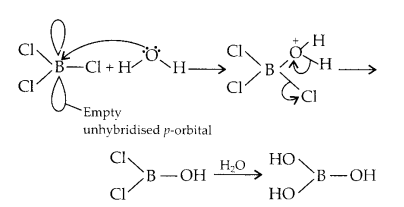
BCl3 is an electron deficient compound. Also, it has an empty unhybridised p-orbital which can accept electrons. In presence of water, BCl3 hydrolyses and forms B(OH)3.
NCERT Solutions for Class 11 Chemistry Chapter 11 The p Block Elements 2
But, when CCl4 is mixed with water, no reaction takes place because carbon neither has any unhybridised, empty p-orbital where it can accommodate electrons from water nor it has empty d-orbital.
CCl4 + H2O ➝ No reaction

Question 5.
Is boric acid a protic acid? Explain.
Solution.
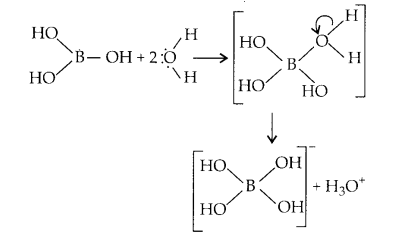
Boric acid – H3BO3 or B(OH)3, is not a protic acid (which are acids that donate protons). But an aqueous solution of boric acid is found to be weakly acidic in nature. This acidic character arises due to the Lewis acid character of boric acid which abstracts a hydroxyl ion from water and leaves free H+ ions which make the solution acidic.
NCERT Solutions for Class 11 Chemistry Chapter 11 The p Block Elements 3

Question 6.
Explain what happens when boric acid is heated.
Solution.
On heating orthoboric acid above 370 K, it forms metaboric acid, HBO2 which on further heating yields boric oxide, B2O3.
NCERT Solutions for Class 11 Chemistry Chapter 11 The p Block Elements 4

Question 7.
Describe the shapes of BF3 and B{ H }_{ 4 }^{ - }. Assign the hybridisation of boron in these species.
Solution.
BF3 has a planar triangular structure which arises from the sp2 hybrid orbitals.
NCERT Solutions for Class 11 Chemistry Chapter 11 The p Block Elements 5
These three sp² hybrid orbitals are directed towards the corners of triangle and BF³ has a trigonal structure.
NCERT Solutions for Class 11 Chemistry Chapter 11 The p Block Elements 6
B{ H }_{ 4 }^{ - } may be assumed to be made of a central B atom, 3H atoms and one hydride ion H.
NCERT Solutions for Class 11 Chemistry Chapter 11 The p Block Elements 7
In order to accommodate the 3H atoms and one H ion, B undergoes sp3 hybridisation yielding four orbitals, 3 of which contain one e each and one is empty. The fourth, empty orbital accomodates the H ion. Thus, the structure of B{ H }_{ 4 }^{ - } is tetrahedral.

Question 8.
Write reactions to justify amphoteric nature of aluminium.
Solution.
Amphoteric substances are those that can react with both acids and bases. Aluminium reacts with HCl to liberate H2 gas as :
NCERT Solutions for Class 11 Chemistry Chapter 11 The p Block Elements 8

Question 9.
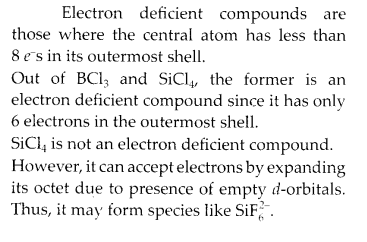
What are electron deficient compounds? Are BCl3 and SiCl4 electron deficient species? Explain
Solution.
NCERT Solutions for Class 11 Chemistry Chapter 11 The p Block Elements 9

Question 10.
Write the resonance structures of { CO }_{ 3 }^{ 2- } and { HCO }_{ 3 }^{ - }.
Solution.
The resonance structures of { CO }_{ 3 }^{ 2- } and { HCO }_{ 3 }^{ - } are :
NCERT Solutions for Class 11 Chemistry Chapter 11 The p Block Elements 10

Question 11.
What is the state of hybridisation of carbon in
(a) { CO }_{ 3 }^{ 2- }
(b) diamond
(c) graphite?
Solution.
NCERT Solutions for Class 11 Chemistry Chapter 11 The p Block Elements 11

Question 12.
Explain the difference in properties of diamond and graphite on the basis of their structures.
Solution.

Criterion

Diamond

Graphite

Hybradisation

Sp3Sp2
Structure of CTetrahedral carbon which gives rise to a 3-dimensional structure.Planar trigonal which gives rise to a 2-dimensional sheet like structure of carbon.
C – C154 pm141.5 pm
HardnessDue to 3-D structure, diamond is the hardest natural element on the earth.It is made up of 2-D sheets of carbon which slip over each other. This gives graphite a slippery surface.
Electrical ConductivityDiamond is an insulator

Graphite is a good conductor of electricity due to presence of delocalized π-electrons.


Question 13.
Rationalise the given statements and give chemical reactions:
(i) Lead (II) chloride reacts with Cl2 to give PbCI4.
(ii) Lead (IV) chloride is highly unstable towards heat.
(iii) Lead is known not to form an iodide, Pbl4.
Solution.
NCERT Solutions for Class 11 Chemistry Chapter 11 The p Block Elements 12

Question 14.
Suggest reasons why the B—F bond lengths in BF3 (130 pm) and { BF }_{ 4 }^{ - } (143 pm) differ.
Solution.
The bond length in anv compound is dependent on the hybridisation of the central atom. Boron in BF3 is sp2 hybridised which means that the s-character is 33% and therefore, the bond length is shorter. Also due to similar size of both atoms and vacant p-orbital of B, a pπ-pπ back bonding from F to B occurs causes partial double bond character. This further decreases the bond length of B — F. In { BF }_{ 4 }^{ - }, the hybridisation of B is sp3 which means that the s-character is 25% and therefore, a longer bond length.

Question 15.
If B—Cl bond has a dipole moment, explain why BCl3 molecule has zero dipole moment.
Solution.
The dipole moment of any molecule is the vector sum total of each of the dipole moments. In BCl3, molecule, although the B-Cl bonds individually are polar, the resultant dipole moment becomes zero.
NCERT Solutions for Class 11 Chemistry Chapter 11 The p Block Elements 13
We can see that the dipole moments of B-1Cl and B-2Cl produce a resultant which is equal in magnitude but opposite in direction to B-3Cl and hence cancels it out. That is why the net dipole moment of BCl3, is zero.

Question 16.
Aluminium trifluoride is insoluble in anhydrous HF but dissolves on addition of NaF. Aluminium trifluoride precipitates out of the resulting solution when gaseous BF3 is bubbled through. Give reasons.
Solution.
AlF3 is insoluble in anhydrous HF but when little NaF is added the compound becomes soluble. On adding BF3 to the above solution, AlF3 is reprecipitated along with sodium tetrafluoroborate.
NCERT Solutions for Class 11 Chemistry Chapter 11 The p Block Elements 14

Question 17.
Suggest a reason as to why CO is poisonous.
Solution.
Carbon monoxide is a colourless, odourless gas which has a tendency to bind to haemoglobin (the oxygen carrying molecule in blood), forming a complex called carboxyhaemoglobin. This complex is 300 times more stable than oxyhaemoglobin complex and therefore, if once, formed can seriously hamper the oxvgen supply to different organs and ultimately can cause death. This is why CO is said to be so dangerous.

Question 18.
Flow is excessive content of CO2 responsible for global warming?
Solution.
CO2 molecule is transparent to UV radiation but is opaque to IR radiation. Due to this, it allows the UV radiations of sunlight to pass into earth’s atmosphere but does not allow heat, which is in the form of 1R radiation, to move out of earth’s atmosphere. This causes heating of the atmosphere and produces a greenhouse effect.

Question 19.
Explain structures of diborane and boric acid. Diborane:
Solution.
NCERT Solutions for Class 11 Chemistry Chapter 11 The p Block Elements 15

The four terminal hydrogen atoms and the two boron atoms lie in one plane. Above and below this plane, there are two bridging hvdrogen atoms. The four terminal B – H bonds are regular two centre-two electron bonds (2c – 2e) while the two bridge (B – H – B) bonds are different and can be described in terms of three centre-two electron bonds (3c-2e).
NCERT Solutions for Class 11 Chemistry Chapter 11 The p Block Elements 16
Each B atom uses sp3 hybrids for bonding. Out of the four sp3 hybrids on each B atom, one is without an electron shown in broken lines. The terminal B-H bonds are normal 2-centre-2-electron bonds but the two bridge bonds are 3-centre-2-electron bonds. The 3- centre-2-electron bridge bonds are also referred to as banana bonds.
Boric acid : In boric acid, planar B03 units are joined by hydrogen bonds to give a layered structure.
NCERT Solutions for Class 11 Chemistry Chapter 11 The p Block Elements 18

Question 20.
What happens when:
(a) Borax is heated strongly.
(b) Boric acid is added to water.
(c) Aluminium is treated with dilute NaOFI.
(d) BF3 is reacted with ammonia.
Solution.
NCERT Solutions for Class 11 Chemistry Chapter 11 The p Block Elements 19

Question 21.
Explain the following reactions :
(a) Silicon is heated with methyl chloride at high temperature in the presence of copper;
(b) Silicon dioxide is treated with hydrogen fluoride;
(c) CO is heated with ZnO;
(d) Hydrated alumina is treated with aqueous NaOH solution.
Solution.
NCERT Solutions for Class 11 Chemistry Chapter 11 The p Block Elements 20
NCERT Solutions for Class 11 Chemistry Chapter 11 The p Block Elements 21

Question 22.
Give reasons:
(i) Conc. HNO3 can be transported in aluminium container.
(ii) A mixture of dilute NaOH and aluminium pieces is used to open drain.
(iii) Graphite is used as lubricant.
(iv) Diamond is used as an abrasive.
(v) Aluminium alloys are used to make aircraft body.
(vi) Aluminium utensils should not be kept in water overnight.
(vii) Aluminium wire is used to make transmission cables.
Solution.
NCERT Solutions for Class 11 Chemistry Chapter 11 The p Block Elements 22

Question 23.
Explain why is there a phenomenal decrease in ionization enthalpy from carbon to silicon?
Solution.
Large decrease in ionisation potential from C to Si is due to increase in size of the atom and shielding effect.

Question 24.
How would you explain the lower atomic radius of Ga as compared to Al?
Solution.
This can be understood from the variation in the inner core of the electronic configuration. The presence of additional 10 d-electrons offer only poor screening effect for the outer electron from the increased nuclear charge in gallium. Consequently, the atomic radius of gallium (135 pm) is less than that of aluminium (143 pm).

Question 25.
What are allotropes? Sketch the structure of two allotropes of carbon namely diamond and graphite. What is the impact of structure on physical properties of two allotropes?
Solution.
The property due to which an element exists in two or more forms which differ in their physical and some of the chemical properties is known as allotropy and the various forms are called allotropes or allotropic modifications. Carbon exists in two allotropic forms crystalline and amorphous. The crystalline forms are diamond and graphite.
NCERT Solutions for Class 11 Chemistry Chapter 11 The p Block Elements 23
Diamond due to extended covalent bonding is the hardest natural substance on the earth.
with Al2(SO4)3 which is soluble in Water.

Question 26.
NCERT Solutions for Class 11 Chemistry Chapter 11 The p Block Elements 24
Solution.
NCERT Solutions for Class 11 Chemistry Chapter 11 The p Block Elements 25

Question 27.
In some of the reactions thallium resembles aluminium, whereas in others it resembles group I metals. Support this statement by giving some evidence.
Solution.
NCERT Solutions for Class 11 Chemistry Chapter 11 The p Block Elements 26

Question 28.
NCERT Solutions for Class 11 Chemistry Chapter 11 The p Block Elements 27
Solution.
NCERT Solutions for Class 11 Chemistry Chapter 11 The p Block Elements 28

Question 29.
What do you understand by
(a) inert pair effect
(b) allotropy and
(c) catenation?
Solution.
(a) Inert pair effect : The reluctance of ns2 pair in p-block elements having higher atomic number to take part in bond formation is called inert pair effect.
(b) Allotropy : The existence of an element in more than one form having different physical properties but same or slightly different chemical properties is called allotropy.
(c) Catenation : The property by virtue of which a large number of atoms of the same element get linked together through covalent bonds resulting in the formation of long chains, branched chains and rings of different sizes is called catenation.

Question 30.
A certain salt X, gives the following results :
(i) Its aqueous solution is alkaline to litmus.
(ii) It swells up to a glassy material Yon strong heating.
(iii) When conc. H2SO4 is added to a hot solution of X, white crystal of acid Z separates out.
Write equations for all the above reactions and identify X, Y and Z.
Solution.
NCERT Solutions for Class 11 Chemistry Chapter 11 The p Block Elements 29

Question 31.
Write balanced equations for:
NCERT Solutions for Class 11 Chemistry Chapter 11 The p Block Elements 30
Solution.
NCERT Solutions for Class 11 Chemistry Chapter 11 The p Block Elements 31

Question 32.
Give one method for industrial preparation and one for laboratory preparation of CO and CO2 each.
Solution.
NCERT Solutions for Class 11 Chemistry Chapter 11 The p Block Elements 32
NCERT Solutions for Class 11 Chemistry Chapter 11 The p Block Elements 33

Question 33.
An aqueous solution of borax is
(a) neutral
(b) amphoteric
(c) basic
(d) acidic.
Solution.
NCERT Solutions for Class 11 Chemistry Chapter 11 The p Block Elements 34

Question 34.
Boric acid is polymeric due to
(a) its acidic nature
(b) the presence of hydrogen bonds
(c) its monobasic nature
(d) its geometry.
Solution.
(b) the presence of hydrogen bonds

Question 35.
The type of hybridisation of boron in diborane is
(a) sp
(b) sp2
(c) sp3
(d) dsp2
Solution.
(c) sp3

Question 36.
Thermodynamically the most stable form of carbon is
(a) diamond
(b) graphite
(c) fullerenes
(d) coal
Solution.
(b) : Graphite is thermodynamically more stable than diamond and its free energy of formation is 1.9 kJ mol-1 less than diamond.

Question 37.
Elements of group 14
(a) exhibit oxidation state of +4 only
(b) exhibit oxidation state of +2 and +4
(c) form M2- and M4+ ions
(d) form M2+ and M4+ ions.
Solution.
(b, d): The group 14 elements have four electrons in outermost shell. The common oxidation states exhibited by these elements are +4 and +2.
Elements like Sn and Pb are metallic thus, form M2+ and M4+ ions.

Question 38.
If the starting material for the manufacture of silicones is RSiCl3, write the structure of the product formed.
Solution.
NCERT Solutions for Class 11 Chemistry Chapter 11 The p Block Elements 35

Read More

CLASS 11th CHAPTER -10 The s Block Elements |Chemistry | NCERT SOLUTION| EDUGROWN

NCERT Solutions for Class 11 Chemistry Chapter -10 The S Block Element includes all the important topics with detailed explanation that aims to help students to understand the concepts better. Students who are preparing for their Class 11 Chemistry exams must go through NCERT Solutions for Class 11 Chemisrty Chapter -10 The S Block Element. NCERT Solutions will make you understand the topics in most simple manner and grasp it easily to perform better.

NCERT Solutions for Class 11 Chemistry Part 2

There are seven chapters in Class 11 Chemistry Part 2 textbook which will make you well versed in variety of topics and allows students to cover the entire syllabus effectively without any frustration. These NCERT Solutions are curated by the experts in a comprehensive which can be helpful in clearing your doubts instantly.

Class 11th Chapter -10 The S Block Element | NCERT CHEMISRTY SOLUTION |

NCERT Exercises

Question 1.
What are the common physical and chemical features of alkali metals ?
Solution.
General characteristics of alkali metals :

  1.  Electronic configuration : General electronic configuration of the valence shell is ‘ns1‘ where ‘n’ gives the number of the outermost shells.
  2.  Atomic and ionic sizes : They have the largest size in their respective periods. The atomic size regularly increases upon descending the group.
  3.  Ionisation enthalpy : It decreases down the group due to decreasing effective nuclear charge. 2nd ionisation enthalpy is very high as now an electron has to be removed from stable noble gas configuration.
  4.  Melting and boiling points: Due to weak metallic bond strength and large atomic sizes, all alkali metals are soft and have low melting and boiling points.
  5.  Metallic character : Alkali metals readily lose their valence electron and form M+ ions showing +1 oxidation states. Metallic character increases as we descend.
  6.  Flame colouration : They impart characteristic colours to flame.
  7.  Photoelectric effect : Due to very low value of ionisation enthalpies, alkali metals exhibit photoelectric effect.
  8.  Nature of compounds : Due to highly electropositive character, compounds of alkali metals are ionic in nature.
  9.  Reactivity towards air : Their lustrous surface gets tarnished when exposed to air. They burn violently in air or oxygen forming oxides. Li forms monoxide (Li2O), Na forms peroxide (Na2O2) while K, Rb, Cs form superoxides (KO2, RbO2, CsO2).
  10.  Reactivity towards water : Alkali metals form hydroxides when they come in contact with water and liberate hydrogen gas.
  11.  Reactivity towards hydrogen : They form ionic hydride (M+H) Ionic character of hydrides increases on descending the group. They act as strong reducing agents.
  12.  Reactivity towards halogen : They react with halogens to form ionic halides (M+X). The ionic character of metal halides increases down the group.
  13.  Reducing character : An element which acts as a reducing agent, must have low ionisation energy. Alkali metals act as strong reducing agents as their ionisation energy values are low. Since ionisation energy decreases on moving down from Li to Cs, the reducing property increases in the same order. Thus, Li is weakest reducing agent while Cs is the strongest reducing agent amongst alkali metals in free state.
  14.  Solution in liquid ammonia : They dissolve in liq. NH3 forming blue coloured solutions, which are good reducing agents and good conductors of electricity.

NCERT Solutions for Class 11 Chemistry Chapter 10 The s Block Elements 1
The blue colour of the solution is due to ammoniated electron.

Question 2.
Discuss the general characteristics and gradation in properties of alkaline earth metals.
Solution.

  1. Electronic configuration : The valence electronic configuration of atoms of the group II A elements is ns2, where ‘n’ is the period number.
  2.  Atomic and ionic sizes : The size of the atom increases gradually from Be to Ra. Their ions are also large and size of the ion increases from Be2+ to Ra2+.
  3.  Ionisation enthalpy : The 1st and 2nd ionisation energies of these metals decrease from Be to Ba as size increases.
  4.  Melting and boiling points : Due to the presence of two electrons in the valence shell and stronger bonding in solid state, they have higher melting and boiling points than corresponding alkali metals.
  5.  Metallic character : Due to low ionisation energy values, these metals are highly electropositive and readily form M2+ ions.
  6.  Flame colouration : Except Be and Mg, other members impart characteristic colours when their salts are introduced in the flame.
  7.  Hydration energy : The M2+ ions of alkaline earth metals are extensively hydrated to form [M(H2O)x]2+ ions and during hydration a huge amount of energy called hydration energy is released.
    M2+ + xH2O ➝ [M(H2O)x]2+ + Energy
  8.  Reactivity towards air or oxygen : They react with air or oxygen slowly on heating. Be, Mg and Ca form normal oxides (MO) while Sr and Ba form superoxides (SrO2, BaO2). BeO is amphoteric, MgO is weakly basic and others are distinctly basic.
  9.  Reactivity towards water : They have lesser reactivity towards water. Be does not react even with boiling water. Mg forms Mg(OH)2 liberating H2 gas with boiling water.
  10.  Reactivity towards halogens : All the metals of the group combine with various halogens at appropriate temperature forming halides of the formula MX2.
  11.  Tendency to form complexes : Due to their smaller ionic sizes and greater charge densities Be, Mg metals have highest tendency to form complexes.
    BeF2 + 2F ➝ [BeF4]2-
  12.  Reducing character : Except Be all other metals of this group are reducing agents.

Question 3.
Why are alkali metals not found in nature ?
Solution.
All the alkali metals have one valence electron, ns1, outside the noble gas core. The loosely held s-electron in the outermost valence shell of these elements makes them the most electropositive metals. They readily lose an electron to give monovalent M+ ions. Thus, due to the reason cited above, alkali metals are never found free in nature but are always found in combined state.

Question 4.
Find out the oxidation state of sodium in Na2O2.
Solution.

NCERT Solutions for Class 11 Chemistry Chapter 10 The s Block Elements 2

Question 5.

Explain why is sodium less reactive than potassium.
Solution.
This is mainly due to high ionisation enthalpy of sodium as compared to potassium. Therefore, potassium is more electropositive and a stronger reducing agent than sodium. It also reacts with water more violently than sodium.

Question 6.
Compare the alkali metals and alkaline earth metals with respect to

  1.  ionisation enthalpy
  2.  basicity of oxides and
  3.  solubility of hydroxides.

Solution.

  1.  Ionisation Enthalpy: The ionisation energies of alkaline earth elements are higher than those of alkali metals due to higher nuclear charge and smaller radii.
  2.  Basicity of oxides : Oxides of alkali metals are stronger bases as compared to those of alkaline earth metals present in the same period, e.g., when Na2O is dissolved in water, NaOH formed is a stronger base than when MgO is dissolved in water to form Mg(OH)2. This is due to higher ionisation energies of alkaline earth metals.
  3.  Solubility of hydroxides : Alkali metal hydroxides are more soluble in water as compared to the hydroxides of alkaline earth metals present in the same period. This is due to higher lattice energy of the hydroxides of alkaline earth elements as compared to those of alkali metals.

Question 7.
In what ways lithium shows similarities to magnesium in its chemical behaviour?
Solution.
NCERT Solutions for Class 11 Chemistry Chapter 10 The s Block Elements 3

Question 8.
Explain why can alkali and alkaline earth metals not be obtained by chemical reduction methods?
Solution.
Alkali and alkaline earth metals cannot be extracted by the reduction of their oxides and other compounds as they are strong reducing agents themselves and no such reducing agents are there which can reduce them to get pure metal.

Question 9.
Why are potassium and caesium, rather than lithium used in photoelectric cells?
Solution.
The ns1 electron in K and Cs is so loosely held that even the low energy photons can eject this electron from the metal surface. This property is termed as photoelectric effect. K and Cs are used in photoelectric cells because they have very low ionisation energies. But lithium having very high ionisation energy cannot be used for photoelectric effect.

Question 10.
When an alkali metal dissolves in liquid ammonia the solution can acquire different colours. Explain the reasons for this type of colour change.
Solution.
The alkali metals dissolve in liq. NH3 without evolution of hydrogen. The colour of the dilute solution is blue. The metal atom loses an electron and it combines with ammonia molecule.
NCERT Solutions for Class 11 Chemistry Chapter 10 The s Block Elements 4
The blue colour of the solution is due to the ammoniated electron which absorbs energy in the visible region of light and thus, imparts blue colour to the solution. The solutions are paramagnetic and on standing, slowly they liberate hydrogen resulting in the formation of an amide.
NCERT Solutions for Class 11 Chemistry Chapter 10 The s Block Elements 5
In concentrated solution, the blue colour changes to bronze and becomes diamagnetic.

Question 11.
Beryllium and magnesium do not give colour to flame whereas other alkaline earth metals do so. Why ?
Solution.
In the case of Ca, Sr, Ba and Ra, the electrons can be excited by the supply of energy to higher energy levels. When the excited electrons return to the original level, the energy is released in the form of light. In Be and Mg, the electrons are tightly held and excitation by mere flame is rather difficult, thus, they do not show flame colouration. Ca imparts brick red colour, Sr imparts crimson colour, Ba imparts apple green colour and Ra imparts crimson colour to the flame.

Question 12.
Discuss the various reactions that occur in the Solvay process.
Solution.
Solvay process : It is an industrial method for obtaining sodium carbonate from sodium chloride (NaCl) and limestone (CaCO3). The raw materials required in this process are common salt, ammonia and limestone. The equations for the complete process may be written as :
NCERT Solutions for Class 11 Chemistry Chapter 10 The s Block Elements 6
Sodium hydrogen carbonate crystal separates out and is heated to give sodium carbonate.
NCERT Solutions for Class 11 Chemistry Chapter 10 The s Block Elements 7

Question 13.
Potassium carbonate cannot be prepared by Solvay process. Why ?
Solution.
Solvay process cannot be extended to the manufacture of K2CO3 because KHCO3 is too soluble to be precipitated by the addition of ammonium hydrogen carbonate to a saturated solution of potassium chloride.

Question 14.
Why is Li2CO3 decomposed at a lower temperature whereas Na2CO3 at higher temperature?
Solution.
NCERT Solutions for Class 11 Chemistry Chapter 10 The s Block Elements 8

Question 15.

Compare the solubility and thermal stability of the following compounds of the alkali metals with those of the alkaline earth metals.
(a) Nitrates
(b) Carbonates
(c) Sulphates.
Solution.
NCERT Solutions for Class 11 Chemistry Chapter 10 The s Block Elements 9NCERT Solutions for Class 11 Chemistry Chapter 10 The s Block Elements 10

Question 16.
Starting with sodium chloride how would you proceed to prepare
(i) sodium metal
(ii) sodium hydroxide
(iii) sodium peroxide
(iv) sodium carbonate ?
Solution.
NCERT Solutions for Class 11 Chemistry Chapter 10 The s Block Elements 11NCERT Solutions for Class 11 Chemistry Chapter 10 The s Block Elements 12

Question 17.
What happens when
(i) magnesium is burnt in air
(ii) quick lime is heated with silica
(iii) chlorine reacts with slaked lime
(iv) calcium nitrate is heated ?
Solution.
NCERT Solutions for Class 11 Chemistry Chapter 10 The s Block Elements 13

Question 18.
Describe two important uses of each of the following:
(i) caustic soda
(ii) sodium carbonate
(iii) quick lime.
Solution.
(i) Caustic soda : It is the commercial name of NaOH. It is used :
(a) in refining of petroleum.
(b) in the manufacture of soap, paper, rayon, drugs and dyes.
(ii) Sodium Carbonate : It is used :
(a) in laundries and in softening of water as washing soda.
(b) in the manufacture of glass, sodium silicate, paper, borax, caustic soda, etc.
(iii) Quick lime : It is used :
(a) in the purification of sugar, manufacture of dye stuffs, bleaching powder, CaC2, mortar, cement, glass, etc.
(b) as a cheap alkali, i.e., as acid neutraliser.

Question 19.
Draw the structure of
(i) BeCl2 (vapour)
(ii) BeCl2 (solid).

Solution.
NCERT Solutions for Class 11 Chemistry Chapter 10 The s Block Elements 14

Question 20.
The hydroxides and carbonates of sodium and potassium are easily soluble in water while the corresponding salts of magnesium and calcium are sparingly soluble in water. Explain.
Solution.
The solubility of an ionic compound depends on two factors :
(i) lattice energy and
(ii) hydration energy.
These two factors oppose each other.
If lattice energy is high, the ions will be tightly packed in the crystal and therefore, solubility will be low. If the hydration energy is high, the ions will have greater tendency to be hydrated and therefore, solubility will be high. Alkali metals i.e., sodium or potassium hydroxides will be highly soluble in water due to larger size of Na and K as compared to that of Mg and Ca, the lattice energies of hydroxides and carbonates of sodium and potassium are much lower than those of hydroxides and carbonates of magnesium and calcium. As a result, the hydroxides and carbonates of Na and K are easily soluble in water while the corresponding salts of Mg and Ca are sparingly soluble in water.

Question 21.
Describe the importance of the following :
(i) limestone
(ii) cement
(iii) plaster of Paris.
Solution.
(i) Limestone : It is used,
(a) in the manufacture of quick lime, slaked lime, cement, washing soda and glass,
(b) as a flux in the smelting of iron and lead ores.
(ii) Cement : It is an important building material. It is used in concrete and reinforced concrete, in plastering and in the construction of bridges, dams and buildings.
(iii) Plaster of Paris : The largest use of plaster of Paris is in the building industry as well as plasters. It is used for immobilising the affected part of organ where there is a bone fracture or sprain. It is also employed in dentistry, in ornamental work and for making casts of statues.

Question 22.
Why are lithium salts commonly hydrated and those of the other alkali ions are usually anhydrous?
Solution.
Because of smallest size among alkali metals, Li+ can polarise water molecules more easily than the other alkali metal ions and hence get attached to lithium salts as water of crystallisation. For example, lithium chloride crystallises as LiCl.2H2O but sodium chloride as NaCl.

Question 23.
Why is LiF almost insoluble in water whereas LiCI is soluble not only in water but also in acetone ?
Solution.
Insolubility of LiF in water can be elucidated as follows:
The lithium ion has the highest energy of hydration as it is small in size in comparison to the other alkali metal ions and so it should be highly soluble. But the small Li+ and F ions interact very strongly resulting in high lattice energy of LiF which is responsible for its insolubility whereas in LiCl due to the difference in atomic size between Li+ and Cl, they do not interact very strongly, the lattice energy is comparatively small and the magnitude of hydration enthalpy is quite large. Therefore, LiCI dissolves in water. As LiCl has more covalent character than LiF (Fajan’s rule) thus, it is soluble in organic solvents like acetone.

Question 24.
Explain the significance of sodium, potassium, magnesium and calcium in biological fluids.
Solution.
Biological importance of sodium : Sodium ions are found primarily outside the cells in blood plasma and in the interstitial fluids which surround the cells. These ions participate in the transmission of nerve signals, in regulating the flow of water across cell membranes and in the transport of sugars and amino acids into cells.
Biological importance of potassium : Potassium ions are the most abundant cations within cell fluids, where they activate many enzymes, participate in the oxidation of glucose to produce ATP and with sodium, are responsible for the transmission of nerve signals.
Biological importance of magnesium : All enzymes that utilise ATP in phosphate transfer require magnesium as the cofactor. The main pigment for the absorption of light in plants is chlorophyll which contains magnesium.
Biological importance of calcium: About 99% of body calcium is present in bones and teeth. It also plays important roles in neuromuscular function, maintenance of a regular heartbeat, various aspects of metabolism and blood clotting. The calcium concentration in plasma is maintained by two hormones : calcitonin and parathyroid hormone.

Question 25.
What happens when
(i) sodium metal is dropped in water ?
(ii) sodium metal is heated in free supply of air?
(iii) sodium peroxide dissolves in water ?
Solution.
NCERT Solutions for Class 11 Chemistry Chapter 10 The s Block Elements 15

Question 26.
Comment on each of the following observations:
NCERT Solutions for Class 11 Chemistry Chapter 10 The s Block Elements 16
Solution.
(a) This is attributed to the hydration of the cation in water. As a result, size of the cation increases and its mobility decreases. Due to the smallest size, Li* ion is hydrated to the maximum and has least mobility while Cs+ ion due to least hydration has maximum mobility.
(b) Lithium is a very strong reducing agent. As a result, it directly combines with nitrogen to form its nitride (Li3N).
(c) E° of any M2+/M electrode depends upon three factors :
(i) enthalpy of vaporisation,
(ii) ionisation enthalpy
(iii) enthalpy of hydration. Since the combined effect of these factors is approximately the same for Ca, Sr and Ba, therefore, their electrode potentials are nealy constant.

Question 27.
State as to why
(a) a solution of Na2C03 is alkaline?
(b) alkali metals are prepared by electrolysis of their fused chlorides?
(c) sodium is found to be more useful than potassium?
Solution.
(a) Sodium carbonate being a salt of strong base (NaOH) and weak acid (H2CO3) forms an alkaline solution upon hydrolysis.
NCERT Solutions for Class 11 Chemistry Chapter 10 The s Block Elements 17
(b) Alkali metals are prepared by the electrolysis of their fused chlorides as if aqueous solution of their salts are used for extraction by electrolytic method then hydrogen is discharged at cathode instead of an alkali metal as the discharge potentials of alkali metals are high.
(c) Sodium is relatively more abundant than potassium. At the same time, it is also less reactive and its reactions with other substances can be better controlled.

Question 28.
Write balanced equations for reactions between
(a) Na2O2 and water
(b) KO2 and water
(c) Na2O and CO2.
Solution.
NCERT Solutions for Class 11 Chemistry Chapter 10 The s Block Elements 18

Question 29.
How would you explain the following observations?
(i) BeO is almost insoluble but BeSO4 is soluble in water,
(ii) BaO is soluble but BaSO4 is insoluble in water,
(iii) LiI is more soluble than KI in ethanol.
Solution.
NCERT Solutions for Class 11 Chemistry Chapter 10 The s Block Elements 19

Question 30.
Which of the alkali metal is having least melting point ?
(a) Na
(b) K
(c) Rb
(d) Cs
Solution.
(d) : Cs ➝ Least melting point.
As the size of metal increases, the metallic bonding decreases and melting point decreases.

Question 31.
Which one of the following alkali metals gives hydrated salts ?
(a) Li
(b) Na
(c) K
(d) Cs
Solution.
(a) : Li ➝ Highest number of hydrated salts Due to small size of Li, it has high charge density that attracts water molecules strongly.

Question 32.
Which one of the alkaline earth metal carbonates is thermally the most stable ?
(a) MgCO3
(b) CaCO3
(c) SrCO3
(d) BaCO3
Solution.
(d) : BaC03 ➝ Most thermally stable carbonate.
{ CO }_{ 3 }^{ 2- } being a bigger anion stabilises a bigger cation more efficiently. Thus, Ba2+ being bigger in size is the most stable.

Read More