Class 12th Chapter -2 Inverse Trigonometric Functions | NCERT Maths Solution | NCERT Solution | Edugrown

It is important that you have a strong foundation in Maths Solutions. This can help you immensely in exams. Because there is no paper pattern set for the board exams. Every year there are different twists and turns in questions asked in board exams. While preparing for maths it becomes to go through every bit of detail. Thus, NCERT Solutions Class 12 Maths can help you lay a strong foundation. There solutions of each and every question given in the NCERT 12 Textbook in this article. There are crucial chapters like integration, algebra, and calculus which you can solve easily using these Class 12 Maths solutions. Using these NCERT Maths Class 12 Solutions can give you an edge over the other students.

NCERT Solutions for Class 12 Maths Chapter : 2 Inverse Trigonometric

Ex 2.1 Class 12 Maths Question 1-10.
Find the principal values of the following:
(1) \sin ^{ -1 }{ \left( -\frac { 1 }{ 2 } \right) }
(2) \cos ^{ -1 }{ \left( \frac { \sqrt { 3 } }{ 2 } \right) }
(3) \csc ^{ -1 }{ (2) }
(4) \tan ^{ -1 }{ \left( -\sqrt { 3 } \right) }
(5) \cos ^{ -1 }{ \left( -\frac { 1 }{ 2 } \right) }
(6) \tan ^{ -1 }{ (-1) }
(7) \sec ^{ -1 }{ \left( \frac { 2 }{ \sqrt { 3 } } \right) }
(8)\cot ^{ -1 }{ \left( \sqrt { 3 } \right) }
(9) \cos ^{ -1 }{ \left( -\frac { 1 }{ \sqrt { 2 } } \right) }
(10) \csc ^{ -1 }{ \left( -\sqrt { 2 } \right) }
Solution:
(1) Let \sin ^{ -1 }{ \left( -\frac { 1 }{ 2 } \right) }  = y
∴ sin\quad y=-\frac { 1 }{ 2 } =-sin\frac { \pi }{ 6 } =sin\left( -\frac { \pi }{ 6 } \right)
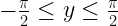
the range of principal value of sin-1 is
NCERT Solutions for Class 12 Maths Chapter 2 Inverse Trigonometric Functions Ex 2.1 Q1.1
NCERT Solutions for Class 12 Maths Chapter 2 Inverse Trigonometric Functions Ex 2.1 Q1.2
NCERT Solutions for Class 12 Maths Chapter 2 Inverse Trigonometric Functions Ex 2.1 Q1.3
NCERT Solutions for Class 12 Maths Chapter 2 Inverse Trigonometric Functions Ex 2.1 Q1.4

Ex 2.1 Class 12 Maths Question 11-12.
Find the principal values of the following:
(11) \tan ^{ -1 }{ (1) } +\cos ^{ -1 }{ \left( -\frac { 1 }{ 2 } \right) } +\sin ^{ -1 }{ \left( -\frac { 1 }{ 2 } \right) }
(12) \cos ^{ -1 }{ \left( \frac { 1 }{ 2 } \right) } +2\sin ^{ -1 }{ \left( \frac { 1 }{ 2 } \right) }
Solution:
(11) \tan ^{ -1 }{ (1) } +\cos ^{ -1 }{ \left( -\frac { 1 }{ 2 } \right) } +\sin ^{ -1 }{ \left( -\frac { 1 }{ 2 } \right) }
Now tan-1 (1) = \frac { \pi }{ 4 }
∴the range of principal value branch of
NCERT Solutions for Class 12 Maths Chapter 2 Inverse Trigonometric Functions Ex 2.1 Q2.1

Ex 2.1 Class 12 Maths Question 13.
If sin-1 x = y, then
(a) 0 ≤ y ≤ π
(b) -\frac { \pi }{ 2 } \le y\le \frac { \pi }{ 2 }
(c) 0 < y < π
(d) -\frac { \pi }{ 2 } <y<\frac { \pi }{ 2 }
Solution:
The range of principal value of sin is \left[ -\frac { \pi }{ 2 } ,\frac { \pi }{ 2 } \right]
∴ if sin-1 x = y then
-\frac { \pi }{ 2 } \le y\le \frac { \pi }{ 2 }
Option (b) is correct

Ex 2.1 Class 12 Maths Question 14.
\tan ^{ -1 }{ \sqrt { 3 } -\sec ^{ -1 }{ (-2) } }  is equal to
(a) π
(b) -\frac { \pi }{ 3 }
(c) \frac { \pi }{ 3 }
(d) \frac { 2\pi }{ 3 }
Solution:
\tan ^{ -1 }{ \sqrt { 3 } =\frac { \pi }{ 3 } ,\sec ^{ -1 }{ (-2) } } =\pi -\frac { \pi }{ 3 } =\frac { 2\pi }{ 3 }
∴ Principal values of sec-1 is [0,π] – \left\{ \frac { \pi }{ 2 } \right\}
\tan ^{ -1 }{ \sqrt { 3 } - } \sec ^{ -1 }{ (-2) } =\frac { \pi }{ 3 } -\frac { 2\pi }{ 3 } =-\frac { \pi }{ 3 }
Option (b) is correct

Ex 2.2 Class 12 Maths Question 1.
3\sin ^{ -1 }{ x=\sin ^{ -1 }{ (3x-4x^{ 3 });x\in \left[ -\frac { 1 }{ 2 } ,\frac { 1 }{ 2 } \right] } }
Solution:
Let sin-1 x = θ
sin θ = x sin 3θ = 3 sin θ – 4 sin³ θ
sin 3θ = 3x – 4x³
3θ = sin-1 (3x – 4x³)
or 3\sin ^{ -1 }{ x=\sin ^{ -1 }{ (3x-4x^{ 3 });x\in \left[ -\frac { 1 }{ 2 } ,\frac { 1 }{ 2 } \right] } }

Ex 2.2 Class 12 Maths Question 2.
3\cos ^{ -1 }{ x } =\cos ^{ -1 }{ \left( { 4x }^{ 3 }-3x \right) ,x\in \left[ \frac { 1 }{ 2 } ,1 \right] }
Solution:
Let cos-1 x = θ
x = cos θ
R.H.S= cos-1 (4x³ – 3cosx)
= cos-1 (4 cos³θ – 3 cosθ)
= cos-1 (cos 3θ) [∴ cos 3θ = 4 cos³ θ – 3 cos θ]
= 3θ
= 3 cos-1 x
= L.H.S.

Ex 2.2 Class 12 Maths Question 3.
\tan ^{ -1 }{ \frac { 2 }{ 11 } } +\tan ^{ -1 }{ \frac { 7 }{ 24 } } =\tan ^{ -1 }{ \frac { 1 }{ 2 } }
Solution:
L.H.S = \tan ^{ -1 }{ \frac { 2 }{ 11 } } +\tan ^{ -1 }{ \frac { 7 }{ 24 } }
\tan ^{ -1 }{ \left[ \frac { \frac { 2 }{ 11 } +\frac { 7 }{ 24 } }{ 1-\frac { 2 }{ 11 } \times \frac { 7 }{ 24 } } \right] }
\tan ^{ -1 }{ \left[ \frac { 1 }{ 2 } \right] }
= R.H.S

Ex 2.2 Class 12 Maths Question 4.
2\tan ^{ -1 }{ \frac { 1 }{ 2 } } +\tan ^{ -1 }{ \frac { 1 }{ 7 } } =\tan ^{ -1 }{ \frac { 31 }{ 17 } }
Solution:
L.H.S =
2\tan ^{ -1 }{ \frac { 1 }{ 2 } } +\tan ^{ -1 }{ \frac { 1 }{ 7 } }
NCERT Solutions for Class 12 Maths Chapter 2 Inverse Trigonometric Functions Ex 2.2 Q4.1

Ex 2.2 Class 12 Maths Question 5.
Write the function in the simplest form
\tan ^{ -1 }{ \left( \frac { \sqrt { 1+{ x }^{ 2 }-1 } }{ x } \right) } ,x\neq 0
Solution:
Putting x = θ
∴ θ = tan-1 x
NCERT Solutions for Class 12 Maths Chapter 2 Inverse Trigonometric Functions Ex 2.2 Q5.1

Ex 2.2 Class 12 Maths Question 6.
\tan ^{ -1 }{ \left( \frac { 1 }{ \sqrt { { x }^{ 2 }-1 } } \right) ,\left| x \right| } >1
Solution:
Given expression
\tan ^{ -1 }{ \left( \frac { 1 }{ \sqrt { { x }^{ 2 }-1 } } \right) ,\left| x \right| } >1
Let x = secθ
NCERT Solutions for Class 12 Maths Chapter 2 Inverse Trigonometric Functions Ex 2.2 Q6.1

Ex 2.2 Class 12 Maths Question 7.
\tan ^{ -1 }{ \left( \sqrt { \frac { 1-cosx }{ 1+cosx } } \right) } ,0<x<\pi
Solution:
\tan ^{ -1 }{ \left( \sqrt { \frac { 1-cosx }{ 1+cosx } } \right) } ,0<x<\pi
\tan ^{ -1 }{ \left[ \sqrt { \frac { { 2sin }^{ 2 }\frac { x }{ 2 } }{ { 2cos }^{ 2 }\frac { x }{ 2 } } } \right] }
NCERT Solutions for Class 12 Maths Chapter 2 Inverse Trigonometric Functions Ex 2.2 Q7.1

Ex 2.2 Class 12 Maths Question 8.
\tan ^{ -1 }{ \left( \frac { cosx-sinx }{ cosx+sinx } \right) ,0<x<\pi }
Solution:
\tan ^{ -1 }{ \left( \frac { cosx-sinx }{ cosx+sinx } \right) ,0<x<\pi }
Dividing numerator and denominator by cos x
NCERT Solutions for Class 12 Maths Chapter 2 Inverse Trigonometric Functions Ex 2.2 Q8.1

Ex 2.2 Class 12 Maths Question 9.
\tan ^{ -1 }{ \left( \frac { x }{ \sqrt { { a }^{ 2 }-{ x }^{ 2 } } } \right) ,\left| x \right| } <a
Solution:
Let x = a sinθ
=> \\ \frac { x }{ a }  = sinθ
NCERT Solutions for Class 12 Maths Chapter 2 Inverse Trigonometric Functions Ex 2.2 Q9.1

Ex 2.2 Class 12 Maths Question 10.
\tan ^{ -1 }{ \left[ \frac { { 3a }^{ 2 }-{ x }^{ 3 } }{ { a }^{ 3 }-{ 3ax }^{ 2 } } \right] ,a>0;\frac { -a }{ \sqrt { 3 } } <x,<\frac { a }{ \sqrt { 3 } } }
Solution:
Put x = a tanθ,
we get
NCERT Solutions for Class 12 Maths Chapter 2 Inverse Trigonometric Functions Ex 2.2 Q10.1

Ex 2.2 Class 12 Maths Question 11.
Find the value of the following
\tan ^{ -1 }{ \left[ 2cos\left( 2\sin ^{ -1 }{ \frac { 1 }{ 2 } } \right) \right] }
Solution:
\tan ^{ -1 }{ \left[ 2cos\left( 2\sin ^{ -1 }{ \frac { 1 }{ 2 } } \right) \right] }
\tan ^{ -1 }{ \left[ 2cos2.\frac { \pi }{ 6 } \right] }
NCERT Solutions for Class 12 Maths Chapter 2 Inverse Trigonometric Functions Ex 2.2 Q11.1

Ex 2.2 Class 12 Maths Question 12.
cot[tan-1 a + cot-1 a]
Solution:
Given
cot[tan-1 a + cot-1 a]
cot\left( \tan ^{ -1 }{ a } +\tan ^{ -1 }{ \frac { 1 }{ a } } \right)
NCERT Solutions for Class 12 Maths Chapter 2 Inverse Trigonometric Functions Ex 2.2 Q12.1

Ex 2.2 Class 12 Maths Question 13.
tan\frac { 1 }{ 2 } \left[ \sin ^{ -1 }{ \frac { 2x }{ 1+{ x }^{ 2 } } +\cos ^{ -1 }{ \frac { 1-{ y }^{ 2 } }{ 1+{ y }^{ 2 } } } } \right] \left| x \right| <1,y>0\quad and\quad xy<1
Solution:
Putting x = tanθ
=> tan-1 x = θ
NCERT Solutions for Class 12 Maths Chapter 2 Inverse Trigonometric Functions Ex 2.2 Q13.1

Ex 2.2 Class 12 Maths Question 14.
If sin\left( \sin ^{ -1 }{ \frac { 1 }{ 5 } } +\cos ^{ -1 }{ x } \right) =1 then find the value of x
Solution:
sin\left( \sin ^{ -1 }{ \frac { 1 }{ 5 } } +\cos ^{ -1 }{ x } \right) =sin\frac { \pi }{ 2 }
NCERT Solutions for Class 12 Maths Chapter 2 Inverse Trigonometric Functions Ex 2.2 Q14.1

Ex 2.2 Class 12 Maths Question 15.
If \tan ^{ -1 }{ \frac { x-1 }{ x-2 } } +\tan ^{ -1 }{ \frac { x+1 }{ x+2 } } =\frac { \pi }{ 4 }  then find the value of x
Solution:
L.H.S
\tan ^{ -1 }{ \frac { x-1 }{ x-2 } } +\tan ^{ -1 }{ \frac { x+1 }{ x+2 } } =\frac { \pi }{ 4 }
NCERT Solutions for Class 12 Maths Chapter 2 Inverse Trigonometric Functions Ex 2.2 Q15.1

Ex 2.2 Class 12 Maths Question 16.
\sin ^{ -1 }{ \left( sin\frac { 2\pi }{ 3 } \right) }
Solution:
\sin ^{ -1 }{ \left( sin\frac { 2\pi }{ 3 } \right) }
\sin ^{ -1 }{ \left( sin\left( \pi -\frac { \pi }{ 3 } \right) \right) }
\sin ^{ -1 }{ \left( sin\left( \frac { \pi }{ 3 } \right) \right) } =\frac { \pi }{ 3 }

Ex 2.2 Class 12 Maths Question 17.
\tan ^{ -1 }{ \left( tan\frac { 3\pi }{ 4 } \right) }
Solution:
\tan ^{ -1 }{ \left( tan\frac { 3\pi }{ 4 } \right) }
\tan ^{ -1 }{ \left( sin\frac { 3\pi }{ 4 } \right) }
\tan ^{ -1 }{ tan\left( \pi -\frac { \pi }{ 4 } \right) }
NCERT Solutions for Class 12 Maths Chapter 2 Inverse Trigonometric Functions Ex 2.2 Q17.1

Ex 2.2 Class 12 Maths Question 18.
tan\left( \sin ^{ -1 }{ \frac { 3 }{ 5 } +\cot ^{ -1 }{ \frac { 3 }{ 2 } } } \right)
Solution:
tan\left( \sin ^{ -1 }{ \frac { 3 }{ 5 } +\cot ^{ -1 }{ \frac { 3 }{ 2 } } } \right)
Let \sin ^{ -1 }{ \frac { 3 }{ 5 } = } \theta
sinθ = \\ \frac { 3 }{ 5 }
NCERT Solutions for Class 12 Maths Chapter 2 Inverse Trigonometric Functions Ex 2.2 Q18.1

Ex 2.2 Class 12 Maths Question 19.
\cos ^{ -1 }{ \left( cos\frac { 7\pi }{ 6 } \right) }  is equal to
(a) \frac { 7\pi }{ 6 }
(b) \frac { 5\pi }{ 6 }
(c) \frac { \pi }{ 5 }
(d) \frac { \pi }{ 6 }
Solution:
\cos ^{ -1 }{ \left( cos\frac { 7\pi }{ 6 } \right) }
\cos ^{ -1 }{ cos\left( \pi +\frac { \pi }{ 6 } \right) }
NCERT Solutions for Class 12 Maths Chapter 2 Inverse Trigonometric Functions Ex 2.2 Q19.1

Ex 2.2 Class 12 Maths Question 20.
sin\left[ \frac { \pi }{ 3 } -\sin ^{ -1 }{ \left( -\frac { 1 }{ 2 } \right) } \right]  is equal to
(a) \\ \frac { 1 }{ 2 }
(b) \\ \frac { 1 }{ 3 }
(c) \\ \frac { 1 }{ 4 }
(d) 1
Solution:
sin\left[ \frac { \pi }{ 3 } -\sin ^{ -1 }{ \left( -\frac { 1 }{ 2 } \right) } \right]
NCERT Solutions for Class 12 Maths Chapter 2 Inverse Trigonometric Functions Ex 2.2 Q20.1

Ex 2.2 Class 12 Maths Question 21.
\tan ^{ -1 }{ \sqrt { 3 } -\cot ^{ -1 }{ \left( -\sqrt { 3 } \right) } }  is equal to
(a) π
(b) -\frac { \pi }{ 2 }
(c) 0
(d) 2√3
Solution:
\tan ^{ -1 }{ \sqrt { 3 } -\cot ^{ -1 }{ \left( -\sqrt { 3 } \right) } }
NCERT Solutions for Class 12 Maths Chapter 2 Inverse Trigonometric Functions Ex 2.2 Q21.1

Page No: 51
 
Miscellaneous Exercise on Chapter 2

Find the value of the following:

Question: 1
 
 
Answer
 
 
Question: 2
 
Answer
 
 
Prove that
 
Question: 3
 
Answer
 
 
Question: 4
 
Answer
 
 
Question: 5
 
Answer
 
 
Question: 6
 
Answer
 
 
Question: 7
 
Answer
 
 
Question: 8
 
Answer
 
 
Page No. 52
 
Prove that
 
Question: 9
 
Answer
 
Question: 10
 
 
Answer
 
 
Question: 11
 
Answer
 
 
Question: 12
 
Answer
 
 
Solve the following equations:
 
Question: 13
 
Answer
 
 
Question: 14
 
Answer
 
 
Question: 15
 
Answer
 
The correct option is D.
 
Question: 16
sin–1(1 – x) – 2 sin–1x = π/2, then x is equal to
(A) 0, 1/2
(B) 1, 1/2
(C) 0 
(D) 1/2
 
Answer
 
Given that sin–1(1 − x) − 2sin–1x = π/2
Let x = sin y
∴ sin–1(1 − sin y) − 2y = π/2
⇒ sin–1(1 − sin y) = π/2 + 2y
⇒ 1 − sin y = sin (π/2 + 2y)
⇒ 1 − sin y = cos 2y
⇒ 1 − sin y = 1 − 2sin2y [as cos2y = 1−2sin2y]
⇒ 2sin2y − sin y = 0
⇒ 2x2 − x = 0 [as x = sin y]
⇒ x(2x − 1) = 0
⇒ x = 0 or,  x = 1/2
 
But x = 1/2 does not satisfy the given equation.
∴ x = 0 is the solution of the given equation.
The correct option is C.
 
Question: 17
tan–1(x/y) − tan–1(x-y/x+y) is equal to
(A) π/2
(B) π/3
(C) π/4
(D) -3π/4
 
Answer
The correct option is C.
Read More

Class 12th Chapter -1 Relations and Functions | NCERT Maths Solution | NCERT Solution | Edugrown

It is important that you have a strong foundation in Maths Solutions. This can help you immensely in exams. Because there is no paper pattern set for the board exams. Every year there are different twists and turns in questions asked in board exams. While preparing for maths it becomes to go through every bit of detail. Thus, NCERT Solutions Class 12 Maths can help you lay a strong foundation. There solutions of each and every question given in the NCERT 12 Textbook in this article. There are crucial chapters like integration, algebra, and calculus which you can solve easily using these Class 12 Maths solutions. Using these NCERT Maths Class 12 Solutions can give you an edge over the other students.

NCERT Solutions for Class 12 Maths Chapter 1 Relations and Functions

Ex 1.1 Class 12 Maths Question 1.
Determine whether each of the following relations are reflexive, symmetric and transitive:
(i) Relation R in the set A= {1,2,3,….13,14} defined as R={(x,y):3x – y = 0}
(ii) Relation R in the set N of natural numbers defined as R= {(x, y): y = x + 5 and x < 4}
(iii) Relation R in the set A= {1,2,3,4,5,6} as R= {(x, y): y is divisible by x}
(iv) Relation R in the set Z of all integers defined as R = {(x, y): x – y is an integer}
(v) Relation R in the set A of human beings in a town at a particular time given by
(a) R = {(x, y): x and y work at the same place}
(b) R = {(x, y) : x and y live in the same locality}
(c) R = {(x, y) : x is exactly 7 cm taller than y}
(d) R={(x,y) : x is wife of y}
(e) R= {(x, y): x is father of y}
Solution:
(i) Relation R in the set A = {1, 2,….,14} defined as R= {(x,y): 3x  -y = 0}
(a) Put y = x, 3x – x ≠ 0 => R is not reflexive.
(b) If 3x – y = 0, then 3y – x ≠ 0, R is not symmetric
(c) If 3x – y = 0, 3y – z = 0,then 3x – z ≠ 0,R is not transitive.

(ii) Relations in the set N of natural numbers in defined by R = {(x, y): y = x + 5 and x < 4}
(a) Putting y = x, x ≠ x + 5, R is not reflexive
(b) Putting y = x + 5, then x ≠ y + 5,R is not symmetric.
(c) If y = x + 5, z = y + 5, then z ≠ x + 5 =>R is not transitive.

(iii) Relation R in the set A = {1,2,3,4,5,6} asR = {(x, y): y is divisible by x}
(a) Putting y = x, x is divisible by x => R is reflexive.
(b) If y is divisible by x, then x is not divisible by y when x ≠ y => R is not symmetric.
(c) If y is divisible by x and z is divisible by y then z is divisible by x e.g., 2 is divisible by 1,4 is divisible by 2.
=> 4 is divisible by 1 => R is transitive.

(iv) Relation R in Z of all integers defined as R = {(x, y): x – y is an integer}
(a) x – x=0 is an integer => R is reflexive
(b) x – y is an integer so is y – x => R is transitive.
(c) x – y is an integer, y- z is an integer and x – z is also an integer => R is transitive.

(v) R is a set of human beings in a town at a particular time.
(a) R = {(x, y)} : x and y work at the same place. It is reflexive as x works at the same place. It is symmetric since x and y or y and x work at same place.
It is transitive since X, y work at the same place and if y, z work at the same place,u then x and z also work at the same place.
(b) R : {(x, y) : x and y line in the same locality}
With similar reasoning as in part (a), R is reflexive, symmetrical and transitive.
(c) R: {(x, y)}: x is exactly 7 cm taller than y it is not reflexive: x cannot 7 cm taller than x. It is not symmetric: x is exactly 7 cm taller than y, y cannot be exactly 7 cm taller than x. It is not transitive: If x is exactly 7 cm taller than y and if y is exactly taller than z, then x is not exactly 7 cm taller than z.
(d) R = {(x, y): x is wife of y}
R is not reflexive: x cannot be wife of x. R is not symmetric: x is wife of y but y is not wife of x.
R is not transitive: if x is a wife of y then y cannot be the wife of anybody else.
(e) R= {(x, y): x is a father of y}
It is not reflexive: x cannot be father of himself. It is not symmetric: x is a father of y but y cannot be the father of x.
It is not transitive: x is a father of y and y is a father of z then x cannot be the father of z.

Ex 1.1 Class 12 Maths Question 2.
Show that the relation R in the set R of real numbers, defined as
R = {(a, b) : a ≤, b²} is neither reflexive nor symmetric nor transitive.
Solution:
(i) R is not reflexive, a is not less than or equal to a² for all a ∈ R, e.g., \\ \frac { 1 }{ 2 }  is not less than \\ \frac { 1 }{ 4 } .
(ii) R is not symmetric since if a ≤ b² then b is not less than or equal to a² e.g. 2 < 5² but 5 is not less than 2².
(iii) R is not transitive: If a ≤ b², b ≤ c², then a is not less than c², e.g. 2 < (-2)², -2 < (-1)², but 2 is not less than (-1)².

Ex 1.1 Class 12 Maths Question 3.
Check whether the relation R defined in the set {1,2,3,4,5,6} as
R={(a, b): b = a+1} is reflexive, symmetric or transitive.
Solution:
(i) R is not reflexive a ≠ a + 1.
(ii) R is not symmetric if b = a + 1, then a ≠ b+ 1
(iii) R is not transitive if b = a + 1, c = b + 1 then c ≠ a + 1.

Ex 1.1 Class 12 Maths Question 4.
Show that the relation R in R defined as R={(a, b): a ≤ b}, is reflexive and transitive but not symmetric.
R = {(a,b):a≤b}
Solution:
(i) R is reflexive, replacing b by a, a ≤ a =>a = a is true.
(ii) R is not symmetric, a ≤ b, and b ≤ a which is not true 2 < 3, but 3 is not less than 2.
(iii) R is transitive, if a ≤ b and b ≤ c, then a ≤ c, e.g. 2 < 3, 3 < 4 => 2 < 4.

Ex 1.1 Class 12 Maths Question 5.
Check whether the relation R in R defined by R = {(a, b): a ≤ b³} is reflexive, symmetric or transitive.
Solution:
(i) R is not reflexive.
(ii) R is not symmetric.
(iii) R is not transitive.

Ex 1.1 Class 12 Maths Question 6.
Show that the relation R in the set {1,2,3} given by R = {(1, 2), (2,1)} is symmetric but neither reflexive nor transitive.
Solution:
(i) (1, 1),(2, 2),(3, 3) do not belong to relation R
∴ R is not reflexive.
(ii) It is symmetric (1,2) and (2,1) belong to R.
(iii) there are only two element 1 and 2 in this relation and there is no third element c in it =>R is not transitive

Ex 1.1 Class 12 Maths Question 7.
Show that the relation R in the set A of all the books in a library of a college, given by R= {(x, y): x and y have same number of pages} is an equivalence relation.
Solution:
(i) The number of pages in a book remain the same
=> Relation R is reflexive.
(ii) The book x has the same number of pages as the book y.
=> Book y has the same number of pages as the book x.
=> The relation R is symmetric.
(iii) Book x and y have the same number of pages. Also book y and z have the same number of pages.
=> Books x and z also have the same number of pages.
R is transitive also Thus, R is an equivalence relation.

Ex 1.1 Class 12 Maths Question 8.
Show that the relation R in the set A= {1,2,3,4,5} given by R = {(a, b) : |a – b| is even}, is an equivalence relation. Show that all the elements of {1,3,5} are related to each other and all the elements of {2,4} are related to each other. But no element of {1,3,5} is related to any element of {2,4}.
Solution:
A= {1,2,3,4,5} and R= {(a,b): |a – b| is even}
R= {(1,3), (1,5), (3,5), (2,4)}
(a) (i) Let us take any element of a set A. then |a – a| = 0 which is even.
=> R is reflexive.
(ii) If |a – b| is even, then |b – a| is also even, where,
R = {(a, b) : |a – b| is even} => R is symmetric.
(iii) Further a – c = a – b + b – c
If |a – b| and |b – c| are even, then their sum |a – b + b – c| is also even.
=> |a – c| is even,
∴ R is transitive. Hence R is an equivalence relation.

(b) Elements of {1,3,5} are related to each other.
Since|1 – 3| = 2, |3 – 5| = 2, |1 – 5| = 4. All are even numbers.
= Elements of {1, 3, 5} are related to each other. Similarly elements of {2,4} are related to each other. Since |2 – 4| = 2 an even number.
No element of set {1, 3, 5} is related to any element of {2,4}.

Ex 1.1 Class 12 Maths Question 9.
Show that each of the relation R in the set A = {x ∈ Z: 0 ≤ x ≤ 12}, given by
(i) R={(a,b) : |a – b|is a multiple of 4}
(ii) R={(a, b) : a = b}
is an equivalence relation. Find the set of all elements related to 1 in each case.
Solution:
The set A ∴ {x ∈ Z : 0 ≤ x ≤ 12} = {0, 1, 2,…..12}
(i) R= {(a, b): |a – b| is a multiple of 4}
|a – b| = 4k on b = a + 4k.
∴R ={(1,5),(1,9),(2, 6), (2, 10), (3, 7), (3, 11) , (4,8), (4,12), (5,9), (6,10), (7,11), (8.12) ,(0,0),(1,1), (2,2),…..(12,12)
(a) (a – a) = 0 = 4k,where k = 0=>(a,a)∈R
∴ R is reflexive.
(b) If |a – b| = 4k,then|b – a| = 4k i.e. (a,b) and (b, a) both belong to R. R is symmetric.
(c) a – c = a – b + b – c
when a – b and b – c are both multiples of 4 then a – c is also a multiple of 4. This shows if (a,b)(b,c) ∈ R then a – c also ∈ R
∴ R is an equivalence relation. The sets related 1 are {(1,5), (1,9)}.

(ii) R= {(a, b):a = b}
{(0,0), (1,1), (2,2)…..(12,12)}
(a) a = a => (a, a) ∈R
R is reflexive.
(b) Again if (a, b) ∈R, then (b, a) also ∈R
Since a = b and (a, b) ∈ R => R is symmetric.
(c) If(a, b) ∈R,then (b, c) ∈R =>a = b = c
∴ a = c => (a, c) ∈R, Hence, R is transitive set related is {1}.

Ex 1.1 Class 12 Maths Question 10.
Give an example of a relation which is
(i) Symmetric but neither reflexive nor transitive.
(ii) Transitive but neither reflexive nor symmetric.
(iii) Reflexive and symmetric but not transitive.
(iv) Reflexive and transitive but not symmetric.
(v) Symmetric and transitive but not reflexive.
Solution:
Let A = set of straight lines in a plane
(i) R: {(a, b): a is perpendicular to b} let a, b be two perpendicular lines.

(ii) Let A = set of real numbers R= {(a,b):a>b}
(a) An element is not greater than itself
∴R is not reflexive.
(b) If a > b than b is not greater than a => R is not symmetric
(c) If a > b also b > c, then a > c thus R is transitive
Hence, R is transitive but neither reflexive nor symmetric.

(iii) The relation R in the set {1,2,3} is given by R= {(a, b) :a + b≤4}
R= {(1,1), (1,2), (2,1), (1,3), (3,1), (2,2)} (1,1), (2,2) ∈ R => R is reflexive
(1,2), (2,1), (1,3), (3,1) => R is symmetric
But it is not transitive, since (2,1) ∈R, (1,3) ∈R but (2,3)∉R.

(iv) The relation R in the set {1,2,3} given by R = {(a, b): a≤b} = {(1,2), (2,2), (3,3), (2,3), 0,3)}
(a) (1,1), (2,2), (3,3) ≤R => R is reflexive
(b) (1, 2) ∈R, but (2, 1) ∉R => R is not symmetric
(c) (1,2) ∈R, (2,3) ∈R,Also (1,3) ∈R=>R is transitive.

(v) The relation R in the set {1,2,3} given by R= {(a, b): 0 < |a – b| ≤ 2} = {(1,2), (2,1), (1, 3), (3,1), (2,3), (3,2)}
(a) R is not reflexive
∵ (1,1),(2,2), (3,3) do not belong to R
(b) R is symmetric
∵ (1,2), (2,1), (1,3), (3,1), (2,3), (3,2) ∈R
(c) R is transitive (1,2) ∈R, (2,3) ∈R, Also (1,3) ∈R

Ex 1.1 Class 12 Maths Question 11.
Show that the relation R in the set A of punts in a plane given by R = {(P, Q) : distance of the point P from the origin is same as the distance of the punt Q from the origin}, is an equivalence relation. Further, show that the set of all punts related to a point P ≠ (0,0) is the circle passing through P with origin as centre.
Solution:
Let O be the origin then the relation
R={(P,Q):OP=OQ}
(i) R is reflexive. Take any distance OP,
OP = OP => R is reflexive.
(ii) R is symmetric, if OP = OQ then OQ = OP
(iii) R is transitive, let OP = OQ and OQ = OR =>OP=OR
Hence, R is an equivalence relation.
Since OP = K (constant) => P lies on a circle with centre at the origin.

Ex 1.1 Class 12 Maths Question 12.
Show that the relation R defined in the set A of all triangles as R= {(T1, T2): T1 is similar to T2}, is equivalence relation. Consider three right angle triangles T1 with sides 3,4,5, T2 with sides 5,12,13 and T3 with sides 6,8,10. Which triangles among T1, T2 and T3 are related?
Solution:
(i) In a set of triangles R = {(T1, T2) : T1 is similar T2}
(a) Since A triangle T is similar to itself. Therefore (T, T) ∈ R for all T ∈ A.
∴ Since R is reflexive
(b) If triangle T1 is similar to triangle T2 then T2 is similar triangle T1
∴ R is symmetric.
(c) Let T1 is similar to triangle T2 and T2 to T3 then triangle T1 is similar to triangle T3,
∴ R is transitive.
Hence, R is an equivalence relation.
(ii) Two triangles are similar if their sides are proportional now sides 3,4,5 of triangle T1 are proportional to the sides 6, 8, 10 of triangle T3.
∴ T1 is related to T3.

Ex 1.1 Class 12 Maths Question 13.
Show that the relation R defined in the set A of all polygons as R = {(P1, P2) : P1 and P2 have same number of sides}, is an equivalence relation. What is the set of all elements in A related to the right angle triangle T with sides 3,4 and 5?
Solution:
Let n be the number of sides of polygon P1.
R= {(P1, P2): P1 and P2 are n sides polygons}
(i) (a) Any polygon P1 has n sides => R is reflexive
(b) If P1 has n sides, P2 also has n sides then if P2 has n sides P1 also has n sides.
=> R is symmetric.
(c) Let P1, P2; P2, P3 are n sided polygons. P1 and P3 are also n sided polygons.
=> R is transitive. Hence R is an equivalence relation.
(ii) The set A = set of all the triangles in a plane.

Ex 1.1 Class 12 Maths Question 14.
Let L be the set of all lines in XY plane and R be the relation in L defined as R={(L1, L2): L1 is parallel to L2}. Show that R is an equivalence relation. Find the set of all lines related to the line y = 2x+4.
Solution:
L = set of all the lines in XY plane, R= {(L1,L2) : L1 is parallel to L2}
(i) (a) L1 is parallel to itself => R is reflexive.
(b) L1 is parallel to L2 => L2 is parallel to L1 R is symmetric.
(c) Let L1 is parallel to L2 and L2 is parallel to L3 and L1 is parallel to L3 => R is transitive.
Hence, R is an equivalence relation.
(ii) Set of parallel lines related to y = 2x + 4 is y = 2x + c, where c is an arbitrary constant.

Ex 1.1 Class 12 Maths Question 15.
Let R be the relation in the set {1,2,3,4} given by R={(1,2), (2,2), (1,1), (4,4), (1,3), (3,3), (3,2) }. Choose the correct answer.
(a) R is reflexive and symmetric but not transitive.
(b) R is reflexive and transitive but not symmetric.
(c) R is symmetric and transitive but not reflexive.
(d) R is an equivalence relation.
Solution:
(b)

Ex 1.1 Class 12 Maths Question 16.
Let R be the relation in the set N given by R = {(a, b): a=b – 2, b > 6}. Choose the correct answer.
(a)(2,4)∈R
(b)(3,8)∈R
(c)(6,8)∈R
(d)(8,7)∈R
Solution:
Option (c) satisfies the condition that a = b – 2
i. e. 6 = 8 – 2 and b > 6, i.e. b = 8
=> option (c) is correct.

Ex 1.2 Class 12 Maths Question 1.
Show that the function f: R —> R defined by f (x) = \\ \frac { 1 }{ x }  is one-one onto, where R is the set of all non-zero real numbers. Is the result true, if the domain R is replaced by N with co-domain being same as R ?
Solution:
(a) We observe the following properties of f:
(i) f(x) = \\ \frac { 1 }{ x }  if f(x1) = f(x2)
\frac { 1 }{ { x }_{ 1 } } =\frac { 1 }{ { x }_{ 2 } }
=> x1 = x2
Each x ∈ R has a unique image in codomain
=> f is one-one.
(ii) For each y belonging codomain then
y= \frac { 1 }{ x }  or x= \frac { 1 }{ y }  there is a unique pre image of y.
=> f is onto.

(b) When domain R is replaced by N. codomain remaining the same, then f: N—> R If f(x1) = f(x2)
=> \frac { 1 }{ { n }_{ 1 } } =\frac { 1 }{ { n }_{ 2 } }  => n1 = n2 where n1; n2 ∈ N
=> f is one-one.
But for every real number belonging to codomain may not have a pre-image in N.
eg:\frac { 1 }{ 2 } ,\frac { 3 }{ 2 } ,N
∴ f is not onto.

Ex 1.2 Class 12 Maths Question 2.
Check the injectivity and surjectivity of the following functions:
(i) f: N -> N given by f (x) = x²
(ii) f: Z -> Z given by f (x) = x²
(iii) f: R -> R given by f (x) = x²
(iv) f: N -> N given by f (x) = x³
(v) f: Z ->Z given by f (x) = x³
Solution:
(i) f: N —> N given by f (x) = x²
(a) f(x1) =>f(x2)
=>x12 = x22 =>x1 = x2
∴ f is one-one i.e. it is injective.
(b) There are such member of codomain which have no image in domain N.
e.g. 3 ∈ codomain N. But there is no pre-image in domain of f.
=> f is not onto i.e. not surjective.
(ii) f: z —> z given by f(x) = x²
(a) f (-1) = f (1) = 1 => -1 and 1 have the same image.
∴ f is not one-one i.e. not injective.
(b) There are many such elements belonging to codomain have no pre-image in its codomain z.
e.g. 3 ∈ codomain z but √3 ∉ domain z of f,
∴ f is not onto i.e. not surjective
(iii) f: R->R, given by f(x) = x²
(a) f is not one-one since f(-1) = f(1) = 1
– 1 and 1 have the same image i.e., f is not injective
(b) – 2∈ codomain R off but √-2 does not belong to domain R of f.
=> f is not onto i.e. f is not surjective.
(iv) Injective but not surjective.
(v) Injective but not surjective.

Ex 1.2 Class 12 Maths Question 3.
Prove that the Greatest Integer Function f: R->R given by f (x)=[x], is neither one-one nor onto, where [x] denotes the greatest integer less than or equal to x.
Solution:
f: R—> R given by f (x) = [x]
(a) f(1. 2) = 1, f(1. 5) = 1 => f is not one-one
(b) All the images of x e R belonging to its domain have integers as the images in codomain. But no fraction proper or improper belonging to codomain of f has any pre-image in its domain.
=> f is not onto.

Ex 1.2 Class 12 Maths Question 4.
Show that the Modulus Function f: R -> R given by f (x) = |x|, is neither one-one nor onto, where |x| is x, if x is positive or 0 and |x| is- x, if xis negative.
Solution:
f: R->R given by f(x) = |x|
(a) f(-1) = |-1| = 1,f(1) = |1| = 1
=> -1 and 1 have the same image
∴ f is not one-one
(b) No negative value belonging to codomain of f has any pre-image in its domain
∴ f is not onto. Hence, f is neither one-one nor onto.

Ex 1.2 Class 12 Maths Question 5.
Show that the Signum Function f: R–>R given by
f(x) = 1, if x > 0
f(x) = 0, if x = 0
f(x) = – 1, if x < 0
is neither one-one nor onto.
Solution:
f: R–>R given by
f(x) = 1, if x > 0
f(x) = 0, if x = 0
f(x) = -1, if x < 0
(a) f(x1) = f(x2) = 1
∴ 1 and 2 have the same image i.e.
f(x1) = f(x2) = 1 for x>0
=> x1≠x2
Similarly f(x1) = f(x2) = – 1, for x<0 where x1 ≠ x2 => f is not one-one.
(b) Except – 1,0,1 no other member of codomain of f has any pre-image in its domain.
∴ f is not onto.
=> f is neither into nor onto.

Ex 1.2 Class 12 Maths Question 6.
Let A= {1,2,3}, B = {4,5,6,7} and let f = {(1,4), (2,5), (3,6)} be a function from A to B. Show that f is one-one.
Solution:
A= {1,2,3},B= {4,5,6,7} f= {(1,4), (2,5), (3,6) }.
Every member of A has a unique image in B
NCERT Solutions for Class 12 Maths Chapter 1 Relations and Functions Ex 1.2 Q6.1
∴ f is one – one.

Ex 1.2 Class 12 Maths Question 7.
In each of die following cases, state whether the function is one-one, onto or bijective. Justify your answer.
(i) f: R–>R defined by f(x) = 3 – 4x
(ii) f: R–>R defined by f(x) = 1 + x²
Solution:
(i) f: R —> R defined by 3 – 4x,
f (x1) = 3 – 4x1, f(x2) = 3 – 4x2
(a) f(x1) = f(x2) =>3 – 4x1 = 3 – 4x2
=> x1 = x2. This shows that f is one-one
(b) f(x) = y = 3 – 4x
x= \frac { 3-y }{ 4 }
For every value of y belonging to its codomain. There is a pre-image in its domain => f is onto.
Hence, f is one-one onto

(ii) f: R—>R given by f(x)= 1 + x²
(a) f(1) = 1 + 1 = 2,f(-1) = 1 +1 = 2
∴ f (-1) = f (1) = 2 i.e.-1 and 1 have the same image 2.
=> f is not one-one.
(b) No negative number belonging to its codomain has its pre-image in its domain
=> f is not onto. Thus f is neither one- one nor onto.

Ex 1.2 Class 12 Maths Question 8.
Let A and B be sets. Show that f:A x B –>B x A such that f (a, b) = (b, a) is bijective function.
Solution:
We have f: (A x B) —> B x A such that f (a, b) = b, a
(a) ∴ f(a1, b1)= (b1, a1) f(a2, b2) = (b2, a2) f(a1, b1) = f(a2, b2)
=>(b1, a1)
= (b2, a2)
=> b1 = b2 and a1 = a2 f is one-one
(b) Every member (p, q) belonging to its codomain has its pre-image in its domain as (q, p) f is onto. Thus, f is one-one and onto i.e. it is bijective.

Ex 1.2 Class 12 Maths Question 9.
Let f: N —> N be defined by
f (n) = 
\frac { n+1 }{ 2 }  ,if n is odd
f (n) = \frac { n }{ 2 }  ,if n is even
for all n∈N

State whether the function f is bijective. Justify your answer.
Solution:
f: N —> N, defined by
NCERT Solutions for Class 12 Maths Chapter 1 Relations and Functions Ex 1.2 Q9.1
The elements 1, 2 belonging to domain of f have the same image 1 in its codomain
=> f is not one-one.
∴ it is not injective,
(b) Every member of codomain has pre-image in its domain e.g. 1 has two pre-images 1 and 2
=> f is onto. Thus f is not one-one but it is onto
=> f is not bijective.

Ex 1.2 Class 12 Maths Question 10.
Let A = R-{3} and B = R-{1}. consider the function f: A -> B defined by f (x) = \left( \frac { x-2 }{ x-3 } \right)
Solution:
Is f one-one and onto? Justify your answer.
f: A –> B where A = R – {3}, B = R – {1} f is defined by
NCERT Solutions for Class 12 Maths Chapter 1 Relations and Functions Ex 1.2 Q10.1

Ex 1.2 Class 12 Maths Question 11.
Let f: R -> R be defined as f (x)=x4. Choose the correct answer.
(a) f is one-one onto
(b) f is many-one onto
(c) f is one-one but not onto
(d) f is neither one-one nor onto
Solution:
f(-1) = (-1)4 = 1,f(1) = 14 = 1
∴ – 1, 1 have the same image 1 => f is not one- one
Further – 2 in the codomain of f has no pre-image in its domain.
∴ f is not onto i.e. f is neither one-one nor onto Option (d) is correct.

Question 12.
Let f: R –> R be defined as f (x)=3x. Choose the correct answer.
(a) f is one-one onto
(b) f is many-one onto
(c) f is one-one but not onto
(d) f is neither one-one nor onto
Solution:
f: R –> R is defined by f (x) = 3x
(a) f(x1) = 3x1, f(x2) = 3x2
=> f(x1) = f(x2)
=> 3x1 = 3x2
=> x1 = x2
=> f is one-one
(b) for every member y belonging to co-domain has pre-image x in domain of f.
∵ y = 3x
=>x= \frac { y }{ 3 }
f is onto
f is one-one and onto. Option (a) is correct.

Ex 1.3 Class 12 Maths Question 1.
Let f: {1,3,4} –> {1,2, 5} and g : {1, 2,5} –> {1,3} be given by f = {(1, 2), (3,5), (4,1) and g = {(1,3), (2,3), (5,1)}. Write down g of.
Solution:
f= {(1,2),(3,5),(4,1)}
g= {(1,3),(2,3),(5,1)}
f(1) = 2, g(2) = 3 => gof(1) = 3
f(3) = 5, g(5)= 1 =>gof(3) = 1
f(4) = 1, g(1) = 3 => gof(4) = 3
=> gof= {(1,3), (3,1), (4,3)}

Ex 1.3 Class 12 Maths Question 2.
Let f, g and h be functions from R to R. Show that (f + g) oh = foh + goh, (f • g) oh = (foh) • (goh)
Solution:
f + R –> R, g: R –> R, h: R –> R
(i) (f+g)oh(x)=(f+g)[h(x)]
= f[h(x)]+g[h(x)]
={foh} (x)+ {goh} (x)
=>(f + g) oh = foh + goh
(ii) (f • g) oh (x) = (f • g) [h (x)]
= f[h (x)] • g [h (x)]
= {foh} (x) • {goh} (x)
=> (f • g) oh = (foh) • (goh)

Ex 1.3 Class 12 Maths Question 3.
Find gof and fog, if
(i) f (x) = |x| and g (x) = |5x – 2|
(ii) f (x) = 8x³ and g (x) = { x }^{ 1/3 }.
Solution:
(i) f(x) = |x|, g(x) = |5x – 2|
(a) gof(x) = g(f(x)) = g|x|= |5| x | – 2|
(b) fog(x) = f(g (x)) = f(|5x – 2|) = ||5 x – 2|| = |5x-2|
(ii) f(x) = 8x³ and g(x) = { x }^{ 1/3 }
(a) gof(x) = g(f(x)) = g(8x³) = { { (8x }^{ 3 }) }^{ 1/3 } = 2x
(b) fog (x) = f(g (x))=f({ x }^{ 1/3 }) = 8.({ x }^{ 1/3 })³ = 8x

Ex 1.3 Class 12 Maths Question 4.
If f(x)=\frac { 4x+3 }{ 6x-4 } x\neq \frac { 2 }{ 3 } , show that fof (x) = x, for all x\neq \frac { 2 }{ 3 } . What is the inverse of f?
Solution:
f(x)=\frac { 4x+3 }{ 6x-4 } x\neq \frac { 2 }{ 3 }
(a) fof (x) = f(f(x)) = f\frac { 4x+3 }{ 6x-4 }
NCERT Solutions for Class 12 Maths Chapter 1 Relations and Functions Ex 1.3 Q4.1

Ex 1.3 Class 12 Maths Question 5.
State with reason whether following functions have inverse
(i) f: {1,2,3,4}–>{10} with f = {(1,10), (2,10), (3,10), (4,10)}
(ii) g: {5,6,7,8}–>{1,2,3,4} with g = {(5,4), (6,3), (7,4), (8,2)}
(iii) h: {1,2,3,4,5}–>{7,9,11,13} with h = {(2,7), (3,9), (4,11), (5,13)}
Solution:
f: {1,2,3,4} –> {10} with f = {(1,10), (2,10), (3,10), (4,10)}
(i) f is not one-one since 1,2,3,4 have the same image 4.
=> f has no inverse.
(ii) g: {5,6,7,8} –> {1,2,3,4} with g = {(5,4), (6,3) , (7,4), (8,2)}
Here also 5 and 7 have the same image
∴ g is not one-one. Therefore g is not invertible.
(iii) f has an inverse


Ex 1.3 Class 12 Maths Question 6.
Show that f: [-1,1] –> R, given by f(x) = \frac { x }{ (x+2) }  is one-one. Find the inverse of the function f: [-1,1] –> Range f.
Hint – For y ∈ Range f, y = f (x) = \frac { x }{ (x+2) }  for some x in [- 1,1], i.e., x = \frac { 2y }{ (1-y) }
Solution:
NCERT Solutions for Class 12 Maths Chapter 1 Relations and Functions Ex 1.3 Q6.1Ex 1.3 Class 12 Maths Question 7.
Consider f: R –> R given by f (x) = 4x + 3. Show that f is invertible. Find the inverse of f.
Solution:
f: R—>R given by f(x) = 4x + 3
f (x1) = 4x1 + 3, f (x2) = 4x2 + 3
If f(x1) = f(x2), then 4x1 + 3 = 4x2 + 3
or 4x1 = 4x2 or x1 = x2
f is one-one
Also let y = 4x + 3, or 4x = y – 3
∴ x=\frac { y-3 }{ 4 }
For each value of y ∈ R and belonging to co-domain of y has a pre-image in its domain.
∴ f is onto i.e. f is one-one and onto
f is invertible and f-1 (y) = g (y) = \frac { y-3 }{ 4 }

Ex 1.3 Class 12 Maths Question 8.
Consider f: R+ –> [4, ∞] given by f (x) = x² + 4. Show that f is invertible with the inverse f-1 of f given by f-1 (y) = √y-4 , where R+ is the set of all non-negative real numbers.
Solution:
f(x1) = x12 + 4 and f(x2) = x22 + 4
f(x1) = f(x2) => x12 + 4 = x22 + 4
or x12 = x22 => x1 = x2 As x ∈ R
∴ x>0, x12 = x22 => x1 = x2 =>f is one-one
Let y = x² + 4 or x² = y – 4 or x = ±√y-4
x being > 0, -ve sign not to be taken
x = √y – 4
∴ f-1 (y) = g(y) = √y-4 ,y ≥ 4
For every y ≥ 4, g (y) has real positive value.
∴ The inverse of f is f-1 (y) = √y-4

Ex 1.3 Class 12 Maths Question 9.
Consider f: R+ –> [- 5, ∞) given by f (x) = 9x² + 6x – 5. Show that f is invertible with
{ f }^{ -1 }(y)=\left( \frac { \left( \sqrt { y+6 } \right) -1 }{ 3 } \right)
Solution:
Let y be an arbitrary element in range of f.
Let y = 9x² + 6x – 5 = 9x² + 6x + 1 – 6
=> y = (3x + 1)² – 6
=> y + 6 = (3x + 1)²
=> 3x + 1 = √y + 6
NCERT Solutions for Class 12 Maths Chapter 1 Relations and Functions Ex 1.3 Q9.1

Ex 1.3 Class 12 Maths Question 10.
Let f: X –> Y be an invertible function. Show that f has unique inverse.
Hint – suppose g1 and g2 are two inverses of f. Then for all y∈Y, fog1(y)=Iy(y)=fog2(y).Use one-one ness of f.
Solution:
If f is invertible gof (x) = Ix and fog (y) = Iy
∴ f is one-one and onto.
Let there be two inverse g1 and g2
fog1 (y) = Iy, fog2 (y) = Iy
Iy being unique for a given function f
=> g1 (y) = g2 (y)
f is one-one and onto
f has a unique inverse.

Ex 1.3 Class 12 Maths Question 11.
Consider f: {1,2,3} –> {a, b, c} given by f (1) = a, f (2)=b and f (3)=c. Find f-1 and show that (f-1)f-1=f.
Solution:
f: {1,2, 3,} –> {a,b,c} so that f(1) = a, f(2) = b, f(3) = c
Now let X = {1,2,3}, Y = {a,b,c}
∴ f: X –> Y
∴ f-1: Y –> X such that f-1 (a)= 1, f-1(b) = 2; f-1(c) = 3
Inverse of this function may be written as
(f-1)-1 : X –> Y such that
(f-1)-1 (1) = a, (f-1)-1 (2) = b, (f-1)-1 (3) = c
We also have f: X –> Y such that
f(1) = a,f(2) = b,f(3) = c => (f-1)-1 = f

Ex 1.3 Class 12 Maths Question 12.
Let f: X –> Y be an invertible function. Show that the inverse of f-1 is f, i.e., (f-1)-1 = f.
Solution:
f: X —> Y is an invertible function
f is one-one and onto
=> g : Y –> X, where g is also one-one and onto such that
gof (x) = Ix and fog (y) = Iy => g = f-1
Now f-1 o (f-1)-1 = I
and fo[f-1o (f-1)-1] =fol
or (fof-1)-1 o (f-1)-1 = f
=> Io (f-1)-1 = f
=> (f-1)-1 = f

Ex 1.3 Class 12 Maths Question 13.
If f: R –> R be given by f(x) = { \left( 3-{ x }^{ 3 } \right) }^{ \frac { 1 }{ 3 } } , then fof (x) is
(a) { x }^{ \frac { 1 }{ 3 } }
(b) x³
(c) x
(d) (3 – x³)
Solution:
f: R-> R defined by f(x) = { \left( 3-{ x }^{ 3 } \right) }^{ \frac { 1 }{ 3 } }
fof (x) = f[f(x)] = {f{ \left( 3-{ x }^{ 3 } \right) }^{ \frac { 1 }{ 3 } }}
{ \left[ 3-{ \left\{ { \left( 3-{ x }^{ 3 } \right) }^{ \frac { 1 }{ 3 } } \right\} }^{ 3 } \right] }^{ \frac { 1 }{ 3 } }
{ \left[ 3-{ \left\{ { \left( 3-{ x }^{ 3 } \right) }^{ \frac { 1 }{ 3 } } \right\} } \right] }
{ \left( { x }^{ 3 } \right) }^{ \frac { 1 }{ 3 } }
= x

Ex 1.3 Class 12 Maths Question 14.
Let f: R-\left\{ -\frac { 4 }{ 3 } \right\} \rightarrow R be a function defined as f (x) = \frac { 4x }{ 3x+4 }  . The inverse of f is the map g: Range f–> R-\left\{ -\frac { 4 }{ 3 } \right\} \rightarrow R given by
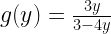
(a) g(y)=\frac { 3y }{ 3-4y }
(b) g(y)=\frac { 4y }{ 4-3y }
(c) g(y)=\frac { 4y }{ 3-4y }
(d) g(y)=\frac { 3y }{ 4-3y }
Solution:
(b)

Ex 1.4 Class 12 Maths Question 1.
Determine whether or not each of the definition of * given below gives a binary operation. In the event that * is not a binary operation, give justification for this.
(i) On Z+,define * by a * b = a – b
(ii) On Z+, define * by a * b = ab
(iii) On R, define * by a * b = ab²
(iv) On Z+,define * by a * b = |a – b|
(v) On Z+, define * by a * b = a
Solution:
(i) If a > b, a * b = a – b > 0, which belongs to Z+.
But if a < b, a * b = a – b < 0, which does not belong to Z+
=> * given operation is not a binary operation.
(ii) For all a and b belonging to Z-1, ab also belongs to Z+.
∴ The operation *, defined by a * b = ab is a binary operation.
(iii) For all a and b belonging to R, ab² also belongs to R.
∴ The operation * defined by a * b = ab² is binary operation.
(iv) For all a and b belonging to Z+, |a – b| also belongs to Z+1
∴ The operation a * b = |a – b| is a binary operation.
(v) On Z+ defined by a * b = a
a, b ∈ Z+ = a ∈ Z+
∴ The operation * is a binary operation.

Ex 1.4 Class 12 Maths Question 2.
For each binary operation * defined below, determine whether * is commutative or associative.
(i) OnZ, define a * b = a – b
(ii) OnQ, define a * b = ab + 1
(iii) On Q, define a * b = \\ \frac { ab }{ 2 }
(iv) On Z+, define a * b = 2ab
(v) On Z+, define a * b = ab
(vi) On R- {-1}, define a * b = \\ \frac { a }{ b+1 }
Solution:
(i) On Z, operation * is defined as
(a) a * b = a – b => b * a = b – a
But a – b ≠ b – a ==> a * b ≠ b * a
Defined operation is not commutative
(b) a – (b – c) ≠ (a – b) – c
Binary operation * as defined is not associative.

(ii) On Q, Operation * is defined as a * b = ab + 1
(a) ab + 1 = ba + 1, a * b = b * a
Defined binary operation is commutative.
(b) (a*b)*c = (ab + 1)*c = (ab + 1)c + 1 = abc + c + 1
a * (b * c) = a * (bc + 1) = a(bc + 1)+ 1 = abc + a+ 1
=> a * (b * c) ≠ (a * b) * c
∴ Binary operation defined is not associative.

(iii) (a) On Q, operation * is defined as a * b = \\ \frac { ab }{ 2 }
∴ a * b = b * a
∴ Operation binary defined is commutative.
be abc
(b) a * (b * c) = a * \\ \frac { bc }{ 2 }  = \\ \frac { abc }{ 4 }  and
(a * b) * c = \\ \frac { bc }{ 2 }  * c \\ \frac { abc }{ 4 }
=> (a * b) * c = \\ \frac { bc }{ 2 }  * c \\ \frac { abc }{ 4 }
Defined binary operation is associative.

(iv) On Z+ operation * is defined as a * b = 2ab
(a) a * b = 2ab, b * a = 2ba = 2ab
=> a * b = b * a .
∴ Binary operation defined as commutative.
(b) a * (b * c) = a * 2ba = 2a.2bc
(a * b) * c = 2ab * c = 22ab
Thus (a * b) * c ≠ a * (b * c)
∴ Binary operation * as defined as is not associative.

(v) On Z+, a * b = ab
(a) b * a = ba .
∴ ab ≠ ba = a * b ≠ b * a.
* is not commutative.
(b) (a*b)*c = ab*c = (ab)c = abc a*(b* c)
= a*bc = abc
Thus (a * b) * c ≠ (a * b * c)
∴ Operation * is not associative.

(vi) Neither commutative nor associative.

Ex 1.4 Class 12 Maths Question 3.
Consider the binary operation ^ on the set {1, 2, 3, 4, 5} defined by a ^ b=min {a, b}. Write the operation table of the operation ^.
Solution:
Operation ^ table on the set {1, 2, 3, 4, 5} is as follows.
NCERT Solutions for Class 12 Maths Chapter 1 Relations and Functions Ex 1.4 Q3.1

Ex 1.4 Class 12 Maths Question 4.
Consider a binary operation * on the set {1, 2, 3, 4, 5} given by the following multiplication table.
(i) Compute (2 * 3) * 4 and 2 * (3 * 4)
(ii) Is * commutative?
(iii) Compute (2 * 3) * (4 * 5).
Hint – use the following table)
NCERT Solutions for Class 12 Maths Chapter 1 Relations and Functions Ex 1.4 Q4.1
Solution:
(i) From the given table, we find
2*3 = 1, 1*4 = 1
(a) (2*3)*4 = 1 * 4 = 1
(b) 2*(3*4) = 2 * 1 = 1
(ii) Let a, b ∈ {1,2,3,4,5} From the given table, we find
a*a = a
a*b = b*a = 1 when a or b or are odd and a b.
2 * 4 = 4 * 2 = 2, when a and b are even and a ≠ b
Thus a * b = b * c
∴Binary operation * given is commutative.
(iii) Binary operation * given is commutative (2 * 3) * (4 * 5) = 1 * 1 = 1.

Ex 1.4 Class 12 Maths Question 5.
Let *’ be the binary operation on the set {1,2,3,4,5} defined by a *’ b=H.C.F. of a and b. Is the operation *’ same as the operation * defined in the exp no. 4 above? Justify your answer.
Solution:
The set is {1,2,3,4, 5} and a * b = HCF of a and b.
Let us prepare the table of operation *.
NCERT Solutions for Class 12 Maths Chapter 1 Relations and Functions Ex 1.4 Q5.1

Ex 1.4 Class 12 Maths Question 6.
Let * be the binary operation on N given by a * b = L.C.M. of a and b.Find
(i) 5 * 7, 20 * 16
(ii) Is * commutative?
(iii) Is * associative?
(iv) Find the identity of * in N
Solution:
Binary operation * defined as a * b = 1 cm. of a and b.
(i) 5 * 7 = 1 cm of 5 and 7 = 35
20 * 16= 1 cm of 20 and 16 = 80
(ii) a * b= 1 cm of a and b b * a = 1 cm of b and a
=> a * b = b * a, 1 cm of a, b and b, a are equal
∴ Binary operation * is commutative.
(iii) a * (b * c) = 1 cm of a, b, c and (a * b) * c = 1 cm of a, b, c
=> a * (b * c) = (a * b) * c
=> Binary operation * given is associative.
(iv) Identity of * in N is 1
1 * a = a * 1 = a = 1 cm of 1 and a.
(v) Let * : N x N—> N defined as a * b = 1.com of (a, b)
For a = 1, b = 1, a * b = l b * a
Otherwise a * b ≠ 1
∴ Binary operation * is not invertible
=> 1 is invertible for operation *

Ex 1.4 Class 12 Maths Question 7.
Is * defined on the set {1, 2, 3, 4, 5} by a * b = L.C.M. of a and b a binary operation? Justify your answer.
Solution:
The given set = {1,2,3,4,5} Binary operation is defined as a * b = 1 cm of a and b. 4 * 5 = 20 which does not belong to the given set {1, 2, 3, 4, 5}.
It is not a binary operation.

Ex 1.4 Class 12 Maths Question 8.
Let * be the binary operation on N defined by a * b = H.C.F. of a and b. Is * commutative? Is * associative? Does there exist identity for this binary operation on N?
Solution:
Binary operation on set N is defined as a * b = HCF of a and b
(a) We know HCF of a, b = HCF of b, a
∴ a * b = b * a
∴ Binary operation * is commutative.
(b) a*(b*c) = a* (HCF of b, c) = HCF of a and (HCF of b, c) = HCF of a, b and c
Similarly (a * b) * c = HCF of a, b, and c
=> (a * b) * c = a * (b * c)
Binary operation * as defined above is associative.
(c) 1 * a = a * 1 = 1 ≠ a
∴ There does not exists any identity element.

Ex 1.4 Class 12 Maths Question 9.
Let * be a binary operation on the set Q of rational numbers as follows:
(i) a * b = a – b
(ii) a * b = a² + b²
(iii) a * b = a + ab
(iv) a * b = (a – b)²
(v) a * b = \\ \frac { ab }{ 2 }
(vi) a * b = ab²
Find which of the binary operations are commutative and which are associative.
Solution:
Operation is on the set Q.,,
(i) defined as a * b = a – b
(a) Now b * a = b – a
But a – b ≠ b – a
∴ a * b ≠ b * a
∴ Operation * is not commutative.
(b) a * (b * c) = a * (b – c) = a – (b – c) = a – b + c (a * b) * c = (a – b) * c = a – b – c
Thus a * (b * c)¹ (a * b) * c = (a² + b²)² + c²
=> a * (b * c) ≠ (a * b) * c
∴ The operation * as defined is not associative.

(ii) (a) a * b = a² + b * a = b² + a² = a² + b².
a * b = b * a
This binary operation is commutative,
(b) a*(b*c) = a*(b² + c²) = a² + (b²)² + c²)²
=> (a*b)*c = (a² + b²)*c = (a² + b²) + c²
Thus a * (b*c) (a*b) * c
The operation * given is not associative.

(iii) Operation * is defined as a * b = a + ab
(a) b * a = b + ba
a * b ≠ b * a
The operation is not commutative.
(b) a*(b*c) = a*(b + bc)
= a + a(b + bc)
= a + ab + abc (a * b) * c
= (a + ab) * c
= (a + ab) + (a + ab) • c
= a + ab + ac + abc
=> a * (b * c) ≠ (a * b) * c
=> The binary operation is not associative.

(iv) The binary operation is defined as a * b = (a – b)²
(a) b*a = (b – a)² = (a – b)² => a*b = b*a
.’. This binary operation * is commutative.
(b) a*(b*c) = a*(b – c)² = [a – (b – c)²]² (a * b) * c
= (a – b)² * c
= [(a – b)² – c]²
=> a * (b * c) ≠ (a * b) * c
the operation * is not associative.

(v) Commutative and associative.

(vi) Neither commutative nor associative.

Ex 1.4 Class 12 Maths Question 10.
Show that none of the operations given above has identity.
Solution:
The binary operation * on set Q is
(i) defined as a*b = a – b
For identity element e, a*e = e*a = a
But a*e = a – e≠a and e*a = e – a≠a
There is no identity element for this operation
(ii) Binary operation * is defined as a * b = a² + b² ≠ a
This operation * has no identity.
(iii) The binary operation is defined as a*b = a+ab
Putting b = e, a + e = a + eb ≠ a
There is no identity element.
(iv) The binary operation is defined as a * b = (a – b)²
Put b = e, a * e = (a – e)² ≠ a for any value of
e∈Q
=> there is no Identity Element.
(v) The operation is a * b = \\ \frac { ab }{ 4 }
∴ a * e = \\ \frac { ae }{ 4 }  ≠ a for any value of e ∈ Q
∴ Operation * has no identity
(vi) The operation * is a * b = ab² Put b = e, a
*e = ae² and e * a = ea² ≠ a for any value of e∈Q
=> There is no Identity Element. Thus, these operations have no Identity.

Ex 1.4 Class 12 Maths Question 11.
Let A=N x N and * be the binary operation on A defined by (a,b)*(c,d)=(a+c,b+d)
Show that * is commutative and associative. Find the identity element for * on A, if any.
Solution:
A = N x N Binary operation * is defined as (a, b) * (c, d) = (a + c, b + d)
(a) Now (c, d) * (a,b) = (c+a, d+b) = (a+c,b+d)
=> (a, b) * (c, d) = (c, d) * (a, b)
∴ This operation * is commutative
(b) Next(a,b)* [(c,d)*(e,f)]=(a,b)*(c+e,d+f) = ((a + c + e), (b + d + f))
and [(a, b) * (c, d)] * (e, f)=(a+c, b+d) * (e, f) = ((a + c + e, b+d + f))
=> (a, b) * [(c, d) * (e, f)] = [(a, b) * (c, d)] * (e,f)
∴ The binary operation given is associative
(c) Identity element does not exists.

Ex 1.4 Class 12 Maths Question 12.
State whether the following statements are true or false. Justify.
(i) For an arbitrary binary operation * on a set N,
a*a=a∀a∈N.
(ii) If * is a commutative binary operation on N, then
a * (b * c) = (c * b) * a
Solution:
(i) A binary operation on N is defined as
a*a=a∀a∈N.
Here operation * is not defined.
∴ Given statement is false.
(ii) * is a binary commutative operation on N. c
* b = b * c
∵ * is commutative
∵ (c * b) * a = (b * c) * a = a * (b * c)
∴ Thus a * (b * c) = (c * b) * a
This statement is true.

Ex 1.4 Class 12 Maths Question 13.
Consider a binary operation * on N defined as a * b = a³ + b³. Choose the correct answer.
(a) Is * both associative and commutative?
(b) Is * commutative but not associative?
(c) Is * associative but not commutative?
(d) Is * neither commutative nor associative?
Solution:
(b)

Exercise 1.3
 
1. Let f : R → R be defined as f(x) = 10x + 7. Find the function g : R → R such that gof = fog = IR .
 
Answer
 
It is given that f: R → R is defined as f(x) = 10x + 7.
For one – one
Let f(x) = f(y), where x, y ∈ R.
⇒ 10x + 7 = 10y + 7
⇒ x = y
∴ f is a one – one function.
For onto
For y ∈ R, let y = 10x + 7.
∴ f is onto.
Therefore, f is one–one and onto.
Thus, f is an invertible function.
Let us define g: R → R as g(y) = y−7/10
Now, we have
 
2. Let f : W → W be defined as f(n) = n–1, if n is odd and f(n) = n+1, if n is even. Show that f is invertible. Find the inverse of f. Here, W is the set of all whole numbers.
 
Answer
 
It is given that:
For one–one
Let f(n) = f(m).
It can be observed that if n is odd and m is even, then we will have n−1 = m + 1.
⇒ n − m = 2
However, this is impossible.
Similarly, the possibility of n being even and m being odd can also be ignored
under a similar argument.
∴ Both n and m must be either odd or even. Now, if both n and m are odd,
Then, we have
f(n) = f(m)
⇒ n − 1 = m – 1
⇒ n = m
Again, if both n and m are even,
Then, we have
f(n) = f(m)
⇒ n + 1 = m + 1
⇒ n = m
∴ f is one–one.
 
For onto:
It is clear that any odd number 2r + 1 in co-domain N is the image of 2r in domain
N and any even number 2r in co-domain N is the image of 2r + 1 in domain N.
∴ f is onto.
Hence, f is an invertible function.
Now, when n is odd
gof(n) = g(f(n)) = g(n − 1) = n − 1 + 1 = n and
When n is even
gof(n) = g(f(n)) = g(n + 1) = n + 1 − 1 = n
Similarly,
When m is odd
fog(m) = f(g(m)) = f(m − 1) = m − 1 + 1 = m and
When m is even
fog(m) = f(g(m)) = f(m + 1) = m + 1 − 1 = m
∴ gof = IW and fog = IW
Thus, f is invertible and the inverse of f is given by f-1 = g, which is the same as f. Hence, the inverse of f is f itself.
 
3. If f : R → R is defined by f(x) = x2 – 3x + 2, find f (f(x)).
 
Answer
 
It is given that f: R → R is defined as f(x) = x2 − 3x + 2.
f(f(x)) = f(x2 − 3x + 2)
= (x2 − 3x + 2)2 − 3(x2 − 3x + 2) + 2
= (x4 + 9x2 + 4 − 6x3 − 12x + 4x2) + (−3x2 + 9x − 6) + 2
= x4 − 6x3 + 10x2 − 3x
 
4. Show that the function f : R → {x ∈ R : –1 < x < 1} defined by
 , x ∈ R is one one and onto function.
 
Answer
 
For one – one
Suppose f(x) = f(y), where x, y ∈ R.
Since, x is positive and y is negative
x > y ⇒ x − y > 0
But, 2xy is negative.
Then 2xy ≠ x − y
 
Thus, the case of x being positive and y being negative can be ruled out.
Under a similar argument, x being negative and y being positive can also be ruled out.
∴ x and y have to be either positive or negative.
When x and y are both positive, we have
∴ f is one – one.
For onto
Now, let y ∈ R such that −1 < y < 1.
If y is negative, then, there exists x =y/1+y ∈ R such that
∴ f is onto.
Hence, f is one–one and onto.
 
5. Show that the function f : R → R given by f(x) = x3 is injective.
 
Answer
 
f: R → R is given as f(x) = x3.
 
For one – one
Suppose f(x) = f(y), where x, y ∈ R.
⇒ x3 = y3 ….(1)
Now, we need to show that x = y.
Suppose x ≠ y, their cubes will also not be equal.
⇒ x3 ≠ y3
However, this will be a contradiction to (1).
∴ x = y
Hence, f is injective.
 
6. Give examples of two functions f : N → Z and g : Z → Z such that g o f is injective but g is not injective.
(Hint : Consider f(x) = x and g (x) = | x |). 
 
Answer
 
Define f: N → Z as f(x) = x and g: Z → Z as g (x) = |x|.
We first show that g is not injective.
It can be observed that
g (−1) =|−1| = 1
g (1) = |1| = 1
∴ g (−1) = g (1), but −1 ≠ 1.
∴ g is not injective.
Now, g of: N → Z is defined as gof(x) = g(f(x)) = g(x) = |x|.
Let x, y ∈ N such that g of(x) = g of(y).
⇒ |x| = |y|
Since x and y ∈ N, both are positive.
∴ |x| = |y| ⇒ x = y
Hence, gof is injective.
 
7. Give examples of two functions f : N → N and g : N → N such that g o f is onto but f is not onto.
 
Answer
 
Define f: N → N by f(x) = x + 1 and,
We first show that g is not onto.
For this, consider element 1 in co-domain N. It is clear that this element is not an image of any of the elements in domain N.
∴ f is not onto.
Now, gof: N → N is defined by
gof(x) = g(f(x)) = g(x + 1) = x + 1 − 1 = x [x ∈ N ⇒ x + 1 > 1]
Then, it is clear that for y ∈ N, there exists x = y ∈ N such that gof(x) = y.
Hence, gof is onto.
 
8. Given a non empty set X, consider P(X) which is the set of all subsets of X.
Define the relation R in P(X) as follows:
For subsets A, B in P(X), ARB if and only if A ⊂ B. Is R an equivalence relation on P(X)? Justify your answer.
 
Answer
 
Since every set is a subset of itself, ARA for all A ∈ P(X).
∴ R is reflexive.
Let ARB ⇒ A ⊂ B.
This cannot be implied to B ⊂ A.
For instance, if A = {1, 2} and B = {1, 2, 3}, then it cannot be implied that B is
related to A.
∴ R is not symmetric.
Further, if ARB and BRC, then A ⊂ B and B ⊂ C.
⇒ A ⊂ C
⇒ ARC
∴ R is transitive.
Hence, R is not an equivalence relation as it is not symmetric.
 
Page No. 30
 
9. Given a non-empty set X, consider the binary operation ∗ : P(X) × P(X) → P(X) given by A ∗ B = A ∩ B ∀ A, B in P(X), where P(X) is the power set of X. Show that X is the identity element for this operation and X is the only invertible element in P(X) with respect to the operation ∗.
 
Answer
 
It is given the binary operation *:
P(X) × P(X) → P(X) given by A * B = A ∩ B ∀ A, B in P(X)
We know that A ∩ X = A = X ∩ A for all A ∈ P(X)
⇒ A * X = A = X * A for all A ∈ P(X)
Thus, X is the identity element for the given binary operation *.
Now, an element A ∈ P(X) is invertible if there exists B ∈ P(X) such that
A * B = X = B * A [As X is the identity element]
or
A ∩ B = X = B ∩ A
This case is possible only when A = X = B.
Thus, X is the only invertible element in P(X) with respect to the given operation*.
Hence, the given result is proved.
10. Find the number of all onto functions from the set {1, 2, 3, … , n} to itself.
 
Answer
 
Onto functions from the set {1, 2, 3, … , n} to itself is simply a permutation on n symbols 1, 2, …, n.
Thus, the total number of onto maps from {1, 2, … , n} to itself is the same as the total number of permutations on n symbols 1, 2, …, n, which is n.
 
11. Let S = {a, b, c} and T = {1, 2, 3}. Find F-1 of the following functions F from S to T, if it exists.
(i) F = {(a, 3), (b, 2), (c, 1)}
(ii) F = {(a, 2), (b, 1), (c, 1)}
 
Answer
 
S = {a, b, c}, T = {1, 2, 3}
(i) F: S → T is defined as F = {(a, 3), (b, 2), (c, 1)}
⇒ F (a) = 3, F (b) = 2, F(c) = 1
Therefore, F-1 : T → S is given by F-1 = {(3, a), (2, b), (1, c)}.
 
(ii) F: S → T is defined as F = {(a, 2), (b, 1), (c, 1)}
Since F (b) = F (c) = 1, F is not one – one.
Hence, F is not invertible i.e., F-1 does not exist.
 
12. Consider the binary operations ∗ : R × R → R and o : R × R → R defined as a ∗b = |a – b| and a o b = a, ∀ a, b ∈ R. Show that ∗ is commutative but not associative, o is associative but not commutative. Further, show that ∀ a, b, c ∈ R, a ∗ (b o c) = (a ∗ b) o (a ∗ c). [If it is so, we say that the operation ∗ distributes over the operation o]. Does o distribute over ∗? Justify your answer.
 
Answer
 
It is given that *: R × R → and o: R × R → R is defined as a ∗ b = |a − b| and
aob = a, ∀ a, b ∈ R
For a, b ∈ R, we have
a ∗ b = |a − b| and b ∗ a = |b − a| = |−(a − b)| = |a − b|
∴ a * b = b * a
Hence, the operation * is commutative.
It can be observed that
(1 ∗ 2) ∗ 3 = (|1 − 2|) ∗ 3 = 1 ∗ 3 = |1 − 3| = 2
and
1 ∗ (2 ∗ 3) = 1 ∗ (|2 − 3|) = 1 ∗ 1 = |1 − 1| = 0
∴ (1 ∗ 2) ∗ 3 ≠ 1 ∗ (2 ∗ 3) where 1, 2, 3 ∈ R.
Hence, the operation * is not associative.
Now, consider the operation o
It can be observed that 1 o 2 = 1 and 2 o 1 = 2.
∴ 1 o 2 ≠ 2 o 1 where 1, 2 ∈ R.
Hence, the operation o is not commutative.
Let a, b, c ∈ R. Then, we have
(a o b) o c = a o c = a
and
a o (b o c) = a o b = a
∴ (a o b) o c = a o (b o c), where a, b, c ∈ R
Hence, the operation o is associative.
Now, let a, b, c ∈ R, then we have
a * (b o c) = a * b =|a − b|
(a * b) o (a * c) = (|a − b|)o(|a − c|) = |a − b|
Hence, a * (b o c) = (a * b) o (a * c).
Now,
1 o (2 ∗ 3) = 1o(|2 − 3|) = 1o1 = 1
(1 o 2) * (1 o 3) = 1 * 1 = |1 − 1| = 0
∴ 1 o (2 * 3) ≠ (1 o 2) * (1 o 3) where 1, 2, 3 ∈ R
Hence, the operation o does not distribute over *.
 
13. Given a non-empty set X, let ∗ : P(X) × P(X) → P(X) be defined as A * B = (A–B) ∪ (B–A), ∀ A, B ∈ P(X). Show that the empty set φ is the identity for the operation ∗ and all the elements A of P(X) are invertible with A-1 = A. (Hint : (A–φ) ∪ (φ–A) = A and (A–A) ∪ (A–A) = A ∗ A = φ).
 
Answer
 
It is given that *: P(X) × P(X) → P(X) is defined
as A * B = (A − B) ∪ (B − A) ∀ A, B ∈ P(X).
Let A ∈ P(X). Then, we have
A * Φ = (A − Φ) ∪ (Φ − A) = A ∪ Φ = A
Φ * A = (Φ − A) ∪ (A − Φ) = Φ ∪ A = A
∴ A * Φ = A = Φ * A for all A ∈ P(X)
Thus, Φ is the identity element for the given operation*.
Now, an element A ∈ P(X) will be invertible if there exists B ∈ P(X) such that
A * B = Φ = B * A. [As Φ is the identity element]
Now, we observed that,
A * A = ( A – A) ∪ (A – A) = Φ ∪ Φ = Φ for all A ∈ P(X).
Hence, all the elements A of P(X) are invertible with A-1 = A.
 
14. Define a binary operation ∗ on the set {0, 1, 2, 3, 4, 5} as
Show that zero is the identity for this operation and each element a ≠ 0 of the set is invertible with 6–a being the inverse of a
 
Answer
 
Let X = {0, 1, 2, 3, 4, 5}.
An element e ∈ X is the identity element for the operation *, if
a ∗ e = a = e ∗ a for all a ∈ X
For a ∈ X, we have
a ∗ 0 = a + 0 = a [a ∈ X ⇒ a + 0 < 6]
0 ∗ a = 0 + a = a [a ∈ X ⇒ 0 + a < 6]
∴ a ∗ 0 = a = 0 ∗ a for all a ∈ X
Thus, 0 is the identity element for the given operation *.
 
An element a ∈ X is invertible if there exists b ∈ X such that a * b = 0 = b * a.
⇒ a = −b or b = 6 − a
But, X = {0, 1, 2, 3, 4, 5} and a, b ∈ X. Then, a ≠ −b.
∴ b = 6 − a is the inverse of a for all a ∈ X.
Hence, the inverse of an element a ∈X, a ≠ 0 is 6 − a i.e., a-1 = 6 − a.
 
15. Let A = {– 1, 0, 1, 2}, B = {– 4, – 2, 0, 2} and f, g : A → B be functions defined by
Justify your answer. (Hint: One may note that two functions f : A → B and g : A → B such that f(a) = g (a) ∀ a ∈ A, are called equal functions).
 
Answer
 
It is given that A = {−1, 0, 1, 2}, B = {−4, −2, 0, 2}.
Also, it is given that f, g: A → B are defined by
∴ f(a) = g(a) for all a ∈ A
Hence, the functions f and g are equal.
 
16. Let A = {1, 2, 3}. Then number of relations containing (1, 2) and (1, 3) which are
reflexive and symmetric but not transitive is
(A) 1
(B) 2
(C) 3
(D) 4
 
Answer
 
The given set is A = {1, 2, 3}.
The smallest relation containing (1, 2) and (1, 3) which is reflexive and symmetric, but not transitive is given by:
R = {(1, 1), (2, 2), (3, 3), (1, 2), (1, 3), (2, 1), (3, 1)}
This is because relation R is reflexive as (1, 1), (2, 2), (3, 3) ∈ R.
Relation R is symmetric since (1, 2), (2, 1) ∈ R and (1, 3), (3, 1) ∈ R.
But relation R is not transitive as (3, 1), (1, 2) ∈ R, but (3, 2) ∉ R.
Now, if we add any two pairs (3, 2) and (2, 3) (or both) to relation R, then relation R will become transitive.
Hence, the total number of desired relations is one.
 
The correct answer is A.
 
17. Let A = {1, 2, 3}. Then number of equivalence relations containing (1, 2) is
(A) 1
(B) 2
(C) 3
(D) 4
 
Answer
 
It is given that A = {1, 2, 3}.
The smallest equivalence relation containing (1, 2) is given by,
R1 = {(1, 1), (2, 2), (3, 3), (1, 2), (2, 1)}
Now, we are left with only four pairs i.e., (2, 3), (3, 2), (1, 3), and (3, 1).
If we odd any one pair [say (2, 3)] to R1, then for symmetry we must add (3, 2).
Also, for transitivity we are required to add (1, 3) and (3, 1).
Hence, the only equivalence relation (bigger than R1) is the universal relation.
This shows that the total number of equivalence relations containing (1, 2) is two.
 
The correct answer is B.
 
Page No. 31
 
18. Let f : R → R be the Signum Function defined as
and g : R → R be the Greatest Integer Function given by g (x) = [x], where [x] is greatest integer less than or equal to x. Then, does fog and gof coincide in (0, 1]?
 
Answer
 
It is given that,
Also, g: R → R is defined as g(x) = [x], where [x] is the greatest integer less than or equal to x.
Now, let x (0, 1].
Then, we have
[x] = 1 if x = 1 and [x] = 0 if 0 < x < 1.
 
19. Number of binary operations on the set {a, b} are
(A) 10 
(B) 16 
(C) 20
(D ) 8
 
Answer
 
A binary operation * on {a, b} is a function from {a, b} × {a, b} → {a, b}
i.e., * is a function from {(a, a), (a, b), (b, a), (b, b)} → {a, b}.
Hence, the total number of binary operations on the set {a, b} is 24 i.e., 16.
 
The correct answer is B.
Read More

NCERT MCQ CLASS-12 CHAPTER-7 | CHEMISTRY NCERT MCQ | THE p-BLOCK ELEMENTS | EDUGROWN

In This Post we are  providing Chapter-7 The p-Block Elements NCERT MCQ for Class 12 Chemistry which will be beneficial for students. These solutions are updated according to 2021-22 syllabus. These MCQS  can be really helpful in the preparation of Board exams and will provide you with a brief knowledge of the chapter.

NCERT MCQ ON THE p-BLOCK ELEMENTS

1. Among the following, which one is a wrong statement.
(a) PH5 and BiCl5 do not exist.
(b) pπ-dπ bonds are present in SO2
(c) SeF4 and CH4 have same shape.
(d) I3 has bent geometry.

Answer: c

2. In which of the pair of ions, both species contain S—S bond?
Chemistry MCQs for Class 12 with Answers Chapter 7 The p-Block Elements 1

Answer: a

3. Which one of the following order is correct for the bond dissociation enthalpy of halogen molecule?
(a) Br2 > I2 > F2 > Cl2
(b) F2 > Cl2 > Br2 > I2
(c) I2 > Br2 > Cl2 > F2
(d) Cl2 > Br2 > F2 > I2

Answer: d

4. Which is strongest acid in the following:
(a) HClO4
(b) H2SO3
(c) H2SO4
(d) HClO3

Answer: a

5. In which of the following pairs, the two species are isostructural
Chemistry MCQs for Class 12 with Answers Chapter 7 The p-Block Elements 2

Answer: c

6. The correct order of oxidizing power is
(a) HClO4 > HClO3 > HClO2 > HCIO
(b) HOCl > HClO2 > HClO3 > HClO4
(c) HClO3 > HClO4 > HClO2 > HClO
(d) HCIO2 > HOCl > HClO3 > HClO4

Answer: b

7. The correct order of acid strength is
(a) HClO4 < HClO3 < HClO2 < HClO
(b) HCIO < HClO2 < HClO3 < HClO4
(c) HClO4 < HClO < HClO2 < HClO3
(d) HClO2 < HClO3 < HClO4 < HClO

Answer: b

8. Among the following which is strongest oxidizing agent.
(a) Br2
(b) I2
(c) Cl2
(d) F2

Answer: d

9. The correct order of bond angles in the following species is
Chemistry MCQs for Class 12 with Answers Chapter 7 The p-Block Elements 3

Answer: b

10. Sulphur trioxide can be obtained by which of the following:
Chemistry MCQs for Class 12 with Answers Chapter 7 The p-Block Elements 4

Answer: (b)

11. When Cl2 reacts with hot and cone. NaOH, the oxidation number of chlorine changes from
(a) zero to +1 and zero to +5
(b) 0 to -1 and 0 to +5
(c) zero to -1 and zero to +3
(d) 0 to +1 and 0 to -3

Answer: b

12. Acidity of diprotic acid in aqueous solution increases in the order.
(a) H2S < H2Se < H2Te
(b) H2Se < H2S < H2Te
(c) H2Te < H2S < H2Se
(d) H2Se < H2Te < H2S

Answer: a

13. Which of the following statement is incorrect?
(a) ONF is isoelectronic with NO2
(h) OF2 is an oxide of fluoride
(c) Cl2O7 is an anhydride of perchloric acid
(d) O3 molecule is bent

Answer: b

14. Chlorine reacts with excess of NH3 to form
(a) NH4Cl
(b) N2 + HCl
(c) N2 + NH4Cl
(d) NCl3 + HCl

Answer: c

15. Which of the following reactions is an example of redox reaction?
(a) XeF4 + O2F2 → XeF6 + O2
(b) XeF2 + PF5 → [XeF]+ [PF6]
(c) XeF6 + H2O → XeOF4 + 2HF

Answer: a


Read More

NCERT MCQ CLASS-12 CHAPTER-6 | CHEMISTRY NCERT MCQ | GENERAL PRINCIPLES AND PROCESSES OF ISOLATION OF ELEMENTS | EDUGROWN

In This Post we are  providing Chapter-6 General Principles and Processes of Isolation of Elements NCERT MCQ for Class 12 Chemistry which will be beneficial for students. These solutions are updated according to 2021-22 syllabus. These MCQS  can be really helpful in the preparation of Board exams and will provide you with a brief knowledge of the chapter.

NCERT MCQ ON GENERAL PRINCIPLES AND PROCESSES OF ISOLATION OF ELEMENTS

Question 1.
Concentration of sulphide ore is done by

(a) froth flotation process
(b) electrolysis
(c) roasting
(d) None of these

Answer: (a) froth flotation process

Question 2.
Malachite is an ore of

(a) iron
(b) copper
(c) zinc
(d) Sliver

Answer: (b) copper

Question 3.
Formula of copper pyrite is

(a)Cu2S
(b) CuFeS
(c) CuFeS2
(d) Cu2Fe2S2

Answer: (c) CuFeS2

Question 4.
Ore of aluminum is

(a) bauxite
(b) hematite
(c) dolomite
(d) None of these

Answer: (a) bauxite

Question 5.
Removal of the unwanted materials like sand, clays, etc. from the ore is known as ………., …….. or ……….

(a) concentration, dressing, benefaction
(b) separation, refining, gangue
(c) magnetic separation, purification, gangue
(d) washing, refining, amalgamation

Answer: (a) concentration, dressing, benefaction

Question 6.
For which of the following ores froth floatation method is used for concentration?

(a) Hematite
(b) Zinc blende
(c) Magnetite
(d) Camallite

Answer: (b) Zinc blende

Question 7.
The powdered ore is agitated with water or washed with running stream of water. The heavy ore particles and lighter impurities are separated. This method of concentration is known as

(a) metallurgy
(b) leaching
(c) froth floatation process
(d) gravity separation

Answer: (d) gravity separation

Question 8.
The oil used as frothing agent in froth floatation process is

(a) coconut oil
(b) castor oil
(c) palmitic oil
(d) pine oil

Answer: (d) pine oil

Question 9.
Which of the following metals is not extracted by leaching?

(a) Aluminum
(b) Mercury
(c) Silver
(d) Gold

Answer: (b) Mercury

Question 10.
Sulphide ore of zinc/copper is concentrated by

(a) floatation process
(b) electromagnetic process
(c) gravity separation
(d) distillation

Answer: (a) floatation process

Question 11.
Which of the following ores is concentrated by chemical leaching method?

(a) Cinnabar
(b) Argentite
(c) Copper pyrites
(d) Galena

Answer: (b) Argentite

Question 12.
How do we separate two sulphide ores by froth floatation method?

(a) By using excess of pine oil
(b) By adjusting proportion of oil to water or using depressant.
(c) By using some solvent in which one of the sulphide is soluble
(d) By using collectors and froth stabilizers like xanthates

Answer: (b) By adjusting proportion of oil to water or using depressant.

Question 13.
Common impurities present in bauxite are

(a) CuO
(b) ZnO
(c) CaO
(d) SiO2

Answer: (d) SiO2

Question 14.
An ore of tin containing FeCrO4 is concentrated by

(a) gravity separation
(b) magnetic separation
(c) froth floatation
(d) leaching

Answer: (b) magnetic separation

Question 15.
Which of the following ores cannot be concentrated by magnetic separation?

(a) Hematite
(b) Malachite
(c) Magnetite
(d) Siderite

Answer: (b) Malachite


Read More

NCERT MCQ CLASS-12 CHAPTER-5 | CHEMISTRY NCERT MCQ | SURFACE CHEMISTRY | EDUGROWN

In This Post we are  providing Chapter-5 Surface Chemistry NCERT MCQ for Class 12 Chemistry which will be beneficial for students. These solutions are updated according to 2021-22 syllabus. These MCQS  can be really helpful in the preparation of Board exams and will provide you with a brief knowledge of the chapter.

NCERT MCQ ON SURFACE CHEMISTRY

Question 1.
Movement of dispersion medium under the influence of electric field is known as

(a) electrodialysis
(b) electrophoresis
(c) electro osmosis
(d) cataphoresis.

Answer: (c) electro osmosis

Question 2.
At CMC (Critical Micellization Cone.) the surface molecules

(a) associate
(b) dissociate
(c) decompose
(d) become completely soluble.

Answer: (a) associate

Question 3.
Milk is an example of

(a) emulsion
(b) suspension
(c) foam
(d) sol.

Answer: (a) emulsion

Question 4.
Tyndall effect is due to

(a) electric charge
(b) scattering of light
(c) absorption of light
(d) none of these.

Answer: (b) scattering of light

Question 5.
Fog is a colloidal system of

(a) liquid dispersed in a gas
(b) gas dispersed in a gas
(c) solid dispersed in gas
(d) solid dispersed in liquid

Answer: (a) liquid dispersed in a gas

Question 6.
Blood may be purified by

(a) coagulation
(b) dialysis
(c) electro-osmosis
(d) filtration

Answer: (b) dialysis

Question 7.
Blue color of water in sea is due to

(a) refraction of blue light by impurities in sea water
(b) scattering of light by water
(c) refraction of blue sky by water
(d) None of these

Answer: (a) refraction of blue light by impurities in sea water

Question 8.
The cause of Brownian movement is

(a) heat change in liquid state
(b) attractive force between colloidal particles and dispersion medium
(c) bombardment of the colloidal particles by the molecules of the dispersion medium
(d) interaction of charged particles

Answer: (c) bombardment of the colloidal particles by the molecules of the dispersion medium

Question 9.
Emulsifying agent present in milk that makes it stable is

(a) maltose
(b) casein
(c) lactose
(d) none of these

Answer: (b) casein

Question 10.
Cloud is an example of

(a) liquid dispersed in gas
(b) solid dispersed in gas
(c) solid dispersed in liquid
(d) none of these

Answer: (a) liquid dispersed in gas

Question 11.
The color of sky is due to

(a) absorption of light
(b) transmission of light
(c) scattering of light
(d) all of these

Answer: (c) scattering of light

Question 12.
Which of the following is lyophobic colloid?

(a) Starch in water
(b) Gum in water
(c) Soap in water
(d) Gold sol

Answer: (d) Gold sol

Question 13.
At high concentration of soap in water, soap behaves as

(a) molecular colloid
(b) associated colloid
(c) macro molecular colloid
(d) lyophilic colloid

Answer: (b) associated colloid

Question 14.
The efficiency of a protective colloid is described in terms of

(a) gold number
(b) flocculation number
(c) valence of counter ion
(d) Tyndall effect.

Answer: (a) gold number

Question 15.
The function of enzymes in the living system is to

(a) maintain pH
(b) catalyze biochemical process
(c) provide immunity
(d) transport oxygen

Answer: (b) catalyze biochemical process


Read More

NCERT MCQ CLASS-12 CHAPTER-4 | CHEMISTRY NCERT MCQ | CHEMICAL KINETICS | EDUGROWN

In This Post we are  providing Chapter-4 Chemical Kinetics NCERT MCQ for Class 12 Chemistry which will be beneficial for students. These solutions are updated according to 2021-22 syllabus. These MCQS  can be really helpful in the preparation of Board exams and will provide you with a brief knowledge of the chapter.

NCERT MCQ ON CHEMISTRY KINECTICS

Question 1.
A first order reaction has a half life period of 34.65 seconds. Its rate constant is

(a) 2 × 10⁻² s-1
(b) 4 × 10⁻⁴ s-1
(c) 20 s-1
(d) 2 × 10⁻⁴ s-1

Answer: (a) 2 × 10⁻² s-1

Question 2.
If a graph is plotted between In k and 1/T for the first order reaction, the slope of the straight line so obtained is given by
(a) –EaR
(b) Ea2.303R
(c) 2.303Ea.R
(d) Ea2.303

Answer: (a) –EaR

Question 3.
The unit of rate constant for a zero order reaction is

(a) mol L-1s-1
(b) s-1
(c) L mol-1s-1
(d) L2mol-2s-1

Answer: (a) mol L-1s-1

Question 4.
A catalyst increases the speed of a chemical reaction by

(a) increasing activation energy
(b) decreasing activation energy
(c) increasing reactant energy
(d) decreasing threshold energy

Answer: (b) decreasing activation energy

Question 5.
The units of the rate constant for the second order reaction are:

(a) mol-1 litre s-1
(b) mol litre-2 s-1
(c) s-1
(d) mol litre-1 s-1

Answer: (a) mol-1 litre s-1

Question 6.
The value of k for a reaction is 2.96 × 10⁻³⁰ s-1. What is the order of the reaction?

(a) Zero
(b) 3
(c) 2
(d) 1

Answer: (d) 1

Question 7.
A reaction is found to be of second order with respect to concentration of carbon monoxide. If concentration of carbon monoxide is doubled, the rate of reaction will

(a) triple
(b) increase by a factor of 4
(c) double
(d) remain unchanged

Answer: (b) increase by a factor of 4

Question 8.
If the concentrations are expressed in mol litre-1 and time in s, then the units of rate constant for the first-order reactions are

(a) mol litre-1 s-1
(b) mol-1 litre s-1
(c) s-1
(d) mol² litre-2 s-1

Answer: (c) s-1

Question 9.
The half life of a first order reaction having rate constant 200 s-1 is

(a) 3.465 × 10⁻² s
(b) 3.465 × 10⁻³ s
(c) 1.150 × 10⁻² S
(d) 1.150 × 10⁻³ S

Answer: (b) 3.465 × 10⁻³ s

Question 10.
The rate of a reaction is 1.209 × 10⁻⁴L² mol-2s-1. The order of the reaction is:

(a) zero
(b) first
(c) second
(d) third

Answer: (d) third

Question 11.
A catalyst increases the rate of a reaction by

(a) increasing threshold energy
(b) increasing activation energy
(c) activating the reactants
(d) lowering activation energy

Answer: (d) lowering activation energy

Question 12.
Time required for 100% completion of a zero order reaction is:

(a) t100% = a/k
(b) t100% = a.k
(c) t100% = a/2k
(d) None of these

Answer: (a) t100% = a/k

Question 13.
Arrhenius equation is represented by:

(a) k = AeEa/RT
(b) k = Ae-Ea/RT
(c) t1/2 = 0.693/k
(d) None of these

Answer: (b) k = Ae-Ea/RT

Question 14.
The overall order of a reaction, which has the rate expression: Rate = AC[A]1/2[B]3/2 is:

(a) First order
(b) Second order
(c) Third order
(d) Zero order

Answer: (b) Second order

Question 15.
If half life period of a first order reaction is 100 seconds. Then rate constant will be:

(a) 6.93 × 10⁻³ second-1
(b) 6.93 × 10⁻² second-1
(c) 0.693 second-1
(d) 6.93 second-1

Answer: (a) 6.93 × 10⁻³ second-1


Read More

NCERT MCQ CLASS-12 CHAPTER-3 | CHEMISTRY NCERT MCQ | ELECTROCHEMISTRY | EDUGROWN

In This Post we are  providing Chapter-3 Electrochemistry NCERT MCQ for Class 12 Chemistry which will be beneficial for students. These solutions are updated according to 2021-22 syllabus. These MCQS  can be really helpful in the preparation of Board exams and will provide you with a brief knowledge of the chapter.

NCERT MCQ ON ELECTROCHEMISTRY

Question 1.
If 96500 coulomb electricity is passed through CuSO4 solution, it will liberate

(a) 63.5 gm of Cu
(b) 31.76 gm of Cu
(c) 96500 gm of Cu
(d) 100 gm of Cu

Answer: (b) 31.76 gm of Cu

Question 2.
Fused NaCl on electrolysis gives ………….. on cathode.
(a) Chlorine
(b) Sodium
(c) Sodium amalgam

Answer: (b) Sodium

Question 3.
The standard electrode potentials for the half cell reactions are:
Zn → Zn2-– 2e E° = 0.76 V
Fe → Fe2- + 2 E° = -0.41 V
The emf of the cell reaction
Fe2- + Zn → Zn2- + Fe is

(a) -0.35 V
(b) +0.35 V
(c) -1.17 V
(d) +1.17 V

Answer: (b) +0.35 V

Question 4.
Which of the following is a secondary cell?

(a) Leclanche cell
(b) Lead storage battery
(c) Concentration cell
(d) All of these

Answer: (b) Lead storage battery

Question 5.
For a certain redox reaction, E° is positive. This means that

(a) ΔG° is positive, K is greater than 1
(b) ΔG° is positive, K is less than 1
(c) ΔG° is negative, K is greater than 1
(d) ΔG° is negative, K is less than 1Answer

Answer: (c) ΔG° is negative, K is greater than 1

Question 6.
Cell reaction is spontaneous, when

(a) E0red is negative
(b) ΔG° is negative
(c) E0oxid is Positive
(d) ΔG° is positive

Answer: (b) ΔG° is negative

Question 7.
Equilibrium constant K is related to E0cell and not Ecell because
(a) E0cell is easier to measure than Ecell
(b) Ecell becomes zero at equilibrium point but E0cell remains constant under all conditions
(c) at a given temperature, Ecell changes hence value of K can’t be measured
(d) any of the terms Ecell or E0cell can be used

Answer: (b) Ecell becomes zero at equilibrium point but E0cell remains constant under all conditions

Question 8.
Molar conductivity of 0.15 M solution of KCl at 298 K, if its conductivity of 0.0152 S cm-1 w ill be

(a) 124 Ω-1 cm² mol-1
(b) 204 Ω-1 cm² mol-1
(c) 101 Ω-1 cm² mol-1
(d) 300 Ω-1 cm² mol-1

Answer: (c) 101 Ω-1 cm² mol-1

Question 9.
Electrical conductance through metals is called metallic or electronic conductance and is due to the movement of electrons. The electronic conductance depends on

(a) the nature and structure of the metal
(b) the number of valence electrons per atom
(c) change in temperature
(d) all of these

Answer: (d) all of these

Question 10.
The specific conductivity of N/10 KCl solution at 20°C is 0.0212 ohm-1 cm-1 and the resistance of the cell containing this solution at 20°C is 55 ohm. The cell constant is

(a) 3.324 cm-1
(b) 1.166 cm-1
(c) 2.372 cm-1
(d) 3.682 cm-1

Answer: (b) 1.166 cm-1

Question 11.
Faraday’s law of electrolysis is related to

(a) Atomic number of cation
(b) Speed of cation
(c) Speed of anion
(d) Equivalent weight of electrolyte

Answer: (d) Equivalent weight of electrolyte

Question 12.
The molar conductivity is maximum for the solution of concentration

(a) 0.004 M
(b) 0.002 M
(c) 0.005 M
(d) 0.001 M

Answer: (d) 0.001 M

Question 13.
Units of the properties measured are given below. Which of the properties has been not matched correctly?

(a) Molar conductance = Sm2 mol-1
(b) Cell constant = m-1
(c) Specific conductance of = S m²
(d) Equivalence conductance = S m² (g eq)-1

Answer: (c) Specific conductance of = S m²

Question 14.
How long would it take to deposit 50 g of Al from an electrolytic cell containing Al2O3 using a current of 105 ampere?

(a) 1.54 h
(b) 1.42 h
(c) 1.32 h
(d) 2.15 h

Answer: (b) 1.42 h

Question 15.
The charge required for reducing 1 mole of MnO−4 to Mn2- is

(a) 1.93 × 10⁵ C
(b) 2.895 × 10⁵ C
(c) 4.28 × 10⁵ C
(d) 4.825 × 10⁵ C

Answer: (d) 4.825 × 10⁵ C


Read More

CLASS 11TH -पाठ 12 – देव |अंतरा भाग-2 हिंदी |NCERT SOLUTION| EDUGROWN

Class 11 NCERT Solutions for Hindi Antra provides you an idea of the language and helps you understand the subject better. We have explained NCERT Solutions for Class 11th Hindi Antra.

Class 11 Hindi Antra textbook has 19 chapters in which first 9 chapters are prose while other 10 are poems. These pieces are very useful in the development of language and communication skills of students

NCERT Solutions for Class 11th -पाठ 12 - देव -अंतरा भाग-2 हिंदी

प्रश्न-अभ्यास
 
1. ‘हँसी की चोट’ सवैये में कवि ने किन पंच तत्त्वों का वर्णन किया है तथा वियोग में वे किस प्रकार विदा होते हैं?
 
उत्तर
 
‘हँसी की चोट’ सवैये में कवि ने पाँच तत्वों आकाश, अग्नि, वायु, भूमि तथा जल का वर्णन किया गया है। गोपी द्वारा तेज़-तेज़ साँस लेने-छोड़ने से वायु तत्व चला गया है। अत्यधिक रोने से जल तत्व आँसुओं के रूप में विदा हो गया है। तन में व्याप्त गर्मी के जाने से अग्नि तत्व समाप्त हो गया है। वियोग में कमज़ोर होने के कारण भूमि तत्व चला गया है।

2. नायिका सपने में क्यों प्रसन्न थी और वह सपना कैसे टूट गया?

उत्तर

नायिका ने सपने में देखा कि कृष्ण उसके पास आते हैं और उसे झूला-झूलने का निमंत्रण देते हैं। यह उसके लिए बहुत प्रसन्नता की बात थी। उसे सपने में ही सही कृष्ण का साथ मिला था। वह जैसे ही प्रसन्नतापूर्वक कृष्ण के साथ चलने के लिए उठती है, इस बीच उसकी नींद उचट जाती है। नींद उचटने से उसका सपना टूट जाता है और कृष्ण का साथ भी छूट जाता है।

3. ‘सपना’ कवित्त का भाव-सौंदर्य लिखिए।

उत्तर

‘सपना’ कवित्त में गोपी का श्रीकृष्ण के प्रति अगाध प्रेम और मिलन की इच्छा का भाव व्यक्त हुआ है। सपने में नायिका कृष्ण का साथ पाती है। वह जैसे ही इस साथ को और आगे तक ले जाना चाहती है नींद खुलने के कारण छूट जाता है। सपना टूटने से कृष्ण का साथ छूट जाता है और वह दुखी हो जाती है।अनुप्रास तथा पुनरुक्ति प्रकाश अलंकार के प्रयोग को देखकर ‘सपना’ कवित्त में कवि के शिल्प सौंदर्य की अद्भुत क्षमता का पता चलता है। इसने कवित्त के भाव सौंदर्य को निखारने में सोने पर सुहागा जैसा काम किया है।

4. ‘दरबार’ सवैये में किस प्रकार के वातावरण का वर्णन किया गया है?

उत्तर

‘दरबार’ सवैये को पढ़कर ही पता चलता है कि इसमें दरबार के विषय में कहा गया है। उस समय दरबार में कला की कमी थी। भोग तथा विलास दरबार की पहचान बनती जा रही थी। कर्म का अभाव दरबारियों में था।

5. दरबार में गुणग्राहकता और कला की परख को किस प्रकार अनदेखा किया जाता है?

उत्तर

दरबार में गुणग्राहकता और कला की परख को चाटुकारों की बातें सुनकर अनदेखा किया गया है। यही कारण है कि वहाँ पर कला को अनदेखा किया जाता है। कला की परख करना, तो उन्हें आता ही नहीं है। चाटुकारों द्वारा की गई चापलूसी से भरी कविताओं को मान मिलता है। राजा तथा दरबारी भोग-विलास के कारण अंधे बन गए हैं। ऐसे वातावरण में कला का कोई महत्व नहीं होता है।

6. भाव स्पष्ट कीजिए-

(क) हेरि हियो जु लियो हरि जू हरि।

उत्तर

नायक ने जब से नायिका को हँसकर देखा है तब से नायिका को ऐसा लगता है जैसे उस नायक ने हँसकर देखने मात्र से ही उस का हृदय चुरा लिया है। वह नायक से मिलने के लिए व्याकुल रहने लगती है और निरंतर उससे नहीं मिल पाने की वियोगाग्नि में जलती रहती है।

(ख) सोए गए भाग मेरे जानि वा जगन में।

उत्तर

गोपी कृष्ण से मिलन का सपना देख रही थी। कृष्ण ने उसे अपने साथ झूला झूलने का निमंत्रण दिया था, वह इससे प्रसन्न थी। कृष्ण के साथ जाने के लिए वह उठने ही वाली थी कि उसकी नींद टूट गई। इसलिए  वह कहती है कि उसका जागना उसके भाग्य को सुला गया यानी उसके नींद से जागने के कारण कृष्ण का साथ छूट गया। यह जागना उसके लिए दुर्भाग्य के समान है।
(ग) वेई छाई बूंदें मेरे आँसु है दुगन में।।

उत्तर

श्रीकृष्ण ने गोपी को उसके सपने में जब झूले पर झूलने का आग्रह किया था तब बाहर रिमझिम बारिश की झड़ी लगी हुई थी। गोपी की नींद खुलते ही उसे वास्तविकता का पता चला कि वह तो सपना देख रही थी। न तो बाहर वर्षा हो रही थी और न ही श्रीकृष्ण वहाँ थे। इस कारण उसकी आँखों से आँसू बह निकले। गोपी को लगा कि वही वर्षा की बूंदें उसकी आँखों में आँसू की बूंदों के रूप में दिखाई देने लगी हैं।

(घ) साहिब अंध, मुसाहिब मूक, सभा बहिरी।

उत्तर

देव दरबारी वातावरण का वर्णन कर रहे हैं। वह कहते हैं कि दरबार का राजा अँधा हो गया है। दरबारी गूँगे तथा बहरे हो गए हैं। वे भोग-विलास में इतना लिप्त हैं कि उन्हें कुछ भी सुनाई दिखाई नहीं देता है। इसलिए वे बोलने में भी असमर्थ हैं।

7. देव ने दरबारी चाटुकारिता और दंभपूर्ण वातावरण पर किस प्रकार व्यंग्य किया है?

उत्तर

देव दरबार के दंभपूर्ण वातावरण का वर्णन करते हुए बताते हैं कि दरबार में राजा तथा लोग भोग विलास में लिप्त रहते हैं। दरबारियों के साथ-साथ राजा भी अंधा है, जो कुछ देख नहीं पा रहा है। यही कारण है कि कला तथा सौंदर्य का उन्हें ज्ञान नहीं रह गया है। अहंकार उन पर इतना हावी है कि कोई किसी की बात सुनने या मानने को राज़ी नहीं है।

8. निम्नलिखित पद्यांशों की सप्रसंग व्याख्या करिए-

(क) साँसनि ही ………तनुता करि।

उत्तर

प्रसंग- प्रस्तुत पंक्ति देव द्वारा रचित रचना ‘हँसी की चोट’ से ली गई है। इसमें एक गोपी के विरह का वर्णन है। कृष्ण की उपेक्षा पूर्ण व्यवहार उसे दुखी कर गया है।

व्याख्या- गोपी कहती है कि कृष्ण की उपेक्षित द़ृष्टि के कारण उसकी दशा बहुत खराब है। वह विरह की अग्नि में जल रही है। विरह में तेज़-तेज़ साँसें छोड़ने से वायु तत्व चला गया है। अत्यधिक रोने से जल तत्व आँसुओं के रूप में विदा हो गया है। तन में व्याप्त गर्मी के जाने से अग्नि तत्व समाप्त हो गया है और वियोग में कमज़ोर होने के कारण भूमि तत्व भी चला गया है।

(ख) झहरि ………  गगन में।

उत्तर

प्रसंग- प्रस्तुत पंक्ति देव द्वारा रचित रचना ‘सपना’ से ली गई है। इसमें वर्षा ऋतु का वर्णन है। आकाश में बादल छाए हैं और बूँदे बरस रही हैं।

व्याख्या- कवि कहता है कि वर्षा ऋतु के समय बारिश की बूँदे झर रही हैं। आकाश में काली घटाएँ छा गई हैं।

(ग) साहिब अंधा ……… बाच्यो।

उत्तर

प्रसंग- प्रस्तुत पंक्ति देव द्वारा रचित रचना ‘दरबार’ से ली गई है। इसमें कवि राज दरबार में स्थित राजा और सभासदों के व्यवहार का वर्णन करता है।

व्याख्या- देव दरबार के दंभपूर्ण वातावरण का वर्णन करते हुए बताते हैं कि दरबार में राजा तथा लोग भोग-विलास में लिप्त रहते हैं। दरबारियों के साथ-साथ राजा भी अंधा है, जो कुछ देख नहीं पा रहा है। यही कारण है कि कला तथा सौंदर्य का उन्हें ज्ञान नहीं रह गया है। दरबारियों पर अहंकार इतना हावी है कि कोई किसी की बात सुनने या मानने को राज़ी नहीं है। भोग-विलास के कारण वे काम  नहीं रह गए हैं|

 
9. देव के अलंकार प्रयोग और भाषा प्रयोग के कुछ उदाहरण पठित पदों से लिखिए।

उत्तर

‘हेरि हियो जु लियो हरि जू हरि’ में अनुप्रास और यमक अलंकार है।
‘झहरि-झहरि’, ‘घहरि-घहरि’ आदि में पुनरुक्ति प्रकाश अलंकार है।
घहरि-घहरि घटा घेरी में अनुप्रास अलंकार का प्रयोग है।
‘सोए गए भाग मेरे जानि व जगन में’ विरोधाभास अलंकार का सुंदर उदाहरण है।
‘रंग रीझ को माच्यो’ में अनुप्रास अलंकार है।
‘फूली न समानी’ ‘सोए गए भाग’ और मुहावरों का सटीक प्रयोग किया गया है।
Read More

CLASS 11TH – पाठ 11 – सूरदास |अंतरा भाग-2 हिंदी |NCERT SOLUTION| EDUGROWN

Class 11 NCERT Solutions for Hindi Antra provides you an idea of the language and helps you understand the subject better. We have explained NCERT Solutions for Class 11th Hindi Antra.

Class 11 Hindi Antra textbook has 19 chapters in which first 9 chapters are prose while other 10 are poems. These pieces are very useful in the development of language and communication skills of students

NCERT Solutions for Class 11th - पाठ 11 - सूरदास -अंतरा भाग-2 हिंदी

प्रश्न-अभ्यास
 
1. ‘खेलन में को काको गुसैयाँ’ पद में कृष्ण और सुदामा के बीच किस बात पर तकरार हुई?
 
उत्तर
 
कृष्ण और सुदामा के खेल-खेल में रूठने और फिर खुद मान जाने के स्वाभाविक प्रसंग का वर्णन किया गया है। श्रीकृष्ण खेल में हार गए थे और श्रीदामा जीत गए थे, पर श्रीकृष्ण अपनी हार मानने को तैयार नहीं थे। खेल रुक गया। श्रीकृष्ण अभी और खेलना चाहते थे, इसलिए उन्होंने नंद बाबा की दुहाई देते हुए अपनी हार मान ली।

2. खेल में रूठनेवाले साथी के साथ सब क्यों नहीं खेलना चाहते?
 
उत्तर
 
खेल में रूठनेवाले साथी से सभी परेशान हो जाते हैं। खेल में सभी बराबर होते हैं। अतः जो हारता है, उसे दूसरों को बारी देनी होती है। जो अपनी बारी नहीं देता है और रूठा रहता है, उसे कोई पसंद नहीं करता है। सभी खेलना चाहते हैं। अतः ऐसे साथी से सभी दूर रहते हैं।

3. खेल में कृष्ण के रूठने पर उनके साथियों ने उन्हें डाँटते हुए क्या-क्या तर्क दिए?
 
उत्तर
 
खेल में कृष्ण के रूठने पर उनके साथियों ने डाँटते हुए ये तर्क दिए-
• तुम्हारी हार हुई है और तुम नाराज़ हो रहे हो। यह गलत है।
• तुम्हारी और हमारी जाति सबकी समान है। खेल में सभी समान होते हैं।
• तुम हमारे पालक नहीं हो। इसलिए तुम्हें हमें यह अकड़ नहीं दिखानी चाहिए।
• तुम यदि खेलते समय बेईमानी करोगे, तो कोई तुम्हारे साथ नहीं खेलेगा।

4. कृष्ण ने नंद बाबा की दुहाई देकर दाँव क्यों दिया?
 
उत्तर
 
कृष्ण ने नंद बाबी की दुहाई देकर यह निश्चित किया कि वह अपनी बारी देंगे और सबको हारकर ही रहेंगे। नंद उनके पिता है। इसलिए पिता का नाम लेकर वह झूठ नहीं बोलेंगे और सब उनकी बात मान जाएँगे। इसलिए उन्होंने नंद बाबा की दुहाई दी।

5. इस पद से बाल-मनोविज्ञान पर क्या प्रकाश पड़ता है?
 
उत्तर
 
इस पद से बाल-मनोविज्ञान पर प्रकाश पड़ता है कि बच्चे हमेशा जीतना चाहते हैं| उनके अनुसार हमेशा जीत जरूरी होती है| वे हर बात का सूक्ष्म अध्ययन करते हैं। वह ऊँच-नीच, बड़ा-छोटा, अच्छा-बुरा सब समझते है। हालांकि उनके बीच के मनमुटाव क्षणिक होते हैं| थोड़ी देर में वह फिर एक हो जाते हैं।

6. ‘गिरिधर नार नवावति’ से सखी का क्या आशय है?
 
उत्तर
 
ऐसा कहकर गोपियाँ कृष्ण पर व्यंग्य कसती हैं। वे कहती हैं कि कृष्ण प्रेम के वशीभूत होकर एक साधारण बाँसुरी को बजाते समय अपनी गर्दन झुका देते हैं। चूँकि गोपियाँ चूंकि बाँसुरी से सौत के समान ईर्ष्या रखती हैं। इसलिए वे बाँसुरी को औरत के रूप में देखते हुए उन पर व्यंग्य कसती हैं। वे नहीं चाहती कि कृष्ण बाँसुरी को इस प्रकार अपने होटों से लगाए।

7. कृष्ण के अधरों की तुलना सेज से क्यों की गई है?
 
उत्तर
कृष्ण के अधरों की तुलना निम्नलिखित कारणों से की गई हैं।-
• कृष्ण के अधर सेज के समान कोमल हैं।
• जिस प्रकार सेज सोने के काम आती है, वैसे ही कृष्ण बाँसुरी को बजाने के लिए अपने अधर रूपी सेज में रखते हैं। ऐसा लगता है मानो बाँसुरी सो रही है।

8. पठित पदों के आधार पर सूरदास के काव्य की विशेषताएँ बताइए।
 
उत्तर
 
सूरदास श्रीकृष्ण भक्त हैं जिन्होनें अपनी पदों में श्रीकृष्ण के प्रति अपनी अगाध भक्तिभावना को प्रकट किया है। उन्होंने पहले पद में बाल-लीलाओं का सुंदर चित्रण किया है।  बालकों के बीच अक्सर होते मनमुटाव और फिर कुछ देर में सुलह का बड़ा ही मनोहारी चित्रण किया है| इससे पता लगता है की सूरदास बाल मनोविज्ञान को अच्छी तरह से समझते हैं| दूसरे पद में उन्होंने स्त्रियों की मनोदशा को बहुत अच्छी तरह से दिखाया है| किस तरह उनका कोमल हृदय अपने प्रिय से मिलने को तरसता है इसलिए वे बाँसुरी को भला-बुरा कहती हैं क्योंकि वह श्रीकृष्ण और उनके बीच की एक बाधा बन रही थी| वात्सल्य और श्रृंगार रसों का पूर्ण रूप से प्रयोग किया है| पदों में उत्प्रेक्षा, उपमा तथा अनुप्रास अलंकार का सुंदर चित्रण है। ब्रजभाषा का प्रयोग हुआ है। पदों में गेयता का गुण विद्यमान है।

9. निम्नलिखित पद्यांशों की संदर्भ सहित व्याख्या कीजिए-

(क) जाति-पाँति…”तुम्हारै गैयाँ।
उत्तर
 
प्रसंग- प्रस्तुत पंक्ति सूरदास द्वारा लिखित ग्रंथ सूरसागर से ली गई हैं। इस पंक्ति में कृष्ण द्वारा बारी न दिए जाने पर ग्वाले कृष्ण को नाना प्रकार से समझाते हुए अपनी बारी देने के लिए विवश करते हैं।

व्याख्या- ‘कृष्ण’ गोपियों से हारने पर नाराज़ होकर बैठ जाते हैं। उनके मित्र उन्हें उदाहरण देकर समझाते हैं। वे कहते हैं कि तुम जाति-पाति में हमसे बड़े नहीं हो, तुम हमारा पालन-पोषण भी नहीं करते हो। अर्थात तुम हमारे समान ही हो। इसके अतिरिक्त यदि तुम्हारे पास हमसे अधिक गाएँ हैं और तुम इस अधिकार से हम पर अपनी चला रहे हो, तो यह उचित नहीं कहा जाएगा। अर्थात खेल में सभी समान होते हैं। जाति, धन आदि के कारण किसी को खेल में विशेष अधिकार नहीं मिलता है। खेलभावना को इन सब बातों से अलग रखकर खेलना चाहिए।
 
(ख) सुनि री”.”नवावति।
 
उत्तर
 
प्रसंग- प्रस्तुत पंक्ति सूरदास द्वारा लिखित ग्रंथ सूरसागर से ली गई हैं। इस पंक्ति में गोपियों की जलन का पता चलता है। वह कृष्ण द्वारा बजाई जाने वाली बाँसुरी से सौत की सी ईर्ष्या रखती हैं।
 
व्याख्या- एक गोपी अन्य गोपी से कहती है कि हे सखी! सुन यह बाँसुरी तो श्रीकृष्ण से अत्यंत अपमानजनक व्यवहार करती है, फिर भी वह उन्हें अच्छी लगती है। यह नंदलाल को अनेक भाँति से नचाती है। उन्हें एक ही पाँव पर खड़ा करके रखती है और अपना बहुत अधिक अधिकार जताती है। कृष्ण का शरीर कोमल है ही, वह उनसे अपनी आज्ञा का पालन करवाती है और इसी कारण से उनकी कमर टेढ़ी हो जाती है| यह बाँसुरी ऐसे कृष्ण को अपना कृतज्ञ बना देती है, जो स्वयं चतुर हैं। इसने गोर्वधन पर्वत उठाने वाले कृष्ण तक को अपने सम्मुख झुक जाने पर विवश कर दिया है। असल में बाँसुरी बजाते समय के साड़ी मुद्राओं को देखकर गोपियों को लगता है कि कृष्ण हमारी कुछ नहीं सुनते हैं। जब बाँसुरी बजाने की बारी आती है, तो कृष्ण इसके कारण हमें भूल जाते हैं।
 
Read More

NCERT MCQ CLASS-12 CHAPTER-2 | CHEMISTRY NCERT MCQ | SOLUTIONS CLASS | EDUGROWN

In This Post we are  providing Chapter-2 Solutions Class NCERT MCQ for Class 12 Chemistry which will be beneficial for students. These solutions are updated according to 2021-22 syllabus. These MCQS  can be really helpful in the preparation of Board exams and will provide you with a brief knowledge of the chapter.

NCERT MCQ ON SOLUTIONS CLASS

Question 1 : An aqueous solution of hydrochloric acid

a) Obeys Raoult’s law
b) Shows negative deviation from Raoult’s law
c) Shows positive deviation from Raoult’s law
d) Obeys Henry’s law at all compositions

Answer : B

Question 2 :12g of urea is dissolved in 1 liter of water and 68.4 g of sucrose is dissolved in 1 liter of water. The lowering of vapor pressure of first case is

a) equal to second
b) greater than second
c) less than second
d) double that of second

Answer : A

Question 3 : At a particular temperature, the vapor pressures of two liquids A and B are respectively 120 and 180 mm of mercury. If 2 moles of A and 3 moles of B are mixed to form an ideal solution, the vapor pressure of the solution at the same temperature will be (in mm of mercury)

a) 156

b) 145
c) 150

d) 108

Answer : A

Question 4 : The freezing point of equimolar aqueous solution will be highest for

a) C6H5NH3 +Cl   b) Ca(NO3)2
c) La(NO3)        d) C6H12O6

Answer : D

Question 5: Which of the following 0.10 m aqueous solutions will have the lowest freezing point ?

a) Al2(SO4)3

 b) C6H12O6
c) KCl  

d) C12H22O11

Answer : A

Question 6 : A solution containing 10g per dm3 of urea (molecular mass = 60 gmol–1) is isotonic with a 5% solution of a non volatile solute. The molecular mass of this non volatile solute is

a) 300 g mol–1

 b) 350 g mol–1
c) 200 g mol–1

 b) 250 g mol–1

Answer : A 

Question 7: The vapor pressure of a solvent decreases by 10 mm of Hg when a non-volatile solute was added to the solvent. The mole fraction of the solute in the solution is 0.2. What should be the mole fraction of the solvent if the decrease in
the vapor pressure is to be 20 mm of Hg ?

a) 0.8

b) 0.6
c) 0.4

d) 0.2

Answer : B

Question 8 : A solution containing 1.8 g of a compound (empirical formula CH2O) in 40 g of water is observed to freeze at –0.465° C. The molecular formula of the compound is (Kf of water = 1.86 kg K mol–1)

a) C2H4O2 

b) C3H6O3
c) C4H8O4 

d) C6H12O6

Answer : D

Question 9 : Which observation(s) reflect(s) colligative properties?
(i) A 0.5 m NaBr solution has a higher vapor pressure than a 0.5 m BaCl2 solution at the same temperature
(ii) Pure water freezes at the higher temperature than pure methanol
(iii) a 0.1 m NaOH solution freezes at a lower temperature than pure water

Choose the correct answer from the codes given below

a) (i), (ii) and (iii) b) (i) and (ii)
c) (ii) and (iii)       d) (i) and (iii)

Answer : D

Question 10 : The vapor pressure of benzene at 30°C is 121.8 mm. By adding 15 g of non-volatile solute in 250 g of benzene, its vapor pressure is decreased to 120.2 mm. The molecular weight of solute is :

a) 156.6 g

b) 267.4 g
c) 356.3 g

d) 467.4 g

Answer : C

Question 11: Pure benzene freezes at 5.45°C. A 0.374 m solution of tetrachloroethane in benzene freezes at 3.55°C. The Kf for benzene is:

a) 0.508

b) 5.08
c) 50.8  

d) 508

Answer : B

Question 12 : 0.450 g of urea (mol.wt.60) in 22.5 g of water show 0.170°C of elevation in boiling point. The molal elevation constant of water is:

a) 0.051°C

b) 0.51°C
c) 5.1°C  

d) 0.83°C

Answer : B

Question 13 : The colligative property is not represented by :

a) elevation in boiling point
b) osmotic pressure
c) optical activity
d) relative lowering of vapour pressure

Answer : C

Question 14 : 20 g of a substance were dissolved in 500 mL of water and the osmotic pressure of the solution was found to be 600 mm of mercury at 15°C. The molecular weight of substance is :

a) 998 

b) 1028
c) 1098

d) 1198

Answer : D

Question 15 : Which one of the statements given below concerning properties of solutions, describes a colligative effect?

a) Boiling point of pure water decreases by the addition of ethanol
b) Vapour pressure of pure water decreases by the addition of nitric acid
c) Vapour pressure of pure benzene decreases by the addition of naphthalene
d) Boiling point of pure benzene increases by the addition of toluene

Answer : C

Read More