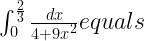
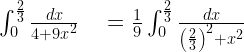
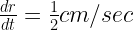
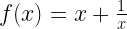
Class 12th Chapter -9 Differential Equations | NCERT Maths Solution | NCERT Solution | Edugrown

It is important that you have a strong foundation in Maths Solutions. This can help you immensely in exams. Because there is no paper pattern set for the board exams. Every year there are different twists and turns in questions asked in board exams. While preparing for maths it becomes to go through every bit of detail. Thus, NCERT Solutions Class 12 Maths can help you lay a strong foundation. There solutions of each and every question given in the NCERT 12 Textbook in this article. There are crucial chapters like integration, algebra, and calculus which you can solve easily using these Class 12 Maths solutions. Using these NCERT Maths Class 12 Solutions can give you an edge over the other students.

NCERT Solutions for Class 12 Maths Chapter :9 Differential Equations

Determine order and degree (if defined) of the differential equations given in Questions 1 to 10.

Looking for a tool that does Partial Derivation easily? Utilize our Partial Derivative Calculator tool and obtain the result instantly.

Ex 9.1 Class 12 Maths Question 1.
\frac { { d }^{ 4 }y }{ { dx }^{ 4 } } +({ sin }y^{ III })=0
Solution:
Order of the equation is 4
It is not a polynomial in derivatives so that it
has not degree.

Ex 9.1 Class 12 Maths Question 2.
{ y }^{ I }+5y=0
Solution:
{ y }^{ I }+5y=0
It is a D.E. of order one and degree one.

Ex 9.1 Class 12 Maths Question 3.
{ \left( \frac { ds }{ dt } \right) }^{ 4 }+3s{ \left( \frac { { d }^{ 2 }s }{ { dt }^{ 2 } } \right) }=0
Solution:
Order of the equation is 2.
Degree of the equation is

Ex 9.1 Class 12 Maths Question 4.
{ \left( \frac { { d }^{ 2 }y }{ { dx }^{ 2 } } \right) }^{ 2 }+cos\left( \frac { dy }{ dx } \right) =0
Solution:
{ \left( \frac { { d }^{ 2 }y }{ { dx }^{ 2 } } \right) }^{ 2 }+cos\left( \frac { dy }{ dx } \right) =0
It is a D.E. of order 2 and degree undefined

Ex 9.1 Class 12 Maths Question 5.
\frac { { d }^{ 2 }y }{ { dx }^{ 2 } } =cos3x+sin3x
Solution:
\frac { { d }^{ 2 }y }{ { dx }^{ 2 } } =cos3x+sin3x
It is a D.E. of order 2 and degree 1.

Ex 9.1 Class 12 Maths Question 6.
{ { (y }^{ III }) }^{ 2 }+{ { ( }y^{ II }) }^{ 3 }+{ { (y }^{ I }) }^{ 4 }+{ y }^{ 5 }=0
Solution:
Order of the equation is 3
Degree of the equation is 2

Ex 9.1 Class 12 Maths Question 7.
{ { y }^{ III } }+{ 2y^{ II } }+{ { y }^{ I } }=0
Solution:
{ { y }^{ III } }+{ 2y^{ II } }+{ { y }^{ I } }=0
The highest order derivative is y.
Thus the order of the D.E. is 3.
The degree of D.E is 1

Ex 9.1 Class 12 Maths Question 8.
{ y }^{ I }+y={ e }^{ x }
Solution:
{ y }^{ I }+y={ e }^{ x }
The order of the D. E. = 1 (highest order derivative)
The degree of the D.E. = 1.

Ex 9.1 Class 12 Maths Question 9.
{ y }^{ III }+{ { (y }^{ I }) }^{ 2 }+2y=0
Solution:
{ y }^{ III }+{ { (y }^{ I }) }^{ 2 }+2y=0
The highest derivative is 2.
Order of the D.E. = 2.
Degree of the D. E = 1

Ex 9.1 Class 12 Maths Question 10.
{ y }^{ II }+{ { 2y }^{ I } }+siny=0
Solution:
Order of the equation is 2
Degree of the equation is 1

Ex 9.1 Class 12 Maths Question 11.
The degree of the differential equation
{ \left( \frac { { d }^{ 2 }y }{ { dx }^{ 2 } } \right) }^{ 3 }{ +\left( \frac { dy }{ dx } \right) }^{ 2 }+sin{ \left( \frac { dy }{ dx } \right) }+1=0
(a) 3
(b) 2
(c) 1
(d) not defined
Solution:
{ \left( \frac { { d }^{ 2 }y }{ { dx }^{ 2 } } \right) }^{ 3 }{ +\left( \frac { dy }{ dx } \right) }^{ 2 }+sin{ \left( \frac { dy }{ dx } \right) }+1=0
The degree not defined.
Because the differential equation can not be written as a polynomial in all the differential coefficients.
Hence option (d) is correct.

Ex 9.1 Class 12 Maths Question 12.
The order of the differential equation
{ 2x }^{ 2 }\frac { { d }^{ 2 }y }{ { dx }^{ 2 } } -3\frac { dy }{ dx } +y=0
(a) 2
(b) 1
(c) 0
(d) not defined
Solution:
{ 2x }^{ 2 }\frac { { d }^{ 2 }y }{ { dx }^{ 2 } } -3\frac { dy }{ dx } +y=0
Thus order of the D.E. = 2
Hence option (a) is correct.

Verify that the given functions (explicit or implicit) is a solution of the corresponding differential equation

Ex 9.2 Class 12 Maths Question 1.
y={ e }^{ x }+1:{ y }^{ II }-{ y }^{ I }=0
Solution:
y={ e }^{ x }+1:{ y }^{ II }-{ y }^{ I }=0
NCERT Solutions for Class 12 Maths Chapter 9 Differential Equations Ex 9.2 Q1.1

Ex 9.2 Class 12 Maths Question 2.
y=x^{ 2 }+2x+c:{ y }^{ I }-2x-2=0
Solution:
y=x^{ 2 }+2x+c:{ y }^{ I }-2x-2=0
NCERT Solutions for Class 12 Maths Chapter 9 Differential Equations Ex 9.2 Q2.1

Ex 9.2 Class 12 Maths Question 3.
y=cosx+c:{ y }^{ I }+sinx=0
Solution:
y=cosx+c:{ y }^{ I }+sinx=0
NCERT Solutions for Class 12 Maths Chapter 9 Differential Equations Ex 9.2 Q3.1

Ex 9.2 Class 12 Maths Question 4.
y=\sqrt { 1+{ x }^{ 2 } } :{ y }^{ I }=\frac { xy }{ 1+{ x }^{ 2 } }
Solution:
y=\sqrt { 1+{ x }^{ 2 } } :{ y }^{ I }=\frac { xy }{ 1+{ x }^{ 2 } }
NCERT Solutions for Class 12 Maths Chapter 9 Differential Equations Ex 9.2 Q4.1

Ex 9.2 Class 12 Maths Question 5.
y=Ax:x{ y }^{ I }=y(x\neq 0)
Solution:
y=Ax:x{ y }^{ I }=y(x\neq 0)
NCERT Solutions for Class 12 Maths Chapter 9 Differential Equations Ex 9.2 Q5.1

Ex 9.2 Class 12 Maths Question 6.
y=x\quad sinx;{ xy }^{ I }=y+x\sqrt { { x }^{ 2 }-{ y }^{ 2 } } (x\neq 0\quad and\quad x>y\quad or\quad x<-y)
Solution:
y=x\quad sinx;{ xy }^{ I }=y+x\sqrt { { x }^{ 2 }-{ y }^{ 2 } } (x\neq 0\quad and\quad x>y\quad or\quad x<-y)
NCERT Solutions for Class 12 Maths Chapter 9 Differential Equations Ex 9.2 Q6.1

Ex 9.2 Class 12 Maths Question 7.
xy = logy + C,
NCERT Solutions for Class 12 Maths Chapter 9 Differential Equations Ex 9.2 Q7.1
Solution:
xy = logy + C,
NCERT Solutions for Class 12 Maths Chapter 9 Differential Equations Ex 9.2 Q7.2

Ex 9.2 Class 12 Maths Question 8.
y-cosy=x:(ysiny+cosy+x){ y }^{ I }=y
Solution:
y-cosy=x:(ysiny+cosy+x){ y }^{ I }=y
NCERT Solutions for Class 12 Maths Chapter 9 Differential Equations Ex 9.2 Q8.1

Ex 9.2 Class 12 Maths Question 9.
x+y={ ta }n^{ -1 }y;{ y }^{ 2 }{ y }^{ I }+{ y }^{ 2 }+1=0
Solution:
x+y={ ta }n^{ -1 }y;{ y }^{ 2 }{ y }^{ I }+{ y }^{ 2 }+1=0
NCERT Solutions for Class 12 Maths Chapter 9 Differential Equations Ex 9.2 Q9.1

Ex 9.2 Class 12 Maths Question 10.
y=\sqrt { { a }^{ 2 }-{ x }^{ 2 } } x\in (-a,a);x+y\frac { dy }{ dx } =0,(y\neq 0)
Solution:
y=\sqrt { { a }^{ 2 }-{ x }^{ 2 } } x\in (-a,a);x+y\frac { dy }{ dx } =0,(y\neq 0)
NCERT Solutions for Class 12 Maths Chapter 9 Differential Equations Ex 9.2 Q10.1

Ex 9.2 Class 12 Maths Question 11.
The number of arbitrary constants in the general solution of a differential equation of fourth order are:
(a) 0
(b) 2
(c) 3
(d) 4
Solution:
(b) The general solution of a differential equation of fourth order has 4 arbitrary constants.
Because it contains the same number of arbitrary constants as the order of differential equation.

Ex 9.2 Class 12 Maths Question 12.
The number of arbitrary constants in the particular solution of a differential equation of third order are:
(a) 3
(b) 2
(c) 1
(d) 0
Solution:
(d) Number of arbitrary constants = 0
Because particular solution is free from arbitrary constants.

In each of the following, Q. 1 to 5 form a differential equation representing the given family of curves by eliminating arbitrary constants a and b.

Ex 9.3 Class 12 Maths Question 1.
\frac { x }{ a } +\frac { y }{ b } =1
Solution:
Given that \frac { x }{ a } +\frac { y }{ b } =1 …(i)
differentiating (i) w.r.t x, we get
\frac { 1 }{ a } +\frac { 1 }{ b } { y }^{ I }=0 …(ii)
again differentiating w.r.t x, we get
\frac { 1 }{ b } { y }^{ II }=0\Rightarrow { y }^{ II }=0
which is the required differential equation

Ex 9.3 Class 12 Maths Question 2.
y² = a(b² – x²)
Solution:
given that
y² = a(b² – x²)…(i)
NCERT Solutions for Class 12 Maths Chapter 9 Differential Equations Ex 9.3 Q2.1

Ex 9.3 Class 12 Maths Question 3.
y = ae3x+be-2x
Solution:
Given that
y = ae3x+be-2x …(i)
NCERT Solutions for Class 12 Maths Chapter 9 Differential Equations Ex 9.3 Q3.1

Ex 9.3 Class 12 Maths Question 4.
y = e2x (a+bx)
Solution:
y = e2x (a+bx)
NCERT Solutions for Class 12 Maths Chapter 9 Differential Equations Ex 9.3 Q4.1

Ex 9.3 Class 12 Maths Question 5.
y = ex(a cosx+b sinx)
Solution:
The curve y = ex(a cosx+b sinx) …(i)
differentiating w.r.t x
NCERT Solutions for Class 12 Maths Chapter 9 Differential Equations Ex 9.3 Q5.1

Ex 9.3 Class 12 Maths Question 6.
Form the differential equation of the family of circles touching the y axis at origin
Solution:
The equation of the circle with centre (a, 0) and radius a, which touches y- axis at origin
NCERT Solutions for Class 12 Maths Chapter 9 Differential Equations Ex 9.3 Q6.1

Ex 9.3 Class 12 Maths Question 7.
Form the differential equation of the family of parabolas having vertex at origin and axis along positive y-axis.
Solution:
The equation of parabola having vertex at the origin and axis along positive y-axis is
NCERT Solutions for Class 12 Maths Chapter 9 Differential Equations Ex 9.3 Q7.1

Ex 9.3 Class 12 Maths Question 8.
Form the differential equation of family of ellipses having foci on y-axis and centre at origin.
Solution:
The equation of family ellipses having foci at y- axis is
NCERT Solutions for Class 12 Maths Chapter 9 Differential Equations Ex 9.3 Q8.1

Ex 9.3 Class 12 Maths Question 9.
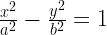
Form the differential equation of the family of hyperbolas having foci on x-axis and centre at the origin.
Solution:
Equation of the hyperbola is \frac { { x }^{ 2 } }{ { a }^{ 2 } } -\frac { { y }^{ 2 } }{ { b }^{ 2 } } =1
Differentiating both sides w.r.t x
NCERT Solutions for Class 12 Maths Chapter 9 Differential Equations Ex 9.3 Q9.1
which is the req. differential eq. of the hyperbola.
Ex 9.3 Class 12 Maths Question 10.
Form the differential equation of the family of circles having centre on y-axis and radius 3 units
Solution:
Let centre be (0, a) and r = 3
Equation of circle is
x² + (y – a)² = 9 …(i)
Differentiating both sides, we get
NCERT Solutions for Class 12 Maths Chapter 9 Differential Equations Ex 9.3 Q10.1
which is required equation

Ex 9.3 Class 12 Maths Question 11.
Which of the following differential equation has y={ c }_{ 1 }{ e }^{ x }+{ c }_{ 2 }{ e }^{ -x } as the general solution ?
(a) \frac { { d }^{ 2 }y }{ { dx }^{ 2 } } +y=0
(b) \frac { { d }^{ 2 }y }{ { dx }^{ 2 } } -y=0
(c) \frac { { d }^{ 2 }y }{ { dx }^{ 2 } } +1=0
(d) \frac { { d }^{ 2 }y }{ { dx }^{ 2 } } -1=0
Solution:
(b) y={ c }_{ 1 }{ e }^{ x }+{ c }_{ 2 }{ e }^{ -x }\Rightarrow \frac { dy }{ dx } ={ c }_{ 1 }{ e }^{ x }-{ c }_{ 2 }{ e }^{ -x }
\frac { { d }^{ 2 }y }{ { dx }^{ 2 } } ={ c }_{ 1 }{ e }^{ x }+{ c }_{ 2 }{ e }^{ -x }\Rightarrow \frac { { d }^{ 2 }y }{ { dx }^{ 2 } } -y=0

Ex 9.3 Class 12 Maths Question 12.
Which of the following differential equations has y = x as one of its particular solution ?
(a) \frac { { d }^{ 2 }y }{ { dx }^{ 2 } } -{ x }^{ 2 }\frac { dy }{ dx } +xy=x
(b) \frac { { d }^{ 2 }y }{ { dx }^{ 2 } } +{ x }\frac { dy }{ dx } +xy=x
(c) \frac { { d }^{ 2 }y }{ { dx }^{ 2 } } -{ x }^{ 2 }\frac { dy }{ dx } +xy=0
(d) \frac { { d }^{ 2 }y }{ { dx }^{ 2 } } +{ x }\frac { dy }{ dx } +xy=0
Solution:
(c) y = x
\frac { dy }{ dx } =1,\frac { { d }^{ 2 }y }{ { dx }^{ 2 } } =0
\frac { { d }^{ 2 }y }{ { dx }^{ 2 } } -{ x }^{ 2 }\frac { dy }{ dx } +xy=0

For each of the following D.E in Q. 1 to 10 find the general solution:

Ex 9.4 Class 12 Maths Question 1.
\frac { dy }{ dx } =\frac { 1-cosx }{ 1+cosx }
Solution:
\frac { dy }{ dx } =\frac { 1-cosx }{ 1+cosx }
\frac { dy }{ dx } =\frac { 1-cosx }{ 1+cosx } =\frac { { 2sin }^{ 2 }\left( \frac { x }{ 2 } \right) }{ { 2cos }^{ 2 }\left( \frac { x }{ 2 } \right) } ={ tan }^{ 2 }\left( \frac { x }{ 2 } \right)
integrating both sides, we get
NCERT Solutions for Class 12 Maths Chapter 9 Differential Equations Ex 9.4 Q1.1

Ex 9.4 Class 12 Maths Question 2.
\frac { dy }{ dx } =\sqrt { 4-{ y }^{ 2 } } (-2<y<2)
Solution:
\frac { dy }{ dx } =\sqrt { 4-{ y }^{ 2 } } \Rightarrow \int { \frac { dy }{ \sqrt { { 4-y }^{ 2 } } } } =\int { dx }
\Rightarrow { sin }^{ -1 }\frac { y }{ 2 } =x+C
\Rightarrow y=2sin(x+C)

Ex 9.4 Class 12 Maths Question 3.
\frac { dy }{ dx } +y=1(y\neq 1)
Solution:
\frac { dy }{ dx } +y=1\Rightarrow \int { \frac { dy }{ y-1 } } =-\int { dx }
\Rightarrow log(y-1)=-x+c\Rightarrow y=1+{ e }^{ -x }.{ e }^{ c }
Hence\quad y=1+{ Ae }^{ -x }
which is required solution

Ex 9.4 Class 12 Maths Question 4.
sec² x tany dx+sec² y tanx dy = 0
Solution:
we have
sec² x tany dx+sec² y tanx dy = 0
NCERT Solutions for Class 12 Maths Chapter 9 Differential Equations Ex 9.4 Q4.1

Ex 9.4 Class 12 Maths Question 5.
\left( { e }^{ x }+{ e }^{ -x } \right) dy-\left( { e }^{ x }-{ e }^{ -x } \right) dx=0
Solution:
we have
\left( { e }^{ x }+{ e }^{ -x } \right) dy-\left( { e }^{ x }-{ e }^{ -x } \right) dx=0
Integrating on both sides
NCERT Solutions for Class 12 Maths Chapter 9 Differential Equations Ex 9.4 Q5.1

Ex 9.4 Class 12 Maths Question 6.
\frac { dy }{ dx } =\left( { 1+x }^{ 2 } \right) \left( { 1+y }^{ 2 } \right)
Solution:
\frac { dy }{ { 1+y }^{ 2 } } =\left( { 1+x }^{ 2 } \right) dx
integrating on both side we get
{ tan }^{ -1 }y={ x+\frac { 1 }{ 3 } }x^{ 3 }+c
which is required solution

Ex 9.4 Class 12 Maths Question 7.
y logy dx – x dy = 0
Solution:
\because \quad y\quad logy\quad dx=x\quad dy\Rightarrow \frac { dy }{ y\quad logy } =\frac { dx }{ x }
integrating we get
NCERT Solutions for Class 12 Maths Chapter 9 Differential Equations Ex 9.4 Q7.1

Ex 9.4 Class 12 Maths Question 8.
{ x }^{ 5 }\frac { dy }{ dx } =-{ y }^{ 5 }
Solution:
{ x }^{ 5 }\frac { dy }{ dx } =-{ y }^{ 5 }\Rightarrow \int { { y }^{ -5 }dy } =-\int { { x }^{ -5 }dx }
\Rightarrow -\frac { 1 }{ { y }^{ 4 } } =\frac { 1 }{ { x }^{ 4 } } +4c\Rightarrow { x }^{ -4 }+{ y }^{ -4 }=k

Ex 9.4 Class 12 Maths Question 9.
solve the following
\frac { dy }{ dx } ={ sin }^{ -1 }x
Solution:
\frac { dy }{ dx } ={ sin }^{ -1 }x\Rightarrow \int { dy } =\int { { sin }^{ -1 }xdx }
integrating both sides we get
NCERT Solutions for Class 12 Maths Chapter 9 Differential Equations Ex 9.4 Q9.1

Ex 9.4 Class 12 Maths Question 10.
{ e }^{ x }tany\quad dx+{ (1-e }^{ x }){ sec }^{ 2 }dy=0
Solution:
{ e }^{ x }tany\quad dx+{ (1-e }^{ x }){ sec }^{ 2 }dy=0
we can write in another form
NCERT Solutions for Class 12 Maths Chapter 9 Differential Equations Ex 9.4 Q10.1

Find a particular solution satisfying the given condition for the following differential equation in Q.11 to 14.

Ex 9.4 Class 12 Maths Question 11.
\left( { x }^{ 3 }+{ x }^{ 2 }+x+1 \right) \frac { dy }{ dx } ={ 2x }^{ 2 }+x;y=1,when\quad x=0
Solution:
here
dy=\frac { { 2x }^{ 2 }+x }{ \left( { x }^{ 3 }+{ x }^{ 2 }+x+1 \right) } dx
integrating we get
NCERT Solutions for Class 12 Maths Chapter 9 Differential Equations Ex 9.4 Q11.1

Ex 9.4 Class 12 Maths Question 12.
x\left( { x }^{ 2 }-1 \right) \frac { dy }{ dx } =1,y=0\quad when\quad x=2
Solution:
x\left( { x }^{ 2 }-1 \right) \frac { dy }{ dx } =1,y=0\quad when\quad x=2
\Rightarrow \int { dy } =\int { \frac { dy }{ x(x+1)(x-1) } }
NCERT Solutions for Class 12 Maths Chapter 9 Differential Equations Ex 9.4 Q12.1

Ex 9.4 Class 12 Maths Question 13.
cos\left( \frac { dy }{ dx } \right) =a,(a\epsilon R),y=1\quad when\quad x=0
Solution:
cos\left( \frac { dy }{ dx } \right) =a\quad \therefore \frac { dy }{ dx } ={ cos }^{ -1 }a
NCERT Solutions for Class 12 Maths Chapter 9 Differential Equations Ex 9.4 Q13.1

Ex 9.4 Class 12 Maths Question 14.
\frac { dy }{ dx } =ytanx,y=1\quad when\quad x=0
Solution:
\frac { dy }{ dx } =ytanx\Rightarrow \int { \frac { dy }{ y } } =\int { tanx\quad dx }
=> logy = logsecx + C
When x = 0, y = 1
=> log1 = log sec0 + C => 0 = log1 + C
=> C = 0
∴ logy = log sec x
=> y = sec x.

Ex 9.4 Class 12 Maths Question 15.
Find the equation of the curve passing through the point (0,0) and whose differential equation { y }^{ I }={ e }^{ x }sinx
Solution:
{ y }^{ I }={ e }^{ x }sinx
\Rightarrow dy={ e }^{ x }sinx\quad dx
NCERT Solutions for Class 12 Maths Chapter 9 Differential Equations Ex 9.4 Q15.1

Ex 9.4 Class 12 Maths Question 16.
For the differential equation xy\frac { dy }{ dx } =(x+2)(y+2) find the solution curve passing through the point (1,-1)
Solution:
The differential equation isxy\frac { dy }{ dx } =(x+2)(y+2)
or xydy=(x + 2)(y+2)dx
NCERT Solutions for Class 12 Maths Chapter 9 Differential Equations Ex 9.4 Q16.1

Ex 9.4 Class 12 Maths Question 17.
Find the equation of a curve passing through the point (0, -2) given that at any point (pc, y) on the curve the product of the slope of its tangent and y-coordinate of the point is equal to the x-coordinate of the point
Solution:
According to the question y\frac { dy }{ dx } =x
\Rightarrow \int { ydy } =\int { xdx } \Rightarrow \frac { { y }^{ 2 } }{ 2 } =\frac { { x }^{ 2 } }{ 2 } +c
0, – 2) lies on it.c = 2
∴ Equation of the curve is : x² – y² + 4 = 0.

Ex 9.4 Class 12 Maths Question 18.
At any point (x, y) of a curve the slope of the tangent is twice the slope of the line segment joining the point of contact to the point (-4,-3) find the equation of the curve given that it passes through (- 2,1).
Solution:
Slope of the tangent to the curve = \frac { dy }{ dx }
slope of the line joining (x, y) and (- 4, – 3)
NCERT Solutions for Class 12 Maths Chapter 9 Differential Equations Ex 9.4 Q18.1

Ex 9.4 Class 12 Maths Question 19.
The volume of a spherical balloon being inflated changes at a constant rate. If initially its radius is 3 units and offer 3 seconds it is 6 units. Find the radius of balloon after t seconds.
Solution:
Let v be volume of the balloon.
NCERT Solutions for Class 12 Maths Chapter 9 Differential Equations Ex 9.4 Q19.1

Ex 9.4 Class 12 Maths Question 20.
In a bank principal increases at the rate of r% per year. Find the value of r if Rs 100 double itself in 10 years
Solution:
Let P be the principal at any time t.
According to the problem
NCERT Solutions for Class 12 Maths Chapter 9 Differential Equations Ex 9.4 Q20.1

Ex 9.4 Class 12 Maths Question 21.
In a bank principal increases at the rate of 5% per year. An amount of Rs 1000 is deposited with this bank, how much will it worth after 10 years
Solution:
Let p be the principal Rate of interest is 5%
NCERT Solutions for Class 12 Maths Chapter 9 Differential Equations Ex 9.4 Q21.1

Ex 9.4 Class 12 Maths Question 22.
In a culture the bacteria count is 1,00,000. The number is increased by 10% in 2 hours. In how many hours will the count reach 2,00,000 if the rate of growth of bacteria is proportional to the number present
Solution:
Let y denote the number of bacteria at any instant t • then according to the question
NCERT Solutions for Class 12 Maths Chapter 9 Differential Equations Ex 9.4 Q22.1

Ex 9.4 Class 12 Maths Question 23.
The general solution of a differential equation \frac { dy }{ dx } ={ e }^{ x+y }  is
(a) { e }^{ x }+{ e }^{ -y }=c
(b) { e }^{ x }+{ e }^{ y }=c
(c) { e }^{ -x }+{ e }^{ y }=c
(d) { e }^{ -x }+{ e }^{ -y }=c
Solution:
(a) \frac { dy }{ dx } ={ e }^{ x }.{ e }^{ y }\Rightarrow \int { { e }^{ -y }dy } =\int { { e }^{ x }dx }
\Rightarrow { e }^{ -y }={ e }^{ x }+k\Rightarrow { e }^{ x }+{ e }^{ -y }=c

Show that the given differential equation is homogeneous and solve each of them in Questions 1 to 10

Ex 9.5 Class 12 Maths Question 1.
(x²+xy)dy = (x²+y²)dx
Solution:
(x²+xy)dy = (x²+y²)dx
NCERT Solutions for Class 12 Maths Chapter 9 Differential Equations Ex 9.5 Q1.1
NCERT Solutions for Class 12 Maths Chapter 9 Differential Equations Ex 9.5 Q1.2

Ex 9.5 Class 12 Maths Question 2.
{ y }^{ I }=\frac { x+y }{ x }
Solution:
{ y }^{ I }=\frac { x+y }{ x }
NCERT Solutions for Class 12 Maths Chapter 9 Differential Equations Ex 9.5 Q2.1

Ex 9.5 Class 12 Maths Question 3.
(x-y)dy-(x+y)dx=0
Solution:
\frac { dy }{ dx } =\frac { x+y }{ x-y } =\frac { 1+\frac { y }{ x } }{ 1-\frac { y }{ x } }
NCERT Solutions for Class 12 Maths Chapter 9 Differential Equations Ex 9.5 Q3.1

Ex 9.5 Class 12 Maths Question 4.
(x²-y²)dx+2xy dy=0
Solution:
\frac { dy }{ dx } =\frac { { y }^{ 2 }-{ x }^{ 2 } }{ 2xy }
NCERT Solutions for Class 12 Maths Chapter 9 Differential Equations Ex 9.5 Q4.1

Ex 9.5 Class 12 Maths Question 5.
{ x }^{ 2 }\frac { dy }{ dx } ={ x }^{ 2 }-{ 2y }^{ 2 }+xy
Solution:
\frac { dy }{ dx } =1-2{ \left( \frac { y }{ x } \right) }^{ 2 }+\frac { y }{ x }
NCERT Solutions for Class 12 Maths Chapter 9 Differential Equations Ex 9.5 Q5.1

Ex 9.5 Class 12 Maths Question 6.
xdy-ydx=\sqrt { { x }^{ 2 }+{ y }^{ 2 } } dx
Solution:
xdy-ydx=\sqrt { { x }^{ 2 }+{ y }^{ 2 } } dx
NCERT Solutions for Class 12 Maths Chapter 9 Differential Equations Ex 9.5 Q6.1

Ex 9.5 Class 12 Maths Question 7.
\left\{ xcos\left( \frac { y }{ x } \right) +ysin\left( \frac { y }{ x } \right) \right\} ydx=\left\{ ysin\left( \frac { y }{ x } \right) -xcos\left( \frac { y }{ x } \right) \right\} xdy
Solution:
\left\{ xcos\left( \frac { y }{ x } \right) +ysin\left( \frac { y }{ x } \right) \right\} ydx=\left\{ ysin\left( \frac { y }{ x } \right) -xcos\left( \frac { y }{ x } \right) \right\} xdy
NCERT Solutions for Class 12 Maths Chapter 9 Differential Equations Ex 9.5 Q7.1
NCERT Solutions for Class 12 Maths Chapter 9 Differential Equations Ex 9.5 Q7.2
NCERT Solutions for Class 12 Maths Chapter 9 Differential Equations Ex 9.5 Q7.3

Ex 9.5 Class 12 Maths Question 8.
x\frac { dy }{ dx } -y+xsin\left( \frac { y }{ x } \right) =0
Solution:
x\frac { dy }{ dx } -y+xsin\left( \frac { y }{ x } \right) =0\Rightarrow \frac { dy }{ dx } =\frac { y }{ x } -sin\frac { y }{ x }
NCERT Solutions for Class 12 Maths Chapter 9 Differential Equations Ex 9.5 Q8.1

Ex 9.5 Class 12 Maths Question 9.
ydx+xlog\left( \frac { y }{ x } \right) dy-2xdy=0
Solution:
\frac { dy }{ dx } =\frac { y }{ 2x-xlog\frac { y }{ x } } =\frac { \frac { y }{ x } }{ 2-log\frac { y }{ x } }
NCERT Solutions for Class 12 Maths Chapter 9 Differential Equations Ex 9.5 Q9.1

Ex 9.5 Class 12 Maths Question 10.
\left( { 1+e }^{ \frac { x }{ y } } \right) dx+{ e }^{ \frac { x }{ y } }\left( 1-\frac { x }{ y } \right) dy=0
Solution:
\frac { dx }{ dy } =-\frac { { e }^{ \frac { x }{ y } }\left( 1-\frac { x }{ y } \right) }{ { 1+e }^{ \frac { x }{ y } } } =\frac { \left( \frac { x }{ y } -1 \right) { e }^{ \frac { x }{ y } } }{ { 1+e }^{ \frac { x }{ y } } } =f(x,y)
NCERT Solutions for Class 12 Maths Chapter 9 Differential Equations Ex 9.5 Q10.1
NCERT Solutions for Class 12 Maths Chapter 9 Differential Equations Ex 9.5 Q10.2

For each of the following differential equation in Q 11 to 15 find the particular solution satisfying the given condition:

Ex 9.5 Class 12 Maths Question 11.
(x + y) dy+(x – y)dx = 0,y = 1 when x = 1
Solution:
given
(x + y) dy+(x – y)dx = 0
NCERT Solutions for Class 12 Maths Chapter 9 Differential Equations Ex 9.5 Q11.1

Ex 9.5 Class 12 Maths Question 12.
x²dy+(xy+y²)dx=0, y=1 when x=1
Solution:
\frac { dy }{ dx } =\frac { xy+{ y }^{ 2 } }{ { x }^{ 2 } } =f(x,y)
f(x,y) is homogeneous
∴ put y = vx
NCERT Solutions for Class 12 Maths Chapter 9 Differential Equations Ex 9.5 Q12.1
NCERT Solutions for Class 12 Maths Chapter 9 Differential Equations Ex 9.5 Q12.2

Ex 9.5 Class 12 Maths Question 13.
\left( x{ sin }^{ 2 }\frac { y }{ x } -y \right) dx+xdy=0,y=\frac { \pi }{ 4 } ,when\quad x=1
Solution:
\left( x{ sin }^{ 2 }\frac { y }{ x } -y \right) dx+xdy=0
NCERT Solutions for Class 12 Maths Chapter 9 Differential Equations Ex 9.5 Q13.1

Ex 9.5 Class 12 Maths Question 14.
\frac { dy }{ dx } -\frac { y }{ x } +cosec\left( \frac { y }{ x } \right) =0,y=0\quad when\quad x=1
Solution:
\frac { dy }{ dx } -\frac { y }{ x } +cosec\left( \frac { y }{ x } \right) =0
which is a homogeneous differential equation
NCERT Solutions for Class 12 Maths Chapter 9 Differential Equations Ex 9.5 Q14.1

Ex 9.5 Class 12 Maths Question 15.
2xy-{ y }^{ 2 }-{ 2x }^{ 2 }\frac { dy }{ dx } =0,y=2,when\quad x=1
Solution:
\frac { dy }{ dx } =\frac { y }{ x } +\frac { 1 }{ 2 } { \left( \frac { y }{ x } \right) }^{ 2 } …(i)
NCERT Solutions for Class 12 Maths Chapter 9 Differential Equations Ex 9.5 Q15.1

Ex 9.5 Class 12 Maths Question 16.
A homogeneous equation of the form \frac { dx }{ dy } =h\left( \frac { x }{ y } \right)  can be solved by making the substitution,
(a) y=vx
(b) v=yx
(c) x=vy
(d) x=v
Solution:
(c) option x = vy

Ex 9.5 Class 12 Maths Question 17.
Which of the following is a homogeneous differential equation?
(a) (a) (4x + 6y + 5)dy-(3y + 2x + 4)dx = 0
(b) (xy)dx-({ x }^{ 3 }+{ y }^{ 3 })dy
(c) ({ x }^{ 3 }+{ 2y }^{ 2 })dx+2xydy=0
(d) { y }^{ 2 }dx+{ (x }^{ 2 }-xy-{ y }^{ 2 })dy=0
Solution:
(d)

Find the general solution of the following differential equations in Q.1 to 12

Ex 9.6 Class 12 Maths Question 1.
\frac { dy }{ dx } +2y=sinx
Solution:
Given equation is a linear differential equation of the form \frac { dy }{ dx } +Py=Q;
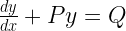
Here, P = 2, Q = sin x
NCERT Solutions for Class 12 Maths Chapter 9 Differential Equations Ex 9.6 Q1.1

Ex 9.6 Class 12 Maths Question 2.
\frac { dy }{ dx } +3y={ e }^{ -2x }
Solution:
\frac { dy }{ dx } +3y={ e }^{ -2x }
Here P = 3, IF={ e }^{ \int { p.dx } }={ e }^{ 3x }
NCERT Solutions for Class 12 Maths Chapter 9 Differential Equations Ex 9.6 Q2.1
which is required equation

Ex 9.6 Class 12 Maths Question 3.
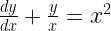
\frac { dy }{ dx } +\frac { y }{ x } ={ x }^{ 2 }
Solution:
\frac { dy }{ dx } +\frac { y }{ x } ={ x }^{ 2 }
IF={ e }^{ \int { \frac { 1 }{ x } dx } }={ e }^{ logx }=x
NCERT Solutions for Class 12 Maths Chapter 9 Differential Equations Ex 9.6 Q3.1

Ex 9.6 Class 12 Maths Question 4.
\frac { dy }{ dx } +(secx)y=tanx\left( 0\le x<\frac { \pi }{ 2 } \right)
Solution:
Here, P = secx, Q = tanx; IF={ e }^{ \int { p.dx } }={ e }^{ \int { secx.dx } }
={ e }^{ log|secx+tanx| }
= sec x + tan x
i.e., The solu. is y.× I.F. = ∫Q × I.F. dx + c
or y × (secx+tanx) = ∫tanx(secx+tanx)dx+c
Reqd. sol. is
∴ y(secx + tanx) = (secx + tanx)-x + c


Ex 9.6 Class 12 Maths Question 5.
{ cos }^{ 2 }x\frac { dy }{ dx } +y=tanx\left( 0\le x\le \frac { \pi }{ 2 } \right)
Solution:
\frac { dy }{ dx } +{ y\quad sec }^{ 2 }x={ sec }^{ 2 }x\quad tanx
⇒ integrating factor = { e }^{ \int { { sec }^{ 2 }xdx } }={ e }^{ tanx }
NCERT Solutions for Class 12 Maths Chapter 9 Differential Equations Ex 9.6 Q5.1

Ex 9.6 Class 12 Maths Question 6.
x\frac { dy }{ dx } +2y={ x }^{ 2 }logx
Solution:
\frac { dy }{ dx } +\frac { 2 }{ x } y\quad =\quad x\quad logx
Here P = \frac { 2 }{ x } and Q = x logx
NCERT Solutions for Class 12 Maths Chapter 9 Differential Equations Ex 9.6 Q6.1

Ex 9.6 Class 12 Maths Question 7.
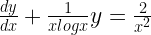
xlogx\frac { dy }{ dx } +y=\frac { 2 }{ x } logx
Solution:
\frac { dy }{ dx } +\frac { 1 }{ xlogx } y=\frac { 2 }{ { x }^{ 2 } }
NCERT Solutions for Class 12 Maths Chapter 9 Differential Equations Ex 9.6 Q7.1

Ex 9.6 Class 12 Maths Question 8.
(1+x²)dy+2xy dx = cotx dx(x≠0)
Solution:
(1+x²)dy+2xy dx = cotx dx
NCERT Solutions for Class 12 Maths Chapter 9 Differential Equations Ex 9.6 Q8.1

Ex 9.6 Class 12 Maths Question 9.
x\frac { dy }{ dx } +y-x+xy\quad cotx=0(x\neq 0)
Solution:
x\frac { dy }{ dx } +y-x+xy\quad cotx=0
x\frac { dy }{ dx } +(1+xcot x)y=x
NCERT Solutions for Class 12 Maths Chapter 9 Differential Equations Ex 9.6 Q9.1

Ex 9.6 Class 12 Maths Question 10.
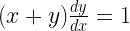
(x+y)\frac { dy }{ dx } =1
Solution:
(x+y)\frac { dy }{ dx } =1
\frac { 1 }{ (x+y) } \frac { dx }{ dy } =1\Rightarrow \frac { dx }{ dy } =x+y
NCERT Solutions for Class 12 Maths Chapter 9 Differential Equations Ex 9.6 Q10.1

Ex 9.6 Class 12 Maths Question 11.
ydx+(x-{ y }^{ 2 })dy=0
Solution:
ydx+(x-{ y }^{ 2 })dy=0
\Rightarrow y\frac { dx }{ dy } +x-{ y }^{ 2 }=0
NCERT Solutions for Class 12 Maths Chapter 9 Differential Equations Ex 9.6 Q11.1

Ex 9.6 Class 12 Maths Question 12.
\left( { x+3y }^{ 2 } \right) \frac { dy }{ dx } =y(y>0)
Solution:
y\frac { dx }{ dy } =x+{ 3y }^{ 2 }\quad or\quad \frac { dx }{ dy } -\frac { x }{ y } =3y
NCERT Solutions for Class 12 Maths Chapter 9 Differential Equations Ex 9.6 Q12.1

For each of the following Questions 13 to is find a particular solution, satisfying the given condition:

Ex 9.6 Class 12 Maths Question 13.
\frac { dy }{ dx } +2ytanx=sinx,y=0\quad when\quad x=\frac { \pi }{ 3 }
Solution:
\frac { dy }{ dx } +(2tanx)y=sinx,P=2tanx
NCERT Solutions for Class 12 Maths Chapter 9 Differential Equations Ex 9.6 Q13.1

Ex 9.6 Class 12 Maths Question 14.
\left( 1+{ x }^{ 2 } \right) \frac { dy }{ dx } +2xy=\frac { 1 }{ 1+{ x }^{ 2 } } ,y=0\quad when\quad x=1
Solution:
\frac { dy }{ dx } +\frac { 2x }{ 1+{ x }^{ 2 } } y=\frac { 1 }{ { \left( { 1+x }^{ 2 } \right) }^{ 2 } }
NCERT Solutions for Class 12 Maths Chapter 9 Differential Equations Ex 9.6 Q14.1

Ex 9.6 Class 12 Maths Question 15.
\frac { dy }{ dx } -3ycotx=sin2x,y=2\quad when\quad x=\frac { \pi }{ 2 }
Solution:
Here P = -3cot x
Q = sin 2x
NCERT Solutions for Class 12 Maths Chapter 9 Differential Equations Ex 9.6 Q15.1

Ex 9.6 Class 12 Maths Question 16.
Find the equation of the curve passing through the origin given that the slope of the tangent to the curve at any point (x,y) is equal to the sum of the coordinates of the point
Solution:

\frac { dy }{ dx } =x+y\Rightarrow \frac { dy }{ dx } -y=x\Rightarrow P=-1
NCERT Solutions for Class 12 Maths Chapter 9 Differential Equations Ex 9.6 Q16.1

Ex 9.6 Class 12 Maths Question 17.
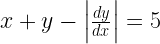
Find the equation of the curve passing through the point (0, 2) given that the sum of the coordinates of any point on the curve exceeds the magnitude of the slope of the tangent to the curve at that point by 5
Solution:
By the given condition
x+y-\left| \frac { dy }{ dx } \right|=5
NCERT Solutions for Class 12 Maths Chapter 9 Differential Equations Ex 9.6 Q17.1
NCERT Solutions for Class 12 Maths Chapter 9 Differential Equations Ex 9.6 Q17.2

Ex 9.6 Class 12 Maths Question 18.
The integrating factor of the differential equation x\frac { dy }{ dx } -y={ 2x }^{ 2 }
(a) { e }^{ -x }
(b) { e }^{ -y }
(c) \frac { 1 }{ x }
(d) x
Solution:
(c) P=\frac { -1 }{ x } \therefore IF={ e }^{ -\int { \frac { 1 }{ x } dx } }={ e }^{ -logx }=\frac { 1 }{ x }

Ex 9.6 Class 12 Maths Question 19.
The integrating factor of the differential equation \left( { 1-y }^{ 2 } \right) \frac { dx }{ dy } +yx=ay(-1<y<1) is
(a) \frac { 1 }{ { y }^{ 2 }-1 }
(b) \frac { 1 }{ \sqrt { { y }^{ 2 }-1 } }
(c) \frac { 1 }{ 1-{ y }^{ 2 } }
(d) \frac { 1 }{ \sqrt { { 1-y }^{ 2 } } }
Solution:
(d) \left( { 1-y }^{ 2 } \right) \frac { dx }{ dy } +yx=ay
NCERT Solutions for Class 12 Maths Chapter 9 Differential Equations Ex 9.6 Q19.1

Read More

Class 12th Chapter -8 Application of Integrals | NCERT Maths Solution | NCERT Solution | Edugrown

It is important that you have a strong foundation in Maths Solutions. This can help you immensely in exams. Because there is no paper pattern set for the board exams. Every year there are different twists and turns in questions asked in board exams. While preparing for maths it becomes to go through every bit of detail. Thus, NCERT Solutions Class 12 Maths can help you lay a strong foundation. There solutions of each and every question given in the NCERT 12 Textbook in this article. There are crucial chapters like integration, algebra, and calculus which you can solve easily using these Class 12 Maths solutions. Using these NCERT Maths Class 12 Solutions can give you an edge over the other students.

NCERT Solutions for Class 12 Maths Chapter : 8 Application of Integrals

Ex 8.1 Class 12 Maths Question 1.
Find the area of the region bounded by the curve y² = x and the lines x = 1, x = 4, and the x-axis.
Solution:
The curve y² = x is a parabola with vertex at origin.Axis of x is the line of symmetry, which is the axis of parabola. The area of the region bounded by the curve, x = 1, x=4 and the x-axis. Area LMQP
NCERT Solutions for Class 12 Maths Chapter 8 Application of Integrals Ex 8.1 Q1.1

Ex 8.1 Class 12 Maths Question 2.
Find the area of the region bounded by y² = 9x, x = 2, x = 4 and x-axis in the first quadrant
Solution:
The given curve is y² = 9x, which is a parabola with vertex at (0, 0) and axis along x-axis. It is symmetrical about x-axis, as it contains only even powers of y. x = 2 and x = 4 are straight lines parallel toy-axis at a positive distance of 2 and 4 units from it respectively.
∴ Required area = Area ABCD
NCERT Solutions for Class 12 Maths Chapter 8 Application of Integrals Ex 8.1 Q2.1

Ex 8.1 Class 12 Maths Question 3.
Find the area of the region bounded by x² = 4y, y = 2, y = 4 and the y-axis in the first quadrant.
Solution:
The given curve x² = 4y is a parabola with vertex at (0,0). Also since it contains only even powers of x,it is symmetrical about y-axis.y = 2 and y = 4 are straight lines parallel to x-axis at a positive distance of 2 and 4 from it respectively.
NCERT Solutions for Class 12 Maths Chapter 8 Application of Integrals Ex 8.1 Q3.1

Ex 8.1 Class 12 Maths Question 4.
Find the area of the region bounded by the ellipse \frac { { x }^{ 2 } }{ 16 } +\frac { { y }^{ 2 } }{ 9 } =1
Solution:
The equation of the ellipse is \frac { { x }^{ 2 } }{ 16 } +\frac { { y }^{ 2 } }{ 9 } =1
The given ellipse is symmetrical about both axis as it contains only even powers of y and x.
NCERT Solutions for Class 12 Maths Chapter 8 Application of Integrals Ex 8.1 Q4.1

Ex 8.1 Class 12 Maths Question 5.
Find the area of the region bounded by the ellipse \frac { { x }^{ 2 } }{ 4 } +\frac { { y }^{ 2 } }{ 9 } =1
Solution:
\frac { { x }^{ 2 } }{ 4 } +\frac { { y }^{ 2 } }{ 9 } =1 It is an ellipse with centre (0,0) and length of major axis = 2a = 2×3 = 6 and length of minor axis = 2b = 2 × 2 = 4.
NCERT Solutions for Class 12 Maths Chapter 8 Application of Integrals Ex 8.1 Q5.1

Ex 8.1 Class 12 Maths Question 6.
Find the area of the region in the first quadrant enclosed by x-axis, line x = √3y and the circle x² + y² = 4. .
Solution:
Consider the two equations x² + y² = 4 … (i)
and x = √3y i.e. y=\frac { 1 }{ \sqrt { 3 } } x …(ii)
(1) x² + y² = 4 is a circle with centre O (0,0) and radius = 2.
NCERT Solutions for Class 12 Maths Chapter 8 Application of Integrals Ex 8.1 Q6.1

Ex 8.1 Class 12 Maths Question 7.
Find the area of the smaller part of the circle x² + y² = a² cut off by the line x=\frac { a }{ \sqrt { 2 } }
Solution:
The equation of the given curve are
x² + y² = a² …(i) and x=\frac { a }{ \sqrt { 2 } }  …(ii)
Clearly, (i) represent a circle and (ii) is the equation of a straight line parallel to y-axis at a
NCERT Solutions for Class 12 Maths Chapter 8 Application of Integrals Ex 8.1 Q7.1

Ex 8.1 Class 12 Maths Question 8.
The area between x = y² and x = 4 is divided into two equal parts by the line x = a, find the value of a.
Solution:
Graph of the curve x = y² is a parabola as given in the figure. Its vertex is O and axis is x-axis. QR is the ordinate along x = 4
NCERT Solutions for Class 12 Maths Chapter 8 Application of Integrals Ex 8.1 Q8.1

Ex 8.1 Class 12 Maths Question 9.
Find the area of the region bounded by the parabola y = x² and y = |x|.
Solution:
Clearly x² = y represents a parabola with vertex at (0, 0) positive direction of y-axis as its axis it opens upwards.
y = |x| i.e., y = x and y = -x represent two lines passing through the origin and making an angle of 45° and 135° with the positive direction of the x-axis.
The required region is the shaded region as shown in the figure. Since both the curve are symmetrical about y-axis. So,
Required area = 2 (shaded area in the first quadrant)
NCERT Solutions for Class 12 Maths Chapter 8 Application of Integrals Ex 8.1 Q9.1

Ex 8.1 Class 12 Maths Question 10.
Find the area bounded by the curve x² = 4y and the line x = 4y – 2
Solution:
Given curve is x² = 4y …(i)
which is an upward parabola with vertex at (0,0) and it is symmetrical about y-axis
Equation of the line is x = 4y – 2 …(ii)
Solving (i) and (ii) simultaneously, we get; (4y – 2)² = 4y
⇒ 16y² – 16y + 4 = 4y
⇒ 4y² – 5y + 1 = 0
NCERT Solutions for Class 12 Maths Chapter 8 Application of Integrals Ex 8.1 Q10.1
NCERT Solutions for Class 12 Maths Chapter 8 Application of Integrals Ex 8.1 Q10.2

Ex 8.1 Class 12 Maths Question 11.
Find the area of the region bounded by the curve y² = 4x and the line x = 3.
Solution:
The curve y² = 4x is a parabola as shown in the figure. Axis of the parabola is x-axis. The area of the region bounded by the curve y² = 4x and the line x = 3 is
A = Area of region OPQ = 2 (Area of the region OLQ)
NCERT Solutions for Class 12 Maths Chapter 8 Application of Integrals Ex 8.1 Q11.1

Choose the correct answer in the following Exercises 12 and 13:

Ex 8.1 Class 12 Maths Question 12.

Area lying in the first quadrant and bounded by the circle x² +

 y² = 4 and the lines x = 0 and x = 2 is

(a) π
(b) \frac { \pi }{ 2 }
(c) \frac { \pi }{ 3 }
(d) \frac { \pi }{ 4 }
Solution:
(a) x² + y² = 4. It is a circle at the centre (0,0) and r=2
NCERT Solutions for Class 12 Maths Chapter 8 Application of Integrals Ex 8.1 Q12.1

Ex 8.1 Class 12 Maths Question 13.
Area of the region bounded by the curve y² = 4x, y-axis and the line y = 3 is
(a) 2
(b) \frac { 9 }{ 4 }
(c) \frac { 9 }{ 3 }
(d) \frac { 9 }{ 2 }
Solution:
(b) y² = 4x is a parabola
NCERT Solutions for Class 12 Maths Chapter 8 Application of Integrals Ex 8.1 Q13.1

Ex 8.2 Class 12 Maths Question 1.
Find the area of the circle 4x² + 4y² = 9 which is interior to the parabola x² = 4y.
Solution:
Area is bounded by the circle 4x² + 4y² = 9 and interior of the parabola x² = 4y.
Putting x² = 4y in x² + y² = \frac { 9 }{ 4 }
We get 4y + y² = \frac { 9 }{ 4 }
NCERT Solutions for Class 12 Maths Chapter 8 Application of Integrals Ex 8.2 Q1.1

Ex 8.2 Class 12 Maths Question 2.
Find the area bounded by curves (x – 1)² + y² = 1 and x² + y² = 1.
Solution:
Given circles are x² + y² = 1 …(i)
and (x – 1)² + y² = 1 …(ii)
Centre of (i) is O (0,0) and radius = 1
NCERT Solutions for Class 12 Maths Chapter 8 Application of Integrals Ex 8.2 Q2.1
NCERT Solutions for Class 12 Maths Chapter 8 Application of Integrals Ex 8.2 Q2.2

Ex 8.2 Class 12 Maths Question 3.
Find the area of the region bounded by the curves y = x² + 2, y = x, x = 0 and x = 3.
Solution:
Equation of the parabola is y = x² + 2 or x² = (y – 2)
Its vertex is (0,2) axis is y-axis.
Boundary lines are y = x, x = 0, x = 3.
Graphs of the curve and lines have been shown in the figure.
Area of the region PQRO = Area of the region OAQR-Area of region OAP
NCERT Solutions for Class 12 Maths Chapter 8 Application of Integrals Ex 8.2 Q3.1

Ex 8.2 Class 12 Maths Question 4.
Using integration find the area of region bounded by the triangle whose vertices are (-1,0), (1,3) and (3,2).
Solution:
The points A (-1,0), B( 1,3) and C (3,2) are plotted and joined.
Area of ∆ABC = Area of ∆ ABL + Area of trap. BLMC – Area of ∆ACM …(i)
The equation of the line joining the points
NCERT Solutions for Class 12 Maths Chapter 8 Application of Integrals Ex 8.2 Q4.1

Ex 8.2 Class 12 Maths Question 5.
Using integration find the area of the triangular region whose sides have the equations y = 2x + 1,y = 3x + 1 and x = 4.
Solution:
The given lines are y = 2x + 1 …(i)
y = 3x + 1 …(ii)
x = 4 …(iii)
Subtract (i) from eq (ii) we get x = 0, Putting x = 0 in eq(i) y = 1
∴ Lines (ii) and (i) intersect at A (0,1) putting x = 4 in eq. (2) =>y = 12 + 1 = 13
The lines (ii) and (iii) intersect at B (4,13) putting x=4ineq. (i):y = 8 + 1 = 9
∴ Lines (i) and (ii); Intersect at C (4,9),
NCERT Solutions for Class 12 Maths Chapter 8 Application of Integrals Ex 8.2 Q5.1

Ex 8.2 Class 12 Maths Question 6.
Smaller area bounded by the circle x² + y² = 4 and the line x + y = 2
(a) 2 (π – 2)
(b) π – 2
(c) 2π – 1
(d) 2(π + 2)
Solution:
(b) A circle of radius 2 and centre at O is drawn.The line AB: x + y = 2 is passed through (2,0) and (0,2). Area of the region ACB
= Area of quadrant OAB – Area of ∆OAB …(i)
NCERT Solutions for Class 12 Maths Chapter 8 Application of Integrals Ex 8.2 Q6.1

Ex 8.2 Class 12 Maths Question 7.
Area lying between the curves y² = 4x and y = 2x.
(a) \frac { 2 }{ 3 }
(b) \frac { 1 }{ 3 }
(c) \frac { 1 }{ 4 }
(d) \frac { 3 }{ 4 }
Solution:
(b) The curve is y² = 4x …(1)
and the line is y = 2x …(2)
NCERT Solutions for Class 12 Maths Chapter 8 Application of Integrals Ex 8.2 Q7.1

Read More

Class 12th Chapter -7 Integrals | NCERT Maths Solution | NCERT Solution | Edugrown

It is important that you have a strong foundation in Maths Solutions. This can help you immensely in exams. Because there is no paper pattern set for the board exams. Every year there are different twists and turns in questions asked in board exams. While preparing for maths it becomes to go through every bit of detail. Thus, NCERT Solutions Class 12 Maths can help you lay a strong foundation. There solutions of each and every question given in the NCERT 12 Textbook in this article. There are crucial chapters like integration, algebra, and calculus which you can solve easily using these Class 12 Maths solutions. Using these NCERT Maths Class 12 Solutions can give you an edge over the other students.

NCERT Solutions for Class 12 Maths Chapter : 7 Integrals

Find an antiderivative (or integral) of the following by the method of inspection:

Ex 7.1 Class 12 Maths Question 1.
sin 2x
Solution:
\int { sin2x\quad dx=-\frac { cos2x }{ 2 } +C }

Ex 7.1 Class 12 Maths Question 2.
cos 3x
Solution:
\int { cos3x\quad dx=\frac { sin3x }{ 3 } +C }

Ex 7.1 Class 12 Maths Question 3.
{ e }^{ 2x }
Solution:
\int { { e }^{ 2x }dx=\frac { { e }^{ 2x } }{ 2 } +C }

Ex 7.1 Class 12 Maths Question 4.
(ax + c)²
Solution:
\int { { (ax+b) }^{ 2 }dx=\frac { { (ax+b) }^{ 3 } }{ 3a } } +C

Ex 7.1 Class 12 Maths Question 5.
{ sin\quad 2x-4e }^{ 3x }
Solution:
\int { \left( { sin2x-4e }^{ 3x } \right) dx=-\frac { cos2x }{ 2 } -\frac { { 4e }^{ 3x } }{ 3 } +C }

Find the following integrals in Exercises 6 to 20 :

Ex 7.1 Class 12 Maths Question 6.
\int { \left( { 4e }^{ 3x }+1 \right) dx }
Solution:
=\int { { 4e }^{ 3x }dx+\int { dx=\frac { 4 }{ 3 } { e }^{ 3x }+x+c } }

Ex 7.1 Class 12 Maths Question 7.
\int { { x }^{ 2 }\left( 1-\frac { 1 }{ { x }^{ 2 } } \right) dx }
Solution:
=\int { { x }^{ 2 }\left( 1-\frac { 1 }{ { x }^{ 2 } } \right) dx } =\frac { { x }^{ 3 } }{ 3 } -x+C

Ex 7.1 Class 12 Maths Question 8.
\int { { (ax }^{ 2 }+bx+c)dx }
Solution:
=\frac { { ax }^{ 3 } }{ 3 } +\frac { { bx }^{ 2 } }{ 2 } +cx+d

Ex 7.1 Class 12 Maths Question 9.
\int { \left( { 2x }^{ 2 }+{ e }^{ x } \right) dx }
Solution:
=\frac { { 2x }^{ 3 } }{ 3 } +{ e }^{ x }+c

Ex 7.1 Class 12 Maths Question 10.
\int { { \left[ \sqrt { x } -\frac { 1 }{ \sqrt { x } } \right] }^{ 2 }dx }
Solution:
=\frac { { x }^{ 2 } }{ 2 } +logx-2x+C

Ex 7.1 Class 12 Maths Question 11.
\int { \frac { { x }^{ 3 }+{ 5x }^{ 2 }-4 }{ { x }^{ 2 } } dx }
Solution:
\int { \left( \frac { { x }^{ 3 } }{ { x }^{ 2 } } +\frac { { 5x }^{ 2 } }{ { x }^{ 2 } } -\frac { 4 }{ { x }^{ 2 } } \right) }
=\int { xdx+5\int { 1dx-4 } \int { { x }^{ 2 }dx } }
=\frac { { x }^{ 2 } }{ 2 } +5x+\frac { 4 }{ x } +c

Ex 7.1 Class 12 Maths Question 12.
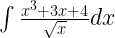
\int { \frac { { x }^{ 3 }+3x+4 }{ \sqrt { x } } dx }
Solution:
=\int { \left( { x }^{ \frac { 5 }{ 2 } }+{ 3x }^{ \frac { 1 }{ 2 } }+4{ x }^{ -\frac { 1 }{ 2 } } \right) } dx
=\frac { 2 }{ 7 } { x }^{ \frac { 7 }{ 2 } }+{ 2x }^{ \frac { 3 }{ 2 } }+8\sqrt { x } +c

Ex 7.1 Class 12 Maths Question 13.
\int { \frac { { x }^{ 3 }-{ x }^{ 2 }+x-1 }{ x-1 } dx }
Solution:
=\int { \frac { { x }^{ 2 }(x-1)+(x-1) }{ x-1 } dx }
=\int { \left( { x }^{ 2 }+1 \right) dx } =\frac { { x }^{ 3 } }{ 3 } +x+c

Ex 7.1 Class 12 Maths Question 14.
\int { \left( 1-x \right) \sqrt { x } dx }
Solution:
=\int { { x }^{ \frac { 1 }{ 2 } }-{ x }^{ \frac { 3 }{ 2 } }dx\quad =\quad \frac { 2 }{ 3 } { x }^{ \frac { 3 }{ 2 } }-\frac { 2 }{ 5 } { x }^{ \frac { 5 }{ 2 } } }

Ex 7.1 Class 12 Maths Question 15.
\int { \sqrt { x } \left( { 3x }^{ 2 }+2x+3 \right) dx }
Solution:
=\int { \left( { 3x }^{ \frac { 5 }{ 2 } }+{ 2 }^{ \frac { 3 }{ 2 } }+{ 3x }^{ \frac { 1 }{ 2 } } \right) dx }
=\frac { 6 }{ 7 } { x }^{ \frac { 7 }{ 2 } }+\frac { 4 }{ 5 } { x }^{ \frac { 5 }{ 2 } }+\frac { 6 }{ 3 } { x }^{ \frac { 3 }{ 2 } }+c

Ex 7.1 Class 12 Maths Question 16.
\int { (2x-3cosx+{ e }^{ x })dx }
Solution:
=\frac { { 2x }^{ 2 } }{ 2 } -3sinx+{ e }^{ x }+c
={ x }^{ 2 }-3sinx+{ e }^{ x }+c

Ex 7.1 Class 12 Maths Question 17.
\int { \left( { 2x }^{ 2 }-3sinx+5\sqrt { x } \right) dx }
Solution:
=\frac { { 2x }^{ 3 } }{ 3 } +3cosx+5\frac { { x }^{ \frac { 3 }{ 2 } } }{ \frac { 3 }{ 2 } } +c
=\frac { 2 }{ 3 } { x }^{ 3 }+3cosx+\frac { 10 }{ 3 } { x }^{ \frac { 3 }{ 2 } }+c

Ex 7.1 Class 12 Maths Question 18.
\int { secx(secx+tanx)dx }
Solution:
=\int { { (sec }^{ 2 }x+secxtanx)dx }
= tanx + secx + c

Ex 7.1 Class 12 Maths Question 19.
\int { \frac { { sec }^{ 2 }x }{ { cosec }^{ 2 }x } dx }
Solution:
=\int { \frac { 1 }{ { cos }^{ 2 }x } } { sin }^{ 2 }xdx
=\int { tan } ^{ 2 }xdx\quad =\int { { (sec }^{ 2 }x-1)dx\quad =tanx-x+c }

Ex 7.1 Class 12 Maths Question 20.
\int { \frac { 2-3sinx }{ { cos }^{ 2 }x } dx }
Solution:
=\int { \left( \frac { 2 }{ { cos }^{ 2 }x } -3\frac { sinx }{ { cos }^{ 2 }x } \right) dx }
=\int { ({ 2sec }^{ 2 }x-3secxtanx)dx }
= 2tanx – 3secx + c

Choose the correct answer in Exercises 21 and 22.

Ex 7.1 Class 12 Maths Question 21.
The antiderivative \left( \sqrt { x } +\frac { 1 }{ \sqrt { x } } \right)  equals
(a) \frac { 1 }{ 3 } { x }^{ \frac { 1 }{ 3 } }+{ 2x }^{ \frac { 1 }{ 2 } }+c
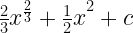
(b) \frac { 2 }{ 3 } { x }^{ \frac { 2 }{ 3 } }+{ \frac { 1 }{ 2 } x }^{ 2 }+c
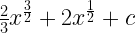
(c) \frac { 2 }{ 3 } { x }^{ \frac { 3 }{ 2 } }+{ 2x }^{ \frac { 1 }{ 2 } }+c
(d) \frac { 3 }{ 2 } { x }^{ \frac { 3 }{ 2 } }+\frac { 1 }{ 2 } { x }^{ \frac { 1 }{ 2 } }+c
Solution:
(c) \int { \left( \sqrt { x } +\frac { 1 }{ \sqrt { x } } \right) dx }
=\int { \left( { x }^{ \frac { 1 }{ 2 } }+{ x }^{ \frac { 1 }{ 2 } } \right) dx }
=\frac { 2 }{ 3 } { x }^{ \frac { 3 }{ 2 } }+{ 2x }^{ \frac { 1 }{ 2 } }+c

Ex 7.1 Class 12 Maths Question 22.
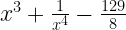
If \frac { d }{ dx } f(x)={ 4x }^{ 3 }-\frac { 3 }{ { x }^{ 4 } }  such that f(2)=0 then f(x) is
(a) { x }^{ 4 }+\frac { 1 }{ { x }^{ 3 } } -\frac { 129 }{ 8 }
(b) { x }^{ 3 }+\frac { 1 }{ { x }^{ 4 } } +\frac { 129 }{ 8 }
(c) { x }^{ 4 }+\frac { 1 }{ { x }^{ 3 } } +\frac { 129 }{ 8 }
(d) { x }^{ 3 }+\frac { 1 }{ { x }^{ 4 } } -\frac { 129 }{ 8 }
Solution:
(a) f(x)=\int { \left( { 4x }^{ 3 }-\frac { 3 }{ { x }^{ 4 } } \right) dx }
={ x }^{ 4 }+\frac { 1 }{ { x }^{ 3 } } +c
\therefore f(2)={ (2) }^{ 4 }+\frac { 1 }{ { (2) }^{ 3 } } +c=0=-\frac { 129 }{ 8 }

Integrate the functions in Exercises 1 to 37:

Ex 7.1 Class 12 Maths Question 1.
\frac { 2x }{ 1+{ x }^{ 2 } }
Solution:
Let 1+x² = t
⇒ 2xdx = dt
\therefore \int { \frac { 2x }{ 1+{ x }^{ 2 } } dx\quad = } \int { \frac { dt }{ t } \quad =logt+C\quad =log(1+{ x }^{ 2 })+C }

Ex 7.2 Class 12 Maths Question 2.
\frac { { \left( logx \right) }^{ 2 } }{ x }
Solution:
Let logx = t
⇒ \frac { 1 }{ x }dx=dt
\therefore \int { \frac { { (logx) }^{ 2 } }{ x } dx } \quad =\int { { t }^{ 2 }dt } \quad =\frac { { t }^{ 3 } }{ 3 } +c\quad =\frac { 1 }{ 3 } { (logx) }^{ 3 }+c

Ex 7.2 Class 12 Maths Question 3.
\frac { 1 }{ x+xlogx }
Solution:
Put 1+logx = t
∴ \frac { 1 }{ x }dx=dt
\int { \frac { 1 }{ x(1+logx) } dx } =\int { \frac { 1 }{ t } dt } =log|t|+c
= log|1+logx|+c

Ex 7.2 Class 12 Maths Question 4.
sinx sin(cosx)
Solution:
Put cosx = t, -sinx dx = dt
\int { sinx\quad sin(cosx)dx } =-\int { sin(cosx) } (-sinx)dx
=-\int { sint\quad dt } \quad =cost+c\quad =cos(cosx)+c

Ex 7.2 Class 12 Maths Question 5.
sin(ax+b) cos(ax+b)
Solution:
let sin(ax+b) = t
⇒ cos(ax+b)dx = dt
\therefore \int { sin(ax+b)cos(ax+b)dx } =\frac { 1 }{ a } \int { t\quad dt }
=\frac { 1 }{ a } .\frac { { t }^{ 2 } }{ 2 } +c\quad =\frac { 1 }{ 2a } { sin }^{ 2 }(ax+b)+C

Ex 7.2 Class 12 Maths Question 6.
\sqrt { ax+b }
Solution:
\int { \sqrt { ax+b } dx } \quad =\frac { 2 }{ 3a } { (ax+b) }^{ \frac { 3 }{ 2 } }+C

Ex 7.2 Class 12 Maths Question 7.
x\sqrt { x+2 }
Solution:
Let x+2 = t²
⇒ dx = 2t dt
NCERT Solutions for Class 12 Maths Chapter 7 Integrals Ex 7.2 Q7.1

Ex 7.2 Class 12 Maths Question 8.
x\sqrt { 1+{ 2x }^{ 2 } }
Solution:
let 1+2x² = t²
⇒ 4x dx = 2t dt
x\quad dx=\frac { t }{ 2 } dt\int { x\sqrt { 1+{ 2x }^{ 2 } } dx }
=\frac { 1 }{ 2 } \int { { t }^{ 2 }dt } =\frac { { t }^{ 3 } }{ 6 } +c=\frac { 1 }{ 6 } { ({ 1+2x }^{ 2 }) }^{ \frac { 3 }{ 2 } }+c

Ex 7.2 Class 12 Maths Question 9.
(4x+2)\sqrt { { x }^{ 2 }+x+1 }
Solution:
let x²+x+1 = t
⇒(2x+1)dx = dt
\therefore \int { (4x+1)\sqrt { { x }^{ 2 }+x+1 } dx } =2\int { \sqrt { t } dt }
=\frac { { 2t }^{ \frac { 3 }{ 2 } } }{ ^{ \frac { 3 }{ 2 } } } +c\quad =\frac { 4 }{ 3 } { t }^{ \frac { 3 }{ 2 } }+c\quad =\frac { 4 }{ 3 } { ({ x }^{ 2 }+x+1) }^{ \frac { 3 }{ 2 } }+c

Ex 7.2 Class 12 Maths Question 10.
\frac { 1 }{ x-\sqrt { x } }
Solution:
\int { \frac { 1 }{ x-\sqrt { x } } dx } =\int { \frac { 1 }{ \sqrt { x } (\sqrt { x-1 } ) } dx } =I
Let √x-1 = t
\frac { 1 }{ 2 } { x }^{ -\frac { 1 }{ 2 } }dx=dt
I=2\int { \frac { dt }{ t } }
= 2logt + c
= 2log(√x-1)+c

Ex 7.2 Class 12 Maths Question 11.
\frac { x }{ \sqrt { x+4 } } ,x>0
Solution:
let x+4 = t
⇒ dx = dt, x = t-4
NCERT Solutions for Class 12 Maths Chapter 7 Integrals Ex 7.2 Q11.1

Ex 7.2 Class 12 Maths Question 12.
{ { (x }^{ 3 }-1) }^{ \frac { 1 }{ 3 } }.{ x }^{ 5 }
Solution:
\int { { { (x }^{ 3 }-1) }^{ \frac { 1 }{ 3 } }.{ x }^{ 5 }.dx } \quad =\frac { 1 }{ 7 } { { (x }^{ 3 }-1) }^{ \frac { 7 }{ 3 } }+\frac { 1 }{ 4 } { { (x }^{ 3 }-1) }^{ \frac { 4 }{ 3 } }+c

Ex 7.2 Class 12 Maths Question 13.
\frac { { x }^{ 2 } }{ { { (2+3x }^{ 3 }) }^{ 3 } }
Solution:
Let 2+3x³ = t
⇒ 9x² dx = dt
\therefore \int { \frac { { x }^{ 2 } }{ { { (2+3x }^{ 3 }) }^{ 3 } } dx } =\frac { 1 }{ 9 } \int { \frac { dt }{ { t }^{ 3 } } =\frac { 1 }{ 9 } \int { { t }^{ -3 }dt } }
=-\frac { 1 }{ { 18t }^{ 2 } } +c\quad =-\frac { 1 }{ 18(2+{ 3x }^{ 3 })^{ 2 } } +c

Ex 7.2 Class 12 Maths Question 14.
\frac { 1 }{ x(logx)^{ m } } ,x>0
Solution:
Put log x = t, so that \frac { 1 }{ x }dx=dt
\therefore \int { \frac { 1 }{ { x(logx) }^{ m } } dx } =\int { \frac { dt }{ { t }^{ m } } =\frac { { t }^{ -m+1 } }{ -m+1 } +c }
=\frac { { (logx) }^{ 1-m } }{ 1-m } +c

Ex 7.2 Class 12 Maths Question 15.
\frac { x }{ 9-4{ x }^{ 2 } }
Solution:
put 9-4x² = t, so that -8x dx = dt
\therefore \int { \frac { x }{ 9-{ 4x }^{ 2 } } dx } =-\frac { 1 }{ 8 } \int { \frac { dt }{ t } } =-\frac { 1 }{ 8 } log|t|+c
=\frac { 1 }{ 8 } log\frac { 1 }{ |9-{ 4x }^{ 2 }| } +c

Ex 7.2 Class 12 Maths Question 16.
{ e }^{ 2x+3 }
Solution:
put 2x+3 = t
so that 2dx = dt
\int { { e }^{ 2x+3 } } dx\quad =\frac { 1 }{ 2 } \int { { e }^{ t }dt } \quad =\frac { 1 }{ 2 } { e }^{ t }+c\quad =\frac { 1 }{ 2 } { e }^{ 2x+3 }+c

Ex 7.2 Class 12 Maths Question 17.
\frac { x }{ { e }^{ { x }^{ 2 } } }
Solution:
Let x² = t
⇒ 2xdx = dt ⇒ xdx=\frac { dt }{ 2 }
\therefore \int { \frac { x }{ { e }^{ { x }^{ 2 } } } dx } \quad =\frac { 1 }{ 2 } \int { \frac { dt }{ { e }^{ t } } \quad =\frac { 1 }{ 2 } \int { { e }^{ -t } } dt }
=-\frac { 1 }{ 2 } { e }^{ { -x }^{ 2 } }+c

Ex 7.2 Class 12 Maths Question 18.
\frac { { e }^{ { tan }^{ -1 }x } }{ 1+{ x }^{ 2 } }
Solution:
let\quad { tan }^{ -1 }x=t\Rightarrow \frac { 1 }{ 1+{ x }^{ 2 } } dx=dt
\therefore \int { \frac { { e }^{ { tan }^{ -1 }x } }{ 1+{ x }^{ 2 } } dx } \quad =\int { { e }^{ t }dt\quad ={ e }^{ { tan }^{ -1 }x }+c }

Ex 7.2 Class 12 Maths Question 19.
\frac { { e }^{ 2x }-1 }{ { e }^{ 2x }+1 }
Solution:
\int { \frac { { e }^{ 2x }-1 }{ { e }^{ 2x }+1 } dx\quad =\int { \frac { { e }^{ x }({ e }^{ x }-{ e }^{ -x }) }{ { e }^{ x }({ e }^{ x }+{ e }^{ -x }) } dx=I } }
put ex+e-x = t
so that (ex-e-x)dx = dt
\therefore I=\int { \frac { dt }{ t } =log|t|+c } =log|{ e }^{ x }+{ e }^{ -x }|+c

Ex 7.2 Class 12 Maths Question 20.
\frac { { e }^{ 2x }-{ e }^{ 2x } }{ { e }^{ 2x }+{ e }^{ -2x } }
Solution:
put e2x-e-2x = t
so that (2e2x-2e-2x)dx = dt
\therefore \int { \frac { { e }^{ 2x }-{ e }^{ 2x } }{ { e }^{ 2x }+{ e }^{ -2x } } } dx=\frac { 1 }{ 2 } \int { \frac { 1 }{ t } dt } =\frac { 1 }{ 2 } log|t|+c
=\frac { 1 }{ 2 } log+|{ e }^{ 2x }+{ e }^{ -2x }|+c

Ex 7.2 Class 12 Maths Question 21.
tan²(2x-3)
Solution:
∫tan²(2x-3)dx = ∫[sec²(2x-3)-1]dx = I
put 2x-3 = t
so that 2dx = dt
I = \frac { 1 }{ 2 } ∫sec²t dt-x+c
\frac { 1 }{ 2 }t-x+c
\frac { 1 }{ 2 }tan(2x-3)-x+c

Ex 7.2 Class 12 Maths Question 22.
sec²(7-4x)
Solution:
∫sec²(7-4x)dx
\frac { tan(7-4x) }{ -4 }+c

Ex 7.2 Class 12 Maths Question 23.
\frac { { sin }^{ -1 }x }{ \sqrt { 1-{ x }^{ 2 } } }
Solution:
let\quad { sin }^{ -1 }x=t\quad \Rightarrow \frac { 1dx }{ \sqrt { 1-{ x }^{ 2 } } } =dt
\int { \frac { { sin }^{ -1 }x }{ \sqrt { 1-{ x }^{ 2 } } } dx } =\int { t\quad dt } =\frac { 1 }{ 2 } { t }^{ 2 }+c=\frac { 1 }{ 2 } { { (sin }^{ -1 }x) }^{ 2 }+c

Ex 7.2 Class 12 Maths Question 24.
\frac { 2cosx-3sinx }{ 6cosx+4sinx }
Solution:
put 2sinx+4cosx = t
⇒ (2cosx-3sinx)dx = dt
\frac { 1 }{ 2 } \int { \frac { 2cosx-3sinx }{ 2sinx+3cosx } dx } =\frac { 1 }{ 2 } \int { \frac { dt }{ t } } =\frac { 1 }{ 2 } log|t|+c
\frac { 1 }{ 2 } log|2sinx+3cosx|+c

Ex 7.2 Class 12 Maths Question 25.
\frac { 1 }{ { cos }^{ 2 }x{ (1-tanx) }^{ 2 } }
Solution:
put 1-tanx = t
so that -sec²x dx = dt
\therefore \int { \frac { 1 }{ { cos }^{ 2 }x{ (1-tanx) }^{ 2 } } dx } =\int { \frac { { sec }^{ 2 }x }{ { (1-tanx) }^{ 2 } } dx }
=-\int { \frac { dt }{ { t }^{ 2 } } } =\frac { 1 }{ t } +c=\frac { 1 }{ (1-tanx) } +c

Ex 7.2 Class 12 Maths Question 26.
\frac { cos\sqrt { x } }{ \sqrt { x } }
Solution:
put\quad \sqrt { x } =t,so\quad that\frac { 1 }{ 2\sqrt { x } } dx=dt
\therefore \int { \frac { cos\sqrt { x } }{ \sqrt { x } } } dx\quad =\quad 2\quad =\int { cost\quad dt\quad = } 2sint+c
= 2sin√x+c

Ex 7.2 Class 12 Maths Question 27.
\sqrt { sin2x } cos2x
Solution:
put sin2x = t²
⇒ cos2x dx = t dt
\therefore \int { \sqrt { sin2x } .cos2x\quad dx } \quad =\int { t.tdt=\frac { { t }^{ 3 } }{ 3 } +c }
=\frac { { (sin2x) }^{ \frac { 3 }{ 2 } } }{ 3 } +c

Ex 7.2 Class 12 Maths Question 28.
\frac { cosx }{ \sqrt { 1+sinx } }
Solution:
put 1+sinx = t²
⇒cosx dx = 2t dt
\therefore \int { \frac { cosx }{ \sqrt { 1+sinx } } dx } =2\int { dt } =2t+c
=2\sqrt { 1+sinx } +c

Ex 7.2 Class 12 Maths Question 29.
cotx log sinx
Solution:
put log sinx = t,
⇒ cot x dx = dt
\therefore \int { cot\quad logsinx\quad dx } =\int { t } dt\quad =\frac { { t }^{ 2 } }{ 2 } +c
=\frac { 1 }{ 2 } { (log\quad sinx) }^{ 2 }+c

Ex 7.2 Class 12 Maths Question 30.
\frac { sinx }{ 1+cosx }
Solution:
put 1+cosx = t
⇒ -sinx dx = dt
\therefore \int { \frac { sinx }{ 1+cosx } dx } =\int { -\frac { dt }{ t } } =-logt+c
=-log(1+cosx)+c

Ex 7.2 Class 12 Maths Question 31.
\frac { sinx }{ { (1+cosx) }^{ 2 } }
Solution:
put 1+cosx = t
so that -sinx dx = dt
\therefore \int { \frac { sinx }{ { (1+cosx) }^{ 2 } } dx } =-\int { \frac { dt }{ { t }^{ 2 } } }
=\frac { 1 }{ t } +c=\frac { 1 }{ 1+cosx } +c

Ex 7.2 Class 12 Maths Question 32.
\frac { 1 }{ 1+cotx }
Solution:
\int { \frac { 1 }{ 1+\frac { cosx }{ sinx } } } dx=\frac { 1 }{ 2 } \int { \frac { 2sinx\quad dx }{ sinx+cosx } }
NCERT Solutions for Class 12 Maths Chapter 7 Integrals Ex 7.2 Q32.1

Ex 7.2 Class 12 Maths Question 33.
\frac { 1 }{ 1-tanx }
Solution:
\int { \frac { 1 }{ 1-tanx } } dx=\frac { 1 }{ 2 } \int { \frac { 2cosx\quad dx }{ cosx-sinx } }
NCERT Solutions for Class 12 Maths Chapter 7 Integrals Ex 7.2 Q33.1

Ex 7.2 Class 12 Maths Question 34.
\frac { \sqrt { tanx } }{ sinxcosx }
Solution:
\int { \frac { \sqrt { tanx } }{ sinxcosx } dx } =\int { \frac { \sqrt { tanx } }{ tanx } } .{ sec }^{ 2 }xdx
NCERT Solutions for Class 12 Maths Chapter 7 Integrals Ex 7.2 Q34.1

Ex 7.2 Class 12 Maths Question 35.
\frac { { (1+logx) }^{ 2 } }{ x }
Solution:
let 1+logx = t
⇒ \frac { 1 }{ x }dx=dt
\int { \frac { { (1+logx) }^{ 2 } }{ x } dx } =\int { { t }^{ 2 }dt } =\frac { { t }^{ 3 } }{ 3 } +c
=\frac { 1 }{ 3 } { (1+logx) }^{ 3 }+c

Ex 7.2 Class 12 Maths Question 36.
\frac { (x+1){ (x+logx) }^{ 2 } }{ x }
Solution:
put x+logx = t
\left( \frac { x+1 }{ x } \right) dx=dt
\therefore \int { \frac { { (x+1)(x+logx) }^{ 2 } }{ x } } dx=\int { { t }^{ 2 }dt }
=\frac { { (x+logx) }^{ 3 } }{ 3 } +c

Ex 7.2 Class 12 Maths Question 37.
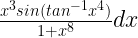
\frac { { x }^{ 3 }sin({ tan }^{ -1 }{ x }^{ 4 }) }{ 1+{ x }^{ 8 } } dx
Solution:
put\quad { tan }^{ -1 }{ x }^{ 4 }=t\quad so\quad that\frac { 1 }{ 1+{ x }^{ 8 } } .{ 4x }^{ 3 }dx=dt
\therefore \int { \frac { { x }^{ 3 }sin({ tan }^{ -1 }{ x }^{ 4 }) }{ 1+{ x }^{ 8 } } } dx=\frac { 1 }{ 4 } \int { sint\quad dt }
=\frac { 1 }{ 4 } (-cost)+c=-\frac { 1 }{ 4 } cos({ tan }^{ -1 }{ x }^{ 4 })+c

Choose the correct answer in exercises 38 and 39

Ex 7.2 Class 12 Maths Question 38.
\int { \frac { { 10x }^{ 9 }+{ 10 }^{ x }log{ e }^{ 10 } }{ { x }^{ 10 }+{ 10 }^{ x } } dx }
(a) 10x – x10 + C
(b) 10x + x10 + C
(c) (10x – x10) + C
(d) log (10x + x10) + C
Solution:
(d) \int { \frac { { 10x }^{ 9 }+{ 10 }^{ x }log{ e }^{ 10 } }{ { x }^{ 10 }+{ 10 }^{ x } } dx }
= log (10x + x10) + C

Ex 7.2 Class 12 Maths Question 39.
\int { \frac { dx }{ { sin }^{ 2 }x{ \quad cos }^{ 2 }x } = }
(a) tanx + cotx + c
(b) tanx – cotx + c
(c) tanx cotx + c
(d) tanx – cot2x + c
Solution:
(c) \int { \frac { dx }{ { sin }^{ 2 }x{ \quad cos }^{ 2 }x } = }
=\int { \left( { sec }^{ 2 }x+{ cosec }^{ 2 }x \right) dx }
= tanx – cotx + c

Find the integrals of the functions in Exercises 1 to 22.

Ex 7.3 Class 12 Maths Question 1.
sin²(2x+5)
Solution:
∫sin²(2x+5)dx
\frac { 1 }{ 2 }∫[1-cos2(2x+5)]dx
\frac { 1 }{ 2 }∫[1-cos(4x+10)]dx
\frac { 1 }{ 2 } \left[ x-\frac { sin(4x+10) }{ 4 } \right] +c

Ex 7.3 Class 12 Maths Question 2.
sin3x cos4x
Solution:
∫sin3x cos4x
\frac { 1 }{ 2 }∫[sin(3x+4x)+cos(3x-4x)]dx
\frac { 1 }{ 2 }∫[sin7x+sin(-x)]dx
-\frac { 1 }{ 14 } cos7x+\frac { 1 }{ 2 } cosx+c

Ex 7.3 Class 12 Maths Question 3.
∫cos2x cos4x cos6x dx
Solution:
\frac { 1 }{ 2 } ∫cos2x cos4x cos6x dx
\frac { 1 }{ 2 } ∫(cos6x+cos2x) cos6x dx
NCERT Solutions for Class 12 Maths Chapter 7 Integrals Ex 7.3 Q3.1

Ex 7.3 Class 12 Maths Question 4.
∫sin3(2x+1)dx
Solution:
\frac { 1 }{ 4 } ∫[3sin(2x+1)-sin3(2x+1)]dx
-\frac { 3 }{ 8 } cos(2x+1)+\frac { 1 }{ 24 } [4{ cos }^{ 3 }(2x+1)-3cos(2x+1)]+c
-\frac { 1 }{ 2 } cos(2x+1)+\frac { 1 }{ 6 } { cos }^{ 3 }(2x+1)+c

Ex 7.3 Class 12 Maths Question 5.
sin3x cos3x
Solution:
put sin x = t
⇒ cos x dx = dt
\therefore \int { { sin }^{ 3 }x{ cos }^{ 3 }xdx } =\int { { t }^{ 3 }(1-{ t }^{ 2 })dt }
\frac { { t }^{ 4 } }{ 4 } -\frac { { t }^{ 6 } }{ 6 } +c=\frac { { (sinx) }^{ 4 } }{ 4 } -\frac { { (sinx) }^{ 6 } }{ 6 } +c

Ex 7.3 Class 12 Maths Question 6.
sinx sin2x sin3x
Solution:
∫sinx sin2x sin3x dx
\frac { 1 }{ 2 } ∫ 2sin x sin 2x sin 3x dx
\frac { 1 }{ 2 } ∫ (cosx – cos3x)sin 3x dx
\frac { 1 }{ 2 } ∫ (sin 4x + sin 2x – sin 6x)dx
\frac { 1 }{ 4 } \left\{ \frac { -cos4x }{ 4 } -\frac { cos2x }{ 2 } +\frac { cos6x }{ 6 } \right\} +c

Ex 7.3 Class 12 Maths Question 7.
sin 4x sin 8x
Solution:
\frac { 1 }{ 2 }∫sin 4x sin 8xdx
\frac { 1 }{ 2 }∫(cos 4x – cos 12x)dx
\frac { 1 }{ 2 } \left[ \frac { sin4x }{ 4 } -\frac { sin12x }{ 12 } \right] +c

Ex 7.3 Class 12 Maths Question 8.
\frac { 1-cosx }{ 1+cosx }
Solution:
\int { \frac { 1-cosx }{ 1+cosx } dx }
\int { \frac { { 2sin }^{ 2 }\frac { x }{ 2 } }{ { 2cos }^{ 2 }\frac { x }{ 2 } } dx } =\int { { tan }^{ 2 }\frac { x }{ 2 } dx }
=\int { \left[ { sec }^{ 2 }\frac { x }{ 2 } -1 \right] } dx\quad =2tan\frac { x }{ 2 } -x+c

Ex 7.3 Class 12 Maths Question 9.
\frac { cosx }{ 1+cosx }
Solution:
\int { \frac { cosx }{ 1+cosx } dx }
=\int { 1 } dx-\int { \frac { 1 }{ 1+cosx } dx }
=x-\frac { 1 }{ 2 } \int { { sec }^{ 2 }\frac { x }{ 2 } dx+c\quad =x-tan\frac { x }{ 2 } +c }

Ex 7.3 Class 12 Maths Question 10.
∫sinx4 dx
Solution:
\int { { (\frac { 1-cos2x }{ 2 } ) }^{ 2 }dx } \quad =\frac { 1 }{ 4 } \int { \left( { 1+cos }^{ 2 }2x-2cos2x \right) dx }
NCERT Solutions for Class 12 Maths Chapter 7 Integrals Ex 7.3 Q10.1

Ex 7.3 Class 12 Maths Question 11.
cos4 2x
Solution:
∫ cos4 2x dx
\int { { \left( \frac { 1+cos4x }{ 2 } \right) }^{ 2 } } dx
NCERT Solutions for Class 12 Maths Chapter 7 Integrals Ex 7.3 Q11.1

Ex 7.3 Class 12 Maths Question 12.
\frac { { sin }^{ 2 }x }{ 1+cosx }
Solution:
\int { \frac { { sin }^{ 2 }x }{ 1+cosx } } dx\quad =\int { \frac { 1-{ cos }^{ 2 }x }{ 1+cosx } } dx
\int { (1-cosx) } dx\quad =x-sinx+c

Ex 7.3 Class 12 Maths Question 13.
\frac { cos2x-cos2\alpha }{ cosx-cos\alpha }
Solution:
let I = \int { \frac { \left( { 2cos }^{ 2 }x-1 \right) -\left( { 2cos }^{ 2 }\alpha -1 \right) }{ cosx-cos\alpha } } dx
\int { \frac { 2\left( { cos }x-cos\alpha \right) -\left( { cos }x+cos\alpha \right) }{ cosx-cos\alpha } } dx
= 2∫cos x dx + 2cos α∫dx
= 2(sinx+xcosα)+c

Ex 7.3 Class 12 Maths Question 14.
\frac { cosx-sinx }{ 1+sin2x }
Solution:
let I = \int { \frac { cosx-sinx }{ 1+sin2x } } dx=\int { \frac { cosx-sinx }{ { (cosx+sinx) }^{ 2 } } dx }
put cosx+sinx = t
⇒ (-sinx+cosx)dx = dt
I=\int { \frac { dt }{ { t }^{ 2 } } } =-\frac { 1 }{ t } +c\quad =\frac { -1 }{ cosx+sinx } +c

Ex 7.3 Class 12 Maths Question 15.
\int { { tan }^{ 3 }2x\quad sec2x\quad dx=I }
Solution:
I = ∫(sec22x-1)sec2x tan 2xdx
put sec2x=t,2 sec2x tan2x dx=dt
NCERT Solutions for Class 12 Maths Chapter 7 Integrals Ex 7.3 Q15.1

Ex 7.3 Class 12 Maths Question 16.
tan4x
Solution:
let I = ∫tan4 dx
= ∫(sec²x-1)²dx
NCERT Solutions for Class 12 Maths Chapter 7 Integrals Ex 7.3 Q16.1
Ex 7.3 Class 12 Maths Question 17.
\frac { { sin }^{ 3 }x+{ cos }^{ 3 }x }{ { sin }^{ 2 }x{ cos }^{ 2 }x }
Solution:
\int { \left( \frac { { sin }^{ 3 }x }{ { sin }^{ 2 }x{ cos }^{ 2 }x } +\frac { { cos }^{ 2 }x }{ sinx{ cos }^{ 2 }x } \right) dx }
= secx-cosecx+c

Ex 7.3 Class 12 Maths Question 18.
\frac { cos2x+{ 2sin }^{ 2 }x }{ { cos }^{ 2 }x }
Solution:
I=\int { \frac { \left( { cos }^{ 2 }x-{ sin }^{ 2 }x \right) +2{ sin }^{ 2 }x }{ { cos }^{ 2 }x } } dx
=\int { \frac { \left( { cos }^{ 2 }x-{ sin }^{ 2 }x \right) }{ { cos }^{ 2 }x } } dx\quad =\int { { sec }^{ 2 }xdx\quad =tanx+c }

Ex 7.3 Class 12 Maths Question 19.
\frac { 1 }{ sinx{ cos }^{ 3 }x }
Solution:
I=\int { \left( tanx+\frac { 1 }{ tanx } \right) } { sec }^{ 2 }xdx
put tanx = t
so that sec²x dx = dt
I=\int { \left( t+\frac { 1 }{ t } \right) } dt\quad =\frac { { t }^{ 2 } }{ 2 } +log|t|+c
=log|tanx|+\frac { 1 }{ 2 } { tan }^{ 2 }x+c

Ex 7.3 Class 12 Maths Question 20.
\frac { cos2x }{ { (cosx+sinx) }^{ 2 } }
Solution:
I=\int { \frac { { cos }^{ 2 }x-{ sin }^{ 2 }x }{ (cosx+sinx)^{ 2 } } dx } =\int { \frac { cosx-sinx }{ cosx+sinx } dx }
put cosx+sinx=t
⇒(-sinx+cox)dx = dt
I=\int { \frac { dt }{ t } } =log|t|+c\quad =log|cosx+sinx|+c

Ex 7.3 Class 12 Maths Question 21.
sin-1 (cos x)
Solution:
\int { { sin }^{ -1 }(cosx)dx } \quad ={ sin }^{ -1 }\left[ sin\left( \frac { \pi }{ 2 } -x \right) \right] dx
\int { \left( \frac { \pi }{ 2 } -x \right) dx } \quad =\frac { \pi x }{ 2 } -\frac { { x }^{ 2 } }{ 2 } +c

Ex 7.3 Class 12 Maths Question 22.
\int { \frac { 1 }{ cos(x-a)cos(x-b) } dx }
Solution:
\frac { 1 }{ sin(a-b) } \int { \frac { sin[(x-b)-(x-a)] }{ cos(x-a)cos(x-b) } dx }
=\frac { 1 }{ sin(a-b) } \left[ \int { tan(x-b)dx-\int { tan(x-a)dx } } \right]
=\frac { 1 }{ sin(a-b) } log\left| \frac { cos(x-a) }{ cos(x-b) } \right| +c

Ex 7.3 Class 12 Maths Question 23.
\int { \frac { { sin }^{ 2 }x-{ cos }^{ 2 }x }{ { sin }^{ 2 }x{ cos }^{ 2 }x } } dx\quad is\quad equal\quad to
(a) tanx+cotx+c
(b) tanx+cosecx+c
(c) -tanx+cotx+c
(d) tanx+secx+c
Solution:
(a) \int { \frac { { sin }^{ 2 }x-{ cos }^{ 2 }x }{ { sin }^{ 2 }x{ cos }^{ 2 }x } } dx
= ∫(sec²x-cosec²x)dx
= tanx+cotx+c

Ex 7.3 Class 12 Maths Question 24.
\int { \frac { e^{ x }(1+x) }{ cos^{ 2 }({ e }^{ x }.{ x }) } } dx\quad is\quad equal\quad to
(a) -cot(e.xx)+c
(b) tan(xex)+c
(c) tan(ex)+c
(d) cot ex+c
Solution:
(b) \int { \frac { e^{ x }(1+x) }{ cos^{ 2 }({ e }^{ x }.{ x }) } } dx
= ∫sec²t dt
= tan t+c = tan(xex)+c

Integrate the functions in exercises 1 to 23

Ex 7.4 Class 12 Maths Question 1.
\frac { { 3x }^{ 2 } }{ { x }^{ 6 }+1 }
Solution:
Let x3 = t ⇒ 3x²dx = dt
\int { \frac { { 3x }^{ 2 } }{ { x }^{ 6 }+1 } dx } =\int { \frac { dt }{ { t }^{ 2 }+1 } } ={ tan }^{ -1 }t+c
= tan-1 (x3)+c

Ex 7.4 Class 12 Maths Question 2.
\frac { 1 }{ \sqrt { 1+{ 4x }^{ 2 } } }
Solution:
\frac { 1 }{ 2 } \int { \frac { dx }{ \sqrt { \frac { 1 }{ 4 } +{ x }^{ 2 } } } } =\frac { 1 }{ 2 } \int { \frac { dx }{ \sqrt { { \left( \frac { 1 }{ 2 } \right) }^{ 2 }+{ x }^{ 2 } } } }
=\frac { 1 }{ 2 } log\left| 2x+\sqrt { 1+{ 4x }^{ 2 } } \right| +c

Ex 7.4 Class 12 Maths Question 3.
\frac { 1 }{ \sqrt { { (2-x) }^{ 2 }+1 } }
Solution:
put (2-x)=t
so that -dx=dt
⇒ dx=-dt
\int { \frac { dx }{ \sqrt { { (2-x) }^{ 2 }+1 } } } =-\int { \frac { dt }{ \sqrt { { t }^{ 2 }+1 } } } =-log|t+\sqrt { { t }^{ 2 }+1 } |+c
=log\left| \frac { 1 }{ (2-x)+\sqrt { { x }^{ 2 }-4x+5 } } \right| +c

Ex 7.4 Class 12 Maths Question 4.
\frac { 1 }{ \sqrt { 9-{ 25x }^{ 2 } } }
Solution:
\int { \frac { dx }{ \sqrt { 9-{ 25x }^{ 2 } } } } =\frac { 1 }{ 5 } \int { \frac { dx }{ \sqrt { { \left( \frac { 3 }{ 5 } \right) }^{ 2 }-{ x }^{ 2 } } } }
=\frac { 1 }{ 5 } { sin }^{ -1 }\left( \frac { x }{ \frac { 3 }{ 5 } } \right) +c\quad =\frac { 1 }{ 5 } { sin }^{ -1 }\left( \frac { 5x }{ 3 } \right) +c

Ex 7.4 Class 12 Maths Question 5.
\frac { 3x }{ 1+{ 2x }^{ 4 } }
Solution:
Put x²=t,so that 2x dx=dt
⇒x dx = \frac { dt }{ 2 }
\therefore \int { \frac { 3x }{ 1+{ 2x }^{ 4 } } dx } =\frac { 1 }{ 2 } \int { \frac { dt }{ 1+{ 2t }^{ 2 } } } =\frac { 3 }{ 4 } \int { \frac { dt }{ { \left( \frac { 1 }{ \sqrt { 2 } } \right) }^{ 2 }+{ t }^{ 2 } } }
=\frac { 3 }{ 2\sqrt { 2 } } { tan }^{ -1 }(\sqrt { 2t } )+c\quad =\frac { 3 }{ 2\sqrt { 2 } } { tan }^{ -1 }(\sqrt { { 2x }^{ 2 } } )+c

Ex 7.4 Class 12 Maths Question 6.
\frac { { x }^{ 2 } }{ 1-{ x }^{ 6 } }
Solution:
put x3 = t,so that 3x²dx = dt
\int { \frac { { x }^{ 2 } }{ 1-{ x }^{ 6 } } dx } \quad =\frac { 1 }{ 3 } \int { \frac { dt }{ 1-{ t }^{ 2 } } \quad =\frac { 1 }{ 6 } log } \left| \frac { 1+t }{ 1-t } \right| +c
=\frac { 1 }{ 6 } log\left| \frac { 1+{ x }^{ 3 } }{ 1-{ x }^{ 3 } } \right| +c

Ex 7.4 Class 12 Maths Question 7.
\frac { x-1 }{ \sqrt { { x }^{ 2 }-1 } }
Solution:
I=\int { \frac { x-1 }{ \sqrt { { x }^{ 2 }-1 } } dx } -\int { \frac { 1 }{ \sqrt { { x }^{ 2 }-1 } } dx } ,I={ I }_{ 1 }-{ I }_{ 2 }
put x²-1 = t,so that 2x dx = dt
NCERT Solutions for Class 12 Maths Chapter 7 Integrals Ex 7.4 Q7.1

Ex 7.4 Class 12 Maths Question 8.
\frac { { x }^{ 2 } }{ \sqrt { { x }^{ 6 }+{ a }^{ 6 } } }
Solution:
put x3 = t
so that 3x2dx = dt
I=\frac { 1 }{ 3 } \int { \frac { dt }{ { t }^{ 2 }+{ { (a }^{ 3 }) }^{ 2 } } =\frac { 1 }{ 3 } log\left| t+\sqrt { { t }^{ 2 }+{ a }^{ 6 } } \right| +c }
=\frac { 1 }{ 3 } log|{ x }^{ 3 }+\sqrt { { a }^{ 6 }+{ x }^{ 6 } } |+c

Ex 7.4 Class 12 Maths Question 9.
\frac { { sec }^{ 2 }x }{ \sqrt { { tan }^{ 2 }x+4 } }
Solution:
let tanx = t
sec x²dx = dt
I=\int { \frac { dt }{ \sqrt { { t }^{ 2 }+{ (2) }^{ 2 } } } } =log|t+\sqrt { { t }^{ 2 }+4 } |+c
=log|tanx+\sqrt { { tan }^{ 2 }x+4 } |+c

Ex 7.4 Class 12 Maths Question 10.
\frac { 1 }{ \sqrt { { x }^{ 2 }+2x+2 } }
Solution:
\int { \frac { 1 }{ \sqrt { { x }^{ 2 }+2x+2 } } dx } =\int { \frac { dx }{ \sqrt { { (x+1) }^{ 2 }+1 } } }
=log|(x+1)+\sqrt { { x }^{ 2 }+2x+2 } |+c

Ex 7.4 Class 12 Maths Question 11.
\frac { 1 }{ { 9x }^{ 2 }+6x+5 }
Solution:
\int { \frac { 1 }{ { 9x }^{ 2 }+6x+5 } } =\frac { 1 }{ 9 } \int { \frac { dx }{ { \left( x+\frac { 1 }{ 3 } \right) }^{ 2 }{ +\left( \frac { 2 }{ 3 } \right) }^{ 2 } } }
=\frac { 1 }{ 6 } { tan }^{ -1 }\left( \frac { 3x+1 }{ 2 } \right) +c

Ex 7.4 Class 12 Maths Question 12.
\frac { 1 }{ \sqrt { 7-6x-{ x }^{ 2 } } }
Solution:
I=\int { \frac { dx }{ \sqrt { { 4 }^{ 2 }-{ (x+3) }^{ 2 } } } } \quad ={ sin }^{ -1 }\left( \frac { x+3 }{ 4 } \right) +c

Ex 7.4 Class 12 Maths Question 13.
\frac { 1 }{ \sqrt { (x-1)(x-2) } }
Solution:
\int { \frac { 1 }{ \sqrt { (x-1)(x-2) } } dx } =\int { \frac { dx }{ \sqrt { { \left( x-\frac { 3 }{ 2 } \right) }^{ 2 }-{ \left( \frac { 1 }{ 2 } \right) }^{ 2 } } } }
=log\left| x-\frac { 3 }{ 2 } +\sqrt { { x }^{ 2 }-3x+2 } \right| +c

Ex 7.4 Class 12 Maths Question 14.
\frac { 1 }{ \sqrt { 8+3x-{ x }^{ 2 } } }
Solution:
\int { \frac { dx }{ \sqrt { 8+3x-{ x }^{ 2 } } } } =\int { \frac { dx }{ \sqrt { 8-\left( { x }^{ 2 }-3x \right) } } }
=\int { \frac { dx }{ \sqrt { { \left( \frac { \sqrt { 41 } }{ 2 } \right) }^{ 2 }-{ \left( x-\frac { 3 }{ 2 } \right) }^{ 2 } } } } \quad ={ sin }^{ -1 }\left( \frac { 2x-3 }{ \sqrt { 41 } } \right) +c

Ex 7.4 Class 12 Maths Question 15.
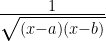
\frac { 1 }{ \sqrt { (x-a)(x-b) } }
Solution:
\int { \frac { dx }{ \sqrt { (x-a)(x-b) } } } =\int { \frac { dx }{ { \left( x-\frac { a+b }{ 2 } \right) }^{ 2 }-{ \left( \frac { a-b }{ 2 } \right) }^{ 2 } } }
=log\left| \left( x-\frac { a+b }{ 2 } \right) +\sqrt { (x-a)(x-b) } \right| +c

Ex 7.4 Class 12 Maths Question 16.
\frac { 4x+1 }{ \sqrt { { 2x }^{ 2 }+x-3 } }
Solution:
let\quad I=\int { \frac { 4x+1 }{ \sqrt { { 2x }^{ 2 }+x-3 } } } dx
put 2x²+x-3=t
so that (4x+1)dx=dt
let\quad I=\int { \frac { 4x+1 }{ \sqrt { { 2x }^{ 2 }+x-3 } } } dx
\therefore I=\int { \frac { dt }{ \sqrt { t } } } ={ 2t }^{ \frac { 1 }{ 2 } }+c\quad =2\sqrt { { 2x }^{ 2 }+x-3 } +c

Ex 7.4 Class 12 Maths Question 17.
\frac { x+2 }{ \sqrt { { x }^{ 2 }-1 } }
Solution:
\int { \frac { x+2 }{ \sqrt { { x }^{ 2 }-1 } } dx } \quad =\int { \frac { x }{ \sqrt { { x }^{ 2 }-1 } } dx } +\int { \frac { 2 }{ \sqrt { { x }^{ 2 }-1 } } dx }
NCERT Solutions for Class 12 Maths Chapter 7 Integrals Ex 7.4 Q17.1

Ex 7.4 Class 12 Maths Question 18.
\frac { 5x-2 }{ 1+2x+{ 3x }^{ 2 } }
Solution:
put 5x-2=A\frac { d }{ dx }(1+2x+3x²)+B
⇒ 6A=5, A=\frac { 5 }{ 6 }-2=2A+B, B=-\frac { 11 }{ 3 }
NCERT Solutions for Class 12 Maths Chapter 7 Integrals Ex 7.4 Q18.1

Ex 7.4 Class 12 Maths Question 19.
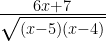
\frac { 6x+7 }{ \sqrt { (x-5)(x-4) } }
Solution:
\int { \frac { 6x+7 }{ \sqrt { (x-5)(x-4) } } dx } =\int { \frac { (6x+7)dx }{ \sqrt { { x }^{ 2 }-9x+20 } } }
NCERT Solutions for Class 12 Maths Chapter 7 Integrals Ex 7.4 Q19.1

Ex 7.4 Class 12 Maths Question 20.
\frac { x+2 }{ \sqrt { 4x-{ x }^{ 2 } } }
Solution:
I=\int { \frac { x-2 }{ \sqrt { 4-{ (x-2) }^{ 2 } } } dx+4\int { \frac { dx }{ \sqrt { 4-{ (x-2) }^{ 2 } } } } }
NCERT Solutions for Class 12 Maths Chapter 7 Integrals Ex 7.4 Q20.1

Ex 7.4 Class 12 Maths Question 21.
\frac { x+2 }{ \sqrt { { x }^{ 2 }+2x+3 } }
Solution:
I=\frac { 1 }{ 2 } \int { \frac { 2x+2 }{ \sqrt { { x }^{ 2 }+2x+3 } } dx }
NCERT Solutions for Class 12 Maths Chapter 7 Integrals Ex 7.4 Q21.1

Ex 7.4 Class 12 Maths Question 22.
\frac { x+3 }{ { x }^{ 2 }-2x-5 }
Solution:
I=\frac { 1 }{ 2 } \int { \frac { 2x-2 }{ { x }^{ 2 }-2x-5 } dx } +\int { \frac { dx }{ { x }^{ 2 }-2x-5 } }
NCERT Solutions for Class 12 Maths Chapter 7 Integrals Ex 7.4 Q22.1

Ex 7.4 Class 12 Maths Question 23.
\frac { 5x+3 }{ \sqrt { { x }^{ 2 }+4x+10 } }
Solution:
I=\int { \frac { \frac { 5 }{ 2 } (2x+4)+(3-10) }{ \sqrt { { x }^{ 2 }+4x+10 } } dx }
NCERT Solutions for Class 12 Maths Chapter 7 Integrals Ex 7.4 Q23.1

Ex 7.4 Class 12 Maths Question 24.
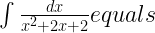
\int { \frac { dx }{ { x }^{ 2 }+2x+2 } equals }
(a) xtan-1(x+1)+c
(b) (x+1)tan-1x+c
(c) tan-1(x+1)+c
(d) tan-1x+c
Solution:
(b) let\quad I=\int { \frac { dx }{ { x }^{ 2 }+2x+2 } } =\int { \frac { dx }{ (x+1)^{ 2 }+1 } }
= (x+1)tan-1x+c

Ex 7.4 Class 12 Maths Question 25.
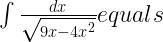
\int { \frac { dx }{ \sqrt { 9x-{ 4x }^{ 2 } } } equals }
(a) \frac { 1 }{ 9 } { sin }^{ -1 }\left( \frac { 9x-8 }{ 8 } \right) +c
(b) \frac { 1 }{ 2 } { sin }^{ -1 }\left( \frac { 8x-9 }{ 9 } \right) +c
(c) \frac { 1 }{ 3 } { sin }^{ -1 }\left( \frac { 9x-8 }{ 8 } \right) +c
(d) { sin }^{ -1 }\left( \frac { 9x-8 }{ 9 } \right) +c
Solution:
(b) \int { \frac { dx }{ \sqrt { 9x-{ 4x }^{ 2 } } } } =\frac { 1 }{ 2 } \left[ \frac { dx }{ \sqrt { \left( \frac { 9 }{ 8 } \right) ^{ 2 }-\left[ { x }^{ 2 }-{ \frac { 9 }{ 4 } }x+\left( \frac { 9 }{ 8 } \right) ^{ 2 } \right] } } \right]
\frac { 1 }{ 2 } { sin }^{ -1 }\left( \frac { 8x-9 }{ 9 } \right) +c

Integrate the rational function in exercises 1 to 21

Ex 7.5 Class 12 Maths Question 1.
\frac { x }{ (x+1)(x+2) }
Solution:
let \frac { x }{ (x+1)(x+2) } ≡ \frac { A }{ x+1 } +\frac { B }{ x+2 }
⇒ x ≡ A(x+2)+B(x+1)….(i)
putting x = -1 & x = -2 in (i)
we get A = 1,B = 2
\therefore \int { \frac { 1 }{ (x+1)(x+2) } dx } =\int { \frac { -1 }{ x+1 } dx } +\int { \frac { 2 }{ x+2 } dx }
=-log|x+1| + 2log|x+2|+c

Ex 7.5 Class 12 Maths Question 2.
\frac { 1 }{ { x }^{ 2 }-9 }
Solution:
let \frac { 1 }{ { x }^{ 2 }-9 } =\frac { 1 }{ (x-3)(x+3) } \equiv \frac { A }{ x-3 } +\frac { B }{ x+3 }
⇒ x ≡ A(x+3)+B(x-3)…(i)
put x = 3, -3 in (i)
we get A=\frac { 1 }{ 6 } & B=-\frac { 1 }{ 6 }
\therefore \int { \frac { 1 }{ { x }^{ 2 }-9 } dx } =\frac { 1 }{ 6 } \int { \left[ \frac { 1 }{ x-3 } -\frac { 1 }{ x+3 } \right] dx }
=\frac { 1 }{ 6 } log\left| \frac { x-3 }{ x+3 } \right| +c

Ex 7.5 Class 12 Maths Question 3.
\frac { 3x-1 }{ (x-1)(x-2)(x-3) }
Solution:
Let \frac { 3x-1 }{ (x-1)(x-2)(x-3) } =\frac { A }{ x-1 } +\frac { B }{ x-2 } +\frac { C }{ x-3 }
⇒ 3x-1 = A(x-2)(x-3)+B(x-1)(x-3)+C(x-1)(-2)…..(i)
put x = 1,2,3 in (i)
we get A = 1,B = -5 & C = 4
\therefore I=\int { \frac { 1 }{ x-1 } dx } -5\int { \frac { 1 }{ x-2 } dx } +4\int { \frac { 1 }{ x-3 } dx }
=log|x-1| – 5log|x-2| + 4log|x+3| + C

Ex 7.5 Class 12 Maths Question 4.
\frac { x }{ (x-1)(x-2)(x-3) }
Solution:
let \frac { x }{ (x-1)(x-2)(x-3) } =\frac { A }{ x-1 } +\frac { B }{ x-2 } +\frac { C }{ x-3 }
⇒ x ≡ A(x-2)(x-3)+B(x-1)(x-3)+C(x-1)(x-2)…(i)
put x = 1,2,3 in (i)
A=\frac { 1 }{ 2 } ,B=-2,C=\frac { 3 }{ 2 }
\therefore I=\frac { 1 }{ 2 } \int { \frac { dx }{ x-1 } } -2\int { \frac { dx }{ x-2 } } +\frac { 3 }{ 2 } \int { \frac { dx }{ x-3 } }
=\frac { 1 }{ 2 } log|x-1|-2log|x-2|+\frac { 3 }{ 2 } log|x-3|+c

Ex 7.5 Class 12 Maths Question 5.
\frac { 2x }{ { x }^{ 2 }+3x+2 }
Solution:
let \frac { 2x }{ { x }^{ 2 }+3x+2 } =\frac { 2x }{ (x+1)(x+2) } =\frac { A }{ x+1 } +\frac { B }{ x+2 }
⇒ 2x = A(x+2)+B(x+1)…(i)
put x = -1, -2 in (i)
we get A = -2, B = 4
\therefore \int { \frac { 2x }{ { x }^{ 2 }+3x+2 } dx } =-2\int { \frac { dx }{ x+1 } } +4\int { \frac { dx }{ x+2 } }
=-2log|x+1|+4log|x+2|+c

Ex 7.5 Class 12 Maths Question 6.
\frac { 1-{ x }^{ 2 } }{ x(1-2x) }
Solution:
\frac { 1-{ x }^{ 2 } }{ (x-2{ x }^{ 2 }) }  is an improper fraction therefore we
convert it into a proper fraction. Divide 1 – x² by x – 2x² by long division.
NCERT Solutions for Class 12 Maths Chapter 7 Integrals Ex 7.5 Q6.1

Ex 7.5 Class 12 Maths Question 7.
\frac { x }{ \left( { x }^{ 2 }+1 \right) \left( x-1 \right) }
Solution:
let \frac { x }{ \left( { x }^{ 2 }+1 \right) \left( x-1 \right) } =\frac { A }{ x-1 } +\frac { Bx+C }{ { x }^{ 2 }+1 }
⇒ x = A(x²+1)+(Bx+C)(x-1)
Put x = 1,0
⇒ A=\frac { 1 }{ 2 } C=\frac { 1 }{ 2 } \Rightarrow B=-\frac { 1 }{ 2 }
\therefore I=\frac { 1 }{ 2 } \int { \frac { dx }{ x-1 } } -\frac { 1 }{ 2 } \int { \frac { x }{ { x }^{ 2 }+1 } dx } +\frac { 1 }{ 2 } \int { \frac { dx }{ { x }^{ 2 }+1 } }
=\frac { 1 }{ 2 } log(x-1)-\frac { 1 }{ 4 } log({ x }^{ 2 }+1)+\frac { 1 }{ 2 } { tan }^{ -1 }x+c

Ex 7.5 Class 12 Maths Question 8.
\frac { x }{ { \left( x-1 \right) }^{ 2 }\left( x+2 \right) }
Solution:
\frac { x }{ { \left( x-1 \right) }^{ 2 }\left( x+2 \right) } =\frac { A }{ x-1 } +\frac { B }{ { \left( x-1 \right) }^{ 2 } } +\frac { C }{ x+2 }
⇒ x ≡ A(x-1)(x+2)+B(x+2)+C(x-1)² …(i)
put x = 1, -2
we get B=\frac { 1 }{ 3 } ,C=\frac { -2 }{ 9 }
\therefore I=\frac { 2 }{ 9 } \int { \frac { 1 }{ x-1 } dx } +\frac { 1 }{ 3 } \int { \frac { 1 }{ { (x-1) }^{ 2 } } dx } -\frac { 2 }{ 9 } \int { \frac { 1 }{ x+2 } dx }
=\frac { 2 }{ 9 } log\left| \frac { x-1 }{ x+2 } \right| -\frac { 1 }{ 3\left( x-1 \right) } +c

Ex 7.5 Class 12 Maths Question 9.
\frac { 3x+5 }{ { x }^{ 3 }-{ x }^{ 2 }-x+1 }
Solution:
let \frac { 3x+5 }{ { x }^{ 2 }(x-1)-1(x-1) }
\frac { 3x+5 }{ (x-1)^{ 2 }(x+1) } =\frac { A }{ x-1 } +\frac { B }{ { (x-1) }^{ 2 } } +\frac { C }{ x+1 }
⇒ 3x+5 = A(x-1)(x+1)+B(x+1)+C(x-1)
put x = 1,-1,0
we get B=4,C=\frac { 1 }{ 2 } ,A=-\frac { 1 }{ 2 }
\therefore I=-\frac { 1 }{ 2 } \int { \frac { dx }{ (x-1) } } +4\frac { dx }{ { (x-1) }^{ 2 } } +\frac { 1 }{ 2 } \int { \frac { dx }{ x+1 } }
=\frac { 1 }{ 2 } log\left| \frac { x+1 }{ x-1 } \right| -\frac { 4 }{ x-1 } +c

Ex 7.5 Class 12 Maths Question 10.
\frac { 2x-3 }{ ({ x }^{ 2 }-1)(2x+3) }
Solution:
\frac { 2x-3 }{ ({ x }^{ 2 }-1)(2x+3) } =\frac { 2x-3 }{ (x-1)(x+1)(2x+3) }
NCERT Solutions for Class 12 Maths Chapter 7 Integrals Ex 7.5 Q10.1

Ex 7.5 Class 12 Maths Question 11.
\frac { 5x }{ (x-1)({ x }^{ 2 }-4) }
Solution:
let \frac { 5x }{ (x-1)({ x }^{ 2 }-4) } =\frac { 5x }{ (x+1)(x+2)(x-2) }
NCERT Solutions for Class 12 Maths Chapter 7 Integrals Ex 7.5 Q11.1

Ex 7.5 Class 12 Maths Question 12.
\frac { { x }^{ 3 }+x+1 }{ { x }^{ 2 }-1 }
Solution:
\frac { { x }^{ 3 }+x+1 }{ { x }^{ 2 }-1 } =x+\frac { 2x+1 }{ (x+1)(x-1) }
NCERT Solutions for Class 12 Maths Chapter 7 Integrals Ex 7.5 Q12.1

Ex 7.5 Class 12 Maths Question 13.
\frac { 2 }{ (1-x)(1+{ x }^{ 2 }) }
Solution:
\frac { 2 }{ (1-x)(1+{ x }^{ 2 }) } =\frac { A }{ 1-x } +\frac { Bx+C }{ 1+{ x }^{ 2 } }
⇒ 2 = A(1+x²) + (Bx+C)(1 -x) …(i)
Putting x = 1 in (i), we get; A = 1
Also 0 = A – B and 2 = A + C ⇒B = A = 1 & C = 1
NCERT Solutions for Class 12 Maths Chapter 7 Integrals Ex 7.5 Q13.1

Ex 7.5 Class 12 Maths Question 14.
\frac { 3x-1 }{ { (x+2) }^{ 2 } }
Solution:
\frac { 3x-1 }{ { (x+2) }^{ 2 } } \equiv \frac { A }{ x+1 } +\frac { B }{ { (x+2) }^{ 2 } }
=>3x – 1 = A(x + 2) + B …(i)
Comparing coefficients A = -1 and B = -7
\therefore \int { \frac { 3x-1 }{ { (x+2) }^{ 2 } } dx } =3\int { \frac { dx }{ x+2 } } -7\int { \frac { dx }{ { (x+2) }^{ 2 } } }
=3log|x+2|+\frac { 7 }{ x+2 } +c

Ex 7.5 Class 12 Maths Question 15.
\frac { 1 }{ { x }^{ 4 }-1 }
Solution:
\frac { 1 }{ { x }^{ 4 }-1 } =\frac { A }{ x+1 } +\frac { B }{ x-1 } +\frac { Cx+D }{ { x }^{ 2 }+1 }
⇒ 1 ≡ A(x-1)(x²+1) + B(x+1)(x²+1) + (Cx+D)(x+1)(x-1) ….(i)
NCERT Solutions for Class 12 Maths Chapter 7 Integrals Ex 7.5 Q15.1

Ex 7.5 Class 12 Maths Question 16.
\frac { 1 }{ x({ x }^{ n }+1) }
[Hint : multiply numerator and denominator by xn-1 and put xn = t ]
Solution:
\frac { { x }^{ n-1 } }{ x.{ x }^{ n-1 }({ x }^{ n }+1) } =\frac { { x }^{ n-1 } }{ { x }^{ n }({ x }^{ n }+1) }
NCERT Solutions for Class 12 Maths Chapter 7 Integrals Ex 7.5 Q16.1

Ex 7.5 Class 12 Maths Question 17.
\frac { cosx }{ (1-sinx)(2-sinx) }
Solution:
put sinx = t
so that cosx dx = dt
\therefore I=\int { \frac { 1 }{ (1-t)(2-t) } dt }
NCERT Solutions for Class 12 Maths Chapter 7 Integrals Ex 7.5 Q17.1

Ex 7.5 Class 12 Maths Question 18.
\frac { \left( { x }^{ 2 }+1 \right) \left( { x }^{ 2 }+2 \right) }{ \left( { x }^{ 2 }+3 \right) \left( { x }^{ 2 }+4 \right) }
Solution:
put x²=y
I=1-\frac { 2(2y+5) }{ (y+3)(y+4) }
NCERT Solutions for Class 12 Maths Chapter 7 Integrals Ex 7.5 Q18.1

Ex 7.5 Class 12 Maths Question 19.
\frac { 2x }{ ({ x }^{ 2 }+1)({ x }^{ 2 }+3) }
Solution:
put x²=y
so that 2xdx = dy
\therefore \int { \frac { 2x }{ ({ x }^{ 2 }+1)({ x }^{ 2 }+3) } dx } =\int { \frac { dy }{ (y+1)(y+3) } }
NCERT Solutions for Class 12 Maths Chapter 7 Integrals Ex 7.5 Q19.1

Ex 7.5 Class 12 Maths Question 20.
\frac { 1 }{ x({ x }^{ 4 }-1) }
Solution:
put x4 = t
so that 4x3 dx = dt
NCERT Solutions for Class 12 Maths Chapter 7 Integrals Ex 7.5 Q20.1

Ex 7.5 Class 12 Maths Question 21.
\frac { 1 }{ { e }^{ x }-1 }
Solution:
Let ex = t ⇒ ex dx = dt
⇒ dx=\frac { dt }{ t }
NCERT Solutions for Class 12 Maths Chapter 7 Integrals Ex 7.5 Q21.1

Ex 7.5 Class 12 Maths Question 22.
choose the correct answer in each of the following :
\int { \frac { xdx }{ (x-1)(x-2) } equals }
(a) log\left| \frac { { (x-1) }^{ 2 } }{ x-2 } \right| +c
(b) log\left| \frac { { (x-2) }^{ 2 } }{ x-1 } \right| +c
(c) log\left| \left( \frac { x-{ 1 }^{ 2 } }{ x-2 } \right) \right| +c
(d) log|(x-1)(x-2)|+c
Solution:
(b) \int { \frac { x }{ (x-1)(x-2) } dx } =\int { \left[ \frac { -1 }{ x-1 } +\frac { 2 }{ x-2 } \right] dx }
log\left| \frac { { (x-2) }^{ 2 } }{ x-1 } \right| +c

Ex 7.5 Class 12 Maths Question 23.
\int { \frac { dx }{ x({ x }^{ 2 }+1) } equals }
(a) log|x|-\frac { 1 }{ 2 } log({ x }^{ 2 }+1)+c
(b) log|x|+\frac { 1 }{ 2 } log({ x }^{ 2 }+1)+c
(c) -log|x|+\frac { 1 }{ 2 } log({ x }^{ 2 }+1)+c
(d) \frac { 1 }{ 2 } log|x|+log({ x }^{ 2 }+1)+c
Solution:
(a) let \frac { 1 }{ x\left( { x }^{ 2 }+1 \right) } =\frac { A }{ x } +\frac { Bx+C }{ { x }^{ 2 }+1 }
⇒ 1 = A(x²+1)+(Bx+C)(x)
NCERT Solutions for Class 12 Maths Chapter 7 Integrals Ex 7.5 Q23.1

Integrate the functions in Exercises 1 to 22.

Ex 7.6 Class 12 Maths Question 1.
x sinx
Solution:
By part integration
∫x sinx dx = x(-cosx) – ∫1(-cosx)dx
=-x cosx + ∫cosxdx
=-x cosx + sinx + c

Ex 7.6 Class 12 Maths Question 2.
x sin3x
Solution:
∫x sin3x dx = x\left( -\frac { cos3x }{ 3 } \right) -\int { 1 } .\left( \frac { -cos3x }{ 3 } \right) dx
=-\frac { 1 }{ 3 } x\quad cos3x+\frac { 1 }{ 9 } sin3x+c

Ex 7.6 Class 12 Maths Question 3.
{ x }^{ 2 }{ e }^{ x }
Solution:
\int { { x }^{ 2 }{ e }^{ x } } dx={ x }^{ 2 }{ e }^{ x }-2{ x }{ e }^{ x }+2{ e }^{ x }+c
={ e }^{ x }\left( { x }^{ 2 }-2x+2 \right) +c

Ex 7.6 Class 12 Maths Question 4.
x logx
Solution:
\int { xlogx\quad dx } =logx\int { xdx } -\int { \left[ \frac { d }{ dx } (logx)\int { xdx } \right] dx }
=\frac { { x }^{ 2 } }{ 2 } logx-\frac { 1 }{ 2 } \int { x\quad dx } =\frac { { x }^{ 2 } }{ 2 } logx-\frac { 1 }{ 4 } { x }^{ 2 }+c

Ex 7.6 Class 12 Maths Question 5.
x log2x
Solution:
\int { x\quad log2xdx } =(log2x)\frac { { x }^{ 2 } }{ 2 } -\int { \frac { 1 }{ 2x } } .2\left( \frac { { x }^{ 2 } }{ 2 } \right) dx
=\frac { { x }^{ 2 } }{ 2 } log|2x|-\frac { 1 }{ 2 } \int { xdx } =\frac { { x }^{ 2 } }{ 2 } log|2x|-\frac { { x }^{ 2 } }{ 4 } +c

Ex 7.6 Class 12 Maths Question 6.
{ x }^{ 2 }logx
Solution:
\int { { x }^{ 2 }logxdx } =log|x|\left( \frac { { x }^{ 3 } }{ 3 } \right) -\int { \frac { 1 }{ x } } \left( \frac { { x }^{ 3 } }{ 3 } \right) dx
=\frac { { x }^{ 3 } }{ 3 } log|x|-\frac { 1 }{ 3 } \int { { x }^{ 2 }dx } =\frac { { x }^{ 3 } }{ 3 } log|x|-\frac { { x }^{ 3 } }{ 9 } +c

Ex 7.6 Class 12 Maths Question 7.
x\quad { sin }^{ -1 }x
Solution:
I=x\quad { sin }^{ -1 }x.\left( \frac { { x }^{ 2 } }{ 2 } \right) -\int { \frac { 1 }{ \sqrt { 1-{ x }^{ 2 } } } } .\frac { { x }^{ 2 } }{ 2 } dx
NCERT Solutions for Class 12 Maths Chapter 7 Integrals Ex 7.6 Q7.1

Ex 7.6 Class 12 Maths Question 8.
x\quad { tan }^{ -1 }x
Solution:
I=x\quad { tan}^{ -1 }x.\left( \frac { { x }^{ 2 } }{ 2 } \right) -\int { \frac { 1 }{ \sqrt { 1+{ x }^{ 2 } } } } .\frac { { x }^{ 2 } }{ 2 } dx
=\frac { { x }^{ 2 } }{ 2 } { tan }^{ -1 }x-\frac { 1 }{ 2 } \int { \left( 1-\frac { 1 }{ 1+{ x }^{ 2 } } \right) dx }
=\frac { { x }^{ 2 } }{ 2 } { tan }^{ -1 }x-\frac { 1 }{ 2 } x+\frac { 1 }{ 2 } { tan }^{ -1 }x+c

Ex 7.6 Class 12 Maths Question 9.
x\quad { cos }^{ -1 }x
Solution:
let I = \int { x } { cos }^{ -1 }xdx=\int { { cos }^{ -1 }x } .xdx
NCERT Solutions for Class 12 Maths Chapter 7 Integrals Ex 7.6 Q9.1

Ex 7.6 Class 12 Maths Question 10.
{ (sin }^{ -1 }{ x })^{ 2 }
Solution:
put\quad { sin }^{ -1 }x=\theta \Rightarrow x=sin\theta \Rightarrow dx=cos\theta d\theta
NCERT Solutions for Class 12 Maths Chapter 7 Integrals Ex 7.6 Q10.1

Ex 7.6 Class 12 Maths Question 11.
\frac { x\quad { cos }^{ -1 }x }{ \sqrt { 1-{ x }^{ 2 } } }
Solution:
put\quad { cos }^{ -1 }x=t\quad so\quad that\frac { x\quad { cos }^{ -1 }x }{ \sqrt { 1-{ x }^{ 2 } } } dx=dt
NCERT Solutions for Class 12 Maths Chapter 7 Integrals Ex 7.6 Q11.1

Ex 7.6 Class 12 Maths Question 12.
x sec²x
Solution:
∫x sec²x dx =x(tanx)-∫1.tanx dx
= x tanx+log cosx+c

Ex 7.6 Class 12 Maths Question 13.
{ ta }n^{ -1 }x
Solution:
\int { { tan }^{ -1 }xdx } =x{ tan }^{ -1 }x-\frac { 1 }{ 2 } \int { \frac { 2x }{ 1+{ x }^{ 2 } } dx }
=x{ tan }^{ -1 }x-\frac { 1 }{ 2 } log|1+{ x }^{ 2 }|+c

Ex 7.6 Class 12 Maths Question 14.
x(logx)²
Solution:
∫x(logx)² dx
=\frac { { x }^{ 2 } }{ 2 } { (logx) }^{ 2 }-\left[ (logx)\frac { { x }^{ 2 } }{ 2 } -\int { \frac { 1 }{ x } \frac { { x }^{ 2 } }{ 2 } dx } \right]
=\frac { { x }^{ 2 } }{ 2 } { (logx) }^{ 2 }-\frac { { x }^{ 2 } }{ 2 } logx+\frac { 1 }{ 4 } { x }^{ 2 }+c

Ex 7.6 Class 12 Maths Question 15.
(x²+1)logx
Solution:
∫(x²+1)logx dx
=logx\left( \frac { { x }^{ 3 } }{ 3 } +x \right) -\int { \frac { 1 }{ x } \left( \frac { { x }^{ 3 } }{ 3 } +x \right) dx }
=\left( \frac { { x }^{ 3 } }{ 3 } +x \right) logx-\frac { { x }^{ 3 } }{ 9 } -x+c

Ex 7.6 Class 12 Maths Question 16.
{ e }^{ x }(sinx+cosx)
Solution:
put\quad { e }^{ x }sinx=t\Rightarrow { e }^{ x }(sinx+cosx)dx=dt
\therefore \int { { e }^{ x }(sinx+cosx)dx } =\int { dt } =t+c
={ e }^{ x }sinx+c

Ex 7.6 Class 12 Maths Question 17.
\frac { { xe }^{ x } }{ { (1+x) }^{ 2 } }
Solution:
\int { \frac { { xe }^{ x } }{ { (1+x) }^{ 2 } } }
NCERT Solutions for Class 12 Maths Chapter 7 Integrals Ex 7.6 Q17.1

Ex 7.6 Class 12 Maths Question 18.
\frac { { e }^{ x }(1+sinx) }{ 1+cosx }
Solution:
I=\int { { e }^{ x } } \left[ \frac { 1+2sin\frac { x }{ 2 } cos\frac { x }{ 2 } }{ 2{ cos }^{ 2 }\frac { x }{ 2 } } \right] dx
NCERT Solutions for Class 12 Maths Chapter 7 Integrals Ex 7.6 Q18.1

Ex 7.6 Class 12 Maths Question 19.
{ e }^{ x }\left( \frac { 1 }{ x } -\frac { 1 }{ { x }^{ 2 } } \right)
Solution:
put \frac { { e }^{ x } }{ x } =t\Rightarrow { e }^{ x }\left( \frac { 1 }{ x } -\frac { 1 }{ { x }^{ 2 } } \right) dx=dt
\therefore I=\int { dt } =t+c=\frac { { e }^{ x } }{ x } +c

Ex 7.6 Class 12 Maths Question 20.
\frac { { (x-2)e }^{ x } }{ { (x-1) }^{ 3 } }
Solution:
I=\int { { e }^{ x }\left[ \frac { 1 }{ { (x-1) }^{ 2 } } -\frac { 2 }{ { (x-1) }^{ 3 } } \right] dx }
NCERT Solutions for Class 12 Maths Chapter 7 Integrals Ex 7.6 Q20.1

Ex 7.6 Class 12 Maths Question 21.
{ e }^{ 2x }sinx
Solution:
let I=\int { { e }^{ 2x }sinx }
={ e }^{ 2x }(-cosx)-\int { 2{ e }^{ 2x }(-cosx)dx }
NCERT Solutions for Class 12 Maths Chapter 7 Integrals Ex 7.6 Q21.1

Ex 7.6 Class 12 Maths Question 22.
{ sin }^{ -1 }\left( \frac { 2x }{ 1+{ x }^{ 2 } } \right)
Solution:
Put x = tan t
so that dx = sec² t dt
NCERT Solutions for Class 12 Maths Chapter 7 Integrals Ex 7.6 Q22.1

Choose the correct answer in exercise 23 and 24

Ex 7.6 Class 12 Maths Question 23.
\int { { x }^{ 2 }{ e }^{ { x }^{ 3 } } } dx\quad equals
(a) \frac { 1 }{ 3 } { e }^{ { x }^{ 3 } }+c
(b) \frac { 1 }{ 3 } +{ e }^{ { x }^{ 2 } }+c
(c) \frac { 1 }{ 2 } { e }^{ { x }^{ 3 } }+c
(d) \frac { 1 }{ 2 } { e }^{ { x }^{ 2 } }+c
Solution:
(a) let x³ = t
⇒3x² dx = dt
\therefore \int { { x }^{ 2 }{ e }^{ { x }^{ 3 } }dx } =\frac { 1 }{ 3 } \int { { e }^{ t }dt } =\frac { 1 }{ 3 } { e }^{ t }+c=\frac { 1 }{ 3 } { e }^{ { x }^{ 3 } }+c

Ex 7.6 Class 12 Maths Question 24.
\int { { e }^{ x }secx(1+tanx) } dx\quad equals
(a) { e }^{ x }cosx+c
(b) { e }^{ x }secx+c
(c) { e }^{ x }sinx+c
(d) { e }^{ x }tanx+c
Solution:
(b) \int { { e }^{ x }(secx+secx\quad tanx)dx } ={ e }^{ x }secx+c

Integral the function in exercises 1 to 9

Ex 7.7 Class 12 Maths Question 1.
\sqrt { 4-{ x }^{ 2 } }
Solution:
let\quad I=\int { \sqrt { 4-{ x }^{ 2 } } } dx=\int { \sqrt { { (2) }^{ 2 }-{ x }^{ 2 } } dx }
=\frac { x\sqrt { 4-{ x }^{ 2 } } }{ 2 } +2{ sin }^{ -1 }\left( \frac { x }{ 2 } \right) +c

Ex 7.7 Class 12 Maths Question 2.
\sqrt { 1-{ 4x }^{ 2 } }
Solution:
\int { \sqrt { 1-{ 4x }^{ 2 } } } dx=2\int { \sqrt { { \left( \frac { 1 }{ 2 } \right) }^{ 2 }-{ x }^{ 2 } } } dx
=\frac { x\sqrt { 1-{ 4x }^{ 2 } } }{ 2 } +\frac { 1 }{ 4 } { sin }^{ -1 }(2x)+c

Ex 7.7 Class 12 Maths Question 3.
\sqrt { { x }^{ 2 }+4x+6 }
Solution:
\int { \sqrt { { x }^{ 2 }+4x+6 } } dx=\int { \sqrt { { (x+2) }^{ 2 }+{ (\sqrt { 2 } ) }^{ 2 } } } dx
=\frac { x+2 }{ 2 } \sqrt { { x }^{ 2 }+4x+6 } +log\left| (x+2)+\sqrt { { x }^{ 2 }+4x+6 } \right| +c

Ex 7.7 Class 12 Maths Question 4.
\sqrt { { x }^{ 2 }+4x+1 }
Solution:
\int { \sqrt { { x }^{ 2 }+4x+1 } } dx=\int { \sqrt { { (x+2) }^{ 2 }-{ (\sqrt { 3 } ) }^{ 2 } } } dx
=\frac { x+2 }{ 2 } \sqrt { { x }^{ 2 }+4x+1 } -\frac { 3 }{ 2 } log\left| (x+2)+\sqrt { { x }^{ 2 }+4x+1 } \right| +c

Ex 7.7 Class 12 Maths Question 5.
\sqrt { 1-4x-{ x }^{ 2 } }
Solution:
\int { \sqrt { 1-4x-{ x }^{ 2 } } } dx=\int { \sqrt { { (5) }^{ 2 }-{ (x+2) }^{ 2 } } dx }
=\frac { x+2 }{ 2 } \sqrt { 5-{ (x+2) }^{ 2 } } dx

Ex 7.7 Class 12 Maths Question 6.
\sqrt { { x }^{ 2 }+4x-5 }
Solution:
\int { \sqrt { { x }^{ 2 }+4x-5 } } dx=\int { \sqrt { { (x+2) }^{ 2 }-{ (3) }^{ 2 } } } dx
=\frac { x+2 }{ 2 } \sqrt { { x }^{ 2 }+4x-5 } -\frac { 9 }{ 2 } log|x+2+\sqrt { { x }^{ 2 }+4x-5 } |+c

Ex 7.7 Class 12 Maths Question 7.
\sqrt { 1+3x-{ x }^{ 2 } }
Solution:
\int { \sqrt { 1-\left( { x }^{ 2 }-3x \right) } } dx
=\int { \sqrt { { \left( \frac { \sqrt { 13 } }{ 2 } \right) }^{ 2 }-{ \left( x-\frac { 3 }{ 2 } \right) }^{ 2 } } } dx
=\frac { 2x-3 }{ 4 } \sqrt { 1+3x-{ x }^{ 2 } } +\frac { 13 }{ 8 } { sin }^{ -1 }\left[ \frac { 2x-3 }{ \sqrt { 3 } } \right] +c

Ex 7.7 Class 12 Maths Question 8.
\sqrt { { x }^{ 2 }+3x }
Solution:
\int { \sqrt { { x }^{ 2 }+3x } } dx=\int { \sqrt { { \left( x+\frac { 3 }{ 2 } \right) }^{ 2 }-{ \left( \frac { 3 }{ 2 } \right) }^{ 2 } } } dx
=\frac { 2x+3 }{ 4 } \sqrt { { x }^{ 2 }+3x } -\frac { 9 }{ 8 } log\left| x+\frac { 3 }{ 2 } +\sqrt { { x }^{ 2 }+3x } \right| +c

Ex 7.7 Class 12 Maths Question 9.
\sqrt { 1+\frac { { x }^{ 2 } }{ 9 } }
Solution:
\int { \sqrt { 1+\frac { { x }^{ 2 } }{ 9 } } } dx=\frac { 1 }{ 3 } \int { \sqrt { { x }^{ 2 }+{ 3 }^{ 2 } } }
=\frac { 1 }{ 6 } \left[ x\sqrt { { x }^{ 2 }+9 } +9log|x+\sqrt { { x }^{ 2 }+9 } | \right] +c

Choose the correct answer in the Exercises 10 to 11:

Ex 7.7 Class 12 Maths Question 10.
\int { \sqrt { 1+{ x }^{ 2 } } } dx\quad is\quad equal\quad to
(a) \frac { x }{ 2 } \sqrt { 1+{ x }^{ 2 } } +\frac { 1 }{ 2 } log|x+\sqrt { 1+{ x }^{ 2 } } |+c
(b) \frac { 2 }{ 3 } { \left( 1+{ x }^{ 2 } \right) }^{ \frac { 3 }{ 2 } }+c
(c) \frac { 2 }{ 3 } x{ \left( 1+{ x }^{ 2 } \right) }^{ \frac { 3 }{ 2 } }+c
(d) \frac { { x }^{ 2 } }{ 2 } \sqrt { 1+{ x }^{ 2 } } +\frac { 1 }{ 2 } { x }^{ 2 }log\left| x+\sqrt { 1+{ x }^{ 2 } } \right| +c
Solution:
(a) \int { \sqrt { 1+{ x }^{ 2 } } } dx
=\frac { x }{ 2 } \sqrt { 1+{ x }^{ 2 } } +\frac { 1 }{ 2 } log(x+\sqrt { 1+{ x }^{ 2 } } )+c

Ex 7.7 Class 12 Maths Question 11.
\int { \sqrt { { x }^{ 2 }-8x+7 } } dx\quad is\quad equal\quad to
NCERT Solutions for Class 12 Maths Chapter 7 Integrals Ex 7.7 Q11.1
Solution:
(d) \int { \sqrt { { x }^{ 2 }-8x+7 } } dx=\int { \sqrt { { (x-4) }^{ 2 }-{ (3) }^{ 2 } } } dx
=\frac { x-4 }{ 2 } \sqrt { { x }^{ 2 }-8x+7 } -\frac { 9 }{ 2 } log\left| (x-4)+\sqrt { { x }^{ 2 }+8x+7 } \right| +c

Evaluate the following definite integral as limit of sums.

Ex 7.8 Class 12 Maths Question 1.
\int _{ a }^{ b }{ x\quad dx }
Solution:
on comparing
\int _{ a }^{ b }{ x\quad dx } \quad with\quad \int _{ a }^{ b }{ f(x)dx }
we have
NCERT Solutions for Class 12 Maths Chapter 7 Integrals Ex 7.8 Q1.1

Ex 7.8 Class 12 Maths Question 2.
\int _{ 0 }^{ 5 }{ (x+1)dx }
Solution:
on comparing
\int _{ 0 }^{ 5 }{ (x+1)dx } \quad with\quad \int _{ 0 }^{ 5 }{ f(x)dx }
we have f(x) = x+1, a = 0, b = 5
and nh = b-a = 5-0 = 5
NCERT Solutions for Class 12 Maths Chapter 7 Integrals Ex 7.8 Q2.1

Ex 7.8 Class 12 Maths Question 3.
\int _{ 2 }^{ 3 }{ { x }^{ 2 } } dx
Solution:
compare
\int _{ 2 }^{ 3 }{ { x }^{ 2 } } dx\quad with\quad \int _{ a }^{ b }{ f({ x }) } dx
we have
NCERT Solutions for Class 12 Maths Chapter 7 Integrals Ex 7.8 Q3.1

Ex 7.8 Class 12 Maths Question 4.
\int _{ 1 }^{ 4 }{ ({ x }^{ 2 }-x) } dx
Solution:
compare
\int _{ 1 }^{ 4 }{ ({ x }^{ 2 }-x) } dx\quad with\quad \int _{ a }^{ b }{ f({ x }) } dx
we have f(x) = x²-x and a = 1, b = 4
NCERT Solutions for Class 12 Maths Chapter 7 Integrals Ex 7.8 Q4.1

Ex 7.8 Class 12 Maths Question 5.
\int _{ -1 }^{ 1 }{ { e }^{ x } } dx\quad
Solution:
compare
\int _{ -1 }^{ 1 }{ { e }^{ x } } dx\quad with\quad \int _{ a }^{ b }{ f({ x }) } dx
we have
NCERT Solutions for Class 12 Maths Chapter 7 Integrals Ex 7.8 Q5.1

Ex 7.8 Class 12 Maths Question 6.
\int _{ 0 }^{ 4 }{ { (x+e }^{ 2x }) } dx\quad
Solution:
let f(x) = x + e2x,
a = 0, b = 4
and nh = b – a = 4 – 0 = 4

Evaluate the definite integrals in Exercise 1 to 20.

Ex 7.9 Class 12 Maths Question 1.
\int _{ -1 }^{ 1 }{ { (x+1 }) } dx\quad
Solution:
{ =\left[ \frac { { x }^{ 2 } }{ 2 } +x \right] }_{ -1 }^{ 1 }=\frac { 1 }{ 2 } (1-1)+(1+1)\quad =2

Ex 7.9 Class 12 Maths Question 2.
\int _{ 2 }^{ 3 }{ \frac { 1 }{ x } dx }
Solution:
={ \left[ log\quad x \right] }_{ 2 }^{ 3 }\quad =log3-log2\quad =log\frac { 3 }{ 2 }

Ex 7.9 Class 12 Maths Question 3.
\int _{ 1 }^{ 2 }{ \left( { 4x }^{ 3 }-{ 5x }^{ 2 }+6x+9 \right) dx }
Solution:
={ \left[ \frac { { 4x }^{ 4 } }{ 4 } -\frac { { 5x }^{ 3 } }{ 3 } +\frac { { 6x }^{ 2 } }{ 2 } +9x \right] }_{ 1 }^{ 2 }
={ \left[ { x }^{ 4 }-\frac { 5 }{ 3 } { x }^{ 3 }+{ 3x }^{ 2 }+9x \right] }_{ 1 }^{ 2 }\quad =\frac { 64 }{ 3 }

Ex 7.9 Class 12 Maths Question 4.
\int _{ 0 }^{ \frac { \pi }{ 4 } }{ sin2x\quad dx }
Solution:
={ \left[ -\frac { 1 }{ 2 } cos2x \right] }_{ 0 }^{ \frac { \pi }{ 4 } }\quad =\frac { 1 }{ 2 }

Ex 7.9 Class 12 Maths Question 5.
\int _{ 0 }^{ \frac { \pi }{ 2 } }{ cos2x\quad dx }
Solution:
={ \left[ \frac { 1 }{ 2 } sin2x \right] }_{ 0 }^{ \frac { \pi }{ 2 } }\quad =0

Ex 7.9 Class 12 Maths Question 6.
\int _{ 4 }^{ 5 }{ { e }^{ x }dx }
Solution:
={ \left[ { e }^{ x } \right] }_{ 4 }^{ 5 }\quad ={ e }^{ 5 }-{ e }^{ 4 }

Ex 7.9 Class 12 Maths Question 7.
\int _{ 0 }^{ \frac { \pi }{ 4 } }{ tanx\quad dx }
Solution:
={ \left[ log\quad secx \right] }_{ 0 }^{ \frac { \pi }{ 4 } }\quad =\frac { 1 }{ 2 } log2

Ex 7.9 Class 12 Maths Question 8.
\int _{ \frac { \pi }{ 6 } }^{ \frac { \pi }{ 4 } }{ cosec\quad xdx }
Solution:
=log{ \left( cosecx-cotx \right) }_{ \frac { \pi }{ 6 } }^{ \frac { \pi }{ 4 } }
=log(\sqrt { 2 } -1)-log(2-\sqrt { 3 } )\quad =log\left( \frac { \sqrt { 2 } -1 }{ 2-\sqrt { 3 } } \right)

Ex 7.9 Class 12 Maths Question 9.
\int _{ 0 }^{ 1 }{ \frac { dx }{ \sqrt { 1-{ x }^{ 2 } } } }
Solution:
={ sin }^{ -1 }(1)-{ sin }^{ -1 }(0)\quad =\frac { \pi }{ 2 }

Ex 7.9 Class 12 Maths Question 10.
\int _{ 0 }^{ 1 }{ \frac { dx }{ 1+{ x }^{ 2 } } }
Solution:
={ \left[ { tan }^{ -1 }x \right] }_{ 0 }^{ 1 }\quad ={ tan }^{ -1 }(1)-{ ta }n^{ -1 }(0)\quad =\frac { \pi }{ 4 }

Ex 7.9 Class 12 Maths Question 11.
\int _{ 2 }^{ 3 }{ \frac { dx }{ { x }^{ 2 }-1 } }
Solution:
={ \left[ \frac { 1 }{ 2 } log\left( \frac { x-1 }{ x+1 } \right) \right] }_{ 2 }^{ 3 }\quad =\frac { 1 }{ 2 } log\frac { 3 }{ 2 }

Ex 7.9 Class 12 Maths Question 12.
\int _{ 0 }^{ \frac { \pi }{ 2 } }{ { cos }^{ 2 } } xdx
Solution:
=\int _{ 0 }^{ \frac { \pi }{ 2 } }{ { \frac { 1+cos2x }{ 2 } } } dx=\frac { 1 }{ 2 } { \left[ x+\frac { sin2x }{ 2 } \right] }_{ 0 }^{ \frac { \pi }{ 2 } }=\frac { \pi }{ 4 }

Ex 7.9 Class 12 Maths Question 13.
\int _{ 2 }^{ 3 }{ \frac { x }{ { x }^{ 2 }+1 } } dx
Solution:
=\frac { 1 }{ 2 } \int _{ 2 }^{ 3 }{ \frac { 2x }{ { x }^{ 2 }+1 } } dx\quad =\frac { 1 }{ 2 } { \left[ log\left( { x }^{ 2 }+1 \right) \right] }_{ 2 }^{ 3 }\quad =\frac { 1 }{ 2 } log2

Ex 7.9 Class 12 Maths Question 14.
\int _{ 0 }^{ 1 }{ \frac { 2x+3 }{ { 5x }^{ 2 }+1 } dx }
Solution:
=\frac { 1 }{ 5 } \int _{ 0 }^{ 1 }{ \frac { 10x }{ { 5x }^{ 2 }+1 } dx } +\frac { 3 }{ 5 } \int _{ 0 }^{ 1 }{ \frac { dx }{ { { x }^{ 2 }+\left[ \frac { 1 }{ \sqrt { 5 } } \right] }^{ 2 } } }
NCERT Solutions for Class 12 Maths Chapter 7 Integrals Ex 7.9 Q14.1

Ex 7.9 Class 12 Maths Question 15.
\int _{ 0 }^{ 1 }{ { xe }^{ { x }^{ 2 } }dx }
Solution:
let x² = t ⇒ 2xdx = dt
when x = 0, t = 0 & when x = 1,t = 1
\therefore I=\frac { 1 }{ 2 } \int _{ 0 }^{ 1 }{ { e }^{ t }dt } \quad =\frac { 1 }{ 2 } { \left( { e }^{ t } \right) }_{ 0 }^{ 1 }\quad =\frac { 1 }{ 2 } [e-1]

Ex 7.9 Class 12 Maths Question 16.
\int _{ 1 }^{ 2 }{ \frac { { 5x }^{ 2 } }{ { x }^{ 2 }+4x+3 } dx }
Solution:
\int _{ 1 }^{ 2 }{ \left( 5-\frac { 20x+15 }{ { x }^{ 2 }+4x+3 } \right) dx }
NCERT Solutions for Class 12 Maths Chapter 7 Integrals Ex 7.9 Q16.1

Ex 7.9 Class 12 Maths Question 17.
\int _{ 0 }^{ \frac { \pi }{ 4 } }{ \left( { 2sec }^{ 2 }x+{ x }^{ 3 }+2 \right) dx }
Solution:
={ \left[ 2tanx+\frac { { x }^{ 4 } }{ 4 } +2x \right] }_{ 0 }^{ \frac { \pi }{ 4 } }
NCERT Solutions for Class 12 Maths Chapter 7 Integrals Ex 7.9 Q17.1

Ex 7.9 Class 12 Maths Question 18.
\int _{ 0 }^{ \pi }{ \left( { sin }^{ 2 }\frac { x }{ 2 } -{ cos }^{ 2 }\frac { x }{ 2 } \right) } dx
Solution:
=-\int _{ 0 }^{ \pi }{ cosx } dx\quad =-{ \left[ sinx \right] }_{ 0 }^{ \pi }-(0-0)\quad =0

Ex 7.9 Class 12 Maths Question 19.
\int _{ 0 }^{ 2 }{ \frac { 6x+3 }{ { x }^{ 2 }+4 } } dx
Solution:
=\int _{ 0 }^{ 2 }{ \frac { 6x }{ { x }^{ 2 }+4 } } dx+\int _{ 0 }^{ 2 }{ \frac { 3 }{ { x }^{ 2 }+4 } dx }
NCERT Solutions for Class 12 Maths Chapter 7 Integrals Ex 7.9 Q19.1

Ex 7.9 Class 12 Maths Question 20.
\int _{ 0 }^{ 1 }{ \left( { xe }^{ x }+sin\frac { \pi x }{ 4 } \right) dx }
Solution:
=\int _{ 0 }^{ 1 }{ { xe }^{ x }dx } +\int _{ 0 }^{ 1 }{ sin\frac { \pi x }{ 4 } } dx
NCERT Solutions for Class 12 Maths Chapter 7 Integrals Ex 7.9 Q20.1

Ex 7.9 Class 12 Maths Question 21.
\int _{ 1 }^{ \sqrt { 3 } }{ \frac { dx }{ { 1+x }^{ 2 } } \quad equals }
(a) \frac { \pi }{ 3 }
(b) \frac { 2\pi }{ 3 }
(c) \frac { \pi }{ 6 }
(d) \frac { \pi }{ 12 }
Solution:
(d) \int _{ 1 }^{ \sqrt { 3 } }{ \frac { dx }{ { 1+x }^{ 2 } } } \quad ={ \left[ { tan }^{ -1 }x \right] }_{ 1 }^{ \sqrt { 3 } }\quad =\frac { \pi }{ 3 } -\frac { \pi }{ 4 } \quad =\frac { \pi }{ 12 }

Ex 7.9 Class 12 Maths Question 22.
\int _{ 0 }^{ \frac { 2 }{ 3 } }{ \frac { dx }{ 4+{ 9x }^{ 2 } } equals }
(a) \frac { \pi }{ 6 }
(b) \frac { \pi }{ 12 }
(c) \frac { \pi }{ 24 }
(d) \frac { \pi }{ 4 }
Solution:
(c) \int _{ 0 }^{ \frac { 2 }{ 3 } }{ \frac { dx }{ 4+{ 9x }^{ 2 } } } \quad =\frac { 1 }{ 9 } \int _{ 0 }^{ \frac { 2 }{ 3 } }{ \frac { dx }{ { \left( \frac { 2 }{ 3 } \right) }^{ 2 }+{ x }^{ 2 } } }
=\frac { 1 }{ 6 } { \left[ { tan }^{ -1 }\left( \frac { 3x }{ 2 } \right) \right] }_{ 0 }^{ \frac { 2 }{ 3 } }\quad =\frac { 1 }{ 6 } \times \frac { \pi }{ 4 } \quad =\frac { \pi }{ 24 }

Evaluate the integrals in Exercises 1 to 8 using substitution.

Ex 7.10 Class 12 Maths Question 1.
\int _{ 0 }^{ 1 }{ \frac { x }{ { x }^{ 2 }+1 } } dx=I
Solution:
Let x² + 1 = t
⇒2xdx = dt
when x = 0, t = 1 and when x = 1, t = 2
\therefore I=\frac { 1 }{ 2 } \int _{ 0 }^{ 1 }{ \frac { dt }{ t } } ={ \left[ \frac { 1 }{ 2logt } \right] }_{ 1 }^{ 2 }\quad =\frac { 1 }{ 2 } log2

Ex 7.10 Class 12 Maths Question 2.
\int _{ 0 }^{ \frac { \pi }{ 2 } }{ \sqrt { sin\phi } { cos }^{ 5 }\phi d\phi =I }
Solution:
I=\int _{ 0 }^{ \frac { \pi }{ 2 } }{ \sqrt { sin\phi } { (1-{ sin }^{ 2 }) }^{ 2 }cos\phi d\phi }
put sinφ = t,so that cosφdφ = dt
NCERT Solutions for Class 12 Maths Chapter 7 Integrals Ex 7.10 Q2.1

Ex 7.10 Class 12 Maths Question 3.
\int _{ 0 }^{ 1 }{ { sin }^{ -1 } } \left( \frac { 2x }{ 1+{ x }^{ 2 } } \right) dx=I
Solution:
let x = tanθ =>dx = sec²θ dθ
when x = 0 => θ = 0
and when x = 1 => \theta \frac { \pi }{ 4 }
\frac { 1 }{ 2 }
NCERT Solutions for Class 12 Maths Chapter 7 Integrals Ex 7.10 Q3.1

Ex 7.10 Class 12 Maths Question 4.
\int _{ 0 }^{ 2 }{ x\sqrt { x+2 } } dx=I(say)(put\quad x+2={ t }^{ 2 })
Solution:
let x+2 = t =>dx = dt
when x = 0,t = 2 and when x = 2, t = 4
NCERT Solutions for Class 12 Maths Chapter 7 Integrals Ex 7.10 Q4.1

Ex 7.10 Class 12 Maths Question 5.
\int _{ 0 }^{ \frac { \pi }{ 2 } }{ \frac { sinx\quad dx }{ 1+{ cos }^{ 2 }x } =I }
Solution:
put cosx = t
so that -sinx dx = dt
when x = 0, t = 1; when x=\frac { \pi }{ 2 }, t = 0
\therefore I=\int _{ 1 }^{ 0 }{ \frac { -dt }{ 1+{ t }^{ 2 } } =-{ \left[ { tan }^{ -1 }t \right] }_{ 1 }^{ 0 } } =\frac { \pi }{ 4 }

Ex 7.10 Class 12 Maths Question 6.
\int _{ 0 }^{ 2 }{ \frac { dx }{ x+4-{ x }^{ 2 } } =I }
Solution:
\int _{ 0 }^{ 2 }{ \frac { dx }{ x+4-{ x }^{ 2 } } =I }
NCERT Solutions for Class 12 Maths Chapter 7 Integrals Ex 7.10 Q6.1

Ex 7.10 Class 12 Maths Question 7.
\int _{ -1 }^{ 1 }{ \frac { dx }{ { x }^{ 2 }+2x+5 } =I }
Solution:
I=\int _{ -1 }^{ 1 }{ \frac { dx }{ { (x+1) }^{ 2 }+{ 2 }^{ 2 } } } =\frac { 1 }{ 2 } { \left[ { tan }^{ -1 }\frac { x+1 }{ 2 } \right] }_{ -1 }^{ 1 }\quad =\frac { \pi }{ 8 }

Ex 7.10 Class 12 Maths Question 8.
\int _{ 1 }^{ 2 }{ \left[ \frac { 1 }{ x } -\frac { 1 }{ { 2x }^{ 2 } } \right] { e }^{ 2x }dx } =I
Solution:
let 2x = t ⇒ 2dx = dt
when x = 1, t = 2 and when x = 2, t = 4
I=\int _{ 2 }^{ 4 }{ e } ^{ t }\left( \frac { 1 }{ t } -\frac { 1 }{ { t }^{ 2 } } \right) dt\quad ={ e }^{ t }{ \left[ \frac { 1 }{ t } \right] }_{ 2 }^{ 4 }\quad =\frac { e^{ 2 } }{ 2 } \left[ \frac { { e }^{ 2 } }{ 2 } -1 \right]

Choose the correct answer in Exercises 9 and 10

Ex 7.10 Class 12 Maths Question 9.
The value of integral \int _{ \frac { 1 }{ 3 } }^{ 1 }{ \frac { { { (x-x }^{ 3 }) }^{ \frac { 1 }{ 3 } } }{ { x }^{ 4 } } dx }  is
(a) 6
(b) 0
(c) 3
(d) 4
Solution:
(a) let I = \int _{ \frac { 1 }{ 3 } }^{ 1 }{ \frac { { { (x-x }^{ 3 }) }^{ \frac { 1 }{ 3 } } }{ { x }^{ 4 } } dx } \quad =\int _{ \frac { 1 }{ 3 } }^{ 1 }{ \frac { { x }^{ \frac { 1 }{ 3 } }(1-{ x }^{ 2 })^{ \frac { 1 }{ 3 } } }{ { x }^{ 4 } } dx }
NCERT Solutions for Class 12 Maths Chapter 7 Integrals Ex 7.10 Q9.1

Ex 7.10 Class 12 Maths Question 10.
If\quad f(x)=\int _{ 0 }^{ x }{ tsint,\quad then\quad { f }^{ \prime }(x)\quad is }
(a) cosx+xsinx
(b) xsinx
(c) xcosx
(d) sinx+xcosx
Solution:
(b) f(x)=\int _{ 0 }^{ x }{ tsint\quad dt }
=t(-cost)-\int { 1{ \left[ (-cost)dt \right] }_{ 0 }^{ x } }
=-x cox+sinx

By using the properties of definite integrals, evaluate the integrals in Exercises 1 to 19.

Ex 7.11 Class 12 Maths Question 1.
\int _{ 0 }^{ \frac { \pi }{ 2 } }{ { cos }^{ 2 }x\quad dx } =I
Solution:
I=\frac { 1 }{ 2 } \int _{ 0 }^{ \frac { \pi }{ 2 } }{ (1+cos2x)dx } =\frac { 1 }{ 2 } { \left[ x+\frac { sin2x }{ 2 } \right] }_{ 0 }^{ \frac { \pi }{ 2 } }\quad =\frac { \pi }{ 4 }

Ex 7.11 Class 12 Maths Question 2.
\int _{ 0 }^{ \frac { \pi }{ 2 } }{ \frac { \sqrt { sinx } }{ \sqrt { sinx } +\sqrt { cosx } } dx }
Solution:
let I = \int _{ 0 }^{ \frac { \pi }{ 2 } }{ \frac { \sqrt { sinx } }{ \sqrt { sinx } +\sqrt { cosx } } dx }
NCERT Solutions for Class 12 Maths Chapter 7 Integrals Ex 7.11 Q2.1

Ex 7.11 Class 12 Maths Question 3.
\int _{ 0 }^{ \frac { \pi }{ 2 } }{ \frac { { sin }^{ \frac { 3 }{ 2 } }xdx }{ { sin }^{ \frac { 3 }{ 2 } }x+{ cos }^{ \frac { 3 }{ 2 } }dx } dx }
Solution:
let I = \int _{ 0 }^{ \frac { \pi }{ 2 } }{ \frac { { sin }^{ \frac { 3 }{ 2 } }xdx }{ { sin }^{ \frac { 3 }{ 2 } }x+{ cos }^{ \frac { 3 }{ 2 } }dx } dx }
NCERT Solutions for Class 12 Maths Chapter 7 Integrals Ex 7.11 Q3.1

Ex 7.11 Class 12 Maths Question 4.
\int _{ 0 }^{ \frac { \pi }{ 2 } }{ \frac { { cos }^{ 5 }xdx }{ { sin }^{ 5 }x+{ cos }^{ 5 }x } }
Solution:
let I = \int _{ 0 }^{ \frac { \pi }{ 2 } }{ \frac { { cos }^{ 5 }xdx }{ { sin }^{ 5 }x+{ cos }^{ 5 }x } }
NCERT Solutions for Class 12 Maths Chapter 7 Integrals Ex 7.11 Q4.1

Ex 7.11 Class 12 Maths Question 5.
\int _{ -5 }^{ 5 }{ \left| x+2 \right| dx=I }
Solution:
I=\int _{ -5 }^{ 5 }{ \left| x+2 \right| dx+\int _{ -2 }^{ 5 }{ \left| x+2 \right| dx } }
at x = – 5, x + 2 < 0; at x = – 2, x + 2 = 0; at x = 5, x + 2>0;x + 2<0, x + 2 = 0, x + 2>0
NCERT Solutions for Class 12 Maths Chapter 7 Integrals Ex 7.11 Q5.1

Ex 7.11 Class 12 Maths Question 6.
\int _{ 2 }^{ 8 }{ |x-5|dx } =I
Solution:
\int _{ 2 }^{ 8 }{ |x-5|dx } =I
NCERT Solutions for Class 12 Maths Chapter 7 Integrals Ex 7.11 Q6.1

Ex 7.11 Class 12 Maths Question 7.
\int _{ 0 }^{ 1 }{ x(1-x)^{ n }dx } =I
Solution:
\int _{ 0 }^{ 1 }{ x(1-x)^{ n }dx } =I
NCERT Solutions for Class 12 Maths Chapter 7 Integrals Ex 7.11 Q7.1

Ex 7.11 Class 12 Maths Question 8.
\int _{ 0 }^{ \frac { \pi }{ 4 } }{ log(1+tanx)dx }
Solution:
let I = \int _{ 0 }^{ \frac { \pi }{ 4 } }{ log(1+tanx)dx }
NCERT Solutions for Class 12 Maths Chapter 7 Integrals Ex 7.11 Q8.1

Ex 7.11 Class 12 Maths Question 9.
\int _{ 0 }^{ 2 }{ x\sqrt { 2-x } dx=I }
Solution:
let 2-x = t
⇒ – dx = dt
when x = 0, t = 2 and when x = 2,t = 0
\frac { 1 }{ 2 }
NCERT Solutions for Class 12 Maths Chapter 7 Integrals Ex 7.11 Q9.1

Ex 7.11 Class 12 Maths Question 10.
\int _{ 0 }^{ \frac { \pi }{ 2 } }{ \left( 2logsinx-logsin2x \right) dx=I }
Solution:
\int _{ 0 }^{ \frac { \pi }{ 2 } }{ \left( 2logsinx-logsin2x \right) dx=I }
NCERT Solutions for Class 12 Maths Chapter 7 Integrals Ex 7.11 Q10.1

Ex 7.11 Class 12 Maths Question 11.
\int _{ \frac { -\pi }{ 2 } }^{ \frac { \pi }{ 2 } }{ { sin }^{ 2 } } xdx
Solution:
Let f(x) = sin² x
f(-x) = sin² x = f(x)
∴ f(x) is an even function
\therefore \int _{ \frac { -\pi }{ 2 } }^{ \frac { \pi }{ 2 } }{ { sin }^{ 2 } } xdx\quad =2\int _{ 0 }^{ \frac { \pi }{ 2 } }{ \left[ \frac { 1-cos2x }{ 2 } \right] dx }
={ \left[ x-\frac { sin2x }{ x } \right] }_{ 0 }^{ \frac { \pi }{ 2 } }\therefore I=\frac { \pi }{ 2 }

Ex 7.11 Class 12 Maths Question 12.
\int _{ 0 }^{ \pi }{ \frac { xdx }{ 1+sinx } }
Solution:
let I = \int _{ 0 }^{ \pi }{ \frac { xdx }{ 1+sinx } }  …(i)
NCERT Solutions for Class 12 Maths Chapter 7 Integrals Ex 7.11 Q12.1

Ex 7.11 Class 12 Maths Question 13.
\int _{ \frac { -\pi }{ 2 } }^{ \frac { \pi }{ 2 } }{ { sin }^{ 7 } } xdx
Solution:
Let f(x) = sin7 xdx
⇒ f(-x) = -sin7 x = -f(x)
⇒ f(x) is an odd function of x
⇒ \int _{ \frac { -\pi }{ 2 } }^{ \frac { \pi }{ 2 } }{ { sin }^{ 7 } } xdx=0

Ex 7.11 Class 12 Maths Question 14.
\int _{ 0 }^{ 2\pi }{ { cos }^{ 5 } } xdx
Solution:
let f(x) = cos5 x
⇒ f(2π – x) = cos5 x
NCERT Solutions for Class 12 Maths Chapter 7 Integrals Ex 7.11 Q14.1

Ex 7.11 Class 12 Maths Question 15.
\int _{ 0 }^{ \frac { \pi }{ 2 } }{ \frac { sinx-cosx }{ 1+sinx\quad cosx } dx }
Solution:
let I = \int _{ 0 }^{ \frac { \pi }{ 2 } }{ \frac { sinx-cosx }{ 1+sinx\quad cosx } dx }  …(i)
NCERT Solutions for Class 12 Maths Chapter 7 Integrals Ex 7.11 Q15.1

Ex 7.11 Class 12 Maths Question 16.
\int _{ 0 }^{ \pi }{ log(1+cosx)dx }
Solution:
let I = \int _{ 0 }^{ \pi }{ log(1+cosx)dx }
then I = \int _{ 0 }^{ \pi }{ log[1+cos(\pi -x)]dx }
NCERT Solutions for Class 12 Maths Chapter 7 Integrals Ex 7.11 Q16.1
NCERT Solutions for Class 12 Maths Chapter 7 Integrals Ex 7.11 Q16.2

Ex 7.11 Class 12 Maths Question 17.
\int _{ 0 }^{ a }{ \frac { \sqrt { x } }{ \sqrt { x } +\sqrt { a-x } } dx }
Solution:
let I = \int _{ 0 }^{ a }{ \frac { \sqrt { x } }{ \sqrt { x } +\sqrt { a-x } } dx }  …(i)
NCERT Solutions for Class 12 Maths Chapter 7 Integrals Ex 7.11 Q17.1

Ex 7.11 Class 12 Maths Question 18.
\int _{ 0 }^{ 4 }{ \left| x-1 \right| dx=I }
Solution:
I=-\int _{ 0 }^{ 1 }{ (x-1)dx } +\int _{ 1 }^{ 4 }{ (x-1)dx }
=-{ \left[ \frac { { x }^{ 2 } }{ 2 } -x \right] }_{ 0 }^{ 1 }+{ \left[ \frac { { x }^{ 2 } }{ 2 } -x \right] }_{ 1 }^{ 4 }=5

Ex 7.11 Class 12 Maths Question 19.
show that 4\int _{ 0 }^{ a }{ f(x)g(x)dx } =2\int _{ 0 }^{ a }{ f(x)dx }  if f and g are defined as f(x)=f(a-x) and g(x)+g(a-x)=4
Solution:
let I = \int _{ 0 }^{ a }{ f(x)g(x)dx }
NCERT Solutions for Class 12 Maths Chapter 7 Integrals Ex 7.11 Q19.1

Ex 7.11 Class 12 Maths Question 20.
The value of \int _{ \frac { -\pi }{ 2 } }^{ \frac { \pi }{ 2 } }{ \left( { x }^{ 3 }+xcosx+{ tan }^{ 5 }x+1 \right) dx }  is
(a) 0
(b) 2
(c) π
(d) 1
Solution:
(c) let I = \int _{ \frac { -\pi }{ 2 } }^{ \frac { \pi }{ 2 } }{ \left( { x }^{ 3 }+xcosx+{ tan }^{ 5 }x+1 \right) dx }  is
NCERT Solutions for Class 12 Maths Chapter 7 Integrals Ex 7.11 Q20.1

Ex 7.11 Class 12 Maths Question 21.
The value of \int _{ 0 }^{ \frac { \pi }{ 2 } }{ log\left[ \frac { 4+3sinx }{ 4+3sinx } \right] dx }  is
(a) 2
(b) \frac { 3 }{ 4 }
(c) 0
(d) -2
Solution:
let I = \int _{ 0 }^{ \frac { \pi }{ 2 } }{ log\left[ \frac { 4+3sinx }{ 4+3sinx } \right] dx }
NCERT Solutions for Class 12 Maths Chapter 7 Integrals Ex 7.11 Q21.1

Read More

Class 12th Chapter -6 Application of Derivatives | NCERT Maths Solution | NCERT Solution | Edugrown

It is important that you have a strong foundation in Maths Solutions. This can help you immensely in exams. Because there is no paper pattern set for the board exams. Every year there are different twists and turns in questions asked in board exams. While preparing for maths it becomes to go through every bit of detail. Thus, NCERT Solutions Class 12 Maths can help you lay a strong foundation. There solutions of each and every question given in the NCERT 12 Textbook in this article. There are crucial chapters like integration, algebra, and calculus which you can solve easily using these Class 12 Maths solutions. Using these NCERT Maths Class 12 Solutions can give you an edge over the other students.

NCERT Solutions for Class 12 Maths Chapter : 6 Application of Derivatives

Ex 6.1 Class 12 Maths Question 1.
Find the rate of change of the area of a circle with respect to its radius r when (a) r = 3 cm (b) r = 4 cm
Solution:
Let A be the area of the circle
NCERT Solutions for Class 12 Maths Chapter 6 Application of Derivatives Ex 6.1 Q1.1

Ex 6.1 Class 12 Maths Question 2.
The volume of a cube is increasing at the rate of 8 cm³/s. How fast is the surface area increasing when the length of an edge is 12 cm?
Solution:
Let x be the length of the cube volume V = x³,
NCERT Solutions for Class 12 Maths Chapter 6 Application of Derivatives Ex 6.1 Q2.1

Ex 6.1 Class 12 Maths Question 3.
The radius of a circle is increasing uniformly at the rate of 3 cm/s. Find the rate at which the area of the circle is increasing when the radius is 10 cm.
Solution:
Let r be the radius of the circle.
Area of circle = πr² = A also \frac { dr }{ dt } = 3 cm/ sec.
NCERT Solutions for Class 12 Maths Chapter 6 Application of Derivatives Ex 6.1 Q3.1

Ex 6.1 Class 12 Maths Question 4.
An edge of a variable cube is increasing at the rate of 3 cm/s. How fast is the volume of the cube increasing when the edge is 10 cm long?
Solution:
Let the edge of the cube = x cm
∴ \frac { dx }{ dt } = 3
NCERT Solutions for Class 12 Maths Chapter 6 Application of Derivatives Ex 6.1 Q4.1

Ex 6.1 Class 12 Maths Question 5.
A stone is dropped into a quiet lake and waves move in circles at the speed of 5 cm/s. At the instant when the radius of the circular wave is 8 cm, how fast is the enclosed area increasing?
Solution:
Let r be the radius of a wave circle: \frac { dx }{ dt } = 5cm/sec.
NCERT Solutions for Class 12 Maths Chapter 6 Application of Derivatives Ex 6.1 Q5.1

Ex 6.1 Class 12 Maths Question 6.
The radius of a circle is increasing at the rate of 0.7 cm/s. What is the rate of increase of its circumference?
Solution:
The rate of change of circle w.r.t time t is given
to be 0.7 cm/sec. i.e. \frac { dr }{ dt } = 0.7 cm/sec.
Now, circumference of the circle is c = 2πr
\therefore \frac { dc }{ dt } =\left[ \frac { d }{ dr } \left( 2\pi r \right) .\frac { dr }{ dt } \right] =2\pi \frac { dr }{ dt } =1.4\pi cm/sec

Ex 6.1 Class 12 Maths Question 7.
The length x of a rectangle is decreasing at the rate of 5 cm/minute and the width y is increasing at the rate of 4 cm/minute. When x = 8 cm and y = 6 cm, find the rates of change of
(a) the perimeter, and
(b) the area of the rectangle.
Solution:
(a) The length x of a rectangle is decreasing at dx the rate of 5cm/min. => \frac { dx }{ dt } = – 5cm min …(i)
The width y is increasing at the rate of 4cm/min.
NCERT Solutions for Class 12 Maths Chapter 6 Application of Derivatives Ex 6.1 Q7.1

Ex 6.1 Class 12 Maths Question 8.
A balloon, which always remains spherical on inflation, is being inflated by pumping in 900 cubic centimetres of gas per second. Find the rate at which the radius of the balloon increases when the radius is 15 cm.
Solution:
Volume of the spherical balloon = V = \frac { 4 }{ 3 } \pi { r }^{ 3 }
NCERT Solutions for Class 12 Maths Chapter 6 Application of Derivatives Ex 6.1 Q8.1

Ex 6.1 Class 12 Maths Question 9.
A balloon, which always remains spherical has a variable radius. Find the rate at which its volume is increasing with the radius when the later is 10 cm.
Solution:
Let r be the variable radius of the balloon which is in the form of sphere Vol. of the sphere
NCERT Solutions for Class 12 Maths Chapter 6 Application of Derivatives Ex 6.1 Q9.1

Ex 6.1 Class 12 Maths Question 10.
A ladder 5 m long is leaning against a wall. The bottom of the ladder is pulled along the ground, away from the wall, at the rate of 2cm/s. How fast is its height on the wall decreasing when the foot of the ladder is 4m away from die wall ?
Solution:
Let AB be the ladder and OB be the wall. At an instant,
let OA = x, OB = y,
x² + y² = 25 …(i)
On differentiating,
NCERT Solutions for Class 12 Maths Chapter 6 Application of Derivatives Ex 6.1 Q10.1

Ex 6.1 Class 12 Maths Question 11.
A particle moves along the curve 6y = x3 + 2. Find the points on the curve at which the y-coordinate is changing 8 times as fast as the x-coordinate.
Solution:
We have
6y = x3 + 2…(i)
NCERT Solutions for Class 12 Maths Chapter 6 Application of Derivatives Ex 6.1 Q11.1

Ex 6.1 Class 12 Maths Question 12.
The radius of an air bubble is increasing at the rate of \frac { 1 }{ 2 } cm/s. At what rate is the volume of the bubble increasing when the radius is 1 cm?
Solution:
Let r be the radius then V = \frac { 4 }{ 3 } \pi { r }^{ 3 }
\frac { dr }{ dt } =\frac { 1 }{ 2 } cm/sec
\frac { dv }{ dt } =\frac { d }{ dt } \left( \frac { 4 }{ 3 } \pi { r }^{ 3 } \right) =\frac { 4 }{ 3 } { \pi .3r }^{ 2 }.\frac { dr }{ dt } ={ 2\pi r }^{ 2 }
Hence, the rate of increase of volume when radius is 1 cm = 2π x 1² = 2π cm3/sec.

Ex 6.1 Class 12 Maths Question 13.
A balloon, which always remains spherical, has a variable diameter \frac { 3 }{ 2 }(2x+1) . Find the rate of change of its volume with respect to x.
Solution:
Dia of sphere = \frac { 3 }{ 2 }(2x+1)
∴ Radius = \frac { 3 }{ 4 }(2x+1)
NCERT Solutions for Class 12 Maths Chapter 6 Application of Derivatives Ex 6.1 Q13.1

Ex 6.1 Class 12 Maths Question 14.
Sand is pouring from a pipe at the rate of 12 cm3/s. The falling sand forms a cone on the ground in such a way that the height of the cone is always one-sixth of the radius of the base. How fast is the height of the sand cone increasing when the height is 4 cm?
Solution:
Let r and h be the radius and height of the sand
– cone at time t respectively, h = \frac { r }{ 6 }  …(i)
NCERT Solutions for Class 12 Maths Chapter 6 Application of Derivatives Ex 6.1 Q14.1

Ex 6.1 Class 12 Maths Question 15.
The total cost C (x) in Rupees associated with the production of x units of an item is given by C (x) = 0.007 x3 – 0.003 x2 + 15x + 4000. Find the marginal cost when 17 units are produced.
Solution:
Marginal cost MC = Instantaneous rate of change
of total cost at any level of out put = \frac { dC }{ dx }
NCERT Solutions for Class 12 Maths Chapter 6 Application of Derivatives Ex 6.1 Q15.1

Ex 6.1 Class 12 Maths Question 16.
The total revenue in Rupees received from the sale of x units of a product is given by
R (x) = 13x² + 26x +15. Find the marginal revenue when x = 7.
Solution:
Marginal Revenue (MR)
= Rate of change of total revenue w.r.t. the
number of items sold at an instant = \frac { dR }{ dx }
We know R(x) = 13x² + 26x + 15,
MR = \frac { dR }{ dx }  = 26x + 26 = 26(x+1)
Now x = 7, MR = 26 (x + 1) = 26 (7 + 1) = 208
Hence, Marginal Revenue = Rs 208.

Choose the correct answer in the Exercises 17 and 18.

Ex 6.1 Class 12 Maths Question 17.
The rate of change of the area of a circle with respect to its radius r at r = 6 cm is
(a) 10π
(b) 12π
(c) 8π
(d) 11π
Solution:
(b) ∵ A = πr² => \frac { dA }{ dr }  = 2π x 6 = 12π cm²/radius

Ex 6.1 Class 12 Maths Question 18.
The total revenue in Rupees received from the sale of x units of a product is given by R (x) = 3x² + 36x + 5. The marginal revenue, when x = 15 is
(a) 116
(b) 96
(c) 90
(d) 126
Solution:
(d) R(x) = 3x² + 36x + 5 ,
MR = \frac { dR }{ dx }  = 6x + 36 ,
At x = 15; \frac { dR }{ dx }  = 6 x 15 + 36 = 90 + 36 = 126

Ex 6.2 Class 12 Maths Question 1.
Show that the function given by f (x) = 3x+17 is strictly increasing on R.
Solution:
f(x) = 3x + 17
∴ f’ (x) = 3>0 ∀ x∈R
⇒ f is strictly increasing on R.

Ex 6.2 Class 12 Maths Question 2.
Show that the function given by f (x) = e2x is strictly increasing on R.
Solution:
We have f (x) = e2x
⇒ f’ (x) = 2e2x
Case I When x > 0, then f’ (x) = 2e2x
NCERT Solutions for Class 12 Maths Chapter 6 Application of Derivatives Ex 6.2 Q2.1

Ex 6.2 Class 12 Maths Question 3.
Show that the function given by f (x) = sin x is
(a) strictly increasing in \left( 0,\frac { \pi }{ 2 } \right)
(b) strictly decreasing in \left( \frac { \pi }{ 2 } ,\pi \right)
(c) neither increasing nor decreasing in (0, π)
Solution:
We have f(x) = sinx
∴ f’ (x) = cosx
(a) f’ (x) = cos x is + ve in the interval \left( 0,\frac { \pi }{ 2 } \right)
⇒ f(x) is strictly increasing on \left( 0,\frac { \pi }{ 2 } \right)
(b) f’ (x) = cos x is a -ve in the interval \left( \frac { \pi }{ 2 } ,\pi \right)
⇒ f (x) is strictly decreasing in \left( \frac { \pi }{ 2 } ,\pi \right)
(c) f’ (x) = cos x is +ve in the interval \left( 0,\frac { \pi }{ 2 } \right)
while f’ (x) is -ve in the interval \left( \frac { \pi }{ 2 } ,\pi \right)
∴ f(x) is neither increasing nor decreasing in (0,π)

Ex 6.2 Class 12 Maths Question 4.
Find the intervals in which the function f given by f(x) = 2x² – 3x is
(a) strictly increasing
(b) strictly decreasing
Solution:
f(x) = 2x² – 3x
⇒ f’ (x) = 4x – 3
⇒ f’ (x) = 0 at x = \frac { 3 }{ 4 }
The point x=\frac { 3 }{ 4 } divides the real
NCERT Solutions for Class 12 Maths Chapter 6 Application of Derivatives Ex 6.2 Q4.1

Ex 6.2 Class 12 Maths Question 5.
Find the intervals in which the function f given by f (x) = 2x3 – 3x² – 36x + 7 is
(a) strictly increasing
(b) strictly decreasing
Solution:
f(x) = 2x3 – 3x² – 36x + 7;
f (x) = 6 (x – 3) (x + 2)
⇒ f’ (x) = 0 at x = 3 and x = – 2
The points x = 3, x = – 2, divide the real line into three disjoint intervals viz. (-∞,-2), (-2,3), (3,∞)
Now f’ (x) is +ve in the intervals (-∞, -2) and (3,∞). Since in the interval (-∞, -2) each factor x – 3, x + 2 is -ve.
⇒ f’ (x) = + ve.
(a) f is strictly increasing in (-∞, -2)∪(3,∞)
(b) In the interval (-2,3), x+2 is +ve and x-3 is -ve.
f (x) = 6(x – 3)(x + 2) = + x – = -ve
∴ f is strictly decreasing in the interval (-2,3).

Ex 6.2 Class 12 Maths Question 6.
Find the intervals in which the following functions are strictly increasing or decreasing:
(a) x² + 2x – 5
(b) 10 – 6x – 2x²
(c) – 2x3 – 9x² – 12x + 1
(d) 6 – 9x – x²
(e) (x + 1)3(x – 3)3
Solution:
(c) Let f(x) = – 2x3 – 9x2 – 12x + 1
∴ f’ (x) = – 6x2 – 18x – 12
= – 6(x2 + 3x + 2)
f'(x) = – 6(x + 1)(x + 2), f’ (x) = 0 gives x = -1 or x = -2
The points x = – 2 and x = – 1 divide the real line into three disjoint intervals namely ( – ∞, – 2) ( – 2, – 1) and( – 1 ∞).
In the interval (-∞,-2) i.e.,-∞<x<-2 (x+ 1) (x+2) are -ve.
∴f’ (x) = (-) (-) (- ) = – ve.
⇒ f (x) is decreasing in (-∞,-2)
In the interval (-2, -1) i.e., – 2 < x < -1,
(x + 1) is -ve and (x + 2) is + ve.
∴ f'(x) = (-)(-) (+) = + ve.
⇒ f (x) is increasing in (-2, -1)
In the interval (-1,∞) i.e.,-1 <x<∞,(x + 1) and (x + 2) are both positive. f’ (x) = (-) (+) (+) = -ve.
⇒ f (x) is decreasing in (-1, ∞)
Hence, f (x) is increasing for – 2 < x < – 1 and decreasing for x<-2 and x>-1.

Ex 6.2 Class 12 Maths Question 7.
Show that y=log(1+x)-\frac { 2x }{ 2+x } x>-1, is an increasing function of x throughout its domain.
Solution:
let f(x)=log(1+x)-\frac { 2x }{ 2+x } x>-1
f’ (x) = \frac { { x }^{ 2 } }{ { (x+1)(x+2) }^{ 2 } }
For f (x) to be increasing f’ (x) > 0
\Rightarrow \frac { 1 }{ x+1 } >0\Rightarrow x>-1
Hence, y=log(1+x)-\frac { 2x }{ 2+x }  is an increasing function of x for all values of x > – 1.

Ex 6.2 Class 12 Maths Question 8.
Find the values of x for which y = [x (x – 2)]² is an increasing function.
Solution:
y = x4 – 4x3 + 4x2
∴ \frac { dy }{ dx } = 4x3 – 12x2 + 8x
For the function to be increasing \frac { dy }{ dx } >0
4x3 – 12x2 + 8x>0
⇒ 4x(x – 1)(x – 2)>0
For 0 < x < 1, \frac { dy }{ dx } = (+)(-)(-) = +ve and for x > 2, \frac { dy }{ dx } = (+) (+) (+) = +ve
Thus, the function is increasing for 0 < x < 1 and x > 2.

Ex 6.2 Class 12 Maths Question 9.
Prove that y=\frac { 4sin\theta }{ (2+cos\theta ) } -\theta  is an increasing function of θ in \left[ 0,\frac { \pi }{ 2 } \right]
Solution:
\frac { dy }{ dx } =\frac { 8cos\theta +4 }{ { (2+cos\theta ) }^{ 2 } } -1=\frac { cos\theta (4-cos\theta ) }{ { (2+cos\theta ) }^{ 2 } }
For the function to be increasing \frac { dy }{ dx } > 0
⇒ cosθ(4-cos2θ)>0
⇒ cosθ>0
⇒ θ∈\left[ 0,\frac { \pi }{ 2 } \right]1

Ex 6.2 Class 12 Maths Question 10.
Prove that the logarithmic function is strictly increasing on (0, ∞).
Solution:
Let f (x) = log x
Now, f’ (x) = \frac { 1 }{ x } ; When takes the
values x > 0, \frac { 1 }{ x } > 0, when x > 0,
∵ f’ (x) > 0
Hence, f (x) is an increasing function for x > 0 i.e

Ex 6.2 Class 12 Maths Question 11.
Prove that the function f given by f (x) = x² – x + 1 is neither strictly increasing nor strictly decreasing on (-1,1).
Solution:
Given
f (x) = x² – x + 1
NCERT Solutions for Class 12 Maths Chapter 6 Application of Derivatives Ex 6.2 Q11.1
∴ f (x) is neither increasing nor decreasing on (-1,1).

Ex 6.2 Class 12 Maths Question 12.
Which of the following functions are strictly decreasing on \left[ 0,\frac { \pi }{ 2 } \right]
(a) cos x
(b) cos 2x
(c) cos 3x
(d) tan x
Solution:
(a) We have f (x) = cos x
∴ f’ (x) = – sin x < 0 in \left[ 0,\frac { \pi }{ 2 } \right]
∴ f’ (x) is a decreasing function.
NCERT Solutions for Class 12 Maths Chapter 6 Application of Derivatives Ex 6.2 Q12.1

Ex 6.2 Class 12 Maths Question 13.
On which of the following intervals is the function f given by f (x )= x100 + sin x – 1 strictly decreasing ?
(a) (0,1)
(b) \left[ \frac { \pi }{ 2 } ,\pi \right]
(c) \left[ 0,\frac { \pi }{ 2 } \right]
(d) none of these
Solution:
(d) f(x) = x100 + sin x – 1
∴ f’ (x)= 100x99+ cos x
(a) for(-1, 1)i.e.,- 1 <x< 1,-1 <x99< 1
⇒ -100<100x99<100;
Also 0 ⇒ f’ (x) can either be +ve or -ve on(-1, 1)
∴ f (x) is neither increasing nor decreasing on (-1,1).
(b) for (0,1) i.e. 0<x< 1 x99 and cos x are both +ve ∴ f’ (x) > 0
⇒ f (x) is increasing on(0,1)
NCERT Solutions for Class 12 Maths Chapter 6 Application of Derivatives Ex 6.2 Q13.1

Ex 6.2 Class 12 Maths Question 14.
Find the least value of a such that the function f given by f (x) = x² + ax + 1 is strictly increasing on (1,2).
Solution:
We have f (x) = x² + ax + 1
∴ f’ (x) = 2x + a.
Since f (x) is an increasing function on (1,2)
f’ (x) > 0 for all 1 < x < 2 Now, f” (x) = 2 for all x ∈ (1,2) ⇒ f” (x) > 0 for all x ∈ (1,2)
⇒ f’ (x) is an increasing function on (1,2)
⇒ f’ (x) is the least value of f’ (x) on (1,2)
But f’ (x)>0 ∀ x∈ (1,2)
∴ f’ (1)>0 =>2 + a>0
⇒ a > – 2 : Thus, the least value of a is – 2.

Ex 6.2 Class 12 Maths Question 15.
Let I be any interval disjoint from (-1,1). Prove that the function f given by f(x)=x+\frac { 1 }{ x }  is strictly increasing on I.
Solution:
Given
f(x)=x+\frac { 1 }{ x }
NCERT Solutions for Class 12 Maths Chapter 6 Application of Derivatives Ex 6.2 Q15.1
Hence, f’ (x) is strictly increasing on I.

Ex 6.2 Class 12 Maths Question 16.
Prove that the function f given by f (x) = log sin x is strictly increasing on \left( 0,\frac { \pi }{ 2 } \right)  and strictly decreasing on
\left( \frac { \pi }{ 2 } ,\pi \right)
Solution:
f’ (x) = \frac { 1 }{ sin\quad x } .cos\quad x\quad cot\quad x\quad
when 0 < x < \frac { \pi }{ 2 } , f’ (x) is +ve; i.e., increasing
When \frac { \pi }{ 2 }  < x < π, f’ (x) is – ve; i.e., decreasing,
∴ f (x) is decreasing. Hence, f is increasing on (0, π/2) and strictly decreasing on (π/2, π).

Ex 6.2 Class 12 Maths Question 17.
Prove that the function f given by f(x) = log cos x is strictly decreasing on \left( 0,\frac { \pi }{ 2 } \right)  and strictly increasing on \left( \frac { \pi }{ 2 } ,\pi \right)
Solution:
f(x)=log\quad cosx
f’ (x) = \frac { 1 }{ cosx } (-sinx)=-tanx
In the interval \left( 0,\frac { \pi }{ 2 } \right)  ,f’ (x) = -ve
∴ f is strictly decreasing.
In the interval \left( \frac { \pi }{ 2 } ,\pi \right) , f’ (x) is + ve.
∴ f is strictly increasing in the interval.

Ex 6.2 Class 12 Maths Question 18.
Prove that the function given by
f (x) = x3 – 3x2 + 3x -100 is increasing in R.
Solution:
f’ (x) = 3x2 – 6x + 3
= 3 (x2 – 2x + 1)
= 3 (x -1 )2
Now x ∈ R, f'(x) = (x – 1)2≥0
i.e. f'(x)≥0 ∀ x∈R; hence, f(x) is increasing on R.

Ex 6.2 Class 12 Maths Question 19.
The interval in which y = x2 e-x is increasing is
(a) (-∞,∞)
(b) (-2,0)
(c) (2,∞)
(d) (0,2)
Solution:
(d) f’ (x) = 2xe-x + x2( – e-x) = xe-x(2-x) = e-xx(2-x)
Now e-x is positive for all x ∈ R f’ (x) = 0 at x = 0,2
x = 0, x = 2 divide the number line into three disjoint intervals, viz. (-∞, 0), (0,2), (2, ∞)
(a) Interval (-∞,0) x is +ve and (2-x) is +ve
∴ f’ (x) = e-xx (2- x)=(+)(-) (+) = -ve
⇒ f is decreasing in (-∞,0)
(b) Interval (0,2) f’ (x) = e-x x (2 – x)
= (+)(+)(+) = +ve
⇒ f is increasing in (0,2)
(c) Interval (2, ∞) f’ (x) = e-x x (2 – x) = (+) (+) (-)
= – ve
⇒ f is decreasing in the interval (2, ∞)

Ex 6.3 Class 12 Maths Question 1.
Find the slope of the tangent to the curve y = 3x4 – 4x at x = 4.
Solution:
The curve is y = 3x4 – 4x
\frac { dy }{ dx } = 12x3 – 4
∴Req. slope = { \left( \frac { dy }{ dx } \right) }_{ x=4 }
= 12 x 43 – 4 = 764.

Ex 6.3 Class 12 Maths Question 2.
Find the slope of the tangent to the curve y=\frac { x-1 }{ x-2 } ,x\neq 2 at x = 10.
Solution:
The curve is y=\frac { x-1 }{ x-2 }
NCERT Solutions for Class 12 Maths Chapter 6 Application of Derivatives Ex 6.3 Q2.1

Ex 6.3 Class 12 Maths Question 3.
Find the slope of the tangent to curve y = x3 – x + 1 at the point whose x-coordinate is 2.
Solution:
The curve is y = x3 – x + 1
\frac { dy }{ dx } = 3x² – 1
∴slope of tangent = { \left( \frac { dy }{ dx } \right) }_{ x=2 }
= 3 x 2² – 1
= 11

Ex 6.3 Class 12 Maths Question 4.
Find the slope of the tangent to the curve y = x3 – 3x + 2 at the point whose x-coordinate is 3.
Solution:
The curve is y = x3 – 3x + 2
\frac { dy }{ dx } = 3x² – 3
∴slope of tangent = { \left( \frac { dy }{ dx } \right) }_{ x=3 }
= 3 x 3² – 3
= 24

Ex 6.3 Class 12 Maths Question 5.
Find the slope of the normal to the curve x = a cos3 θ, y = a sin3 θ at θ = \frac { \pi }{ 4 }  .
Solution:
\frac { dx }{ d\theta } =-3a\quad { cos }^{ 2 }\theta sin\theta ,\frac { dy }{ d\theta } =3a\quad { sin }^{ 2 }\theta cos\theta
NCERT Solutions for Class 12 Maths Chapter 6 Application of Derivatives Ex 6.3 Q5.1

Ex 6.3 Class 12 Maths Question 6.
Find the slope of the normal to the curve x = 1 – a sin θ, y = b cos² θ at θ = \frac { \pi }{ 2 }
Solution:
\frac { dx }{ d\theta } =-a\quad cos\theta \quad \& \quad \frac { dy }{ d\theta } =2b\quad cos\theta (-sin\theta )
NCERT Solutions for Class 12 Maths Chapter 6 Application of Derivatives Ex 6.3 Q6.1

Ex 6.3 Class 12 Maths Question 7.
Find points at which the tangent to the curve y = x3 – 3x2 – 9x + 7 is parallel to the x-axis.
Solution:
Differentiating w.r.t. x; \frac { dy }{ dx } = 3 (x – 3) (x + 1)
Tangent is parallel to x-axis if the slope of tangent = 0
or \frac { dy }{ dx }=0
⇒3(x + 3)(x + 1) = 0
⇒x = -1, 3
when x = -1, y = 12 & When x = 3, y = – 20
Hence the tangent to the given curve are parallel to x-axis at the points (-1, -12), (3, -20)

Ex 6.3 Class 12 Maths Question 8.
Find a point on the curve y = (x – 2)² at which the tangent is parallel to the chord joining the points (2,0) and (4,4).
Solution:
The equation of the curve is y = (x – 2)²
Differentiating w.r.t x
\frac { dy }{ dx }=2(x-2)
The point A and B are (2,0) and (4,4) respectively.
NCERT Solutions for Class 12 Maths Chapter 6 Application of Derivatives Ex 6.3 Q8.1
Slope of AB = \frac { { y }_{ 2 }-{ y }_{ 1 } }{ { x }_{ 2 }-{ x }_{ 1 } } =\frac { 4-0 }{ 4-2 } =\frac { 4 }{ 2 }  = 2 …(i)
Slope of the tangent = 2 (x – 2) ….(ii)
from (i) & (ii) 2 (x – 2)=2
∴ x – 2 = 1 or x = 3
when x = 3,y = (3 – 2)² = 1
∴ The tangent is parallel to the chord AB at (3,1)

Ex 6.3 Class 12 Maths Question 9.
Find the point on the curve y = x3 – 11x + 5 at which the tangent is y = x – 11.
Solution:
Here, y = x3 – 11x + 5
⇒ \frac { dy }{ dx } = 3x² – 11
The slope of tangent line y = x – 11 is 1
∴ 3x² – 11 = 1
⇒ 3x² = 12
⇒ x² = 4, x = ±2
When x = 2, y = – 9 & when x = -2,y = -13
But (-2, -13) does not lie on the curve
∴ y = x – 11 is the tangent at (2, -9)

Ex 6.3 Class 12 Maths Question 10.
Find the equation of all lines having slope -1 that are tangents to the curve y=\frac { 1 }{ x-1 }, x≠1
Solution:
Here
y=\frac { 1 }{ x-1 }
⇒ \frac { dy }{ dx } =\frac { -1 }{ { (x-1) }^{ 2 } }
NCERT Solutions for Class 12 Maths Chapter 6 Application of Derivatives Ex 6.3 Q10.1

Ex 6.3 Class 12 Maths Question 11.
Find the equation of ail lines having slope 2 which are tangents to the curve y=\frac { 1 }{ x-3 }, x≠3.
Solution:
Here
y=\frac { 1 }{ x-3 }
\frac { dy }{ dx } ={ (-1)(x-3) }^{ -2 }=\frac { -1 }{ { (x-3) }^{ 2 } }
∵ slope of tangent = 2
\frac { -1 }{ { (x-3) }^{ 2 } } =2\Rightarrow { (x-3) }^{ 2 }=-\frac { 1 }{ 2 }
Which is not possible as (x – 3)² > 0
Thus, no tangent to y=\frac { 1 }{ x-3 } has slope 2.

Ex 6.3 Class 12 Maths Question 12.
Find the equations of all lines having slope 0 which are tangent to the curve y=\frac { 1 }{ { x }^{ 2 }-2x+3 }
Solution:
Let the tangent at the point (x1, y1) to the curve
NCERT Solutions for Class 12 Maths Chapter 6 Application of Derivatives Ex 6.3 Q12.1

Ex 6.3 Class 12 Maths Question 13.
Find points on the curve \frac { { x }^{ 2 } }{ 9 } +\frac { { y }^{ 2 } }{ 16 } =1 at which the tangents are
(a) parallel to x-axis
(b) parallel to y-axis
Solution:
The equation of the curve is \frac { { x }^{ 2 } }{ 9 } +\frac { { y }^{ 2 } }{ 16 } =1…(i)
NCERT Solutions for Class 12 Maths Chapter 6 Application of Derivatives Ex 6.3 Q13.1

Ex 6.3 Class 12 Maths Question 14.
Find the equations of the tangent and normal to the given curves at the indicated points:
(i) y = x4 – 6x3 + 13x2 – 10x + 5 at (0,5)
(ii) y = x4 – 6x3 + 13x2 – 10x + 5 at (1,3)
(iii) y = x3 at (1, 1)
(iv) y = x2 at (0,0)
(v) x = cos t, y = sin t at t = \frac { \pi }{ 4 }
Solution:
\frac { dy }{ dx } ={ 4x }^{ 3 }-18{ x }^{ 2 }+26x-10
Putting x = 0, \frac { dy }{ dx }  at (0,5) = – 10
NCERT Solutions for Class 12 Maths Chapter 6 Application of Derivatives Ex 6.3 Q14.1
NCERT Solutions for Class 12 Maths Chapter 6 Application of Derivatives Ex 6.3 Q14.2

Ex 6.3 Class 12 Maths Question 15.
Find the equation of the tangent line to the curve y = x2 – 2x + 7 which is
(a) parallel to the line 2x – y + 9 = 0
(b) perpendicular to the line 5y – 15x = 13.
Solution:
Equation of the curve is y = x² – 2x + 7 …(i)
\frac { dy }{ dx }  = 2x – 2 = 2(x – 1)
(a) Slope of the line 2x – y + 9 = 0 is 2
⇒ Slope of tangent = \frac { dy }{ dx }  = 2(x – 1) = 2
NCERT Solutions for Class 12 Maths Chapter 6 Application of Derivatives Ex 6.3 Q15.1

Ex 6.3 Class 12 Maths Question 16.
Show that the tangents to the curve y = 7x3 + 11 at the points where x = 2 and x = – 2 are parallel.
Solution:
Here, y = 7x3 + 11
=> x \frac { dy }{ dx } = 21 x²
Now m1 = slope at x = 2 is { \left( \frac { dy }{ dx } \right) }_{ x=2 } = 21 x 2² = 84
and m2 = slope at x = -2 is { \left( \frac { dy }{ dx } \right) }_{ x=-2 } = 21 x (-2)² = 84
Hence, m1 = m2 Thus, the tangents to the given curve at the points where x = 2 and x = – 2 are parallel

Ex 6.3 Class 12 Maths Question 17.
Find the points on the curve y = x3 at which the slope of the tangent is equal to the y-coordinate of the point
Solution:
Let P (x1, y1) be the required point.
The given curve is: y = x3
NCERT Solutions for Class 12 Maths Chapter 6 Application of Derivatives Ex 6.3 Q17.1

Ex 6.3 Class 12 Maths Question 18.
For the curve y = 4x3 – 2x5, find all the points at which the tangent passes through the origin.
Solution:
Let (x1, y1) be the required point on the given curve y = 4x3 – 2x5, then y1 = 4x13 – 2x15 …(i)
NCERT Solutions for Class 12 Maths Chapter 6 Application of Derivatives Ex 6.3 Q18.1

Ex 6.3 Class 12 Maths Question 19.
Find the points on the curve x2 + y2 – 2x – 3 = 0 at which the tangents are parallel to the x-axis.
Solution:
Here, x2 + y2 – 2x – 3 = 0
=> \frac { dy }{ dx } =\frac { 1-x }{ y }
Tangent is parallel to x-axis, if \frac { dy }{ dx }=0 i.e.
if 1 – x = 0
⇒ x = 1
Putting x = 1 in (i)
⇒ y = ±2
Hence, the required points are (1,2), (1, -2) i.e. (1, ±2).

Ex 6.3 Class 12 Maths Question 20.
Find the equation of the normal at the point (am2, am3) for the curve ay2 = x3.
Solution:
Here, ay2 = x3
2ay\frac { dy }{ dx } ={ 3x }^{ 2 }\Rightarrow \frac { dy }{ dx } =\frac { { 3x }^{ 2 } }{ 2ay }
NCERT Solutions for Class 12 Maths Chapter 6 Application of Derivatives Ex 6.3 Q20.1

Ex 6.3 Class 12 Maths Question 21.
Find the equation of the normal’s to the curve y = x3 + 2x + 6 which are parallel to the line x + 14y + 4 = 0.
Solution:
Let the required normal be drawn at the point (x1, y1)
The equation of the given curve is y = x3 + 2x + 6 …(i)
NCERT Solutions for Class 12 Maths Chapter 6 Application of Derivatives Ex 6.3 Q21.1

Ex 6.3 Class 12 Maths Question 22.
Find the equations of the tangent and normal to the parabola y² = 4ax at the point (at²,2at).
Solution:
NCERT Solutions for Class 12 Maths Chapter 6 Application of Derivatives Ex 6.3 Q22.1

Ex 6.3 Class 12 Maths Question 23.
Prove that the curves x = y² and xy = k cut at right angles if 8k² = 1.
Solution:
The given curves are x = y² …(i)
and xy = k …(ii)
NCERT Solutions for Class 12 Maths Chapter 6 Application of Derivatives Ex 6.3 Q23.1

Ex 6.3 Class 12 Maths Question 24.
Find the equations of the tangent and normal to the hyperbola \frac { { x }^{ 2 } }{ { a }^{ 2 } } -\frac { { y }^{ 2 } }{ { b }^{ 2 } } =1 at the point (x0 ,y0).
Solution:
NCERT Solutions for Class 12 Maths Chapter 6 Application of Derivatives Ex 6.3 Q24.1

Ex 6.3 Class 12 Maths Question 25.
Find the equation of the tangent to the curve y=\sqrt { 3x-2 }  which is parallel to the line 4x – 2y + 5 = 0.
Solution:
Let the point of contact of the tangent line parallel to the given line be P (x1, y1) The equation of the curve is y=\sqrt { 3x-2 }
NCERT Solutions for Class 12 Maths Chapter 6 Application of Derivatives Ex 6.3 Q25.1

Choose the correct answer in Exercises 26 and 27.

Ex 6.3 Class 12 Maths Question 26.
The slope of the normal to the curve y = 2x² + 3 sin x at x = 0 is
(a) 3
(b) \frac { 1 }{ 3 }
(c) -3
(d) -\frac { 1 }{ 3 }
Solution:
(d) ∵ y = 2x² + 3sinx
\frac { dy }{ dx }=4x+3cosx at
x = 0,\frac { dy }{ dx }=3
∴ slope = 3
⇒ slope of normal is = \frac { 1 }{ 3 }

Ex 6.3 Class 12 Maths Question 27.
The line y = x + 1 is a tangent to the curve y² = 4x at the point
(a) (1,2)
(b) (2,1)
(c) (1,-2)
(d) (-1,2)
Solution:
(a) The curve is y² = 4x,
∴ \frac { dy }{ dx } =\frac { 4 }{ 2y } =\frac { 2 }{ y }
Slope of the given line y = x + 1 is 1 ∴ \frac { 2 }{ y }=1
y = 2 Putting y= 2 in y² = 4x 2² = 4x
⇒ x = 1
∴ Point of contact is (1,2)

Ex 6.5 Class 12 Maths Question 1.
Find the maximum and minimum values, if any, of the following functions given by
(i) f(x) = (2x – 1)² + 3
(ii) f(x) = 9x² + 12x + 2
(iii) f(x) = – (x – 1)² + 10
(iv) g(x) = x3 + 1
Solution:
(i) Minimum value of (2x – 1)² is zero.
Minimum value of (2x – 1)² + 3 is 3
Clearly it does not have maximum value,
(ii) f(x) = 9x² + 12x + 2
⇒ f(x) = (3x + 2)² – 2
Minimum value of (3 + 2)² is zero.
∴ Min.value of (3x + 2)² – 2 = 9x² + 12x + 2 is – 2
f (x) does not have finite maximum value
(iii) f(x) = – (x – 1)² + 10
Maximum value of – (x – 1)² is zero
Maximum valuer f f(x) = – (x – 1)² + 10 is 10
f (x) does not have finite minimum value.
(iv) As x—»∞,g(x)—»∞;Also x—»-∞,g(x)—»-∞
Thus there is no maximum or minimum value of f(x)

Ex 6.5 Class 12 Maths Question 2.
Find the maximum and minimum values, if any, of the following functions given by
(i) f(x) = |x + 2| – 1
(ii) g(x) = -|x + 1| + 3
(iii) h (x) = sin 2x + 5
(iv) f(x) = |sin(4x + 3)|
(v) h(x) = x + 1,x∈(-1,1)
Solution:
(i) We have :f(x) = |x + 2 |-1 ∀x∈R
Now |x + 2|≥0∀x∈R
|x + 2| – 1 ≥ – 1 ∀x∈R ,
So -1 is the min. value of f(x)
now f(x) = -1
⇒ |x + 2|-1
⇒ |x + 2| = 0
⇒ x = – 2
(ii) We have g(x) = -|x + 1| + 3 ∀x∈R
Now | x + 1| ≥ 0 ∀x∈R
-|x+ 1| + 3 ≤3 ∀x∈R
So 3 is the minimum value of f(x).
Now f(x) = 3
⇒ -|x+1| + 3
⇒ |x+1| = 0
⇒ x = – 1.
(iii) Thus maximum value of f(x) is 6 and minimum value is 4.
(iv) Let f(x) = |sin4x + 3|
Maximum value of sin 4x is 1
∴ Maximum value of |sin(4x+3)| is |1+3| = 4
Minimum value of sin 4x is -1
∴ Minimum value of f(x) is |-1+3| = |2|= 2
(v) Greatest value of f (x) is 2 and least value is 0.

Ex 6.5 Class 12 Maths Question 3.
Find the local maxima and local minima, if any, of the following functions. Find also the local maximum and the local minimum values, as the case may be:
(i) f(x) = x2
(ii) g(x) = x3 – 3x
(iii) h(x) = sinx+cosx,0<x<\frac { \pi }{ 4 }
(iv) f(x) = sin4x + cos4x,0<x<\frac { \pi }{ 2 }
(v) f(x) = x– 6x2 + 9x:+15
(vi) g(x) = \frac { x }{ 2 } +\frac { 2 }{ x } , x>0
(vii) g(x) = \frac { 1 }{ { x }^{ 2 }+2 } , x>0
(viii) f(x) = x\sqrt { 1-x } , x>0
Solution:
(i) Let f(x) = x² ⇒ f’(x) = 2x
Now f'(x) = 0 ⇒ 2x = 0 i.e., x = 0
At x = 0; When x is slightly < 0, f’ (x) is -ve When x is slightly > 0, f(x) is +ve
∴ f(x) changes sign from -ve to +ve as x increases through 0.
⇒ f’ (x) has a local minimum at x = 0 local minimum value f(0) = 0.
NCERT Solutions for Class 12 Maths Chapter 6 Application of Derivatives Ex 6.5 Q3.1
NCERT Solutions for Class 12 Maths Chapter 6 Application of Derivatives Ex 6.5 Q3.2
NCERT Solutions for Class 12 Maths Chapter 6 Application of Derivatives Ex 6.5 Q3.3
NCERT Solutions for Class 12 Maths Chapter 6 Application of Derivatives Ex 6.5 Q3.4
NCERT Solutions for Class 12 Maths Chapter 6 Application of Derivatives Ex 6.5 Q3.5
NCERT Solutions for Class 12 Maths Chapter 6 Application of Derivatives Ex 6.5 Q3.6

Ex 6.5 Class 12 Maths Question 4.
Prove that the following functions do not have maxima or minima:
(i) f(x) = ex
(ii) f(x) = log x
(iii) h(x) = x3 + x2 + x + 1
Solution:
(i) f'(x) = ex;
Since f’ (x) ≠ 0 for any value of x.
So f(x) = ex does not have a max. or min.
(ii) f’ (x) = \frac { 1 }{ x }; Clearly f’ (x) ≠ 0 for any value of x.
So,f’ (x) = log x does not have a maximum or a minimum.
(iii) We have f(x) = x3 + x2 + x + 1
⇒f’ (x) = 3x2 + 2x + 1
Now, f’ (x) = 0 => 3x2 + 2x + 1 = 0
x=\frac { -2\pm \sqrt { 4-12 } }{ 6 } =\frac { -1+\sqrt { -2 } }{ 3 }
i.e. f'(x) = 0 at imaginary points
i.e. f'(x) ≠ 0 for any real value of x
Hence, there is neither max. nor min.

Ex 6.5 Class 12 Maths Question 5.
Find the absolute maximum value and the absolute minimum value of the following functions in the given intervals:
(i) f(x) = x3, x∈ [-2,2]
(ii) f(x) = sin x + cos x, x ∈ [0, π]
(iii) f(x) = 4x-\frac { 1 }{ 2 } { x }^{ 2 },x\in \left[ -2,\frac { 9 }{ 2 } \right]
(iv) f(x) = { (x-1) }^{ 2 }+3,x\in \left[ -3,1 \right]
Solution:
(i) We have f’ (x) = x3 in [ -2,2]
∴ f'(x) = 3x²; Now, f’ (x) = 0 at x = 0, f(0) = 0
Now, f(-2) = (-2)3 = – 8; f(0) = (0)² = 0 and f(0) = (2) = 8
Hence, the absolute maximum value of f (x) is 8 which it attained at x = 2 and absolute minimum value of f(x) = – 8 which is attained at x = -2.
(ii) We have f (x) = sin x + cos x in [0, π]
f’ (x) = cos x – sin x for extreme values f’ (x) = 0
NCERT Solutions for Class 12 Maths Chapter 6 Application of Derivatives Ex 6.5 Q5.1

Ex 6.5 Class 12 Maths Question 6.
Find the maximum profit that a company can make, if the profit function is given by p(x) = 41 – 24x – 18x²
Solution:
Profit function in p(x) = 41 – 24x – 18x²
∴ p'(x) = – 24 – 36x = – 12(2 + 3x)
for maxima and minima, p'(x) = 0
Now, p'(x) = 0
⇒ – 12(2 + 3x) = 0
⇒ x = -\frac { 2 }{ 3 },
p'(x) changes sign from +ve to -ve.
⇒ p (x) has maximum value at x = -\frac { 2 }{ 3 }
Maximum Profit = 41 + 16 – 8 = 49.

Ex 6.5 Class 12 Maths Question 7.
Find both the maximum value and the minimum value of 3x4 – 8x3 + 12x2 – 48x + 25 on the interval [0,3].
Solution:
Let f(x) = 3x4 – 8x3 + 12x2 – 48x + 25
∴f'(x) = 12x3 – 24x2 + 24x – 48
= 12(x2 + 2)(x – 2)
For maxima and minima, f'(x) = 0
⇒ 12(x2 + 2)(x – 2) = 0
⇒ x = 2
Now, we find f (x) at x = 0,2 and 3, f (0) = 25,
f (2) = 3 (24) – 8 (23) + 12 (22) – 48 (2) + 25 = – 39
and f (3) = (34) – 8 (33) + 12 (32) – 48 (3) + 25
= 243 – 216 + 108 – 144 + 25 = 16
Hence at x = 0, Maximum value = 25
at x = 2, Minimum value = – 39.

Ex 6.5 Class 12 Maths Question 8.
At what points in the interval [0,2π], does the function sin 2x attain its maximum value?
Solution:
We have f (x) = sin 2x in [0,2π], f’ (x) = 2 cos 2 x
For maxima and minima f’ (x) = 0 => cos 2 x = 0
NCERT Solutions for Class 12 Maths Chapter 6 Application of Derivatives Ex 6.5 Q8.1

Ex 6.5 Class 12 Maths Question 9.
What is the maximum value of the function sin x + cos x?
Solution:
Consider the interval [0, 2π],
Let f(x) = sinx + cosx,
f’ (x) = cosx – sinx
For maxima and minima, f’ (x) = 0
NCERT Solutions for Class 12 Maths Chapter 6 Application of Derivatives Ex 6.5 Q9.1

Ex 6.5 Class 12 Maths Question 10.
Find the maximum value of 2x3 – 24x + 107 in the interval [1,3]. Find the maximum value of the same function in [-3, -1].
Solution:
∵ f(x) = 2x3 – 24x + 107
∴f(x) = 6x2 – 24 ,
For maxima and minima f'(x) = 0;⇒ x = ±2
For the interval [ 1,3], we find the values of f (x)
at x = 1,2,3; f(1) = 85, f(2) = 75, f(3) = 89
Hence, maximum f (x) = 89 at x = 3
For the interval [-3, -1], we find the values of f(x) at x = – 3, – 2, – 1;
f(-3) = 125;
f(-2) = 139
f(-1) = 129
∴ max.f(x) = 139 at x = – 2.

Ex 6.5 Class 12 Maths Question 11.
It is given that at x = 1, the function x4 – 62x2 + ax + 9 attains its maximum value, on the interval [0,2]. Find the value of a.
Solution:
∵ f(x) = x4 – 62x2 + ax + 9
∴ f’ (x) = 4x3 – 124x + a
Now f’ (x) = 0 at x = 1
⇒ 4 – 124 + a = 0
⇒ a = 120
Now f” (x) = 12x2 – 124:
At x = 1 f” (1) = 12 – 124 = – 112 < 0
⇒ f(x) has a maximum at x = 1 when a = 120.

Ex 6.5 Class 12 Maths Question 12.
Find the maximum and minimum values of x + sin 2x on [0,2π]
Solution:
∴f(x) = x + sin2x on[0,2π]
∴f’ (x) = 1+2 cos2x
For maxima and minima f’ (x) = 0
NCERT Solutions for Class 12 Maths Chapter 6 Application of Derivatives Ex 6.5 Q12.1

Ex 6.5 Class 12 Maths Question 13.
Find two numbers whose sum is 24 and whose product is as large as possible.
Solution:
Let the required numbers hex and (24-x)
∴Their product,p = x(24 – x) = 24x – x²
Now \frac { dp }{ dx } = 0 ⇒24 – 2x = 0 ⇒ x = 12
Also \frac { { d }^{ 2 }p }{ { dx }^{ 2 } }  = -2<0: ⇒ p is max at x = 12
Hence, the required numbers are 12 and (24-12)i.e. 12.

Ex 6.5 Class 12 Maths Question 14.
Find two positive numbers x and y such that x + y = 60 and xy3 is maximum.
Solution:
We have x + y = 60
⇒ y = 60 – x …(i)
NCERT Solutions for Class 12 Maths Chapter 6 Application of Derivatives Ex 6.5 Q14.1
Hence, the req. numbers are 15 and (60 -15) i.e. 15 and 45.

Ex 6.5 Class 12 Maths Question 15.
Find two positive numbers x and y such that their sum is 35 and the product x2 y5 is a maximum.
Solution:
We have x + y = 35 ⇒ y = 35 – x
Product p = x2 y5
= x2 (35 – x)5
NCERT Solutions for Class 12 Maths Chapter 6 Application of Derivatives Ex 6.5 Q15.1

Ex 6.5 Class 12 Maths Question 16.
Find two positive numbers whose sum is 16 and the sum of whose cubes is minimum.
Solution:
Let two numbers be x and 16 – x
NCERT Solutions for Class 12 Maths Chapter 6 Application of Derivatives Ex 6.5 Q16.1
Hence, the required numbers are 8 and (16-8) i.e. 8 and 8.

Ex 6.5 Class 12 Maths Question 17.
A square piece of tin of side 18 cm is to be made into a box without top, by cutting a square from each corner and folding up the flaps to form the box. What should be the side of the square to be cut off so that the volume of the box is the maximum possible.
Solution:
Let each side of the square to be cut off be x cm.
∴ for the box length = 18 – 2x: breadth = 18 – 2x and height = x
NCERT Solutions for Class 12 Maths Chapter 6 Application of Derivatives Ex 6.5 Q17.1

Ex 6.5 Class 12 Maths Question 18.
A rectangular sheet of tin 45 cm by 24 cm is to be made into a box without top, by cutting off square from each comer and folding up the flaps. What should be the side of the square to be cut off so that the volume of the box is maximum?
Solution:
Let each side of the square cut off from each comer be x cm.
∴ Sides of the rectangular box are (45 – 2x), (24 – 2x) and x cm.
NCERT Solutions for Class 12 Maths Chapter 6 Application of Derivatives Ex 6.5 Q18.1

Ex 6.5 Class 12 Maths Question 19.
Show that of all the rectangles inscribed in a given fixed circle, the square has the maximum area.
Solution:
Let the length and breadth of the rectangle inscribed in a circle of radius a be x and y respectively.
∴ x² + y² = (2a)² => x² + y² = 4a² …(i)
∴ Perimeter = 2 (x + y)
NCERT Solutions for Class 12 Maths Chapter 6 Application of Derivatives Ex 6.5 Q19.1

Ex 6.5 Class 12 Maths Question 20.
Show that the right circular cylinder of given surface and maximum volume is such that its height is equal to the diameter of the base.
Solution:
Let S be the given surface area of the closed cylinder whose radius is r and height h let v be the its Volume. Then
NCERT Solutions for Class 12 Maths Chapter 6 Application of Derivatives Ex 6.5 Q20.1

Ex 6.5 Class 12 Maths Question 21.
Of all the closed cylindrical cans (right circular), of a given volume of 100 cubic centimeters, find the dimensions of the can which has the minimum surface area ?
Solution:
Let r be the radius and h be the height of cylindrical can.
NCERT Solutions for Class 12 Maths Chapter 6 Application of Derivatives Ex 6.5 Q21.1

Ex 6.5 Class 12 Maths Question 22.
A wire of length 28 m is to be cut into two pieces. One of the pieces is to be made into a square and the other into a circle. What should be the length of the two pieces so that the combined area of the square and the circle is minimum ?
Solution:
Let one part be of length x, then the other part = 28 – x
Let the part of the length x be converted into a circle of radius r.
NCERT Solutions for Class 12 Maths Chapter 6 Application of Derivatives Ex 6.5 Q22.1
NCERT Solutions for Class 12 Maths Chapter 6 Application of Derivatives Ex 6.5 Q22.2
Ex 6.5 Class 12 Maths Question 23.
Prove that the volume of the largest cone that can be inscribed in a sphere of radius R is \frac { 8 }{ 27 } of the volume of the sphere.
Solution:
Let a cone. VAB of greatest volume be inscribed in the sphere let AOC = θ
∴ AC, radius of the base of the cone = R sin θ
and VC = VO + OC = R(1 +cosθ)
= R + Rcosθ
= height of the cone.,
V, the volume of the cone.
NCERT Solutions for Class 12 Maths Chapter 6 Application of Derivatives Ex 6.5 Q23.1
NCERT Solutions for Class 12 Maths Chapter 6 Application of Derivatives Ex 6.5 Q23.2

Ex 6.5 Class 12 Maths Question 24.
Show that die right circular cone of least curved surface and given volume has an altitude equal to √2 time the radius of the base.
Solution:
Let r and h be the radius and height of the cone.
NCERT Solutions for Class 12 Maths Chapter 6 Application of Derivatives Ex 6.5 Q24.1

Ex 6.5 Class 12 Maths Question 25.
Show that the semi-vertical angle of the cone of the maximum volume and of given slant height is tan-1 √2.
Solution:
Let v be the volume, l be the slant height and 0 be the semi vertical angle of a cone.
NCERT Solutions for Class 12 Maths Chapter 6 Application of Derivatives Ex 6.5 Q25.1

Ex 6.5 Class 12 Maths Question 26.
Show that semi-vertical angle of right circular cone of given surface area and maximum volume is { sin }^{ -1 }\left( \frac { 1 }{ 3 } \right)
Solution:
Let r be radius, l be the slant height and h be the height of the cone of given surface area s.Then
NCERT Solutions for Class 12 Maths Chapter 6 Application of Derivatives Ex 6.5 Q26.1
NCERT Solutions for Class 12 Maths Chapter 6 Application of Derivatives Ex 6.5 Q26.2

Choose the correct answer in the Exercises 27 and 29.

Ex 6.5 Class 12 Maths Question 27.
The point on die curve x² = 2y which is nearest to the point (0,5) is
(a) (2 √2,4)
(b) (2 √2,0)
(c) (0,0)
(d) (2,2)
Solution:
(a) Let P (x, y) be a point on the curve The other point is A (0,5)
Z = PA² = x² + y² + 25 – 10y [∵ x² = 2y]
NCERT Solutions for Class 12 Maths Chapter 6 Application of Derivatives Ex 6.5 Q27.1

Ex 6.5 Class 12 Maths Question 28.
For all real values of x, the minimum value of \frac { 1-x+{ x }^{ 2 } }{ 1+x+{ x }^{ 2 } }
(a) 0
(b) 1
(c) 3
(d) \frac { 1 }{ 3 }
Solution:
(d) Let y=\frac { 1-x+{ x }^{ 2 } }{ 1+x+{ x }^{ 2 } }
NCERT Solutions for Class 12 Maths Chapter 6 Application of Derivatives Ex 6.5 Q28.1

Ex 6.5 Class 12 Maths Question 29.
The maximum value of { \left[ x\left( x-1 \right) +1 \right] }^{ \frac { 1 }{ 3 } },0\le x\le 1 is
(a) { \left( \frac { 1 }{ 3 } \right) }^{ \frac { 1 }{ 3 } }
(b) \frac { 1 }{ 2 }
(c) 1
(d) 0
Solution:
(c) Let y = { \left[ x\left( x-1 \right) +1 \right] }^{ \frac { 1 }{ 3 } },0\le x\le 1
NCERT Solutions for Class 12 Maths Chapter 6 Application of Derivatives Ex 6.5 Q29.1

Read More

NCERT MCQ CLASS-12 CHAPTER-10 | CHEMISTRY NCERT MCQ | HALOALKANES AND HALOARENES | EDUGROWN

In This Post we are  providing Chapter-10 Haloalkanes and Haloarenes  NCERT MCQ for Class 12 Chemistry which will be beneficial for students. These solutions are updated according to 2021-22 syllabus. These MCQS  can be really helpful in the preparation of Board exams and will provide you with a brief knowledge of the chapter.

NCERT MCQ ON HALOALKANES AND HALOARENES

Question 1.
Good conductor of electricity and heat is

(a) Anthracite coke
(b) Diamond
(c) Graphite
(d) Charcoal

Answer: (c) Graphite

Question 2.
In which of the following allotropes of carbon, percentage of carbon is maximum?

(a) Wood charcoal
(b) Coconut charcoal
(c) Graphite
(d) None of these

Answer: (c) Graphite

Question 3.
The hybridization of carbon in diamond is

(a) sp3
(b) sp2
(c) sp
(d) dsp2Answer

Answer: (a) sp3

Question 4.
Organic compound must contain an element

(a) oxygen
(b) carbon
(c) hydrogen
(d) nitrogen

Answer: (b) carbon

Question 5.
Alkene gives which of the following reactions?

(a) Addition reaction
(b) Substitution reaction
(c) Both (a) and (b)
(d) None of these

Answer: (c) Both (a) and (b)

Question 6.
Single bond length between carbon-carbon is

(a) 1.34 Å
(b) 1.20 Å
(c) 1.54 Å
(d) none of these

Answer: (c) 1.54 Å

Question 7.
Valency of carbon is

(a) 1
(b) 2
(c) 3
(d) 4

Answer: (d) 4

Question 8.
Criteria for purity of organic solid is

(a) boiling point
(b) melting point
(c) specific gravity
(d) none of these

Answer: (b) melting point

Question 9.
General formula of Alkene is

(a) CnH2n
(b) CnH2n+2
(c) CnH2n-2
(d) none of these

Answer: (a) CnH2n

Question 10.
Hybridization of carbon in ethane is

(a) sp3
(b) sp2
(c) sp
(d) sp3d2

Answer: (a) sp3

Question 11.
Number of π bonds in ethyne is

(a) 1
(b) 2
(c) 3
(d) 4

Answer: (b) 2

Question 12.
The compound having general formula CnH2n+2 is

(a) Alkene
(b) Alkyne
(c) Alkane
(d) none of these

Answer: (c) Alkane

Question 13.
Which of the following is not correctly matched with its IUPAC name?

(a) CHF2CBrClF : 1-Bromo-1-chIoro-1, 2, 2-trifluoroethane
(b) (CCl3)3CCl : 2-(Trichloromethyl)-1, 1, 2, 3, 3-heptachloropropane
(c) CH3C (p-ClC6H4)2CH(Br)CH3 : 2-Bromo-3, 3-bis (4- chlorophenyl) butane
(d) o-BrC6H4CH (CH3) CH2CH3 : 2-Bromo-l- methylpropylbenzene

Answer: (b) (CCl3)3CCl : 2-(Trichloromethyl)-1, 1, 2, 3, 3-heptachloropropane

Question 14.
The negative part of the addendum (the molecule to be added) adds on the carbon atom of the double bond containing the least number of hydrogen atoms. This rule is known as

(a) Saytzeffs rule
(b) Peroxide rule
(c) Markovnikov’s rule
(d) Van’t Hoff rule

Answer: (c) Markovnikov’s rule

Question 15.
Which of the following compounds can yield only one monochlorinated product upon free radical chlorination?

(a) 2, 2-Dimethylpropane
(b) 2-Methylpropane
(c) 2-Methylbutane
(d) n-Butane

Answer: (a) 2, 2-Dimethylpropane


Read More

NCERT MCQ CLASS-12 CHAPTER-9 | CHEMISTRY NCERT MCQ | COORDINATION COMPOUNDS | EDUGROWN

In This Post we are  providing Chapter-9 Coordination Compounds NCERT MCQ for Class 12 Chemistry which will be beneficial for students. These solutions are updated according to 2021-22 syllabus. These MCQS  can be really helpful in the preparation of Board exams and will provide you with a brief knowledge of the chapter.

NCERT MCQ ON COORDINATION COMPOUNDS

1. The sum of coordination number of oxidation number of the metal M in the complex [M(en)2 C204] Cl are
(a) 7
(b) 8
(c) 9
(d) 6

Answer: c

2. Which of the following will not give test for Cl with AgNO3(aq) at 25°C?
(a) COCl3.5NH3
(b) COCl3.6NH3
(c) COCl3.3NH3
(d) COCl3.4NH3

Answer: c

3. Which of these statements about [Co(CN)6]3- is true?
(a) It has 4 unpaired electron, high spin
(b) No unpaired electron, high spin
(c) No unpaired electron, low spin
(d) 4 unpaired electron, low spin

Answer: c

4. The correct order of the stoichiometry’s of AgCl formed when AgNO3 in excess is treated with complexes: COCl3.6NH3, C0Cl3.5NH3, C0Cl3.4NH3 respectively is
(a) 3AgCl, lAgCl, 2AgCl
(b) 3AgCl, 2AgCl, 1AgCl
(c) 2AgCl, 3AgCl, 2AgCl
(d) lAgCl, 3AgCl, 2AgCl

Answer: b

5. Correct increasing order of wavelength of absorption in visible region for complex of Co3+ is
Chemistry MCQs for Class 12 with Answers Chapter 9 Coordination Compounds 1

Answer: d

6. Pick out the correct statement with respect to [Mn(CN)J2-
(a) It is sp²d² hybridized, tetrahedral
(b) It is d²sp3 hybridized, octahedral
(c) It is dsp² hybridized, square planar
(d) It is sp3d² hybridized octahedral

Answer: b

7. Facial and meridional isomerism will be shown by
(a) [Co(NH3)3Cl3]
(b) [Co(NH3)4Cl2] Cl
(c) [Co(en)3] Cl3
(d) [Co(NH3)5Cl] Cl2

Answer: a

8. Which one has highest molar conductivity?
(a) [Pt(NH3)2 Cl2]
(b) [CO(NH3)4 Cl2] Cl
(c) K4[Fe(CN)6]
(d) [Cr(H2O)6] Cl3

Answer: c

9. Which one will show optical isomerism?
(a) [Co(NH3)3Cl3]
(b) cis-[Co(en)2 Cl2] Cl
(c) trans-[Co(en)2 Cl2] Cl
(d) [Co(NH3)4 Cl2] Cl

Answer: b

10. The pair having the same magnetic moment is (At No. Cr = 24, Mn = 25, Fe = 26, Co = 27)
(а) [Cr(H2O)6]2+ and [CoCl4]2-
(b) [Cr(H2O)6]2+ and [Fe (H2O)6]2+
(c) [Mn(H2O)6]2+ and[Cr(H2O)6]2+
(d) [COCl4]2- and [Fe(H2O)6]2+

Answer: b

11. On treatment of 100 mL of 0.1 MCOCl3.6H2O with excess of AgNO3, 1.2 × 10²² ions are precipitated. The complex is
(a) [Co(H2O)4Cl2]Cl.2H2O
(b) [Co(H2O)3Cl3]3H2O
(c) [Co(H2O)6] Cl3
(d) [Co(H2O)5 Cl] Cl2.H2O

Answer: d

12. Among the ligands NH3, en, CN and CO, the correct order of field strength is
(a) NH3 < en < CN < CO
(b) CN < NH3 < CO < en
(c) en < CN< NH3 < CO
(d) CO < NH3 < en < CN

Answer: a

13. Which of the following complexes formed by Cu2+ ions is most stable?
Chemistry MCQs for Class 12 with Answers Chapter 9 Coordination Compounds 2

Answer: b

14. The stabilization of coordination compounds due to chelation is called the chelate effect. Which of the following is the most stable complex species?
(a) [Fe(CO)5]
(b) [Fe(CN)6]3-
(c) [Fe(C2O4)3]3-
(d) [Fe(H2O)6]3+

Answer: c

15. Indicate the complex ion which shows geometrical isomerism.
(a) [Cr(H2O)4Cl2]+
(b) [Pt(NH3)3 Cl]
(c) [Co(NH3)6]3+
(d) [Co(CN)5(NC)]3-

Answer: a


Read More

NCERT MCQ CLASS-12 CHAPTER-8 | CHEMISTRY NCERT MCQ | THE d AND f-BLOCK ELEMENTS | EDUGROWN

In This Post we are  providing Chapter-8 The d and f-Block Elements NCERT MCQ for Class 12 Chemistry which will be beneficial for students. These solutions are updated according to 2021-22 syllabus. These MCQS  can be really helpful in the preparation of Board exams and will provide you with a brief knowledge of the chapter.

NCERT MCQ ON THE d AND f-BLOCK ELEMENTS

Question 1.
Oxidation number of gold metal is

(a) +1
(b) 0
(c) -1
(d) all of these

Answer: (a) +1

Question 2.
Shape of d-orbital is

(a) spherical
(b) dumb bell
(c) double dumb bell
(d) none of these

Answer: (c) double dumb bell

Question 3.
Electronic configuration of alkaline earth element is

(a) ns2
(b) ns1
(c) np6
(d) ns0

Answer: (a) ns2

Question 4.
Lanthanoid contraction is due to increase in

(a) atomic number
(b) effective nuclear charge
(c) atomic radius
(d) valence electrons

Answer: (b) effective nuclear charge

Question 5.
Which one of the following is called green vitriol?

(a) FeSO4 7H2O
(b) CuSO4 5H2O
(c) CaSO4 2H2O
(d) None of these

Answer: (a) FeSO4 7H2O

Question 6.
Which block of elements are known as transition elements?

(a) p-block
(b) s-block
(c) d-block
(d) f-block

Answer: (c) d-block

Question 7.
Most abundant element in earth’s crust is

(a) Si
(b) Al
(c) Zn
(d) Fe

Answer: (a) Si

Question 8.
Which one of the following is diamagnetic ion?

(a) Co2+
(b) Ni2+
(c) Cu2+
(d) Zn2+

Answer: (d) Zn2+

Question 9.
Which of the following is not an element of first transition series?

(a) Iron
(b) Chromium
(c) Magnesium
(d) Nickel

Answer: (c) Magnesium

Question 10.
The correct order of EM2+/M0 values with negative sign for the four successive elements Cr, Mn, Fe and Co is

(a) Fe > Mn > Cr > Co
(b) Cr > Mn > Fe > Co
(c) Mn > Cr > Fe > Co
(d) Cr > Fe > Mn > Co

Answer: (c) Mn > Cr > Fe > Co

Question 11.
The number of unpaired electrons in gaseous species of Mn3+, Cl3+ and V3+ respectively are and the most stable species is

(a) 4, 3 and 2; V3+
(b) 3, 3 and 2; Cr3+
(c) 4, 3 and 2; Cr3+
(d) 3, 3 and 3; Mn3+

Answer: (c) 4, 3 and 2; Cr3+

Question 12.
Fe3+ ion is more stable than Fe2+ ion because

(a) more the charge on the atom, more is its stability
(b) configuration of Fe2+ is 3d5 while Fe3+ is 3d5
(c) Fe2+ has a larger size than Fe3+
(d) Fe3+ ions are colored hence more stable

Answer: (b) configuration of Fe2+ is 3d5 while Fe3+ is 3d5

Question 13.
Color of transition metal ions are due to absorption of some wavelength. This results in

(a) d-s transition
(b) s-s transition
(c) s-t/transition
(d) d-d transition

Answer: (d) d-d transition

Question 14.
Which group contains colored ions out of the following?

1. Cu. 2. Ti4- 3. Co2+ 4. Fe2-
(a) 1, 2, 3, 4
(b) 3, 4
(c) 2, 3
(4) 1, 2

Answer: (b) 3, 4

Question 15.
The melting points of Cu, Ag and Au follow the order

(a) Cu > Ag > Au
(b) Cu >Au > Ag
(c) Au > Ag > Cu
(d) Ag > Au > Cu

Answer: (b) Cu >Au > Ag


Read More

Class 12th Chapter -5 Continuity and Differentiability | NCERT Maths Solution | NCERT Solution | Edugrown

It is important that you have a strong foundation in Maths Solutions. This can help you immensely in exams. Because there is no paper pattern set for the board exams. Every year there are different twists and turns in questions asked in board exams. While preparing for maths it becomes to go through every bit of detail. Thus, NCERT Solutions Class 12 Maths can help you lay a strong foundation. There solutions of each and every question given in the NCERT 12 Textbook in this article. There are crucial chapters like integration, algebra, and calculus which you can solve easily using these Class 12 Maths solutions. Using these NCERT Maths Class 12 Solutions can give you an edge over the other students.

NCERT Solutions for Class 12 Maths Chapter : 5 Continuity and Differentiability

Ex 5.1 Class 12 Maths Question 1.
Prove that the function f (x) = 5x – 3 is continuous at x = 0, at x = – 3 and at x = 5.
Solution:
(i) At x = 0. limx–>0 f (x) = limx–>0 (5x – 3) = – 3 and
f(0) = – 3
∴f is continuous at x = 0
(ii) At x = – 3, limx–>3 f(x)= limx–>-3 (5x – 3) = – 18
and f( – 3) = – 18
∴ f is continuous at x = – 3
(iii) At x = 5, limx–>5 f(x) = limx–>5 (5x – 3) = 22 and
f(5) = 22
∴ f is continuous at x = 5

Ex 5.1 Class 12 Maths Question 2.
Examine the continuity of the function f(x) = 2x² – 1 at x = 3.
Solution:
limx–>3 f(x) = limx–>3 (2x² – 1) = 17 and f(3)= 17
∴ f is continuous at x = 3

Ex 5.1 Class 12 Maths Question 3.
Examine the following functions for continuity.
(a) f(x) = x – 5
(b) f(x) = \\ \frac { 1 }{ x-5 } , x≠5
(c) f(x) = \frac { { x }^{ 2 }-25 }{ x+5 } ,x≠5
(d) f(x) = |x – 5|
Solution:
(a) f(x) = (x-5) => (x-5) is a polynomial
∴it is continuous at each x ∈ R.
NCERT Solutions for Class 12 Maths Chapter 5 Continuity and Differentiability Ex 5.1 Q3.1

Ex 5.1 Class 12 Maths Question 4.
Prove that the function f (x) = xn is continuous at x = n, where n is a positive integer.
Solution:
f (x) = xn is a polynomial which is continuous for all x ∈ R.
Hence f is continuous at x = n, n ∈ N.

Ex 5.1 Class 12 Maths Question 5.
Is the function f defined by f(x)=\begin{cases} x,ifx\le 1 \\ 5,ifx>1 \end{cases} continuous at x = 0? At x = 1? At x = 2?
Solution:
(i) At x = 0
limx–>0- f(x) = limx–>0- x = 0 and
limx–>0+ f(x) = limx–>0+ x = 0 => f(0) = 0
∴ f is continuous at x = 0
(ii) At x = 1
limx–>1- f(x) = limx–>1- (x) = 1 and
limx–>1+ f(x) = limx–>1+(x) = 5
∴ limx–>1- f(x) ≠ limx–>1+ f(x)
∴ f is discontinuous at x = 1
(iii) At x = 2
limx–>2 f(x) = 5, f(2) = 5
∴ f is continuous at x = 2

Find all points of discontinuity off, where f is defined by

Ex 5.1 Class 12 Maths Question 6.
f(x)=\begin{cases} 2x+3,if\quad x\le 2 \\ 2x-3,if\quad x>2 \end{cases}
Solution:
f(x)=\begin{cases} 2x+3,if\quad x\le 2 \\ 2x-3,if\quad x>2 \end{cases} at x≠2
NCERT Solutions for Class 12 Maths Chapter 5 Continuity and Differentiability Ex 5.1 Q6.1

Ex 5.1 Class 12 Maths Question 7.
f(x)=\begin{cases} |x|+3,if\quad x\le -3 \\ -2x,if\quad -3<x<3 \\ 6x+2,if\quad x\ge 3 \end{cases}
Solution:
f(x)=\begin{cases} |x|+3,if\quad x\le -3 \\ -2x,if\quad -3<x<3 \\ 6x+2,if\quad x\ge 3 \end{cases}
NCERT Solutions for Class 12 Maths Chapter 5 Continuity and Differentiability Ex 5.1 Q7.1
NCERT Solutions for Class 12 Maths Chapter 5 Continuity and Differentiability Ex 5.1 Q7.2

Ex 5.1 Class 12 Maths Question 8.
Test the continuity of the function f (x) at x = 0
f(x)=\begin{cases} \frac { |x| }{ x } ;x\neq 0 \\ 0;x=0 \end{cases}
Solution:
We have;
(LHL at x=0)
NCERT Solutions for Class 12 Maths Chapter 5 Continuity and Differentiability Ex 5.1 Q8.1

Ex 5.1 Class 12 Maths Question 9.
f(x)=\begin{cases} \frac { x }{ |x| } ;if\quad x<0 \\ -1,if\quad x\ge 0 \end{cases}
Solution:
f(x)=\begin{cases} \frac { x }{ |x| } ;if\quad x<0 \\ -1,if\quad x\ge 0 \end{cases}
NCERT Solutions for Class 12 Maths Chapter 5 Continuity and Differentiability Ex 5.1 Q9.1

Ex 5.1 Class 12 Maths Question 10.
f(x)=\begin{cases} x+1,if\quad x\ge 1 \\ { x }^{ 2 }+1,if\quad x<1 \end{cases}
Solution:
f(x)=\begin{cases} x+1,if\quad x\ge 1 \\ { x }^{ 2 }+1,if\quad x<1 \end{cases}
NCERT Solutions for Class 12 Maths Chapter 5 Continuity and Differentiability Ex 5.1 Q10.1

Ex 5.1 Class 12 Maths Question 11.
f(x)=\begin{cases} { x }^{ 3 }-3,if\quad x\le 2 \\ { x }^{ 2 }+1,if\quad x>2 \end{cases}
Solution:
f(x)=\begin{cases} { x }^{ 3 }-3,if\quad x\le 2 \\ { x }^{ 2 }+1,if\quad x>2 \end{cases}
At x = 2, L.H.L. limx–>2- (x³ – 3) = 8 – 3 = 5
R.H.L. = limx–>2+ (x² + 1) = 4 + 1 = 5
NCERT Solutions for Class 12 Maths Chapter 5 Continuity and Differentiability Ex 5.1 Q11.1

Ex 5.1 Class 12 Maths Question 12.
f(x)=\begin{cases} { x }^{ 10 }-1,if\quad x\le 1 \\ { x }^{ 2 },if\quad x>1 \end{cases}
Solution:
f(x)=\begin{cases} { x }^{ 10 }-1,if\quad x\le 1 \\ { x }^{ 2 },if\quad x>1 \end{cases}
NCERT Solutions for Class 12 Maths Chapter 5 Continuity and Differentiability Ex 5.1 Q12.1

Ex 5.1 Class 12 Maths Question 13.
Is the function defined by f(x)=\begin{cases} x+5,if\quad x\le 1 \\ x-5,if\quad x>1 \end{cases}  a continuous function?
Solution:
At x = 1,L.H.L.= limx–>1- f(x) = limx–>1- (x + 5) = 6,
R.HL. = limx–>1+ f(x) = limx–>1+ (x – 5) = – 4
f(1) = 1 + 5 = 6,
f(1) = L.H.L. ≠ R.H.L.
=> f is not continuous at x = 1
At x = c < 1, limx–>c (x + 5) = c + 5 = f(c)
At x = c > 1, limx–>c (x – 5) = c – 5 = f(c)
∴ f is continuous at all points x ∈ R except x = 1.

Discuss the continuity of the function f, where f is defined by

Ex 5.1 Class 12 Maths Question 14.
f(x)=\begin{cases} 3,if\quad 0\le x\le 1 \\ 4,if\quad 1<x<3 \\ 5,if\quad 3\le x\le 10 \end{cases}
Solution:
f(x)=\begin{cases} 3,if\quad 0\le x\le 1 \\ 4,if\quad 1<x<3 \\ 5,if\quad 3\le x\le 10 \end{cases}
In the interval 0 ≤ x ≤ 1,f(x) = 3; f is continuous in this interval.
At x = 1,L.H.L. = lim f(x) = 3,
R.H.L. = limx–>1+ f(x) = 4 => f is discontinuous at
x = 1
At x = 3, L.H.L. = limx–>3- f(x)=4,
R.H.L. = limx–>3+ f(x) = 5 => f is discontinuous at
x = 3
=> f is not continuous at x = 1 and x = 3.

Ex 5.1 Class 12 Maths Question 15.
f(x)=\begin{cases} 2x,if\quad x<0 \\ 0,if\quad 0\le x\le 1 \\ 4x,if\quad x>1 \end{cases}
Solution:
f(x)=\begin{cases} 2x,if\quad x<0 \\ 0,if\quad 0\le x\le 1 \\ 4x,if\quad x>1 \end{cases}
At x = 0, L.H.L. = limx–>0- 2x = 0 ,
R.H.L. = limx–>0+ (0)= 0 , f(0) = 0
=> f is continuous at x = 0
At x = 1, L.H.L. = limx–>1- (0) = 0,
R.H.L. = limx–>1+ 4x = 4
f(1) = 0, f(1) = L.H.L.≠R.H.L.
∴ f is not continuous at x = 1
when x < 0 f (x) = 2x, being a polynomial, it is
continuous at all points x < 0. when x > 1. f (x) = 4x being a polynomial, it is
continuous at all points x > 1.
when 0 ≤ x ≤ 1, f (x) = 0 is a continuous function
the point of discontinuity is x = 1.

Ex 5.1 Class 12 Maths Question 16.
f(x)=\begin{cases} -2,if\quad x\le -1 \\ 2x,if\quad -1<x\le 1 \\ 2,if\quad x>1 \end{cases}
Solution:
f(x)=\begin{cases} -2,if\quad x\le -1 \\ 2x,if\quad -1<x\le 1 \\ 2,if\quad x>1 \end{cases}
At x = – 1,L.H.L. = limx–>1- f(x) = – 2, f(-1) = – 2,
R.H.L. = limx–>1+ f(x) = – 2
=> f is continuous at x = – 1
At x= 1, L.H.L. = limx–>1- f(x) = 2,f(1) = 2
∴ f is continuous at x = 1,
R.H.L. = limx–>1+ f(x) = 2
Hence, f is continuous function.

Ex 5.1 Class 12 Maths Question 17.
Find the relationship between a and b so that the function f defined by
f(x)=\begin{cases} ax+1,if\quad x\le 3 \\ bx+3,if\quad x>3 \end{cases}
is continuous at x = 3
Solution:
At x = 3, L.H.L. = limx–>3- (ax+1) = 3a+1 ,
f(3) = 3a + 1, R.H.L. = limx–>3+ (bx+3) = 3b+3
f is continuous ifL.H.L. = R.H.L. = f(3)
3a + 1 = 3b + 3 or 3(a – b) = 2
a – b = \\ \frac { 2 }{ 3 }  or a = b + \\ \frac { 2 }{ 3 } , for any arbitrary value of b.
Therefore the value of a corresponding to the value of b.

Ex 5.1 Class 12 Maths Question 18.
For what value of λ is the function defined by
f(x)=\begin{cases} \lambda ({ x }^{ 2 }-2x),if\quad x\le 0 \\ 4x+1,if\quad x>0 \end{cases}
continuous at x = 0? What about continuity at x = 1?
Solution:
At x = 0, L.H.L. = limx–>0- λ (x² – 2x) = 0 ,
R.H.L. = limx–>0+ (4x+ 1) = 1, f(0)=0
f (0) = L.H.L. ≠ R.H.L.
=> f is not continuous at x = 0,
whatever value of λ ∈ R may be
At x = 1, limx–>1 f(x) = limx–>1 (4x + l) = f(1)
=> f is not continuous at x = 0 for any value of λ but f is continuous at x = 1 for all values of λ.

Ex 5.1 Class 12 Maths Question 19.
Show that the function defined by g (x) = x – [x] is discontinuous at all integral points. Here [x] denotes the greatest integer less than or equal to x.
Solution:
Let c be an integer, [c – h] = c – 1, [c + h] = c, [c] = c, g(x) = x – [x].
At x = c, limx–>c- (x – [x]) = limh–>0 [(c – h) – (c – 1)]
= limh–>0 (c – h – (c – 1)) = 1[∵ [c – h] = c – 1]
R.H.L. = limx–>c+ (x – [x])= limh–>0 (c + h – [c + h])
= limh–>0 [c + h – c] = 0
f(c) = c – [c] = 0,
Thus L.H.L. ≠ R.H.L. = f (c) => f is not continuous at integral points.

Ex 5.1 Class 12 Maths Question 20.
Is the function defined by f (x) = x² – sin x + 5 continuous at x = π?
Solution:
Let f(x) = x² – sinx + 5,
NCERT Solutions for Class 12 Maths Chapter 5 Continuity and Differentiability Ex 5.1 Q20.1

Ex 5.1 Class 12 Maths Question 21.
Discuss the continuity of the following functions:
(a) f (x) = sin x + cos x
(b) f (x) = sin x – cos x
(c) f (x) = sin x · cos x
Solution:
(a) f(x) = sinx + cosx
NCERT Solutions for Class 12 Maths Chapter 5 Continuity and Differentiability Ex 5.1 Q21.1
NCERT Solutions for Class 12 Maths Chapter 5 Continuity and Differentiability Ex 5.1 Q21.2
NCERT Solutions for Class 12 Maths Chapter 5 Continuity and Differentiability Ex 5.1 Q21.3

Ex 5.1 Class 12 Maths Question 22.
Discuss the continuity of the cosine, cosecant, secant and cotangent functions.
Solution:
(a) Let f(x) = cosx
NCERT Solutions for Class 12 Maths Chapter 5 Continuity and Differentiability Ex 5.1 Q22.1
NCERT Solutions for Class 12 Maths Chapter 5 Continuity and Differentiability Ex 5.1 Q22.2

Ex 5.1 Class 12 Maths Question 23.
Find all points of discontinuity of f, where
f(x)=\begin{cases} \frac { sinx }{ x } ,if\quad x<0 \\ x+1,if\quad x\ge 0 \end{cases}
Solution:
At x = 0
NCERT Solutions for Class 12 Maths Chapter 5 Continuity and Differentiability Ex 5.1 Q23.1

Ex 5.1 Class 12 Maths Question 24.
Determine if f defined by f(x)=\begin{cases} { x }^{ 2 }sin\frac { 1 }{ x } ,if\quad x\neq 0 \\ 0,if\quad x=0 \end{cases} is a continuous function?
Solution:
At x = 0
NCERT Solutions for Class 12 Maths Chapter 5 Continuity and Differentiability Ex 5.1 Q24.1

Ex 5.1 Class 12 Maths Question 25.
Examine the continuity of f, where f is defined by f(x)=\begin{cases} sinx-cosx,if\quad x\neq 0 \\ -1,if\quad x=0 \end{cases}
Solution:
NCERT Solutions for Class 12 Maths Chapter 5 Continuity and Differentiability Ex 5.1 Q25.1

Find the values of k so that the function is continuous at the indicated point in Questions 26 to 29.

Ex 5.1 Class 12 Maths Question 26.
f(x)=\begin{cases} \frac { k\quad cosx }{ \pi -2x } ,\quad if\quad x\neq \frac { \pi }{ 2 } \quad at\quad x=\frac { \pi }{ 2 } \qquad \\ 3,if\quad x=\frac { \pi }{ 2 } \quad at\quad x=\frac { \pi }{ 2 } \end{cases}
Solution:
At x = \frac { \pi }{ 2 }
L.H.L = \underset { x\rightarrow { \left( \frac { \pi }{ 2 } \right) }^{ - } }{ lim } \frac { k\quad cosx }{ \pi -2x }
NCERT Solutions for Class 12 Maths Chapter 5 Continuity and Differentiability Ex 5.1 Q26.1

Ex 5.1 Class 12 Maths Question 27.
f(x)=\begin{cases} { kx }^{ 2 },if\quad x\le 2\quad at\quad x=2 \\ 3,if\quad x>2\quad at\quad x=2 \end{cases}
Solution:
f(x)=\begin{cases} { kx }^{ 2 },if\quad x\le 2\quad at\quad x=2 \\ 3,if\quad x>2\quad at\quad x=2 \end{cases}
NCERT Solutions for Class 12 Maths Chapter 5 Continuity and Differentiability Ex 5.1 Q27.1

Ex 5.1 Class 12 Maths Question 28.
f(x)=\begin{cases} kx+1,if\quad x\le \pi \quad at\quad x=\pi \\ cosx,if\quad x>\pi \quad at\quad x=\pi \end{cases}
Solution:
NCERT Solutions for Class 12 Maths Chapter 5 Continuity and Differentiability Ex 5.1 Q28.1

Ex 5.1 Class 12 Maths Question 29.
f(x)=\begin{cases} kx+1,if\quad x\le 5\quad at\quad x=5 \\ 3x-5,if\quad x>5\quad at\quad x=5 \end{cases}
Solution:
f(x)=\begin{cases} kx+1,if\quad x\le 5\quad at\quad x=5 \\ 3x-5,if\quad x>5\quad at\quad x=5 \end{cases}
NCERT Solutions for Class 12 Maths Chapter 5 Continuity and Differentiability Ex 5.1 Q29.1

Ex 5.1 Class 12 Maths Question 30.
Find the values of a and b such that the function defined by
f(x)=\begin{cases} 5,if\quad x\le 2 \\ ax+b,if\quad 2<x<10 \\ 21,if\quad x\ge 10 \end{cases}
to is a continuous function.
Solution:
NCERT Solutions for Class 12 Maths Chapter 5 Continuity and Differentiability Ex 5.1 Q30.1

Ex 5.1 Class 12 Maths Question 31.
Show that the function defined by f(x)=cos (x²) is a continuous function.
Solution:
Now, f (x) = cosx², let g (x)=cosx and h (x) x²
∴ goh(x) = g (h (x)) = cos x²
Now g and h both are continuous ∀ x ∈ R.
f (x) = goh (x) = cos x² is also continuous at all x ∈ R.

Ex 5.1 Class 12 Maths Question 32.
Show that the function defined by f (x) = |cos x| is a continuous function.
Solution:
Let g(x) =|x|and h (x) = cos x, f(x) = goh(x) = g (h (x)) = g (cosx) = |cos x |
Now g (x) = |x| and h (x) = cos x both are continuous for all values of x ∈ R.
∴ (goh) (x) is also continuous.
Hence, f (x) = goh (x) = |cos x| is continuous for all values of x ∈ R.

Ex 5.1 Class 12 Maths Question 33.
Examine that sin |x| is a continuous function.
Solution:
Let g (x) = sin x, h (x) = |x|, goh (x) = g (h(x))
= g(|x|) = sin|x| = f(x)
Now g (x) = sin x and h (x) = |x| both are continuous for all x ∈ R.
∴f (x) = goh (x) = sin |x| is continuous at all x ∈ R.

Ex 5.1 Class 12 Maths Question 34.
Find all the points of discontinuity of f defined by f(x) = |x|-|x+1|.
Solution:
f(x) = |x|-|x+1|, when x< – 1,
f(x) = -x-[-(x+1)] = – x + x + 1 = 1
when -1 ≤ x < 0, f(x) = – x – (x + 1) = – 2x – 1,
when x ≥ 0, f(x) = x – (x + 1) = – 1
NCERT Solutions for Class 12 Maths Chapter 5 Continuity and Differentiability Ex 5.1 Q34.1

Differentiate the functions with respect to x in Questions 1 to 8.

Ex 5.2 Class 12 Maths Question 1.
sin(x² + 5)
Solution:
Let y = sin(x2 + 5),
put x² + 5 = t
y = sint
t = x²+5
\frac { dy }{ dx } =\frac { dy }{ dt } .\frac { dt }{ dx }
\frac { dy }{ dx } =cost.\frac { dt }{ dx } =cos({ x }^{ 2 }+5)\frac { d }{ dx } ({ x }^{ 2 }+5)
= cos (x² + 5) × 2x
= 2x cos (x² + 5)

Ex 5.2 Class 12 Maths Question 2.
cos (sin x)
Solution:
let y = cos (sin x)
put sinx = t
∴ y = cost,
t = sinx
\frac { dy }{ dx } =-sin\quad t,\frac { dt }{ dx } =cos\quad x
\frac { dy }{ dx } =\frac { dy }{ dt } .\frac { dt }{ dx } =(-sint)\times cosx
Putting the value of t, \frac { dy }{ dx } =-sin(sinx)\times cosx
\frac { dy }{ dx } =-[sin(sinx)]cosx

Ex 5.2 Class 12 Maths Question 3.
sin(ax+b)
Solution:
let = sin(ax+b)
put ax+bx = t
∴ y = sint
t = ax+b
\frac { dy }{ dt } =cost,\frac { dt }{ dx } =\frac { d }{ dx } (ax+b)=a
Now\frac { dy }{ dx } =\frac { dy }{ dt } .\frac { dt }{ dx } =cost\times a=acos\quad t
\frac { dy }{ dx } =acos(ax+b)

Ex 5.2 Class 12 Maths Question 4.
sec(tan(√x))
Solution:
let y = sec(tan(√x))
by chain rule
\frac { dy }{ dx } =sec(tan\sqrt { x } )tan(tan\sqrt { x } )\frac { d }{ dx } (tan\sqrt { x } )
\frac { dy }{ dx } =sec(tan\sqrt { x } ).tan(tan\sqrt { x } ){ sec }^{ 2 }\sqrt { x } .\frac { 1 }{ 2\sqrt { x } }

Ex 5.2 Class 12 Maths Question 5.
\\ \frac { sin(ax+b) }{ cos(cx+d) }
Solution:
y = \\ \frac { sin(ax+b) }{ cos(cx+d) }  = \\ \frac { v }{ u }
u = sin(ax+b)
NCERT Solutions for Class 12 Maths Chapter 5 Continuity and Differentiability Ex 5.2 Q5.1

Ex 5.2 Class 12 Maths Question 6.
cos x³ . sin²(x5) = y(say)
Solution:
Let u = cos x³ and v = sin² x5,
put x³ = t
NCERT Solutions for Class 12 Maths Chapter 5 Continuity and Differentiability Ex 5.2 Q6.1

Ex 5.2 Class 12 Maths Question 7.
2\sqrt { cot({ x }^{ 2 }) } =y(say)
Solution:
2\sqrt { cot({ x }^{ 2 }) } =y(say)
NCERT Solutions for Class 12 Maths Chapter 5 Continuity and Differentiability Ex 5.2 Q7.1

Ex 5.2 Class 12 Maths Question 8.
cos(√x) = y(say)
Solution:
cos(√x) = y(say)
\frac { dy }{ dx } =\frac { d }{ dx } cos\left( \sqrt { x } \right) =-sin\sqrt { x } .\frac { d\sqrt { x } }{ dx }
=-sin\sqrt { x } .\frac { 1 }{ 2 } { (x) }^{ -\frac { 1 }{ 2 } }=\frac { -sin\sqrt { x } }{ 2\sqrt { x } }
NCERT Solutions for Class 12 Maths Chapter 5 Continuity and Differentiability Ex 5.2 Q8.1

Ex 5.2 Class 12 Maths Question 9.
Prove that the function f given by f (x) = |x – 1|,x ∈ R is not differential at x = 1.
Solution:
The given function may be written as
f(x)=\begin{cases} x-1,\quad if\quad x\ge 1 \\ 1-x,\quad if\quad x<1 \end{cases}
R.H.D\quad at\quad x=1\quad =\underset { h\rightarrow 0 }{ lim } \frac { f(1+h)-f(1) }{ h }

Ex 5.2 Class 12 Maths Question 10.
Prove that the greatest integer function defined by f (x)=[x], 0 < x < 3 is not differential at x = 1 and x = 2.
Solution:
(i) At x = 1
R.H.D=\underset { h\rightarrow 0 }{ lim } \frac { f(1+h)-f(1) }{ h }
NCERT Solutions for Class 12 Maths Chapter 5 Continuity and Differentiability Ex 5.2 Q10.1

Find \\ \frac { dy }{ dx }  in the following

Ex 5.3 Class 12 Maths Question 1.
2x + 3y = sinx
Solution:
2x + 3y = sinx
Differentiating w.r.t x,
2+3\frac { dy }{ dx } =cosx
=>\frac { dy }{ dx } =\frac { 1 }{ 3 } (cosx-2)

Ex 5.3 Class 12 Maths Question 2.
2x + 3y = siny
Solution:
2x + 3y = siny
Differentiating w.r.t x,
2+3.\frac { dy }{ dx } =cosy\frac { dy }{ dx }
=>\frac { dy }{ dx } =\frac { 2 }{ cosy-3 }

Ex 5.3 Class 12 Maths Question 3.
ax + by² = cosy
Solution:
ax + by² = cosy
Differentiate w.r.t. x,
a+2\quad by\quad \frac { dy }{ dx } =-siny\frac { dy }{ dx }
=>or\quad (2b+siny)\frac { dy }{ dx } =-a=>\frac { dy }{ dx } =-\frac { a }{ 2b+siny }
NCERT Solutions for Class 12 Maths Chapter 5 Continuity and Differentiability Ex 5.3 Q3.1Ex 5.3 Class 12 Maths Question 4.
xy + y² = tan x + y
Solution:
xy + y² = tanx + y
Differentiating w.r.t. x,
NCERT Solutions for Class 12 Maths Chapter 5 Continuity and Differentiability Ex 5.3 Q4.1

Ex 5.3 Class 12 Maths Question 5.
x² + xy + y² = 100
Solution:
x² + xy + xy = 100
Differentiating w.r.t. x,
NCERT Solutions for Class 12 Maths Chapter 5 Continuity and Differentiability Ex 5.3 Q5.1

Ex 5.3 Class 12 Maths Question 6.
x³ + x²y + xy² + y³ = 81
Solution:
Given that
x³ + x²y + xy² + y³ = 81
Differentiating both sides we get
NCERT Solutions for Class 12 Maths Chapter 5 Continuity and Differentiability Ex 5.3 Q6.1

Ex 5.3 Class 12 Maths Question 7.
sin² y + cos xy = π
Solution:
Given that
sin² y + cos xy = π
Differentiating both sides we get
2\quad sin\quad y\frac { d\quad siny }{ dx } +(-sinxy)\frac { d(xy) }{ dx } =0
NCERT Solutions for Class 12 Maths Chapter 5 Continuity and Differentiability Ex 5.3 Q7.1

Ex 5.3 Class 12 Maths Question 8.
sin²x + cos²y = 1
Solution:
Given that
sin²x + cos²y = 1
Differentiating both sides, we get
NCERT Solutions for Class 12 Maths Chapter 5 Continuity and Differentiability Ex 5.3 Q8.1

Ex 5.3 Class 12 Maths Question 9.
y={ sin }^{ -1 }\left( \frac { 2x }{ { 1+x }^{ 2 } } \right)
Solution:
y={ sin }^{ -1 }\left( \frac { 2x }{ { 1+x }^{ 2 } } \right)
put x = tanθ
y={ sin }^{ -1 }\left( \frac { 2tan\theta }{ { 1+tan }^{ 2 }\theta } \right) ={ sin }^{ -1 }(sin2\theta )=2\theta
y={ 2sin }^{ -1 }x\quad \therefore \frac { dy }{ dx } =\frac { 2 }{ 1+{ x }^{ 2 } }

Ex 5.3 Class 12 Maths Question 10.
y={ tan }^{ -1 }\left( \frac { { 3x-x }^{ 3 } }{ { 1-3x }^{ 2 } } \right) ,-\frac { 1 }{ \sqrt { 3 } } <x<\frac { 1 }{ \sqrt { 3 } }
Solution:
y={ tan }^{ -1 }\left( \frac { { 3x-x }^{ 3 } }{ { 1-3x }^{ 2 } } \right)
put x = tanθ
NCERT Solutions for Class 12 Maths Chapter 5 Continuity and Differentiability Ex 5.3 Q10.1

Ex 5.3 Class 12 Maths Question 11.
y={ cos }^{ -1 }\left( \frac { 1-{ x }^{ 2 } }{ 1+{ x }^{ 2 } } \right) ,0<x<1
Solution:
y={ cos }^{ -1 }\left( \frac { 1-{ x }^{ 2 } }{ 1+{ x }^{ 2 } } \right) ,0<x<1
put x = tanθ
y={ cos }^{ -1 }\left( \frac { 1-tan^{ 2 }\quad \theta }{ 1+{ tan }^{ 2 }\quad \theta } \right) ={ cos }^{ -1 }(cos2\theta )=2\theta
y={ 2tan }^{ -1 }x\quad \therefore \frac { dy }{ dx } =\frac { 2 }{ 1+{ x }^{ 2 } }

Ex 5.3 Class 12 Maths Question 12.
y={ sin }^{ -1 }\left( \frac { 1-{ x }^{ 2 } }{ 1+{ x }^{ 2 } } \right) ,0<x<1
Solution:
y={ sin }^{ -1 }\left( \frac { 1-{ x }^{ 2 } }{ 1+{ x }^{ 2 } } \right) ,0<x<1
put x = tanθ
we get
NCERT Solutions for Class 12 Maths Chapter 5 Continuity and Differentiability Ex 5.3 Q12.1

Ex 5.3 Class 12 Maths Question 13.
y={ cos }^{ -1 }\left( \frac { 2x }{ 1+{ x }^{ 2 } } \right) ,-1<x<1
Solution:
y={ cos }^{ -1 }\left( \frac { 2x }{ 1+{ x }^{ 2 } } \right) ,-1<x<1
put x = tanθ
we get
NCERT Solutions for Class 12 Maths Chapter 5 Continuity and Differentiability Ex 5.3 Q13.1

Ex 5.3 Class 12 Maths Question 14.
y=sin^{ -1 }\left( 2x\sqrt { 1-{ x }^{ 2 } } \right) ,-\frac { 1 }{ \sqrt { 2 } } <x<\frac { 1 }{ \sqrt { 2 } }
Solution:
y=sin^{ -1 }\left( 2x\sqrt { 1-{ x }^{ 2 } } \right) ,-\frac { 1 }{ \sqrt { 2 } } <x<\frac { 1 }{ \sqrt { 2 } }
put x = tanθ
we get
y=sin^{ -1 }\left( 2sin\quad \theta \sqrt { 1-{ x }^{ 2 } } \right)
y=sin^{ -1 }\left( 2sin\theta \quad cos\theta \right) \quad ={ sin }^{ -1 }(sin2\theta )\quad =2\theta
y=2sin^{ -1 }x\quad \therefore \frac { dy }{ dx } =\frac { 2 }{ \sqrt { { 1-x }^{ 2 } } }

Ex 5.3 Class 12 Maths Question 15.
y=sin^{ -1 }\left( \frac { 1 }{ { 2x }^{ 2 }-1 } \right) ,0<x<\frac { 1 }{ \sqrt { 2 } }
Solution:
y=sin^{ -1 }\left( \frac { 1 }{ { 2x }^{ 2 }-1 } \right) ,0<x<\frac { 1 }{ \sqrt { 2 } }
put x = tanθ
we get
y=sec^{ -1 }\left( \frac { 1 }{ { 2cos }^{ 2 }\theta -1 } \right) ={ sec }^{ -1 }\left( \frac { 1 }{ cos2\theta } \right)
y=sec^{ -1 }(sec2\theta )=2\theta ,\quad y=2{ cos }^{ -1 }x
\therefore \frac { dy }{ dx } =\frac { -2 }{ \sqrt { { 1-x }^{ 2 } } }

Differentiate the following w.r.t.x:

Ex 5.4 Class 12 Maths Question 1.
\frac { { e }^{ x } }{ sinx }
Solution:
y=\frac { { e }^{ x } }{ sinx }
for\quad y=\frac { u }{ v } ,
\frac { dy }{ dx } =\frac { { e }^{ x }{ sin }x-{ e }^{ x }cosx }{ { sin }^{ 2 }x }
or\frac { dy }{ dx } =\frac { { e }^{ x }{ sin }x-{ e }^{ x }cosx }{ { sin }^{ 2 }x } ,where\quad x\neq n\pi ,x\in z

Ex 5.4 Class 12 Maths Question 2.
{ e }^{ { sin }^{ -1 }x }
Solution:
{ e }^{ { sin }^{ -1 }x }
y={ e }^{ { sin }^{ -1 }x }
x=sint
\therefore y={ e }^{ t },\frac { dt }{ dx } =\frac { 1 }{ \sqrt { 1-{ x }^{ 2 } } } ,\frac { dy }{ dt } ={ e }^{ t }
\therefore \frac { dy }{ dx } =\frac { dy }{ dt } .\frac { dt }{ dx } ={ e }^{ t }.\frac { 1 }{ \sqrt { { 1- }x^{ 2 } } } =\frac { { e }^{ { sin }^{ -1 }x } }{ \sqrt { 1-{ x }^{ 2 } } }

Ex 5.4 Class 12 Maths Question 3.
{ e }^{ { x }^{ 3 } }=y
Solution:
{ e }^{ { x }^{ 3 } }=y
Put\quad { x }^{ 3 }=t\quad \therefore \quad y={ e }^{ t },\frac { dy }{ dt } ={ e }^{ t },\frac { dt }{ dx } ={ 3x }^{ 2 }
\therefore \frac { dy }{ dx } =\frac { dy }{ dt } \times \frac { dt }{ dx } ={ e }^{ t }\times { 3x }^{ 2 }={ 3x }^{ 2 }{ e }^{ { x }^{ 3 } }

Ex 5.4 Class 12 Maths Question 4.
sin\left( { tan }^{ -1 }{ e }^{ -x } \right) =y
Solution:
sin\left( { tan }^{ -1 }{ e }^{ -x } \right) =y
\frac { dy }{ dx } =cos\left( { tan }^{ -1 }{ e }^{ -x } \right) \frac { d }{ dx } \left( { tan }^{ -1 }{ e }^{ -x } \right)
=cos\left( { tan }^{ -1 }{ e }^{ -x } \right) \frac { 1 }{ 1+{ e }^{ -2x } } \frac { d }{ dx } \left( { e }^{ -x } \right)
=-cos\left( { tan }^{ -1 }{ e }^{ -x } \right) \frac { 1 }{ 1+{ e }^{ -2x } } .\left( { e }^{ -x } \right)

Ex 5.4 Class 12 Maths Question 5.
log(cos\quad { e }^{ x })=y
Solution:
\frac { dy }{ dx } =\frac { 1 }{ cos\quad { e }^{ x } } \left( -sin{ e }^{ x } \right) .{ e }^{ x }\quad =-tan\left( { e }^{ x } \right)

Ex 5.4 Class 12 Maths Question 6.
{ e }^{ x }+{ e }^{ { x }^{ 2 } }++{ e }^{ { x }^{ 5 } }=y(say)
Solution:
let\quad u={ e }^{ { x }^{ n } },put\quad { x }^{ n }=t,u={ e }^{ t },t={ x }^{ n }
{ e }^{ x }+{ e }^{ { x }^{ 2 } }++{ e }^{ { x }^{ 5 } }=y(say)
NCERT Solutions for Class 12 Maths Chapter 5 Continuity and Differentiability Ex 5.4 Q6.1

Ex 5.4 Class 12 Maths Question 7.
\sqrt { { e }^{ \sqrt { x } } } ,x>0
Solution:
y = \sqrt { { e }^{ \sqrt { x } } } ,x>0
y=\sqrt { { e }^{ \sqrt { x } } } ,let\quad y=\sqrt { s } ,s={ e }^{ t },t=\sqrt { x }
NCERT Solutions for Class 12 Maths Chapter 5 Continuity and Differentiability Ex 5.4 Q7.1

Ex 5.4 Class 12 Maths Question 8.
log(log x),x>1
Solution:
y = log(log x),
put y = log t, t = log x,
differentiating
NCERT Solutions for Class 12 Maths Chapter 5 Continuity and Differentiability Ex 5.4 Q8.1

Ex 5.4 Class 12 Maths Question 9.
\frac { cosx }{ logx } =y(say),x>0
Solution:
let y=\frac { cosx }{ logx }
NCERT Solutions for Class 12 Maths Chapter 5 Continuity and Differentiability Ex 5.4 Q9.1

Ex 5.4 Class 12 Maths Question 10.
cos(log x+ex),x>0
Solution:
y = cos(log x+ex),x>0
put y = cos t,t = log x+ex
NCERT Solutions for Class 12 Maths Chapter 5 Continuity and Differentiability Ex 5.4 Q10.1

Differentiate the functions given in Questions 1 to 11 w.r.to x

Ex 5.5 Class 12 Maths Question 1.
cos x. cos 2x. cos 3x
Solution:
Let y = cos x. cos 2x . cos 3x,
Taking log on both sides,
log y = log (cos x. cos 2x. cos 3x)
log y = log cos x + log cos 2x + log cos 3x,
Differentiating w.r.t. x, we get
NCERT Solutions for Class 12 Maths Chapter 5 Continuity and Differentiability Ex 5.5 Q1.1

Ex 5.5 Class 12 Maths Question 2.
\sqrt { \frac { (x-1)(x-2) }{ (x-3)(x-4)(x-5) } }
Solution:
y=\sqrt { \frac { (x-1)(x-2) }{ (x-3)(x-4)(x-5) } }
taking log on both sides
log y = log \sqrt { \frac { (x-1)(x-2) }{ (x-3)(x-4)(x-5) } }
NCERT Solutions for Class 12 Maths Chapter 5 Continuity and Differentiability Ex 5.5 Q2.1

Ex 5.5 Class 12 Maths Question 3.
(log x)cosx
Solution:
let y = (log x)cosx
Taking log on both sides,
log y = log (log x)cosx
log y = cos x log (log x),
Differentiating w.r.t. x,
NCERT Solutions for Class 12 Maths Chapter 5 Continuity and Differentiability Ex 5.5 Q3.1Ex 5.5 Class 12 Maths Question 4.
x – 2sinx
Solution:
let y = x – 2sinx,
y = u – v
NCERT Solutions for Class 12 Maths Chapter 5 Continuity and Differentiability Ex 5.5 Q4.1

Ex 5.5 Class 12 Maths Question 5.
(x+3)2.(x + 4)3.(x + 5)4
Solution:
let y = (x + 3)2.(x + 4)3.(x + 5)4
Taking log on both side,
logy = log [(x + 3)2 • (x + 4)3 • (x + 5)4]
= log (x + 3)2 + log (x + 4)3 + log (x + 5)4
log y = 2 log (x + 3) + 3 log (x + 4) + 4 log (x + 5)
Differentiating w.r.t. x, we get
NCERT Solutions for Class 12 Maths Chapter 5 Continuity and Differentiability Ex 5.5 Q5.1

Ex 5.5 Class 12 Maths Question 6.
{ \left( x+\frac { 1 }{ x } \right) }^{ x }+{ x }^{ \left( 1+\frac { 1 }{ x } \right) }
Solution:
let y={ \left( x+\frac { 1 }{ x } \right) }^{ x }+{ x }^{ \left( 1+\frac { 1 }{ x } \right) }
let u={ \left( x+\frac { 1 }{ x } \right) }^{ x }and\quad v={ x }^{ \left( 1+\frac { 1 }{ x } \right) }
NCERT Solutions for Class 12 Maths Chapter 5 Continuity and Differentiability Ex 5.5 Q6.1
NCERT Solutions for Class 12 Maths Chapter 5 Continuity and Differentiability Ex 5.5 Q6.2
NCERT Solutions for Class 12 Maths Chapter 5 Continuity and Differentiability Ex 5.5 Q6.3

Ex 5.5 Class 12 Maths Question 7.
(log x)x + xlogx
Solution:
let y = (log x)x + xlogx = u+v
where u = (log x)x
∴ log u = x log(log x)
NCERT Solutions for Class 12 Maths Chapter 5 Continuity and Differentiability Ex 5.5 Q7.1
NCERT Solutions for Class 12 Maths Chapter 5 Continuity and Differentiability Ex 5.5 Q7.2

Ex 5.5 Class 12 Maths Question 8.
(sin x)x+sin-1 √x
Solution:
Let y = (sin x)+ sin-1 √x
let u = (sin x)x, v = sin-1 √x
NCERT Solutions for Class 12 Maths Chapter 5 Continuity and Differentiability Ex 5.5 Q8.1
NCERT Solutions for Class 12 Maths Chapter 5 Continuity and Differentiability Ex 5.5 Q8.2

Ex 5.5 Class 12 Maths Question 9.
xsinx + (sin x)cosx
Solution:
let y = xsinx + (sin x)cosx = u+v
where u = xsinx
log u = sin x log x
NCERT Solutions for Class 12 Maths Chapter 5 Continuity and Differentiability Ex 5.5 Q9.1
NCERT Solutions for Class 12 Maths Chapter 5 Continuity and Differentiability Ex 5.5 Q9.2

Ex 5.5 Class 12 Maths Question 10.
{ x }^{ x\quad cosx }+\frac { { x }^{ 2 }+1 }{ { x }^{ 2 }-1 }
Solution:
y={ x }^{ x\quad cosx }+\frac { { x }^{ 2 }+1 }{ { x }^{ 2 }-1 }
y = u + v
NCERT Solutions for Class 12 Maths Chapter 5 Continuity and Differentiability Ex 5.5 Q10.1

Ex 5.5 Class 12 Maths Question 11.
{ (x\quad cosx) }^{ x }+{ (x\quad sinx) }^{ \frac { 1 }{ x } }
Solution:
y={ (x\quad cosx) }^{ x }+{ (x\quad sinx) }^{ \frac { 1 }{ x } }
Let u = (x cosx)x
logu = x log(x cosx)
NCERT Solutions for Class 12 Maths Chapter 5 Continuity and Differentiability Ex 5.5 Q11.1
NCERT Solutions for Class 12 Maths Chapter 5 Continuity and Differentiability Ex 5.5 Q11.2

Find \\ \frac { dy }{ dx }  of the functions given in Questions 12 to 15.

Ex 5.5 Class 12 Maths Question 12.
xy + yx = 1
Solution:
xy + yx = 1
let u = xy and v = yx
∴ u + v = 1,
\frac { du }{ dx } +\frac { dv }{ dx }=0
Now u = x
NCERT Solutions for Class 12 Maths Chapter 5 Continuity and Differentiability Ex 5.5 Q12.1

Ex 5.5 Class 12 Maths Question 13.
y= xy
Solution:
y = x
x logy = y logx
NCERT Solutions for Class 12 Maths Chapter 5 Continuity and Differentiability Ex 5.5 Q13.1

Ex 5.5 Class 12 Maths Question 14.
(cos x)y = (cos y)x
Solution:
We have
(cos x)y = (cos y)x
=> y log (cosx) = x log (cosy)
NCERT Solutions for Class 12 Maths Chapter 5 Continuity and Differentiability Ex 5.5 Q14.1

Ex 5.5 Class 12 Maths Question 15.
xy = e(x-y)
Solution:
log(xy) = log e(x-y)
=> log(xy) = x – y
=> logx + logy = x – y
=>\frac { 1 }{ x } +\frac { 1 }{ y } \frac { dy }{ dx } =1-\frac { dy }{ dx } =>\frac { dy }{ dx } =\frac { y(x-1) }{ x(y+1) }

Ex 5.5 Class 12 Maths Question 16.
Find the derivative of the function given by f (x) = (1 + x) (1 + x2) (1 + x4) (1 + x8) and hence find f'(1).
Solution:
Let f(x) = y = (1 + x)(1 + x2)(1 + x4)(1 + x8)
Taking log both sides, we get
logy = log [(1 + x)(1 + x2)(1 + x4)(1 + x8)]
logy = log(1 + x) + log (1 + x2) + log(1 + x4) + log(1 + x8)
NCERT Solutions for Class 12 Maths Chapter 5 Continuity and Differentiability Ex 5.5 Q16.1

Ex 5.5 Class 12 Maths Question 17.
Differentiate (x2 – 5x + 8) (x3 + 7x + 9) in three ways mentioned below:
(i) by using product rule
(ii) by expanding the product to obtain a single polynomial.
(iii) by logarithmic differentiation.
Do they all give the same answer?
Solution:
(i) By using product rule
f’ = (x2 – 5x + 8) (3x2 + 7) + (x3 + 7x + 9) (2x – 5)
f = 5x4 – 20x3 + 45x2 – 52x + 11.
(ii) By expanding the product to obtain a single polynomial, we get
NCERT Solutions for Class 12 Maths Chapter 5 Continuity and Differentiability Ex 5.5 Q17.1

Ex 5.5 Class 12 Maths Question 18.
If u, v and w are functions of w then show that
\frac { d }{ dx } (u.v.w)=\frac { du }{ dx } v.w+u.\frac { dv }{ dx } .w+u.v\frac { dw }{ dx }
in two ways-first by repeated application of product rule, second by logarithmic differentiation.
Solution:
Let y = u.v.w
=> y = u. (vw)
NCERT Solutions for Class 12 Maths Chapter 5 Continuity and Differentiability Ex 5.5 Q18.1

If x and y are connected parametrically by the equations given in Questions 1 to 10, without eliminating the parameter. Find \\ \frac { dy }{ dx } .

Ex 5.6 Class 12 Maths Question 1.
x = 2at², y = at4
Solution:
\frac { dx }{ dt } =4at,\frac { dy }{ dt } ={ 4at }^{ 3 }\quad \therefore \frac { dy }{ dx } =\frac { \frac { dy }{ dt } }{ \frac { dx }{ dt } } =\frac { { 4at }^{ 3 } }{ { 4at } } ={ t }^{ 2 }

Ex 5.6 Class 12 Maths Question 2.
x = a cosθ,y = b cosθ
Solution:
\frac { dx }{ d\theta } =-asin\theta ,\frac { dy }{ d\theta } =-sinb\quad sin\theta =>\frac { dy }{ dx } =\frac { b }{ a }

Ex 5.6 Class 12 Maths Question 3.
x = sin t, y = cos 2t
Solution:
\therefore \frac { dx }{ dt } =cos\quad t\quad and\frac { dy }{ dt } =-sin2t.2=-2sin2t
\frac { dy }{ dx } =\frac { -2sin2t }{ cost } =\frac { -2.2sintcost }{ cost } =-4sint

Ex 5.6 Class 12 Maths Question 4.
x=4t,y=\frac { 4 }{ t }
Solution:
\frac { dx }{ dt } =4;\frac { dy }{ dt } =\frac { -4 }{ { t }^{ 2 } } =>\frac { dy }{ dx } =\frac { -4 }{ { t }^{ 2 } } \times \frac { 1 }{ 4 } =\frac { -1 }{ { t }^{ 2 } }

Ex 5.6 Class 12 Maths Question 5.
x = cos θ – cos 2θ, y = sin θ – sin 2θ
Solution:
\frac { dx }{ d\theta } =-sin\theta -(-sin2\theta ).2=2sin2\theta -sin\theta
\frac { dy }{ d\theta } =cos\theta -2cos2\theta \quad \therefore \frac { dy }{ dx } =\frac { cos\theta -2cos2\theta }{ 2sin2\theta -sin\theta }

Ex 5.6 Class 12 Maths Question 6.
x = a(θ – sinθ), y = a(1 + cosθ)
Solution:
\frac { dx }{ d\theta } =a\left[ 1-cos\theta \right] \& \frac { dy }{ d\theta } =-asin\theta
\frac { dy }{ dx } =\frac { -asin\theta }{ a(1-cos\theta ) } =\frac { -2sin\frac { \theta }{ 2 } .cos\frac { \theta }{ 2 } }{ 2{ sin }^{ 2 }\frac { \theta }{ 2 } } =-cot\frac { \theta }{ 2 }

Ex 5.6 Class 12 Maths Question 7.
x=\frac { { sin }^{ 3 }t }{ \sqrt { cos2t } } \& y=\frac { { cos }^{ 3 }t }{ \sqrt { cos2t } }
Solution:
x=\frac { { sin }^{ 3 }t }{ \sqrt { cos2t } } \& y=\frac { { cos }^{ 3 }t }{ \sqrt { cos2t } }
NCERT Solutions for Class 12 Maths Chapter 5 Continuity and Differentiability Ex 5.6 Q7.1

Ex 5.6 Class 12 Maths Question 8.
x=a\left( cost+log\quad tan\frac { t }{ 2 } \right) ,y=a\quad sint
Solution:
x=a\left( cost+log\quad tan\frac { t }{ 2 } \right) ,y=a\quad sint
NCERT Solutions for Class 12 Maths Chapter 5 Continuity and Differentiability Ex 5.6 Q8.1

Ex 5.6 Class 12 Maths Question 9.
x = a sec θ,y = b tan θ
Solution:
x = a sec θ,y = b tan θ
\frac { dx }{ d\theta } =a\quad sec\theta \quad tan\theta \quad and\frac { dy }{ d\theta } =b{ sec }^{ 2 }\theta
\frac { dy }{ dx } =\frac { { bsec }^{ 2 }\theta }{ asec\theta tan\theta } \frac { b }{ a } cosec\theta

Ex 5.6 Class 12 Maths Question 10.
x = a(cosθ+θsinθ), y = a(sinθ-θcosθ)
Solution:
x = a(cosθ+θsinθ), y = a(sinθ-θcosθ)
\frac { dx }{ d\theta } =a\left[ -sin\theta +\theta .cos\theta +sin\theta \right] =a\theta cos\theta
\frac { dy }{ d\theta } =a\theta sin\theta =>\frac { dy }{ dx } =\frac { a\theta sin\theta }{ a\theta cos\theta } =tan\theta

Ex 5.6 Class 12 Maths Question 11.
If x=\sqrt { { a }^{ { sin }^{ -1 }t } } ,y=\sqrt { { a }^{ { cos }^{ -1 }t } }  show that \frac { dy }{ dx } =-\frac { y }{ x }
Solution:
Given that
x=\sqrt { { a }^{ { sin }^{ -1 }t } } ,y=\sqrt { { a }^{ { cos }^{ -1 }t } }
NCERT Solutions for Class 12 Maths Chapter 5 Continuity and Differentiability Ex 5.6 Q11.1

Find the second order derivatives of the functions given in Questions 1 to 10.

Ex 5.7 Class 12 Maths Question 1.
x² + 3x + 2 = y(say)
Solution:
\frac { dy }{ dx } =2x+3\quad and\frac { { d }^{ 2 }y }{ { dx }^{ 2 } } =2

Ex 5.7 Class 12 Maths Question 2.
x20 = y(say)
Solution:
\frac { dy }{ dx } ={ 20 }x^{ 19 }\quad =>\frac { { d }^{ 2 }y }{ { dx }^{ 2 } } =20\times { 19x }^{ 18 }={ 380 }x^{ 18 }\qquad

Ex 5.7 Class 12 Maths Question 3.
x.cos x = y(say)
Solution:
\frac { dy }{ dx } =x(-sinx)+cosx.1,=-xsinx+cosx
\frac { { d }^{ 2 }y }{ { dx }^{ 2 } } =-xcosx-sinx-sinx=-xcosx-2sinx

Ex 5.7 Class 12 Maths Question 4.
log x = y (say)
Solution:
\frac { dy }{ dx } =\frac { 1 }{ x } =>\frac { { d }^{ 2 }y }{ { dx }^{ 2 } } =-\frac { 1 }{ { x }^{ 2 } }

Ex 5.7 Class 12 Maths Question 5.
x3 log x = y (say)
Solution:
x3 log x = y
=>\frac { dy }{ dx } ={ x }^{ 3 }.\frac { 1 }{ x } +logx\times { 3x }^{ 2 }={ x }^{ 2 }+{ 3x }^{ 2 }logx
\frac { { d }^{ 2 }y }{ { dx }^{ 2 } } =2x+{ 3x }^{ 2 }.\frac { 1 }{ x } +logx.6x=x(5+6logx)

Ex 5.7 Class 12 Maths Question 6.
ex sin5x = y
Solution:
ex sin5x = y
NCERT Solutions for Class 12 Maths Chapter 5 Continuity and Differentiability Ex 5.7 Q6.1

Ex 5.7 Class 12 Maths Question 7.
e6x cos3x = y
Solution:
e6x cos3x = y
NCERT Solutions for Class 12 Maths Chapter 5 Continuity and Differentiability Ex 5.7 Q7.1

Ex 5.7 Class 12 Maths Question 8.
tan-1 x = y
Solution:
\frac { dy }{ dx } =\frac { 1 }{ 1+{ x }^{ 2 } } =>\frac { { d }^{ 2y } }{ { dx }^{ 2 } } =\frac { -2x }{ { ({ 1+x }^{ 2 }) }^{ 2 } }

Ex 5.7 Class 12 Maths Question 9.
log(logx) = y
Solution:
log(logx) = y
\frac { dy }{ dx } =\frac { 1 }{ logx } .\frac { 1 }{ x }
NCERT Solutions for Class 12 Maths Chapter 5 Continuity and Differentiability Ex 5.7 Q9.1

Ex 5.7 Class 12 Maths Question 10.
sin(log x) = y
Solution:
sin(log x) = y
\frac { dy }{ dx } =\frac { cos(logx) }{ x }
and\quad \frac { { d }^{ 2 }y }{ { dx }^{ 2 } } =\frac { x.\left[ -sin(logx) \right] .\frac { 1 }{ x } -cos(logx).1 }{ { x }^{ 2 } }
=\frac { \left[ sin(logx)+cos(logx) \right] }{ { x }^{ 2 } }

Ex 5.7 Class 12 Maths Question 11.
If y = 5 cosx – 3 sin x, prove that \frac { { d }^{ 2 }y }{ { dx }^{ 2 } } +y=0
Solution:
\frac { dy }{ dx } =-5sinx-3cosx
\frac { { d }^{ 2 }y }{ { dx }^{ 2 } } =-5cosx+3sinx=-y
\frac { { d }^{ 2 }y }{ { dx }^{ 2 } } +y=0
Hence proved

Ex 5.7 Class 12 Maths Question 12.
If y = cos-1 x, Find \frac { { d }^{ 2 }y }{ { dx }^{ 2 } }  in terms of y alone.
Solution:
\frac { dy }{ dx } =-{ \left( { 1-x }^{ 2 } \right) }^{ -\frac { 1 }{ 2 } }
\frac { { d }^{ 2 }y }{ { dx }^{ 2 } } =\frac { -cosy }{ { \left( { sin }^{ 2 }y \right) }^{ \frac { 3 }{ 2 } } } =-coty\quad { cosec }^{ 2 }y

Ex 5.7 Class 12 Maths Question 13.
If y = 3 cos (log x) + 4 sin (log x), show that
{ x }^{ 2 }{ y }_{ 2 }+{ xy }_{ 1 }+y=0
Solution:
Given that
y = 3 cos (log x) + 4 sin (log x)
NCERT Solutions for Class 12 Maths Chapter 5 Continuity and Differentiability Ex 5.7 Q13.1

Ex 5.7 Class 12 Maths Question 14.
If\quad y=A{ e }^{ mx }+B{ e }^{ nx },\quad show\quad that\quad \frac { { d }^{ 2 }y }{ { dx }^{ 2 } } -(m+n)\frac { dy }{ dx } +mny=0
Solution:
Given that
\quad y=A{ e }^{ mx }+B{ e }^{ nx },\quad
NCERT Solutions for Class 12 Maths Chapter 5 Continuity and Differentiability Ex 5.7 Q14.1

Ex 5.7 Class 12 Maths Question 15.
If y = 500e7x + 600e-7x, show that \frac { { d }^{ 2 }y }{ { dx }^{ 2 } } =49y.
Solution:
we have
y = 500e7x + 600e-7x
NCERT Solutions for Class 12 Maths Chapter 5 Continuity and Differentiability Ex 5.7 Q15.1

Ex 5.7 Class 12 Maths Question 16.
If ey(x+1) = 1,show that \frac { { d }^{ 2 }y }{ { dx }^{ 2 } } ={ \left( \frac { dy }{ dx } \right) }^{ 2 }
Solution:
{ e }^{ y }(x+1)=1=>{ e }^{ y }=\frac { 1 }{ x+1 }
NCERT Solutions for Class 12 Maths Chapter 5 Continuity and Differentiability Ex 5.7 Q16.1

Ex 5.7 Class 12 Maths Question 17.
If y=(tan-1 x)² show that (x²+1)²y2+2x(x²+1)y1=2
Solution:
we have
y=(tan-1 x)²
NCERT Solutions for Class 12 Maths Chapter 5 Continuity and Differentiability Ex 5.7 Q17.1

Ex 5.8 Class 12 Maths Question 1.
Verify Rolle’s theorem for the function
f(x) = x² + 2x – 8,x∈ [-4,2]
Solution:
Now f(x) = x² + 2x – 8 is a polynomial
∴ it is continuous and derivable in its domain x∈R.
Hence it is continuous in the interval [-4,2] and derivable in the interval (- 4,2)
f(-4) = (-4)² + 2(-4) – 8 = 16 – 8 – 8 = 0,
f(2) = 2² + 4 – 8 = 8 – 8 = 0
Conditions of Rolle’s theorem are satisfied.
f'(x) = 2x + 2
∴ f’ (c) = 2c + 2 = 0
or c = – 1, c = – 1 ∈ [-4,2]
Thus f’ (c) = 0 at c = – 1.

Ex 5.8 Class 12 Maths Question 2.
Examine if Rolle’s theorem is applicable to any of the following functions. Can you say some thing about the converse of Rolle’s theorem from these example?
(i) f(x) = [x] for x ∈ [5,9]
(ii) f (x) = [x] for x ∈ [-2,2]
(iii) f (x) = x² – 1 for x ∈ [1,2]
Solution:
(i) In the interval [5, 9], f (x) = [x] is neither continuous nor derivable at x = 6,7,8 Hence Rolle’s theorem is not applicable
(ii) f (x) = [x] is not continuous and derivable at -1, 0, 1. Hence Rolle’s theorem is not applicable.
(iii) f(x) = (x² – 1),f(1) = 1 – 1 = 0,
f(2) = 22 – 1 = 3
f(a)≠f(b)
Though it is continous and derivable in the interval [1,2].
Rolle’s theorem is not applicable.
In case of converse if f (c)=0, c ∈ [a, b] then conditions of rolle’s theorem are not true.
(i) f (x) = [x] is the greatest integer less than or equal to x.
∴f(x) = 0, But fis neither continuous nor differentiable in the interval [5,9].
(ii) Here also, theough f (x) = 0, but f is neither continuous nor differentiable in the interval [-2,2].
(iii) f (x)=x² – 1, f'(x)=2x. Here f'(x) is not zero in the [1,2], So f (2) ≠ f’ (2).

Ex 5.8 Class 12 Maths Question 3.
If f: [-5,5] –>R is a differentiable function and if f (x) does not vanish anywhere then prove that f (- 5) ≠ f (5).
Solution:
For Rolle’s theorem
If (i) f is continuous in [a, b]
(ii) f is derivable in [a, b]
(iii) f (a) = f (b)
then f’ (c)=0, c e (a, b)
∴ f is continuous and derivable
but f (c) ≠ 0 =>f(a) ≠ f(b) i.e., f(-5)≠f(5)

Ex 5.8 Class 12 Maths Question 4.
Verify Mean Value Theorem, if
f (x) = x² – 4x – 3 in the interval [a, b], where a = 1 and b = 4.
Solution:
f (x) = x² – 4x – 3. It being a polynomial it is continuous in the interval [1,4] and derivable in (1,4), So all the condition of mean value theorem hold.
then f’ (x) = 2x – 4,
f’ (c) = 2c – 4
f(4)= 16 – 16 – 3 = – 3,
f(1)= 1 – 4 – 3 = – 6
Then there exist a value c such that
NCERT Solutions for Class 12 Maths Chapter 5 Continuity and Differentiability Ex 5.8 Q4.1

Ex 5.8 Class 12 Maths Question 5.
Verify Mean Value Theorem, if f (x)=x3 – 5x2 – 3x in the interval [a, b], where a = 1 and b = 3. Find all c ∈ (1,3) for which f’ (c) = 0.
Solution:
f (x)=x3 – 5x2 – 3x,
It is a polynomial. Therefore it is continuous in the interval [1,3] and derivable in the interval (1,3)
Also, f'(x)=3x²-10x-3
NCERT Solutions for Class 12 Maths Chapter 5 Continuity and Differentiability Ex 5.8 Q5.1

Ex 5.8 Class 12 Maths Question 6.
Examine the applicability of Mean Value theroem for all three functions given in the above Question 2.
Solution:
(i) F (x)= [x] for x ∈ [5,9], f (x) = [x] in the interval [5, 9] is neither continuous, nor differentiable.
(ii) f (x) = [x], for x ∈ [-2,2],
Again f (x) = [x] in the interval [-2,2] is neither continous, nor differentiable.
(iii) f(x) = x²-1 for x ∈ [1,2], It is a polynomial. Therefore it is continuous in the interval [1,2] and differentiable in the interval (1,2)
f (x) = 2x, f(1) = 1 – 1 = 0 ,
f(2) = 4 – 1 = 3, f'(c) = 2c
NCERT Solutions for Class 12 Maths Chapter 5 Continuity and Differentiability Ex 5.8 Q6.1

Read More

Class 12th Chapter -4 Determinants | NCERT Maths Solution | NCERT Solution | Edugrown

It is important that you have a strong foundation in Maths Solutions. This can help you immensely in exams. Because there is no paper pattern set for the board exams. Every year there are different twists and turns in questions asked in board exams. While preparing for maths it becomes to go through every bit of detail. Thus, NCERT Solutions Class 12 Maths can help you lay a strong foundation. There solutions of each and every question given in the NCERT 12 Textbook in this article. There are crucial chapters like integration, algebra, and calculus which you can solve easily using these Class 12 Maths solutions. Using these NCERT Maths Class 12 Solutions can give you an edge over the other students.

NCERT Solutions for Class 12 Maths Chapter : 4 Determinants

Ex 4.1 Class 12 Maths Question 1.
Evaluate the following determinant:
\begin{vmatrix} 2 & 4 \\ -5 & -1 \end{vmatrix}
Solution:
\begin{vmatrix} 2 & 4 \\ -5 & -1 \end{vmatrix}
= 2x(-1)-(-5)x(4)
=-2+20
=18

Ex 4.1 Class 12 Maths Question 2.
(i) \begin{vmatrix} cos\theta & \quad -sin\theta \\ sin\theta & \quad cos\theta \end{vmatrix}
(ii) \begin{vmatrix} { x }^{ 2 }-x+1 & x-1 \\ x+1 & x+1 \end{vmatrix}
Solution:
(i) \begin{vmatrix} cos\theta & \quad -sin\theta \\ sin\theta & \quad cos\theta \end{vmatrix}
= cosθ cosθ – (sinθ)(-sinθ)
= cos²θ + sin²θ
= 1
NCERT Solutions for Class 12 Maths Chapter 4 Determinants Ex 4.1 Q2.1

Ex 4.1 Class 12 Maths Question 3.
If A=\begin{bmatrix} 1 & 2 \\ 4 & 2 \end{bmatrix} then show that |2A|=|4A|
Solution:
A=\begin{bmatrix} 1 & 2 \\ 4 & 2 \end{bmatrix}
=> 2A=\begin{bmatrix} 2 & 4 \\ 8 & 4 \end{bmatrix}
L.H.S = |2A|
2A=\begin{bmatrix} 2 & 4 \\ 8 & 4 \end{bmatrix}
= – 24
NCERT Solutions for Class 12 Maths Chapter 4 Determinants Ex 4.1 Q3.1

Ex 4.1 Class 12 Maths Question 4.
A=\left[ \begin{matrix} 1 & 0 & 1 \\ 0 & 1 & 2 \\ 0 & 0 & 4 \end{matrix} \right]  , then show that |3A| = 27|A|
Solution:
3A = 3\left[ \begin{matrix} 1 & 0 & 1 \\ 0 & 1 & 2 \\ 0 & 0 & 4 \end{matrix} \right]
3\left[ \begin{matrix} 3 & 0 & 3 \\ 0 & 3 & 6 \\ 0 & 0 & 12 \end{matrix} \right]
NCERT Solutions for Class 12 Maths Chapter 4 Determinants Ex 4.1 Q4.1

Ex 4.1 Class 12 Maths Question 5.
Evaluate the following determinant:
(i) \left| \begin{matrix} 3 & -1 & -2 \\ 0 & 0 & -1 \\ 3 & -5 & 0 \end{matrix} \right|
(ii) \left| \begin{matrix} 3 & -4 & 5 \\ 1 & 1 & -2 \\ 2 & 3 & 1 \end{matrix} \right|
(iii) \left| \begin{matrix} 0 & 1 & 2 \\ -1 & 0 & -3 \\ -2 & 3 & 0 \end{matrix} \right|
(iv) \left| \begin{matrix} 2 & -1 & -2 \\ 0 & 2 & -1 \\ 3 & -5 & 0 \end{matrix} \right|
Solution:
(i) \left| \begin{matrix} 3 & -1 & -2 \\ 0 & 0 & -1 \\ 3 & -5 & 0 \end{matrix} \right|
NCERT Solutions for Class 12 Maths Chapter 4 Determinants Ex 4.1 Q5.1>

Ex 4.1 Class 12 Maths Question 6.
If \left[ \begin{matrix} 1 & 1 & -2 \\ 2 & 1 & -3 \\ 5 & 4 & -9 \end{matrix} \right] , find |A|
Solution:
|A| = \left[ \begin{matrix} 1 & 1 & -2 \\ 2 & 1 & -3 \\ 5 & 4 & -9 \end{matrix} \right]
= 1(-9+12)-1(-18+15)-2(8-5)
= 0

Ex 4.1 Class 12 Maths Question 7.
Find the values of x, if
(i) \begin{vmatrix} 2 & 4 \\ 5 & 1 \end{vmatrix}=\begin{vmatrix} 2x & 4 \\ 6 & x \end{vmatrix}
(ii)\begin{vmatrix} 2 & 3 \\ 4 & 5 \end{vmatrix}=\begin{vmatrix} x & 3 \\ 2x & 5 \end{vmatrix}
Solution:
(i) \begin{vmatrix} 2 & 4 \\ 5 & 1 \end{vmatrix}=\begin{vmatrix} 2x & 4 \\ 6 & x \end{vmatrix}
=> 2 – 20 = 2x² – 24
=> x² = 3
=> x = ±√3
(ii)\begin{vmatrix} 2 & 3 \\ 4 & 5 \end{vmatrix}=\begin{vmatrix} x & 3 \\ 2x & 5 \end{vmatrix}
or
2 × 5 – 4 × 3 = 5 × x – 2x × 3
=>x = 2

Ex 4.1 Class 12 Maths Question 8.
If \begin{vmatrix} x & 2 \\ 18 & x \end{vmatrix}=\begin{vmatrix} 6 & 2 \\ 18 & 6 \end{vmatrix}, then x is equal to
(a) 6
(b) +6
(c) -6
(d) 0
Solution:
(b) \begin{vmatrix} x & 2 \\ 18 & x \end{vmatrix}=\begin{vmatrix} 6 & 2 \\ 18 & 6 \end{vmatrix}
=> x² – 36 = 36 – 36
=> x² = 36
=> x = ± 6

Ex 4.2 Class 12 Maths Question 1.
\left| \begin{matrix} x & a & x+a \\ y & b & y+b \\ z & c & z+c \end{matrix} \right| =0
Solution:
L.H.S = \left| \begin{matrix} x & a & x \\ y & b & y \\ z & c & z \end{matrix} \right| +\left| \begin{matrix} x & a & a \\ y & b & b \\ z & c & c \end{matrix} \right|
(C1 = C3 and C2 = C3)
= 0 + 0
= 0
= R.H.S

Ex 4.2 Class 12 Maths Question 2.
\left| \begin{matrix} a-b & b-c & c-a \\ b-c & c-a & a-b \\ c-a & a-b & b-c \end{matrix} \right| =0
Solution:
L.H.S = \left| \begin{matrix} a-b & b-c & c-a \\ b-c & c-a & a-b \\ c-a & a-b & b-c \end{matrix} \right| =0
NCERT Solutions for Class 12 Maths Chapter 4 Determinants Ex 4.2 Q2.1

Ex 4.2 Class 12 Maths Question 3.
\left| \begin{matrix} 2 & 7 & 65 \\ 3 & 8 & 75 \\ 5 & 9 & 86 \end{matrix} \right| =0
Solution:
\left| \begin{matrix} 2 & 7 & 65 \\ 3 & 8 & 75 \\ 5 & 9 & 86 \end{matrix} \right| =\left| \begin{matrix} 2 & 7 & 0 \\ 3 & 8 & 0 \\ 5 & 9 & 0 \end{matrix} \right|
{ C }_{ 3 }\rightarrow { C }_{ 3 }-{ C }_{ 1 }-{ 9C }_{ 2 }=0

Ex 4.2 Class 12 Maths Question 4.
\left| \begin{matrix} 1 & bc & a(b+c) \\ 1 & ca & b(c+a) \\ 1 & ab & c(a+b) \end{matrix} \right| =0
Solution:
L.H.S = \left| \begin{matrix} 1 & bc & a(b+c) \\ 1 & ca & b(c+a) \\ 1 & ab & c(a+b) \end{matrix} \right|
NCERT Solutions for Class 12 Maths Chapter 4 Determinants Ex 4.2 Q4.1

Ex 4.2 Class 12 Maths Question 5.
\left| \begin{matrix} b+c & q+r & y+z \\ c+a & r+p & z+x \\ a+b & p+q & x+y \end{matrix} \right| =2\left| \begin{matrix} a & p & x \\ b & q & y \\ c & r & z \end{matrix} \right|
Solution:
L.H.S = ∆ = \left| \begin{matrix} b+c & q+r & y+z \\ c+a & r+p & z+x \\ a+b & p+q & x+y \end{matrix} \right|
NCERT Solutions for Class 12 Maths Chapter 4 Determinants Ex 4.2 Q5.1

By using properties of determinants in Q 6 to 14, show that

Ex 4.2 Class 12 Maths Question 6.
\left| \begin{matrix} 0 & a & -b \\ -a & 0 & -c \\ b & c & 0 \end{matrix} \right| =0
Solution:
L.H.S = ∆ = \left| \begin{matrix} 0 & a & -b \\ -a & 0 & -c \\ b & c & 0 \end{matrix} \right|  …(i)
NCERT Solutions for Class 12 Maths Chapter 4 Determinants Ex 4.2 Q6.1

Ex 4.2 Class 12 Maths Question 7.
\left| \begin{matrix} { -a }^{ 2 } & ab & ac \\ ba & { -b }^{ 2 } & bc \\ ac & cb & { -c }^{ 2 } \end{matrix} \right| ={ 4a }^{ 2 }{ b }^{ 2 }{ c }^{ 2 }
Solution:
L.H.S = \left| \begin{matrix} { -a }^{ 2 } & ab & ac \\ ba & { -b }^{ 2 } & bc \\ ac & cb & { -c }^{ 2 } \end{matrix} \right|
NCERT Solutions for Class 12 Maths Chapter 4 Determinants Ex 4.2 Q7.1

Ex 4.2 Class 12 Maths Question 8.
(a) \left| \begin{matrix} 1 & a & { a }^{ 2 } \\ 1 & b & { b }^{ 2 } \\ 1 & c & { c }^{ 2 } \end{matrix} \right| =(a-b)(b-c)(c-a)
(b) \left| \begin{matrix} 1 & 1 & 1 \\ a & b & c \\ { a }^{ 3 } & { b }^{ 3 } & { c }^{ 3 } \end{matrix} \right| =(a-b)(b-c)(c-a)(a+b+c)
Solution:
(a) L.H.S = \left| \begin{matrix} 1 & a & { a }^{ 2 } \\ 1 & b & { b }^{ 2 } \\ 1 & c & { c }^{ 2 } \end{matrix} \right|
NCERT Solutions for Class 12 Maths Chapter 4 Determinants Ex 4.2 Q8.1
NCERT Solutions for Class 12 Maths Chapter 4 Determinants Ex 4.2 Q8.2

Ex 4.2 Class 12 Maths Question 9.
\left| \begin{matrix} x & x^{ 2 } & yx \\ y & { y }^{ 2 } & zx \\ z & { z }^{ 2 } & xy \end{matrix} \right| =(x-y)(y-z)(z-x)(xy+yz+zx)
Solution:
Let ∆ = \left| \begin{matrix} x & x^{ 2 } & yx \\ y & { y }^{ 2 } & zx \\ z & { z }^{ 2 } & xy \end{matrix} \right|
Applying R1–>R1 – R2, R2–>R2 – R3
NCERT Solutions for Class 12 Maths Chapter 4 Determinants Ex 4.2 Q9.1

Ex 4.2 Class 12 Maths Question 10.
(a) \left| \begin{matrix} x+4 & 2x & 2x \\ 2x & x+4 & 2x \\ 2x & 2x & x+4 \end{matrix} \right| =(5x+4){ (4-x) }^{ 2 }
(b) \left| \begin{matrix} y+x & y & y \\ y & y+k & y \\ y & y & y+k \end{matrix} \right| ={ k }^{ 2 }(3y+k)
Solution:
(a) L.H.S = \left| \begin{matrix} x+4 & 2x & 2x \\ 2x & x+4 & 2x \\ 2x & 2x & x+4 \end{matrix} \right|<br />
NCERT Solutions for Class 12 Maths Chapter 4 Determinants Ex 4.2 Q10.1
NCERT Solutions for Class 12 Maths Chapter 4 Determinants Ex 4.2 Q10.2

Ex 4.2 Class 12 Maths Question 11.
(a) \left| \begin{matrix} a-b-c & \quad 2a & \quad 2a \\ 2b & \quad b-c-a & \quad 2b \\ 2c & 2c & \quad c-a-b \end{matrix} \right| ={ (a+b+c) }^{ 3 }
(b) \left| \begin{matrix} x+y+2z & \quad z & \quad z \\ x & \quad y+z+2x & \quad x \\ y & y & \quad z+x+2y \end{matrix} \right| ={ 2(x+y+z) }^{ 3 }
Solution:
(a) L.H.S = \left| \begin{matrix} a-b-c & \quad 2a & \quad 2a \\ 2b & \quad b-c-a & \quad 2b \\ 2c & 2c & \quad c-a-b \end{matrix} \right|
\left( a+b+c \right) \left| \begin{matrix} 1 & \quad 1 & \quad 1 \\ 2b & \quad b-c-a & \quad 2b \\ 2c & \quad 2c & \quad c-a-b \end{matrix} \right|
NCERT Solutions for Class 12 Maths Chapter 4 Determinants Ex 4.2 Q11.1
NCERT Solutions for Class 12 Maths Chapter 4 Determinants Ex 4.2 Q11.2

Ex 4.2 Class 12 Maths Question 12.
\left| \begin{matrix} 1 & \quad x & { \quad x }^{ 2 } \\ { x }^{ 2 } & \quad 1 & x \\ x & { \quad x }^{ 2 } & 1 \end{matrix} \right| ={ { (1-x }^{ 3 }) }^{ 2 }
Solution:
L.H.S = \left| \begin{matrix} 1 & \quad x & { \quad x }^{ 2 } \\ { x }^{ 2 } & \quad 1 & x \\ x & { \quad x }^{ 2 } & 1 \end{matrix} \right|
NCERT Solutions for Class 12 Maths Chapter 4 Determinants Ex 4.2 Q12.1

Ex 4.2 Class 12 Maths Question 13.
\left| \begin{matrix} 1+{ a }^{ 2 }-{ b }^{ 2 } & \quad 2ab & \quad -2b \\ 2ab & \quad 1-{ a }^{ 2 }+{ b }^{ 2 } & \quad 2a \\ 2b & \quad -2a & \quad 1-{ a }^{ 2 }+{ b }^{ 2 } \end{matrix} \right| ={ (1+{ a }^{ 2 }+{ b }^{ 2 }) }^{ 3 }
Solution:
L.H.S = \left| \begin{matrix} 1+{ a }^{ 2 }-{ b }^{ 2 } & \quad 2ab & \quad -2b \\ 2ab & \quad 1-{ a }^{ 2 }+{ b }^{ 2 } & \quad 2a \\ 2b & \quad -2a & \quad 1-{ a }^{ 2 }+{ b }^{ 2 } \end{matrix} \right|
NCERT Solutions for Class 12 Maths Chapter 4 Determinants Ex 4.2 Q13.1

Ex 4.2 Class 12 Maths Question 14.
\left| \begin{matrix} { a }^{ 2 }+1 & \quad ab & \quad ac \\ ab\quad & \quad b^{ 2 }+1 & \quad bc \\ ca\quad & \quad cb & \quad { c }^{ 2 }+1 \end{matrix} \right| =1+{ a }^{ 2 }+{ b }^{ 2 }+{ c }^{ 2 }
Solution:
Let ∆ = \left| \begin{matrix} { a }^{ 2 }+1 & \quad ab & \quad ac \\ ab\quad & \quad b^{ 2 }+1 & \quad bc \\ ca\quad & \quad cb & \quad { c }^{ 2 }+1 \end{matrix} \right|
\left| \begin{matrix} { a }^{ 2 }+1 & \quad ab+0 & \quad ac+0 \\ ab+0\quad & \quad b^{ 2 }+1 & \quad bc+0 \\ ca+0\quad & \quad cb+0 & \quad { c }^{ 2 }+1 \end{matrix} \right|
This may be expressed as the sum of 8 determinants
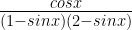
NCERT Solutions for Class 12 Maths Chapter 4 Determinants Ex 4.2 Q14.1

Ex 4.2 Class 12 Maths Question 15.
If A be a square matrix of order 3×3, then | kA | is equal to
(a) k|A|
(b) k² |A|
(c) k³ |A|
(d) 3k|A|
Solution:
Option (c) is correct.

Ex 4.2 Class 12 Maths Question 16.
Which of the following is correct:
(a) Determinant is a square matrix
(b) Determinant is a number associated to a matrix
(c) Determinant is a number associated to a square matrix
(d) None of these
Solution:
Option (c) is correct

Ex 4.3 Class 12 Maths Question 1.
Find the area of the triangle with vertices at the point given in each of the following:
(i) (1,0), (6,0) (4,3)
(ii) (2,7), (1,1), (10,8)
(iii) (-2,-3), (3,2), (-1,-8)
Solution:
(i) Area of triangle = \frac { 1 }{ 2 } \left| \begin{matrix} 1\quad & 0 & \quad 1 \\ 6\quad & 0 & \quad 1 \\ 4\quad & 3 & \quad 1 \end{matrix} \right|
\\ \frac { 1 }{ 2 }  [1(0-3)+1(18-0)]
= 7.5 sq units
NCERT Solutions for Class 12 Maths Chapter 4 Determinants Ex 4.3 Q1.1

Ex 4.3 Class 12 Maths Question 2.
Show that the points A (a, b + c), B (b, c + a) C (c, a+b) are collinear.
Solution:
The vertices of ∆ABC are A (a, b + c), B (b, c + a) and C (c, a + b)
NCERT Solutions for Class 12 Maths Chapter 4 Determinants Ex 4.3 Q2.1

Ex 4.3 Class 12 Maths Question 3.
Find the value of k if area of triangle is 4 square units and vertices are
(i) (k, 0), (4,0), (0,2)
(ii) (-2,0), (0,4), (0, k).
Solution:
(i) Area of ∆ = 4 (Given)
\frac { 1 }{ 2 } \left| \begin{matrix} k\quad & 0 & \quad 1 \\ 4\quad & 0 & \quad 1 \\ 0\quad & 2 & \quad 1 \end{matrix} \right|
\\ \frac { 1 }{ 2 }  [-2k+8]
= -k+4
Case (a): -k + 4 = 4 ==> k = 0
Case(b): -k + 4 = -4 ==> k = 8
Hence, k = 0,8
(ii) The area of the triangle whose vertices are (-2,0), (0,4), (0, k)
NCERT Solutions for Class 12 Maths Chapter 4 Determinants Ex 4.3 Q3.1

Ex 4.3 Class 12 Maths Question 4.
(i) Find the equation of line joining (1, 2) and (3,6) using determinants.
(ii) Find the equation of line joining (3,1), (9,3) using determinants.
Solution:
(i) Given: Points (1,2), (3,6)
Equation of the line is
NCERT Solutions for Class 12 Maths Chapter 4 Determinants Ex 4.3 Q4.1

Ex 4.3 Class 12 Maths Question 5.
If area of triangle is 35 sq. units with vertices (2, – 6), (5,4) and (k, 4). Then k is
(a) 12
(b) – 2
(c) -12,-2
(d) 12,-2
Solution:
(d) Area of ∆ = \frac { 1 }{ 2 } \left| \begin{matrix} 2\quad & -6 & \quad 1 \\ 5\quad & 4 & \quad 1 \\ k\quad & 4 & \quad 1 \end{matrix} \right|
\\ \frac { 1 }{ 2 }  [50 – 10k] = 25 – 5k
∴ 25-5k = 35 or 25-5k = -35
-5k = 10 or 5k = 60
=> k = -2 or k = 12

Ex 4.4 Class 12 Maths Question 1.
Write the minors and cofactors of the elements of following determinants:
(i) \begin{vmatrix} 2 & -4 \\ 0 & 3 \end{vmatrix}
(ii) \begin{vmatrix} a & c \\ b & d \end{vmatrix}
Solution:
(i) Let A = \begin{vmatrix} 2 & -4 \\ 0 & 3 \end{vmatrix}
M11 = 3, M12 = 0, M21 = – 4, M22 = 2
For cofactors
NCERT Solutions for Class 12 Maths Chapter 4 Determinants Ex 4.4 Q1.1

Ex 4.4 Class 12 Maths Question 2.
Write Minors and Cofactor of elements of following determinant
(i) \left| \begin{matrix} 1 & 0 & 0 \\ 0 & 1 & 0 \\ 0 & 0 & 1 \end{matrix} \right|
(ii) \left| \begin{matrix} 1 & 0 & 4 \\ 3 & 5 & -1 \\ 0 & 1 & 2 \end{matrix} \right|
Solution:
(i) Minors M11 = \begin{vmatrix} 1 & 0 \\ 0 & 1 \end{vmatrix} = 1
NCERT Solutions for Class 12 Maths Chapter 4 Determinants Ex 4.4 Q2.1
NCERT Solutions for Class 12 Maths Chapter 4 Determinants Ex 4.4 Q2.2
NCERT Solutions for Class 12 Maths Chapter 4 Determinants Ex 4.4 Q2.3

Ex 4.4 Class 12 Maths Question 3.
Using cofactors of elements of second row, evaluate
\Delta =\left| \begin{matrix} 5 & 3 & 8 \\ 2 & 0 & 1 \\ 1 & 2 & 3 \end{matrix} \right|
Solution:
Given
\Delta =\left| \begin{matrix} 5 & 3 & 8 \\ 2 & 0 & 1 \\ 1 & 2 & 3 \end{matrix} \right|
NCERT Solutions for Class 12 Maths Chapter 4 Determinants Ex 4.4 Q3.1

Ex 4.4 Class 12 Maths Question 4.
Using Cofactors of elements of third column, evaluate
\Delta =\left| \begin{matrix} 1 & x & yz \\ 1 & y & zx \\ 1 & z & xy \end{matrix} \right|
Solution:
Elements of third column are yz, zx, xy
NCERT Solutions for Class 12 Maths Chapter 4 Determinants Ex 4.4 Q4.1

Ex 4.4 Class 12 Maths Question 5.
If \Delta =\left| \begin{matrix} { a }_{ 11 } & { a }_{ 12 } & { a }_{ 13 } \\ { a }_{ 21 } & { a }_{ 22 } & { a }_{ 23 } \\ { a }_{ 31 } & { a }_{ 32 } & { a }_{ 33 } \end{matrix} \right|  and Aij is the cofactors of aij? then value of ∆ is given by
(a) a11A31+a12A32+a13A33
(b) a11A11+a12A21+a13A31
(c) a21A11+a22A12+a23A13
(d) a11A11+a21A21+a31A31
Solution:
Option (d) is correct.

Find the adjoint of each of the matrices in Questions 1 and 2.

Ex 4.5 Class 12 Maths Question 1.
\begin{bmatrix} 1 & 2 \\ 3 & 4 \end{bmatrix}=A(say)
Solution:
Let Cij be cofactor of aij in A. Then, the cofactors of elements of A are given by
C11 = (-1)1+1 (4) = 4; C12 = (-1)1+2 (3) = -3
C21 = (-1)2+1 (2)= – 2; C22 = (-1)2+2 (1) = -1
Adj A = \begin{bmatrix} 4 & -3 \\ -2 & 1 \end{bmatrix}
\begin{bmatrix} 4 & -2 \\ -3 & 1 \end{bmatrix}

Ex 4.5 Class 12 Maths Question 2.
\left[ \begin{matrix} 1 & -1 & 2 \\ 2 & 3 & 5 \\ -2 & 0 & 1 \end{matrix} \right] =A(say)
Solution:
{ A }_{ 11 }={ (-1) }^{ 1+1 }M_{ 11 }=\begin{vmatrix} 3 & 5 \\ 0 & 1 \end{vmatrix}=3
Similarly,
NCERT Solutions for Class 12 Maths Chapter 4 Determinants Ex 4.5 Q2.1

Verify A (adjA) = (adjA) •A = |A| I in Qs. 3 and 4.
Ex 4.5 Class 12 Maths Question 3.
\begin{bmatrix} 2 & 3 \\ -4 & 6 \end{bmatrix}=A(say)
Solution:
|A| = 24
NCERT Solutions for Class 12 Maths Chapter 4 Determinants Ex 4.5 Q3.1

Ex 4.5 Class 12 Maths Question 4.
\left[ \begin{matrix} 1 & -1 & 2 \\ 3 & 0 & -2 \\ 1 & 0 & 3 \end{matrix} \right] =A(say)
Solution:
A11 = 0, A12 = – 11, A13 = 0,
A21 = – 3, A22 = 1, A23 = 1, A31 = – 2
A32 = 8, A33 = – 3
NCERT Solutions for Class 12 Maths Chapter 4 Determinants Ex 4.5 Q4.1

Find the inverse of each of the matrices (if it exists) given in Questions 5 to 11:

Ex 4.5 Class 12 Maths Question 5.
\begin{bmatrix} 2 & -2 \\ 4 & 3 \end{bmatrix}=A(say)
Solution:
\left| A \right| =\begin{vmatrix} 2 & -2 \\ 4 & 3 \end{vmatrix}=6+8=14\neq 0
So, A is a non-singular matrix and therefore it is invertible. Let cij be cofactor of aij in A. Then, the cofactors of elements of A are given by
NCERT Solutions for Class 12 Maths Chapter 4 Determinants Ex 4.5 Q5.1

Ex 4.5 Class 12 Maths Question 6.
\begin{bmatrix} -1 & 5 \\ -3 & 2 \end{bmatrix}=A(say)
Solution:
\left| A \right| =\begin{vmatrix} -1 & 5 \\ -3 & 2 \end{vmatrix}=-2+15=13\neq 0
So, A is a non-singular matrix and therefore it is invertible. Let cij be cofactor of aij in A. Then, the cofactors of elements of A are given by
NCERT Solutions for Class 12 Maths Chapter 4 Determinants Ex 4.5 Q6.1

Ex 4.5 Class 12 Maths Question 7.
\left[ \begin{matrix} 1 & 2 & 3 \\ 0 & 2 & 4 \\ 0 & 0 & 5 \end{matrix} \right] =A
Solution:
|A| = 10
\left[ \begin{matrix} 1 & 2 & 3 \\ 0 & 2 & 4 \\ 0 & 0 & 5 \end{matrix} \right] =A
NCERT Solutions for Class 12 Maths Chapter 4 Determinants Ex 4.5 Q7.1

Ex 4.5 Class 12 Maths Question 8.
\left[ \begin{matrix} 1 & 0 & 0 \\ 3 & 3 & 0 \\ 5 & 2 & -1 \end{matrix} \right] =A
Solution:
\left| A \right| =\left| \begin{matrix} 1 & 0 & 0 \\ 3 & 3 & 0 \\ 5 & 2 & -1 \end{matrix} \right| =1\left| \begin{matrix} 3 & 0 \\ 2 & -1 \end{matrix} \right| =-3\neq 0
So, A is a non-singular matrix and therefore it is invertible. Let cij be cofactor of aij in A. Then, the cofactors of elements of A are given by
NCERT Solutions for Class 12 Maths Chapter 4 Determinants Ex 4.5 Q8.1

Ex 4.5 Class 12 Maths Question 9.
\left[ \begin{matrix} 2 & 1 & 3 \\ 4 & -1 & 0 \\ -7 & 2 & 1 \end{matrix} \right] =A
Solution:
|A| = \left[ \begin{matrix} 2 & 1 & 3 \\ 4 & -1 & 0 \\ -7 & 2 & 1 \end{matrix} \right] =A
= 2(-1-0)-1(4-0)+3(8-3)
So, A is non-singular matrix and therefore, it is invertible.
NCERT Solutions for Class 12 Maths Chapter 4 Determinants Ex 4.5 Q9.1

Ex 4.5 Class 12 Maths Question 10.
\left[ \begin{matrix} 1 & -1 & 2 \\ 0 & 2 & -3 \\ 3 & -2 & 4 \end{matrix} \right] =A
Solution:
|A| = \left[ \begin{matrix} 1 & -1 & 2 \\ 0 & 2 & -3 \\ 3 & -2 & 4 \end{matrix} \right] =A
= 1(8-6)+1(0+9)+2(0-6)
= 2+9-12
= -1≠0
∴A is invertible and
{ A }^{ -1 }=\frac { Adj\quad A }{ |A| }
NCERT Solutions for Class 12 Maths Chapter 4 Determinants Ex 4.5 Q10.1

Ex 4.5 Class 12 Maths Question 11.
\left[ \begin{matrix} 1 & 0 & 0 \\ 0 & cos\alpha & sin\alpha \\ 0 & sin\alpha & -cos\alpha \end{matrix} \right]
Solution:
A = \left[ \begin{matrix} 1 & 0 & 0 \\ 0 & cos\alpha & sin\alpha \\ 0 & sin\alpha & -cos\alpha \end{matrix} \right]
adj A = \left[ \begin{matrix} -1 & 0 & 0 \\ 0 & -cos\alpha & -sin\alpha \\ 0 & -sin\alpha & cos\alpha \end{matrix} \right]
First find |A| = -cos²α-sin²α
=-1≠0
NCERT Solutions for Class 12 Maths Chapter 4 Determinants Ex 4.5 Q11.1

Ex 4.5 Class 12 Maths Question 12.
Let A=\begin{bmatrix} 3 & 7 \\ 2 & 5 \end{bmatrix},B=\begin{bmatrix} 6 & 8 \\ 7 & 9 \end{bmatrix}, verify that (AB)-1 = B-1A-1
Solution:
Here |A| = A=\begin{bmatrix} 3 & 7 \\ 2 & 5 \end{bmatrix}
= 15-14
= 1≠0
Adj A=\begin{bmatrix} 5 & -7 \\ -2 & 3 \end{bmatrix}
NCERT Solutions for Class 12 Maths Chapter 4 Determinants Ex 4.5 Q12.1
NCERT Solutions for Class 12 Maths Chapter 4 Determinants Ex 4.5 Q12.2

Ex 4.5 Class 12 Maths Question 13.
If A=\begin{bmatrix} 3 & 1 \\ -1 & 2 \end{bmatrix}  show that A² – 5A + 7I = 0,hence find A-1
Solution:
A = \begin{bmatrix} 3 & 1 \\ -1 & 2 \end{bmatrix}
A² = \begin{bmatrix} 8 & 5 \\ -5 & 3 \end{bmatrix}
NCERT Solutions for Class 12 Maths Chapter 4 Determinants Ex 4.5 Q13.1

Ex 4.5 Class 12 Maths Question 14.
For the matrix A = \begin{bmatrix} 3 & 2 \\ 1 & 1 \end{bmatrix}  find file numbers a and b such that A²+aA+bI²=0. Hence, find A-1.
Solution:
A = \begin{bmatrix} 3 & 2 \\ 1 & 1 \end{bmatrix}
A²+aA+bI²=0
NCERT Solutions for Class 12 Maths Chapter 4 Determinants Ex 4.5 Q14.1

Ex 4.5 Class 12 Maths Question 15.
For the matrix A=\left[ \begin{matrix} 1 & 1 & 1 \\ 1 & 2 & -3 \\ 2 & -1 & 3 \end{matrix} \right]  Show that A³-6A²+5A+11I3=0.Hence find A-1
Solution:
A² =  \left[ \begin{matrix} 4 & 2 & 1 \\ -3 & 8 & -14 \\ 7 & -3 & 14 \end{matrix} \right]
NCERT Solutions for Class 12 Maths Chapter 4 Determinants Ex 4.5 Q15.1
NCERT Solutions for Class 12 Maths Chapter 4 Determinants Ex 4.5 Q15.2

Ex 4.5 Class 12 Maths Question 16.
If A=\left[ \begin{matrix} 2 & -1 & 1 \\ -1 & 2 & -1 \\ 1 & -1 & 2 \end{matrix} \right]  show that A³-6A²+9A-4I=0 and hence, find A-1
Solution:
We have
A=\left[ \begin{matrix} 2 & -1 & 1 \\ -1 & 2 & -1 \\ 1 & -1 & 2 \end{matrix} \right]
NCERT Solutions for Class 12 Maths Chapter 4 Determinants Ex 4.5 Q16.1
NCERT Solutions for Class 12 Maths Chapter 4 Determinants Ex 4.5 Q16.2

Ex 4.5 Class 12 Maths Question 17.
Let A be a non-singular square matrix of order 3×3. Then | Adj A | is equal to:
(a) | A |
(b) | A |²
(c) | A |³
(d) 3 | A |
Solution:
Let A = \left[ \begin{matrix} { a }_{ 11 } & { a }_{ 12 } & { a }_{ 13 } \\ { a }_{ 21 } & { a }_{ 22 } & { a }_{ 23 } \\ { a }_{ 31 } & { a }_{ 32 } & { a }_{ 33 } \end{matrix} \right]
NCERT Solutions for Class 12 Maths Chapter 4 Determinants Ex 4.5 Q17.1
Dividing by | A |, |Adj. A| = | A |²
Hence, Part (b) is the correct answer.

Ex 4.5 Class 12 Maths Question 18.
If A is an invertible matrix of order 2, then det. (A-1) is equal to:
(a) det. (A)
(b) \\ \frac { 1 }{ det.(A) }
(c) 1
(d) 0
Solution:
|A|≠0
=> A-1 exists => AA-1 = I
|AA-1| = |I| = I
=> |A||A-1| = I
|{ A }^{ -1 }|=\frac { 1 }{ |A| }
Hence option (b) is correct.


Examine the consistency of the system of equations in Questions 1 to 6Ex 4.6 Class 12 Maths Question 1.
x + 2y = 2
2x + 3y = 3
Solution:
x + 2y = 2,
2x + 3y = 3
=> \begin{bmatrix} 1 & 2 \\ 2 & 3 \end{bmatrix}\left[ \begin{matrix} x \\ y \end{matrix} \right] =\left[ \begin{matrix} 2 \\ 3 \end{matrix} \right]
=> AX = B
Now |A| = \begin{vmatrix} 1 & 2 \\ 2 & 3 \end{vmatrix}= 3 – 4
= – 1 ≠ 0.
Hence, equations are consistent.

Ex 4.6 Class 12 Maths Question 2.
2x – y = 5
x + y = 4
Solution:
2x – y = 5,
x + y = 4
=> \begin{bmatrix} 2 & -1 \\ 1 & 1 \end{bmatrix}\left[ \begin{matrix} x \\ y \end{matrix} \right] =\left[ \begin{matrix} 5 \\ 4 \end{matrix} \right]
=> AX = B
Now |A| = \begin{vmatrix} 2 & -1 \\ 1 & 1 \end{vmatrix}
= 2 + 1
= 3 ≠ 0.
Hence, equations are consistent.

Ex 4.6 Class 12 Maths Question 3.
x + 3y = 5,
2x + 6y = 8
Solution:
x + 3y = 5,
2x + 6y = 8
=> \begin{bmatrix} 1 & 3 \\ 2 & 6 \end{bmatrix}\left[ \begin{matrix} x \\ y \end{matrix} \right] =\left[ \begin{matrix} 5 \\ 8 \end{matrix} \right]
=> AX = B
Now |A| = \begin{vmatrix} 1 & 3 \\ 2 & 6 \end{vmatrix}
= 6 – 6
= 0.
NCERT Solutions for Class 12 Maths Chapter 4 Determinants Ex 4.6 Q3.1
Hence, equations are consistent with no solution

Ex 4.6 Class 12 Maths Question 4.
x + y + z = 1
2x + 3y + 2z = 2
ax + ay + 2az = 4
Solution:
x + y + z = 1
2x + 3y + 2z = 2
x + y + z = \\ \frac { 4 }{ a }
NCERT Solutions for Class 12 Maths Chapter 4 Determinants Ex 4.6 Q4.1Ex 4.6 Class 12 Maths Question 5.
3x – y – 2z = 2
2y – z = – 1
3x – 5y = 3
Solution:
\left[ \begin{matrix} 3 & -1 & -2 \\ 0 & 2 & -1 \\ 3 & -5 & 0 \end{matrix} \right] \left[ \begin{matrix} x \\ y \\ z \end{matrix} \right] =\left[ \begin{matrix} 2 \\ -1 \\ 3 \end{matrix} \right]
=> AX = B
NCERT Solutions for Class 12 Maths Chapter 4 Determinants Ex 4.6 Q5.1


Ex 4.6 Class 12 Maths Question 6.
5x – y + 4z = 5
2x + 3y + 5z = 2
5x – 2y + 6z = -1
Solution:
Given
5x – y + 4z = 5
2x + 3y + 5z = 2
5x – 2y + 6z = -1
\left[ \begin{matrix} 5 & -1 & 4 \\ 2 & 3 & 5 \\ 5 & -2 & 6 \end{matrix} \right] \left[ \begin{matrix} x \\ y \\ z \end{matrix} \right] =\left[ \begin{matrix} 5 \\ 2 \\ -1 \end{matrix} \right]
AX=B|A|=\left[ \begin{matrix} 5 & -1 & 4 \\ 2 & 3 & 5 \\ 5 & -2 & 6 \end{matrix} \right]
= 5(18 + 10)+1(12 – 25)+4(-4-15)
= 140-13-76
= 51 ≠ 0
Hence equations are consistent with a unique
solution.

Solve system of linear equations using matrix method in Questions 7 to 14:

Ex 4.6 Class 12 Maths Question 7.
5x + 2y = 4
7x + 3y = 5
Solution:
The given system of equations can be written as
NCERT Solutions for Class 12 Maths Chapter 4 Determinants Ex 4.6 Q7.1

Ex 4.6 Class 12 Maths Question 8.
2x – y = – 2
3x + 3y = 3
Solution:
The given system of equations can be written
NCERT Solutions for Class 12 Maths Chapter 4 Determinants Ex 4.6 Q8.1

Ex 4.6 Class 12 Maths Question 9.
4x – 3y = 3
3x – 5y = 7
Solution:
The given system of equations can be written as
\begin{bmatrix} 4 & -3 \\ 3 & -5 \end{bmatrix}\left[ \begin{matrix} x \\ y \end{matrix} \right] =\left[ \begin{matrix} 3 \\ 7 \end{matrix} \right] i.e,,AX=B
where A=\begin{bmatrix} 4 & -3 \\ 3 & -5 \end{bmatrix}
NCERT Solutions for Class 12 Maths Chapter 4 Determinants Ex 4.6 Q9.1

Ex 4.6 Class 12 Maths Question 10.
5x + 2y = 3
3x + 2y = 5
Solution:
The given system of equations can be written as
\begin{bmatrix} 5 & 2 \\ 3 & 2 \end{bmatrix}\left[ \begin{matrix} x \\ y \end{matrix} \right] =\left[ \begin{matrix} 3 \\ 5 \end{matrix} \right] i.e,,AX=B
where A=\begin{bmatrix} 5 & 2 \\ 3 & 2 \end{bmatrix}
NCERT Solutions for Class 12 Maths Chapter 4 Determinants Ex 4.6 Q10.1

Ex 4.6 Class 12 Maths Question 11.
2x + y + z = 1,
x – 2y – z = 3/2
3y – 5z = 9
Solution:
The given system of equations are
2x + y + z = 1,
x – 2y – z = 3/2,
3y – 5z = 9
We know AX = B => X = A-1B
NCERT Solutions for Class 12 Maths Chapter 4 Determinants Ex 4.6 Q11.1

Ex 4.6 Class 12 Maths Question 12.
x – y + z = 4
2x + y – 3z = 0
x + y + z = 2.
Solution:
The given system of equations can be written
\left[ \begin{matrix} 1 & -1 & 1 \\ 2 & 1 & -3 \\ 1 & 1 & 1 \end{matrix} \right] \left[ \begin{matrix} x \\ y \\ z \end{matrix} \right] =\left[ \begin{matrix} 4 \\ 0 \\ 2 \end{matrix} \right] i.e,,AX=B
NCERT Solutions for Class 12 Maths Chapter 4 Determinants Ex 4.6 Q12.1

Ex 4.6 Class 12 Maths Question 13.
2x + 3y + 3z = 5
x – 2y + z = – 4
3x – y – 2z = 3
Solution:
The given system of equations can be written as:
\left[ \begin{matrix} 2 & 3 & 3 \\ 1 & -2 & 1 \\ 3 & -1 & -2 \end{matrix} \right] \left[ \begin{matrix} x \\ y \\ z \end{matrix} \right] =\left[ \begin{matrix} 5 \\ -4 \\ 3 \end{matrix} \right] i.e,,AX=B
NCERT Solutions for Class 12 Maths Chapter 4 Determinants Ex 4.6 Q13.1
NCERT Solutions for Class 12 Maths Chapter 4 Determinants Ex 4.6 Q13.2

Ex 4.6 Class 12 Maths Question 14.
x – y + 2z = 7
3x + 4y – 5z = – 5
2x – y + 3z = 12.
Solution:
The given system of equations can be written
\left[ \begin{matrix} 1 & -1 & 2 \\ 3 & 4 & -5 \\ 2 & -1 & 3 \end{matrix} \right] \left[ \begin{matrix} x \\ y \\ z \end{matrix} \right] =\left[ \begin{matrix} 7 \\ -5 \\ 12 \end{matrix} \right] i.e,,AX=B
NCERT Solutions for Class 12 Maths Chapter 4 Determinants Ex 4.6 Q14.1
NCERT Solutions for Class 12 Maths Chapter 4 Determinants Ex 4.6 Q14.2

Ex 4.6 Class 12 Maths Question 15.
If A = \left[ \begin{matrix} 2 & -3 & 5 \\ 3 & 2 & -4 \\ 1 & 1 & -2 \end{matrix} \right]  Find A-1. Using A-1Solve the following system of linear equations 2x – 3y + 5z = 11,3x + 2y – 4z = – 5, x + y – 2z = – 3
Solution:
We have AX = B
where A=\left[ \begin{matrix} 2 & -3 & 5 \\ 3 & 2 & -4 \\ 1 & 1 & -2 \end{matrix} \right] ,X=\left[ \begin{matrix} x \\ y \\ z \end{matrix} \right]
NCERT Solutions for Class 12 Maths Chapter 4 Determinants Ex 4.6 Q15.1
NCERT Solutions for Class 12 Maths Chapter 4 Determinants Ex 4.6 Q15.2

Ex 4.6 Class 12 Maths Question 16.
The cost of 4 kg onion, 3 kg wheat and 2 kg rice is Rs. 69. The cost of 2 kg onion, 4 kg wheat and 6 kg rice is Rs. 90. The cost of 6 kg onion, 2 kg wheat and 3 kg rice is Rs. 70. Find the cost of each item per kg by matrix method
Solution:
Let cost of 1 kg onion = Rs x
and cost of 1 kg wheat = Rs y
and cost of 1 kg rice = Rs z
4x+3y+2z=60
2x+4y+6z=90
6x+2y+3z=70
NCERT Solutions for Class 12 Maths Chapter 4 Determinants Ex 4.6 Q16.1
NCERT Solutions for Class 12 Maths Chapter 4 Determinants Ex 4.6 Q16.2

Read More

Class 12th Chapter -3 Matrices | NCERT Maths Solution | NCERT Solution | Edugrown

It is important that you have a strong foundation in Maths Solutions. This can help you immensely in exams. Because there is no paper pattern set for the board exams. Every year there are different twists and turns in questions asked in board exams. While preparing for maths it becomes to go through every bit of detail. Thus, NCERT Solutions Class 12 Maths can help you lay a strong foundation. There solutions of each and every question given in the NCERT 12 Textbook in this article. There are crucial chapters like integration, algebra, and calculus which you can solve easily using these Class 12 Maths solutions. Using these NCERT Maths Class 12 Solutions can give you an edge over the other students.

NCERT Solutions for Class 12 Maths Chapter : 3 Matrices

Ex 3.1 Class 12 Maths Question 1.
In the matrix A=\left[ \begin{matrix} 2 \\ 35 \\ \sqrt { 3 } \end{matrix}\begin{matrix} 5 \\ -2 \\ 1 \end{matrix}\begin{matrix} 19 \\ 5/2 \\ -5 \end{matrix}\begin{matrix} -7 \\ 12 \\ 17 \end{matrix} \right]
(i) The order of the matrix
(ii) The number of elements
(iii) Write the elements a13, a21, a33, a24, a23
Solution:
(i) The matrix A has three rows and 4 columns.
The order of the matrix is 3 x 4.
(ii) There are 3 x 4 = 12 elements in the matrix A
(iii) a13 = 19, a21 = 35, a33 = – 5, a24 = 12, a23 = \\ \frac { 5 }{ 2 }

Ex 3.1 Class 12 Maths Question 2.
If a matrix has 24 elements, what are the possible orders it can have? What, if it has 13 elements?
Solution:
(i) 24 = 1 x 24 = 2 x 12 = 3 x 8 = 4 x 6
Thus there are 8 matrices having 24 elements their order are (1 x 24), (24 x 1), (2 x 12), (12 x 2),(3 x 8), (8 x 3), (4 x 6), (6 x 4).
(ii) 13 = 1 x 13,
There are 2 matrices of 13 elements of order (1 x 13) and (13 x 1).

Ex 3.1 Class 12 Maths Question 3.
If a matrix has 18 elements, what are the possible orders it can have ? What, if it has 5 elements.
Solution:
We know that if a matrix is of order m × n, it has mn elements.
=> 18 = 1 x 18 = 2 x 9 = 3 x 6
Thus, all possible ordered pairs of the matrix
having 18 elements are:
(1,18), (18,1), (2,9), (9,2), (3,6), (6,3)
If it has 5 elements, then possible order are: (1,5), (5,1)

Ex 3.1 Class 12 Maths Question 4.
Construct a 2 x 2 matrix, A= [aij] whose elements are given by:
(i)\quad { a }_{ ij }=\frac { { (i+j) }^{ 2 } }{ 2 }
(ii)\quad { a }_{ ij }=\frac { i }{ j }
(iii)\quad { a }_{ ij }=\frac { { (i+2j) }^{ 2 } }{ 2 }
Solution:
A={ \left[ { a }_{ ij } \right] }_{ 2\times 2 }=\begin{bmatrix} { a }_{ 11 } & { a }_{ 12 } \\ { a }_{ 21 } & { a }_{ 22 } \end{bmatrix}
(i)\quad { a }_{ ij }=\frac { { (i+j) }^{ 2 } }{ 2 }
NCERT Solutions for Class 12 Maths Chapter 3 Matrices Ex 3.1 Q4.1
NCERT Solutions for Class 12 Maths Chapter 3 Matrices Ex 3.1 Q4.2

Ex 3.1 Class 12 Maths Question 5.
Construct a 3 x 4 matrix , whose elements are given by:
(i){ a }_{ ij }=\frac { 1 }{ 2 } \left| -3i+j \right|
(ii){ a }_{ ij }=2i-j
Solution:
A={ \left[ { a }_{ ij } \right] }_{ 3\times 4 }=\left[ \begin{matrix} { a }_{ 11 } \\ { a }_{ 21 } \\ { a }_{ 31 } \end{matrix}\begin{matrix} { a }_{ 12 } \\ { a }_{ 22 } \\ { a }_{ 32 } \end{matrix}\begin{matrix} { a }_{ 13 } \\ { a }_{ 23 } \\ { a }_{ 33 } \end{matrix}\begin{matrix} { a }_{ 14 } \\ { a }_{ 24 } \\ { a }_{ 34 } \end{matrix} \right]
(i){ a }_{ ij }=\frac { 1 }{ 2 } \left| -3i+j \right|
NCERT Solutions for Class 12 Maths Chapter 3 Matrices Ex 3.1 Q5.1
NCERT Solutions for Class 12 Maths Chapter 3 Matrices Ex 3.1 Q5.2

Ex 3.1 Class 12 Maths Question 6.
Find the values of x, y, z from the following equations:
(i)\begin{bmatrix} 4 & 3 \\ x & 5 \end{bmatrix}=\begin{bmatrix} y & z \\ 1 & 5 \end{bmatrix}
(ii)\begin{bmatrix} x+y & 2 \\ 5+z & xy \end{bmatrix}=\begin{bmatrix} 6 & 2 \\ 5 & 8 \end{bmatrix}
(iii)\left[ \begin{matrix} \begin{matrix} x+ & y+ & z \end{matrix} \\ \begin{matrix} x & +y \end{matrix} \\ \begin{matrix} y & +z \end{matrix} \end{matrix} \right] =\left[ \begin{matrix} 9 \\ 5 \\ 7 \end{matrix} \right]
Solution:
(i)\begin{bmatrix} 4 & 3 \\ x & 5 \end{bmatrix}=\begin{bmatrix} y & z \\ 1 & 5 \end{bmatrix}
Clearly x = 1,y = 4,z = 3
(ii)\begin{bmatrix} x+y & 2 \\ 5+z & xy \end{bmatrix}=\begin{bmatrix} 6 & 2 \\ 5 & 8 \end{bmatrix}
Now 5 + z = 5 => z = 0
Now x + y = 6 and xy = 8
∴ y = 6 – x and x(6 – x) = 8
6x – x² = 8
x² – 6x + 8 = 0
(x – 4)(x – 2) = 0
=>x = 2,4
When x = 2, y = 6 – 2 = 4
and when x = 4,y = 6 – 4 = 2
Hence x = 2,y = 4,z = 0 or x = 4,y = 2,z = 0.
(iii) Equating the corresponding elements.
=> x+y+z=9 …..(i)
x+z = 5 …(ii)
y+ z = 7 …(iii)
Adding eqs. (ii) & (iii)
x + y + 2z = 12
=> (x+y+z) + z = 12,
9+z = 12 (from equ (i))
z = 3
x + z = 5
=>x + 3 = 5 => x = 2
and y+z = 7
=>y+3 = 7
=> y = 4
=> x = 2, y = 4 and z = 3

Ex 3.1 Class 12 Maths Question 7.
Find the values of a,b,c and d from the equation:
\begin{bmatrix} a-b & 2a+c \\ 2a-b & 3c+d \end{bmatrix}=\begin{bmatrix} -1 & 5 \\ 0 & 13 \end{bmatrix}
Solution:
\begin{bmatrix} a-b & 2a+c \\ 2a-b & 3c+d \end{bmatrix}=\begin{bmatrix} -1 & 5 \\ 0 & 13 \end{bmatrix}
NCERT Solutions for Class 12 Maths Chapter 3 Matrices Ex 3.1 Q7.1

Ex 3.1 Class 12 Maths Question 8.
A = [aij]m×n is a square matrix, if
(a) m < n (b) n > n
(c) m = n
(d) none of these
Solution:
For a square matrix m=n.
Thus option (c) m = n, is correct.

Ex 3.1 Class 12 Maths Question 9.
Which of the given values of x and y make the following pairs of matrices equal:
\begin{bmatrix} 3x+7 & 5 \\ y+1 & 2-3x \end{bmatrix},\begin{bmatrix} 0 & y-2 \\ 8 & 4 \end{bmatrix}
(a) x=\frac { -1 }{ 3 } ,y=7
(b) Not possible to find
(c) y=7,x=\frac { -2 }{ 3 }
(d) x=\frac { -1 }{ 3 } ,y=\frac { -2 }{ 3 }
Solution:
\begin{bmatrix} 3x+7 & 5 \\ y+1 & 2-3x \end{bmatrix},\begin{bmatrix} 0 & y-2 \\ 8 & 4 \end{bmatrix}
(a) x=\frac { -1 }{ 3 } ,y=7
NCERT Solutions for Class 12 Maths Chapter 3 Matrices Ex 3.1 Q9.1
NCERT Solutions for Class 12 Maths Chapter 3 Matrices Ex 3.1 Q9.2

Ex 3.1 Class 12 Maths Question 10.
The number of all possible matrices of order 3×3 with each entry 0 or 1 is
(a) 27
(b) 18
(c) 81
(d) 512
Solution:
There are 3 x 3 matrix or 9 entries in matrix each place can be filled with 0 or 1
∴ 9 Places can be filled in 29 = 512 ways
Number of such matrices = 512
Option (d) is correct.


Ex 3.2 Class 12 Maths Question 1.
Let A=\begin{bmatrix} 2 & 4 \\ 3 & 2 \end{bmatrix},B=\begin{bmatrix} 1 & 3 \\ -2 & 5 \end{bmatrix},C=\begin{bmatrix} -2 & 5 \\ 3 & 4 \end{bmatrix}\qquad
Find each of the following:
(i) A + B
(ii) A – B
(iii) 3A – C
(iv) AB
(v) BA
Solution:
Let A=\begin{bmatrix} 2 & 4 \\ 3 & 2 \end{bmatrix},B=\begin{bmatrix} 1 & 3 \\ -2 & 5 \end{bmatrix},C=\begin{bmatrix} -2 & 5 \\ 3 & 4 \end{bmatrix}\qquad
(i) A + B
NCERT Solutions for Class 12 Maths Chapter 3 Matrices Ex 3.2 Q1.1

Ex 3.2 Class 12 Maths Question 2.
Compute the following:
(i)\begin{bmatrix} a & \quad b \\ -b & \quad a \end{bmatrix}+\begin{bmatrix} a & \quad b \\ b & \quad a \end{bmatrix}
(ii)\begin{bmatrix} { a }^{ 2 }+{ b }^{ 2 } & \quad { b }^{ 2 }+{ c }^{ 2 } \\ { a }^{ 2 }+{ c }^{ 2 } & \quad { a }^{ 2 }+{ b }^{ 2 } \end{bmatrix}+\begin{bmatrix} 2ab & \quad 2bc \\ -2ac & \quad -2ab \end{bmatrix}
(iii)\left[ \begin{matrix} \begin{matrix} -1 \\ 8 \\ 2 \end{matrix} & \begin{matrix} 4 \\ 5 \\ 8 \end{matrix} & \begin{matrix} -6 \\ 16 \\ 5 \end{matrix} \end{matrix} \right] +\left[ \begin{matrix} \begin{matrix} 12 \\ 8 \\ 3 \end{matrix} & \begin{matrix} 7 \\ 0 \\ 2 \end{matrix} & \begin{matrix} 6 \\ 5 \\ 4 \end{matrix} \end{matrix} \right]
(iv)\begin{bmatrix} { cos }^{ 2 }x & \quad { sin }^{ 2 }x \\ { sin }^{ 2 }x & { \quad cos }^{ 2 }x \end{bmatrix}+\begin{bmatrix} { sin }^{ 2 }x & \quad { cos }^{ 2 }x \\ { cos }^{ 2 }x & { \quad sin }^{ 2 }x \end{bmatrix}
Solution:
(i)\begin{bmatrix} a & \quad b \\ -b & \quad a \end{bmatrix}+\begin{bmatrix} a & \quad b \\ b & \quad a \end{bmatrix}
=\begin{bmatrix} 2a & \quad 2b \\ 0 & \quad 2a \end{bmatrix}
NCERT Solutions for Class 12 Maths Chapter 3 Matrices Ex 3.2 Q2.1

Ex 3.2 Class 12 Maths Question 3.
Compute the indicated products.
(i) \begin{bmatrix} a & \quad b \\ -b & \quad a \end{bmatrix}\begin{bmatrix} a & \quad -b \\ b & \quad \quad a \end{bmatrix}
(ii) \left[ \begin{matrix} 1 \\ 2 \\ 3 \end{matrix} \right] \left[ \begin{matrix} 2 & 3 & 4 \end{matrix} \right]
(iii) \begin{bmatrix} 1 & -2 \\ 2 & \quad 3 \end{bmatrix}\left[ \begin{matrix} 1 & 2 & 3 \\ 2 & 3 & 1 \end{matrix} \right]
(iv) \left[ \begin{matrix} 2 & 3 & 4 \\ 3 & 4 & 5 \\ 4 & 5 & 6 \end{matrix} \right] \left[ \begin{matrix} 1 & -3 & 5 \\ 0 & 2 & 4 \\ 3 & 0 & 5 \end{matrix} \right]
(v) \left[ \begin{matrix} 2 \\ 3 \\ -1 \end{matrix}\begin{matrix} 1 \\ 2 \\ 1 \end{matrix} \right] \left[ \begin{matrix} \begin{matrix} 1 & 0 & 1 \end{matrix} \\ \begin{matrix} -1 & 2 & 1 \end{matrix} \end{matrix} \right]
(vi) \left[ \begin{matrix} \begin{matrix} 3 & -1 & 3 \end{matrix} \\ \begin{matrix} -1 & 0 & 2 \end{matrix} \end{matrix} \right] \left[ \begin{matrix} \begin{matrix} 2 \\ 1 \\ 3 \end{matrix} & \begin{matrix} -3 \\ 0 \\ 1 \end{matrix} \end{matrix} \right]
Solution:
(i) \begin{bmatrix} a & \quad b \\ -b & \quad a \end{bmatrix}\begin{bmatrix} a & \quad -b \\ b & \quad \quad a \end{bmatrix}
\begin{bmatrix} { a }^{ 2 }+{ b }^{ 2 } & 0 \\ 0 & { b }^{ 2 }+{ a }^{ 2 } \end{bmatrix}
NCERT Solutions for Class 12 Maths Chapter 3 Matrices Ex 3.2 Q3.1
NCERT Solutions for Class 12 Maths Chapter 3 Matrices Ex 3.2 Q3.2

Ex 3.2 Class 12 Maths Question 4.
If A=\left[ \begin{matrix} 1 & 2 & -3 \\ 5 & 0 & 2 \\ 1 & -1 & 1 \end{matrix} \right] ,B=\left[ \begin{matrix} 3 & -1 & 2 \\ 4 & 2 & 5 \\ 2 & 0 & 3 \end{matrix} \right] ,C=\left[ \begin{matrix} 4 & 1 & 2 \\ 0 & 3 & 2 \\ 1 & -2 & 3 \end{matrix} \right]
then compute (A + B) and (B – C). Also verify that A + (B – C) = (A + B) – C.
Solution:
Given
A=\left[ \begin{matrix} 1 & 2 & -3 \\ 5 & 0 & 2 \\ 1 & -1 & 1 \end{matrix} \right] ,B=\left[ \begin{matrix} 3 & -1 & 2 \\ 4 & 2 & 5 \\ 2 & 0 & 3 \end{matrix} \right] ,C=\left[ \begin{matrix} 4 & 1 & 2 \\ 0 & 3 & 2 \\ 1 & -2 & 3 \end{matrix} \right]
NCERT Solutions for Class 12 Maths Chapter 3 Matrices Ex 3.2 Q4.1

Ex 3.2 Class 12 Maths Question 5.
If A=\left[ \begin{matrix} \frac { 2 }{ 3 } & 1 & \frac { 5 }{ 3 } \\ \frac { 1 }{ 3 } & \frac { 2 }{ 3 } & \frac { 4 }{ 3 } \\ \frac { 7 }{ 3 } & 2 & \frac { 2 }{ 3 } \end{matrix} \right] and\quad B=\left[ \begin{matrix} \frac { 2 }{ 5 } & \frac { 3 }{ 5 } & 1 \\ \frac { 1 }{ 5 } & \frac { 2 }{ 5 } & \frac { 4 }{ 5 } \\ \frac { 7 }{ 5 } & \frac { 6 }{ 5 } & \frac { 2 }{ 5 } \end{matrix} \right] ,
then compute 3A – 5B.
Solution:
3A-5B=3\left[ \begin{matrix} \frac { 2 }{ 3 } & 1 & \frac { 5 }{ 3 } \\ \frac { 1 }{ 3 } & \frac { 2 }{ 3 } & \frac { 4 }{ 3 } \\ \frac { 7 }{ 3 } & 2 & \frac { 2 }{ 3 } \end{matrix} \right] -5\left[ \begin{matrix} \frac { 2 }{ 5 } & \frac { 3 }{ 5 } & 1 \\ \frac { 1 }{ 5 } & \frac { 2 }{ 5 } & \frac { 4 }{ 5 } \\ \frac { 7 }{ 5 } & \frac { 6 }{ 5 } & \frac { 2 }{ 5 } \end{matrix} \right] ,
\left[ \begin{matrix} 2 & 3 & 5 \\ 1 & 2 & 4 \\ 7 & 6 & 2 \end{matrix} \right] -\left[ \begin{matrix} 2 & 3 & 5 \\ 1 & 2 & 4 \\ 7 & 6 & 2 \end{matrix} \right] =\left[ \begin{matrix} 0 & 0 & 0 \\ 0 & 0 & 0 \\ 0 & 0 & 0 \end{matrix} \right]

Ex 3.2 Class 12 Maths Question 6.
Simplify:
cos\theta \begin{bmatrix} cos\theta & sin\theta \\ -sin\theta & cos\theta \end{bmatrix}+sin\theta \begin{bmatrix} sin\theta & -cos\theta \\ cos\theta & sin\theta \end{bmatrix}
Solution:
cos\theta \begin{bmatrix} cos\theta & sin\theta \\ -sin\theta & cos\theta \end{bmatrix}+sin\theta \begin{bmatrix} sin\theta & -cos\theta \\ cos\theta & sin\theta \end{bmatrix}
NCERT Solutions for Class 12 Maths Chapter 3 Matrices Ex 3.2 Q6.1

Ex 3.2 Class 12 Maths Question 7.
Find X and Y if
(i)\quad X+Y=\begin{bmatrix} 7 & 0 \\ 2 & 5 \end{bmatrix}and\quad X-Y=\begin{bmatrix} 3 & 0 \\ 0 & 3 \end{bmatrix}
(ii)\quad 2X+3Y=\begin{bmatrix} 2 & 0 \\ 4 & 0 \end{bmatrix}and\quad 3X+2Y=\begin{bmatrix} 2 & -2 \\ -1 & 5 \end{bmatrix}
Solution:
(i)\quad X+Y=\begin{bmatrix} 7 & 0 \\ 2 & 5 \end{bmatrix}and\quad X-Y=\begin{bmatrix} 3 & 0 \\ 0 & 3 \end{bmatrix}
NCERT Solutions for Class 12 Maths Chapter 3 Matrices Ex 3.2 Q7.1
NCERT Solutions for Class 12 Maths Chapter 3 Matrices Ex 3.2 Q7.2

Ex 3.2 Class 12 Maths Question 8.
Find
X\quad if\quad Y=\begin{bmatrix} 3 & 2 \\ 1 & 4 \end{bmatrix}and\quad 2X+Y=\begin{bmatrix} 1 & 0 \\ -3 & 2 \end{bmatrix}
Solution:
Y=\begin{bmatrix} 3 & 2 \\ 1 & 4 \end{bmatrix}
We are given that
NCERT Solutions for Class 12 Maths Chapter 3 Matrices Ex 3.2 Q8.1

Ex 3.2 Class 12 Maths Question 9.
Find x and y, if 2\begin{bmatrix} 1 & 3 \\ 0 & x \end{bmatrix}+\begin{bmatrix} y & 0 \\ 1 & 2 \end{bmatrix}=\begin{bmatrix} 5 & 6 \\ 1 & 8 \end{bmatrix}
Solution:
2\begin{bmatrix} 1 & 3 \\ 0 & x \end{bmatrix}+\begin{bmatrix} y & 0 \\ 1 & 2 \end{bmatrix}=\begin{bmatrix} 5 & 6 \\ 1 & 8 \end{bmatrix}
=> \begin{bmatrix} 2+y & \quad 6 \\ 1 & \quad 2x+2 \end{bmatrix}=\begin{bmatrix} 5 & 6 \\ 1 & 8 \end{bmatrix}
=> 2+y = 5 and 2x+2 = 8
=> y=3 and x=3
Hence x=3 and y=3

Ex 3.2 Class 12 Maths Question 10.
Solve the equation for x,y,z and t, if
2\begin{bmatrix} x & z \\ y & t \end{bmatrix}+3\begin{bmatrix} 1 & -1 \\ 0 & 2 \end{bmatrix}=3\begin{bmatrix} 3 & 5 \\ 4 & 6 \end{bmatrix}
Solution:
2\begin{bmatrix} x & z \\ y & t \end{bmatrix}+3\begin{bmatrix} 1 & -1 \\ 0 & 2 \end{bmatrix}=3\begin{bmatrix} 3 & 5 \\ 4 & 6 \end{bmatrix}
NCERT Solutions for Class 12 Maths Chapter 3 Matrices Ex 3.2 Q10.1

Ex 3.2 Class 12 Maths Question 11.
If x\left[ \begin{matrix} 2 \\ 3 \end{matrix} \right] +y\left[ \begin{matrix} -1 \\ 1 \end{matrix} \right] =\left[ \begin{matrix} 10 \\ 5 \end{matrix} \right]  then find the values of x and y
Solution:
x\left[ \begin{matrix} 2 \\ 3 \end{matrix} \right] +y\left[ \begin{matrix} -1 \\ 1 \end{matrix} \right] =\left[ \begin{matrix} 10 \\ 5 \end{matrix} \right]
=> \left[ \begin{matrix} 2x-y \\ 3x+y \end{matrix} \right] =\left[ \begin{matrix} 10 \\ 5 \end{matrix} \right]
NCERT Solutions for Class 12 Maths Chapter 3 Matrices Ex 3.2 Q11.1

Ex 3.2 Class 12 Maths Question 12.
Given
3\begin{bmatrix} x & \quad y \\ z & \quad w \end{bmatrix}=\begin{bmatrix} x & \quad 6 \\ -1 & \quad 2w \end{bmatrix}+\begin{bmatrix} 4 & \quad x+y \\ z+w & 3 \end{bmatrix}
find the values of x,y,z and w.
Solution:
3\begin{bmatrix} x & \quad y \\ z & \quad w \end{bmatrix}=\begin{bmatrix} x & \quad 6 \\ -1 & \quad 2w \end{bmatrix}+\begin{bmatrix} 4 & \quad x+y \\ z+w & 3 \end{bmatrix}
=> \begin{bmatrix} 3x & \quad 3y \\ 3z & \quad 3w \end{bmatrix}=\begin{bmatrix} x+4 & \quad 6+x+y \\ -1+z+w & \quad 2w+3 \end{bmatrix}
=> 3x = x + 4 => x = 2
and 3y = 6 + x + y => y = 4
Also, 3w = 2w + 3 => w = 3
Again, 3z = – 1 + z + w
=> 2z = – 1 + 3
=> 2z = 2
=> z = 1
Hence x = 2 ,y = 4, z = 1, w = 3.

Ex 3.2 Class 12 Maths Question 13.
If F(x) = \left[ \begin{matrix} cosx & -sinx & 0 \\ sinx & cosx & 0 \\ 0 & 0 & 1 \end{matrix} \right]
then show that F(x).F(y) = F(x+y)
Solution:
F(x) = \left[ \begin{matrix} cosx & -sinx & 0 \\ sinx & cosx & 0 \\ 0 & 0 & 1 \end{matrix} \right]
∴ F(y) = \left[ \begin{matrix} cosy & -siny & 0 \\ siny & cosy & 0 \\ 0 & 0 & 1 \end{matrix} \right]
NCERT Solutions for Class 12 Maths Chapter 3 Matrices Ex 3.2 Q13.1

Ex 3.2 Class 12 Maths Question 14.
Show that
(i)\begin{bmatrix} 5 & -1 \\ 6 & 7 \end{bmatrix}\begin{bmatrix} 2 & 1 \\ 3 & 4 \end{bmatrix}\neq \begin{bmatrix} 2 & 1 \\ 3 & 4 \end{bmatrix}\begin{bmatrix} 5 & -1 \\ 6 & 7 \end{bmatrix}
(ii)\left[ \begin{matrix} 1 & 2 & 3 \\ 0 & 1 & 0 \\ 1 & 1 & 0 \end{matrix} \right] \left[ \begin{matrix} -1 & 1 & 0 \\ 0 & -1 & 1 \\ 2 & 3 & 4 \end{matrix} \right] \neq \left[ \begin{matrix} -1 & 1 & 0 \\ 0 & -1 & 1 \\ 2 & 3 & 4 \end{matrix} \right] \left[ \begin{matrix} 1 & 2 & 3 \\ 0 & 1 & 0 \\ 1 & 1 & 0 \end{matrix} \right]
Solution:
(i)L.H.S=\begin{bmatrix} 5 & -1 \\ 6 & 7 \end{bmatrix}\begin{bmatrix} 2 & 1 \\ 3 & 4 \end{bmatrix}=\begin{bmatrix} 7 & 1 \\ 33 & 34 \end{bmatrix}
R.H.S=\begin{bmatrix} 2 & 1 \\ 3 & 4 \end{bmatrix}\begin{bmatrix} 5 & -1 \\ 6 & 7 \end{bmatrix}=\begin{bmatrix} 16 & 5 \\ 39 & 25 \end{bmatrix}
L.H.S≠R.H.S
NCERT Solutions for Class 12 Maths Chapter 3 Matrices Ex 3.2 Q14.1

Ex 3.2 Class 12 Maths Question 15.
Find A² – 5A + 6I, if A = \left[ \begin{matrix} 2 & 0 & 1 \\ 2 & 1 & 3 \\ 1 & -1 & 0 \end{matrix} \right]
Solution:
A² – 5A + 6I = \left[ \begin{matrix} 2 & 0 & 1 \\ 2 & 1 & 3 \\ 1 & -1 & 0 \end{matrix} \right] \left[ \begin{matrix} 2 & 0 & 1 \\ 2 & 1 & 3 \\ 1 & -1 & 0 \end{matrix} \right] -5\left[ \begin{matrix} 2 & 0 & 1 \\ 2 & 1 & 3 \\ 1 & -1 & 0 \end{matrix} \right] +6\left[ \begin{matrix} 1 & 0 & 0 \\ 0 & 1 & 0 \\ 0 & 0 & 1 \end{matrix} \right]
NCERT Solutions for Class 12 Maths Chapter 3 Matrices Ex 3.2 Q15.1

Ex 3.2 Class 12 Maths Question 16.
If A = \left[ \begin{matrix} 1 & 0 & 2 \\ 0 & 2 & 1 \\ 2 & 0 & 3 \end{matrix} \right]  Prove that A³-6A²+7A+2I = 0
Solution:
We have
A² = A x A
\left[ \begin{matrix} 1 & 0 & 2 \\ 0 & 2 & 1 \\ 2 & 0 & 3 \end{matrix} \right] \times \left[ \begin{matrix} 1 & 0 & 2 \\ 0 & 2 & 1 \\ 2 & 0 & 3 \end{matrix} \right] =\left[ \begin{matrix} 5 & 0 & 8 \\ 2 & 4 & 5 \\ 8 & 0 & 13 \end{matrix} \right]
NCERT Solutions for Class 12 Maths Chapter 3 Matrices Ex 3.2 Q16.1

Ex 3.2 Class 12 Maths Question 17.
If A=\begin{bmatrix} 3 & -2 \\ 4 & -2 \end{bmatrix},I=\begin{bmatrix} 1 & 0 \\ 0 & 1 \end{bmatrix} then find k so that A²=kA-2I
Solution:
Given
A=\begin{bmatrix} 3 & -2 \\ 4 & -2 \end{bmatrix},I=\begin{bmatrix} 1 & 0 \\ 0 & 1 \end{bmatrix}
Required: To find the value of k
Now A²=kA-2I
NCERT Solutions for Class 12 Maths Chapter 3 Matrices Ex 3.2 Q17.1

Ex 3.2 Class 12 Maths Question 18.
If A=\begin{bmatrix} 0 & -tan\frac { \alpha }{ 2 } \\ tan\frac { \alpha }{ 2 } & 0 \end{bmatrix} and I is the identity matrix of order 2,show that
I+A=I-A\begin{bmatrix} cos\alpha & \quad -sin\alpha \\ sin\alpha & \quad cos\alpha \end{bmatrix}
Solution:
L.H.S=I+A=\begin{bmatrix} 1 & 0 \\ 0 & 1 \end{bmatrix}+\begin{bmatrix} 0 & -tan\frac { \alpha }{ 2 } \\ tan\frac { \alpha }{ 2 } & 0 \end{bmatrix}
NCERT Solutions for Class 12 Maths Chapter 3 Matrices Ex 3.2 Q18.1
NCERT Solutions for Class 12 Maths Chapter 3 Matrices Ex 3.2 Q18.2
NCERT Solutions for Class 12 Maths Chapter 3 Matrices Ex 3.2 Q18.3

Ex 3.2 Class 12 Maths Question 19.
A trust has Rs 30,000 that must be invested in two different types of bonds. The first bond pays 5% interest per year and second bond pays 7% interest per year. Using matrix multiplication, determine how to divide Rs 30,000 among the two types of bond if the trust fund obtains an annual total interest of
(a) Rs 1800
(b) Rs 2000
Solution:
Let Rs 30,000 be divided into two parts and Rs x and Rs (30,000-x)
Let it be represented by 1 x 2 matrix [x (30,000-x)]
Rate of interest is 005 and 007 per rupee.
It is denoted by the matrix R of order 2 x 1.
NCERT Solutions for Class 12 Maths Chapter 3 Matrices Ex 3.2 Q19.1
NCERT Solutions for Class 12 Maths Chapter 3 Matrices Ex 3.2 Q19.2

Ex 3.2 Class 12 Maths Question 20.
The book-shop of a particular school has 10 dozen Chemistry books, 8 dozen Physics books, 10 dozen Economics books. Their selling price are Rs 80, Rs 60 and Rs 40 each respectively. Find die total amount the book-shop will receive from selling all the books using matrix algebra.
Solution:
Number of Chemistry books = 10 dozen books
= 120 books
Number of Physics books = 8 dozen books = 96 books
Number of Economics books = 10 dozen books
= 120 books
NCERT Solutions for Class 12 Maths Chapter 3 Matrices Ex 3.2 Q20.1

Assuming X, Y, Z, W and P are the matrices of order 2 x n, 3 x k, 2 x p, n x 3 and p x k respectively. Choose the correct answer in Question 21 and 22.

Ex 3.2 Class 12 Maths Question 21.
The restrictions on n, k and p so that PY + WY will be defined are
(a) k = 3 ,p = n
(b) k is arbitrary,p = 2
(c) pis arbitrary, k = 3
(d) k = 2,p = 3
Solution:
Given : x2xn, y3xn, z2xp, wnx3, Ppxk
Now py +wy = Ppxk x y3+k x wnx3  x y3xk
Clearly, k = 3 and p = n
Hence, option (a) is correct p x 2.

Ex 3.2 Class 12 Maths Question 22.
If n = p, then the order of the matrix 7X – 5Z is:
(a) p x 2
(b) 2 x n
(c) n x 3
(d) p x n.
Solution:
7X – 5Z = 7X2xn – 5X2xp
∴ We can add two matrices if their order is same n = P
∴ Order of 7X – 5Z is 2 x n.
Hence, option (b) is correct 2 x n.

Ex 3.3 Class 12 Maths Question 1.
Find the transpose of each of the following matrices:
(i) \left[ \begin{matrix} 5 \\ \frac { 1 }{ 2 } \\ -1 \end{matrix} \right]
(ii) \begin{bmatrix} 1 & -1 \\ 2 & 3 \end{bmatrix}
(iii) \left[ \begin{matrix} -1 & 5 & 6 \\ \sqrt { 3 } & 5 & 6 \\ 2 & 3 & -1 \end{matrix} \right]
Solution:
(i) let A = \left[ \begin{matrix} 5 \\ \frac { 1 }{ 2 } \\ -1 \end{matrix} \right]
∴ transpose of A = A’ = \left[ \begin{matrix} 5 & \frac { 1 }{ 2 } & -1 \end{matrix} \right]
NCERT Solutions for Class 12 Maths Chapter 3 Matrices Ex 3.3 Q1.1

Ex 3.3 Class 12 Maths Question 2.
If A=\left[ \begin{matrix} -1 & 2 & 3 \\ 5 & 7 & 9 \\ -2 & 1 & 1 \end{matrix} \right] ,B=\left[ \begin{matrix} -4 & 1 & -5 \\ 1 & 2 & 0 \\ 1 & 3 & 1 \end{matrix} \right]
then verify that:
(i) (A+B)’=A’+B’
(ii) (A-B)’=A’-B’
Solution:
A=\left[ \begin{matrix} -1 & 2 & 3 \\ 5 & 7 & 9 \\ -2 & 1 & 1 \end{matrix} \right] ,B=\left[ \begin{matrix} -4 & 1 & -5 \\ 1 & 2 & 0 \\ 1 & 3 & 1 \end{matrix} \right]
NCERT Solutions for Class 12 Maths Chapter 3 Matrices Ex 3.3 Q2.1
NCERT Solutions for Class 12 Maths Chapter 3 Matrices Ex 3.3 Q2.2

Ex 3.3 Class 12 Maths Question 3.
If A'=\left[ \begin{matrix} 3 & 4 \\ -1 & 2 \\ 0 & 1 \end{matrix} \right] ,B=\left[ \begin{matrix} -1 & 2 & 1 \\ 1 & 2 & 3 \end{matrix} \right]
then verify that:
(i) (A+B)’ = A’+B’
(ii) (A-B)’ = A’-B’
Solution:
A'=\left[ \begin{matrix} 3 & 4 \\ -1 & 2 \\ 0 & 1 \end{matrix} \right] ,B=\left[ \begin{matrix} -1 & 2 & 1 \\ 1 & 2 & 3 \end{matrix} \right]
NCERT Solutions for Class 12 Maths Chapter 3 Matrices Ex 3.3 Q3.1
NCERT Solutions for Class 12 Maths Chapter 3 Matrices Ex 3.3 Q3.2

Ex 3.3 Class 12 Maths Question 4.
If A'=\begin{bmatrix} -2 & 3 \\ 1 & 2 \end{bmatrix},B=\begin{bmatrix} -1 & 0 \\ 1 & 2 \end{bmatrix}
then find (A+2B)’
Solution:
A'=\begin{bmatrix} -2 & 3 \\ 1 & 2 \end{bmatrix},B=\begin{bmatrix} -1 & 0 \\ 1 & 2 \end{bmatrix}
NCERT Solutions for Class 12 Maths Chapter 3 Matrices Ex 3.3 Q4.1

Ex 3.3 Class 12 Maths Question 5.
For the matrices A and B, verify that (AB)’ = B’A’, where
(i)\quad A=\left[ \begin{matrix} 1 \\ -4 \\ 3 \end{matrix} \right] ,B=\left[ \begin{matrix} -1 & 2 & 1 \end{matrix} \right]
(ii)\quad A=\left[ \begin{matrix} 0 \\ 1 \\ 2 \end{matrix} \right] ,B=\left[ \begin{matrix} 1 & 5 & 7 \end{matrix} \right]
Solution:
(i)\quad A=\left[ \begin{matrix} 1 \\ -4 \\ 3 \end{matrix} \right]
A'=\left[ \begin{matrix} 1 & -4 & 3 \end{matrix} \right]
NCERT Solutions for Class 12 Maths Chapter 3 Matrices Ex 3.3 Q5.1
NCERT Solutions for Class 12 Maths Chapter 3 Matrices Ex 3.3 Q5.2
NCERT Solutions for Class 12 Maths Chapter 3 Matrices Ex 3.3 Q5.3

Ex 3.3 Class 12 Maths Question 6.
If (i) A=\begin{bmatrix} cos\alpha & \quad sin\alpha \\ -sin\alpha & \quad cos\alpha \end{bmatrix}  ,the verify that A’A=I
If (ii) A=\begin{bmatrix} sin\alpha & \quad cos\alpha \\ -cos\alpha & \quad sin\alpha \end{bmatrix} ,the verify that A’A=I
Solution:
(i) A=\begin{bmatrix} sin\alpha & \quad cos\alpha \\ -sin\alpha & \quad cos\alpha \end{bmatrix}
A'=\begin{bmatrix} cos\alpha & \quad -sin\alpha \\ sin\alpha & \quad cos\alpha \end{bmatrix}
NCERT Solutions for Class 12 Maths Chapter 3 Matrices Ex 3.3 Q6.1

Ex 3.3 Class 12 Maths Question 7.
(i) Show that the matrix A=\left[ \begin{matrix} 1 & -1 & 5 \\ -1 & 2 & 1 \\ 5 & 1 & 3 \end{matrix} \right]  is a symmetric matrix.
(ii) Show that the matrix A=\left[ \begin{matrix} 0 & 1 & -1 \\ -1 & 0 & 1 \\ 1 & -1 & 0 \end{matrix} \right]  is a skew-symmetric matrix.
Solution:
(i) For a symmetric matrix aij = aji
Now,
A=\left[ \begin{matrix} 1 & -1 & 5 \\ -1 & 2 & 1 \\ 5 & 1 & 3 \end{matrix} \right]
NCERT Solutions for Class 12 Maths Chapter 3 Matrices Ex 3.3 Q7.1

Ex 3.3 Class 12 Maths Question 8.
For the matrix, A=\begin{bmatrix} 1 & 5 \\ 6 & 7 \end{bmatrix}
(i) (A+A’) is a symmetric matrix.
(ii) (A-A’) is a skew-symmetric matrix.
Solution:
A=\begin{bmatrix} 1 & 5 \\ 6 & 7 \end{bmatrix}
=> A'=\begin{bmatrix} 1 & 6 \\ 5 & 7 \end{bmatrix}
NCERT Solutions for Class 12 Maths Chapter 3 Matrices Ex 3.3 Q8.1

Ex 3.3 Class 12 Maths Question 9.
Find \\ \frac { 1 }{ 2 } (A+A') and \\ \frac { 1 }{ 2 } (A-A'),when
A=\left[ \begin{matrix} 0 & a & b \\ -a & 0 & c \\ -b & -c & 0 \end{matrix} \right]
Solution:
A=\left[ \begin{matrix} 0 & a & b \\ -a & 0 & c \\ -b & -c & 0 \end{matrix} \right]
A'=\left[ \begin{matrix} 0 & -a & -b \\ a & 0 & -c \\ b & c & 0 \end{matrix} \right]
NCERT Solutions for Class 12 Maths Chapter 3 Matrices Ex 3.3 Q9.1

Ex 3.3 Class 12 Maths Question 10.
Express the following matrices as the sum of a symmetric and a skew-symmetric matrix.
(i)\begin{bmatrix} 3 & 5 \\ 1 & -1 \end{bmatrix}
(ii)\left[ \begin{matrix} 6 & -2 & 2 \\ -2 & 3 & -1 \\ 2 & -1 & 3 \end{matrix} \right]
(iii)\left[ \begin{matrix} 3 & 3 & -1 \\ -2 & -2 & 1 \\ -4 & -5 & 2 \end{matrix} \right]
(iv)\begin{bmatrix} 1 & 5 \\ -1 & 2 \end{bmatrix}
Solution:
(i) let A=\begin{bmatrix} 3 & 5 \\ 1 & -1 \end{bmatrix}
=> A'=\begin{bmatrix} 3 & 1 \\ 5 & -1 \end{bmatrix}
NCERT Solutions for Class 12 Maths Chapter 3 Matrices Ex 3.3 Q10.1
NCERT Solutions for Class 12 Maths Chapter 3 Matrices Ex 3.3 Q10.2
NCERT Solutions for Class 12 Maths Chapter 3 Matrices Ex 3.3 Q10.3
NCERT Solutions for Class 12 Maths Chapter 3 Matrices Ex 3.3 Q10.4
NCERT Solutions for Class 12 Maths Chapter 3 Matrices Ex 3.3 Q10.5
NCERT Solutions for Class 12 Maths Chapter 3 Matrices Ex 3.3 Q10.6

Ex 3.3 Class 12 Maths Question 11.
Choose the correct answer in the following questions:
If A, B are symmetric matrices of same order then AB-BA is a
(a) Skew – symmetric matrix
(b) Symmetric matrix
(c) Zero matrix
(d) Identity matrix
Solution:
Now A’ = B, B’ = B
(AB-BA)’ = (AB)’-(BA)’
= B’A’ – A’B’
= BA-AB
= – (AB – BA)
AB – BA is a skew-symmetric matrix Hence, option (a) is correct.

Ex 3.3 Class 12 Maths Question 12.
If A=\begin{bmatrix} cos\alpha & \quad -sin\alpha \\ sin\alpha & \quad cos\alpha \end{bmatrix} then A+A’ = I, if the
value of α is
(a) \frac { \pi }{ 6 }
(b) \frac { \pi }{ 3 }
(c) π
(d) \frac { 3\pi }{ 2 }
Solution:
Now
NCERT Solutions for Class 12 Maths Chapter 3 Matrices Ex 3.3 Q12.1
Thus option (b) is correct.

Ex 3.4 Class 12 Maths Question 1.
\begin{bmatrix} 1 & -1 \\ 2 & 3 \end{bmatrix}
Solution:
Let A=\begin{bmatrix} 1 & -1 \\ 2 & 3 \end{bmatrix}
We know that
A = IA
NCERT Solutions for Class 12 Maths Chapter 3 Matrices Ex 3.4 Q1.1

Ex 3.4 Class 12 Maths Question 2.
\begin{bmatrix} 2 & 1 \\ 1 & 1 \end{bmatrix}
Solution:
Let A=\begin{bmatrix} 2 & 1 \\ 1 & 1 \end{bmatrix}
We know that
A = IA
NCERT Solutions for Class 12 Maths Chapter 3 Matrices Ex 3.4 Q2.1

Ex 3.4 Class 12 Maths Question 3.
\begin{bmatrix} 1 & 3 \\ 2 & 7 \end{bmatrix}
Solution:
Let A=\begin{bmatrix} 1 & 3 \\ 2 & 7 \end{bmatrix}
We know that
A = IA
NCERT Solutions for Class 12 Maths Chapter 3 Matrices Ex 3.4 Q3.1

Ex 3.4 Class 12 Maths Question 4.
\begin{bmatrix} 2 & 3 \\ 5 & 7 \end{bmatrix}
Solution:
Let A=\begin{bmatrix} 2 & 3 \\ 5 & 7 \end{bmatrix}
We know that
A = IA
NCERT Solutions for Class 12 Maths Chapter 3 Matrices Ex 3.4 Q4.1

Ex 3.4 Class 12 Maths Question 5.
\begin{bmatrix} 2 & 1 \\ 7 & 4 \end{bmatrix}
Solution:
Let A=\begin{bmatrix} 2 & 1 \\ 7 & 4 \end{bmatrix}
We know that
A = IA
NCERT Solutions for Class 12 Maths Chapter 3 Matrices Ex 3.4 Q5.1

Ex 3.4 Class 12 Maths Question 6.
\begin{bmatrix} 2 & 5 \\ 1 & 3 \end{bmatrix}
Solution:
Let A=\begin{bmatrix} 2 & 5 \\ 1 & 3 \end{bmatrix}
We know that
A = IA
NCERT Solutions for Class 12 Maths Chapter 3 Matrices Ex 3.4 Q6.1

Ex 3.4 Class 12 Maths Question 7.
\begin{bmatrix} 3 & 1 \\ 5 & 2 \end{bmatrix}
Solution:
Let A=\begin{bmatrix} 3 & 1 \\ 5 & 2 \end{bmatrix}
We know that
A = IA
NCERT Solutions for Class 12 Maths Chapter 3 Matrices Ex 3.4 Q7.1

Ex 3.4 Class 12 Maths Question 8.
\begin{bmatrix} 4 & 5 \\ 3 & 4 \end{bmatrix}
Solution:
Let A=\begin{bmatrix} 4 & 5 \\ 3 & 4 \end{bmatrix}
We know that
A = IA
NCERT Solutions for Class 12 Maths Chapter 3 Matrices Ex 3.4 Q8.1

Ex 3.4 Class 12 Maths Question 9.
\begin{bmatrix} 3 & 10 \\ 2 & 7 \end{bmatrix}
Solution:
Let A=\begin{bmatrix} 3 & 10 \\ 2 & 7 \end{bmatrix}
We know that
A = IA
NCERT Solutions for Class 12 Maths Chapter 3 Matrices Ex 3.4 Q9.1

Ex 3.4 Class 12 Maths Ex 3.4 Class 12 Maths Question 10.
\begin{bmatrix} 3 & -1 \\ -4 & 2 \end{bmatrix}
Solution:
Let A=\begin{bmatrix} 3 & -1 \\ -4 & 2 \end{bmatrix}
NCERT Solutions for Class 12 Maths Chapter 3 Matrices Ex 3.4 Q10.1
NCERT Solutions for Class 12 Maths Chapter 3 Matrices Ex 3.4 Q10.2

Ex 3.4 Class 12 Maths Question 11.
\begin{bmatrix} 2 & -6 \\ 1 & -2 \end{bmatrix}
Solution:
Let A=\begin{bmatrix} 2 & -6 \\ 1 & -2 \end{bmatrix}
We know that
A = IA
NCERT Solutions for Class 12 Maths Chapter 3 Matrices Ex 3.4 Q11.1

Ex 3.4 Class 12 Maths Question 12.
\begin{bmatrix} 6 & -3 \\ -2 & 1 \end{bmatrix}
Solution:
Let A=\begin{bmatrix} 6 & -3 \\ -2 & 1 \end{bmatrix}
We know that
A = IA
NCERT Solutions for Class 12 Maths Chapter 3 Matrices Ex 3.4 Q12.1

Ex 3.4 Class 12 Maths Question 13.
\begin{bmatrix} 2 & -3 \\ -1 & 2 \end{bmatrix}
Solution:
Let A=\begin{bmatrix} 2 & -3 \\ -1 & 2 \end{bmatrix}
We know that
A = IA
NCERT Solutions for Class 12 Maths Chapter 3 Matrices Ex 3.4 Q13.1

Ex 3.4 Class 12 Maths Question 14.
\begin{bmatrix} 2 & 1 \\ 4 & 2 \end{bmatrix}
Solution:
Let A=\begin{bmatrix} 2 & 1 \\ 4 & 2 \end{bmatrix}
We know that
A = IA
NCERT Solutions for Class 12 Maths Chapter 3 Matrices Ex 3.4 Q14.1

Ex 3.4 Class 12 Maths Question 15.
\left[ \begin{matrix} 2 & -3 & 3 \\ 2 & 2 & 3 \\ 3 & -2 & 2 \end{matrix} \right]
Solution:
Let A=\left[ \begin{matrix} 2 & -3 & 3 \\ 2 & 2 & 3 \\ 3 & -2 & 2 \end{matrix} \right]
NCERT Solutions for Class 12 Maths Chapter 3 Matrices Ex 3.4 Q15.1
NCERT Solutions for Class 12 Maths Chapter 3 Matrices Ex 3.4 Q15.2
NCERT Solutions for Class 12 Maths Chapter 3 Matrices Ex 3.4 Q15.3
NCERT Solutions for Class 12 Maths Chapter 3 Matrices Ex 3.4 Q15.4

Ex 3.4 Class 12 Maths Question 16.
\left[ \begin{matrix} 1 & 3 & -2 \\ -3 & 0 & -5 \\ 2 & 5 & 2 \end{matrix} \right]
Solution:
Let A=\left[ \begin{matrix} 1 & 3 & -2 \\ -3 & 0 & -5 \\ 2 & 5 & 2 \end{matrix} \right]
We know that
A = IA
NCERT Solutions for Class 12 Maths Chapter 3 Matrices Ex 3.4 Q16.1
NCERT Solutions for Class 12 Maths Chapter 3 Matrices Ex 3.4 Q16.2
NCERT Solutions for Class 12 Maths Chapter 3 Matrices Ex 3.4 Q16.3

Ex 3.4 Class 12 Maths Question 17.
\left[ \begin{matrix} 2 & 0 & -1 \\ 5 & 1 & 0 \\ 0 & 1 & 3 \end{matrix} \right]
Solution:
Let A=\left[ \begin{matrix} 2 & 0 & -1 \\ 5 & 1 & 0 \\ 0 & 1 & 3 \end{matrix} \right]
We know that
A = IA
NCERT Solutions for Class 12 Maths Chapter 3 Matrices Ex 3.4 Q17.1
NCERT Solutions for Class 12 Maths Chapter 3 Matrices Ex 3.4 Q17.2

Ex 3.4 Class 12 Maths Question 18.
Choose the correct answer in the following question:
Matrices A and B will be inverse of each other only if
(a) AB = BA
(b) AB = BA = 0
(c) AB = 0,BA = 1
(d) AB = BA = I
Solution:
Choice (d) is correct
i.e., AB = BA = I

Read More