Class 12th Chapter -12 Linear Programming | NCERT Maths Solution | NCERT Solution | Edugrown

It is important that you have a strong foundation in Maths Solutions. This can help you immensely in exams. Because there is no paper pattern set for the board exams. Every year there are different twists and turns in questions asked in board exams. While preparing for maths it becomes to go through every bit of detail. Thus, NCERT Solutions Class 12 Maths can help you lay a strong foundation. There solutions of each and every question given in the NCERT 12 Textbook in this article. There are crucial chapters like integration, algebra, and calculus which you can solve easily using these Class 12 Maths solutions. Using these NCERT Maths Class 12 Solutions can give you an edge over the other students.

NCERT Solutions for Class 12 Maths Chapter :12 Linear Programming

olve the following Linear Programming Problems graphically:

Ex 12.1 Class 12 Maths Question 1.
Maximize Z = 3x + 4y
subject to the constraints:
x + y ≤ 4,x ≥ 0,y ≥ 0.
Solution:
As x ≥ 0, y ≥ 0, therefore we shall shade the other inequalities in the first quadrant only. Now consider x + y ≤ 4.
Let x + y = 4 => \frac { x }{ 4 } +\frac { y }{ 4 } =1
Thus the line has 4 and 4 as intercepts along the axes. Now (0, 0) satisfies the inequation i.e., 0 + 0 ≤ 4. Now shaded region OAB is the feasible solution.
NCERT Solutions for Class 12 Maths Chapter 12 Linear Programming Ex 12.1 Q1.1

Ex 12.1 Class 12 Maths Question 2.
Minimize Z = -3x+4y
subject to x + 2y ≤ 8,3x + 2y ≤ 12, x ≥ 0, y ≥ 0
Solution:
Objective function Z = -3x + 4y
constraints are x+2y ≤ 8,
3x + 2y ≤ 12, x ≥ 0,y ≥ 0
(i) Consider the line x+2y = 8. It pass through A (8,0) and B (0,4), putting x = 0, y = 0 in x + 2y ≤ 8,0 ≤ 8 which is true.
=> region x + 2y ≤ 8 lies on and below AB.
NCERT Solutions for Class 12 Maths Chapter 12 Linear Programming Ex 12.1 Q2.1
NCERT Solutions for Class 12 Maths Chapter 12 Linear Programming Ex 12.1 Q2.2

Ex 12.1 Class 12 Maths Question 3.
Maximize Z = 5x+3y
subject to 3x + 5y ≤ 15,5x + 2y ≤ 10, x≥0, y≥0
Solution:
The objective function is Z = 5x + 3y constraints
are 3x + 5y≤15, 5x + 2y≤10,x≥0,y≥0
NCERT Solutions for Class 12 Maths Chapter 12 Linear Programming Ex 12.1 Q3.1
NCERT Solutions for Class 12 Maths Chapter 12 Linear Programming Ex 12.1 Q3.2

Ex 12.1 Class 12 Maths Question 4.
Minimize Z = 3x + 5y such that x + 3y ≥ 3, x + y ≥ 2,x,y ≥ 0.
Solution:
For plotting the graph of x + 3y = 3, we have the following table:
NCERT Solutions for Class 12 Maths Chapter 12 Linear Programming Ex 12.1 Q4.1
NCERT Solutions for Class 12 Maths Chapter 12 Linear Programming Ex 12.1 Q4.2
NCERT Solutions for Class 12 Maths Chapter 12 Linear Programming Ex 12.1 Q4.3

Ex 12.1 Class 12 Maths Question 5.
Maximize Z=3x+2y subject to x+2y ≤ 10, 3x+y ≤ 15, x, y ≥ 0.
Solution:
Consider x + 2y ≤ 10
Let x + 2y = 10
=> \frac { x }{ 10 } +\frac { y }{ 5 } =1
Now (0,0) satisfies the inequation, therefore the half plane containing (0,0) is the required plane.
Again 3x+2y ≤ 15
Let 3x + y = 15
=> \frac { x }{ 5 } +\frac { y }{ 15 } =1
It is also satisfies by (0,0) and its required half plane contains (0,0).
Now double shaded region in the first quadrant contains the solution.
NCERT Solutions for Class 12 Maths Chapter 12 Linear Programming Ex 12.1 Q5.1

Ex 12.1 Class 12 Maths Question 6.
Minimize Z = x + 2y subject to 2x + y ≥ 3, x + 2y ≥ 6, x, y ≥ 0.
Solution:
Consider 2x + y ≥ 3
Let 2x + y = 3
⇒ y = 3 – 2x
NCERT Solutions for Class 12 Maths Chapter 12 Linear Programming Ex 12.1 Q6.1
(0,0) is not contained in the required half plane as (0, 0) does not satisfy the inequation 2x + y ≥ 3.
Again consider x+2y≥6
Let x + 2y = 6
=> \frac { x }{ 6 } +\frac { y }{ 3 } =1
Here also (0,0) does not contain the required half plane. The double-shaded region XABY’ is the solution set. Its comers are A (6,0) and B (0,3). At A, Z = 6 + 0 = 6
At B, Z = 0 + 2 × 3 = 6
We see that at both points the value of Z = 6 which is minimum. In fact at every point on the line AB makes Z=6 which is also minimum.

Show that the minimum of z occurs at more than two points.

Ex 12.1 Class 12 Maths Question 7.
Minimise and Maximise Z = 5x + 10y
subject to x + 2y ≤ 120, x + y ≥ 60, x – 2y ≥ 0, x,y≥0
Solution:
The objective function is Z = 5x + 10y constraints are x + 2y≤120,x+y≥60, x-2y≥0, x,y≥0
NCERT Solutions for Class 12 Maths Chapter 12 Linear Programming Ex 12.1 Q7.1
NCERT Solutions for Class 12 Maths Chapter 12 Linear Programming Ex 12.1 Q7.2

Ex 12.1 Class 12 Maths Question 8.
Minimize and maximize Z = x + 2y subject to x + 2y ≥ 100,2x – y ≤ 0,2x + y ≤ 200;x,y ≥ 0.
Solution:
Consider x + 2y ≥ 100
Let x + 2y = 100
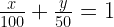
=> \frac { x }{ 100 } +\frac { y }{ 50 } =1
Now x + 2y ≥ 100 represents which does not include (0,0) as it does not made it true.
Again consider 2x – y ≤ 0
Let 2x – y = 0 or y = 2x
NCERT Solutions for Class 12 Maths Chapter 12 Linear Programming Ex 12.1 Q8.1
NCERT Solutions for Class 12 Maths Chapter 12 Linear Programming Ex 12.1 Q8.2

Ex 12.1 Class 12 Maths Question 9.
Maximize Z = -x + 2y, subject to the constraints: x≥3, x + y ≥ 5, x + 2y ≥ 6,y ≥ 0
Solution:
The objective function is Z = – x + 2y.
The constraints are x ≥ 3, x + y ≥ 5, x + 2y ≥ 6, y ≥ 0
NCERT Solutions for Class 12 Maths Chapter 12 Linear Programming Ex 12.1 Q9.1
NCERT Solutions for Class 12 Maths Chapter 12 Linear Programming Ex 12.1 Q9.2

Ex 12.1 Class 12 Maths Question 10.
Maximize Z = x + y subject to x – y≤ -1, -x + y≤0,x,y≥0
Solution:
Objective function Z = x + y, constraints x – y≤ -1, -x + y≤0,x,y≥0
NCERT Solutions for Class 12 Maths Chapter 12 Linear Programming Ex 12.1 Q10.1

Ex 12.2 Class 12 Maths Question 1.
Reshma wishes to mix two types of food P and Q in such a way that the vitamin contents of the mixture contain at least 8 units of vitamin A and 11 units of vitamin B. Food P costs Rs 60/kg and Food Q costs Rs 80/kg. Food P contains 3 units/ kg of Vitamin A and 5 units/ kg of Vitamin B while food Q contains 4 units/kg of Vitamin A and 2 units/kg of vitamin B. Determine the minimum cost of the mixture.
Solution:
Let x kg of food P and y kg of food Q are mixed,
NCERT Solutions for Class 12 Maths Chapter 12 Linear Programming Ex 12.2 Q1.1
NCERT Solutions for Class 12 Maths Chapter 12 Linear Programming Ex 12.2 Q1.2
NCERT Solutions for Class 12 Maths Chapter 12 Linear Programming Ex 12.2 Q1.3
NCERT Solutions for Class 12 Maths Chapter 12 Linear Programming Ex 12.2 Q1.4

Ex 12.2 Class 12 Maths Question 2.
One kind of cake requires 200 g of flour and 25g of fat, and another kind of cake requires 100 g of flour and 50 g of fat Find the maximum number of cakes which can be made from 5 kg of flour and 1 kg of fat assuming that there is no shortage of the other ingredients, used in making the cakes.
Solution:
Let number of cakes made of first kind are x and that of second kind is y.
∴ maximize Z = x + y
NCERT Solutions for Class 12 Maths Chapter 12 Linear Programming Ex 12.2 Q2.1
NCERT Solutions for Class 12 Maths Chapter 12 Linear Programming Ex 12.2 Q2.2

Ex 12.2 Class 12 Maths Question 3.
A factory makes tennis rackets and cricket bats. A tennis racket takes 1.5 hours of machine time and 3 hours of craftman’s time in its making while a cricket bat takes 3 hour of machine time and 1 hour of craftman’s time. In a day, the factory has the availability of not more than 42 hours of machine time and 24 hours of craftsman’s time.
(i) What number of rackets and bats must be made if the factory is to work at full capacity?
(ii) If the profit on a racket and on a bat is Rs 20 and Rs 10 respectively, find the maximum profit of the factory when it works at full capacity. .
Solution:
Let x tennis rackets and y cricket bats are produced in one day in the factory.
NCERT Solutions for Class 12 Maths Chapter 12 Linear Programming Ex 12.2 Q3.1
NCERT Solutions for Class 12 Maths Chapter 12 Linear Programming Ex 12.2 Q3.2
NCERT Solutions for Class 12 Maths Chapter 12 Linear Programming Ex 12.2 Q3.3

Ex 12.2 Class 12 Maths Question 4.
A manufacturer produces nuts and bolts. It takes 1 hour of work on machine A and 3 hours on machine B to produce a package of nuts. It takes 3 hours on machine A and 1 hour on machine B to produce a package of bolts. He earns a profit of Rs 17.50 per package on nuts and Rs 7.00 per package on bolts. How many packages of each should be produced each day so as to maximise his profit, if he operates his machines for at the most 12 hours
Solution:
Let x nuts and y bolts are produced.
NCERT Solutions for Class 12 Maths Chapter 12 Linear Programming Ex 12.2 Q4.1
NCERT Solutions for Class 12 Maths Chapter 12 Linear Programming Ex 12.2 Q4.2
NCERT Solutions for Class 12 Maths Chapter 12 Linear Programming Ex 12.2 Q4.3

Ex 12.2 Class 12 Maths Question 5.
A factory manufactures two types of screws, A and B, Each type of screw requires the use of two machines, an automatic and a hand operated. It takes 4 minutes on the automatic and 6 minutes on hand operated machines to manufacture a package of screws A, while it takes 6 minutes on automatic and 3 minutes on the hand operated machines to manufacture a package of screws B. Each machine is available for at the most 4 hours on any day. The manufacturer can sell a package of screws A at a profit of Rs 7 and screws B at a profit of Rs 10. Assuming that he can sell all the screws he manufactures, how many packages of each type should the factory owner produce in a day in order to maximise his profit? Determine the maximum profit.
Solution:
Let the manufacturer produces x packages of screws A and y packages of screw B, then time taken by x packages of screw A and y packages of screw B on automatic machine = (4x + 6y) minutes.
And hand operated machine = (6x + 3y) minutes
NCERT Solutions for Class 12 Maths Chapter 12 Linear Programming Ex 12.2 Q5.1
NCERT Solutions for Class 12 Maths Chapter 12 Linear Programming Ex 12.2 Q5.2

Ex 12.2 Class 12 Maths Question 6.
A cottage industry manufactures pedestal lamps and wooden shades, each requiring the use of a grinding/ cutting machine and a sprayer. It takes 2 hours on grinding/ cutting machine and 3 hours on the sprayer to manufacture a pedestal lamp, while it takes 1 hour on the grinding/ cutting machine and 2 hours on the sprayer to manufacture a shade. On any day, the sprayer is available for at the most 20 hours and the grinding/cutting machine for at the most 12 hours. The profit from the sale of a lamp is Rs 5 and that from a shade is Rs 3. Assuming that the manufacturer can sell all the lamps and shades that he produces, how should he schedule his daily production in order to maximise his profit?
Solution:
Let the manufacturer produces x pedestal lamps and y wooden shades; then the time taken by x pedestal lamps and y wooden shades on grinding/ cutting machines = (2x + y) hours and time taken by x pedestal lamps and y shades on the sprayer = (3x + 2y) hours.
Since grinding/ cutting machine is available for at the most 12 hours, 2x + y ≤ 12 and sprayer is available for at the most 20 hours.
We have: 3x + 2y ≤ 20.
Profit from the sale of x lamps and y shades.
Z = 5x + 3y
So, our problem is to maximize Z = 5x + 3y subject to constraints 3x + 2y ≤ 20,2x + y ≤ 12, x, y ≥ 0.
Consider 3x + 2y ≤ 20
Let 3x + 2y = 20
y=\frac { 20-3x }{ 2 }
NCERT Solutions for Class 12 Maths Chapter 12 Linear Programming Ex 12.2 Q6.1
NCERT Solutions for Class 12 Maths Chapter 12 Linear Programming Ex 12.2 Q6.2

Ex 12.2 Class 12 Maths Question 7.
A company manufactures two types of novelty souvenirs made of plywood. Souvenirs of type A require 5 minutes each for cutting and 10 minutes each for assembling. Souvenirs of type B require 8 minutes each for cutting and 8 minutes each for assembling. There are 3 hours 20 minutes available for cutting and 4 hours for assembling. The profit is Rs 5 each for type A and Rs 6 each for type B souvenirs. How many souvenirs of each type should be company manufacture in order to maximise the profit?
Solution:
Let the company manufactures x souvenirs of type A and y souvenirs of type B, then time taken for cutting x souvenirs of type A and y souvenirs of type A and y souvenirs of type B = (5x + 8y) minutes.
Since 3 hours 20 minutes i.e 200 minutes are available for cutting, so we should have 5x + 8y ≤ 200
Also as 4 hours i.e., 240 minutes are available for assembling, so we have 10x + 8y ≤ 240 i. e., 5x + 4y ≤ 120
NCERT Solutions for Class 12 Maths Chapter 12 Linear Programming Ex 12.2 Q7.1
NCERT Solutions for Class 12 Maths Chapter 12 Linear Programming Ex 12.2 Q7.2

Ex 12.2 Class 12 Maths Question 8.
A merchant plans to sell two types of personal computers – a desktop model and a portable model that will cost Rs 25000 and Rs 40000 respectively. He estimates that the total monthly demand of computers will not exceed 250 units. Determine the number of units of each type of computers which die merchant should stock to get maximum profit if he does not want to invest more than Rs 70 lakhs and if his profit on the desktop model is Rs 4500 and on portable model is Rs 5000.
Solution:
Let there be x desktop and y portable computers. Total monthly demand of computer does not exceed 250. => x+y ≤ 250, cost of 1 desktop computer if Rs 25000 and 1 portable computer is Rs 40000
∴ cost of x desktop and y portable computer = Rs (25000 x+40000 y)
Maximum investment = Rs 70 lakhs = Rs 70,00,000
=> 25000 x+40000 y≤ 7000000 or 5x+8y ≤ 1400
profit on 1 desktop computer is Rs 4500 and on 1 portable is Rs 5000, total profit,
Z = 4500 x+5000 y
NCERT Solutions for Class 12 Maths Chapter 12 Linear Programming Ex 12.2 Q8.1
NCERT Solutions for Class 12 Maths Chapter 12 Linear Programming Ex 12.2 Q8.2

Ex 12.2 Class 12 Maths Question 9.
A diet is to contain at least 80 units of vitamin A and 100 units of minerals. Two foods Ft and F2 are available. Food F1 costs Rs 4 per unit food and F2 costs Rs 6 per unit.One unit of food F2 contains 3 units of vitamin A and 4 units of minerals. One unit of food F2 contains 6 units of vitamin A and 3 units of minerals. Formulate this as a linear programming problem. Find the minimum cost for diet that consists of mixture of these two foods and also meets the minimal nutritional requirements.
Solution:
Let there be x units of food F1 and y units of food F2.
NCERT Solutions for Class 12 Maths Chapter 12 Linear Programming Ex 12.2 Q9.1
NCERT Solutions for Class 12 Maths Chapter 12 Linear Programming Ex 12.2 Q9.2
NCERT Solutions for Class 12 Maths Chapter 12 Linear Programming Ex 12.2 Q9.3

Ex 12.2 Class 12 Maths Question 10.
There are two types of fertilisers F1, and F2. F1 consists of 10% nitrogen and 6% phosphoric acid and F2 consists of 5% nitrogen and 10% phosphoric acid. After testing the soil conditions, a fanner finds that she needs atleast 14 kg of nitrogen and 14 kg of phsophoric acid for her crop. If F2 costs Rs 6/kg and F2 costs Rs 5/ kg, determine how much of each type of fertiliser should be used so that nutrient requirements are met at a minimum cost What is the minimum cost?
Solution:
Let x kg of festiliser and y kg of fertilised F2. be required.
NCERT Solutions for Class 12 Maths Chapter 12 Linear Programming Ex 12.2 Q10.1
NCERT Solutions for Class 12 Maths Chapter 12 Linear Programming Ex 12.2 Q10.2
NCERT Solutions for Class 12 Maths Chapter 12 Linear Programming Ex 12.2 Q10.3
NCERT Solutions for Class 12 Maths Chapter 12 Linear Programming Ex 12.2 Q10.4

Ex 12.2 Class 12 Maths Question 11.
The corner points of the feasible region determined by the following system of linear inequalities:
2x+y≤10,x+3y≤15, x,y≥0 are (0,0),(5,0), (3,4) and (0,5).
Let Z=px+qy, where p, q > 0. Condition on p and q so that the maximum of Z occurs at both (3,4) and (0,5) is
(a) p=q
(b) p=2q
(c) p=3q
(d) q=3p
Solution:
Maximum value of Z = px + qy occurs at (3,4) and (0,5),
At (3,4), Z = px + qy = 3p + 4q
At (0,5), Z = 0 + q . 5 = 5q
Both are the maximum values
=> 3p + 4q = 5q or q = 3p
Option (d) is correct.

Read More

NCERT MCQ CLASS-12 CHAPTER-1 | BIOLOGY NCERT MCQ | REPRODUCTION IN ORGANISM | EDUGROWN

In This Post we are  providing Chapter-1 Reproduction in Organism  NCERT MCQ for Class 12 Biology which will be beneficial for students. These solutions are updated according to 2021-22 syllabus. These MCQS  can be really helpful in the preparation of Board exams and will provide you with a brief knowledge of the chapter.

NCERT MCQ ON REPRODUCTION IN ORGANISM

Question 1: Offspring formed by sexual reproduction exhibit more variation than those formed by Asexual reproduction because

  • a) gametes of parents have qualitatively different genetic composition
  • b) gametes of parents have qualitatively different genetic composition
  • c) greater amount of DNA is involved in sexual reproduction
  • d) sexual reproduction is a lengthy process

Answer: gametes of parents have qualitatively different genetic composition

Question 2: The property of an undifferentiated cell that has the potential to develop into an entire plant is called

  • a) Totipotency
  • b) Sub potency
  • c) Cloning
  • d) Budding

Answer: Totipotency

Question 3: The development of root and shoot in tissue culture is determined by ______

  • a) Auxin and cytokinin ratio
  • b) None of the above
  • c) Nutrients
  • d) Temperature

Answer: Auxin and cytokinin ratio

Question 4: There is no natural death in single celled organisms like Amoeba and bacteria because

  • a) parental body is distributed among the offspring
  • b) they are microscopic
  • c) they reproduce by binary fission
  • d) they cannot reproduce sexually

Answer: parental body is distributed among the offspring

Question 5: There are various types of reproduction. The type of reproduction adopted by an organism depends on

  • a) the organism’s habitat, physiology, and genetic makeup
  • b) morphology and physiology of the organism
  • c) morphology of the organism
  • d) None of these

Answer: the organism’s habitat, physiology, and genetic makeup

Question 6: A few statements describing certain features of reproduction are given below:

i. Gametic fusion takes place

ii. Transfer of genetic material takes place

iii. Reduction division takes place

iv. Progeny have some resemblance with parents

Select the options that are true for both asexual and sexual reproduction from the options given below:

  • a) ii and iv
  • b) i and iii
  • c) ii and iii
  • d) i and ii

Answer: ii and iv

Question 7: Appearance of vegetative propagules from the nodes of plants such as sugarcane and ginger is mainly because

  • a) nodes have meristematic cells
  • b) nodes have meristematic cells
  • c) nodes have meristematic cells
  • d) nodes are shorter than intenodes

Answer: nodes have meristematic cells

Question 8: Identify the correct sequence of events

  • a) Gametogenesis → Syngamy → Zygote
  • b) Gametogenesis → Embryogenesis → Zygote → Syngamy
  • c) Gametogenesis → Zygote → Syngamy → Embryogenesis
  • d) Gametogenesis → Syngamy Embryogenesis → Zygote

Answer: Gametogenesis → Syngamy → Zygote

Question 9: The term ‘clone’ cannot be applied to offspring formed by sexual reproduction because

  • a) Offspring do not possess exact copies of parental DNA
  • b) DNA of only one parent is copied and passed on to the offspring
  • c) Offspring are formed at different times
  • d) NA of parent and offspring are completely different

Answer: Offspring do not possess exact copies of parental DNA

Question 10: Amoeba and Yeast reproduce asexually by fission and budding respectively, because they are

  • a) Unicellular organisms
  • b) Uninucleate organisms
  • c) Heterotrophic organisms
  • d) Microscopic organisms

Answer: Unicellular organisms

Question 11: A few statements with regard to sexual reproduction are given below:

i. Sexual reproduction does not always require two individuals

ii. Sexual reproduction generally involves gametic fusion

iii. Meiosis never occurs during sexual reproduction

iv. External fertilisation is a rule during sexual reproduction

Choose the correct statements from the options below:

  • a) i and ii
  • b) ii and iii
  • c) i and iv
  • d) i and iv

Answer: i and ii

Question 12: A multicellular, filamentous alga exhibits a type of sexual life cycle in which the meiotic division occurs after the formation of zygote. The adult filament of this alga has

  • a) haploid vegetative cells and haploid gametangia
  • b) diploid vegetative cells and haploid gametangia
  • c) diploid vegetative cells and diploid gametangia
  • d) haploid vegetative cells and diploid gametangia

Answer: haploid vegetative cells and haploid gametangia

Question 13: The male gametes of rice plant have 12 chromosomes in their nucleus. The chromosome number in the female gamete, zygote and the cells of the seedling will be, respectively,

  • a) 12, 24, 24
  • b) 24, 12, 24
  • c) 24, 12, 12
  • d) 12, 24, 12

Answer: 12, 24, 24

Question 14: Given below are a few statements related to external fertilization. Choose the correct statements.

i. The male and female gametes are formed and released simultaneously

ii. Only a few gametes are released into the medium

iii. Water is the medium in a majority of organisms exhibiting external fertilization

iv. Offspring formed as a result of external fertilization have better chance of survival than those formed inside an organism

  • a) i and iii
  • b) ii and iv
  • c) i and iv
  • d) iii and iv

Answer: i and iii

Question 15 : The statements given below describe certain features that are observed in the pistil of flowers.

i. Pistil may have many carpels

ii. Each carpel may have more than one ovule

iii. Each carpel has only one ovule

iv. Pistil have only one carpel

Choose the statements that are true from the options below:

  • a) i and ii
  • b) i and iii
  • c) ii and iv
  • d) iii and iv

Answer: i and ii

Read More

Class 12th Chapter -11 Three Dimensional Geometry | NCERT Maths Solution | NCERT Solution | Edugrown

It is important that you have a strong foundation in Maths Solutions. This can help you immensely in exams. Because there is no paper pattern set for the board exams. Every year there are different twists and turns in questions asked in board exams. While preparing for maths it becomes to go through every bit of detail. Thus, NCERT Solutions Class 12 Maths can help you lay a strong foundation. There solutions of each and every question given in the NCERT 12 Textbook in this article. There are crucial chapters like integration, algebra, and calculus which you can solve easily using these Class 12 Maths solutions. Using these NCERT Maths Class 12 Solutions can give you an edge over the other students.

NCERT Solutions for Class 12 Maths Chapter :11 Three Dimensional Geometry

Ex 11.1 Class 12 Maths Question 1.
If a line makes angles 90°, 135°, 45° with the and z axes respectively, find its direction cosines.
Solution:
Direction angles are 90°, 135°, 45°
Direction cosines are
NCERT Solutions for Class 12 Maths Chapter 11 Three Dimensional Geometry Ex 11.1 Q1.1

Ex 11.1 Class 12 Maths Question 2.
Find the direction cosines of a line which makes equal angles with coordinate axes.
Solution:
Let direction angle be α each
∴ Direction cosines are cos α, cos α, cos α
But l² + m² + n² = 1
∴cos² a + cos² a + cos² a = 1
NCERT Solutions for Class 12 Maths Chapter 11 Three Dimensional Geometry Ex 11.1 Q2.1

Ex 11.1 Class 12 Maths Question 3.
If a line has the direction ratios – 18,12, -4 then what are its direction cosines?
Solution:
Now given direction ratios of a line are -8,12,-4
∴ a = -18,b = 12,c = -4
Direction cosines are
NCERT Solutions for Class 12 Maths Chapter 11 Three Dimensional Geometry Ex 11.1 Q3.1

Ex 11.1 Class 12 Maths Question 4.
Show that the points (2,3,4) (-1,-2,1), (5,8,7) are collinear.
Solution:
Let the points be A(2,3,4), B (-1, -2,1), C (5,8,7).
Let direction ratios of AB be
NCERT Solutions for Class 12 Maths Chapter 11 Three Dimensional Geometry Ex 11.1 Q4.1

Ex 11.1 Class 12 Maths Question 5.
Find the direction cosines of the sides of the triangle whose vertices are (3,5, -4), (-1,1,2) and (-5,-5,-2).
Solution:
The vertices of triangle ABC are A (3, 5, -4), B (-1,1,2), C (-5, -5, -2)
(i) Direction ratios of AB are (-4,-4,6)
Direction cosines are
NCERT Solutions for Class 12 Maths Chapter 11 Three Dimensional Geometry Ex 11.1 Q5.1
NCERT Solutions for Class 12 Maths Chapter 11 Three Dimensional Geometry Ex 11.1 Q5.2

Ex 11.2 Class 12 Maths Question 1.
Show that the three lines with direction cosines:
\frac { 12 }{ 13 } ,\frac { -3 }{ 13 } ,\frac { -4 }{ 13 } ,\frac { 4 }{ 13 } ,\frac { 12 }{ 13 } ,\frac { 3 }{ 13 } ,\frac { 3 }{ 13 } ,\frac { -4 }{ 13 } ,\frac { 12 }{ 13 }
are mutually perpendicular.
Solution:
Let the lines be L1,L2 and L3.
∴ For lines L1 and L2
NCERT Solutions for Class 12 Maths Chapter 11 Three Dimensional Geometry Ex 11.2 Q17.2

Ex 11.2 Class 12 Maths Question 2.
Show that the line through the points (1,-1,2) (3,4, -2) is perpendicular to the line through the points (0,3,2) and (3,5,6).
Solution:
Let A, B be the points (1, -1, 2), (3, 4, -2) respectively Direction ratios of AB are 2,5, -4
Let C, D be the points (0, 3, 2) and (3, 5, 6) respectively Direction ratios of CD are 3, 2,4 AB is Perpendicular to CD if
NCERT Solutions for Class 12 Maths Chapter 11 Three Dimensional Geometry Ex 11.2 Q17.3

Ex 11.2 Class 12 Maths Question 3.
Show that the line through the points (4,7,8) (2,3,4) is parallel to the line through the points (-1,-2,1) and (1,2,5).
Solution:
Let the points be A(4,7,8), B (2,3,4), C (-1,-2,1) andD(1,2,5).
Now direction ratios of AB are
NCERT Solutions for Class 12 Maths Chapter 11 Three Dimensional Geometry Ex 11.2 Q3.1

Ex 11.2 Class 12 Maths Question 4.
Find the equation of the line which passes through the point (1,2,3) and is parallel to the vector 3\hat { i } +2\hat { j } -2\hat { k }
Solution:
Equation of the line passing through the point
NCERT Solutions for Class 12 Maths Chapter 11 Three Dimensional Geometry Ex 11.2 Q17.4

Ex 11.2 Class 12 Maths Question 5.
Find the equation of the line in vector and in cartesian form that passes through the point with position vector 2\hat { i } -\hat { j } +4\hat { k }  and is in the direction \hat { i } +2\hat { j } -\hat { k } .
Solution:
The vector equation of a line passing through a point with position vector \overrightarrow { a }  and parallel to the
NCERT Solutions for Class 12 Maths Chapter 11 Three Dimensional Geometry Ex 11.2 Q17.5
NCERT Solutions for Class 12 Maths Chapter 11 Three Dimensional Geometry Ex 11.2 Q5.1

Ex 11.2 Class 12 Maths Question 6.
Find the cartesian equation of the line which passes through the point (-2,4, -5) and parallel to the line is given by \frac { x+3 }{ 3 } =\frac { y-4 }{ 5 } =\frac { z+8 }{ 6 }
Solution:
The cartesian equation of the line passing through the point (-2,4, -5) and parallel to the
NCERT Solutions for Class 12 Maths Chapter 11 Three Dimensional Geometry Ex 11.2 Q6.1

Ex 11.2 Class 12 Maths Question 7.
The cartesian equation of a line is
\frac { x-5 }{ 3 } =\frac { y+4 }{ 7 } =\frac { z-6 }{ 2 }
write its vector form.

Solution:
The cartesian equation of the line is
\frac { x-5 }{ 3 } =\frac { y+4 }{ 7 } =\frac { z-6 }{ 2 }
Clearly (i) passes through the point (5, – 4, 6) and has 3,7,2 as its direction ratios.
=> Line (i) passes through the point A with
NCERT Solutions for Class 12 Maths Chapter 11 Three Dimensional Geometry Ex 11.2 Q7.1

Ex 11.2 Class 12 Maths Question 8.
Find the vector and the cartesian equations of the lines that passes through the origin and (5,-2,3).
Solution:
The line passes through point
\therefore \overrightarrow { a } =\overrightarrow { 0 }
Direction ratios of the line passing through the
NCERT Solutions for Class 12 Maths Chapter 11 Three Dimensional Geometry Ex 11.2 Q8.1

Ex 11.2 Class 12 Maths Question 9.
Find the vector and cartesian equations of the line that passes through the points (3, -2, -5), (3,-2,6).
Solution:
The PQ passes through the point P(3, -2, -5)
NCERT Solutions for Class 12 Maths Chapter 11 Three Dimensional Geometry Ex 11.2 Q9.1

Ex 11.2 Class 12 Maths Question 10.
Find the angle between the following pair of lines
(i) \overrightarrow { r } =2\hat { i } -5\hat { j } +\hat { k } +\lambda (3\hat { i } +2\hat { j } +6\hat { k } )
and\quad \overrightarrow { r } =7\hat { i } -6\hat { j } +\mu (\hat { i } +2\hat { j } +2\hat { k } )
(ii) \overrightarrow { r } =3\hat { i } +\hat { j } -2\hat { k } +\lambda (\hat { i } -\hat { j } -2\hat { k } )
\overrightarrow { r } =2\hat { i } -\hat { j } -56\hat { k } +\mu (3\hat { i } -5\hat { j } -4\hat { k } )
Solution:
(i) Let θ be the angle between the given lines.
The given lines are parallel to the vectors
NCERT Solutions for Class 12 Maths Chapter 11 Three Dimensional Geometry Ex 11.2 Q10.1

Ex 11.2 Class 12 Maths Question 11.
Find the angle between the following pair of lines
(i) \frac { x-2 }{ 2 } =\frac { y-1 }{ 5 } =\frac { z+3 }{ -3 } and\frac { x+2 }{ -1 } =\frac { y-4 }{ 8 } =\frac { z-5 }{ 4 }
(ii) \frac { x }{ 2 } =\frac { y }{ 2 } =\frac { z }{ 1 } and\frac { x-5 }{ 4 } =\frac { y-2 }{ 1 } =\frac { z-3 }{ 8 }
Solution:
Given
(i) \frac { x-2 }{ 2 } =\frac { y-1 }{ 5 } =\frac { z+3 }{ -3 } and\frac { x+2 }{ -1 } =\frac { y-4 }{ 8 } =\frac { z-5 }{ 4 }
(ii) \frac { x }{ 2 } =\frac { y }{ 2 } =\frac { z }{ 1 } and\frac { x-5 }{ 4 } =\frac { y-2 }{ 1 } =\frac { z-3 }{ 8 }
NCERT Solutions for Class 12 Maths Chapter 11 Three Dimensional Geometry Ex 11.2 Q11.1

Ex 11.2 Class 12 Maths Question 12.
Find the values of p so that the lines
\frac { 1-x }{ 3 } =\frac { 7y-14 }{ 2p } =\frac { z-3 }{ 2 } and\frac { 7-7x }{ 3p } =\frac { y-5 }{ 1 } =\frac { 6-z }{ 5 }
are at right angles
Solution:
The given equation are not in the standard form
The equation of given lines is
NCERT Solutions for Class 12 Maths Chapter 11 Three Dimensional Geometry Ex 11.2 Q12.1

Ex 11.2 Class 12 Maths Question 13.
Show that the lines \frac { x-5 }{ 7 } =\frac { y+2 }{ -5 } =\frac { z }{ 1 } and\frac { x }{ 1 } =\frac { y }{ 2 } =\frac { z }{ 3 }  are perpendicular to each other
Solution:
Given lines
\frac { x-5 }{ 7 } =\frac { y+2 }{ -5 } =\frac { z }{ 1 }  …(i)
\frac { x }{ 1 } =\frac { y }{ 2 } =\frac { z }{ 3 }  …(ii)
NCERT Solutions for Class 12 Maths Chapter 11 Three Dimensional Geometry Ex 11.2 Q13.1

Ex 11.2 Class 12 Maths Question 14.
Find the shortest distance between the lines
\overrightarrow { r } =(\hat { i } +2\hat { j } +\hat { k } )+\lambda (\hat { i } -\hat { j } +\hat { k } ) and
\overrightarrow { r } =(2\hat { i } -\hat { j } -\hat { k } )+\mu (2\hat { i } +\hat { j } +2\hat { k } )
Solution:
The shortest distance between the lines
NCERT Solutions for Class 12 Maths Chapter 11 Three Dimensional Geometry Ex 11.2 Q14.1

Ex 11.2 Class 12 Maths Question 15.
Find the shortest distance between the lines
\frac { x+1 }{ 7 } =\frac { y+1 }{ -6 } =\frac { z+1 }{ 1 } and\frac { x-3 }{ 1 } =\frac { y-5 }{ -2 } =\frac { z-7 }{ 1 }
Solution:
Shortest distance between the lines
NCERT Solutions for Class 12 Maths Chapter 11 Three Dimensional Geometry Ex 11.2 Q15.1

Ex 11.2 Class 12 Maths Question 16.
Find the distance between die lines whose vector equations are:
\overrightarrow { r } =(\hat { i } +2\hat { j } +3\hat { k) } +\lambda (\hat { i } -3\hat { j } +2\hat { k } ) and
\overrightarrow { r } =(4\hat { i } +5\hat { j } +6\hat { k) } +\mu (2\hat { i } +3\hat { j } +\hat { k } )
Solution:
Comparing the given equations with
NCERT Solutions for Class 12 Maths Chapter 11 Three Dimensional Geometry Ex 11.2 Q16.1

Ex 11.2 Class 12 Maths Question 17.
Find the shortest distance between the lines whose vector equations are
\overrightarrow { r } =(1-t)\hat { i } +(t-2)\hat { j } +(3-2t)\hat { k }  and
\overrightarrow { r } =(s+1)\hat { i } +(2s-1)\hat { j } -(2s+1)\hat { k }
Solution:
Comparing these equation with
NCERT Solutions for Class 12 Maths Chapter 11 Three Dimensional Geometry Ex 11.2 Q17.1

Ex 11.3 Class 12 Maths Question 1.
In each of the following cases, determine the direction cosines of the normal to the plane and the distance from the origin.
(a) z = 2
(b) x+y+z = 1
(c) 2x + 3y – z = 5
(d) 5y+8 = 0
Solution:
(a) Direction ratios of the normal to the plane are 0,0,1
=> a = 0, b = 0, c = 1
NCERT Solutions for Class 12 Maths Chapter 11 Three Dimensional Geometry Ex 11.3 Q1.1
NCERT Solutions for Class 12 Maths Chapter 11 Three Dimensional Geometry Ex 11.3 Q1.2

Ex 11.3 Class 12 Maths Question 2.
Find the vector equation of a plane which is at a distance of 7 units from the origin and normal to the vector 3\hat { i } +5\hat { j } -6\hat { k }
Solution:
NCERT Solutions for Class 12 Maths Chapter 11 Three Dimensional Geometry Ex 11.3 Q2.1

Ex 11.3 Class 12 Maths Question 3.
Find the Cartesian equation of the following planes.
(a) \overrightarrow { r } \cdot (\hat { i } +\hat { j } -\hat { k) } =2
(b) \overrightarrow { r } \cdot (\hat { 2i } +3\hat { j } -4\hat { k) } =1
(c) \overrightarrow { r } \cdot [(s-2t)\hat { i } +(3-t)\hat { j } +(2s+t)\hat { k) } =15
Solution:
(a) \overrightarrow { r }  is the position vector of any arbitrary point P (x, y, z) on the plane.
NCERT Solutions for Class 12 Maths Chapter 11 Three Dimensional Geometry Ex 11.3 Q3.1

Ex 11.3 Class 12 Maths Question 4.
In the following cases find the coordinates of the foot of perpendicular drawn from the origin
(a) 2x + 3y + 4z – 12 = 0
(b) 3y + 4z – 6 = 0
(c) x + y + z = 1
(d) 5y + 8 = 0
Solution:
(a) Let N (x1, y1, z1) be the foot of the perpendicular from the origin to the plane 2x+3y+4z-12 = 0
∴ Direction ratios of the normal are 2, 3, 4.
Also the direction ratios of ON are (x1,y1,z1)
NCERT Solutions for Class 12 Maths Chapter 11 Three Dimensional Geometry Ex 11.3 Q4.1
NCERT Solutions for Class 12 Maths Chapter 11 Three Dimensional Geometry Ex 11.3 Q4.2
NCERT Solutions for Class 12 Maths Chapter 11 Three Dimensional Geometry Ex 11.3 Q4.3

Ex 11.3 Class 12 Maths Question 5.
Find the vector and cartesian equation of the planes
(a) that passes through the point (1,0, -2) and the normal to the plane is \hat { i } +\hat { j } -\hat { k }
(b) that passes through the point (1,4,6) and the normal vector to the plane is \hat { i } -2\hat { j } +\hat { k }
Solution:
(a) Normal to the plane is i + j – k and passes through (1,0,-2)
NCERT Solutions for Class 12 Maths Chapter 11 Three Dimensional Geometry Ex 11.3 Q5.1
NCERT Solutions for Class 12 Maths Chapter 11 Three Dimensional Geometry Ex 11.3 Q5.2

Ex 11.3 Class 12 Maths Question 6.
Find the equations of the planes that passes through three points
(a) (1,1,-1) (6,4,-5), (-4, -2,3)
(b) (1,1,0), (1,2,1), (-2,2,-1)
Solution:
(a) The plane passes through the points (1,1,-1) (6,4,-5), (-4,-2,3)
Let the equation of the plane passing through(1,1,-1)be
NCERT Solutions for Class 12 Maths Chapter 11 Three Dimensional Geometry Ex 11.3 Q6.1

Ex 11.3 Class 12 Maths Question 7.
Find the intercepts cut off by the plane 2x+y-z = 5.
Solution:
Equation of the plane is 2x + y- z = 5 x y z
Dividing by 5: \Rightarrow \frac { x }{ \frac { 5 }{ 2 } } +\frac { y }{ 5 } -\frac { z }{ -5 } =1
∴ The intercepts on the axes OX, OY, OZ are \frac { 5 }{ 2 }, 5, -5 respectively

Ex 11.3 Class 12 Maths Question 8.
Find the equation of the plane with intercept 3 on the y- axis and parallel to ZOX plane.
Solution:
Any plane parallel to ZOX plane is y=b where b is the intercept on y-axis.
∴ b = 3.
Hence equation of the required plane is y = 3.

Ex 11.3 Class 12 Maths Question 9.
Find the equation of the plane through the intersection of the planes 3x – y + 2z – 4 = 0 and x + y + z – 2 = 0 and the point (2,2,1).
Solution:
Given planes are:
3x – y + 2z – 4 = 0 and x + y + z – 2 = 0
Any plane through their intersection is
3x – y + 2z – 4 + λ(x + y + z – 2) = 0
point (2,2,1) lies on it,
∴3 x 2 – 2 + 2 x 1 – 4 +λ(2+2+1-2)=0
=>λ = \frac { -2 }{ 3 }
Now required equation is 7x – 5y + 4z – 8 = 0

Ex 11.3 Class 12 Maths Question 10.
Find the vector equation of the plane passing through the intersection of the planes \overrightarrow { r } \cdot \left( 2\hat { i } +2\hat { j } -3\hat { k } \right) =7,\overrightarrow { r } \cdot \left( 2\hat { i } +5\hat { j } +3\hat { k } \right) =9 and through the point (2,1,3).
Solution:
Equation of the plane passing through the line of intersection of the planes
NCERT Solutions for Class 12 Maths Chapter 11 Three Dimensional Geometry Ex 11.3 Q10.1

Ex 11.3 Class 12 Maths Question 11.
Find the equation of the plane through the line of intersection of the planes x + y + z = 1 and 2x + 3y + 4z = 5 which is perpendicular to the plane x – y + z = 0.
Solution:
Given planes are
x + y + z – 1 = 0 …(i)
2x + 3y + 4z – 5 = 0 …(ii)
x – y + z = 0 ….(iii)
NCERT Solutions for Class 12 Maths Chapter 11 Three Dimensional Geometry Ex 11.3 Q11.1

Ex 11.3 Class 12 Maths Question 12.
Find the angle between the planes whose vector equations are \overrightarrow { r } \cdot \left( 2\hat { i } +2\hat { j } -3\hat { k } \right) =5,\overrightarrow { r } \cdot \left( 3\hat { i } -3\hat { j } +5\hat { k } \right) =3
Solution:
The angle θ between the given planes is
NCERT Solutions for Class 12 Maths Chapter 11 Three Dimensional Geometry Ex 11.3 Q12.1

Ex 11.3 Class 12 Maths Question 13.
In the following determine whether the given planes are parallel or perpendicular, and in case they are neither, find the angle between them.
(a) 7x + 5y + 6z + 30 = 0 and 3x – y – 10z + 4 = 0
(b) 2x + y + 3z – 2 = 0 and x – 2y + 5 = 0
(c) 2x – 2y + 4z + 5 = 0 and 3x – 3y + 6z – 1 = 0
(d) 2x – y + 3z – 1 = 0 and 2x – y + 3z + 3 = 0
(e) 4x + 8y + z – 8 = 0 and y + z – 4 = 0.
Solution:
(a) Direction ratios of the normal of the planes 7x + 5y + 6z + 30 = 0 are 7,5,6
Direction ratios of the normal of the plane 3x – y – 10z + 4 = 0 are 3,-1,-10
The plane 7x + 5y + 6z + 30 = 0 …(i)
3x – y – 10z + y = 0 …(ii)
NCERT Solutions for Class 12 Maths Chapter 11 Three Dimensional Geometry Ex 11.3 Q13.1
NCERT Solutions for Class 12 Maths Chapter 11 Three Dimensional Geometry Ex 11.3 Q13.2
NCERT Solutions for Class 12 Maths Chapter 11 Three Dimensional Geometry Ex 11.3 Q13.3

Ex 11.3 Class 12 Maths Question 14.
In the following cases, find the distance of each of the given points from the corresponding given plane.
Point           Plane
(a) (0, 0,0) 3x – 4y + 12z = 3
(b) (3,-2,1) 2x – y + 2z + 3 = 0.
(c) (2,3,-5) x + 2y – 2z = 9
(d) (-6,0,0) 2x – 3y + 6z – 2 = 0
Solution:
(a) Given plane: 3x – 4y + 12z – 3 = 0
NCERT Solutions for Class 12 Maths Chapter 11 Three Dimensional Geometry Ex 11.3 Q14.1q

Read More

NCERT MCQ CLASS-12 CHAPTER-16 | CHEMISTRY NCERT MCQ | CHEMISTRY IN EVERYDAY LIFE | EDUGROWN

In This Post we are  providing Chapter-16 Chemistry in Everyday Life  NCERT MCQ for Class 12 Chemistry which will be beneficial for students. These solutions are updated according to 2021-22 syllabus. These MCQS  can be really helpful in the preparation of Board exams and will provide you with a brief knowledge of the chapter.

NCERT MCQ ON CHEMISTRY IN EVERYDAY LIFE

Question 1: Drugs can be classified on the basis of

  • a) Pharmacological effect
  • b) Drug action
  • c) Chemical structure
  • d) All of these

Answer: All of these

Question 2: Antacids include

  • a) Omeprazole
  • b) Lansoprazole
  • c) Sodium bicarbonate
  • d) All of these

Answer: All of these

Question 3: Drawback of excess of hydrogen carbonate taking as antacid is

  • a) It is insoluble
  • b) It can make stomach alkaline and trigger the production of even more acid
  • c) It causes ulcer
  • d) It causes pain and irritation

Answer: It can make stomach alkaline and trigger the production of even more acid

Question 4: Tranquilizers are prescribed for curing

  • a) Anxiety, stress, irritability
  • b) The growth of microorganism
  • c) Pain, Fever
  • d) All of these

Answer: Anxiety, stress, irritability

Question 5: Tincture of iodine is

  • a) Iodoform
  • b) 100% Iodine
  • c) 2-3% Iodine solution in alcohol-water
  • d) Iodobenzene

Answer: 2-3% Iodine solution in alcohol-water

Question 6: 0.2% of solution of phenol and 0.2–0.4 ppm chlorine in aqueous solution respectively behave as

  • a) Antiseptic, Disinfectant
  • b) Disinfectant, Antiseptic
  • c) Disinfectant, Disinfectant
  • d) Antiseptic, Antiseptic

Answer: Antiseptic, Disinfectant

Question 7:  Birth control pills essentially contains

  • a) Synthetic estrogen
  • b) Synthetic progesterone
  • c) Both (1) & (2)
  • d) Neither (1) nor (2)

Answer:  Both (1) & (2)

Question 8: Which is mismatched, regarding the examples?

  • a) Broad spectrum Antibiotic – Chloramphenicol
  • b) Narrow spectrum antibiotic – Ampicillin
  • c) Antiseptic – Furacine
  • d) Antifertility – Novestrol

Answer:  Narrow spectrum antibiotic – Ampicillin

Question 9: Chemicals are added to food for

  • a) Preservation
  • b) Enhancing the appeal
  • c) Adding nutritive value
  • d) All of these

Answer: All of these

Question 10: The first popular artificial sweetening agent is

  • a) Saccharin
  • b) Aspartame
  • c) Alitame
  • d) Both (2) & (3)

Answer: Saccharin

Question 11:  The compound with structure

NEET Chemistry Chemistry in Everyday Life Online Test Set A-Q29

is used as

  • a) Food preservative
  • b) Artificial sweetener
  • c) Medicine
  • d) Edible color

Answer: Artificial sweetener

Question 12: The main disadvantage associated with use of aspartame is

  • a) Its sweetening power is less
  • b) It is unstable at cooking temperature
  • c) It provide calories
  • d) It is difficult to control its sweetness

Answer: It is unstable at cooking temperature

Question 13: Which of the following can be used as food preservative?

  • a) Vegetable oil
  • b) Table salt
  • c) Sodium benzoate
  • d) All of these

Answer: All of these

Question 14: Among the following, the maximum high potency sugar is

  • a) Saccharin
  • b) Alitame
  • c) Sucralose
  • d) Aspartame

Answer: Alitame

Question 15: Soaps are sodium or potassium salt of long chain fatty acids like

  • a) Palmitic acid
  • b) Oleic acid
  • c) Stearic acid
  • d) All of these

Answer: All of these

Read More

NCERT MCQ CLASS-12 CHAPTER-15 | CHEMISTRY NCERT MCQ | POLYMERS | EDUGROWN

In This Post we are  providing Chapter-15 Polymers  NCERT MCQ for Class 12 Chemistry which will be beneficial for students. These solutions are updated according to 2021-22 syllabus. These MCQS  can be really helpful in the preparation of Board exams and will provide you with a brief knowledge of the chapter.

NCERT MCQ ON POLYMERS

Question 1.
Bakelite is an example of

(a) elastomer
(b) fibre
(c) thermoplastic
(d) thermosetting

Answer: (d) thermosetting

Question 2.
Arrange the following polymers is an increasing order of intermolecular forces: fibre, plastic, elastomer
(a) Elastomer < Fibre < Plastic
(b) Elastomer < Plastic < Fibre
(c) Plastic < Elastomer < Fibre
(d) Fibre < Elastomer < Plastic

Answer: (b) Elastomer < Plastic < Fiber

Question 3.
The correct structure of monomers of Buna-S is

MCQ Questions for Class 12 Chemistry Chapter 15 Polymers with Answers

Answer: (c)

Question 4.
The S in Buna-S refers to

(a) Sulphur
(b) Styrene
(c) Sodium
(d) Salicylate

Answer: (b) Styrene

Question 5.
Identify the type of polymer

(i) -A-A-A-A-A-A-
(ii) -A-B-B-A-A-A-B-A-
(a) (i) Homopolymer, (ii) Copolymer
(b) (i) Natural polymer, (ii) Synthetic polymer
(c) (i) Linear polymer, (ii) Branched polymer
(d) (i) Fiber, (ii) Elastomer

Answer: (a) (i) Homopolymer, (ii) Copolymer

Question 6.
Which of the following are thermoplastic polymers?

(a) Polythene, urea-formaldehyde, polyvinyl
(b) Bakelite, polythene, polystyrene
(c) Polythene, polystyrene, polyvinyl
(d) Urea-formaldehyde, polystyrene, Bakelite

Answer: (c) Polythene, polystyrene, polyvinyl

Question 7.
Glycogen, a naturally occurring polymer stored in animals is a

(a) monosaccharide
(b) disaccharide
(c) trisaccharide
(d) polysaccharide

Answer: (d) polysaccharide

Question 8.
Nylon 6, 6 is obtained by condensation polymerization of

(a) adipic acid and ethylene glycol
(b) adipic acid and hexamethylene diamine
(c) terephthalic acid and ethylene glycol
(d) adipic acid and phenol

Answer: (b) adipic acid and hexamethylene diamine

Question 9.
Teralitre is a condensation polymer of ethylene glycol and

(a) benzoic acid
(b) phthalic acid
(c) dimethyl terephthalate
(d) salicylic acid

Answer: (c) dimethyl terephthalate

Question 10.
Natural rubber is a polymer of

(a) 1, 1-dimethylbufadiene
(b) 2-methyl-1, 3-rbutadiene
(c) 2-chlorobuta-1, 3-diene
(d) 2-chlorobut-2-ene

Answer: (b) 2-methyl-1, 3rbutadiene

Question 11.
Heating rubber with Sulphur is known as

(a) galvanization
(b) bessemerization
(c) vulcanization
(d) sulphonation

Answer: (c) vulcanization

Question 12.
Dacron is an example of

(a) polyamides
(b) polypropenes
(c) polyacrylonitrile
(d) polyesters

Answer: (d) polyesters

Question 13.
Which of the following is a condensation polymer?

(a) Teflon
(b) PVC
(c) Polyester
(d) Neoprene

Answer: (c) Polyester

Question 14.
Which of the following polymers does not involve cross-linkages?

(a) Vulcanized rubber
(b) Bakelite
(c) Melamine
(d) Teflon

Answer: (d) Teflon

Question 15.
Composition of Ziegler-Natta catalyst is

(a) (Et3)3Al.TiCl2
(b) (Me)3Al.TiCl2
(c) (Et)3Al.TiCl4
(d) (Et)3Al.PtCl4

Answer: (c) (Et)3Al.TiCl4


Read More

NCERT MCQ CLASS-12 CHAPTER-14 | CHEMISTRY NCERT MCQ | BIOMOLECULES | EDUGROWN

In This Post we are  providing Chapter-14 Biomolecules  NCERT MCQ for Class 12 Chemistry which will be beneficial for students. These solutions are updated according to 2021-22 syllabus. These MCQS  can be really helpful in the preparation of Board exams and will provide you with a brief knowledge of the chapter.

NCERT MCQ ON BIOMOLECULES

Question 1 : Which of the following gives positive Fehling solution test?

(a) Protein  (b) Sucrose
(c) Glucose (d) Fats

Answer : C

Question 2: Which of the following statements is incorrect regarding glucose?

(a) It is an aldohexose.
(b) It is also known as dextrose
(c) It is monomer of cellulose.
(d) It is the least abundant organic compound on earth.

Answer : D 

Question 3 : Glucose gives silver mirror test with Tollen’s reagent. It shows the presence of

(a) acidic group   (b) alcoholic group
(c) ketonic group (d) aldehyde group

Answer : D  

Question 4: The symbols D and L represents

(a) the optical activity of compounds.
(b) the relative configuration of a particular stereoisomer.
(c) the dextrorotatory nature of molecule.
(d) the levorotatory nature of molecule

Answer : B 

Question 5:   The function of glucose is to

(a) provides energy  (b) promote growth
(c) prevent diseases (d) perform all above

Answer : A

Question 6 : Which one of the following compounds is different from the rest?

(a) Sucrose (b) Maltose
(c) Lactose (d) Glucose

Answer : D 

Question 7 : The two functional groups present in a typical carbohydrate are:

(a) – CHO and – COOH   (b) > C = O and – OH
(c) – OH and – CHO       (d) – OH and – COOH

Answer : C 

Question 8: When glucose reacts with bromine water, the main product is

(a) gluconic acid   (b) glyceraldehyde
(c) saccharic acid (d) acetic acid

Answer : A 

Question 9: Glucose does not react with

(a) Br2/H2O (b) H2NOH
(c) HI         (d) NaHSO3

Answer : D 

Question 10: Biomolecules are

(a) aldehydes and ketones
(b) acids and esters
(c) carbohydrates, proteins and fats
(d) alcohols and phenols

Answer : C

Question 11 : Which of the following monosaccharide is pentose ?

(a) Glucose    (b) Fructose
(c) Arabinose (d) Galactose

Answer : C

Question 12: Which one of the following compounds is found abundantly in nature?

(a) Fructose (b) Starch
(c) Glucose  (d) Cellulose

Answer : D

Question 13: A carbohydrate that cannot be hydrolyzed into simpler units is called

(a) polysaccharides (b) trisaccharide
(c) disaccharides    (d) monosaccharides

Answer : D

Question 14 : Which of the following statements is incorrect ?

(a) Maltose gives two molecules of glucose only.
(b) Cellulose and sucrose are polysaccharide.
(c) Polysaccharides are not sweet in taste.
(d) Polysaccharides are also known as non-sugars

Answer : B

Question 15 : Reducing sugars reduce.

(a) only Fehling’s solution
(b) only Tollen’s solution.
(c) both (a) & (b)
(d) neither (a) nor (b)

Answer : C

Read More

NCERT MCQ CLASS-12 CHAPTER-13 | CHEMISTRY NCERT MCQ | AMINES | EDUGROWN

In This Post we are  providing Chapter-13 Amines  NCERT MCQ for Class 12 Chemistry which will be beneficial for students. These solutions are updated according to 2021-22 syllabus. These MCQS  can be really helpful in the preparation of Board exams and will provide you with a brief knowledge of the chapter.

NCERT MCQ ON AMINES

Question 1.
Nitrogen atom of amino group is ………. hybridized.

(a) sp
(b) sp2
(c) sp3
(d) sp3d

Answer: (c) sp3

Question 2.
Which of the following should be most volatile?

I. CH3CH2CH2NH2
II. (CH3)3N
MCQ Questions for Class 12 Chemistry Chapter 13 Amines with Answers 1
IV. CH3CH2CH3
(a) II
(b) IV
(c) I
(d) III

Answer: (b) IV

Question 3.
C3H8N cannot represent

(a) 1° ammine
(b) 2° ammine
(c) 3° ammine
(d) quaternary ammonium salt

Answer: (d) quaternary ammonium salt

Question 4.
Identify the correct IUPAC name

(a) (CH3CH2)2NCH3 = N-Ethyl-N-methylethanamine
(b) (CH3)3CNH2 = 2-methylpropan-2-amine
(c) CH3NHCH (CH3)2 = N-Methylpropan-2-amine
(d) (CH3)2CHNH2 = 2, 2-Dimethyl-N-propanamine

Answer: (a) (CH3CH2)2NCH3 = N-Ethyl-N-methylethanamine

Question 5.
The most convenient method to prepare primary (i Amine) amine containing one carbon atom less is

(a) Gabriel phthalimide synthesis
(b) Reductive amination of aldehydes
(c) Hofmann bromamide reaction
(d) Reduction of isonitriles

Answer: (c) Hofmann bromamide reaction

Question 6.
Identify the correct pathway to convert propanoic acid to ethylamine. The reagent represented by A, B and C are

MCQ Questions for Class 12 Chemistry Chapter 13 Amines with Answers 2

Answer: (b)

Question 7.
When excess of ethyl iodide is treated with ammonia, the product is

(a) ethylamine
(b) dimethylamine
(c) triethylamine
(d) tetraethylammonium iodide

Answer: (d) tetraethylammonium iodide

Question 8.
Amides may be converted into amines by a reaction named after

(a) Hofmann Bromide
(b) Claisen
(c) Perkin
(d) Kerulen

Answer: (a) Hofmann Bromide

Question 9.
Reduction of CH3CH2NC with hydrogen in presence of Ni or Pt as
catalyst gives
(a) CH3CH2NH2
(b) CH3CH2NHCH3
(c) CH3CH2NHCH2CH3
(d) (CH3)3N

Answer: (b) CH3CH2NHCH3

Question 10.
Secondary amines can be prepared by

(a) reduction of nitro compounds
(b) oxidation of N-substituted amides
(c) reduction of isonitriles
(d) reduction of nitriles

Answer: (c) reduction of isonitriles

Question 11.
Which of the following amides will give ethylamine on reaction with sodium hypo bromide?

(a) Butanamide
(b) Propanamide
(c) Acetamide
(d)Benzamide

Answer: (b) Propanamide

Question 12.
Benzoic acid is treated with SOCl2 and the product (X) formed is reacted with ammonia to give (Y). (Y) on reaction with Br2 and KOH gives (Z). (Z) in the reaction is

(a) aniline
(b) chlorobenzene
(c) benzamide
(d) benzoyl chloride

Answer: (a) aniline

Question 13.
Which one of the following reducing agents is likely to be most effective in bringing about the following change?
MCQ Questions for Class 12 Chemistry Chapter 13 Amines with Answers 3

(a) H2-Ni
(b) NaBH4
(c) LiAlH4 ether
(d) Na-Alcohol

Answer: (c) LiAlH4 ether

Question 14.
Amine that cannot be prepared by Gabricl-Phthalmidie synthesis is

(a) aniline
(b) benzyl amine
(c) methyl amine
(d) iso-butylamine

Answer: (a) aniline

Question 15.
What is the end product in the following sequence of reactions?

MCQ Questions for Class 12 Chemistry Chapter 13 Amines with Answers 4
(a) Aniline
(b) Phenol
(c) Benzene
(d) Benzenediazxonium chloride

Answer: (a) Aniline


Read More

NCERT MCQ CLASS-12 CHAPTER-12 | CHEMISTRY NCERT MCQ | ALDEHYDE, KETONES AND CARBOXYLIC ACIDS | EDUGROWN

In This Post we are  providing Chapter-12 Aldehyde, Ketones and Carboxylic acids  NCERT MCQ for Class 12 Chemistry which will be beneficial for students. These solutions are updated according to 2021-22 syllabus. These MCQS  can be really helpful in the preparation of Board exams and will provide you with a brief knowledge of the chapter.

NCERT MCQ ON ALDEHYDE, KETONES AND CARBOXYLIC ACIDS

1) Which of the following carbonyl compound is used in the preparation of ice cream

a) berzophenone

b) acetophenone

c) acetone

d) acetaldehyde

Answer- : b

2) The polar nature of carbonyl group in aldehydes and ketones is due to____________

a) very less electronegative difference

b) very large electronagative difference

c) presence ot hydrogen bonding

d) presence of sp hybridised characters in carbonyl compound

Answer- : b

3) Which of the following organic compounds are second oxidation products of alkanes?

a) 1°and 2° alcohols

b) carboxylic acids and esters

c) 2° and 3° alcohols

d) aldehyde and ketones

Answer- : d

4) phenones are_________

a) aldehyde in which carbonyl group is attached with benzene ring

b) ketone in which carbonyl group is attached with benzene ring

c) phenols in which carbonyl group is attached with alkyl group 

d) phenols in which carbonyl group is attached with group

Answer- : b

5) Mesity oxide is _________

a) condensation product of acetaldehyde

b) addition product of acetaldehyde nd ammonia 

C) addition product of acetone and ammonia 

d) condensation product of acetone

Answer- : d

6) The dihalide Cl-CH2- CH2- CH2- Cl is _______

a) vicinal dihalide

b) nonterminal geminal dihalide

C) terminal geminal

d) polymethylene dihalide

Answer- : c

7) In IUPAC system

is named as_________

a) naphthalene aldehyde

b) naphthalene carbaldehyde

C) dibenzene aldehyde

d) naphanal

Answer- : b

8) what is the IUPAC name of compound when carbonyl atom carbon atom is attached to Phenyl group and ethyl group

a) propanone benzene

b) phenyl propan- 1-one

c) 2 phenyl propan- 1-one

d) propiophenone

Answer- : c

9) Give the IUPAC name________

CH3- CH2-CH__ CH-CH2-CH3

                   |        |

                 CHO- CH3

a) 4-methyl-2-ethyl pentanal

b) 4-ethyl-3-methyl pentanal

c) 2-ethy-3-methyl pentanal

d )4-methyl hexanal

Answer- : c

10) The IUPAC name of the compound

CH3CH(OH)CH2CH(CH3)CHO is_____

a) 3-hydroxy-1-methyl pentanal

b) 4-hydroxy-Z-methyl pentanal

c) 3-hydroxy-f-methyl pentanal

d 4-hydroxy-3-methyl pentanal

Answer- : b

11) The IUPAC name of the compound, CCl3, CHO is

a) chloral

b) trichloroacetaldehyde

c) 1,1,1-trichloro ethanal

d) 2,2,2-trichloro ethanal

Answer- : d

12) The lUPAC name of methyl iso-propyl ketone is________

a) 3-methyl butan-2-one

b) 2-methyl butan-1-one

c) 3-methyl butan-1-one

d) 1,1-dimethyl-2-one

Answer- : a

13) In aldehydes and ketones the carbonyl carbon is_________

a) sp3-hybridised

b) sp2′ hybridised

c) unhybridised

d)sp-hybridised

Answer- : b

14) Polar nature of >C=0 group in aldehydes and ketones results ______

a) intemolecular association

b) hydrogen bonding

c) intermolecular H-bonding

d) intramolecular H-bonding

Answer -: a

15) which of the following decrease the reactivity of aldehyde?

a)+I effect

b) -Ieffect

c) positive electromeric effect

d) negative electromeric effect

Answer -: a

Read More

NCERT MCQ CLASS-12 CHAPTER-11 | CHEMISTRY NCERT MCQ | ALCOHOLS, PHENOLS AND ETHERS | EDUGROWN

In This Post we are  providing Chapter-11 Alcohols, Phenols, and Ethers NCERT MCQ for Class 12 Chemistry which will be beneficial for students. These solutions are updated according to 2021-22 syllabus. These MCQS  can be really helpful in the preparation of Board exams and will provide you with a brief knowledge of the chapter.

NCERT MCQ ON ALCOHOLS, PHENOLS AND ETHERS

Question 1.
Which of the following alcohols gives 2-butenc on dehydration by conc. H2SO4?
(a) 2-methyl propene-2-ol
(b) 2-methyl 1 -propanol
(c) Butane-2-ol
(d) Butane 1-ol

Answer: (c) Butane-2-ol

Question 2.
One mole of ethyl acetate on titmen with an excess of LiAlH4 in dry ether and subsequent acidification produces

(a) 1 mole acetic acid + 1 mole ethyl alcohol
(b) 1 mole ethyl alcohol + 1 mole methyl alcohol
(c) 2 moles of ethyl alcohol
(d) 1 mole of 2-butanol

Answer: (c) 2 moles of ethyl alcohol

Question 3.
Which of the following reagents can not, be used to oxidise primary alcohols to aldehydes?

(a) CrO3 in anhydrous medium
(b) KMnO4 in acidic medium
(c) Pyridinium chlorochromate
(d) Heat in the presence of Cu at 573 K

Answer: (b) KMnO4 in acidic medium

Question 4.
1-Phenylethanol can be prepared by the reaction of benzaldehyde with

(a) methyl bromide
(b) ethyl iodide and magnesium
(c) methyl iodide and magnesium (Grignard reagent’s)
(d) methyl bromide and aluminum bromide

Answer: (c) methyl iodide and magnesium (Grignard reagent’s)

Question 5.
Which of the following alcohols will give the most stable carbocation during dehydration?

(a) 2-methyl-1-propanol
(b) 2-methyl-2-propanol
(c) 1-Butanol
(d) 2-Butanol

Answer: (b) 2-methyl-2-propanol

Question 6.
A compound X with the molecular formula C2H8O can be oxidized to another compound Y whose molecular formulae is C3H6O2. The compound X may be

(a) CH3CH2OCH3
(b) CH3CH2CHO
(c) CH3CH2CH2OH
(d) CH3CHOHCH3

Answer: (c) CH3CH2CH2OH

Question 7.
Order of esterification of alcohols are

(a) 3° > 1° > 2°
(b) 2°> 3° > 1°
(c) 1 ° > 2° > 3°
(d) None of these

Answer: (c) 1 ° > 2° > 3°

Question 8.
What happens when tertiary butyl alcohol is passed over heated copper at 300°C?

(a) Secondary butyl alcohol is formed
(b) 2-methylpropene is formed
(c) 1-butene is formed
(d) Butanol is formed

Answer: (b) 2-methylpropene is formed

Question 9.
Which of the following compounds will be most easily attacked by an electrophile?

MCQ Questions for Class 12 Chemistry Chapter 11 Alcohols, Phenols and Ethers with Answers 1

Answer: (c)

Question 10.
MCQ Questions for Class 12 Chemistry Chapter 11 Alcohols, Phenols and Ethers with Answers 2
In the reaction, X is
(a) (CH3)2C = CHCH3
(b) CH3C = CH
(c) (CH3)2CHCH2CH3
MCQ Questions for Class 12 Chemistry Chapter 11 Alcohols, Phenols and Ethers with Answers 3

Answer: (a) (CH3)2C = CHCH3

Question 11.
What would be the reactant and reagent used to obtain 2, 4-dimenthyl pentan-3-ol?

(a) Propanal and propyl magnesium bromide
(b) 3-methylbutanal and 2-methyl magnesium iodide
(c) 2-dimethylpropanone and methyl magnesium iodide
(d) 2-methylpropanal and isopropyl magnesium iodide

Answer: (d) 2-methylpropanal and isopropyl magnesium iodide

Question 12.
The decreasing order of boiling point of the following alcohols is

(a) 3-methylbuan-2-ol > 2-methylbutan-2-ol > pentan-1-ol
(b) Pentan-1-ol > 3-methylbutan-2-ol > 2-methylbutan-2-ol
(c) 2-methylbutan-2-ol > 3-methylbutan-2-ol > pentan-1-ol
(d) 2-methylbutan-2-ol > pental-1-ol > 3-methylbutan-2-ol

Answer: (b) Pentan-1-ol > 3-methylbutan-2-ol > 2-methylbutan-2-ol

Question 13.
Acid catalyzed dehydration of t-butanol is faster than that of n-butanol because

(a) tertiary carbocation is more stable than primary carbocation
(b) primary carbocation is more stable than tertiary carbocation
(c) t-butanol has a higher boiling point
(d) rearrangement takes place during dehydration of t- butanol

Answer: (a) tertiary carbocation is more stable than primary carbocation

Question 14.
An unknown alcohol is treated with “Lucas reagent” to determine whether the alcohol is primary, secondary or tertiary. Which alcohol reacts fastest and by what mechanism?

(a) Tertiary alcohol by SN2
(b) Secondary alcohol by SN1
(c) Tertiary alcohol by SN1
(d) Secondary alcohol by SN2

Answer: (c) Tertiary alcohol by SN1

Question 15.
An alcohol X when treated with hot cone. H2SO4 gave an alkene Y with formula C4H8. This alkene on ozonolysis gives single product with molecular formula C2H4O. The alcohol is

(a) butan-1-ol,
(b) butan-2-ol
(c) 2-methylpropan-1-ol
(d) 2,2-dimethylbutynal-1-oI

Answer: (b) butan-2-ol


Read More

Class 12th Chapter -10 Vector Algebra | NCERT Maths Solution | NCERT Solution | Edugrown

It is important that you have a strong foundation in Maths Solutions. This can help you immensely in exams. Because there is no paper pattern set for the board exams. Every year there are different twists and turns in questions asked in board exams. While preparing for maths it becomes to go through every bit of detail. Thus, NCERT Solutions Class 12 Maths can help you lay a strong foundation. There solutions of each and every question given in the NCERT 12 Textbook in this article. There are crucial chapters like integration, algebra, and calculus which you can solve easily using these Class 12 Maths solutions. Using these NCERT Maths Class 12 Solutions can give you an edge over the other students.

NCERT Solutions for Class 12 Maths Chapter :10 Vector Algebra

Ex 10.1 Class 12 Maths Question 1.
Represent graphically a displacement of 40km, 30° east of north.
Solution:
A line segment of 2 cm is drawn on the right of OY making an angle of 30° with it. OP = 40 km,
scale 1cm = 20 km. Vector \overrightarrow { OP }  represents displacement of 40 km 30° east of north.
NCERT Solutions for Class 12 Maths Chapter 10 Vector Algebra Ex 10.1 Q1.1

Ex 10.1 Class 12 Maths Question 2.
Classify the following measures as scalars and vectors.
(i) 10 kg
(ii) 2 metres north- west
(iii) 40°
(iv) 40 watt
(v) 10-19 coulomb
(vi) 20 m/sec².
Solution:
(i) Mass-scalar
(ii) Directed distance-vector
(iii) Temperature-scalar
(iv) Rate of electricity-scalar
(v) Electric charge-vector
(vi) Acceleration-vector

Ex 10.1 Class 12 Maths Question 3.
Classify the following as scalar and vector quantities
(i) time period
(ii) distance
(iii) force
(iv) velocity
(v)work.
Solution:
Scalar Quantity: (i) time period (ii) distance (v) work.
Vector Quantity: (iii) force (iv) velocity

Ex 10.1 Class 12 Maths Question 4.
In a square, identify the following vectors
(i) Co-initial
(ii) Equal
(iii) collinear but not equal
Solution:
(i) Co initial vectors are \overrightarrow { a } ,\overrightarrow { d }
(ii) Equal Vectors are \overrightarrow { b } ,\overrightarrow { d }
(iii) Collinear but not equal vectors are \overrightarrow { a } ,\overrightarrow { c }
NCERT Solutions for Class 12 Maths Chapter 10 Vector Algebra Ex 10.1 Q4.1

Ex 10.1 Class 12 Maths Question 5.
Answer the following as true or false:
(i) \overrightarrow { a } ,\overrightarrow { -a }  are collinear.
(ii) Two collinear vectors are always equal in magnitude.
(iii) Two vectors having same magnitude are collinear.
(iv) Two collinear vectors having the same magnitude are equal.
Solution:
(i) True
(ii) False
(iii) False
(iv) False.

Ex 10.2 Class 12 Maths Question 1.
Compute the magnitude of the following vectors:
\overrightarrow { a } =\hat { i } +\hat { j } +\hat { k } ,\overrightarrow { b } =\hat { 2i } -\hat { 7j } -\hat { 3k }
\overrightarrow { c } =\frac { 1 }{ \sqrt { 3 } } \hat { i } +\frac { 1 }{ \sqrt { 3 } } \hat { j } -\frac { 1 }{ \sqrt { 3 } } \hat { k }
Solution:
\overrightarrow { a } =\hat { i } +\hat { j } +\hat { k }
\left| \overrightarrow { a } \right| =\sqrt { { 1 }^{ 2 }+{ 1 }^{ 2 }+{ 1 }^{ 2 } }
NCERT Solutions for Class 12 Maths Chapter 10 Vector Algebra Ex 10.2 Q1.1

Ex 10.2 Class 12 Maths Question 2.
Write two different vectors having same magnitude.
Solution:
\overrightarrow { a } =\hat { i } +\hat { 2j } +\hat { 3k } ,\overrightarrow { b } =\hat { 3i } +\hat { 2j } +\hat { k }
NCERT Solutions for Class 12 Maths Chapter 10 Vector Algebra Ex 10.2 Q2.1
Such possible answers are infinite

Ex 10.2 Class 12 Maths Question 3.
Write two different vectors having same direction.
Solution:
Let the two vectors be
\overrightarrow { a } =\hat { i } +\hat { j } +\hat { k } ,\overrightarrow { b } =\hat { 3i } +\hat { 3j } +\hat { 3k }
NCERT Solutions for Class 12 Maths Chapter 10 Vector Algebra Ex 10.2 Q3.1
Hence vectors \overrightarrow { a } ,\overrightarrow { b }  have the same direction but different magnitude

Ex 10.2 Class 12 Maths Question 4.
Find the values of x and y so that the vectors \overrightarrow { 2i } +\overrightarrow { 3j } \quad and\quad \hat { xi } +\hat { yj }  are equal.
Solution:
We are given \overrightarrow { 2i } +\overrightarrow { 3j } \quad and\quad \hat { xi } +\hat { yj }
If vectors are equal, then their respective components are equal. Hence x = 2, y = 3.

Ex 10.2 Class 12 Maths Question 5.
Find the scalar and vector components of the vector with initial point (2,1) and terminal point (-5,7).
Solution:
LetA(2, 1) be the initial point and B(-5,7) be the terminal point \overrightarrow { AB } =\left( { x }_{ 2 }-{ x }_{ 1 } \right) \hat { i } +\left( { y }_{ 2 }-{ y }_{ 1 } \right) \hat { j } =-\hat { 7i } +\hat { 6j }
∴The vector components are -\hat { 7i } and\hat { 6j }  and scalar components are – 7 and 6.

Ex 10.2 Class 12 Maths Question 6.
Find the sum of three vectors:
\overrightarrow { a } =\hat { i } -\hat { 2j } +\hat { k } ,\overrightarrow { b } =-2\hat { i } +\hat { 4j } +5\hat { k } \quad and\quad \overrightarrow { c } =\hat { i } -\hat { 6j } -\hat { 7k } ,
Solution:
\overrightarrow { a } =\hat { i } -\hat { 2j } +\hat { k } ,\overrightarrow { b } =-2\hat { i } +\hat { 4j } +5\hat { k } \quad and\quad \overrightarrow { c } =\hat { i } -\hat { 6j } -\hat { 7k } ,
\overrightarrow { a } +\overrightarrow { b } +\overrightarrow { c } =\hat { 0i } -\hat { 4j } -\hat { k } =-4\hat { i } -\hat { k }

Ex 10.2 Class 12 Maths Question 7.
Find the unit vector in the direction of the vector
\overrightarrow { a } =\hat { i } +\hat { j } +\hat { 2k }
Solution:
\overrightarrow { a } =\hat { i } +\hat { j } +\hat { 2k }
NCERT Solutions for Class 12 Maths Chapter 10 Vector Algebra Ex 10.2 Q18.2

Ex 10.2 Class 12 Maths Question 8.
Find the unit vector in the direction of vector \overrightarrow { PQ } , where P and Q are the points (1,2,3) and (4,5,6) respectively.
Solution:
The points P and Q are (1, 2, 3) and (4, 5, 6) respectively
\overrightarrow { PQ } =(4-1)\hat { i } +(5-2)\hat { j } +(6-3)\hat { k }
NCERT Solutions for Class 12 Maths Chapter 10 Vector Algebra Ex 10.2 Q8.1

Ex 10.2 Class 12 Maths Question 9.
For given vectors \overrightarrow { a } =2\hat { i } -\hat { j } +2\hat { k } \quad and\quad \overrightarrow { b } =-\hat { i } +\hat { j } -\hat { k }  find the unit vector in the direction of the vector \overrightarrow { a } +\overrightarrow { b }
Solution:
\overrightarrow { a } =2\hat { i } -\hat { j } +2\hat { k } \quad and\quad \overrightarrow { b } =-\hat { i } +\hat { j } -\hat { k }
NCERT Solutions for Class 12 Maths Chapter 10 Vector Algebra Ex 10.2 Q9.1

Ex 10.2 Class 12 Maths Question 10.
Find a vector in the direction of 5\hat { i } -\hat { j } +2\hat { k }  which has magnitude 8 units.
Solution:
The given vector is \overrightarrow { a } =5\hat { i } -\hat { j } +2\hat { k }
NCERT Solutions for Class 12 Maths Chapter 10 Vector Algebra Ex 10.2 Q10.1

Ex 10.2 Class 12 Maths Question 11.
Show that the vector 2\hat { i } -3\hat { j } +4\hat { k } \quad and\quad -4\hat { i } +6\hat { j } -8\hat { k }  are collinear.
Solution:
\overrightarrow { a } =2\hat { i } -3\hat { j } +4\hat { k } \quad and\quad \overrightarrow { b } =-4\hat { i } +6\hat { j } -8\hat { k }
=-2(2\hat { i } -3\hat { j } +4\hat { k } )
vector \overrightarrow { a } \quad and\quad \overrightarrow { b }  have the same direction they are collinear.

Ex 10.2 Class 12 Maths Question 12.
Find the direction cosines of the vector \hat { i } +2\hat { j } +3\hat { k }
Solution:
let \overrightarrow { p } =\hat { i } +2\hat { j } +3\hat { k }
Now a = 1,b = 2,c = 3
NCERT Solutions for Class 12 Maths Chapter 10 Vector Algebra Ex 10.2 Q12.1

Ex 10.2 Class 12 Maths Question 13.
Find the direction cosines of the vector joining the points A (1,2, -3) and B(-1, -2,1), directed fromAtoB.
Solution:
Vector joining the points A and B is
({ x }_{ 2 }-{ x }_{ 1 })\hat { i } +({ y }_{ 2 }-{ y }_{ 1 })\hat { j } +({ z }_{ 2 }-{ z }_{ 1 })\hat { k }
NCERT Solutions for Class 12 Maths Chapter 10 Vector Algebra Ex 10.2 Q13.1

Ex 10.2 Class 12 Maths Question 14.
Show that the vector \hat { i } +\hat { j } +\hat { k }  are equally inclined to the axes OX, OY, OZ.
Solution:
Let \hat { i } +\hat { j } +\hat { k } =\overrightarrow { a }  , Direction cosines of vector x\hat { i } +y\hat { j } +z\hat { k }  are
NCERT Solutions for Class 12 Maths Chapter 10 Vector Algebra Ex 10.2 Q14.1
which shows that the vector a is equally inclined to the axes OX, OY, OZ.

Ex 10.2 Class 12 Maths Question 15.
Find the position vector of a point R which divides the line joining the points whose positive vector are P(\hat { i } +2\hat { j } -\hat { k } )\quad and\quad Q(-\hat { i } +\hat { j } +\hat { k } ) in the ratio 2:1
(i) internally
(ii) externally.
Solution:
(i) The point R which divides the line joining the point P(\overrightarrow { a } )\quad and\quad Q(\overrightarrow { b } ) in the ratio m : n
NCERT Solutions for Class 12 Maths Chapter 10 Vector Algebra Ex 10.2 Q15.1

Ex 10.2 Class 12 Maths Question 16.
Find position vector of the mid point of the vector joining the points P (2,3,4) and Q (4,1, -2).
Solution:
Let \overrightarrow { OP } =2\hat { i } +3\hat { j } +4\hat { k } \quad and\quad \overrightarrow { OQ } =4\hat { i } +\hat { j } -2\hat { k }
NCERT Solutions for Class 12 Maths Chapter 10 Vector Algebra Ex 10.2 Q16.1

Ex 10.2 Class 12 Maths Question 17.
Show that the points A, B and C with position vector \overrightarrow { a } =3\hat { i } -4\hat { j } -4\hat { k } ,\overrightarrow { b } =2\hat { i } -\hat { j } +\hat { k } and\quad \overrightarrow { c } =\hat { i } -3\hat { j } -5\hat { k }  respectively form the vertices of a right angled triangle.
Solution:
\overrightarrow { AB } =\overrightarrow { b } -\overrightarrow { a } =-\hat { i } +3\hat { j } +5\hat { k }
NCERT Solutions for Class 12 Maths Chapter 10 Vector Algebra Ex 10.2 Q17.1

Ex 10.2 Class 12 Maths Question 18.
In triangle ABC (fig.), which of the following is not
NCERT Solutions for Class 12 Maths Chapter 10 Vector Algebra Ex 10.2 Q18.1
(a) \overrightarrow { AB } +\overrightarrow { BC } +\overrightarrow { CA } =\overrightarrow { 0 }
(b) \overrightarrow { AB } +\overrightarrow { BC } -\overrightarrow { AC } =\overrightarrow { 0 }
(c) \overrightarrow { AB } +\overrightarrow { BC } -\overrightarrow { CA } =\overrightarrow { 0 }
(d) \overrightarrow { AB } -\overrightarrow { CB } +\overrightarrow { CA } =\overrightarrow { 0 }
Solution:
We know that
\overrightarrow { AB } +\overrightarrow { BC } +\overrightarrow { CA } =\overrightarrow { 0 }
\overrightarrow { AB } +\overrightarrow { BC } -\overrightarrow { AC } =\overrightarrow { 0 }
Hence option (c) is not correct

Ex 10.2 Class 12 Maths Question 19.
If \overrightarrow { a } ,\overrightarrow { b }  are two collinear vectors then which of the following are incorrect:
(a) \overrightarrow { b } =\lambda \overrightarrow { a } , for some scalar λ.
(b) \overrightarrow { a } =\pm \overrightarrow { b }
(c) the respective components of \overrightarrow { a } ,\overrightarrow { b }  are proportional.
(d) both the vectors \overrightarrow { a } ,\overrightarrow { b }  have same direction, but different magnitudes.
Solution:
Options (d) is incorrect since both the vectors \overrightarrow { a } ,\overrightarrow { b }  , being collinear, are not necessarily in the same direction. They may have opposite directions. Their magnitudes may be different.

Ex 10.3 Class 12 Maths Question 1.
Find the angle between two vectors \overrightarrow { a } ,\overrightarrow { b }  with magnitudes √3 and 2 respectively, and such that \overrightarrow { a } \cdot \overrightarrow { b } =\sqrt { 6 }
Solution:
Angle θ between two vectors \overrightarrow { a } ,\overrightarrow { b } ,
NCERT Solutions for Class 12 Maths Chapter 10 Vector Algebra Ex 10.3 Q1.1

Ex 10.3 Class 12 Maths Question 2.
Find the angle between the vectors \hat { i } -2\hat { j } +3\hat { k } \quad and\quad 3\hat { i } -2\hat { j } +\hat { k }
Solution:
Let \overrightarrow { a } =\hat { i } -2\hat { j } +3\hat { k } \quad and\quad \overrightarrow { b } =3\hat { i } -2\hat { j } +\hat { k }
Let θ be the angle between \overrightarrow { a } ,\overrightarrow { b } ,
NCERT Solutions for Class 12 Maths Chapter 10 Vector Algebra Ex 10.3 Q2.1

Ex 10.3 Class 12 Maths Question 3.
Find the projection of the vector \overrightarrow { i } -\overrightarrow { j } , on the line represented by the vector \overrightarrow { i } +\overrightarrow { j } ,
Solution:
let \overrightarrow { a } =\hat { i } -\hat { j } \quad and\quad \overrightarrow { b } =\hat { i } +\hat { j }
NCERT Solutions for Class 12 Maths Chapter 10 Vector Algebra Ex 10.3 Q3.1

Ex 10.3 Class 12 Maths Question 4.
Find the projection of the vector \hat { i } +3\hat { j } +7\hat { k }  on the vector 7\hat { i } -\hat { j } +8\hat { k }
Solution:
let \overrightarrow { a } =\hat { i } +3\hat { j } +7\hat { k } \quad and\quad \overrightarrow { b } =7\hat { i } -\hat { j } +8\hat { k }  then
NCERT Solutions for Class 12 Maths Chapter 10 Vector Algebra Ex 10.3 Q4.1

Ex 10.3 Class 12 Maths Question 5.
Show that each of the given three vectors is a unit vector \frac { 1 }{ 7 } \left( 2\hat { i } +3\hat { j } +6\hat { k } \right) ,\frac { 1 }{ 7 } \left( 3\hat { i } -6\hat { j } +2\hat { k } \right) ,\frac { 1 }{ 7 } \left( 6\hat { i } +2\hat { j } -3\hat { k } \right)  Also show that they are mutually perpendicular to each other.
Solution:
Let\quad \overrightarrow { a } =\frac { 1 }{ 7 } \left( 2\hat { i } +3\hat { j } +6\hat { k } \right) ,\overrightarrow { b } =\frac { 1 }{ 7 } \left( 3\hat { i } -6\hat { j } +2\hat { k } \right) ,\overrightarrow { c } =\frac { 1 }{ 7 } \left( 6\hat { i } +2\hat { j } -3\hat { k } \right)
NCERT Solutions for Class 12 Maths Chapter 10 Vector Algebra Ex 10.3 Q5.1

Ex 10.3 Class 12 Maths Question 6.
Find\left| \overrightarrow { a } \right| and\left| \overrightarrow { b } \right| if\left( \overrightarrow { a } +\overrightarrow { b } \right) \cdot \left( \overrightarrow { a } -\overrightarrow { b } \right) =8\quad and\left| \overrightarrow { a } \right| =8\left| \overrightarrow { b } \right|
Solution:
Given \left( \overrightarrow { a } +\overrightarrow { b } \right) \cdot \left( \overrightarrow { a } -\overrightarrow { b } \right) =8
NCERT Solutions for Class 12 Maths Chapter 10 Vector Algebra Ex 10.3 Q6.1

Ex 10.3 Class 12 Maths Question 7.
Evaluate the product :
\left( 3\overrightarrow { a } -5\overrightarrow { b } \right) \cdot \left( 2\overrightarrow { a } +7\overrightarrow { b } \right)
Solution:
\left( 3\overrightarrow { a } -5\overrightarrow { b } \right) \cdot \left( 2\overrightarrow { a } +7\overrightarrow { b } \right)
=6\overrightarrow { a } .\overrightarrow { a } -10\overrightarrow { b } \overrightarrow { a } +21\overrightarrow { a } .\overrightarrow { b } -35\overrightarrow { b } .\overrightarrow { b }
=6{ \left| \overrightarrow { a } \right| }^{ 2 }-11\overrightarrow { a } \overrightarrow { b } -35{ \left| \overrightarrow { b } \right| }^{ 2 }

Ex 10.3 Class 12 Maths Question 8.
Find the magnitude of two vectors \overrightarrow { a } ,\overrightarrow { b }  having the same magnitude and such that the angle between them is 60° and their scalar product is \frac { 1 }{ 2 }
Solution:
We know that \overrightarrow { a } .\overrightarrow { b } =\left| \overrightarrow { a } \right| \left| \overrightarrow { b } \right| cos\theta
NCERT Solutions for Class 12 Maths Chapter 10 Vector Algebra Ex 10.3 Q8.1

Ex 10.3 Class 12 Maths Question 9.
Find \left| \overrightarrow { x } \right|  , if for a unit vector \overrightarrow { a } ,(\overrightarrow { x } -\overrightarrow { a } )\cdot (\overrightarrow { x } +\overrightarrow { a } )=12
Solution:
Given
\overrightarrow { a } ,(\overrightarrow { x } -\overrightarrow { a } )\cdot (\overrightarrow { x } +\overrightarrow { a } )=12
NCERT Solutions for Class 12 Maths Chapter 10 Vector Algebra Ex 10.3 Q9.1

Ex 10.3 Class 12 Maths Question 10.
If \overrightarrow { a } =2\hat { i } +2\hat { j } +3\hat { k } ,\overrightarrow { b } =-\hat { i } +2\hat { j } +\hat { k } and\overrightarrow { c } =3\hat { i } +\hat { j }  such that \overrightarrow { a } +\lambda \overrightarrow { b } \bot \overrightarrow { c }  , then find the value of λ.
Solution:
Given
\overrightarrow { a } =2\hat { i } +2\hat { j } +3\hat { k } ,\overrightarrow { b } =-\hat { i } +2\hat { j } +\hat { k } and\overrightarrow { c } =3\hat { i } +\hat { j }
NCERT Solutions for Class 12 Maths Chapter 10 Vector Algebra Ex 10.3 Q10.1

Ex 10.3 Class 12 Maths Question 11.
Show that \left| \overrightarrow { a } \right| \overrightarrow { b } +\left| \overrightarrow { b } \right| a\quad \bot \quad \left| \overrightarrow { a } \right| \cdot \overrightarrow { b } -\left| \overrightarrow { b } \right| a for any two non-zero vectors \overrightarrow { a } ,\overrightarrow { b }
Solution:
\overrightarrow { a } ,\overrightarrow { b }  are any two non zero vectors
NCERT Solutions for Class 12 Maths Chapter 10 Vector Algebra Ex 10.3 Q11.1

Ex 10.3 Class 12 Maths Question 12.
If \overrightarrow { a } \cdot \overrightarrow { a } =0\quad and\quad \overrightarrow { a } \cdot \overrightarrow { b } =0, then what can be concluded about the vector \overrightarrow { b }  ?
Solution:
\overrightarrow { a } \overrightarrow { a } =0\quad and\quad \overrightarrow { a } .\overrightarrow { b } =0 ,
=> \overrightarrow { b }  = 0
Hence b is any vector.

Ex 10.3 Class 12 Maths Question 13.
If \overrightarrow { a } ,\overrightarrow { b } ,\overrightarrow { c }  are the unit vector such that \overrightarrow { a } +\overrightarrow { b } +\overrightarrow { c } =0 , then find the value of \overrightarrow { a } .\overrightarrow { b } +\overrightarrow { b } .\overrightarrow { c } +\overrightarrow { c } .\overrightarrow { a }
Solution:
We have
\overrightarrow { a } +\overrightarrow { b } +\overrightarrow { c } =0
NCERT Solutions for Class 12 Maths Chapter 10 Vector Algebra Ex 10.3 Q13.1

Ex 10.3 Class 12 Maths Question 14.
If either vector \overrightarrow { a } =0\quad or\quad \overrightarrow { b } =0 then \overrightarrow { a } .\overrightarrow { b } =0. But the converse need not be true. Justify your answer with an example.
Solution:
Given: \overrightarrow { a } =0\quad or\quad \overrightarrow { b } =0
To prove: \overrightarrow { a } .\overrightarrow { b } =0
NCERT Solutions for Class 12 Maths Chapter 10 Vector Algebra Ex 10.3 Q14.1

Ex 10.3 Class 12 Maths Question 15.
If the vertices A,B,C of a triangle ABC are (1,2,3) (-1,0,0), (0,1,2) respectively, then find ∠ABC.
Solution:
Let O be the origin then.
\frac { 1 }{ 2 }
NCERT Solutions for Class 12 Maths Chapter 10 Vector Algebra Ex 10.3 Q15.1

Ex 10.3 Class 12 Maths Question 16.
Show that the points A (1,2,7), B (2,6,3) and C (3,10, -1) are collinear.
Solution:
The position vectors of points A, B, C are
NCERT Solutions for Class 12 Maths Chapter 10 Vector Algebra Ex 10.3 Q16.1

Ex 10.3 Class 12 Maths Question 17.
Show that the vectors 2\hat { i } -\hat { j } +\hat { k } ,\hat { i } -3\hat { j } -5\hat { k }  and \left( 3\hat { i } -4\hat { j } -4\hat { k } \right)  from the vertices of a right angled triangle.
Solution:
The position vectors of the points A, B and C are
2\hat { i } -\hat { j } +\hat { k } ,\hat { i } -3\hat { j } -5\hat { k }  and \left( 3\hat { i } -4\hat { j } -4\hat { k } \right)
NCERT Solutions for Class 12 Maths Chapter 10 Vector Algebra Ex 10.3 Q17.1

Ex 10.3 Class 12 Maths Question 18.
If \overrightarrow { a }  is a non-zero vector of magnitude ‘a’ and λ is a non- zero scalar, then λ \overrightarrow { a }  is unit vector if
(a) λ = 1
(b) λ = – 1
(c) a = |λ|
(d) a = \frac { 1 }{ \left| \lambda \right| }
Solution:
\left| \overrightarrow { a } \right| =a
Given : \lambda \overrightarrow { a }  is a unit vectors
NCERT Solutions for Class 12 Maths Chapter 10 Vector Algebra Ex 10.3 Q18.1

Ex 10.4 Class 12 Maths Question 1.
Find \left| \overrightarrow { a } \times \overrightarrow { b } \right| ,if\quad \overrightarrow { a } =\hat { i } -7\hat { j } +7\hat { k } \quad and\quad \overrightarrow { b } =3\hat { i } -2\hat { j } +2\hat { k }
Solution:
Given
\overrightarrow { a } =\hat { i } -7\hat { j } +7\hat { k } \quad and\quad \overrightarrow { b } =3\hat { i } -2\hat { j } +2\hat { k }
NCERT Solutions for Class 12 Maths Chapter 10 Vector Algebra Ex 10.4 Q1.1

NCERT Maths Class 12 Chapter 10

Ex 10.4 Class 12 Maths Question 2.
Find a unit vector perpendicular to each of the vector \overrightarrow { a } +\overrightarrow { b } \quad and\quad \overrightarrow { a } -\overrightarrow { b } , where \overrightarrow { a } =3\hat { i } +2\hat { j } +2\hat { k } \quad and\quad \overrightarrow { b } =\hat { i } +2\hat { j } -2\hat { k }
Solution:
we have
\overrightarrow { a } =3\hat { i } +2\hat { j } +2\hat { k } \quad and\quad \overrightarrow { b } =\hat { i } +2\hat { j } -2\hat { k }
NCERT Solutions for Class 12 Maths Chapter 10 Vector Algebra Ex 10.4 Q2.1

Ex 10.4 Class 12 Maths Question 3.
If a unit vector \overrightarrow { a }  makes angle \frac { \pi }{ 3 } with\quad \hat { i } ,\frac { \pi }{ 4 } with\quad \hat { j }  and an acute angle θ with \overrightarrow { k } ,then find θ and hence the components of \overrightarrow { a } .
Solution:
Let\quad \overrightarrow { a } ={ a }_{ 1 }\hat { i } +{ a }_{ 2 }\hat { j } +{ a }_{ 3 }\hat { k } such\quad that\quad \left| \overrightarrow { a } \right| =1
NCERT Solutions for Class 12 Maths Chapter 10 Vector Algebra Ex 10.4 Q3.1

Ex 10.4 Class 12 Maths Question 4.
Show that \left( \overrightarrow { a } -\overrightarrow { b } \right) \times \left( \overrightarrow { a } +\overrightarrow { b } \right) =2\left( \overrightarrow { a } \times \overrightarrow { b } \right)
Solution:
LHS = \left( \overrightarrow { a } -\overrightarrow { b } \right) \times \left( \overrightarrow { a } +\overrightarrow { b } \right)
NCERT Solutions for Class 12 Maths Chapter 10 Vector Algebra Ex 10.4 Q4.1

Ex 10.4 Class 12 Maths Question 5.
Find λ and μ if
\left( 2\hat { i } +6\hat { j } +27\hat { k } \right) \times \left( \hat { i } +\lambda \hat { j } +\mu \hat { k } \right) =0
Solution:
\left( 2\hat { i } +6\hat { j } +27\hat { k } \right) \times \left( \hat { i } +\lambda \hat { j } +\mu \hat { k } \right) =0
NCERT Solutions for Class 12 Maths Chapter 10 Vector Algebra Ex 10.4 Q5.1

Ex 10.4 Class 12 Maths Question 6.
Given that \overrightarrow { a } .\overrightarrow { b } =0\quad and\quad \overrightarrow { a } \times \overrightarrow { b } =0. What can you conclude about the vectors \overrightarrow { a } ,\overrightarrow { b }  ?
Solution:
\overrightarrow { a } .\overrightarrow { b } =0\quad and\quad \overrightarrow { a } \times \overrightarrow { b } =0
NCERT Solutions for Class 12 Maths Chapter 10 Vector Algebra Ex 10.4 Q6.1

Ex 10.4 Class 12 Maths Question 7.
Let the vectors \overrightarrow { a } ,\overrightarrow { b } ,\overrightarrow { c }  are given { a }_{ 1 }\hat { i } +{ a }_{ 2 }\hat { j } +{ a }_{ 3 }\hat { k } ,{ b }_{ 1 }\hat { i } +{ b }_{ 2 }\hat { j } +{ b }_{ 3 }\hat { k } ,{ c }_{ 1 }\hat { i } +{ c }_{ 2 }\hat { j } +{ c }_{ 3 }\hat { k } . Then show that \overrightarrow { a } \times \left( \overrightarrow { b } +\overrightarrow { c } \right) =\overrightarrow { a } \times \overrightarrow { b } +\overrightarrow { a } \times \overrightarrow { c }
Solution:
Given
\overrightarrow { a } ,\overrightarrow { b } ,\overrightarrow { c }  are given { a }_{ 1 }\hat { i } +{ a }_{ 2 }\hat { j } +{ a }_{ 3 }\hat { k } ,{ b }_{ 1 }\hat { i } +{ b }_{ 2 }\hat { j } +{ b }_{ 3 }\hat { k } ,{ c }_{ 1 }\hat { i } +{ c }_{ 2 }\hat { j } +{ c }_{ 3 }\hat { k }
NCERT Solutions for Class 12 Maths Chapter 10 Vector Algebra Ex 10.4 Q7.1

Ex 10.4 Class 12 Maths Question 8.
If either \overrightarrow { a } =0\quad or\quad \overrightarrow { b } =0\quad then\quad \hat { a } \times \hat { b } =0.Is the
converse true? Justify your answer with an example.
Solution:
\overrightarrow { a } =0\Rightarrow \left| \overrightarrow { a } \right| =0
NCERT Solutions for Class 12 Maths Chapter 10 Vector Algebra Ex 10.4 Q8.1

Ex 10.4 Class 12 Maths Question 9.
Find the area of the triangle with vertices A (1,1,2), B (2,3,5) and C (1,5,5).
Solution:
A (1,1,2), B (2,3,5) and C (1,5,5).
NCERT Solutions for Class 12 Maths Chapter 10 Vector Algebra 9
NCERT Solutions for Class 12 Maths Chapter 10 Vector Algebra Ex 10.4 Q9.1

Ex 10.4 Class 12 Maths Question 10.
Find the area of the parallelogram whose adjacent sides are determined by the vectors \overrightarrow { a } =\hat { i } -\hat { j } +3\hat { k } ,\overrightarrow { b } =2\hat { i } -7\hat { j } +\hat { k }
Solution:
We have \overrightarrow { a } =\hat { i } -\hat { j } +3\hat { k } ,\overrightarrow { b } =2\hat { i } -7\hat { j } +\hat { k }
NCERT Solutions for Class 12 Maths Chapter 10 Vector Algebra Ex 10.4 Q10.1

Ex 10.4 Class 12 Maths Question 11.
Let the vectors\overrightarrow { a } ,\overrightarrow { b }  such that \left| \overrightarrow { a } \right| =3,\left| \overrightarrow { b } \right| =\frac { \sqrt { 2 } }{ 3 }  then \overrightarrow { a } \times \overrightarrow { b }  is a unit vector if the angle between \overrightarrow { a } ,\overrightarrow { b }  is
(a) \frac { \pi }{ 6 }
(b) \frac { \pi }{ 4 }
(c) \frac { \pi }{ 3 }
(d) \frac { \pi }{ 2 }
Solution:
Given
\left| \overrightarrow { a } \times \overrightarrow { b } \right| =1
\left| \overrightarrow { a } \right| =3,\left| \overrightarrow { b } \right| =\frac { \sqrt { 2 } }{ 3 }
NCERT Solutions for Class 12 Maths Chapter 10 Vector Algebra Ex 10.4 Q11.1

Ex 10.4 Class 12 Maths Question 12.
Area of a rectangles having vertices
A\left( -\hat { i } +\frac { 1 }{ 2 } \hat { j } +4\hat { k } \right) ,B\left( \hat { i } +\frac { 1 }{ 2 } \hat { j } +4\hat { k } \right) ,
C\left( \hat { i } -\frac { 1 }{ 2 } \hat { j } +4\hat { k } \right) ,D\left( -\hat { i } -\frac { 1 }{ 2 } \hat { j } +4\hat { k } \right) ,
(a) \frac { 1 }{ 2 } sq units
(b) 1sq.units
(c) 2sq.units
(d) 4sq.units
Solution:
\overrightarrow { OA } =\left( -\hat { i } +\frac { 1 }{ 2 } \hat { j } +4\hat { k } \right)
\overrightarrow { OB } =\left( \hat { i } +\frac { 1 }{ 2 } \hat { j } +4\hat { k } \right)
NCERT Solutions for Class 12 Maths Chapter 10 Vector Algebra Ex 10.4 Q12.1

Read More