- By Swati
- 0 Comment
- 18 Dec 2021
Chapter 8 Index Numbers NCERT SOLUTION CLASS 11TH STATISTICS FOR ECONOMICS | EDUGROWN NOTES
Question And Answer:
Q.1An index number which accounts for the relative importance of the items is known as
(i) weighted index
(ii) simple aggregative index
(iii) simple average of relatives
ANSWER:
(i) An index number becomes a weighted index when the relative importance of items is taken care of weighted index is the weighted average of different goods.
Q.2In most of the weighted index numbers the weight pertains to
(i) base year
(ii) current year
(iii) both base and current year
ANSWER:
(i) In general, the base period weight is preferred in calculating the weighted index number but as per Laspeyre’s method it uses the base year quantity as weight, Paache uses current year quantities as weight and Fisher’s Index Method uses both base and current year quantities.
Q.3 The impact of change in the price of a commodity with little weight in the index will be
(i) small
(ii) large
(iii) uncertain
ANSWER:
(i) An equal rise in the price of an item with little weight will have lower implications for the overall change in the price ;ndex than that of an Item with more weight.
Q.4 A consumer price index measures changes in
(i) retail prices
(ii) wholesale prices
(iii) producers’prices
ANSWER:
(i) Consumer Price Index (CPI), also known as the cost of living index, measures the average change in retail prices which show the most accurate impact of price rise on the cost of living of common people.
Q.5 The item having the highest weight in consumer price index for industrial workers is
(i) food
(ii) housing
(iii) clothing
ANSWER:
(i) As weight and Fisher’s index method uses both base and current year quantities.
Food is given around 57% weight in CPI for industrial workers as it constitutes the major proportion of their total consumption.
Q.6 QIn general, inflation is calculated by using
(i) wholesale price index
(ii) consumer price index
(iii) producer’s price index
ANSWER:
(i) The WPI is widely used to measure the rate of inflation. The weekly inflation rate is given by
XtXt1Xt−1×100
where X, and Xt-1 to the WPI for the (t)th and (t- 1)th weeks.
Q.7 Why do we need an index number?
ANSWER:
Index number enables us to calculate a single measure of change of a large number of items. The index numbers are needed for the general and specific purpose they are
- Measurement of Change in the Price Level or the Value of ‘ Money Index number measures the value of money during different periods of time as well as we can use it to know the Impact of the change in the value of money on different sections of society. It can be worked out to correct the inflationary and deflationary gaps in the system.
- Information of Foreign Trade Index of export and import provides useful information regarding foreign trade which helps in formulating the policies of export and import.
- Calculating Real Wages CPI are used in calculating the purchasing power of money and real wage as follows
- Purchasing power of money = 1/Cost of living index
- Real wage = (Money wage/Cost of living index) × 100
- Measuring and Comparing Output Index of Industrial Production (IIP) gives us a quantitative figure about the change in production in the industrial sector and thus helps in comparing industrial output in different periods. Similarly, agricultural production index provides us an estimate of the production index provides us an estimate of the production in agricultural sector.
- Policy Making of Government With the help of index numbers government determines the minatory and fiscal prey and take nassery steps to develop the country.
- Indicating Stock Prices Sensex and NIFT are index numbers of share prices on BSE and NSE respectively. They serve as a useful guide for investors in the stock market. If the sensex and nifty are rising, investors have positive expectations about the future performance of the economy and it is an appropriate time for investment.
Q.8 What are the desirable properties of the base period?
ANSWER:
Base period should have the following properties
- The base year should be a normal period and periods in which extraordinary events have occurred should not be taken as base periods as they are not appropriate for general comparisons.
- Extreme values should not be selected as base period.
- The period should not be too far in the past as comparison with current period cannot be done with such base year as policies, economic and social conditions change with time.
- Base period should be updated periodically.
Q.9 Why is it essential to have different CPI for different categories of consumers?
ANSWER:
The Consumer Price Index (CPI) in India is calculated for different categories as under
- CPI for industrial workers.
- CPI for urban non-manual employees.
- CPI for agricultural labourers.
The reason behind calculation of three different CPIs is that the consumption pattern of the three groups (i.e., industrial workers, urban non-manual workers and agricultural labourers) differs significantly from each other. Therefore, to assess the impact of the price change on the cost of living of the three groups, component items included in the index need to be given different weights for each of the group. This necessitates the calculation of different CPI for different categories of consumers.
Q.10 What does a consumer price index for industrial workers measure?
ANSWER:
Consumer price index for industrial workers measures the average change in retail prices of a basket of commodities which an industrial worker generally consumes. Consumer price index for industrial workers is increasingly being considered the appropriate indicator of general inflation, which shows the most accurate impact of price rise on the cost of living of common people.
The items included in CPI (Consumer Price Index) for industrial workers are food, pan, supari, tobacco, fuel and lighting, housing, colthing, and miscellaneous expenses with food being accorded the highest weight. This implies that the food price changes have a significant impact on the CPI.
Q.11What is the difference between a price index and a quantity index?
ANSWER:
The difference between a price index and a quantity index is as follows
- Price index numbers measure and allow for comparison of the prices of certain goods while quantity index number measure the changes in the physical volume of production, construction or employment.
- Price index numbers are more widely used as compared to quantity index numbers.
- Price index is known as unweighted index number while quantity index number is known was weighted index numbers.
Q.12 Is the change in any price reflected in a price index number?
ANSWER:
No, the change in any price is not reflected in a price index number. Price index numbers measure and permit comparison of the prices of certain goods included in the basket being used to compare prices in the base period with prices in the current period. Moreover, an equal rise in the price of an item with large weight and that of an item with low weight will have different implications for the overall change in the price index.
Q.13 Can the CPI number for urban non-manual emplyees represent the changes in the cost of living of the President of India?
ANSWER:
The CPI for the urban non-manual employees cannot represent the changes in the cost of living of the President of India. This is because the consumption basket of an average non-manual employee does not consist of the items that would be a part of the consumption basket of the President of India.
Q.14The monthly per capita expenditure incurred by workers for an industrial centre during 1980 and 2005 on the following items are given below. The weights of these items are 75, 10, 5, 6 and 4 respectively.
Prepare a weghted index number for cost of living for 2005 with 1980 as the base.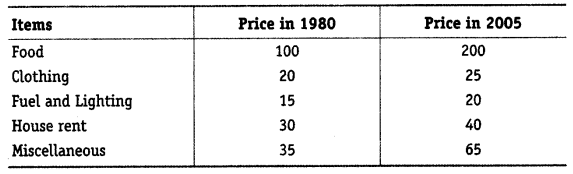
ANSWER: 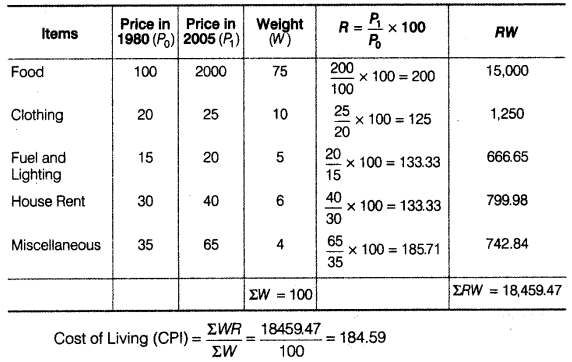
Q.15 Read the following table carefully and give your comments.
ANSWER:
Index of Industrial Production Base 1993-94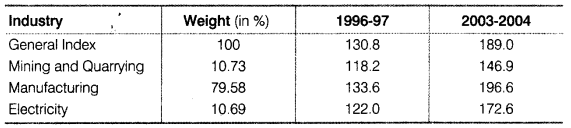
The following conclusions can be made by analysing the above table
- Manufacturing industry has the highest weight of 79.58% in Index of Industrial Production (IIP) while mining and quarrying and electricity industries account for 10.73% and 10.69% respectively.
- Manufacturing Industry has registered the highest growth among all industrial sectors in both the years 1996-97 and 2003-04.
- Mining and quarrying has registered the lowest growth rate in both the years.
- The General Index shows that industrial increased by 30.8% in 1996.-97 as compared to 1993-94 and by 89% in 2003-04.
Q.16 Try to list the important items of consumption in your family.
ANSWER:
(This is a general example. You can use the actual consumption items in your family).
The following items constitute the total consumption needs for a family
- Food
- Clothing
- House-Rent/EMI of Housing loan
- Education
- Electricity
- Entertainment and recreation
- Miscellaneous expenses
Q.17 If the salary of a person in the base year is ? 4,000 per annum and the current year salary is ? 6,000 by how much should his salary rise to maintanin the same standard of living if the CPI is 400?
ANSWER:
Base CPI = ₹ 100
Current CPI = ₹400
Base Year Salary = ₹ 4,000
Current Year Salary = ₹ 6,000
When Base CPI is ₹100, then the salary is = ₹ 4,000
Current salary equivalent to base year salary = (Base year salary/100) × CPI of current year
When Current CPI is ₹ 400, then the salary should be
= 4,000100×400 = ₹ 16,000 100
Thus, his salary should be X 16,000 to maintain his purchasing power. Therefore, in the current year his salary should increase by ₹ 16,000 – ₹ 6,000 = ₹ 10,000 so as to maintain the same level of living in the current year as that of the base year.
Q.18The consumer price index for June, 2005 was 125. The food index was 120 and that of other items
What is the percentage of the total weight given to food?
ANSWER: 
Let the total weight = 100
W1 denotes weight of food
W2 denotes weight of other items
So,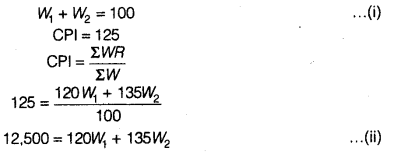
Multiplying both sides of Eq. (i) by 135 and subtracting Eq. (ii) from (i) we get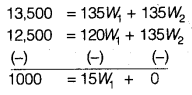
So, W1 = 100015 = 66.67
Substituting the value of in the Eq. (i), we get
W1 + W2 = 100
or 6667 + W2 = 100
W2 = 33.33
Therefore, percentage of total weight given to food is 66.67% and other items 33.33%.
Q.19 An enquiry into the budgets of the middle class families in a certain city gave the following information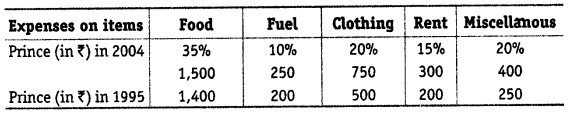
What is the cost of living index of 2004 as compared with 1995?
ANSWER: 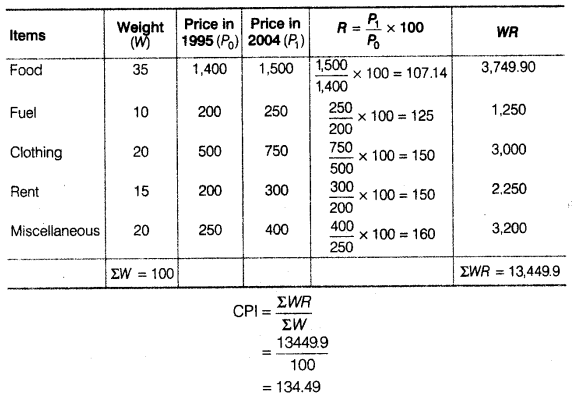
Cost of Living Index = 134.50
Thus, the price rose by 34.50% during 1995 and 2004.
Q.20 Record the daily expenditure quantities bought and prices paid per unit of the daily purchases of your family for two weeks. How has the price change affected your family?
ANSWER:
This is a practical exercise. Record the daily expenditure, quantities bought and prices paid per unit of the daily purchases of your family for two weeks and try to analyse if quantities purchased decrease with rise in price of the respective items and also note if the percentage change in quantity brought about by a percentage change in price differ for different types of items.
Q.21Given the following data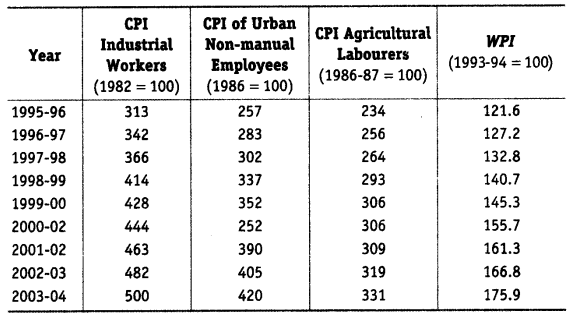
Source Economic Survey, Government of India 2004-2005
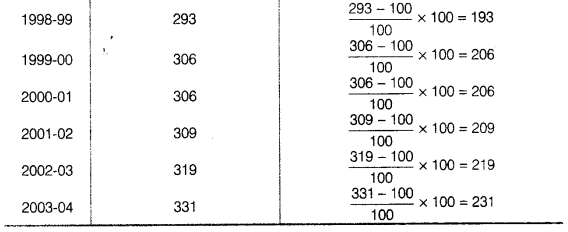
(i) Calculate the inflation rates using different index numbers.
(ii) Comment on the relative values of the index numbers.
(iii) Are they comparable?
ANSWER:
(i) (a) Inflation using CPI of Industrial Workers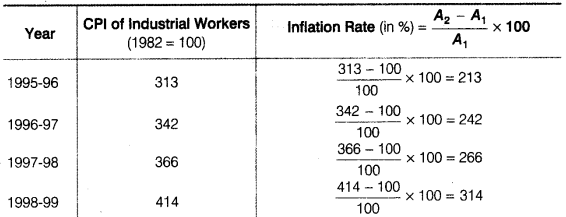
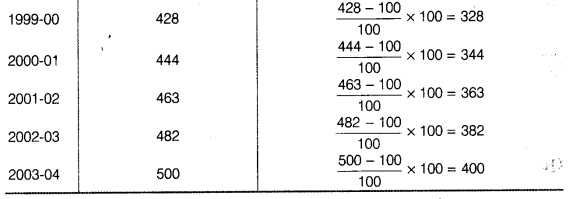
(b) Inflation using CPI of Non-maunal Employees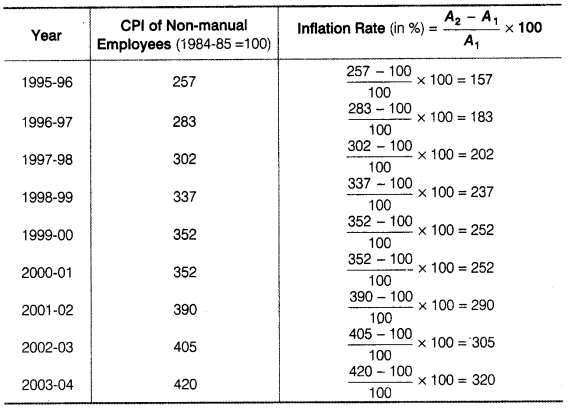
(c) Inflation using CPI of Agricultural Labourers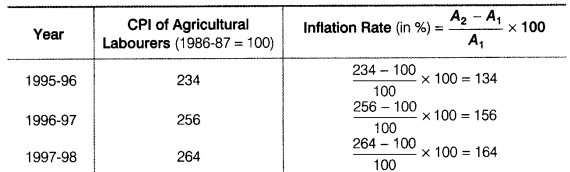
(d) Inflation using WPI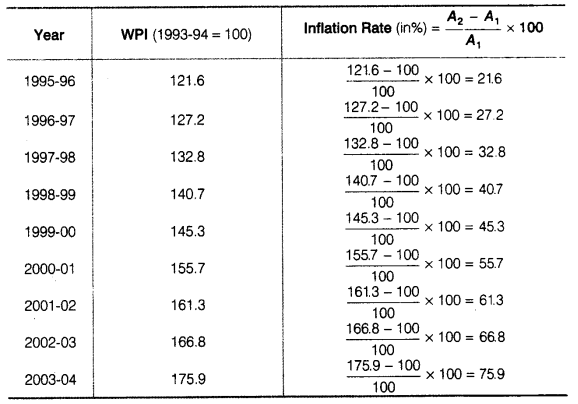
(ii) The inflation rate calculated using CPI industrial worker with the base year 1982 is the highest and inflation rate calculated using WPI with the base year 1993-94 is the least.
(iii) No the index number are not comparable because of the following reasons
- Base periods for CPI of industrial workers, urban non-manual workers, agricultural labourers and WPI are different.
- Commodities and their weightage in different index number may be different.