- Home
- CBSE
- ICSE
- NCERT
- Text Book Solutions
- Our Products
- More

Choose the correct answer:
Question 1.
What do governments do for their people?
(a) Build the roads and schools
(b) Supply the electricity
(c) Take action on social issues
(d) All of these
Answer: (d) All of these
Question 2.
Which agency of the government does the job of protecting the boundaries of the country and maintaining peaceful relations with other countries?
(a) Gram Panchayat
(b) Ministry of Foreign Affairs
(c) Ministry of Defence
(d) Both (b) and (c)
Answer: (d) Both (b) and (c)
Question 3.
What is an important part of the government?
(a) Courts
(b) Private organisations
(c) Public schools
(d) Parliament
Answer: (d) Parliament
Question 4.
At which level does a government work?
(a) Local level
(b) National level
(c) State level
(d) All of these
Answer: (d) All of these
Question 5.
Which of the following is the capital of India?
(a) Mumbai
(b) Agra
(c) New Delhi
(d) Aurangabad
Answer: (c) New Delhi
Question 6.
On which level does Indian Government take decision to maintain peaceful relation with U.S.S.R.?
(a) Local level
(b) State level
(c) Central level
(d) None of these
Answer: (c) Central level
Question 7.
What does the Government make for everyone to follow?
(a) Laws
(b) Decisions
(c) Relations
(d) None of these
Answer: (a) Laws
Question 8.
Any person who is caught driving without licence can be?
(a) jailed
(b) fined a large sum of money
(c) both (a) and (b)
(d) none of them
Answer: (c) both (a) and (b)
Question 9.
Which type of government is chosen by the people?
(a) Democratic Government
(b) Dictatorship
(c) Monarchy Government
(d) None of these
Answer: (a) Democratic Government
Question 10.
What is a Monarchy government?
(a) Chosen by the people
(b) Ruled by the King or Queen
(c) Both (a) and (b)
(d) None of these
Answer: (b) Ruled by the King or Queen
Question 11.
In which type of government do the kings or queens not have to explain their action or decision they take?
(a) Democracy
(b) Monarchy
(c) Both (a) and (b)
(d) None of these
Answer: (b) Monarchy
Question 12.
To whom did the government not allow to participate in election in olden time?
(a) Educated persons
(b) Poor persons
(c) Adults
(d) All of these
Answer: (b) Poor persons
Question 13.
When was only a small minority allowed to vote?
(a) After Independence
(b) Before Independence
(c) Ten years before
(d) Twenty years before
Answer: (b) Before Independence
Question 14.
When was publishing of journal “Young India” started?
(a) 1931
(b) 1941
(c) 1951
(d) 1961
Answer: (a) 1931
Question 1.
Why is a person driving without licence jailed or fined large amount of money?
Answer:
A person has to obtain a driving licence if he wants to drive vehicles.
If he does not possess this driving licence he can be jailed or fined a huge amount of money as penalty.
Question 2.
If the people feel that a law is not easy to be followed, what can they do?
Answer:
Question 1.
Why are some rules to be made?
Answer:
Some rules are to be made that apply to all because of the following reasons:
Question 2.
Give some examples of the institutions of the Government.
Answer:
Some of the institutions of the government are:
Some examples of institutions that are part of the government: The Supreme Court, the Indian Railways and the Bharat Petroleum.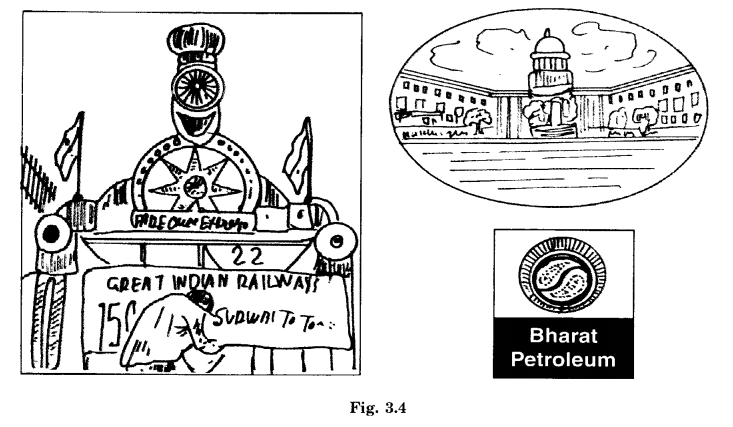
Question 3.
How can a government function?
Answer:
A government can function by doing the following things:
Question 4.
What are the two types of governments?
Answer:
Two types of governments:
Democracy:
Monarchy:
Question 5.
What are the three main features of a democracy?
Answer:
Main features of a Democracy:
Question 6.
What are representative democracies?
Answer:
Representative democracies are those democracies in which people participate in the government through their elected representatives (Through election process).
Question 7.
Before Independence what was the voting system in India?
Answer:
Before independence the voting system in India was:
Question 8.
Why were several people including Gandhiji shocked?
Answer:
Question 9.
What did Gandhiji write in the journal ‘Young India’ in 1931?
Answer:
Writing in the journal Young India in 1931, Gandhiji said, “I cannot possibly bear the idea that a man who has got wealth should get the vote but a man who has got character but no wealth or literacy should have no vote, or that a man who honestly works by the sweat of his brow day in and day out should not have the vote for the crime of being a poor man”.
Question 1.
Question Box:
Nowhere in the world have governments willingly shared power. All over Europe and USA, women and the poor have had to fight for participation in government. Women’s struggle to vote got strengthened during the First World War. This movement is called the women’s suffrage movement as the term suffrage usually means right to vote.
During the War, many men were away fighting, and because of this women were called upon to do work that was earlier considered men’s work. Many women began organising and managing different kinds of work. When people saw this they began to wonder why they had created so many unfair stereotypes about women and what they were capable of doing. So women began to be seen as being equally capable of making decisions.
The suffragettes demanded the right to vote for all women and to get their demands heard they chained themselves to railings in public places. Many suffragettes were imprisoned and went on hunger strikes, and they had to be fed by force. American women got the right to vote in 1920 while women in the UK got to vote on the same terms as men some years later, in 1928.
Study the above advertisement and answer the questions that follow:
Answer:
Choose the correct answer:
Question 1.
What do governments do for their people?
(a) Build the roads and schools
(b) Supply the electricity
(c) Take action on social issues
(d) All of these
Answer:
All of these
Question 2.
Which agency of the government does the job of protecting the boundaries of the country and maintaining peaceful relations with other countries?
(a) Gram Panchayat
(b) Ministry of Foreign Affairs
(c) Ministry of Defence
(d) Both (b) and (c)
Answer:
Both (b) and (c)
Question 3.
What is an important part of the government?
(a) Courts
(b) Private organisations
(c) Public schools
(d) Parliament
Answer:
Parliament
Question 4.
At which level does a government work?
(a) Local level
(b) National level
(c) State level
(d) All of these
Answer:
All of these
Question 5.
Which of the following is the capital of India?
(a) Mumbai
(b) Agra
(c) New Delhi
(d) Aurangabad
Answer:
New Delhi
Question 6.
On which level does Indian Government take decision to maintain peaceful relation with U.S.S.R.?
(a) Local level
(b) State level
(c) Central level
(d) None of these
Answer:
Central level
Question 7.
What does the Government make for everyone to follow?
(a) Laws
(b) Decisions
(c) Relations
(d) None of these
Answer:
Laws
Question 8.
Any person who is caught driving without licence can be?
(a) jailed
(b) fined a large sum of money
(c) both (a) and (b)
(d) none of them
Answer:
both (a) and (b)
Question 9.
Which type of government is chosen by the people?
(a) Democratic Government
(b) Dictatorship
(c) Monarchy Government
(d) None of these
Answer:
Democratic Government
Question 10.
What is a Monarchy government?
(a) Chosen by the people
(b) Ruled by the King or Queen
(c) Both (a) and (b)
(d) None of these
Answer:
Ruled by the King or Queen
Question 11.
In which type of government do the kings or queens not have to explain their action or decision they take?
(a) Democracy
(b) Monarchy
(c) Both (a) and (b)
(d) None of these
Answer:
Monarchy
Question 12.
To whom did the government not allow to participate in election in olden time?
(a) Educated persons
(b) Poor persons
(c) Adults
(d) All of these
Answer:
Poor persons
Question 13.
When was only a small minority allowed to vote?
(a) After Independence
(b) Before Independence
(c) Ten years before
(d) Twenty years before
Answer:
Before Independence
Question 14.
When was publishing of journal “Young India” started?
(a) 1931
(b) 1941
(c) 1951
(d) 1961
Answer:
1931